HuRIC
: a Human Robot Interaction Corpus
Emanuele Bastianelli
(‡), Giuseppe Castellucci
(•), Danilo Croce
(†)Luca Iocchi
(?), Roberto Basili
(†), Daniele Nardi
(?)(†) DII, (‡) DICII, (•) DIE - University of Roma Tor Vergata - Rome, Italy
{bastianelli,castellucci}@ing.uniroma2.it, {basili,croce}@info.uniroma2.it (?) DIAG - University of Roma La Sapienza - Rome, Italy
{nardi,iocchi}@dis.uniroma1.it
Abstract
Recent years show the development of large scale resources (e.g. FrameNet for theFrame Semantics) that supported the definition of several state-of-the-art approaches in Natural Language Processing. However, the reuse of existing resources in heterogeneous domains such as Human Robot Interaction is not straightforward. The generalization offered by many data driven methods is strongly biased by the employed data, whose performance in out-of-domain conditions exhibit large drops. In this paper, we present theHuman Robot Interaction Corpus (HuRIC). It is made of audio files paired with their transcriptions referring to commands for a robot, e.g. in a home environment. The recorded sentences are annotated with different kinds of linguistic information, ranging from morphological and syntactic information to rich semantic information, according to theFrame Semantics, to characterize robot actions, andSpatial Semantics, to capture the robot environment. All texts are represented through theAbstract Meaning Representation, to adopt a simple but expressive representation of commands, that can be more easily translated into the internal representation of the robot.
Keywords:Human-Robot Interaction, Corpus, Natural Language Processing
1.
Human Robot Interaction
Robots are slowly becoming part of everyday life, as they are being marketed for commercial applications (viz. telep-resence, cleaning or entertainment). TheHuman Robot In-teraction(HRI) research field aims at realizing robotic sys-tems that offer an interaction level as much natural as pos-sible (Scheutz et al., 2011). Several issues arise in trans-lating human generated commands into suitable robotic ac-tions. First, the underlying meaning of an utterance needs to be understood, and then mapped into robot-specific com-mands, in order to fill the gap between the robot world rep-resentation and the linguistic information conveyed in user utterances. In a sense, this is a typical form ofsemantic parsing.
Semantics is the crucial support for grounding linguistic ex-pressions into objects, as they are represented in the robot set of beliefs (i.e. robot knowledge). The complexity of this task largely increases in less restricted scenarios, such as house serving tasks, where people do not follow a-priori known subsets of linguistic expressions. This requires ro-bust command understanding processes, in order to face the flexibility of natural language. In many Natural Language Processing tasks, where robustness and domain adaptation are crucial, e.g. Open Domain Question Answering as dis-cussed in (Ferrucci et al., 2010), methods based on Statisti-cal Learning (SL) theory have been successfully applied. In this perspective, we are investigating the combination of different state-of-the-art textual inference technologies aimed at modeling and making use of semantic aspects mostly relevant for HRI. We started from the idea that robotic systems are firstly required to exhibit two main fea-tures: in order to be useful they are expected to perform ac-tions and these take place in a physical environment. Mul-tiplesemantic theoriescan be applied to describe the as-pects of the world that should be taken in account for a
ro-bust HRI. In this work we point outFrame Semantics (Fill-more, 1985) andHolistic Spatial Semantics(Zlatev, 2007) as relevant to our goal. Frame Semantics generalizes the notion of action by making reference to a situation, i.e. an experience usually represented by a Frame, i.e. a micro-theory about a real world situation, such as movement actions. Holistic Spatial Semantics (Zlatev, 2007) de-fines the basic concepts in the domain of natural language spatial expressions. It helps to make reference to the lo-cation or the trajectory of a motion, usually involving one referent in a discourse.
In recent years the adoption of sound linguistic theories brought to the development of large scale resources (e.g. FrameNet (Baker et al., 1998) for theFrame Semanticsor the CLEF Corpus forSpatial Semantics) to support the def-inition of several state-of-the-art Statistical Learning ap-proaches for NL tasks. However, the reuse of these re-sources in heterogeneous domain is not straightforward. The generalization offered by ML algorithms is strongly biased by the employed data, whose performance in out-of-domain conditions may exhibit large drops. This is a crucial problem and a specific research topic, i.e. Domain Adap-tation(Daum´e and Marcu, 2006), deals exactly with these classes of problems. For example, as reported in (Prad-han et al., 2008; Jo(Prad-hansson and Nugues, 2008), a Semantic Parsing system trained over a specific application-domain corpus shows a significant performance drop, when applied to different domains.
In this paper, we will present the Human Robot Interac-tion Corpus(HuRIC) we are collecting1. It is made of 570 audio files paired with their transcriptions referring to com-mands for a robot. The recorded sentences are also anno-tated with different kinds of linguistic information, rang-ing from morphological and syntactic information to rich
1
semantic information, according to Frame Semanticsand Spatial Semanticstheories. It has to be noticed that the two representations look at independent properties and can co-operate to fully express a model of the sentence meaning, useful for the HRI domain. The integration of these in-formation is not straightforward. In order to accommodate different dimensions in the semantic annotation we are fos-tering the adoption of theAbstract Meaning Representation (AMR) (Banarescu et al., 2013). AMR is a novel repre-sentation language that allows to generalize several aspects of the NL semantics. In this representation schema, sen-tences having different syntactic structures, but basically sharing the same meaning, are seemingly expressed and represented by the same structure. It is very useful to pro-vide a simple but expressive representation of commands, that can be easily translated into the internal representation of the robot.
In the rest of the paper we will first introduce the corpus gathering process (Section 2.) Section 3. then reports in-depth details about the corpus, also discussing some ex-amples and issues raised during the annotation process. A first set of evaluation experiments involving HuRIC are pre-sented and discussed in Section 4.
2.
Corpus Collection
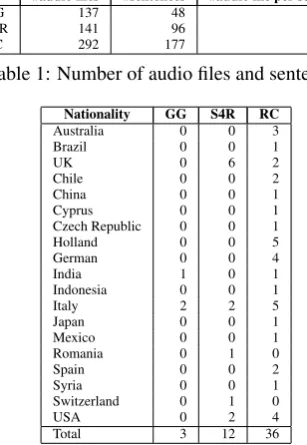
During the recent years the effort of providing resources useful for the automatic understanding robot commands has yielded the definition of corpora for Natural Language HRI, as (Kuhlmann et al., 2004; Tellex et al., 2011; Dukes, 2013). However, these corpora are highly domain or sys-tem dependent. The basic idea of this work is to build a corpus containing information that are yet oriented to a spe-cific application domain, e.g. the house service robotics, but at the same time inspired by sound linguistic theories, that are by definition decoupled from such a domain. The aim is to offer a level of abstraction that is totally indepen-dent from the platform, but yet motivated by supported the-ories. We exploited three different situations to start gather-ing user utterances representgather-ing possible commands given to a robot in a house environment. Two groups of utterances have been recorded during the Speaky for Robots project2, while a third one has been collected by interviewing mem-bers of the teams participating at the Robocup 2013 com-petition. At the end of the gathering, three datasets have been collected, each representing a different working con-dition. Each dataset is mainly characterized by: the com-plexity of the language used by the user, in terms of de-gree of variability of syntactic structures and lexicon; back-ground noise conditions; device used for recording. Each utterance is coupled with its correct transcription, directly inserted by the user under an operator’s control. Utterances have been pronounced by different users, so that multiple spoken versions of the same sentence are included. In the following, the gathering process is discussed for each of the three datasets.
The Grammar Generated (GG) dataset contains sen-tences that have been generated by the speech recognition grammar developed for the Speaky For Robots project. The
2
http://labrococo.dis.uniroma1.it/?q=s4r
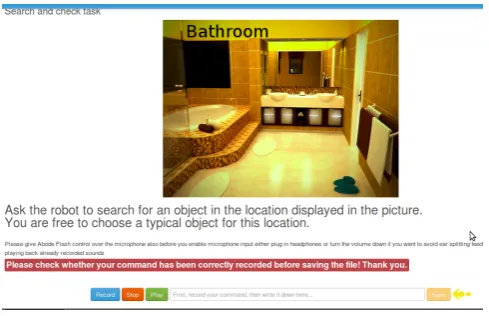
Figure 1: The web portal used for the gathering through crowd-sourcing
generation procedure of this grammar is presented in (Car-lucci Aiello et al., 2013). The generated sentences have then been pronounced by three speakers and recorded us-ing a push-to-talk microphone. The acquisition process took place inside a small room, thus with low background noise. Moreover, the push-to-talk mechanism helped in precisely segmenting the audio stream, and further reduc-ing the noise. Due to its constrained nature, the language represented here is free of colloquial forms of interaction. The S4R Experiment(S4R) dataset has been gathered in two distinct phases of the Speaky for Robots project ex-periment. In the first phase, the users were asked to give commands to a real robot operating in rooms set up as a real home, thus capturing all the interferences generated by talking people or sounds of other working devices nearby. The users were aware about the robot capabilities in terms of action it could perform and about the rooms and all the objects the robot was able to recognize. The same device used for theGGdataset has been employed here for the in-teraction. In a second phase, the users could access the Web portal showed in Figure 1 to record other commands. Gen-eral situations involved in an interaction were described in the portal by displaying text and images. Each user was asked to give a command inherent to the depicted situa-tion. This time the internal microphone of the pc running the portal has been used for recording. Since the users were only partially constrained (they had knowledge only about capabilities of the robot and lexicon handled by the Speech Recognition Engine), the language represented in this dataset is characterized by features that are more simi-lar to free spoken English with respect to the one reported in theGGdataset, including richer syntactic structures. TheRobocup(RC) dataset has been collected during the Robocup@Home (Wisspeintner et al., 2009) competition held in 2013, in the context of the RoCKIn3 project. The same Web portal used for the S4R dataset has been em-ployed, and the recording took place directly in the com-petition venues or in a cafeteria, thus with different levels of background noise. Again, the internal microphone of the pc running the web portal has been employed. Expres-sions uttered here exhibit large flexibility in lexical choices
3
Figure 2: The Data Annotation Platform
Imperative Descriptive Definitional
GG 48 0 0
S4R 96 0 0
RC 150 14 13
Table 4: Distribution of utterance classes
POS GG S4R RC
CC 0 5 31
CD 0 0 16
DT 86 152 285
EX 0 0 11
FW 0 0 1
IN 49 66 134
JJ 0 7 43
JJS 0 0 1
MD 0 2 28
NN 87 188 365
NNS 3 2 22
POS 0 1 0
PRP 2 7 79
POS GG S4R RC PRP$ 3 7 20
RB 5 5 16
RP 0 0 1
TO 12 38 66
UH 0 13 38
VB 47 97 165
VBD 0 4 6
VBG 0 1 2
VBN 0 1 1
VBP 0 1 11
VBZ 0 0 29
WDT 0 0 3
WRB 0 0 2
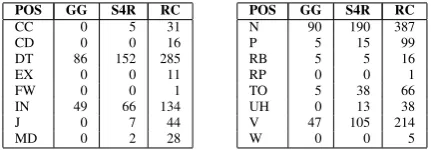
Table 5: Fine-grain morpho-syntactic information
decided to rely onframesas the bridge between the linguis-tic knowledge contained in the utterances and the robolinguis-tic actions. Frame Semantics generalizes the notion of ac-tion by making reference to a situaac-tion, i.e. an experi-ence usually represented by a Semantic Frame(Fillmore, 1985). A frame is a micro-theory about a real world situ-ation: movement actions, such asmoving,events, such asnatural phenomena, orproperties, such as be-ing colored. A set of semantic roles is associated to each frame, i.e. the descriptors of the different elements involved in the described situation (e.g. theAgentof a movement). Linguistic resources providing such information have been produced over the years, as FrameNet (Baker et al., 1998). Frames are interesting primitives in HRI as robot’s actions can be linked to semantic frames. This semantic formal-ism already inspired the RoboFrameNet (Thomas and Jenk-ins, 2012) framework, where a set of semantic frames con-textual to specific robot actions has been defined. The main difference with our work is that in RoboFrameNet the frames have been defined at a finer-grained level with respect to our choices. Higher levels of abstraction of
POS GG S4R RC
CC 0 5 31
CD 0 0 16
DT 86 152 285
EX 0 0 11
FW 0 0 1
IN 49 66 134
J 0 7 44
MD 0 2 28
POS GG S4R RC N 90 190 387
P 5 15 99
RB 5 5 16
RP 0 0 1
TO 5 38 66
UH 0 13 38
V 47 105 214
W 0 0 5
Table 6: Coarse-grain morpho-syntactic information
FrameNet frames allow to treat a more general set of phe-nomena and have been settled as a starting point.
In our case, we selected the subset of FrameNet-inspired se-mantic frames corresponding to the defined robot actions, that are reported in Table 3.2.. Some frames have been slightly adapted, e.g. the frameScrutiny has been called Searching. According to our set of frames, in the com-mand “go near the table of the kitchen” theMotionframe is evoked by the verbgo. The frame element GOAL, rep-resenting the destination of the motion action is assigned to the sequence near the table of the kitchen. The frame instantiated in this way finally encodes all the informa-tion needed to the robot to understand what acinforma-tion to per-form, and which are the arguments involved in the com-mand, i.e. in this case which object to take and where to find it. Besides the number of examples for each se-mantic frame in the three datasets, Table 3.2. reports also the number of examples of each frame element according to its frame. Again, when speakers had more freedom, as in the RC dataset, the expressivity has grown, resulting in a higher number of different frames and related frame el-ements. Furthermore, this aspect is reflected also by the higher average number of roles per sentence that goes from
∼1.5 of the CC dataset to∼2.0 for the RC dataset.
GG S4R RC
Spatial relation 24 15 47
TRAJECTOR 24 15 47
SPATIALINDICATOR 24 15 47
LANDMARK 18 14 41
Av. relation per sentence 0.50 0.16 0.27 Av. role per sentence 1.38 0.46 0.76
Table 9: Distribution of Spatial Relations and Spatial Roles
TRAJECTOR SPATIAL INDICATOR LANDMARK
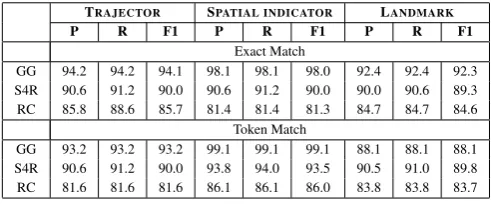
P R F1 P R F1 P R F1
Exact Match
GG 94.2 94.2 94.1 98.1 98.1 98.0 92.4 92.4 92.3 S4R 90.6 91.2 90.0 90.6 91.2 90.0 90.0 90.6 89.3 RC 85.8 88.6 85.7 81.4 81.4 81.3 84.7 84.7 84.6
Token Match
GG 93.2 93.2 93.2 99.1 99.1 99.1 88.1 88.1 88.1 S4R 90.6 91.2 90.0 93.8 94.0 93.5 90.5 91.0 89.8 RC 81.6 81.6 81.6 86.1 86.1 86.0 83.8 83.8 83.7
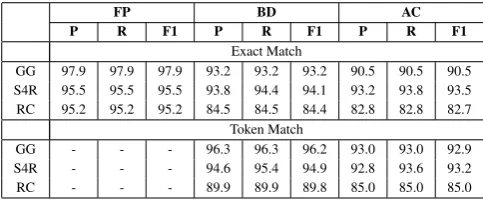
Table 10:Spatial SemanticsInter Annotators Agreement
3.4. Abstract Meaning Representation
From the considerations made in the previous Sections, it arises that the two selected representations look at indepen-dent properties and can cooperate to fully express the mean-ing of a command. They both represent different forms of annotation of relevant expressions useful for the HRI do-main. In order to accommodate different dimensions in the semantic annotation we are fostering the adoption of the Abstract Meaning Representation(AMR) (Banarescu et al., 2013). AMR is a novel representation formalism. It allows to generalize several aspects of the NL semantics and it is ideal to abstract some aspects that are currently less rele-vant (such as quantification) and to focus on spatial (and temporal) concepts, their instances and the individual rela-tions among them. In AMR, sentences that have different syntactic structures, but basically share the same meaning, are seemingly expressed and represented by the same struc-ture. A major advantage in robotic applications is that a fully instantiated AMR annotation can be easily mapped to the corresponding operational commands for the robot, i.e. making a smooth notion of grounding already available.
go near the table in the kitchen
VB IN DT NN IN DT NN
ROOT
PREP
POBJ
DET PREP
POBJ DET
Figure 3: Example of a dependency graph associated to sentence “go near the table in the kitchen”
The AMR annotation provided within HuRIC is automati-cally produced by translating the arguments expressing se-mantic information. The syntactic tree is used to select the semantic head in each argument in order to instantiate all the variables within the AMR resulting structure. When a spatial relation overlaps a frame element, the semantic head expressing the first is linked to the second, so capturing the spatial specification carried out by the Spatial Semantics. For example starting from the two different annotations for the sentence “go near the table in the kitchen”
[go]Motion[near the table in the kitchen]GOAL
go near [the table]TRAJECTOR [in]SPATIAL INDICATOR [the
kitchen]LANDMARK
the spatial relation is used to further specify the GOAL frame element. The syntactic tree shown in Figure 3 sug-gests that thetableis the semantic head of the prepositional construction underlying the GOAL role and, at the same time, it reflects a TRAJECTOR. The spatial information can be thus embedded in the GOALrole, recursively generating the following structure.
(g1/go−Motion
:Goal(i1/in−Spatial relation
:trajector(t1/table) :landmark(k1/kitchen)))
According to the AMR guidelines, the spatial relations can been seen as a surrogate of the information that is repre-sented by the AMR rolebe-located-at.
At the moment of writing, the generation script is able to correctly build the AMR representation for about the 90% of sentences of the whole HuRIC and further work is being done to increase the coverage.
3.5. HuRICResulting Annotations
In this section a list of annotation examples is showed in order to present some directives we adhered and to discuss about issues we faced during the tagging. The main point is that the level of knowledge the robots are today able to manage is quite far and distant from the huge amount of lin-guistic information that is present also in simple sentences like the ones contained in HuRIC. To this end, we propose to use the AMR as a container that can be enriched step by step with all the necessary information, according to the robot capabilities. For example, if the robot is not able to deal with quantification, there will be no need of integrat-ing such information inside the AMR. For this reason, we are removing all those aspects that are currently negligible from the final AMRs. For each frame role, we insert in the structure only the semantic head of its textual span. The se-mantic head is selected by navigating the dependency sub-tree of the frame element text, and looking for the noun that is closer to the root, as it is possible to see in the tagging of the command “can you please bring the phone to the bath-room”:
can [you]AGENT please [bring]Bringing [the phone]THEME [to
the bathroom]GOAL
(b1/bring−Bringing
:Agent(y1/you) :Theme(p1/phone) :Goal(b2/bathroom))
in the AMR only those features that are strictly necessary for our tasks. Noun modifiers and adjectives are most of the time needed in the discrimination process for a robot, in or-der to correctly identify the referenced entity. For example, in the command “carry the mug to the dining room”
[carry]Bringing[the mug]THEME[to the dining room]GOAL
(c1/carry−Bringing
:Theme(m1/mug) :Goal(r1/room
:mod(d1/dining)))
thediningmodifier of the nounroomis crucial to under-stand the specific room we are talking about. Without going to deep in the definition of different non-core roles, we used the:modlabel in those cases.
One main issue, arose during the annotation procedure, concerned the intrinsic ambiguity of some prepositional phrase attachments. This phenomenon has been manifested especially for theTakingframe, as showed by the command “take the bottle on the table”. Here the prepositiononcan be attached directly to the verb or to the nounbottle. This gives rise to different interpretations in term of frames and relative frame elements. According to the first case (1),the bottle andon the table can be tagged respectively as the THEME and the SOURCE for aTakingframe; it has to be said that such approach may rise another issue, sinceon the tablemight be interpreted as the GOALframe element of aBringingframe, thus changing the whole meaning of the command. In the second case (2), the whole sequencethe bottle on the tablecan be labeled as a unique THEME.
1) [take]Taking[the bottle]THEME[on the table]SOURCE
2) [take]Taking[the bottle on the table]THEME
take [the bottle]TRAJECTOR [on]SPATIAL INDICATOR [the
ta-ble]LANDMARK
(t1/take−Taking
:Theme(o1/on−Spatial relation
:trajector(b1/bottle) :landmark(t2/table)) :Source(t2))
As it is possible to notice from the AMR example above, we decided to adhere to the first interpretation (1). This choice has been mainly driven by the CoreNLP syntactic parsing, that uses to attach such prepositions directly to the verb. Moreover, we considered the verbtakeas source from aBringingframe only in those cases in which a frame ele-ment introduced by non ambiguous prepositions astoor to-wardswas present. Another important fact outlined by the Spatial Semanticsannotation of this example is that the two semantic representations may add information that seem re-dundant. Since we are still dealing with these kind of is-sues, we decided to report both the representations in such cases.
Regarding the Inter Annotator Agreement, one of the main source of disagreement in the annotation of the Frame
Semantics concerned the tagging of the role CATEGORY frame element for theBeing in categoryframe. Expecially, what differs in the two annotation approaches is the span to which the frame element has been associated. For exam-ple, for the command this is a bedroom with pictures on the wall, one annotator considered only the portion of text corresponding to the direct entity representing the category, i.e.a bedroomin the following example.
[this]ITEM [is]Being in category [a bedroom]CATEGORY with four
pictures on the wall
The second annotator incorporated the whole span corre-sponding to the sub-tree starting from the entity represent-ing the category, i.e.a bedroom with pictures on the wall.
[this]ITEM[is]Being in category[a bedroom with four pictures on
the wall]CATEGORY
This generated a significant drop in the Boundary Detection and Argument Classification agreement, as it is possible to see in Table 3.2..
4.
A First Empirical Evaluation
As a support to our thesis about the need of liguistic re-sources for Natural Language HRI and in order to verify their possible impact in the development of HRI systems, we ran some preliminary experiments involving HuRIC. We designed a processing chain able to annotateFrame Se-manticsaccording to the schema described in Section 3.2. The chain is realized as a cascade of processors exploit-ing different Statistical Learnexploit-ing algorithms, and it is ex-plained in depth in (Croce et al., 2012). TheFrame Predic-tion task is designed as a multi-classification process, us-ing theSV MM ulticlassalgorithm (Joachims et al., 2009).
BothBoundary DetectionandArgument Classification sub-tasks are realized as a sequential labeling task through the
SV MHmm(Altun et al., 2003), i.e. a Markovian extension
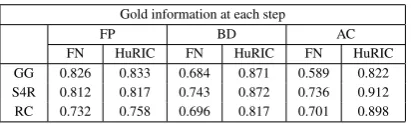
of theSV M. In the first subtask, the labeler gives a label to each word indicating whether this is part or not of a frame element. In the second, the labeler assigns a label to each word, corresponding to the associated frame element. First, we trained the system over the FrameNet corpus, and evaluate its performances over the three dataset compos-ing HuRIC (reported in the F N column of Table 4.). In the second experiment, 66% of annotated examples of each subsets of HuRIC have been added to the FrameNet ma-terial for training. In this way a 3-fold evaluation schema has been enabled: cyclically, three different tests have been made possible on the remaining 33% of each test corpus. The macro-average achieved over three measures have been computed as the final performance, and is reported under theHuRICcolumn in Table 4..
Gold information at each step
FP BD AC
FN HuRIC FN HuRIC FN HuRIC GG 0.826 0.833 0.684 0.871 0.589 0.822 S4R 0.812 0.817 0.743 0.872 0.736 0.912 RC 0.732 0.758 0.696 0.817 0.701 0.898
Table 11: Semantic Role Labeling analysis with HuRIC
examples, especially in theS4R andRC dataset. It con-firms the positive impact of using specialized material, i.e. reflecting the syntactic/semantic peculiarity of robot com-mands.
5.
Conclusion
This paper presents theHuman Robot Interaction Corpus (HuRIC), a first collection of robot commands to support the HRI research. First, sentences have been recorded as audio files. Then, transcriptions have been annotated with different kinds of linguistic information, ranging from mor-phological and syntactic information to rich semantic in-formation, according toFrame SemanticsandSpatial Se-mantics. Finally, the texts annotated in this way have been represented through theAbstract Meaning Represen-tation(AMR) formalism, a novel and flexible representa-tion schema. First experimental evaluarepresenta-tions underline the positive impact of this resource in the adoption of data driven methods for the Semantic Parsing of natural lan-guage commands. Moreover, the adoption of an open rep-resentation schema as AMR will enable for extensions of the corpus according to other semantic theories, as explicit temporal annotations. Such information could be useful for HRI in order to better support the planning of sequences of (and not individual) actions.
Acknowledgment: authors want to thank Cristina Gian-none for her invaluable support in the development of the DAP system.
6.
References
Altun, Y., Tsochantaridis, I., and Hofmann, T. (2003). Hid-den Markov support vector machines. InProceedings of the ICML.
Baker, Collin F., Fillmore, Charles J., and Lowe, John B. (1998). The berkeley framenet project. InProceedings of the ACL 98, pages 86–90, Stroudsburg, PA, USA. As-sociation for Computational Linguistics.
Banarescu, Laura, Bonial, Claire, Cai, Shu, Georgescu, Madalina, Griffitt, Kira, Hermjakob, Ulf, Knight, Kevin, Koehn, Philipp, Palmer, Martha, and Schneider, Nathan. (2013). Abstract meaning representation for sembank-ing. InProceedings of the LAW VII & ID, Sofia, Bul-garia, August.
Carlucci Aiello, L., Bastianelli, E., Iocchi, L., Nardi, D., Perera, V., and Randelli, G. (2013). Knowledgeable talking robots. InAGI.
Croce, Danilo, Castellucci, Giuseppe, and Bastianelli, Emanuele. (2012). Structured learning for semantic role labeling.Intelligenza Artificiale, 6(2):163–176.
Daum´e, III, Hal and Marcu, Daniel. (2006). Domain
adaptation for statistical classifiers. J. Artif. Int. Res., 26(1):101–126, May.
Dukes, Kais. (2013). Train robots: A dataset for natural language human-robot spatial interaction through ver-bal commands. InICSR. Embodied Communication of Goals and Intentions Workshop, October.
Ferrucci, David, Brown, Eric, Chu-Carroll, Jennifer, Fan, James, Gondek, David, Kalyanpur, Aditya A., Lally, Adam, Murdock, J. William, Nyberg, Eric, Prager, John, Schlaefer, Nico, and Welty, Chris. (2010). Building Watson: An Overview of the DeepQA Project. AI Mag-azine, 31(3).
Fillmore, Charles J. (1985). Frames and the semantics of understanding. Quaderni di Semantica, 6(2):222–254. Joachims, Thorsten, Finley, Thomas, and Yu, Chun-Nam.
(2009). Cutting-plane training of structural SVMs. Ma-chine Learning, 77(1):27–59.
Johansson, Richard and Nugues, Pierre. (2008). The effect of syntactic representation on semantic role labeling. In Proceedings of COLING, Manchester, UK, August 18-22.
Klein, Dan and Manning, Christopher D. (2003). Accurate unlexicalized parsing. InProceedings of ACL’03, pages 423–430.
Kolomiyets, Oleksandr, Kordjamshidi, Parisa, Bethard, Steven, and Moens, Marie-Francine. (2013). Semeval-2013 task 3: Spatial role labeling. In Proceedings of SemEval-2013.
Kuhlmann, Gregory, Stone, Peter, Mooney, Raymond, and Shavlik, Jude. (2004). Guiding a reinforcement learner with natural language advice: Initial results in RoboCup soccer. In The AAAI-2004 Workshop on Supervisory Control of Learning and Adaptive Systems, July. Pradhan, Sameer S., Ward, Wayne, and Martin, James H.
(2008). Towards robust semantic role labeling. Comput. Linguist., 34(2):289–310.
Scheutz, Matthias, Cantrell, Rehj, and Schemerhorn, Paul. (2011). Toward humanlike task-based dialogue process-ing for human robot interaction.AI Magazine, 34(4):64– 76.
Tellex, Stefanie, Kollar, Thomas, Dickerson, Steven, Wal-ter, Matthew R., Banerjee, Ashis Gopal, Teller, Seth J., and Roy, Nicholas. (2011). Understanding natural lan-guage commands for robotic navigation and mobile ma-nipulation. In Burgard, Wolfram and Roth, Dan, editors, AAAI. AAAI Press.
Thomas, Brian J and Jenkins, Odest Chadwicke. (2012). Roboframenet: Verb-centric semantics for actions in robot middleware. InRobotics and Automation (ICRA), 2012 IEEE International Conference on.
Wisspeintner, T., van der Zant, T., Iocchi, L., and Schif-fer, S. (2009). RoboCup@Home: Scientific competition and benchmarking for domestic service robots. Interac-tion Studies, 10(3):393–428.