Development of Intuitive Gesture
Vocabularies and Robust Gesture
Recognition
Dissertation
zur Erlangung des akademischen Grades doctor rerum naturalium (Dr. rer. nat.)
im Fach Informatik eingereicht an der
Mathematisch-Naturwissenschaftliche Fakultät der Humboldt-Universität zu Berlin
von M.Sc. Saša Bodiroža Präsident der Humboldt-Universität zu Berlin:
Prof. Dr. Jan-Hendrik Olbertz
Dekan der Mathematisch-Naturwissenschaftlichen Fakultät: Prof. Dr. Elmar Kulke
Gutachter(innen):
1. Prof. Dr. Verena V. Hafner Humboldt-Universität zu Berlin
2. Prof. Dr. Yael Edan Ben-Gurion University of the Negev (Israel) 3. Prof. Dr. Bruno Lara Universidad Autónoma
del Estado de Morelos (Mexico) Tag der Verteidigung: 17.03.2016
Gestures consist of movements of body parts and are a mean of communication that conveys information or intentions to an observer. Therefore, they can be effectively used in human-robot interaction, or in general in human-machine interaction, as a way for a robot or a machine to infer a meaning, e.g., a person’s particular intention or state. In order for people to intuitively use gestures and understand robot gestures, it is necessary to define mappings between gestures and their associated meanings – a gesture vocabulary. The task is to determine human and robot gesture vocabularies. In the former case, the vocabulary defines which gestures a group of people would intuitively use to convey information, while in the latter case, it displays which robot gestures are deemed as fitting for a particular meaning. Once these vocabularies are defined, their effective use depends on techniques for gesture recognition, which considers classification of body motion into discrete gesture classes, relying on pattern recognition and machine learning.
This thesis addresses both research areas, presenting development of gesture vocabularies as well as gesture recognition techniques, focusing on hand and arm gestures. Prior to the gesture vocabularies and recognition, attentional models for humanoid robots were developed as a prereq-uisite for human-robot interaction and a precursor to gesture recognition. A method for defining gesture vocabularies for humans and robots, based on user observations and surveys, is explained and experimental results are presented. As a result of the robot gesture vocabulary experiment, an evolutionary-based approach for refinement of robot gestures is introduced, based on interactive genetic algorithms. A robust and well-performing gesture recognition algorithm based on dynamic time warping has been developed. Most importantly, it employs one-shot learning, meaning that it can be trained using a low number of training samples and employed in real-life scenarios, lowering the effect of environmental constraints such as relative positions and orientations of the sensor and the person, and gesture features. Finally, an approach for learning a relation between self-motion and pointing gestures is presented.
Gesten sind Bewegungen von Körperteilen, und ein Kommunikationsweg, der einem Betrachter Informationen oder Absichten übermittelt. Daher können sie effektiv in der Mensch-Roboter-Interaktion, oder in der Mensch-Maschine-Interaktion allgemein, verwendet werden. Sie stellen eine Möglichkeit für einen Roboter oder eine Maschine dar, um eine Bedeutung abzuleiten, zum Beispiel den Zustand oder die Absicht einer Person. Um Gesten intuitiv benutzen zukönnen und Gesten, die von Robotern ausgeführt werden, zu verstehen, ist es notwendig, Zuordnungen zwi-schen Gesten und den damit verbundenen Bedeutungen zu definieren – ein Gestenvokabular. Es geht darum, Mensch- und Robotergestenvokabulare festzulegen. Im ersten Fall definiert das Voka-bular welche Gesten ein Personenkreis intuitiv verwendet, um Informationen zu übermitteln. Im zweiten Fall zeigt es, welche Robotergesten zu welcher Bedeutung passen. Sind diese Vokabulare einmal definiert, hängt ihre effektive und intuitive Benutzung von Gestenerkennung ab, das heißt von der Klassifizierung der Körperbewegung in diskrete Gestenklassen durch die Verwendung von Mustererkennung und maschinellem Lernen.
Die vorliegende Dissertation befasst sich mit beiden Forschungsbereichen, das heißt mit der Entwicklung von Gestenvokabularen sowie Gestenerkennungstechniken, wobei der Fokus auf Hand-und Armgesten liegt. Als eine Voraussetzung für die intuitive Mensch-Roboter-Interaktion wird zu-nächst ein Aufmerksamkeitsmodell für humanoide Roboter entwickelt. Danach wird ein Verfahren für die Festlegung von Mensch- und Roboter-Gestenvokabulare vorgelegt, das auf Beobachtungen von Benutzern und Umfragen beruht. Anschliessend werden experimentelle Ergebnisse vorgestellt. Eine Methode zur Verfeinerung der Robotergesten wird entwickelt, die auf interaktiven genetischen Algorithmen basiert. Ein robuster und performanter Gestenerkennungsalgorithmus wird entwickelt, der auf Dynamic Time Warping (dynamischer Zeitverzerrung) basiert, und sich durch die Verwen-dung von One-Shot-Learning auszeichnet, das heißt durch die VerwenVerwen-dung einer geringen Anzahl von Trainingsgesten. Der Algorithmus kann in realen Szenarien verwendet werden, womit er den Einfluss von Umweltbedingungen, zum Beispiel die relativen Positionen und Orientierungen des Sensors und der Person, sowie Gesteneigenschaften, senkt. Schließlich wird eine Methode für das Lernen der Beziehungen zwischen Selbstbewegung und Zeigegesten vorgestellt.
The work towards this dissertation was an interesting, enjoyable and at times challenging journey. I am thankful for the support of the people who were around me throughout my doctoral studies at the Humboldt-Universität zu Berlin. Most of all, I would like to express my sincere gratitude to Prof. Verena V. Hafner, who provided me with guidance, as well as with freedom in my research. Her interdisciplinary approach to human-robot interaction inspired me and shaped this thesis in large part. Furthermore, I am thankful to Prof. Yael Edan, Prof. Helman Stern and Prof. Bruno Lara for their support, numerous productive discussions and helpful comments. I am in particular thankful to Prof. Yael Edan for her hospitality during my research visit at the Ben-Gurion University of the Negev.
Working at Verena’s group was an insightful, inspiring and creative experience. Sharing the office and working together with Guido Schillaci has made the days in Adlershof so much more enjoyable. Furthermore, I had the pleasure to meet, work and spend nice time with researchers and students in the group – Siham Al-Rikabi, Ferry Bachmann, Oswald Berthold, Christian Blum, Damien Drix, Lovísa Helgadottír, Ivana Kajić, Heinrich Mellmann, Aleke Nolte, Antonio Pico Villalpando, Claas Ritter, Marcus Scheunemann, Benjamin Schlotter. Renate Zirkelbach made the university bureaucracy a navigable and pleasant environment and I have to thank her for all interesting chats.
A half-year research visit at Yael’s group at the Ben-Gurion University provided a fresh influence on my research, in particular related to the design of gesture vocabularies. I am fully grateful to her and Helman for their support and pleasant and constructive discussions. The stay in Israel was only made better by wonderful people I have met there – in particular to Guillaume Doisy, Pauline Marchand, Yael Ron, Tamir David Hod, Tanya Levi, Danit Nativ, Maayan Sivan.
Being part of the INTRO project, an international research network, enabled me to look on research topics in HRI from various aspects and I would like to thank fantastic project colleagues – Guido Schillaci, Guillaume Doisy, Aleksandar Jevtić, Maria Elena Giannaccini, Bo Li, Benjamin Fonooni and Roy Someshwar. I’m grateful I had a chance to meet you and to work with you.
During the time spent in Berlin, I began to feel here as in my second hometown. It probably wouldn’t be like that if it wasn’t for friends I made here, without whom the time spent in this city would not be nearly as fun. I would like to thank in particular to Rajnish Rao, Ziv Harpaz, Ivana Jerković, Evgeny Bobrov, Mirko Tadić, Bratislav Milić, Smadar Ovadia-Caro, Luis Miranda.
I was always looking forward to going back to Belgrade and spending time with my friends – Jovana Martinović, Jovana Dačković, Ivan Perkov, Minja Davidović, Jovana Avalić, Aleksandar Mirić, Goran Petrović, Mihajlo Stojković, Miloš Ðerić, Jelena Ivanov, Milena Naumović, Blažo Bošković, Filip Maljković. Thank you for being amazing and for bearing with me, for all fun moments we had and for all those that will come.
My parents Milan and Milosava, and my sister Sanja have provided tremendous support. They have always been full of patience, as well as supporting and kind words and I cannot express how thankful I am to them for everything they provided for me. Finally, I would not be who I am today without my partner Ivan. Thank you for being there and for being my best friend.
no. 609465), by the German Research Foundation within the GRK 1589/1 “Sensory Computation in Neural Sys-tems”, and by the Paul Ivanier Center for Robotics Research and Production Management, and the Rabbi W. Gunther Plaut Chair in Manufacturing Engineering, Ben-Gurion University.
List of Figures iii List of Tables v 1 Introduction 1 1.1 Background . . . 1 1.2 Objectives . . . 2 1.3 Methodology . . . 2 1.4 Contribution . . . 4 1.5 Structure . . . 5 1.6 Publications . . . 5 2 Defining Gestures 8 2.1 Gesture Taxonomies in Human-Robot Interaction and Human-Computer Interaction 11 3 Attention Systems for Human-Robot Interaction 14 3.1 Overview . . . 14
3.2 Background . . . 15
3.3 Implementation of an Attentional Mechanism for a Humanoid Robot . . . 17
3.3.1 Saliency Detection and Attention Manipulation . . . 17
3.3.2 Behaviors . . . 22
3.3.3 Robot Platform . . . 23
3.3.4 Experimental Setup . . . 24
3.4 Discussion and Conclusions . . . 31
4 Gesture Vocabularies for Human-Robot Interaction 38 4.1 Overview . . . 38
4.2 Background . . . 38
4.3 Defining Gesture Vocabularies . . . 41
4.4 Case Study: Gesture Vocabularies for a Robot Waiter Scenario . . . 42
4.4.1 Human Gesture Vocabulary . . . 43
4.4.2 Robot Gesture Vocabulary . . . 46
4.4.3 Comparison of Present Actions in Human and Robot Gesture Vocabularies 58 4.5 An Evolutionary Approach for Improving Robot Gestures . . . 58
4.5.1 Genetic Algorithms . . . 58
4.5.2 Interactive Genetic Algorithms . . . 60
4.5.3 Evolution of Robot Gestures . . . 60
4.6 Discussion and Conclusions . . . 65
4.6.1 Development of Gesture Vocabularies . . . 65 i
4.6.2 Evolution of Robot Gestures . . . 66
5 Gesture Recognition and Disambiguation 67 5.1 Overview . . . 67
5.2 Background . . . 69
5.3 Recognition, Representation, Application and Advantages . . . 69
5.4 Framework for Gesture Recognition and Disambiguation . . . 71
5.4.1 Data Acquisition . . . 71
5.4.2 Data Preprocessing . . . 72
5.4.3 Gesture Recognition . . . 74
5.4.4 Gesture Disambiguation . . . 78
5.5 Performance Evaluation . . . 79
5.5.1 Evaluation of the Algorithm . . . 79
5.6 Gesture-based Control of a Person-following Robot . . . 83
5.6.1 Background . . . 83
5.6.2 Framework for Extended Human-Robot Interaction . . . 84
5.6.3 Person Following by a Robot Controlled with Gestures . . . 85
5.7 Internal Models for Gesture Recognition . . . 85
5.7.1 Inverse and Forward Models for Action Execution . . . 86
5.7.2 Learning Motor Control for Rotation Based on Arm Movement . . . 87
5.7.3 Learning Motor Control for Rotation and Translation Based on Pointing Gestures . . . 89
5.8 Discussion and Conclusions . . . 91
6 Conclusions and Future Work 98 6.1 Attentional Models . . . 98
6.2 Gesture Vocabularies . . . 98
6.3 Gesture Recognition and Internal Models . . . 99
6.4 Future Work . . . 100
6.4.1 Attentional Models . . . 100
6.4.2 Gesture Vocabularies . . . 100
6.4.3 Gesture Recognition and Internal Models . . . 101
A Questionnaires 102 A.1 Perception of Robot Behavior . . . 102
A.1.1 Questionnaire . . . 102
A.2 Human Gesture Vocabulary . . . 104
A.2.1 Consent Form . . . 104
A.3 Robot Gesture Vocabulary . . . 104
A.3.1 Consent Form . . . 104
A.3.2 Questionnaire . . . 105
1.1 Flow diagram of the procedure for using gestures in human-robot interaction . . . 3
2.1 Gesture levels . . . 9
2.2 Kendon’s continuum . . . 10
2.3 Gesture spaces . . . 11
2.4 Frequency of gestures according to their type . . . 12
3.1 Overview of the attentive mechanism. . . 18
3.2 Illustration of an ego-sphere representation. . . 19
3.3 A typical babbling sequence using the Nao platform. . . 21
3.4 Example of a sequence of pointing gestures performed by the robot. . . 21
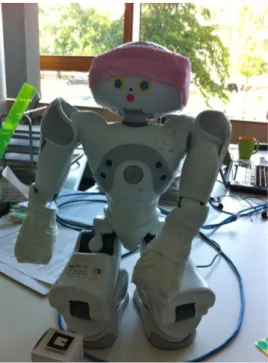
3.5 Nao with colored stickers that indicate the position of the fake eyes. . . 23
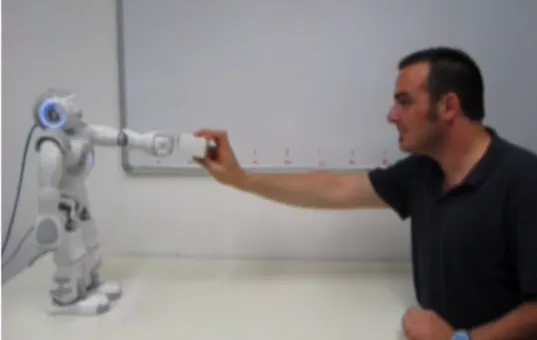
3.6 Experimental setup showing interaction between the Nao and a person. . . 25
3.7 Results of the experiment from the Godspeed questionnaire . . . 29
4.1 Research topics covered in Chapter 4 . . . 39
4.2 Example of a designed gesture vocabulary for a modeled world, and a gesture vo-cabulary seen in the real world . . . 42
4.3 Procedure for obtaining human and robot gesture vocabularies . . . 43
4.4 Obtained human gesture vocabulary, with excluded gesture 11 (“no gesture”) and meaning 11 (“Where is the toilet?”) . . . 46
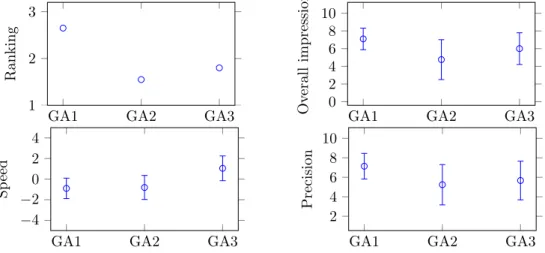
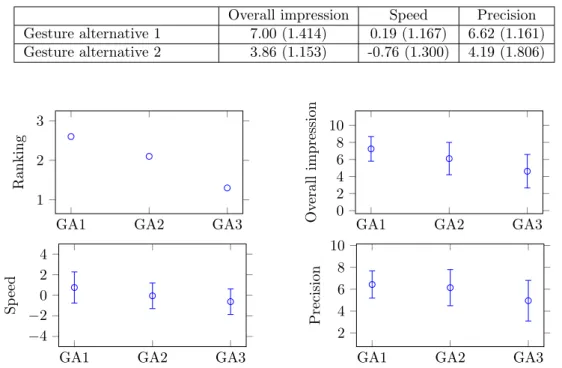
4.5 Rankings and mean overall impressions of gesture alternatives for action 1 . . . 52
4.6 Rankings and mean overall impressions of gesture alternatives for action 2 . . . 53
4.7 Rankings and mean overall impressions of gesture alternatives for action 3 . . . 53
4.8 Rankings and mean overall impressions of gesture alternatives for action 4 . . . 54
4.9 Rankings and mean overall impressions of gesture alternatives for action 5 . . . 55
4.10 Rankings and mean overall impressions of gesture alternatives for action 6 . . . 55
4.11 Rankings and mean overall impressions of gesture alternatives for action 7 . . . 56
4.12 Rankings and mean overall impressions of gesture alternatives for action 8 . . . 56
4.13 Experimental environment for evolution of robot gestures . . . 62
4.14 A decrease in mean fitness value for Action 7 during one experimental run. . . 64
4.15 An example of the trend of mean fitness value for a successful evolution. . . 64
4.16 An example of the trend of mean fitness value for an unsuccessful evolution. . . 65
5.1 Research topics covered in Chapter 5 . . . 68
5.2 Proposed Gesture Recognition and Disambiguation (GRaD) framework . . . 72
5.3 Illustration of direction invariance . . . 75
5.4 Robot platform robuLAB10. . . 86 iii
5.5 Example of a path-following algorithm. . . 86
5.6 Internal models. . . 87
5.7 Representation of the learning process . . . 89
5.8 Representation of the execution process . . . 90
5.9 Illustration of the experimental setup for motor control learning. . . 91
5.10 Experimental setup for motor control learning. . . 92
5.11 Illustration of the interconnected self-organizing maps. . . 92
5.12 Weights of input dimensions of self-organizing maps encoding perceived pointing (SOM 1) and related motor commands (SOM 2) . . . 93
3.1 Most relevant correlations (part 1). . . 34
3.2 Most relevant correlations (part 2). . . 35
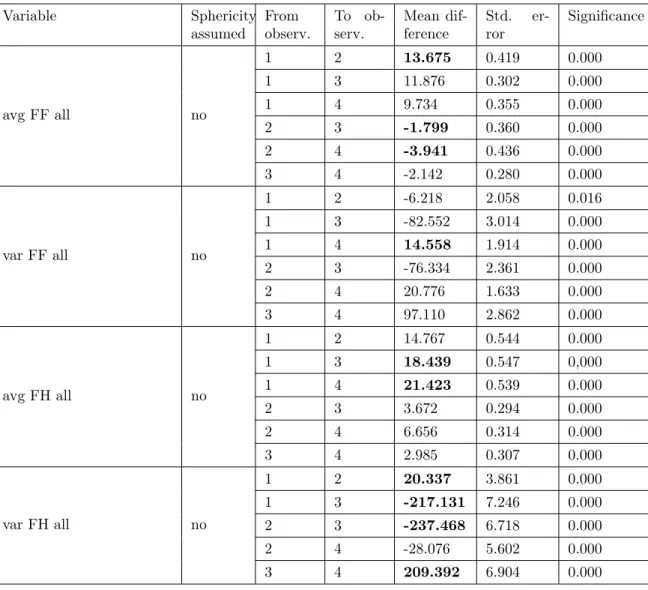
3.3 Statistically significant results of RM ANOVA on the questionnaire variables. . . . 36
3.4 Statistically significant results of RM ANOVA on the proxemics variables. . . 37
4.1 Results of the human gesture vocabulary experiment. . . 45
4.2 Selected actions and their representative gestures . . . 48
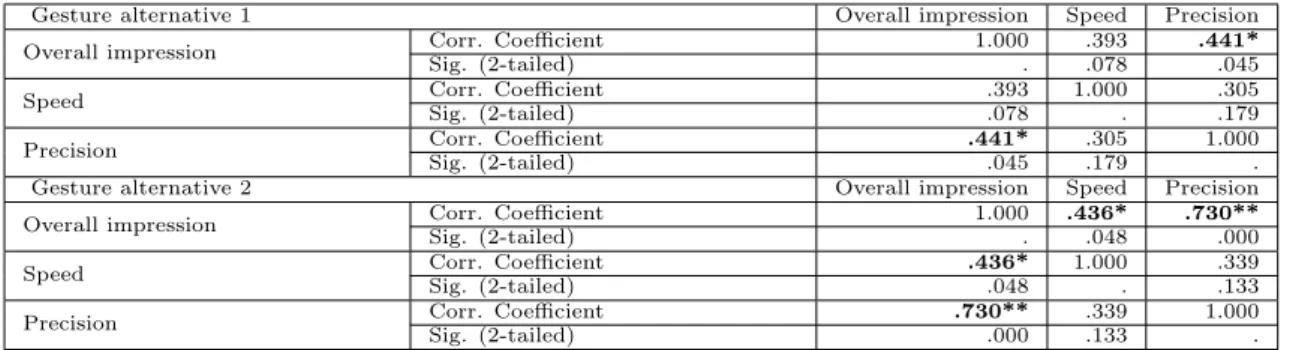
4.3 Correlations for gesture alternatives of action 1. . . 49
4.4 Correlations for gesture alternatives of action 2. . . 49
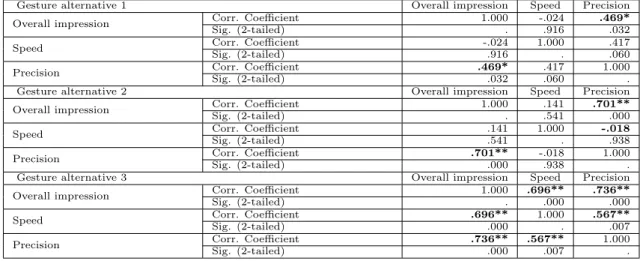
4.5 Correlations for gesture alternatives of action 3. . . 50
4.6 Correlations for gesture alternatives of action 4. . . 50
4.7 Correlations for gesture alternatives of action 5. . . 50
4.8 Correlations for gesture alternatives of action 6. . . 51
4.9 Correlations for gesture alternatives of action 7. . . 51
4.10 Correlations for gesture alternatives of action 8. . . 51
4.11 Means and standard deviations for overall impression, precision and speed of gesture alternatives of action 1. . . 52
4.12 Means and standard deviations for overall impression, precision and speed of gesture alternatives of action 2. . . 53
4.13 Means and standard deviations for overall impression, precision and speed of gesture alternatives of action 3. . . 54
4.14 Means and standard deviations for overall impression, precision and speed of gesture alternatives of action 4. . . 54
4.15 Means and standard deviations for overall impression, precision and speed of gesture alternatives of action 5. . . 54
4.16 Means and standard deviations for overall impression, precision and speed of gesture alternatives of action 6. . . 55
4.17 Means and standard deviations for overall impression, precision and speed of gesture alternatives of action 7. . . 56
4.18 Means and standard deviations for overall impression, precision and speed of gesture alternatives of action 8. . . 57
4.19 Resulting robot gesture vocabulary . . . 57
4.20 Results of the first experiment on gesture evolution with first success criterion . . . 62
4.21 Results of the first experiment on gesture evolution with second success criterion . 63 4.22 Results of the first experiment on gesture evolution with third success criterion . . 63
4.23 Results of the verification experiment on gesture evolution . . . 63
5.1 Issues in gesture recognition . . . 71 v
5.2 Confusion matrix of the gesture recognition without preprocessing. . . 80
5.3 Confusion matrix of the gesture recognition with frame of reference transformation. 81 5.4 Confusion matrix of the gesture recognition with frame of reference transformation and alignment. . . 81
5.5 Confusion matrix of the gesture recognition with frame of reference transformation and scaling. . . 81
5.6 Confusion matrix of the gesture recognition with frame of reference transformation, alignment and scaling. . . 82
5.7 Summary of evaluation results . . . 82
5.8 Confusion matrix of the gesture recognition from the Sehir University gesture dataset (results from paper). . . 83
5.9 Confusion matrix of the gesture recognition from the Sehir University gesture dataset. 83 5.10 Fixed PT-M with no displacement . . . 94
5.11 Fixed PT-M with displacement of0.5mto the left . . . 94
5.12 Fixed PT-M with displacement of0.5mto the right . . . 95
5.13 Fixed PT-M with displacement of1mto the left . . . 95
5.14 Fixed PT-M with displacement of1mto the right . . . 95
5.15 Moving PT-M, distance of2mfrom the robot . . . 96
5.16 Robot moving forward toward the person . . . 96
5.17 Robot moving perpendicular to the person . . . 96
5.18 Robot person-following control . . . 96
Introduction
1.1
Background
Humans rely on various communication methods, such as speech and gestures. Traditionally, communication channels in human-machine interaction do not fully overlap with those used in interpersonal communication, which can result in decrease of system’s intuitiveness and increase in perceived workload during the interaction. Recently, a shift towards more natural and intuitive ways of interaction is observed, such as in use of natural language processing and speech synthesis for issuing commands and providing feedback, respectively.
Another intuitive form of communication are gestures. A gesture is defined as a movement of body parts, most commonly hands and head, with the goal of communicating a particular message (Mitra and Acharya, 2007). They are observed in early development of infants, such as imperative and declarative pointing to specify a particularly interesting point in their environment, prior to development of speech. Furthermore, there is evidence for gesturing in other primates (Tomasello et al., 1997; Pika et al., 2003; Liebal et al., 2006). Due to their ubiquitous use in interpersonal interaction, they could be employed as a natural and intuitive way in human-machine, and in particular in human-robot interaction.
A different form of gestures is already used in human-computer interaction, where a gesture represents motions performed with fingers on touch-sensitive surfaces. However, the focus of this thesis is on use of gestures in human-robot interaction, focusing on the use of gestures that occur naturally in interpersonal interaction. Use of gestures in human-robot interaction is investigated through three, inter-connected areas.
The first area considers methods of developing gesture vocabularies, mappings between gestures and their associated meanings . There are human and robot gesture vocabularies, and partial overlap between those can appear. Gesture vocabularies depend on use-case scenario and features of the people that will interact with the robot, as well as on a morphology of the robot, which defines which gestures can be performed and correctly recognized by a human observer.
The second area deals with gesture recognition. Gesture recognition is a research area within machine learning and pattern recognition, covering detection, segmentation and recognition of gestures in human motion. Its main application is in computer, and later in human-robot interaction, as a way to provide an intuitive interface. In human-computer interaction, communication with gestures was unidirectional, as computers do not posses required capacities to gesture. On the other side, some robots posses limbs which can be used to generate gestures, in order to convey a message in a more intuitive way to a human listener. This poses an open question of defining which gestures should the robot use and how should they be designed. As a result,
there is a need for a comprehensive study on the use of gestures in human-robot interaction, taking in consideration various gesture-related aspects, with the goal of having an intuitive interaction, which defines the main topic of this thesis.
The third area is gesture synthesis, which comprises of methods of how and when should a robot produce a gesture. It includes generative models controlling when a robot gestures, which can be related to robot’s particular state, or what is it currently saying. However, gesture synthesis is partially out of the scope of this work.
1.2
Objectives
Having in mind above outlined areas in gesture use in human-robot interaction, there are three main research questions that are addressed by the thesis:
• How to develop gesture vocabularies, that is sets of gestures mapped to their associated meanings for a particular interaction scenario?
• How can gestures be learned, recognized and reproduced? • How can gestures be disambiguated?
Having in mind that gestures differ between different groups of people, effective methods are needed for development of mappings between gestures and actions they represent, so called gesture vocabularies. Identified gestures need to be analyzed to see whether different gesture classes from a vocabulary can be distinguished and successfully recognized.
Following from the previous, the aims of the thesis are:
• Study gestures that occur in interpersonal interactions and introduce an effective method for development of gesture vocabularies,
• Develop a system for gesture recognition and disambiguation, – Develop an algorithm for dynamic gesture recognition,
– Propose an approach for gesture disambiguation, which can follow the recognition phase.
1.3
Methodology
Use of gestures in human-robot interaction requires a multifaceted approach, as represented with the flow diagram in Figure 1.1. While some gestures will be used across different scenarios, some will be specific for a particular scenario. Therefore, the first part of the process is to define a use-case scenario. For example, the use-case scenario used here is the robot waiter scenario, which describes the interaction occurring between a customer and a waiter in a bar or a restaurant. A set of actions, both user-initiated, such as asking for a menu, and robot-initiated, such as offering a suggestion, can be extracted from the scenario. The gestures coupled with these actions form a gesture vocabulary.
There is more than one approach to selecting gestures to represent the actions. A simple way would be to have a system developer to design gestures and predefine the mappings between gestures and actions. However, with this approach the user is taken out of the loop. A better way would be to look at recorded instances of extracted actions and use the gestures that occur within the recordings. Alternatively, users could be asked to rank and select gestures from a defined set of gestures, or a sample of the user group could be surveyed to find out which gestures they
Define use-case
scenario Extract actions
Define gesture vocabularies Perform user studies for HGV and RGV Analyze obtained GVs Improve robot gestures (optional) Recognition of static gestures (poses) Recognition of dynamic gestures Gesture disambiguation
associate with the actions. The latter approach is used in this work. Firstly, it directly interacts with persons who would interact with the robot. This direct approach might provide gestures that better represent gestures that would be used. A disadvantage of this approach is that it is probable that the resulting mapping between gestures and actions will be many-to-many. However, depending on the particular case, this might not be an issue, if surrounding context is taken into account.
Analysis of the results of the user studies performed for development of human and robot gesture vocabularies drives the further part of the process. In case of gestures appearing in the robot gesture vocabulary (RGV), the results of the study might not be satisfactory – the participants might not see the gestures as good enough. In this case an interactive procedure can be applied for improvement of robot gestures. Interactive genetic algorithm is an appropriate choice, as it can be used in cases where aesthetic qualities are being used as a rating. Gestures appearing in human gesture vocabulary (HGV) drive the development of the gesture recognition and disambiguation systems. In some cases, the vocabulary will contain static gestures, or poses. However, the focus in this work is on the recognition of dynamic gestures.
There are prior methods for recognition of dynamic gestures. However, there was lack of focus on application of gesture recognition approaches in real-life cases. Some of the issues were relying on large training datasets or ignoring some of the environmental issues. Therefore, the approach taken here is based on one-shot learning, where learning algorithms rely on small training datasets. Furthermore, in order to alleviate some of the environmental factors, a pre-processing pipeline was envisioned to improve correct recognition under different situations. The disadvantage of one-shot learning approaches is that they are highly dependent on correct performance of training samples. To evaluate the gesture recognition algorithm, training and test data was collected.
Some other areas are studied in this thesis. Namely, the effect of attention models on percep-tion of the robot was studied in a user survey. This is identified as one of the prerequisites for natural human-robot interaction. Godspeed questionnaire was selected as a standardized method for evaluation of robot’s appearance and behavior. This can show how particular robot’s behavior affect how the others perceive it. An interesting question arose during the research of gesture recognition. Namely, it would be interesting to see how can relation between gestures and actions be learned. Two experiments were performed to see how can gestures lead to action execution.
1.4
Contribution
The main contributions of the work presented in the thesis are:
• An approach for development of human and robot gesture vocabularies based on user studies, thus increasing the intuitiveness of gestures.
– Human and robot gesture vocabularies were developed for an example robot waiter scenario.
• An approach based on interactive genetic algorithms for improvement of robot gestures ac-cording to particular aesthetic preferences of a user or a group of users.
• System for gesture recognition and disambiguation focused on real-life use.
– One-shot learning algorithm for gesture recognition requires very low number of gesture samples for training and is highly robust to environmental interferences, such as position and orientation of the person relative to the robot, gesture location, size of the person, and therefore the size of the gesture, and the speed of performed gestures.
1.5
Structure
The rest of the thesis is organized as follows. Chapter 2 presents a general literal review on what gestures are and how they are defined in literature, as well as present gesture taxonomies in gesture studies. Furthermore, the concept of a gesture space, in which the gesturing occurs, is explained, showing that gestures are not limited to a particular location in gesture space across different persons. Chapter 3 introduces the notion of attentional models and presents an implementation of an attentional model for a humanoid robot, as a prerequisite for intuitive human-robot interaction. The effect of different behaviors on the way others perceive the robot was tested to identify the influence of particular characteristics of robot’s behaviors. Chapter 4 introduces the notion of gesture vocabularies and how they can be developed for both humans and robots. The procedure is applied on development of a human and a robot gesture vocabulary for a robot-waiter interaction scenario. Chapter 5 presents the gesture recognition and disambiguation framework. Firstly, development of a robust gesture recognition algorithm is presented, focusing on its use in real world scenarios. Most importantly, the algorithm applies one-shot learning, which means that the training is performed using low number of training samples. This is followed by presentation of a theoretical concept for gesture disambiguation. The second part of the chapter introduces an approach for learning the relation between visual sensory input and motor commands, using the example of pointing gestures. Finally, Chapter 6 discusses the obtained results, highlights main accomplishments, what are the important outcomes and what could be possible future research directions based on the presented results.
Due to the diverse research directions, chapters 3, 4 and 5 begin with overview sections, outlining what is presented in the chapter, followed by background sections, which cover the literature reviews in their respective fields, instead of having a separate chapter devoted to the literature review.
1.6
Publications
Following publications resulted from the work presented in this thesis. Journal articles
Related to Chapter 3:
• Schillaci, G., Bodiroža, S. and Hafner, V. V. (2012), Evaluating the Effect of Saliency Detection and Attention Manipulation in Human-Robot Interaction, International Journal of Social Robotics, DOI: 10.1007/s12369-012-0174-7.
All authors actively participated in the design and implementation of the experiments. Pointing algorithm was developed by Guido Schillaci.
Peer-reviewed conference proceedings Related to Chapter 3:
• Bodiroza, S., Schillaci, G. and Hafner, V.V. (2011), Robot Ego-sphere: An Approach for Saliency Detection and Attention Manipulation in Humanoid Robots for Intuitive Interac-tion, in Proceedings of the 11th IEEE-RAS International Conference on Humanoid Robots (Humanoids 2011), Bled, Slovenia.
Related to Chapter 4:
• Bodiroža, S., Stern, H. I., Edan Y. (2012), Dynamic Gesture Vocabulary Design for Intuitive Human-Robot Dialog, in Proceedings of the 7th ACM/IEEE International Conference on Human-Robot Interaction (HRI 2012), Boston, USA.
Related to Chapter 5:
• Bodiroža, S., Hafner, V. V. (2014), GRaD: Gesture Recognition and Disambiguation Frame-work for Unconstrained, Real-Life Scenarios, in Workshop Proceedings of 13th International Conference on Intelligent Autonomous Systems (IAS-13), pp. 347-353, Padua, Italy.
• Jevtić, A., Doisy, G., Bodiroža, S., Edan, Y., and Hafner, V. V. (2014), Human-Robot Interaction through 3D Vision and Force Control, in Proceedings of the 9th ACM/IEEE In-ternational Conference on Human-Robot Interaction (HRI 2014), p. 102, Bielefeld, Germany.
Guillaume Doisy and Aleksandar Jevtić worked on person following and pointing algorithms. Aleksandar Jevtić integrated the separate parts into the final demo.
• Bodiroža, S., Jevtić, A., Lara, B. and Hafner, V. V. (2013), Learning the Relation of Motion Control and Gestures Through Self-Exploration, in Proceedings of the Robotics Challenges and Vision Workshop, Robotics: Science and Systems Conference (RSS 2013), Berlin, Ger-many.
• Bodiroža, S., Doisy, G. and Hafner, V. V. (2013), Position-Invariant, Real-Time Gesture Recognition Based on Dynamic Time Warping, in Proceedings of the 8th ACM/IEEE Inter-national Conference on Human-Robot Interaction (HRI 2013), Tokyo, Japan.
Guillaume Doisy provided support with the transformation matrices.
• Doisy, G., Jevtić, A. and Bodiroža, S. (2013), Spatially Unconstrained, Gesture-Based Human-Robot Interaction, in Proceedings of the 8th ACM/IEEE International Conference on Human-Robot Interaction (HRI 2013), Tokyo, Japan.
Guillaume Doisy and Aleksandar Jevtić worked on person tracking, position estimation and following algorithms.
Peer-reviewed conference presentations Related to Chapter 4:
• Bodiroža, S., Stern, H. I., Hafner, V. V., Edan, Y. (2012), A Diachronic Approach for Human-Humanoid Discourse, presented at the 5th Conference of International Society for Gesture Studies, Lund, Sweden. abstract
Related to Chapter 5:
• Bodiroža, S., Jevtić, A., Lara, B. and Hafner, V. V. (2013), Learning Motion Control for Guiding a Robot using Gestures, presented at the 4th Israeli Conference on Robotics, Tel Aviv, Israel.
• Doisy, G., Jevtić, A., Bodiroža, S. and Edan, Y. (2013), Spatially Unconstrained Natural Interface for Controlling a Mobile Robot, presented at the 4th Israeli Conference on Robotics, Tel Aviv, Israel.
Guillaume Doisy and Aleksandar Jevtić worked on person tracking, position estimation and following algorithms.
Following publications were published based on the results not related to the work presented in the thesis:
Peer-reviewed conference proceedings
• Kajić, I., Schillaci, G.,Bodiroža, S.and Hafner, V. V. (2014), Learning Hand-Eye Coordina-tion for a Humanoid Robot Using SOMs, in Proceedings of the 9th ACM/IEEE InternaCoordina-tional Conference on Human-Robot Interaction (HRI 2014), pp. 192-193, Bielefeld, Germany.
• Kajić, I., Schillaci, G.,Bodiroža, S.and Hafner, V.V. (2014), A Biologically Inspired Model for Coding Sensorimotor Experience Leading to the Development of Pointing Behaviour in a Humanoid Robot, Workshop on “HRI: a bridge between Robotics and Neuroscience” at HRI-2014, Bielefeld, Germany.
Defining Gestures
In the scope of human-machine interaction, Mitra and Acharya (2007) define gestures as “expressive, meaningful body motions involving physical movements of the fingers, hands, arms, head, face, or body with the intent of conveying meaningful information, or interacting with the environment.” Due to their impact in the communication, the work presented here focuses on arm gestures with intent of information transfer.
A typical gesture taxonomy would include manipulative and communicative gestures, where the latter can be further divided into symbols, which can be referential or modalizing, and acts, which can bemimeticordeictic (Quek, 1995). Communicative gestures are of higher interest with regards to the aspects of human-robot and human-computer interaction, and are therefore the main target for recognition and disambiguation.
From communicative stance, gestures can be observed within a narrower frame. Kendon (1986) defined a gesture as a movement of body, as already stated above, but with a clear goal of com-municating a thought or emotional state. He specifies that gestures are autonomous, which can appear without speech, orgesticulation, appearing together with speech. McNeill (1986) defines a gesture as “any spontaneous body movement during speech (usually of the hands) not performed for a practical purpose, i.e., not a manipulation of the physical environment to bring about some change of state.” Gesture movements can be observed as a hierarchy, as presented by McNeill et al. (1990) (see Figure 2.1).
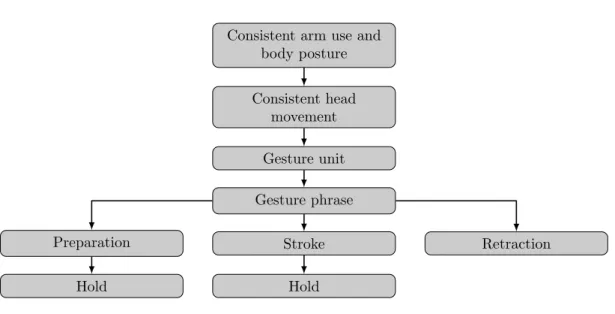
Arm use and body posturerefer to adoption of particular body postures and arm usage patterns. As mentioned by McNeill et al. (1990), Kendon observed stretches where either the left or right arm, or both arms were used, with switches in usage during the interaction. A consistent stretch can roughly be interpreted as a “paragraph”, and a shift in usage defines a kinesic unit on this level. Head movements can appear during a single stretch of consistent arm use and body posture. Gesture unit is defined as the period between rests of the limbs, starting when the limbs starts moving, and ending when the limbs return to the resting position.
A gesture phrase occurs within a gesture unit, and consists of preparation, stroke, and retrac-tion.
Preparation refers to the movement of a limb from its rest position to a position where the gesture begins. Pre-stroke hold may occur for a brief period before the actual stroke, after the limb has reached its starting position in the gesture space. McNeill et al. note that the preparation is optional, however, it is rarely omitted. The hold marks the temporary halt in the movement, but without returning to the resting position, which would mark an end of a current gesture phrase.
Stroke is the central part of a gesture phrase and represents the meaning of the gesture, that is the information that is being transferred to the listener. It is synchronized with linguistic segments that may co-appear with the stroke. Additionally, the stroke is usually performed within the central
Consistent arm use and body posture Consistent head movement Gesture unit Gesture phrase Stroke Preparation Retraction Hold Hold
Figure 2.1: Gesture levels, adapted from McNeill et al. (1990)
gesture space, an area bounded with waist, shoulders and arms. Apost-stroke hold can occur after the stroke, but before the retraction.
Retraction is an optional part of the gesture phrase that is performed to return active hands and arms to their resting positions. In case the current gesture continues into another gesture, this part may be omitted.
Preparation-hold and Stroke-hold parts represent hold of active limbs in the current pose for a brief period of time. These two segments usually appear to compensate for desynchronization between co-expressive spoken utterances and gestures.
The focus of the work presented here is recognition of a gesture stroke. The main assumption made is that little information is present in the preparation and retraction, and that therefore the stroke contains the most information of a gesture. This assumption is well supported by McNeill et al. (1990): “While a gesture phrase cannot exist without a stroke, by definition, the other phases are optional. [ . . . ] In this book most of our observations refer to the lowest level of the kinesic hierarchy, and within this level, to the stroke phase. [ . . . ] The stroke is the phase that carries the gesture content.” It directly influences the design of the recognition algorithm and of the training samples. The recognition should be invariant to the actual starting position of the gesture (e.g., a resting position, or a continuation from a previous gesture). Therefore, training samples should be prepared in such way to minimize included motion related to the preparation and retraction.
Kendon (1988) suggests gesticulation “appears as one of the resources a speaker has for convey-ing meanconvey-ings. [ . . . ] one finds that gesticulation appears to serve a very wide range of communica-tive functions. It may be used to disambiguate potentially ambiguous words; it may be used as a device to convey aspects of meaning the speaker’s words convey only in part, or perhaps not at all; it may be used to complete a spoken utterance, substituting for a segment of the sentence that which is not spoken. In many cases it is possible to see how the speaker deploys gesture together with speech in a way that suggests that he divides the conveyance of his meaning between these two modalities in a way that quite aptly achieves an economy of expression or a particular effect on the recipient.”
Furthermore, Kendon (1988) argues that there is “no sharp dividing line [that] can be drawn between spontaneous gesturing that encodes meaning in a holistic fashion and gestures which, like so-called ‘emblems,’ are not shaped on the spur of the moment but follow an established form within a communication community, or which, like the signs in a sign language, can be shown to
Gesticulation
’Language-like’ gestures
Pantomime Emblems Sign languages
Figure 2.2: Kendon’s continuum, adapted from McNeill et al. (1990)
be structured systematically out of recombineable elements and which do indeed refer to meaning units of great generality, as do words.” McNeill et al. (1990) named this the “Kendon’s continuum” (see Figure 2.2). Moving along the continuum from gesticulation toward sign languages, the co-expressive speech declines, and the language-like properties of gestures and their formalization increase.
Since sign languages posses certain language-like properties, in particular the standardization of sign language signs, their meaning can be more easily obtained. On the other hand,gesticulation, ‘language-like’ gestures andemblems lack standardization, present in sign languages. Hence, the need to define gesture vocabularies, as it was presented in Chapter 4.
With regards to the recognition task, gestures can be static or dynamic. Static gestures repre-sent a specific body posture that is held for a certain amount of time and the meaning of the gesture is held in the particular configuration of relevant body parts. As stated by (Stern et al., 2008), a static gesture is indicated with a fixed position, orientation and configuration, that is having a static posture, while a dynamic gesture is characterized with variations in position, orientation or configuration over time. An “OK” gesture, with a thumb and an index finger forming a ring, while the other fingers are kept extended, is an example of static gestures. On the other hand, the meaning of dynamic gestures is encoded in the motion of some body parts. Greeting someone or attracting someone’s attention with a waving gesture is an example of dynamic gestures. Finally, some gestures contain both static and dynamic component, e.g., signs in sign languages.
Task of gesture recognition is to detect these intentional postures or motion and to classify them into particular gesture classes. It has numerous applications, including sign-language for hearing-impaired people, computer interfaces, natural and intuitive human-robot interaction, gaming in-dustry, system remote control, among others. Various tools have been used for gesture recognition, based on the approaches ranging from statistical modeling, computer vision and pattern recogni-tion, image processing, connectionist systems, etc. (Mitra and Acharya, 2007).
Depth image-based sensors have opened up new possibilities in object detection and recognition. Pixels in a depth image carry information about the object’s distance from the sensor; hence, the image segmentation is performed taking into account distance gradients. One of the main advantages of this technology is that it is in large part insensitive to illumination changes, which is a major bottleneck for 2D image segmentation methods (Liu and Fujimura, 2004).
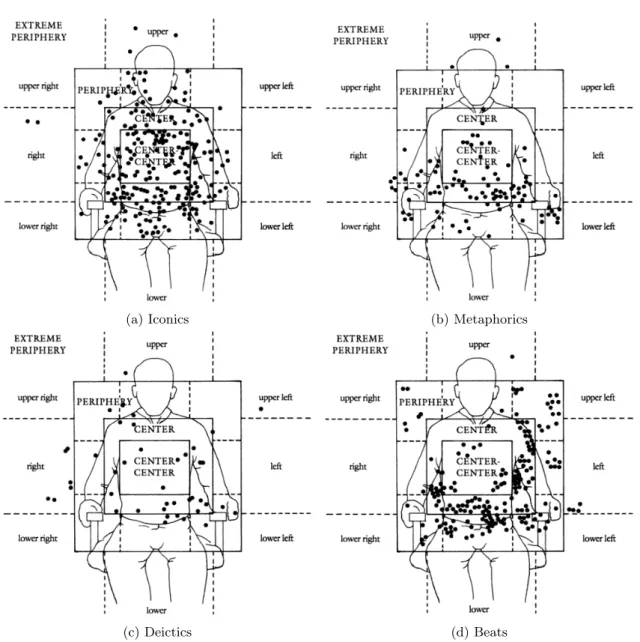
Gesture space is the area in front of the gesturing person, in which most of the gestures occur (McNeill, 1992). It can be seen as a shallow disk, with bottom half flattened when the person is gesturing seated. Figure 2.3 illustrates different zones of the gesture space, while Figure 2.4 displays occurrence of different types of gestures in the gesture space, based on gesturing of six persons. Gestures prevalently appear in the frontal plane of the body and occurrences of gestures behind the body plane is rare. Cultural influences can affect the density of occurrence, e.g., Turkana speakers tend to gesture more in the area around the head, compared to the European speakers (as observed on English, French, German, Italian and Georgian speakers). In the cases presented in Figure 2.4, iconic gestures tended to occur more in the central area (Figure 2.4a, metaphorics in the lower central area (Figure 2.4b), deictics in the peripheral area (Figure 2.4c) and beats were grouped in clusters, where each cluster belonged to one person and indicated their “favorite” area for these gestures (Figure 2.4d).
Figure 2.3: Gesture spaces (McNeill, 1992, image taken from Chapter 3)
2.1
Gesture Taxonomies in Human-Robot Interaction and
Human-Computer Interaction
This section presents gesture taxonomies described by Quek (1995), Pavlovic et al. (1997), and Nehaniv et al. (2005).
Quek (1995) differentiated gestures intomanipulative andcommunicativegestures, with regard to their use in human-computer interaction. The purpose of manipulative gestures is object manip-ulation while communicative gestures are used to transfer information. One qualitative difference is the possibility of visual interpretation. Communicative gestures are visible, providing enough information for their recognition. This means that occluded body parts carry no information re-quired for interpretation. On the other hand, manipulative gestures, e.g. rotation movements of arms while opening a valve, are usually not used for information transfer and, therefore, they might not be fully visible and even interpretable.
Communicative gestures can be symbols andacts. Symbols are arbitrary in nature. They can bereferential or modalizing. Referential symbols refer to an object or a concept (e.g. holding the index and the middle fingers up as a peace sign). Modalizing symbols influence how a statement is understood (e.g. saying “Have you seen its size?” with the hands wide apart to indicate that the object was large). Acts can bemimetic anddeictic. Mimetic gestures imitate the referred object or its use, such as holding both clenched fists together in front of the body and then pulling them closer, as if they are pulling something with a rope. Deictic gestures are gestures that point to the referent. They can be further classified asspecific (pointing to a particular object), generic (pointing to an object which symbolizes the whole class) andmetonymic(pointing to an object to signify some other entity related to it).
(a) Iconics (b) Metaphorics
(c) Deictics (d) Beats
Figure 2.4: Frequency of gestures according to their type (McNeill, 1992, image taken from Chap-ter 3).
Pavlovic et al. (1997) extends the taxonomy by Quek to include unintentional hand movements, such as rubbing hair with the hand, that do not carry any useful information.
Nehaniv et al. (2005) present a gesture taxonomy for application of gestures in human-robot interaction, includingirrelevant or manipulative gestures, side effect of expressive behavior, sym-bolic gestures,interactional gestures andreferential gestures. Irrelevant and manipulative gestures correspond to unintentional hand movements and manipulative gestures, as used by Pavlovic et al. (1997). Side effects of expressive behavior represent gestures that can be observed during speech, with no particular information transfer role. Symbols are defined in a similar way as they are de-fined by Quek (1995). Interactional gestures are used to mediate the interaction between partners. Referential gestures are similar to deictic gestures, as defined by Quek (1995).
The goal of manipulative gestures is usually not information transfer, therefore the focus of this work is on communicative gestures, according to the taxonomy presented by Quek (1995). Considering classification by Nehaniv et al. (2005), the focus of the work is on symbolic and interactional gestures. Furthermore, the focus is on dynamic uni- or bi-handed gestures, and partially on static gestures, by including dynamic information contained in the preparatory and return movements. While the hand pose provides relevant information for certain gestures (e.g., the mentioned “peace” sign, or a dynamic gesture together with a particular hand posture crucial for correct recognition), the framework does not take it into account.
Deictic gestures represent a special case. The primary goal of deictic gestures is to manipulate the attention of an interacting partner to an object or an event of interest, as reported by Masa-taka (2003). The proposed framework does not handle pointing gestures. However, they have a characteristic signature, containing of the preparatory movement, the hold, during which the finger is still and pointing to a location of interest, and the retraction, taking the hand to the resting position, or preparing for the next gesture. The framework could be extended to include additional branch for processing of pointing gestures, in case they are detected based on their signature.
Finally, the choice of these classes is supported by the analysis presented by McNeill (1992). He presented a frequency of gesture types during narration. In summary, a third of narrational clauses were accompanied with iconic gestures, while another third were accompanied with beats. A quarter of the clauses did not have co-occurring gestures, and a smaller part were occurrences of metaphorics and deictics.
Attention Systems for Human-Robot
Interaction
3.1
Overview
Evidence from developmental psychology studies show that the development of skills to understand, manipulate and coordinate attentional behavior is a requirement for imitation learning and social cognition. Pointing is a way for manipulating the attention of someone else. It is not yet clear whether this behavior is innate, learned by imitation, or if it results from reaching behaviors, in its first developmental stage. Recognizing and performing pointing gestures is very important for being able to share attention with another person (Kaplan and Hafner, 2006). In this chapter, an implementation of an attentional model for a humanoid robot is presented, employing both a mechanism for saliency detection and a mechanism for pointing gesture generation (Hafner and Schillaci, 2011).
Moreover, the ability to distinguish between animate and inanimate objects (implemented here by a motion detection filter) and whether this object is a person to interact with, as well as the ability to detect and follow eye gaze (which requires the recognition of faces) are essential prerequisites in the development of a Theory of Mind – or Mindreading (Baron-Cohen, 2001) – the ability to understand the motivations and desires of other people which identifies the clear distinction between us, humans, and other animals.
The robot is also equipped with something similar to human focused attention. It is not hard to imagine an everyday situation during which a person focuses their attention on a certain aspect of the environment, e.g. talking to someone, reading an interesting article or doing work. During the time when their attention is focused on these processes, they suppress most other salient events. This is modeled with a change from exploration to interaction phase once certain conditions have been satisfied, and it is explained later in more detail.
Section 3.3 of the chapter presents the notion of an attentional model and prior work, and a developed implementation of an attentional model in a humanoid robot, using an egosphere as a model of memory representation. This attentional model enables the robot to explore its near environment and locate and remember important detected features, such as motion and faces. Four different behaviors were implemented in order to realize an interaction game. It was tested through an interaction game with participants and the Godspeed questionnaire was used to measure how the participants perceived different behaviors of the robot.
The ability to share the attention with another individual is essential for having intuitive interaction. Two relatively simple, but important prerequisites for this, saliency detection and
attention manipulation by the robot, are identified. By creating a saliency based attentional model combined with a robot ego-sphere and by adopting attention manipulation skills, the robot can engage in an interaction with a human and start an interaction game including objects as a first step towards a joint attention.
An interaction experiment is proposed in which participants can physically interact with a humanoid robot equipped with mechanisms for saliency detection and attention manipulation. The experiment tests four combinations of activated parts of the attention system, resulting in four different behaviors.
The aim is to identify those physical and behavioral characteristics that need to be emphasized when implementing attentive mechanisms in robots, and to measure the user experience when interacting with a robot equipped with attentive mechanisms.
Two techniques are adopted for evaluation of saliency detection and attention manipulation mechanisms in human-robot interaction – user experience, measured by qualitative and quantita-tive questions in questionnaires, and proxemics, estimated from recorded videos of the interactions. Section 3.4 discusses the main outcomes of the work and states the main conclusions presented in this chapter.
This chapter is partially based on work presented in Bodiroza et al. (2011), Schillaci et al. (2013).
3.2
Background
Gestures are important in human-robot interaction, as they can enable intuitive and natural in-teraction. However, interaction relies on the ability to share attention. Kaplan and Hafner (2006) identified the prerequisites for joint attention. Being able to detect, locate and attend to a promi-nent feature in environment is an important prerequisite, since every interaction relies on presence of an agent with whom another interacts. As Kaplan and Hafner (2006) pointed out, there are multiple open questions to development of joint attention. This chapter addresses the issue of equipping the robot with an attentional model that will enable it to explore its immediate envi-ronment and find interesting features.
Social robotics, a new area in human-robot interaction has seen an increase in research in the past decades. As a result, there is a shift in a typical robot working environment from industrial halls to everyday places, such as homes (Jones, 2006), workplaces and service business, e.g., a museum tour-guide robot (Thrun et al., 2000) and a guide robot in a shopping mall (Kanda et al., 2009). As a result, a requirement for natural and intuitive human-robot interaction has emerged. Current social robotic systems usually rely on interaction protocols which decrease the intu-itiveness of the interaction itself, causing frustration and despair in the user. Recently, interest has been focused on measuring the efficacy of robot behaviors and its perceived intelligence based on the evaluation from human users (Burghart and Steinfeld, 2008). Indeed, measuring human-robot interaction could suggest what and how to improve in the cognitive abilities and in the appearance of the robot.
When human-robot interaction fails, the reason most often lies in the fact that the robot and the human try to communicate about different things and that the human partner has wrong expectations of the robotic partner. Several prerequisites have been identified (Kaplan and Hafner, 2006; Schillaci and Hafner, 2011a) about both physical and cognitive features that let a robot interact effectively and naturally with a human user.
Two skills that can be given to the robot and in combination already result in interesting interaction behavior are the ability to focus the attention on salient features and the ability to manipulate each other’s attention by looking and pointing.
There are different existing approaches for saliency detection and visual attention. One ap-proach relies on using saliency maps, also known as attention activation maps, proposed by Itti and Koch (2001), based on the Feature-Integration theory (Treisman and Gelade, 1980). In this method, an image is analyzed using pre-attentive bottom-up processes. Later on, this model has been extended to include motivation-influenced top-down processes, like in the work of Frintrop et al. (2005). First, the image is analyzed in parallel for particular low-level features, such as color, orientation, motion and so on. However, these features are also influenced by a top-down process, which is motivation-specific, as well as depending on the current context, e.g. searching for faces or specified objects. Therefore, regions detected by the bottom-up process are analyzed for specific features. The result of these processes is a saliency map, where salient regions are represented with higher peaks in the map, and their height (or intensity) represents their saliency values. This is in accordance with Treisman (1985), who states that the visual perception process is functionally divided in two levels: early pre-attentive and later attentive. During the pre-attentive stage a rapid scanning of the image is performed, while in the attentive stage the attention shifts toward selected regions.
Another approach partly relies on saliency maps, but also introduces the concept of a multi-modal salient ego-sphere (Peters et al., 2001; Fleming et al., 2006). It is a tessellated sphere, where each of the nodes (vertex on the tessellated sphere surface) represents one point in space. Input images are analyzed by using the aforementioned saliency detection method or by other methods such as face detection (Viola and Jones, 2004) for generation of saliency maps. The mean value of salient regions from the resulting maps are then assigned to the nodes, which are closest to the real position of the projection of the salient region to the sphere surface.
Ruesch et al. (2008) described a framework which is based on the previous concept. However, due to the higher computational capacity of the iCub robot, they use a matrix projection of the ego-sphere, which leads to higher precision of the perception of the world. This also increases the computational complexity, due to required image transformations and a higher number of arithmetic operations required per iteration.
Here the emphasis is placed on the fact that robots need to reach joint attention with the users for having successful interactions. This has not been achieved so far, since joint attention not only requires attention on the same features in the environment, but also skills in attention detection, attention manipulation, social interaction skills and even intentional understanding (Kaplan and Hafner, 2006). In other words, interacting partners need to share their attention on a particular feature, coupled with intention detection and understanding. Features can be physical (e.g. visual or auditory), as well as abstract (e.g. mental imagery). Without joint attention a robot will not be able to achieve a degree of interaction that could be compared to a interpersonal interaction. That is, the robot would still need to rely on receiving precise commands from the interacting participant, which would relate to the actions that it could automatically perform.
Several metrics for measuring HRI have been proposed, from measuring the ability of a robot to engage in temporally structured behavioral interactions with humans (Jonsson and Thorisson, 2010), to evaluating robot social effectiveness from different points of view (engineering, psycho-logical, sociological) (Steinfeld et al., 2006). A series of metrics was adopted for the survey, based on cognitive science studies about measuring social skills in humans and based on studies about how robots are perceived by humans and whether this perception affects the expectation humans have about robot intelligence, the so-called Godspeed questionnaire (Bartneck et al., 2009).
Quantifying human behavior usually requires joint analysis of video recordings, questionnaires and interviews. In this work, the first two methods are used for quantifying the quality of robot behavior. Four interaction experiments between a humanoid robot and a user were setup and recorded. After each experiment, the user was asked to fill a questionnaire on the quality of the interaction and on the perception of several functional and physical properties of the robot. To the best of author’s knowledge, very few studies have been done so far on correlating human perception
of robot skills (measured with the Godspeed questionnaire, whose reliability was tested) with proxemic distances. For example, Takayama and Pantofaru (2009) adopted part of the Godspeed questionnaire in their measurements, finding that people who held more negative attitudes toward robots felt less safe when interacting with them. They also studied human personal space around robots, finding that experience with owning pets decreases the personal space that people maintain around robots, experience with robots decreases the personal space that people maintain around robots, and a robot looking at people in the face influences proxemic behaviors. The latter suggests to perform proxemics analysis when measuring attentive mechanisms in robots.
By choosing a system which resembles the human visual attention system, it can easily be that the expectations of the interacting person will have a higher satisfaction rate. In this case the user might perceive the interaction to be more intuitive and natural.
3.3
Implementation of an Attentional Mechanism for a
Hu-manoid Robot
In this section, an implementation of an attentional model for a humanoid robot is described, encompassing two fundamental skills for joint attention. Furthermore, the quality of this imple-mentation is evaluated through a user study. By evaluating robot skills, the goal is to identify those characteristics that need to be emphasized when implementing attentive mechanisms in robots and to identify correlations between them.
3.3.1
Saliency Detection and Attention Manipulation
Attention is a cognitive skill, studied in humans and observed in some animal species, which lets a subject concentrate on a particular aspect of the environment without the interference of the surrounding. There is evidence from developmental psychology studies that the development of skills to understand, manipulate and coordinate attentional behavior lays the foundation of imitation learning and social cognition (Tomasello, 1995).
In our world, we are constantly surrounded with items, such as objects, people and events, which stand out to their neighboring items. This is represented with the saliency of those items. Saliency detection represents an attentional mechanism, through which those items are discovered, and it enables humans to shift their limited attentional resources to those objects that stand out the most.
There are two approaches that can be combined – a bottom-up, pre-attentive process and a top-down process influenced by motivation. Bottom-up detection uses different low-level features (e.g. motion, color, orientation and intensity) for saliency detection. Top-down detection relies on high-level features, and it is highly influenced by our current goals and intentions. In this case, the motivation system was partially preprogrammed to show how different behaviors can result in the activation or deactivation of parts of the attention system, actually implementing a top-down approach for saliency detection, or in the activation of attention manipulation. The combination of bottom-up and top-down processes is highly inspired by similar mechanisms in humans (Itti and Koch, 2001; Treisman, 1985).
Figure 3.1 gives an overview of the attention mechanism implemented on the humanoid robot Nao.
Saliency Detection
Saliency detection represents a process of image analysis during which regions of interest are detected in the scene. The implemented approach employs bottom-up, based on low-level feature
Figure 3.1: Overview of the attentive mechanism. Frames are analyzed by three different filters which are activated by the motivation system. Optical Flow and Face Detector filters feed the ego-sphere, while the marker detector filter stores objects in a different vector. The motivation system activates or deactivated filters and movements according to its current state.
detection, and top-down processes, based on current motivation, partially reproducing similar mechanisms in humans (Itti and Koch, 2001; Treisman, 1985).
Three filters are used in the current setup: motion detection,face detectionandobject detection. Motion detection is performed using Farnebäck’s optical flow filter. Face detection is performed using the method developed by Viola and Jones (2004). AR markers are used as a shortcut for simplified object detection.1 Information coming from face and motion detection filters are stored
in an ego-sphere, keeping track from which of those two channels information come from. The robot directs its attention to the point which has the highest saliency. In the current implementation, AR marker data are stored separately outside the ego-sphere.
Ego-Sphere. Saliency ego-sphere is a multi-modal, egocentric, spherical map, which represents salient areas in the robot’s surrounding. It enables a robot to shift its attention from one salient area to another one in an apparently random and natural fashion.
The sphere is centered at the robot’s neck coordinate system, while the saliency map of its surrounding is projected on the sphere’s surface. Through mechanisms of habituation, inhibition and forgetting of salient areas the robot is able to explore its surroundings, and by finding areas of maximum saliency, it locates the next area to be attended. Furthermore, the robot uses pointing to point to the currently attended object, as a first step towards joint attention (Kaplan and Hafner, 2006).
There are different representations of the ego-sphere. One representation is where full salient maps of different scenes are stored in a matrix, which represent spherical surface and where images are aligned to a certain extent (Ruesch et al., 2008). Another approach is to reduce the projection and search space by tessellating the sphere and storing information about salient areas in the edges of the tessellated sphere (Fleming et al., 2006), as illustrated in Figure 3.2. The latter approach introduces errors in projection of salient areas, because projection space is reduced to a set of nodes on the sphere surface. Additionally, the mean saliency of a salient area is computed and assigned
to the closest point, which is found using nearest neighbor search. While the former approach has higher precision and finer representation of salient areas, the latter approach is faster, due to the lower number of arithmetic operations that need to be performed during the projection and the search. Due to Nao’s computational limitations, the ego-sphere is represented with a tessellated sphere, where information about salient areas is stored in the edges of the sphere.
Figure 3.2: Illustration of an ego-sphere representation.
The sphere tessellation is performed by recursive division of triangle faces of an icosahedron. By increasing the recursion depth, which represents the number of recursive calls to the tessellation function, each initial face is divided into a higher number of smaller faces, achieving a higher number of nodes and smaller error of projection of salient nodes. The relation between the recursion depth and the tessellation frequency, used by Peters et al. (2001), isft=dr2, whereftis the tessellation
frequency and dr is the recursion depth. In essence, the tessellation frequency represents the
number of edges which connect centers of two neighboring pentagons. The implementation uses a recursion depth of 4, resulting in 2562 nodes, with the mean theoretical projection error being
1.15◦ and maximum2.65◦.
Habituation, inhibition and forgetting. These processes are employed in order to favor shift of attention to information in new locations. This is inspired by the inhibition of return mechanism in humans (Posner et al., 1985). Habituation is the process during which the robot gets used to the attended point, which results in loss of interest in that point. It is modeled with the following function:
h(t) =h(t−1) +wh(1−h(t−1)), (3.1)
wherewh∈[0,1]represents the habituation weight.
When habituation to a certain salient point exceeds a predefined habituation threshold level, inhibition is turned on with a change from 1 to 0, which results in the appearance of a shift of attention to the next most salient point. The reported saliency of a point is the product of its current inhibition value and its saliency.
However, inhibition has a temporary nature and it is updated with an inhibition weight, ac-cording to the following function:
where wi∈[0,1]represents the inhibition weight.
Habituation and inhibition weights affect the speed of the respective processes. For certain filters, such as motion, locations of salient regions will quickly change in time. Motion can be used to initially draw attention, but it should also decay faster, because it is only present for a short period of time. Other filters can be employed to detect different salient objects in and around these areas, such as face or color detection. Under the assumption that the face does not move much during the interaction, a robot should have slower habituation to locations that contain faces.
The values of salient locations decay according to the decay factor d∈[0,1], which enables a form of short-term memory for the robot. After each iteration, each salient location will have a lower value than before, thus newer information will have higher saliency than older information. Attention Manipulation
The ability to draw attention of others is compulsory for having a natural and effective interaction. Pointing gestures can be seen as one of the approaches for this attention manipulation. Therefore, recognizing and performing pointing gestures is very important for being able to share attention with another person, as joint attention relies on the ability of the person to catch the interest of its interlocutor toward an object (Kaplan and Hafner, 2006).
Looking back and forth between the person and the object, or pointing toward the object are examples of non-verbal attention manipulation behaviors. The following subsections present how pointing gesture capabilities in a humanoid robot were implemented.
Pointing. Expression of pointing gestures has also been observed during the first 18 months, but the course for becoming a fundamental communication tool can be divided into two phases, as shown in the following subsection.
Already at the age of 9 months, infants are able to use imperative pointing gestures (Baron-Cohen, 2001). This form of pointing is exhibited by the child regardless of whether an adult is present in the room or is actually looking at the child. Since imperative pointing is not directly used to draw attention, it is possible that it arose from grasping objects within the reach of the child and turned into pointing for objects that were outside the field of grasp.
Some studies showed that there is no relation between producing pointing gestures and under-standing them (Desrochers et al., 1995). This hints to the conclusion that the two skills develop independently from each other and strengthens the hypothesis that pointing may arise from grasp-ing and is not learned by imitation. Schillaci and Hafner (2011b) tested this hypothesis, through a robotic experiment where a humanoid robot learned to reach objects (or positions in its action space) by building a body map during random body babbling.
Body Babbling. Body babbling observed in infants has been classified by Meltzoff and Moore (1997) as a mechanism that provides experience for mapping movements to the resulting body con-figurations. Schillaci and Hafner (2011a) used analogous motor babbling for learning the mapping between different sensory modalities and for equipping the robot with predicting abilities of sensory consequences (in this case, the position of the hand of the robot) from control commands applied to its neck and its arm. Learning through self-exploration was implemented on a humanoid robot, whose dimensions resemble those of a child, actually simulating the real visual input perceived by a young human subject (Schillaci and Hafner, 2011b).
The robot was equipped with an elementary attentive system for perceiving parts of its own body. During babbling, the robot performed random arm movements and tried to follow them moving its head according to the attentive system. 2