Following are the criteria for error classification:
Part of Speech (e.g. article), Phonological element (segment or suprasegmental) or Syntactic category (e.g. verb phrase).
Target modification (i.e. the mechanism of the error): Blend: e.g. novelas de *históricos⇒ históricas or
de historia [‘historical novels’ or ‘about history’] Misformation: e.g. *higenias⇒higiene [‘hygiene’] Misselection: e.g. *es lejos⇒está lejos [‘It is far’] Omission: e.g. article: *camarero está [‘*waiter is’] Unnecessary: e.g. *un mi amigo [‘*a my friend’] Order: e.g. ayuda *me⇒me ayuda [‘It helps me’] Linguistic level:
Grammar: e.g. conjugation: *sé⇒soy ['I am'] Lexis-Semantics: e.g. coinages: *omeleta⇒tortilla Pragmatics-Discourse: e.g. coherence or cohesion. Pronunciation: e.g. wrong word accent.
Type of error (e.g. indicative/subjunctive, ser/estar). Etiology (cause of the error):
Interlinguistic (e.g. false friends as realizar). Intralinguistic (developmental errors). Unknown (e.g. induced errors).
More details about the corpus are briefly explained in Campillos Llanos (2011).
3.
Description of the interface
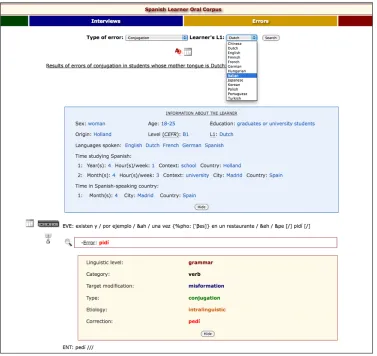
Together with the work of collecting, transcribing and analysing the corpus, a hypertext-based interface has been developed using XML technologies (XML markup, XSL to display the data, an XML native database and XQuery to perform every search). To select which errors to display, the user is presented with a menu to choose among criteria such as category (e.g., article errors), linguistic level (e.g. Grammar), error type (e.g. conjugation), the learner’s L1 or his/her proficiency level, among others. The tool makes it possible to retrieve the utterances along with the fragment of sound where the searched error appears. Every recorded utterance can be listened to along with the explanation of the error, and it is also possible to look up information about the learner such as L1, languages spoken, time studying Spanish or time in Spanish speaking country (Figure 1).
Regarding the user definition, the decision has been to build a tool aimed at teachers of Spanish as a foreign language or specialists in Applied Linguistics. A future possibility could be to adapt it to be used with students of Spanish or Spanish teacher trainees; besides, all the data gathered could benefit NLP researchers interested in automatic analysis of learner language.
error should always be shown. Furthermore, the error descriptors (the name for each error type, the morphosyntactic categories, the etiology or the linguistic level) have not always been clear or understandable enough for the evaluators (Table 6 and Figure 7). A recommendation to overcome this problem was to make a glossary with definitions for specific terminology, which has been added to the current version of the tool.
Figure 7: Opinion about the terms to describe the errors
Frequency Absolute Relative (%)
Understandable 11 50,0%
Some training is needed 9 40,9%
Others 2 9,1%
Not very clear 0 0,0%
Table 6: Opinion about the terms to describe the errors
The error search criteria (for example, category or type of error) were mostly assessed as appropriate (Table 7 and Figure 8). Nevertheless, other suggestions were made to query the data in a more dynamic way: for instance, to use a checklist menu where several criteria can be selected, so that the page is simplified.
Figure 8: Opinions about the error search criteria
Frequency Absolute Relative (%)
Simple or appropriate 18 81,8%
Others 2 9,1%
Difficult to understand 1 4,5%
Some are missing 1 4,5%
Table 7: Opinions about the error search criteria
The navigation scheme or the control of buttons and menus did not seem complicated (Table 8 and Figure 9).
Still, one teacher suggested including (in the introduction section) an explanation about the aims of the tool, the potential user and some usage recommendations.
Figure 9: Opinion about the control of buttons or menus
Frequency Absolute Relative (%)
Very easy 13 59,1%
Intuitive 6 27,3%
Not/wrongly answered 2 9,1%
Not very clear 1 4,5%
Difficult 0 0%
Table 8: Opinion about the control of buttons or menus
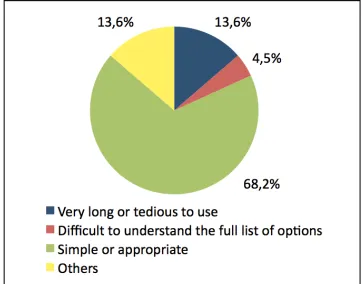
The menus with selectable lists of options for each criteria were mostly assessed as “Simple or appropriate” (Table 9 and Figure 10), in spite of certain negative comments, such as the long list of options or the need to look up a glossary to understand the terms.
Figure 10: Opinions about the selectable list and menus
Frequency Absolute Relative (%)
Simple or appropriate 15 68,2%
Very long or tedious to use 3 13,6%
Others 3 13,6%
Difficult to understand 1 4,5%
Table 9: Opinions about the selectable list and menus
-My opinion about the Error Analysis (EA) methodology is…
Positive With limitations Negative I do not know the EA.
-I consider that the utility of Error Analysis (EA) is… (you can choose more than one) Research in Spanish as a Second/Foreign Language Acquisition.
Improvement of the teaching material according to the learners’ L1. The use of documents or teaching material with authentic errors in class. Others (indicate):
-The terms used in the search tool for each type of error, the etiology or the linguistic level where it appears are…
Not very clear. Understandable.
Some training is needed. Others (indicate):
-Is there any lacking category or a type of error which has not been considered? No. Yes. If so, which one? (indicate)
-Would you improve the error analysis performed so far? No. Yes.
If so, in which aspects? (indicate)
3. Opinions about the search interface
-Regarding the use of the new technologies, you consider yourself a user with this level:
Very low Basic Intermediate Advanced
-Becoming familiar with the control buttons, the navigation scheme or the interface menu is:
Very easy Intuitive Not very clear Difficult
-The aesthetic design of the interface is:
Serious Appropriate Boring Others (indicate): Would you improve anything of the aesthetic design? (optional answer)
-The error search criteria (e.g. category, L1, type of error, linguistic level, etc.) are: Simple or appropriate. Some are missing (indicate): Difficult to understand. Others (indicate):
-Selectable lists and menus to consult the errors (e.g. the options for “type of error”: conjugation, ser/estar...) are: Very long or tedious to use. Simple or appropriate.
Difficult to understand. Others (indicate):
-Would you improve the display of the transcriptions or the full recordings? No. Yes. If so, in which aspects? (indicate)
-What other functionality or features would you like to include in the search tool?