FreeLing 3.0: Towards Wider Multilinguality
Llu´ıs Padr´o
Evgeny Stanilovsky
Software Department – TALP Research Center Universitat Polit`ecnica de Catalunya
FreeLing project developer [email protected]
Abstract
FreeLing is an open-source multilingual language processing library providing a wide range of analyzers for several languages. It offers text processing and language annotation facilities to NLP application developers, lowering the cost of building those applications. FreeLing is customizable, extensible, and has a strong orientation to real-world applications in terms of speed and robustness. Developers can use the default linguistic resources (dictionaries, lexicons, grammars, etc.), extend/adapt them to specific domains, or –since the library is open source– develop new ones for specific languages or special application needs. This paper describes the general architecture of the library, presents the major changes and improvements included in FreeLing version 3.0, and summarizes some relevant industrial projects in which it has been used.
Keywords: Language analyzers, Open source, Industrial applications.
1.
Introduction
FreeLing1is an open-source multilingual language process-ing library providprocess-ing a wide range of analysis functionali-ties for several languages.
The FreeLing project was undertaken at the TALP research center2to provide advances towards general availability of basic NLP tools and resources. That availability should en-able faster advances in research projects and lower costs in industrial development of NLP applications.
The project is conceived as a library that can be called from a user application needing analysis services. The software is distributed as open-source under a GNU General Public License3, and dual-licensed to companies that embed it in their commercial products.
The open-source approach has been very fruitful during the eight years of life of the project (first version was released on 2003). Version 2.2 has been downloaded over 88,000 times since its release in September 2010, and the source for the alpha release for version 3.0 has been downloaded 530 times in the first five weeks it has been published. Di-rect SVN downloads of development versions are not reg-istered, so this figure is probably higher.
This wide user community has extended the initial three languages (English, Spanish and Catalan) to nine (adding Galician, Italian, Welsh, Portuguese, Asturian, and Rus-sian) plus the diachronic variant of Spanish from 12th to 16th centuries (S´anchez-Marco et al., 2011). Also, the open-source nature of the project and its modular architec-ture have made it possible to include code from other simi-lar projects, such as the Word Sense Disambiguator module based on UKB (Agirre and Soroa, 2009).
Current version of the package supports –to different extents– the following languages: Asturian, Catalan, En-glish, Galician, Italian, Portuguese, Russian, and Spanish. Functionalities covered for each languages can be found in Table 1.
1http://nlp.lsi.upc.edu/freeling 2
http://www.talp.upc.edu
3http://www.gnu.org/copyleft/gpl.html
Section 2. describes the main modules and services in FreeLing. Next, the most relevant novelties in version 3.0 are presented in section 3., and section 4. summarizes some of the industrial projects the library has been used in. Fi-nally, we sketch some conclusion and future work lines.
2.
Data Structures and Linguistic Analysis
Services
FreeLing is conceived as a library on top of which powerful NLP applications can be developed, and oriented to ease the integration of language analysis services into higher level applications.
Its architecture consists of a simple two-layer client-server approach: A basic linguistic service layer which provides analysis services (morphological analysis, tagging, parsing, ...), and an application layer which, acting as a client, re-quests the desired services from the analyzers, and uses the result according to the application goal.
The internal architecture of the system is based on two kinds of objects: linguistic data objects and processing ob-jects.
2.1. Linguistic Data Classes
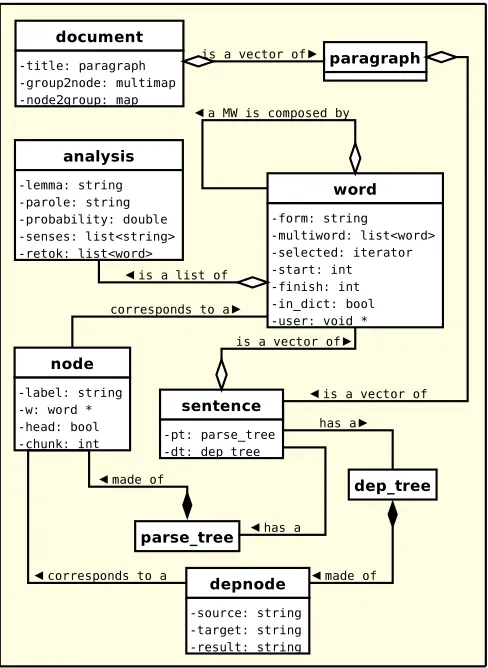
The basic classes in the library are used to contain linguistic data (such as words, PoS tags, sentences, parse trees, doc-uments...) resulting from performed analysis. Any client application must be aware of those classes in order to be able to provide to each processing module the right data, and to correctly interpret the module results.
The linguistic classes supported by the current version are:
• analysis: A tuple <lemma, PoS tag, probability, sense list>.
• word: A word form with a list of possibleanalysis
objects.
• sentence: A list ofwordobjects known to be a
as ca cy en es gl it pt ru
Tokenization X X X X X X X X X
Sentence splitting X X X X X X X X X
Number detection X X X X X X X
Date detection X X X X X X
Morphological dictionary X X X X X X X X X
Affix rules X X X X X X X X
Multiword detection X X X X X X X X
Basic named entity detection X X X X X X X X X
B-I-O named entity detection X X X X
Named Entity Classification X X X X
Quantity detection X X X X X X
PoS tagging X X X X X X X X X
Phonetic encoding X X
WN sense annotation X X X
UKB sense disambiguation X X X
Shallow parsing X X X X X X
Full/dependency parsing X X X X X
Co-reference resolution X
Table 1: Analysis services available for each language.
• paragraph: A list ofsentenceknown to be an in-dependent paragraph.
• document: A list ofparagraphthat form a complete document. It may contain also co-reference information about the entity mentions in the document.
Figure 1 presents a UML diagram with the linguistic data classes.
2.2. Processing Classes
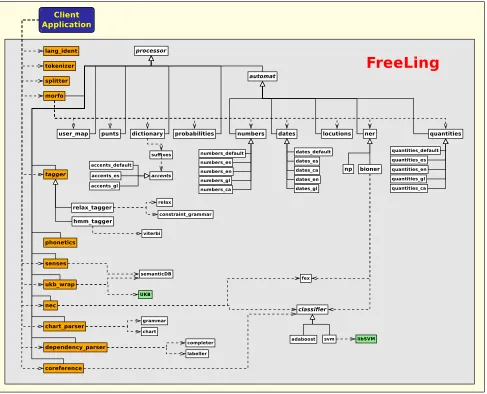
Apart from classes containing linguistic data, the library provides classes able to transform them, usually enriching the structures with additional information. Figure 3 shows an UML diagram with the processing classes described be-low:
Most processing classes are derived from an abstract class processor, and offer the same API (depicted in Fig-ure 2). The API allows to analyze a sentence or a list of sentences, and obtain the results either as enrichment of the original data, or as a copy:
Only three modules do not follow this pattern: Those that are used early in the analysis chain and deal with plain text and lists of tokens before they are organized into sentences:
• lang ident: Language identifier. Receives plain text
and returns a sorted list of pairs<language,probability>.
• tokenizer: Receives plain text and returns a list of
wordobjects.
• splitter: Receives a list ofwordobjects and returns
a list ofsentenceobjects.
All other modules are classes derived from processor, and offer the above described API:
• morfo: Receives a list ofsentenceand
morpholog-ically annotates eachwordof each sentence in the list. This class is actually a meta-module that applies a cas-cade of specialized processors (number detection, date/-time detection, multi-word detection, dictionary search,
Figure 1: Linguistic Data Classes in FreeLing-3.0.
etc.) each of which is in turn a processor derived class that can be called independently if needed. Avail-able processors are:
c l a s s p r o c e s s o r { p u b l i c :
/ / / c o n s t r u c t o r
p r o c e s s o r ( ) ;
/ / / d e s t r u c t o r
v i r t u a l ˜ p r o c e s s o r ( ) { };
/ / / a n a l y z e and e n r i c h s e n t e n c e
v i r t u a l v o i d a n a l y z e ( s e n t e n c e & ) = 0 ;
/ / / a n a l y z e and e n r i c h s e n t e n c e s i n l i s t
v o i d a n a l y z e ( s t d : : l i s t<s e n t e n c e> & ) ; / / / a n a l y z e s e n t e n c e , r e t u r n e n r i c h e d c o p y
s e n t e n c e a n a l y z e ( c o n s t s e n t e n c e & ) ;
/ / / a n a l y z e s e n t e n c e s i n l i s t , r e t u r n e n r i c h e d c o p y
s t d : : l i s t<s e n t e n c e> a n a l y z e ( c o n s t s t d : : l i s t<s e n t e n c e> & ) ; };
Figure 2: API forprocessorabstract class.
– locutions: Multiword recognizer.
– dictionary: Dictionary look-up and suffix han-dling.
– numbers: Numerical expressions recognizer. – dates: Date/time expressions recognizer.
– quantities: Recognized for ratio and percent-age expressions, physical magnitudes, and monetary amounts.
– punts: Punctuation symbol annotator.
– probabilities: Lexical probabilities annotator and unknown word handler.
– ner: Proper noun recognizer. Two modules are provided for this task. A fast and simple pattern– matching module based on capitalization (which yields an accuracy near 90%), and a NE recognizer based on the CoNLL-2002 shared task winning sys-tem (Carreras et al., 2002), rather slower, but with an accuracy over 94%.
• tagger: Receives a list of sentence and disam-biguates the PoS of each wordin the given sentences. If the selected analysis carries retokenization informa-tion, the word may be split in two or more new words (e.g. del→de+el in Spanish, or isn’t→is+not in
En-glish). FreeLing offers two PoS taggers with state-of-the-art accuracy (97%-98%): One HMM–based tagger implemented following (Brants, 2000) and another based on relaxation labelling (Padr´o, 1998) which enables the combination of statistical and hand-written rules.
• NE classifier: Receives a list ofsentenceand classifies allwordtagged as proper nouns in the given sentences. This module is based on the CoNLL-2002 shared task winning system (Carreras et al., 2002).
• Sense annotator: Receives a list of sentence and adds synset information to the selectedanalysis for eachword.
• Word sense disambiguator: Receives a list of
sentenceand ranks the possible senses for for each word selected analysisin the given context. This module is a direct inclusion of the UKB project code (Agirre and Soroa, 2009).
• chunk parser: Receives a list ofsentenceand en-riches each of them with aparse tree. This module consists of a chart parser, and is a reimplementation of (Atserias and Rodr´ıguez, 1998).
• dependency parser: Receives a list of parsed
sentence and enriches each of them with a dependency tree. This module uses a set of hand– written rules to build a dependency tree: First, comple-tion rules are applied to transform the output of the chunk parser into a full parse tree. Then, the tree is converted to dependencies, and the functions are annotated. This module is an extension of that described in (Atserias et al., 2005).
• co-reference solver: Receives a document
formed by parsed sentenceand enriches it with co-reference information. This module is based on the sys-tem proposed by (Soon et al., 2001).
3.
What’s new in FreeLing 3.0
Version 3.0 presents some major changes that aim to make the tool more flexible, usable, and to ease its installa-tion. These changes can be grouped in three main types: Changes related to multilingual support and extension, changes to the Machine-Learning based components of the library, and changes related to the engineering aspects of the project.
3.1. Extending Multilingual Support
Figure 3: Processing classes in FreeLing-3.0.
Another modifications in FreeLing version 3.0 is the full support of Unicode (UTF8) character encodings. This is a major change, and one of the main reasons for the change of version number.
Previous FreeLing versions supported multiple languages, but the developer of the linguistic data for each language should take care of which encoding should be used, and of maintaining the consistency of the encoding for different resource files (lexicon, grammars, multiword lists, etc.) and configuration rules (e.g. regular expressions in tokenizer rules) according to the selected encoding. Also, since each language might use a different encoding, it was not easy to integrate a language identifier able to handle texts in differ-ent alphabets.
With the full support of UTF8 encodings, the same applica-tion may deal with texts in different languages and alpha-bets. This extension enabled several functionality improve-ments:
• A new module for language identification based on
(Padr´o and Padr´o, 2004) has been integrated in the li-brary.
• Ability to change the application locale to match the
language of the processed text, even if it is different
from the default system locale configuration.
• The regular expressions used either in configuration
files or hardwired in the code are now more expressive and easy since POSIX extensions can be used. For instance, the tokenizer regular expression to match a word made of alphabetical characters in Spanish used to be[A-Za-z´a´e´ı¨ı´o´u¨u˜n´A´E´I¨I´O´U¨U˜N]+, and now can be written as[[:alpha:]]+. Note that this same ex-pression can be used to match an alphabetical word in any language or alphabet, just changing the current locale of the application.
de-development of these kind of modules both for existing and new languages.
Acknowledgments
This work has been partially funded by the Spanish Gov-ernment through projects KNOW-2 (TIN2009-14715-C04-03/04) and OpenMT-2 (TIN2009-14675-C03-01), and by the European Union through projects FAUST (FP7-ICT-2009-4) and X-LIKE (FP7-ICT-2011-288342). We also thank ViClone (footnotesizewww.vi-clone.com) for funding part of FreeLing development.
6.
References
Eneko Agirre and Aitor Soroa. 2009. Personalizing pager-ank for word sense disambiguation. In Proceedings of the 12th conference of the European chapter of the As-sociation for Computational Linguistics (EACL-2009), Athens, Greece.
Jordi Atserias and Horacio Rodr´ıguez. 1998. Tacat: Tagged corpus analizer tool. Technical report lsi-98-2-t, Departament de LSI. Universitat Polit`ecnica de Catalunya.
Jordi Atserias, Elisabet Comelles, and Aingeru Mayor. 2005. Txala un analizador libre de dependencias para el castellano. Procesamiento del Lenguaje Natural, (35):455–456, September.
Thorsten Brants. 2000. Tnt - a statistical part- of-speech tagger. In Proceedings of the 6th Conference on Applied Natural Language Processing, ANLP. ACL.
Xavier Carreras, Llu´ıs M`arquez, and Llu´ıs Padr´o. 2002. Named entity extraction using adaboost. In Proceedings of CoNLL Shared Task, pages 167–170, Taipei, Taiwan. C.C. Chang and C.J. Lin. 2011. Libsvm : a library for
sup-port vector machines. ACM Transactions on Intelligent Systems and Technology, 2(3):1–27, April.
Muntsa Padr´o and Llu´ıs Padr´o. 2004. Comparing methods for language identification. Procesamiento del Lenguaje Natural, (33):155–162, September.
Llu´ıs Padr´o. 1998. A Hybrid Environment for Syntax– Semantic Tagging. Ph.D. thesis, Dep. Llenguatges i Sis-temes Inform`atics. Universitat Polit`ecnica de Catalunya, February. http://www.lsi.upc.es/˜padro.
W.M. Soon, H. T. Ng, and D.C.Y. Lim. 2001. A ma-chine learning approach to coreference resolution of noun phrases. Computational Linguistics, 27(4):521– 544.
Cristina S´anchez-Marco and Stefan Evert. 2011. Measur-ing semantic change: The case of spanish participial con-structions. In Proceedings of 4th Conference on Quanti-tative Investigations in Theoretical Linguistics (QITL-4), Berlin, Germany, March.
Cristina S´anchez-Marco, Gemma Boleda, and Llu´ıs Padr´o. 2011. Extending the tool, or how to annotate historical language varieties. In Proceedings of the 5th ACL-HLT Workshop on Language Technology for Cultural Her-itage, Social Sciences, and Humanities, pages 1–9, Port-land, OR, USA, June. Association for Computational Linguistics.