Scaling the ISLE Framework: Use of Existing Corpus Resources for Validation of MT
Evaluation Metrics across Languages
Michelle Vanni* and Keith Miller
†* U.S. Department of Defense Fort Meade, MD 20755
USA
† The MITRE Corporation 7515 Colshire Drive McLean, VA 22102-7508
Abstract
This paper describes a machine translation (MT) evaluation (MTE) research program which has benefited from the availability of two collections of source language texts and the results of processing these texts with several commercial MT engines (DARPA 1994, Doyon, Taylor, & White 1999). The methodology entails the systematic development of a predic tive relationship between discrete, well-defined MTE metrics and specific information processing tasks that can be reliably performed with output of a given MT system. Unlike tests used in initial experiments on automated scoring (Jones and Rusk 2000), we employ traditional measures of MT output quality, selected from the International Standards for Language Engineering (ISLE) framework: Coherence, Clarity, Syntax, Morphology, General and Domain-specific Lexical robustness, to include Named-entity translation. Each test was originally validated on MT output produced by three Spanish-to-English systems (1994 DARPA MTE). We validate tests in the present work, however, with material taken from the MT Scale Evaluation research program produced by Japanese-to-English MT systems. Since Spanish and Japanese differ structurally on the morphological, syntactic, and discourse levels, a comparison of scores on tests measuring these output qualities should reveal how structural similarity, such as that enjoyed by Spanish and English, and structural contrast, such as that found between Japanese and English, affect the linguistic distinctions which must be accommodated by MT systems. Moreover, we show that metrics developed using Spanish-English MT output are equally effective when applied to Japanese-English MT output.
1. Introduction
In this paper, we use existing corpus resources to validate MT output quality tests on data produced by MT systems taking as input a language that is structurally dissimilar both to the target language and to a previously tested source language.1 In earlier work within this research program (Miller and Vanni, 2001), we validated the output quality tests on source language input that was structurally similar to the target output language, namely Spanish. In this work, we validate the tests on a structurally dissimilar language, Japanese. Our research plan, the next stage of which is automation of the tests, will investigate the correlations between score clustering patterns and tasks for which MT output has been previously determined to be suitable.
Our approach to MTE is comprised of distinct stages. These include selection of tests from the ISLE framework, test validation in terms of soundness of design and
1
Because the corpus resources are already in place, evaluators did not carry out the tests in the blind. Filenames indicated the identities of the systems. However, evaluators endeavoured to avoid any preconceptions about systems in evaluating the output.
capacity for replication and automation, approaches to test automation, and experimentation with associating patterns of output quality test scores to those information-processing tasks determined to be performable with the MT output. Once clustering patterns are observed a determination will be made as to whether these patterns are predictive of the type of information processing task previously determined to be performable with the output. Since the intent is to automate the scoring system, this work can also be viewed as the preliminary steps of algorithm design.
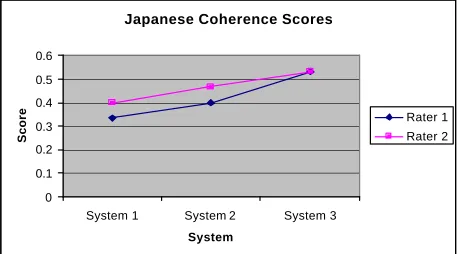
Expository in nature while the repetition of the expression, “also the fact that,” in Sentence Ten, indicates that the sentence is a Coordination. The effect of the heavy reliance on internal cues is a reduction in the amount of interpretation possible at the discourse level. In the Spanish study where the surrounding text lends itself to the understanding of the discourse function of a given sentence, a greater range was found among Coherence scores (0.2 – 1.0) than that found among the scores in the present Japanese-English study (0.3 - 0.5). In both studies, one system nevertheless showed a clear superiority over the others, and it was for this system that the raters’ scores agreed most closely.
Figure 3. Results of the Coherence Test
Figure 3 illustrates the raters’ scores for each system. Note that none of the scores approach 1.0, the highest score for the Spanish-English systems. Although Rater 1 tended toward higher scores in all of the tests, as we will see, both raters were consistent in their giving System 1 a lower rating than System 2 and System 3. Moreover, the difference between raters in relative rankings for the systems on this feature is small enough to lend confidence to the overall design of the test.
5.2. Syntax
As described in previous work, the syntax score is based on the minimal number of corrections necessary to render an MT output sentence grammatical (Miller & Vanni, 2001; Vanni & Miller, 2001). Each evaluator must transform each sentence in the MT output into a grammatical sentence by making the minimum number of replacements, corrections, rearrangements, deletions, or additions possible. The syntax score for each sentence is then defined as the ratio of the number of changes for each sentence to the number of words in the sentence.
Due to the greater divergence in syntactic structure between Japanese and English than between Spanish and English, it was much more difficult to apply the syntactic test to the Japanese output than it had been to apply it to the Spanish output. Nevertheless, we find that raters’ scores tracked well with one another, producing the same relative ranking of systems. Furthermore, the difference in scores between raters for a given system was similar to that of the Spanish systems, with an approximately
3-percentage point maximum difference for any single Spanish system, and a 4 percentage point maximum difference for any single Japanese system. The most notable distinction between the results of application of the syntax test to the Japanese data versus the application of the test to the Spanish data was the relatively wider range of scores for the three Japanese systems. As shown in Figure 4, there was approximately a 17 point difference between the highest-ranked and lowest-ranked Japanese system, whereas this difference was approximately half that for the Spanish systems. This differentiation between systems coincides with intuitive judgements of the variability in quality of the three systems’ output. As with the application of this test to the Spanish data, even when raters had the same score for a given sentence (that is, they have the same total number of changes), it is likely that they chose a different combination of the four operations to arrive at their final grammatical sentence. Although it was not done as part of this effort, further work could consider at a finer level the implications of patterns of numbers of individual syntactic test operations (i.e. deletions, substitutions, additions, and rearrangements) used by raters to make the texts grammatical.
Figure 4. Results of the Syntax Test
While this work showed that it was possible to apply the same syntactic test to the output of the Japanese-English MT systems as was applied to that of the Spanish-English systems, it was also noted that it was much more labor-intensive to apply these tests to the Japanese output. Future work on the automation of this test, or of an automated procedure that correlates highly with this syntactic test will be well worth the effort in terms of labor-savings, and will be valuable in providing an easily and rapidly repeatable measure of syntactic quality that can be applied iteratively as improvements are made to MT systems.
5.3. Morphology
The morphological score is calculated as the number of morphological corrections to the MT output, divided by the total number of inflectable words in the output text. While, as with the Spanish-English output, it was at times difficult to separate purely morphological effects from
Japanese Coherence Scores
0 0.1 0.2 0.3 0.4 0.5 0.6
System 1 System 2 System 3
System
Score
Rater 1
Rater 2
Japanese Syntax Scores
0.5 0.6 0.7 0.8 0.9
System 1 System 2 System 3
System
Score
those that had their roots in syntax, this was less of a problem with the Japanese-English output in which errors in number, such as verb form errors (e.g., make -> makes), were the most common.
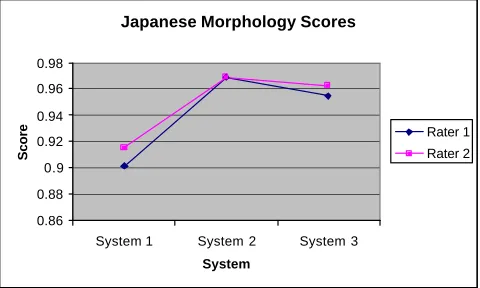
Unlike the output of the Spanish-English systems in which many sentences were found to have no morphological errors, the output of at least two of the Japanese-English systems was wildly varying in numbers of morphological errors. In the System One output, there was an error in nearly every sentence while in the System Two output, only three sentences contained errors. Moreover, although the range of final scores for each set of output was upwards of 0.9, none of the output of the Japanese-English systems ever achieved a score close to 1.0, as one of the Spanish-English systems did.
Figure 5. Results of Morphology test
In carrying out the present study, it was important for the raters that they not allow markings on texts from syntactic tests to influence scoring of morphological features. Morphological quality had to be assessed on the text as it was output by the system and not as it was reformulated in the syntax test to be grammatical. Moreover, in this test, raters encountered adjectival forms which were counted as inflectable words even when they were not, e.g., unique. This was done to simulate an automatic process which would hypothetically have only part-of-speech information for calculating the total number of inflectable words. Finally, the notion of word was not limited to whitespace-delimited lexical units: for example proper nouns containing internal whitespace, such as United States, were counted as one inflectable word.
As is demonstrated in Figure 5, raters showed agreement in the morphological ranking of systems and gave the same score to the highest ranking system.
In Sections 5.5, 5.6, and 5.7, complementary measures of lexical coverage and correctness have been developed and validated: two concern themselves primarily with general and domain-specific lexical coverage, and the other with the handling of named entities. The latter is believed to be crucial in determining the suitability of MT output for use in downstream information extraction tasks.
5.5 Dictionary Update
Although there are many ways that a dictionary update measure could be calculated, two objective and easy-to-observe features of MT output are the number of words not translated and the number of domain-specific words that are correctly translated. It is these two features that we previously tested as dictionary update measures in our set of evaluation measures. The non-translated word score is calculated as the percentage of non-translated words appearing in the target language document, and the domain terminology score was calculated as the percentage of correctly translated domain terms.
Figure 6 Results of Dictionary Update Test
As was true in the application of these tests to the Spanish-English output texts, the application of the tests to Japanese-English MT output was fairly straightforward. Terms such as ayakariakunaino were readily identified and accounted for. It was interesting to note that the system in question did, however, produce a romanization of the untranslated words, and did not leave them in the native script. Also included in this count were particles and other bits of non-English material, which may or may not have been the result of romanization of text found in the source. Examples of this include na, re, X, and inu. This was similar to the case of a non-word, soed, found in the Spanish-English output, which was also taken into account as part of the dictionary update score. Also as for the Spanish, but perhaps to an even greater extent, there were output sentences that were completely unintelligible but in no way due to untranslated words. Thus, this test could clearly not be used in isolation to provide a picture of overall MT quality, whether quality is defined along the lines of clarity, fluency, adequacy, or coherence.
Since this is a deterministic test –the presence or absence of a not-translated-word in a sentence is clear-cut– the two raters scores are identical. Hence, only one set of dictionary update scores is displayed in Figure 6. Finally, that the scores display only approximately one percentage point of difference between the highest-ranked system and the lowest suggests that the differences in scores between the systems are not significant.
5.6 Domain Terminology Japanese Morphology Scores
0.86 0.88 0.9 0.92 0.94 0.96 0.98
System 1 System 2 System 3
System
Score
Rater 1 Rater 2
Japanese Dictionary Update Scores
0.94 0.95 0.96 0.97 0.98 0.99 1
System 1 System 2 System 3
System
This test is also clear-cut, producing a single score for each system, with no variability between raters. The procedure for this test is as follows: First, a list of key term translations is extracted from the human translation. To accomplish this, raters individually select key terms from the human translation, and then the separate key term lists are reconciled before application of the test to the MT systems’ output. During the test application, systems receive a point for each term for which the translation matches exactly, and no point otherwise. The final score is the percentage of exactly-matched translations of key terms.
There are two divergent directions in which this test could be developed in the future. First, it could be made more sensitive to acceptable variation in translation of key terms by application of the ACME cloze test methodology as described in Miller (2000). Another further development of the test could involve the automated extraction of domain term list from the human translation. The application of this test to Japanese-English MT output was found to be similar to its application to Spanish-English MT output. The scores for the three systems were .50 for System 1 and .58 for Systems 2 and 3.
5.7 Names
As a special instance of a terminology score, we separately calculate the percentage of proper names correctly translated. This is directly in line with the spirit of both ISLE-based and Task Based MTE, in that scores in the named-entity translation metric should correlate strongly with the usability of the output of a machine translation system for information extraction tasks. As is the case for domain specific terms, the proper names are first identified in the reference translation. Evaluators then examine the output of each machine translation system, awarding a point for each instance of a correct translation of these proper names. As with the Terminology test, specific guidelines for the test resulted in identical scores by both raters, as seen in Table 1.
Spanish Sys. Japanese Sys. Names Rater 1 Rater 2 Rater 1 Rater 2 Systems1 0.53 0.53 0.38 0.38 Systems 2 0.72 0.72 0.41 0.41 Systems 3 0.59 0.59 0.38 0.38
Table 1. Results of Names test
Note that the scores for the Japanese systems were quite a bit lower than those for the Spanish systems. This is probably due in part to the fact that if a Spanish MT system does not contain a proper name in its lexicon, it will likely appear in the output as an untranslated word, and there is a possibility that this will be the correct ‘translation’ of the name. A hypothetical Japanese system, however, must provide a romanization of the unknown name in order to be counted as correct, and even then, it is not certain that the romanization will match that
found in the human translation. For example, one system produced the romanization Kyuushuu, which did not match the form produced by the human translator (Kyushu). Hence, we see that the romanization, and more importantly, variation and normalization of names is a problem that must be accounted for in the application of a named-entity translation score. The Japanese systems tended to correctly translate the names of big corporations and countries: all systems correctly translated Mitsubishi, Fuji, Japan, and Bulgaria, but at least one of the three systems did not correctly translate Yunishi, Iwate, Datsun, and Estonia. It is worth noting, too, that regardless of its international status, United States was incorrectly translated by all systems, which chose America over the human translator’s two -word translation. This is one example of a situation in which a named entity translation evaluation metric that is sensitive to variation in the representation of named entities would be beneficial. As for the domain terminology metric, this variation could be accounted for by incorporating the ACME cloze testing MTE metric into the named entity testing procedure.
Our future plans in automating the tests will consider the use of the NEE automated measure of named entity translation, as described in Papineni et al. (2002). We believe that this measure, if applied to our texts should provide scores that are very compatible with those we arrived at manually.
5.8 Test Ordering
In previous work on validating the tests on Spanish-English MT output, an attempt was made to determine an ordering for the tests that would attenuate the training effect, such that a test on one aspect of the output would not interfere with a tester’s ability to objectively assess a subsequent feature being evaluated. Based on lessons learned during these previous evaluations, the ordering of the Coherence and Clarity tests was reversed for this round of evaluations. It is felt that this reordering did produce the desired effect of minimizing, if not completely eliminating, the training effect. In fact, preceding the Coherence test with the Clarity test had a positive impact on the ability of the raters to perform both tests in an unbiased way. While this will not likely be an issue for automated versions of the tests, it was an important factor in the performance of the tests by human evaluators.
6 Conclusions and Future Work
which the output has been determined to be useful. As a preparatory step, in this paper, we have performed and reported on a verification run on a set of MT outputs for Japanese-English MT systems. This was an important step, because the systems represented in the DARPA task-based MTE data are Japanese-English MT systems, and our metrics had as yet been untested on any non-Romance source language. The Japanese data for this validation run is also comprised in the DARPA MTE data set, but is contained in a part of the set for which task usability data was not generated. Thus, we are conserving the crucial resource of task-tagged MT output, which is the result of a large human-intensive effort, for the final step in our research program, validating measures on other data before applying them to the actual task-based data set. We have taken account of lessons learned in previous validation runs, and now feel that the tests are ready for the final two steps: automation, to the extent possible, and application to the task-tagged translation data.
It is our belief that certain of the tests lend themselves to complete automation while the labor involved in some
of the other tests could be greatly reduced by some level of automation. In particular, some of the word-based metrics (e.g. domain terms, names) could derive some level of automation as well as benefit from some added flexibility through the implementation of Miller’s (2000) ACME methodology, based on cloze testing. Additionally, automated methods such as the NEE evaluation method will be examined for inclusion as the Named Entity Translation metric. Finally, since automated n-gram metrics such as BLEU have been shown to correlate with Fluency and Adequacy scores, consideration will be given to including those metrics in suite as well. This will be particularly valuable if additional task-tagged translation data is made available, for which there will not likely be analogs of the DARPA fluency and adequacy scores, which were human-intensive to generate. It is our belief that a robust, well-rounded test suite, focusing on linguistic features of the output as well as on features such as Adequacy will provide a tool that is highly predictive in determining the tasks for which the output of a given MT system may be used.
7 References
Balkan, L. 1994. Test Suites: Some issues on their use and design. Machine Translation Ten Years On, Conference at the University of Cranfield. 26-1.
Carlson, L. and D. Marcu. 2001. Discourse Tagging Reference Manual. ISI Technical Report, forthcoming.
Chaumier, J., Mallen, M.C., and Van Slype, G. Evaluation du systeme de traduction automatique SYSTRAN; evaluation de la qualite de la traduction. 1977. CEC. Report number 4. Luxembourg.
Church, K. and E. Hovy. 1993. Good applications for Crummy Machine Translation. Machine Translation 8:239-258. Doyon, J., Taylor, K., and J. White. 1999. Task-Based Evaluation for Machine Translation. Proceedings of MT Summit
7. Singapore.
Flanagan, M. 1994. Error Classification for MT Evaluation. In Technology Partnerships for Crossing the Language Barrier: Proceedings of the First Conference of the Association for Machine Translation in the Americas, Columbia, MD.
Gerber, L. and E. Hovy. 1998. Improving Translation Quality by Manipulating Sentence Length. Lecture Notes in Artificial Intelligence 1529: Machine Translation and the Information Soup : Proceedings of the Third Conference of the Association for Machine Translation in the Americas. 448-460.
Hovy, E. 1999. Toward Finely Differentiated Evaluation Metrics for Machine Translation. Proceedings of the EAGLES Workshop on Standards and Evaluation. Pisa, Italy.
International Standards for Language Engineering. 2000. (http://www.isi.edu/natural-language/mteval) The ISLE Classification of Machine Translation Evaluations, Draft 1, October, 2000. Proceedings of the Hands-on Workshop on Machine Translation Evaluation. Association for Machine Translation in the Americas, Cuernavaca, Mexico.
Jones, D. and G. Rusk. 2000. Toward a Scoring Function for Quality-Driven Machine Translation. In Proceedings of COLING-2000.
Mann, W., and S. Thompson. 1988. Rhetorical Structure Theory: Toward a functional theory of text organization. Text 8:3.243-281.
Miller, K. 2000. The Machine Translation of Prepositional Phrases. Unpublished PhD Dissertation. Georgetown University. Washington, DC.
Miller, K. and M. Vanni. 2001. Scaling the ISLE Taxonomy : Development of Metrics for the Multi-Dimensional Measurement of Machine Translation Quality. In Proceedings of MT Summit VIII. Santiago de Campostela, Spain. Papineni, K., S. Roukos, T. Ward, and W. Zhu. 2001. BLEU : A Method for Automatic Evaluation of Machine
Translation, IBM Research Report, RC22176, September 2001.
Papineni, K., S. Roukos, T. Ward, J. Henderson, and F. Reeder. 2002. Corpus-Based Comprehensive and Diagnostic MT Evaluation : Initial Arabic, Chinese, French, and Spanish Results. Proceedings of the Human Language Technology Conference.
Polvsen, C., N. Underwood, B. Music, and A. Neville. 1998. Evaluating Text-type Suitability for Machine Translation a Case Study on an English-Danish MT System. Proceedings of ELRA Conference, Granada, Spain.
Van Slype, G. 1978. Second Evaluation of the English-French SYSTRAN Machine Translation System of the Commission of the European Communities. 1978. CEC. Final Report. Luxembourg.
Van Slype, G. 1979. Critical Study of Methods for Evaluating the Quality of Machine Translation. Prepared for the Commission of European Communities Directorate General Scientific and Technical Information and Information Management. Report BR 19142.
Vanni, M. 2000. Lessons for Text-Differentiated MT. Proceedings of the Hands-on Workshop on Machine Translation Evaluation. Association for Machine Translation in the Americas, Cuernavaca, Mexico.
Vanni, M. and K. Miller. 2001. Scaling the ISLE Taxonomy : Validating Te sts of Machine Translation Quality for Multi-Dimensional Measurement. In Proceedings of the MT Evaluation Workshop of the MT Summit VIII, Santigao di Campostela, Spain.
Voss, C. and F. Reeder, eds. 1998. Proceedings of the Workshop on Embedded Machine Translation: Design, Construction, and Evaluation of Systems with an MT Component. Association of Machine Translation in the Americas Annual Meeting, Langhorne, PA.
Voss, C. and Van Ess-Dykema. 2000. When is an Embedded MT System “Good Enough” for Filtering? Proceedings of Embedded Machine Translation Systems. ANLP/NAACL 2000 Workshop. Seattle, Washington.
White, J.S. and T.A. O’Connell. 1994. The ARPA MT Evaluation Methodologies: Evolution, Lessons, and Further Approaches. Proceedings of the 1994 Conference of the Association for Machine Translation in the Americas. Columbia, MD.
White, J.S. and K. Taylor. 1998. A Task-Oriented Metric for Machine Translation. Proceedings of the First Language Resources and Evaluation Conference. Granada, Spain.