Input (SF)
GEN
Candidate Set (UF) Rules
EVAL
Output (UF) Lexicon
Constraints
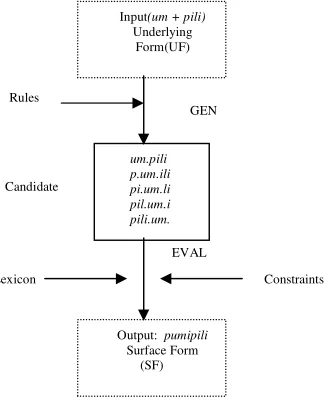
Fosler also employed the um + gradwet sample (which incidentally is in Tagalog) and illustrated in Table 1. NoCoda ranks higher than the Align constraint. NoCoda requires that syllables must be open, while Align requires that the prefix (-um-canappearas a prefix or move slightly into the word to which it is attached [6]) should remain as close to the front of the word as possible. The winning candidate, gru.mad.wet, violated the Align and NoCoda constraints twice. The final candidate violated NoCoda twice also, but it was pruned since it violated Align constraints more times than the winner. The winning candidate has the least number of violations.
Table 1. Fosler’s representation on Tagalog infixation. Candidates NoCoda Align um.grad.wet 3
gum.rad.wet 3 1
gru.mad.wet 2 2
gra.dum.wet 2 4
3 Optimality Theory for Morphological Analysis
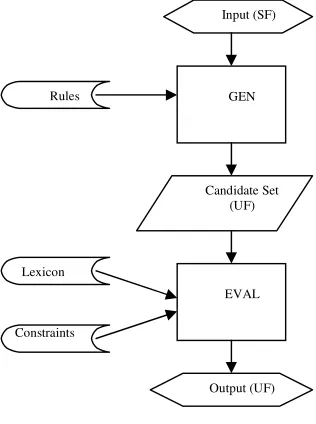
Input in surface form is fed to the GEN function. The GEN function produces an underlying candidate set based on the rules and patterns of the verb. This candidate set will be validated by the EVAL function and an optimal candidate will be determined, based on a set of constraints. The flowchart (in Fig. 3) shows the processes in parsing.
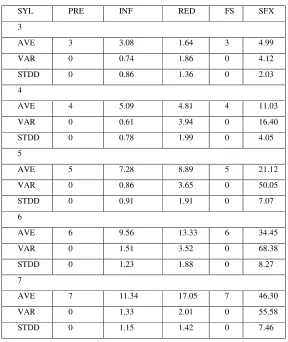
Table 2. Average number of candidates with variance and standard deviation.
SYL PRE INF RED FS SFX
3
AVE 3 3.08 1.64 3 4.99
VAR 0 0.74 1.86 0 4.12
STDD 0 0.86 1.36 0 2.03
4
AVE 4 5.09 4.81 4 11.03
VAR 0 0.61 3.94 0 16.40
STDD 0 0.78 1.99 0 4.05
5
AVE 5 7.28 8.89 5 21.12
VAR 0 0.86 3.65 0 50.05
STDD 0 0.91 1.91 0 7.07
6
AVE 6 9.56 13.33 6 34.45
VAR 0 1.51 3.52 0 68.38
STDD 0 1.23 1.88 0 8.27
7
AVE 7 11.34 17.05 7 46.30
VAR 0 1.33 2.01 0 55.58
STDD 0 1.15 1.42 0 7.46
Rules or patterns are applied by GEN to produce the candidate set. Any conceivable forms within the range of these rules are produced. As shown on Table 3, the number of rules applied in prefix is also predicable and stable. While rules being applied to the rest of the paradigms vary, but generally the relationship of number of syllables to the number of applied rules is approximately linear. This is due to the fact that the length of the candidate’s affixes and stem are being considered before applying the rules.
Table 3. Average number of applied rules.
SYL PRE INF RED FS SFX
3 2 8.86 9.23 4.88 3.22
4 2 12.38 18.21 7.45 7.67
5 2 15.39 28.97 11.64 14.57
6 2 18.50 40.32 17.20 23.32
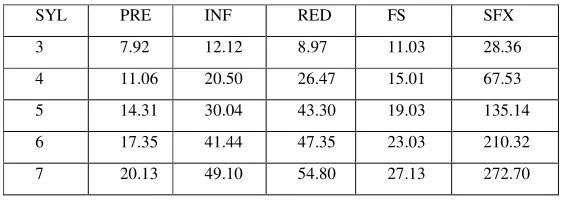
EVAL function makes use of constraints to evaluate the candidate set. These constraints are only applied if certain conditions are met by the candidates. Table 4 shows that the relationship of the number of syllables and the number of applied constraints are linear.
Table 4. Average number of applied constraints.
SYL PRE INF RED FS SFX
3 7.92 12.12 8.97 11.03 28.36
4 11.06 20.50 26.47 15.01 67.53
5 14.31 30.04 43.30 19.03 135.14
6 17.35 41.44 47.35 23.03 210.32
7 20.13 49.10 54.80 27.13 272.70
Overall, the resulting method is able to produce the correct underlying forms of the surface forms of 96% of the tokens in the test data, having a 4% error which is due to the d-r alternation rule. An example of an d-r alternation is in the word lakaran, which is from the root word lakad and suffix an, but d is changed to r.
In contrast, Cheng [9] applied an extension of Wicentowski’s wordframe model [10] that captures both infixation and reduplication, showed a 90% accuracy of the morphological analysis of a corpus of 4,034 words for testing and 36,242 words for learning. Integration of other methods [11, 12] could also be considered to improve the analyzer’s performance.
Although the system is intended for Tagalog verbs but can also be applied to some full-stem or complete reduplication phenomena in Tagalog non-verbs or other languages.
5 Conclusions
The approach has shown to effectively capture both concatenative (e.g. prefixation and suffixation) and non-concatenative morphological phenomena (e.g. infixation, partial and full-stem reduplication) with 96% accuracy.
It is recommended that the execution time of the method could be improved since the approach generates all possible candidate surface forms and eliminates those which violate any of the rules or constraints.
Acknowledgments. This project is funded by the Philippine Council for Advanced Science and Technology for Research and Development, Department of Science and Technology, Philippine Government.
References
1. De Guzman, V.: Syntactic Derivation of Tagalog Verbs. Honolulu. The University Press of Hawaii (1978) 2. Koskenniemi, K.: Two-level Morphology: A General Computational Model for Word-Form Recognition and
Production. Ph. D. Thesis, University of Helsinki (1983).
3. Beesley, Kartunnen & Kartunnen, Lauri: “Finite – State Non- Concatenative Morphotactics” (2000). 4. Kager, R.: Optimality Theory. Cambridge University Press, United Kingdom (1999). Reprinted 2001 5. Fosler, J. E.: On Reversing the Generation Process in Optimality Theory (1996)
6. French, K. M.: Insights into Tagalog Reduplication, Infixation and Stress from Nonlinear Phonology. Texas, USA. The Summer Institute of Linguistics and the University of Texas at Arlington (1988)
8. Ramos, T. & Bautista, M.: Handbook of Tagalog Verbs Inflections, Modes, and Aspects. Honolulu, USA. University of Hawaii Press (1986)
9. Cheng, C. & See, S.: The Revised Wordframe Model for the Filipino Language. To appear in Vol. 3, No. 2, Journal for Research in Computing, Science and Engineering, Dela Salle University, Manila (2006)
10. Wicentowski, R.: Modeling and Learning Multilingual Inflectional Morphology in a Minimally Supervised Framework. PhD Thesis. Johns Hopkins University (2002)
11. Gelbukh, A. & Sidorov, G.: Approach to construction of automatic morphological analysis systems for inflective languages with little effort. Lecture Notes in Computer Science, N 2588, Springer (2003) 215-220 12. Gelbulk, A., Alexandrov, S. Y. Han.: Detecting Inflection Patterns in Natural language by Minimization of