A Flexible XML-based Regular Compiler
for Creation and Conversion of Linguistic Resources
Jakub Piskorski,
:LWROG'UR G \ VNL, Oliver Scherf, Feiyu Xu
DFKI – German Research Center for Artificial Intelligence Stuhlsatzenhausweg 3, 66 123 Saarbrücken, Germany
{piskorsk, witold, scherf, feiyu}@dfki.de
Abstract
Finite-state devices are widely used to compactly model linguistic phenomena, whereas regular expressions are regarded as the adequate level of abstraction for thinking about finite-state languages. In this paper we present a flexible XML-based and Unicode-compatible regular compiler for creating, and integrating existing linguistic resources. Our tool provides user-friendly graphical interface which enables the transparent control of the compilation process and allows for testing generated finite-state grammars with several diagnostic tools. Through the direct database connection, existing linguistic resources can be converted into user-definable finite-state representations.
1. Introduction
Finite-state devices are widely used to compactly model interesting linguistic phenomena because of their expressiveness and computational power. Regular expressions are regarded as the adequate level of abstraction for thinking about finite-state languages (Karttunen et al., 1996). They are usually used to encode linguistic resources like, for instance, definitions of token classes, context-dependent rewrite rules (e.g., part-of-speech filtering rules), grammars for the recognition of small-scale structures (e.g., nominal phrases, verb groups, named entities) and even high-level clausal patterns. Regular compilers are tools for converting regular expressions into their corresponding compressed finite-state representation. A variety of regular compilers based on advanced finite-state optimization toolkits have been presented in (Noord and Gerdemann, 1999; Karttunen et. al., 1997, Silberztein, 1997; Sproat, 1996) and has been successfully applied for the creation of linguistic resources in various domains of natural language processing, including phonology, morphology, part-of-speech filtering, shallow parsing and speech recognition.
In this paper we present a flexible XML-based regular compiler for creation, conversion and integration of existing linguistic resources. Both the definition of regular expressions and the configuration of the transformation process is done via XML which can be edited transparently in a user-friendly graphical editor. This allows for easy and straightforward extension (e.g., introduction of new operators and compilation options) and rapid processing by emerging technologies (e.g., XML parsers). The language resources engineer may flexibly define the way, in which the finite-state devices are merged together, and bias the optimization process. Further, distributed work is possible, since the compiler provides direct database access, which allows to convert existing linguistic resources stored in miscellaneous databases into user-definable finite-state representation in various formats. Additionally, diagnostic tools can be used to provide a deeper insight into the characteristics of the generated finite-state networks. Last but not least the compiler supports the Unicode encoding standard.
2. Regular Compiler
2.1. Architecture
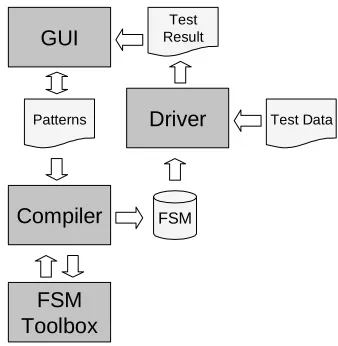
The regular compiler consists of four main modules: (a) Graphical User Interface (GUI), (b) Compiler for regular expressions, (c) Finite-State Machine Toolbox, and (d) Driver for finite-state devices. The coarse-grained architecture of the tool is presented in figure 1.
GUI
Patterns
Compiler
FSM
Toolbox
FSM
Driver
Test Data TestResult
Figure 1. A coarse-grained architecture of the regular compiler.
Grammar development is done by simply encoding the regular patterns via XML, where the first part of the XML code contains compilation and transformation options, and the second part consists solely of pattern definitions. The user creates or modifies pattern definitions via the GUI, which is equipped with a kind of visual XML editor. Contrary to solely DTD or XML-schemata based editors, it has additional features helping the user to create valid XML.
tropical semiring (Mohri, 1997) is applied in order to resolve potential ambiguities (i.e., the identifier of the matching pattern can be computed by combining the weight on the accepting path). The second option is to preserve all ambiguities by introducing appropriate final emissions representing pattern identifiers in the corresponding finite-state devices. The usage of the latter option is illustrated in figure 6 (the arcs labeled with the symbols “#1” and “#2” encode the pattern identifier).
(a) pattern for matching two-digit numbers
(b) pattern for matching all natural numbers
(c) automaton resulting by merging the automata in (a) and (b)
Figure 6. Merging finite-state devices representing ambiguous patterns.
A simplified example of compiler settings encoded in XML is illustrated in figure 7.
<COMPILER_SETTINGS> <UNICODE> true </UNICODE > <INPUT_SETTINGS>
<INPUT_TYPE> scanner </INPUT_TYPE> </INPUT_SETTINGS>
<OUTPUT_SETTINGS> <FILE>
<FILE_FORMAT> xml </FILE_FORMAT> <OUTPUT_DIR> d:\tmp </OUTPUT_DIR> <EPSILON_CODE> EPS </EPSILON_CODE> </FILE>
<SEPARATED_FSM> false </SEPARATED_FSM> <AMBIGUITIES> true </AMBIGUITIES>
</OUTPUT_SETTINGS> <OPTIMIZATION_SETTINGS> <LOCAL_OPT> true </LOCAL_OPT> </OPTIMIZATION_SETTINGS> <COMPILER_SETTINGS>
Figure 7. Compiler Settings
2.5. Graphical User Interface
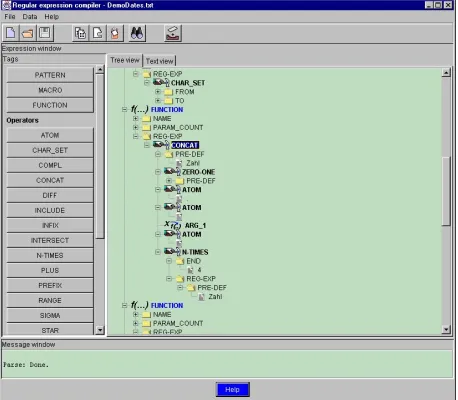
Our tool is equipped with a graphical user interface shown in figure 8, which provides an intelligent XML editor. The user can switch between pure XML code view and tree view for defining patterns and configuration purposes. Both of the views can be modified. In the tree view no manual XML code writing is necessary, since the XML code is automatically generated by clicking buttons which correspond to all supported regular operators (user-defined operators too). Even for accessing special hard-to-find symbols, which have to be included in regular
expressions, simple drag-and-drop mechanisms are provided (Unicode tables). At any point in the input window the user can choose new tags from a list of valid tags which obviously reduces potential mismatch errors.
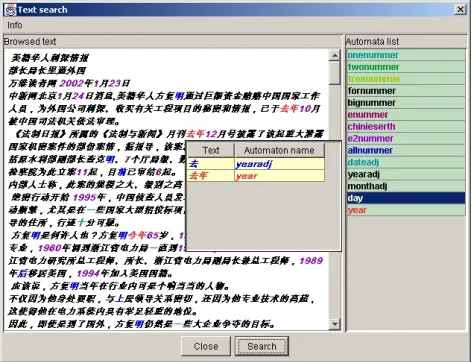
The AT&T dot-Tool (Koustofios, 1996) was integrated in the GUI for the visualization of generated finite-state devices corresponding to single or merged set of patterns. Moreover, the patterns may be tested in a diagnostic window by using a simple finite-state driver and a text sample provided by the user (either ASCII or Unicode). The test results are displayed in an user-friendly way by the GUI, i.e., the part of the input that matches some pattern is highlighted and the list of all patterns that match with any prefix of the highlighted text passage may be displayed by simply clicking the mouse pointing at this marked passage (see figure 9). In this way, the user can easily and directly validate his pattern definitions, which facilitates grammar development. Various searching techniques and strategies may be chosen (e.g., longest matching vs. all matches, local vs. full backtracking, etc.).
Figure 8. GUI for the Regular Compiler. The buttons on the left side are used for automatically generating XML
code for all provided operators. The tree-like structure representing the XML code can be seen in the
window on the right side (Tree view).
Finally, a tool for displaying detailed information about the characteristics of the resulting finite-state devices, including among others statistics about the number of nondeterministic moves, average number of outgoing transitions from a state, alphabet size etc. may support the language engineer in the process of optimally configuring the appropriate finite-state grammar interpreter and to ease the choice of an adequate storage model for the internal representation of the investigated finite-state device.
3. Application
shallow grammars and pattern-based template filler rules in the field of information extraction. In particular, we used this tool for the implementation of a small-scale structure recognition component for Chinese, and an information extraction subsystem applied in the management succession domain.
The major advantage of using the regular compiler in the process of Chinese grammar development (named-entity grammars) is the fact, that the compiler allows the user not only to enter Chinese signs from the keyboard, but also to access the signs from a Unicode table. An example of such table is given in figure 10. Moreover, we could easily convert various existing resources in Chinese (e.g. gazetteers) from different sources, which were useful for increasing the coverage of the discussed component.
Figure 9. Diagnostic window for testing defined patterns.
In the second task we used the regular compiler for the definition of simple template filling rules for German person names which looks like follows:
‘Successor’ ‘of’ <PERSON NAME> [Person_out: <PERSON NAME>]
This rule matches expressions like ‘Successor of Helmut Kohl‘ which contains two string tokens Successor and of followed by a person name, and fills the slot “person_out” with the recognized person name Helmut Kohl. Such rules are encoded in the compiler as regular expressions over the feature structures representing the output of the shallow analysis. The task-specific constraints (the regular compiler may be restricted to allow only predefined feature structures in the patterns) facilitate the grammar development process enormously.
4. Summary and Future Directions
In this paper we presented a flexible XML-based regular compiler for creation, conversion and integration of existing linguistic resources, which provides direct database connection, diagnostic tools, and a user-friendly graphical interface which enables to transparently control the compilation process. This tool was implemented in Java except the Finite-State Machine Toolkit, which was implemented in C++.
In order to improve the expressiveness capabilities of the tool we intend to integrate type definition system like
TDL (Krieger, 1995), and extend the compiler by providing routines for the compilation of weighted context-dependent rules (Mohri, 2000) into corresponding optimized finite-state representations. Currently, we developed an extended experimental version of the compiler which handles unification-based regular grammars. Together with the intended enhanced driver capable of interpreting such grammars, the forthcoming version of the compiler will constitute an integrated grammar development and debugging environment for processing unification-based regular grammars. Finally, we aim at making the regular compiler publicly available and we also intend to perform usability test.
Figure 10. Unicode Table in action
5. References
Daciuk, J., 1998. Incremental Construction of Finite-State Automata and Transducers, and their Use in the Natural Language Processing. Dissertation - Technical University of Gdansk.
Kaplan, R.M., Kay, Martin 94. Regular Models of Phonological Rule Systems. In Computational Linguistics, 20(3).
Kartunen, L., Chanod, J-P., Grefenstette, G., and Schiller, A., 1996. Regular Expressions for Language Engineering. Natural Language Engineering, 2:2:305-328.
Karttunen, L., Gaal, T., and Kempe, A., 1997. Xerox Finite-state Tool. Technical Report, Xerox Research Centre Europe, Grenoble, France.
Koustofios, E., North, S. C., 1996. Drawing Graphs with Dot. AT&T Bell Laboratories, Murray Hill, NJ, Technical Report.
Krieger, H.U., 1995. TDL - A Type Description Language for Constraint-Based Grammars. Foundations, Implementation, and Applications, Saarbrücken Dissertations in Computational Linguistics and Language Technology. Vol. 2.
Mohri, M., Sproat, R., 1996. An Efficient Compiler for Weighted Rewrite Rules. In Proceedings of the 34th Annual Meeting of the ACL.
Mohri, M., 1997. Finite-state Transducers in Language and Speech Processing. Computational Linguistics 23. Mohri, M., 2000. Weighted Grammar Tools: The GRM
Library, in J.-C. Junqua and G. van Noord (eds), Robustness in Language and Speech Technology, Kluwer Academic Publishers.
van Noord, G., Gerdemann, D., 1999. An Extendible Regular Expression Compiler for Finite-State Approaches in Natural Language Processing. Workshop on Implementing Automata, Potsdam, Germany.
van Noord, G., 2000. FSA6 - manual, TR, URL:
http://odur.let.rug.nl/vannoord/Fsa/Manual/.
Piskorski, J., 2002. DFKI Finite-State Machine Toolkit, Technical Report, DFKI GmbH, Saarbrücken, Germany.
Roche, E., and Schabes, Y., 1996. Introduction to Finite-State Devices in Natural Language Processing. Technical report, Mitsubishi Electric Research Laboratories, TR-96-13, 1996.
Silberztein, M., 1997. INTEX: A Finite State Transducer toolbox. In Theoretical Computer Science 231:1, Elsevier Science.