+\SHUQXFOHDU
SK\VLFV
VWXGLHV
RI
WKH
PANDA
H[SHULPHQW
DW
)$,5
Alicia Sanchez Lorente1,a
1Helmholtz Institut Mainz, D-55099 Germany. Tel.: +49 6131 39-27381
Fax: +49 6131 39-27448
Abstract. Hypernuclear research will be one of the main topics addressed by the PANDA experiment at the planned Facility for Antiproton and Ion Research FAIR at Darmstadt (Germany). [1, 2] Thanks to the use of storedpbeams, copious production of doubleΛ hypernuclei is expected at the PANDA experiment, which will enable high precisionγ spectroscopy of such nuclei for the first time, and consequently a unique chance to ex-plore the hyperon-hyperon interaction. In particular, ambiguities of past experiments in determining the strength of theΛΛinteraction will be avoided thanks to the excellent energy precision of a few keV (FWHM) achieved by germanium detectors. Such a reso-lution capability is particularly needed to resolve the small energy spacing of the order of (10–100) keV, which is characteristic from the spin doublet in hypernuclei the so -called "hypernuclear fine structure".
In comparison to previous experiments, PANDA will benefit from a novel technique to assign the various observableγ-transitions in a unique way to specific double hypernuclei by exploring various light targets. Nevertheless, the ability to carry out unique assign-ments requires a devoted hypernuclear detector setup. This consists of a primary nuclear target for the production ofΞ−+ Ξpairs, a secondary active target for the hypernuclei formation and the identification of associated decay products and a germanium array de-tector to performγspectroscopy.
Moreover, one of the most challenging issues of this project is the fact that all detector systems need to operate in the presence of a high magnetic field and a large hadronic background. Accordingly, the need of an innovative detector concept will require dra-matic improvements to fulfil these conditions and that will likely lead to a new genera-tion of detectors. In the present work details concerning the current status of the activities related to the detector developments for this challenging programme will be given. Among these improvements is the new concept for a cooling system for the germanium detector based on a electro-mechanical device. In the present work, the cooling efficiency of such devices has been successfully tested, showing their capability to reach liquid nitrogen temperatures and therefore the possibility to use them as a good alternative to the standard liquid nitrogen dewars. Furthermore, since the momentum resolution of low momentum particles is crucial for the unique identification of hypernuclei, an analysis procedure for improving the momentum resolution in few layer silicon based trackers is presented.
ae-mail: [email protected] C
1 Introduction
The simultaneous production and implementation of two Λ particles into a nucleus is intricate. There is a possibility to produce multi-strange hypernuclei in heavy ion collisions via coalescence [3, 4]. The first observation of antihypernuclei by the STAR collaboration impressively illustrates the potential of this method [5]. However, high resolution spectroscopy of excited states is not feasible. To produce double hypernuclei in a more ’controlled’ way the conversion of a capturedΞ− and a proton into twoΛ particles can be used. This process releases, ignoring binding energy effects, only 28 MeV. For light nuclei there exists, therefore, a significant probability of the order of a few percent that bothΛhyperons are trapped in the same excited nuclear fragment [6–11]. After an atomic cascade, theΞ−hyperon is eventually captured by a secondary target nucleus and converted via theΞ−p → ΛΛ reaction into two Λ hyperons. In a similar two-step process relatively low momentumΞ−can also be produced using antiproton beams inpp→Ξ−Ξ+orpn→Ξ−Ξ0reactions if this reactions happens in a complex nucleus where the producedΞ−can re-scatter [12, 13]. The advantage as compared to the kaon induced reaction is that antiprotons are stable and can be retained in a storage ring. This allows a rather high luminosity even with very thin primary targets. Because of the two-step mechanism, spectroscopic studies, based on two-body kinematics like in single hypernucleus production, cannot be performed. Spectroscopic information on double hypernuclei can therefore only be obtained via their decay products. The kinetic energies of weak decay products are sensitive to the binding energies of the twoΛhyperons. While the double pionic decay of light double hypernuclei can be used as an effective experimental filter to reduce the background [13] the unique identification of hypernuclei ground states only via their pionic decay is usually hampered by the limited resolution.
For the sake of clarity, the decay chain which corresponds to the sequential mesonic decay of 10
ΛΛBe is shown below, 10
ΛΛBe → 10ΛB+π− 10
ΛB → 10C+π−
Instead,γ-rays emitted via the sequential decay of excited double hypernuclei may provide precise information on the level structure [14, 15].
2 Integration inside the
PANDA
spectrometer
This devoted experimental setup consist of,
• A primary target system at the entrance to the central tracking detector ofPANDA.
• A small secondary active sandwich target composed of silicon detectors and9Be,10,11B or12,13C absorbers to slow down and stop theΞ−and to identify the weak decay products.
• To detect theγ-rays from the excited double hypernuclei an array of 16 n-type Germanium triple Cluster-arrays will be added. To maximize the detection efficiency theγ-detectors must be arranged as close as possible to the target at backward axial angles.
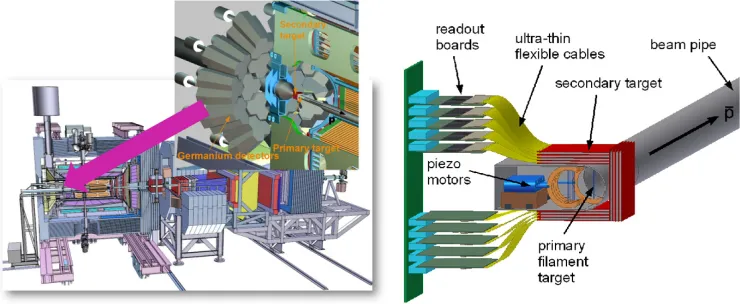
Figure 1. Schematic view of the hypernuclear setup in PANDA. The picture on the left shows a side view of the hypernuclear experimental setup. The picture on the right shows the mechanism which holds the target at a constant interaction rate by an automatic feedback system which continuously adjusts the wire positions via stepping motors. The target mechanism is mounted inside the vertex vessel, surrounded by the moveable parts of the secondary active target(red structure). The principle foreseen to root the analog signals of the sensors outside the interaction region by means of flexible ultra-thin cables is also depicted in this picture.
system has to be placed outside the interaction region of the PANDA spectrometer, detectors such as the Micro Vertex Detector (MVD) and Backward EndCap Calorimeter will be removed to avoid unnecessary radiation damage. In addition, the central frame dedicated to hold the beam line and the central tracker detectors will also be accordingly adapted to the hypernuclear setup.
3 Primary target
The main role of the primary target will be the production of low momentumΞhyperons. Although heavy targets are more efficient for re-scattering of the produced primary particles and hence for the emission of low momentumΞhyperons, light targets will be preferred in order to avoid a high hadronic background into backward axial angles, where the germanium detectors are located. Fur-thermore, Coulomb scattering in heavy primary targets leads to significant losses of antiprotons. Ad-ditionally, it is required that the luminosity of thep-beam remains as constant as possible. In addition, high interaction rates will be avoided by choosing an appropriate fraction of the beam halo onto the target, what can be achieved by an monitoring mechanism where the beam as well as the target can be steered till the desired interaction rate is reached ( see Fig.1). As a result, the use of thin carbon micro-ribbons [16] seems to be the best candidate to allow a stable operation over a sufficiently long measuring period.
4 Secondary active target
such as a large hadronic environment, since it is close to the interaction point. Furthermore, the material budget on the detector volume must be kept low. The feasibility of such a device has recently been studied in Mainz, by evaluating the influence of putting layers of absorber material directly on a silicon sensor [17]. Results have shown no significant change on the preamplifier signal caused by the vicinity of an boron layer [17]. In order to avoid a huge load of hadronic flux on the readout electronics, the use of Ultra-thin Al-Polyimide micro-cables (see Fig.1) is foreseen, by routing the sensor analogue signals to the readout system outside the interaction region and as a result to decrease the amount of material budget on the detecting volume. Further activities are planned to investigate the
Figure 2.The picture on the left depicts the dependence of the tracking accuracy on the magnetic field strength and the polar angle. On the right panel a first evacuated target chamber prototype is shown. A 75μm Kapton foil was glued to the aluminium frame. During the pumping process a slight modification of the surface under vacuum was observed. After the test the foil remained slightly deformed.
effect of the cable length on the signal transmission are in progress. In addition, the primary target as well as the steering mechanism has to operate embedded in a high vacuum environment. In the design of a beam vacuum chamber, the choice of the geometry, materials and pumping is determined by the compromise between vacuum and mechanical stability requirements on the one side and the necessity to minimize the amount of material between the beam and the secondary active target on the other side. However, the material budget of such a compact structure may result in a poor tracking efficiency. As a consequence, a compromise between the production factor and a good tracking accuracy must be found by means of a Monte-Carlo simulation. According with the current geometry (see Fig. 1), the material budget corresponds to a four composite layers structure surrounding the primary interaction point (two additional layers structures have been added to improve the tracking accuracy).
algorithms have to be accomplished. On one side, the tracking of pions emitted from the hypernuclei decay with a momentum ranging between 70 MeV/c and 140 MeV/c will require a reduction of the magnetic field strength.The momentum resolution of low momentum pions have been studied by using the tracking package GenFit [20, 21], which additionally takes care of effects due to energy losses and multi-scattering process inside the detector material. For simplicity , the nominal value of 100 MeV/c for the pion momentum has been chosen to evaluate the tracking accuracy, since pion momentum emitted from a the weak decay of hypernuclei ranges from 70 MeV/c to 140 MeV/c.
The left panel of Fig. 2 shows details of the simulation and tracking results for pions emitted with a momentum of 100 MeV/c. One can see that the momentum resolution decreases as a function of the polar angleθ, reaching a minimum around 90o.
For instance, the momentum resolution of 100 MeV/c pions emitted at a fixed polar angle of 70o amounts 3 % of the total momentum. In addition, it has also been observed that the mean value of the distribution differs from the nominal value of 100 MeV/c. These uncertainties appear due to not op-timal error treatment of the energy loss and therefore further improvements of the tracking algorithm for this purpose are in progress.
Other important aspect is to investigate the mechanical stability of the target chamber by means of a first chamber prototype shown in Fig. 2. This Figure shows an aluminium parallelepiped structure (110 mm x 72 mm x 24 mm) with a thickness of 3 mm. Since the target chamber has to be as trans-parent as possible to scattered particles close to the interaction point, the chamber has been cut off. This area will be in the following covered by a thin foil. The choice and the thickness of this material has to be also justified. During the test, the chamber glued to a 75μm-thick kapton foil was pumped by a roughing pump to 1×10⁻⁴ mbar. As a consequence a slight modification of the surface under vacuum was observed. After the test the foil remained slightly deformed. A better understanding of the mechanical properties of different materials is foreseen, in order to elaborate a chamber design which remains in the elastic range, namely not steady deformations are desirable.
Figure 3. HPGe triple cluster array assembled to a X-Cooler device. The encapsulated n-type coaxial HPGe crystals (EUROBALL) are arranged in a triangular form. The free space behind the crystals is foreseen for electronics. The connection of the crystal vessel to the cold head of the cooler is flexible to enable the placement of each cluster at backward axial angles. (1) encapsulated crystals, (2) flexible neck, (3) X-Cooler cold head, (4) X-Cooler Cable. The figure on the right shows the energy spectra corresponding to the 1,332 keV line of60Co
5 The HPGe cluster Array
In order to increase the detection efficiency needed for a high resolutionγ-Spectroscopy, the high-purity germanium (HPGe) detectors array has to be placed as close as possible to the interaction point and cover a wide solid angle. Due to the limited space of the PANDA spectrometer, the arrangement of the germanium detector array will only be possible at backward axial angles. That means for instance, that the operation of these detectors will have to withstand a large flux of hadronic background and a high magnetic field [18], which can influence the good energy resolution (∼3 keV at the 1,332 MeV line of60Co) of these detectors. A possible solution for the space limitation has been to replace the standard cooling system, based on liquid nitrogen dewars, by a mechanical cooling device [22]. Fig. 3 shows a prototype for a triple germanium cluster array cooled by an electromechanical device. After installation of each of the encapsulated germanium crystals in the cryostat or vacuum vessel, the system has to reach optimum vacuum conditions to be properly operated.
The cooling efficiency of these devices has been successfully tested for three encapsulated germa-nium crystals without observing any additional worsening of the energy resolution [23, 24]. Further investigations are currently taking place in Mainz at a dedicated test station. The scope of these studies is to evaluate to what extent the energy resolution of a germanium detector, cooled electro-mechanically, can be influenced. For this reason, an ORTEC GEM-75205P device and analogue readout electronics has been used. The energy resolution of such a device has been measured with a 60Co source considering two different cooling devices, namely a standard liquid nitrogen dewar and a
X-Cooler device [22]. For the case of a standard cooling system, the energy resolution was found to be 1.86 keV for 1.332 keV line1. The one achieved by the X-cooler device has been 1.97 keV, which seems to be consistent. Fig. 3 shows the energy spectra corresponding to the 1.332 keV line of60Co, obtained by considering the two cooling systems named above. The dashed spectrum corresponds to the case where the germanium crystal has been cooled electro-mechanically and although the energy resolution for this case is slightly worse, one can see that the use of the X-Cooler as a cooling option seems to be nevertheless acceptable. Further investigations on temperature effects and their impact on the spectroscopy properties as well as the performance of the detector and the X-Cooler assembly are in progress. In addition, activities concerning the use of digital electronics to evaluate pile-up effects, and radiation damages in a high flux hadronic environment are also under preparation [24].
6 Conclusions
Hypersystems provide a link between nuclear physics and QCD, and allow the study the basic prop-erties of strongly interacting systems. Antiproton collisions with nuclei as it is planned at thePANDA experiment is an ideal tool to produce exclusiveΞ−Ξ¯+pairs in nuclei at moderate momenta. In ad-dition, the use of a statistical model may help to predict the population of individual excited, particle stable states in doubleΛhypernuclei. Thanks to the high capability of thePANDAspectrometer the
γ-spectroscopy of doubleΛhypernuclei seems feasible.
References
[1] http://www.gsi.de [2] http://www.gsi.de/fair/.
[3] A. K. Kerman and M. S. Weiss, Phys. Rev. C8, 408 (1973). [4] A. S. Botvina and J. Pochodzalla, Phys. Rev. C76, 024909 (2007).
[5] The STAR Collaboration Science 2010 32858-62.
[6] Y. Yamamoto, M. Sano and M. Wakai, Prog. Theor. Phys. Suppl.117, 265 (1994). [7] T. Yamada and K. Ikeda, Phys. Rev. C56, 3216 (1997).
[8] Y. Yamamoto, M. Wakai, T. Motoba, T. Fukuda, Nucl. Phys. A625, 107 (1997). [9] Y. Hirataet al., Nucl. Phys. A639, 389c (1998).
[10] Y. Hirataet al., Prog. Theor. Phys.102, 89 (1999).
[11] S. Aokiet al., KEK E176 Collaboration, Nucl. Phys. A828, 191 (2009). [12] F. Ferroet al., Nucl. Phys. A789, 209 (2007).
[13] Physics Performance Report for PANDA: Strong Interaction Studies with Antiprotons, arXiv:0903.3905v1.
[14] J. Pochodzalla, Nucl. Phys. A754, 430c 2005.
[15] A. Sanchez Lorente, A. Botvina and J. Pochodzalla, Phys. Lett.B 697222 (2011). [16] http://www-panda.gsi.de/db/papersDB/PC19-050217_panda_tpr.pdf
[17] S. Bleser, PhD.Thesis, private communication.
[18] A. Sanchez Lorenteet al., Nucl. Inst. Meth A573, 410(2007). [19] FairRoot,Simulation and Analysis Framework, http://fairroot.gsi.de. [20] http://sourceforge.net/projects/genfit.
[21] CERN Program Library W5013 (1991).
[22] ORTEC. X-CoolerTMII- Mechanical Cooler for HPGe detectors user manual.