Event-Related Brain Potential Studies of
Gist-Based Source Memory Errors
Shih-kuen Cheng
Department of Psychology
University College London
A thesis submitted to the University o f London for the degree of
Doctor of Philosophy
ProQuest Number: U642961
All rights reserved
INFORMATION TO ALL USERS
The quality of this reproduction is dependent upon the quality of the copy submitted.
In the unlikely event that the author did not send a complete manuscript and there are missing pages, these will be noted. Also, if material had to be removed,
a note will indicate the deletion.
uest.
ProQuest U642961
Published by ProQuest LLC(2015). Copyright of the Dissertation is held by the Author.
All rights reserved.
This work is protected against unauthorized copying under Title 17, United States Code. Microform Edition © ProQuest LLC.
ProQuest LLC
789 East Eisenhower Parkway P.O. Box 1346
Abstract
The experiments presented in this thesis employed a procedure that incorporated two
types o f memory errors: ‘source memory errors’ and ‘gist-based false recognition’, and
investigated their underlying mechanisms by recording the ERPs associated with these
errors. Subjects studied lists o f word pairs formed by pairing one o f two, or one o f four,
associated words with a group o f semantically related or unrelated words. At test,
subjects differentiated old pairs from ‘rearranged pairs’, whose initial words had been
exchanged, and ‘old-new pairs’ in which a new second word was paired with an old
initial word. The rearranged pairs were either in accordance or not in accordance with the
gist o f the study pairs. Inaccurate endorsement, or source judgement errors, to these two
classes o f rearranged pairs were compared. One specific point addressed was whether
these memory errors comprise ‘recollection’ o f episodic details, or alternatively, whether
these errors solely reflect undifferentiated familiarity. This issue was explored by
requesting subjects to report their subjective experiences associated with memory
judgments (the Remember/Know procedure) in Experiments One and Three, and by
examining the different ERP effects associated with recollection-based recognition
memory in Experiments Two, Four, and Five. The first two experiments explored how
partial source information derived from gist memories formed at encoding modulates the
involvement o f recollection processes in source memory errors. Experiments Three and
Four explored the necessary conditions for the formation o f gist memories that induce
recollection-based source judgment errors. The last experiment investigated the relation
between brain activity during encoding and subsequent memory judgem ent accuracy. The
results showed that recollection is involved in source judgem ent errors when the
rearranged pairs correspond to the gist o f study pairs formed during encoding. Moreover,
although correctly classified old pairs and incorrectly classified rearranged pairs appear
to engage equivalent processes at the time o f retrieval, these two classes o f memory
A cknowledgem ents
I am deeply grateful to my supervisor, Professor Michael Rugg, for his invaluable
guidance and encouragement during the course o f m y study. I thank m y parents and
brother, who have been supporting me unconditionally, and my wife Yu-ching, who has
been sharing all happiness and sadness with me in the past few years. Thanks also go to
A B S T R A C T ...2
CHAPTER 1. RECOGNITION MEMORY... 14
1.1 In t r o d u c t io n... 14
1.2 Sin g l e- v s. Du a l-Pr o c e s s Mo d e l so f Re c o g n it io n Me m o r y...15
1.2.1 Global Matching M odels...16
1.2.2 Dual-Process M odels...17 1.2.2.1 The Mandler Model and the Atkinson and Juola Model...18
1.2.2.2 The Jacoby Model... 19
1.2.2.3 The Yonelinas M odel...21
1.3 Re c o l l e c t io na n d Fa m il ia r it y... 21
1.3.1 Behavioural Studies o f Recollection and Fam iliarity...22
1.3.1.1 The Remember/Know Procedure...22
1.3.1.2 The Process Dissociation Procedure...28
1.3.1.3 Receiver Operating Characteristics (ROCs)...31
1.3.2 Neuropsychological Studies o f Recollection and Familiarity...34
1.4 Su m m a r y...37
CHAPTER 2. MEMORY DISTORTION... 40
2.1 I n t r o d u c t i o n ...40
2.2 S o u r c e M e m o r y E r r o r s ...40
2.2.1 The Source Monitoring Framework...41
2.2.2 Behavioural Studies o f Source M em ory...42
2.2.2.1 The Dissociation between Source Memory and Item Memory... 42
2.2.2.1 The Characteristics of Memories from Different Origins... 44
2.2.2.3 Memory Characteristics and Memory Strength... 45
2.2.2.4 Decision Processes in Source Monitoring... 49
2.2.2.5 Partial Source Information and Feature Binding... 52
2.2.3 Aging and Neuropsychological Studies o f Source M em ory...54
2.3 Fa l s e Re c o g n i t i o n...57
2.3.1 The Deese-Roediger-McDermott Procedure...58
2.3.2 Behavioural Studies o f DRM Memory Errors...59
2.3.2.1 The Activation/Monitoring Theory for DRM Memory Errors... 63
2.3.2.2 The Fuzzy-Trace/Gist Theory for DRM Memory Errors... 65
2.3.3 Aging Studies o f DRM Memory E rrors...67
2.3.4 Neuropsychological Studies o f DRM Memory Errors...69
2.3.5 Summary o f DRM Memory E rrors...71
2.4 C o n c l u d i n g Re m a r k s... 73
CHAPTER 3. EVENT-RELATED POTENTIALS... 74
3.1 I n t r o d u c t i o n ...74
3.2 E l e c t r o g e n e s i s ...76
3.3 ERP R e c o r d i n g ...78
3.4 E R P Ex t r a c t io n...80
3.5 ERP C o m p o n e n t s ...81
3.6 F u n c t i o n a l I n t e r p r e t a t i o n o f ERP E f f e c t s ...84
CHAPTER 4. EVENT-RELATED POTENTIALS, MEMORY, AND MEMORY DISTORTION... 86
4.1 I n t r o d u c t i o n ...86
4.2 ERP S t u d i e s o f R e t r i e v a l ...87
4.2.1 The Parietal Old/New Effect...88
4.2.2 The Right Frontal Effect...97
4.2.3 The Early Frontal Old/New E ffect...101
4.3 ERP S t u d i e s o f E n c o d i n g : S u b s e q u e n t M e m o r y E f f e c t ...106
4.4 ERP S t u d i e s o f M e m o r y E r r o r s ...110
4.4.1 Source Memory Errors...I l l 4.4.2 Gist-Based False Recognition...115
CHAPTER 5. GENERAL METHODS... 125
5.1 I n t r o d u c t i o n ...125
5.2 S u b j e c t s ...125
5.3 M a t e r i a l s ...125
5.4 E x p e r i m e n t a l P r o c e d u r e s ...126
5.5 E R P Re c o r d in g... 127
5.6 D a t a A n a l y s e s ...129
5.6.1 Remember/Know Judgements...129
5.6.2 ERP Amplitude Analyses...129
5.6.3 ERP Topographic Analyses...131
CHAPTER 6. THE MODULATION OF GIST MEMORIES ON THE INVOLVEMENT OF RECOLLECTION IN SOURCE MEMORY ERRORS: EXPERIMENTS ONE AND TW O...132
6.1 I n t r o d u c t i o n ...132
6.2 E x p e r i m e n t O n e ...133
6.2.1 Method....135
6.2.1.1 Subjects... 135
6.2.1.2 Stimuli and Design... 135
6.2.1.3 Procedure... 136
6.2.2 R esults...138
6.2.2.1 Old/New Recognition... 138
6.2.2.2 Remember/Know Judgement... 139
6.2.3 D iscussion...141
6.3 E x p e r i m e n t T w o ...144
6.3.1 Method....146
6.3.1.1 Subjects... 146
6.3.1.2 Stimuli and Design... 146
6.3.1.3 Procedure... 147
6.3.2 R esults...148
6.3.2.2 ERP Results - Amplitude Analyses...149
6.3.2.3 ERP Results - Topographical Analyses...158
6.3.2.4 Summary of ERP results... 161
6.3.3 D iscussion...161
CHAPTER 7. THE NECESSARY CONDITIONS FOR GIST MEMORY TO MODULATE RECOLLECTION-BASED SOURCE JUDGEMENT ERRORS: EXPERIMENTS THREE AND FOUR...167
7.1 I n t r o d u c t i o n ...167
7.2 E x p e r i m e n t T h r e e ...167
7.2.1 Method....168
7.2.1.1 Subjects... 168
7.2.1.2 Overview of the Experiment... 169
7.2.1.3 Stimuli... 172
7.2.1.4 Procedure... 174
7.2.2 Results...174
7.2.2.1 Old/New Recognition... 174
1.1.2.2 Remember/Know Judgement... 179
7.2.3 D iscussion...184
7.3 E x p e r i m e n t F o u r ...188
7.3.1 Method....191
7.3.1.1 Subjects...191
7.3.1.2 Stimuli and Design... 191
7.3.1.3 Procedure...192
7.3.2 R esults...193
7.3.2.1 Behavioural Results... 193
7.3.2.2 ERP Results - Amplitude Analyses...194
7.3.2.3 ERP Results - Topographical Analyses... 203
7.3.2.4 Summary of ERP results... 205
CHAPTER 8. THE SUBSEQUENT MEMORY EFFECT FOR GIST-BASED MEMORY
ERRORS: EXPERIMENT 5 ...213
8.1 In t r o d u c t io n... 213
8.2 M e t h o d ...216
8.2.1 Subjects...216
8.2.2 Stimuli and D esig n...216
8.2.3 Procedure...217
8.3. B e h a v i o u r a l R e s u l t s ...217
8.4 ERP R e s u l t s...218
8.4.1 ERPs at Study...220
8.4.1.1 Study Phase Amplitude Analyses... 221
8.4.1.2 Study Phase Topographical Analyses... 224
8.4.1.3 Summary of Study Phase ERP Results... 225
8.4.2 ERPs at Test...226
8.4.2.1 Test Phase Amplitude Analyses... 227
8.4.2.2 Test Phase Topographical Analyses...237
8.4.2.B Summary of Test Phase ERP Results... 239
8.5 D i s c u s s i o n... 239
8.5.1 Behavioural Performance at Test...239
8.5.2 ERP Effects Observed at Test...241
8.5.3 ERP Effects Observed at Study...242
CHAPTER 9. GENERAL DISCUSSION... 248
9.1 I n t r o d u c t i o n ...248
9.2 S u m m a r y o f E x p e r i m e n t a l F i n d i n g s ...248
9.3 I m p l i c a t i o n f o r S t u d i e s o f M e m o r y E r r o r s ...252
9.3.1 The Nature o f Gist-Based Recollection...252
9.3.2 The Encoding and Retrieval o f Gist Information and Item-Specific Information 257 9.3.3 Source Memory Errors...259
9.4 I m p l i c a t i o n s f o r ERP E f f e c t s o f R e c o g n i t i o n M e m o r y ...262
9.4.2 Right Frontal Effect...266
9.4.3 Early Frontal E ffect...268
9.5 C o n c l u s i o n s...270
APPENDIX 1. STIMULI OF EXPERIMENT 1... 272
APPENDIX 2. STIMULI OF EXPERIMENTS 2 AND 5 ... 274
APPENDIX 3. STIMULI OF EXPERIMENT 3 ... 276
APPENDIX 4. STIMULI OF EXPERIMENT 4 ... 279
List of Tables
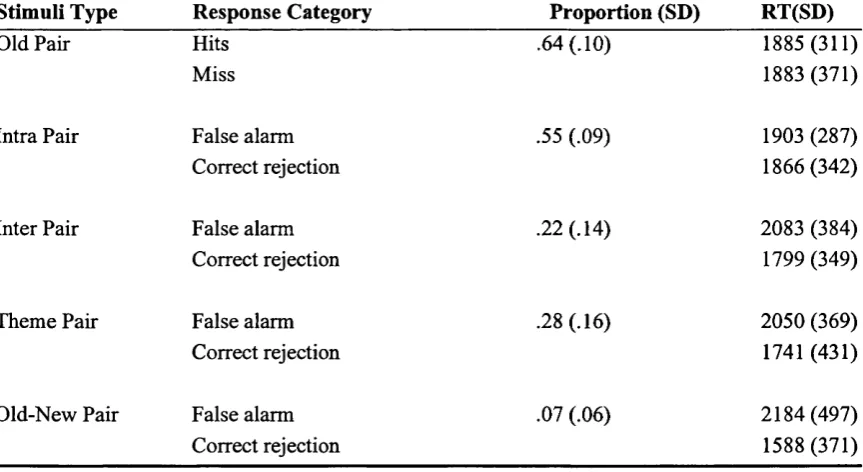
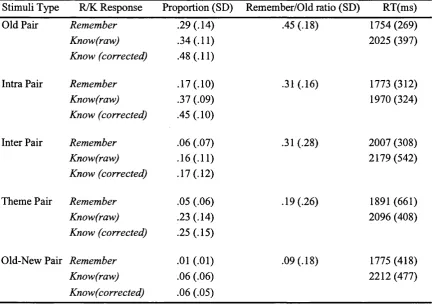
Table 6.1. Behavioural data of Old/New recognitionin Experiment 1...138
Table 6.2. Behavioural data of Remember/Know judgement in Experiment 1... 140
Table 6.3. Behavioural data in Experiment 2... 149
Table 6.4. Results of overall ANOVAs of the magnitude analyses in Experiment 2...154
Table 6.5. Results of subsidiary ANOVAs of the magnitude analyses in Experiment 2... 156
Table 7.1. Behavioural data of Old/New recognition for all subjects in Experiment 3...175
Table 7.2. Behavioural data of Old/New recognition in the ‘related’ and ‘unrelated’ groups of Experiment 3... 176
Table 7.3. Behavioural data of Remember/Know judgement of all subjects in Experiment 3.... 180
Table 7.4. Behavioural data of Remember/Know judgement in the ‘related’ and ‘unrelated groups of Experiment 3... 180
Table 7.5. Behavioural data in Experiment 4... 193
Table 7.6. Results of overall ANOVAs of the magnitude analyses in Experiment 4...199
Table 7.7. Results of subsidiary ANOVAs of the magnitude analyses in Experiment 4...201
Table 7.8. The correlation between the proportions of old responses to different stimulus types in Experiment 2 ...207
Table 7.9. The correlation between the proportions of old responses to different stimulus types in Experiment 4 ...207
Table 8.1. Behavioural data in Experiment 5... 218
Table 8.2. Results of overall ANOVAs of magnitude analyses in the test phase of Experiment 5. ... 229
Table 8.3. Results of subsidiary ANOVAs of the magnitude analyses in the test phase of Experiment 5... 230
List of Figures
Figure 1.1. An equal-variance signal detection model illustrating familiarity distributions
associated with studied and unstudied items... 16
Figure 1.2. A two-criterion signal detection model of Remember and Know responses...24
Figure 1.3. Venn diagrams of theoretical relationships between recollection and familiarity...27
Figure 1.4. Symmetrical and skewed receiver operating characteristic curves plotted on probability coordinates and on z-coordinates... 32
Figure 3.1. Open and Closed electrical fields generated by pyramidal cells and stellate cells... 76
Figure 3.2. Open field source configuration...77
Figure 3.3. Self-cancelling closed field source configurations... 77
Figure 4.1. The ‘late positive component’...88
Figure 4.2. The left parietal old/new effect... 93
Figure 4.3. The right frontal effect... 98
Figure 4.4. The early frontal effect... 102
Figure 5.1. Selected sites from ‘montage 10’ 61 channel equidistant montage employed in Experiments 2, 4, & 5...128
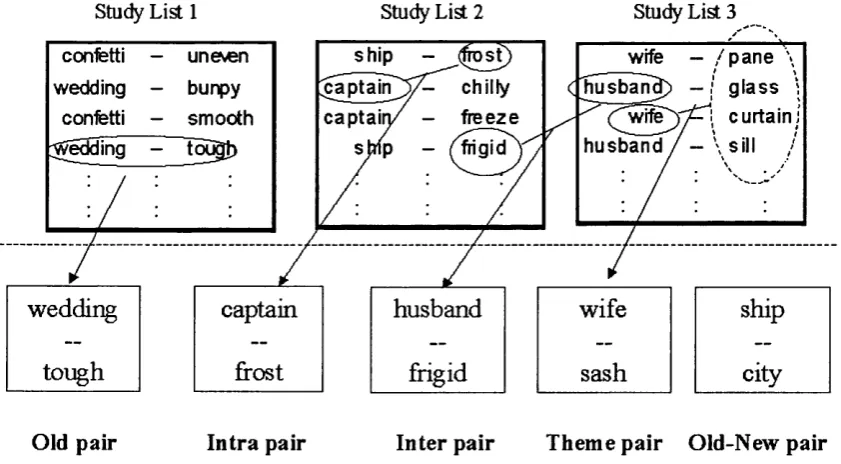
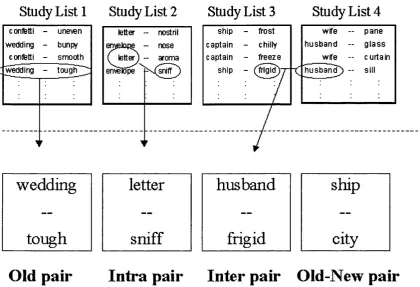
Figure 6.1. Illustration of the formation of one study list and the five types of test pairs generated from this list in Experiment 1...133
Figure 6.2. Illustration of the formation of one study list and the four types of test pairs generated from this list in Experiment 2...147
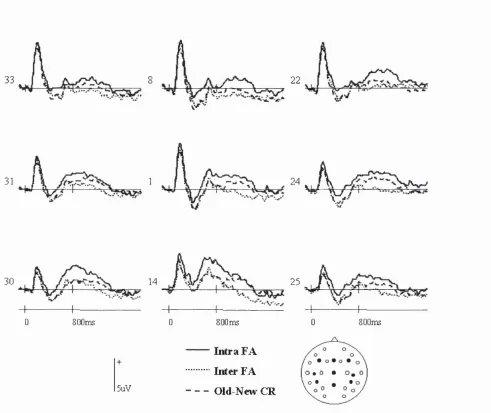
Figure 6.3. Grand average waveforms for Hit, Intra FA, and Old-New CR in Experiment 2 151 Figure 6.4. Grand average waveforms for Intra FA, Inter FA, and Old-New CR in Experiment 2 ... 152
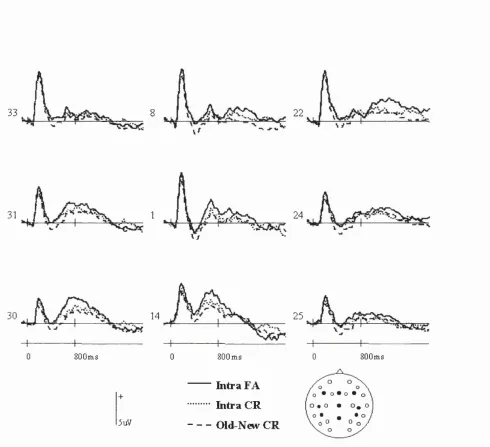
Figure 6.5. Grand average waveforms for Intra FA, Intra CR, and Old-New CR in Experiment 2 ... 153
Figure 6.6. Mean amplitudes associated with the ERP effects for Hits, Intra F As, Inter F As, and Intra CRs in comparison to CRs in Experiment 2... 155
Figure 6.7. ERP waveforms at midfrontal sites in Experiment 2... 159
Figure 6.8. Voltage spline maps showing the topographies of the old/new effect for Old pairs and the false recognition effect for Intra pairs in Experiment 2...160
Figure 7.2. Illustration of the formation of four study lists in one study-test block in the
‘unrelated’ condition of Experiment 3... 171
Figure 7.3. Illustration of the formation of six types of test pairs in the ‘related’ condition of
Experiment 3... 172
Figure 7.4. The difference scores between the proportion of old responses to Old-New pairs and
those to the other five types of test pairs in Experiment 3... 177
Figure 7.5. Illustration of the interaction effect between ‘Association’ and ‘Proximity’ on the
proportion of old responses to the four types of rearranged pairs in Experiment 3... 178
Figure 7.6. Illustration of the interaction effect between ‘Association’ and ‘Proximity’ on the
proportion of ‘R’ responses to the four types of rearranged pairs in Experiment 3... 182
Figure 7.7. The difference scores between the corrected proportion o f ‘Know’ responses to
Old-New pairs and those to the other five types of test pairs in Experiment 3... 183
Figure 7.8. Illustration of the formation of four study lists and the four types of test pairs
generated from these lists in Experiment 4... 190
Figure 7.9. Grand average waveforms forHit, Associated Intra FA, and Old-New CR in
Experiment 4... 196
Figure 7.10. Grand average waveforms for Associated Intra FA, Unassociated Intra FA, and
Old-New CR in Experiment 4... 197
Figure 7.11. Grand average waveforms for Associated Intra FA, Associated Intra CR, and
Old-New CR in Experiment 4... 198
Figure 7.12. Mean amplitudes associated with the ERP effects for Hits, Associated Intra F As,
Unassociated Intra F As, and Associated Intra CRs, in comparison to CRs in Experiment 4
200
Figure 7.13. Voltage spline maps showing the topographies of the old/new effect for Old pairs in
Experiment 4...204
Figure 7.14. Voltage spline maps showing the topographies of the false recognition effect for
Associated Intra pairs in Experiment 4...205
Figure 8.1. Grand average waveforms for Subsequent Hit trials and Subsequent Miss trials
recorded during the study phase of Experiment 5... 220
Figure 8.2. Grand average waveforms for Subsequent Intra CR trials and Subsequent Intra FA
trials recorded during the study phase of Experiment 5... 221
Figure 8.3. The waveforms associated with subsequent hit and subsequent miss trials over the
Figure 8.4. Voltage spline maps showing the topographies of the subsequent effect for Old pairs
during the 1000-1400 ms time region in the study phase of Experiment 5... 224
Figure 8.5. Voltage spline maps showing the topographies of the subsequent effect for Intra pairs
during the 1000-1400 ms time region in the study phase of Experiment 5... 225
Figure 8.6. Grand average waveforms for Hit(t), Intra FA(t), and Old-New CR recorded during
the test phase of Experiment 5...227
Figure 8.7. Grand average waveforms for Intra CR(t), Intra FA(t), and Old-New CR trial recorded
during the test phase of Experiment 5... 228
Figure 8.8. Mean amplitudes associated with the ERP effects for Hit(t), Intra FA(t), and Intra
FA(t) in comparison to Old-New CRs in Experiment 5...231
Figure 8.9. ERP waveforms at midfrontal sites recorded during the test phase of Experiment 5236
Figure 8.10. Voltage spline maps showing the topographies of the old/new effect for Old pairs in
Experiment 5... 237
Figure 8.11. Voltage spline maps showing the topographies of the false recognition effect for
Chapter 1. Recognition Memory
1.1 Introduction
The notion that human memory is not a literal reproduction o f experienced events has
long been recognised by psychologists. Since the pioneering study o f Bartlett (1932),
many laboratory studies and real life events have demonstrated that memory is a
constructive process, and is subject to different kinds o f errors (for review, see Roediger,
1996; Roediger & McDermott, 2000; Schacter, 1995). A rememberer’s report for a past
event can deviate seriously from the event’s actual occurrence due to different factors in
the encoding and retrieval o f a memory. In the past decades, psychologists have
developed a variety o f experimental procedures to investigate memory errors with the
ultimate aim o f increasing our understanding o f human memory. Recently, the rise o f
cognitive neuroscience, which focuses on the relation between brain and cognitive
functions, and the development o f high resolution neuroimaging techniques such as
functional magnetic resonance imaging (fMRI), positron emission tomography (PET) and
event-related potentials (ERPs), have provided us a new vision and framework to explore
the underlying mechanisms o f memory distortion.
The experiments presented in this thesis employed a procedure (introduced in Chapter 5)
that incorporated two types o f memory errors: ‘source memory errors’ and ‘gist-based
false recognition’ (both reviewed in Chapter 2), and investigated their underlying
mechanisms by recording the ERPs (reviewed in Chapter 3) associated with these errors.
One specific point addressed in this thesis was whether these memory errors comprise
‘recollection’ o f episodic details, or alternatively, whether these errors solely reflect
undifferentiated familiarity. This issue was explored by requesting subjects to report their
subjective experiences associated with memory judgments, and by examining the
different ERP effects associated with recollection-based recognition memory (reviewed
in Chapter 4). The aim o f Experiments 1 and 2 (Chapter 6) was to explore how partial
involvement o f recollection processes in source memory errors. Experiments 3 and 4
(Chapter 7) explored the necessary conditions for the formation o f gist memories that
induce recollection-based source judgm ent errors. The last experiment (Chapter 8)
investigated the relation between brain activity during encoding and the subsequent
memory judgment accuracy. The relation between gist memory, recollection-based
recognition, and source monitoring will be discussed on the basis o f the results o f the five
experiments (Chapter 9).
The remainder o f the current chapter reviews previous studies o f recognition memory,
principally concerned with dual-process theories o f recognition memory, such that it will
provide a theoretical context for linking issues o f recollection- and familiarity-based
memory, and the memory errors investigated in this thesis. This review is organised into
three sections. The first section describes the origins o f and the debates between single-
and dual-process models. The second section reviews different methods that have been
used to examine the natures o f recollection and familiarity. In the final section, the
characteristics o f the two processes are summarized.
1.2 Single- vs. Dual-Process Models o f Recognition Memory
Recognition memory refers to the ability to identify items that have been previously
presented from those that have not been experienced before. Tests o f recognition memory
can take the form o f the ‘yes-no’ procedure, in which subjects are presented with a cue
and decide whether it has been presented before; or the form o f the ‘forced-choice’
procedure, in which subjects are presented with a pair o f stimuli and must identify one o f
them as old. A long debate in explaining recognition memory performance concerns
1.2.1 Global Matching Models
One class o f theories, which are collectively referred to as ‘global matching m odels’,
postulate that recognition memory is based on a single factor. Although differing in their
assumptions about representation and retrieval rules, recognition in these theories is
modeled as a signal detection process based on the assessment o f the memory strength, or
the global familiarity, o f the test items (for review o f these models, see Clark &
Gronlund, 1996; Ratcliff & McKoon, 2000). It is postulated that all items have some pre-
experimental familiarity with variation that can be described by a normal distribution.
The mean familiarity value o f an item will be increased or shifted if the item has been
studied. The distributions o f studied old items and unstudied new items may overlap, and
the distance between the mean familiarity values o f studied and unstudied items reflects
the sensitivity or strength o f memory (see figure 1.1). In recognition tests, subjects set a
criterion along the familiarity scale, such that items whose values exceed this level are
identified as studied ones. It is also assumed in these theories that a test cue is combined
with its context to form a single probe o f memory, and this probe is matched against all
items in the memory trace simultaneously. These assumptions enabled global matching
models to explain two characteristics o f recognition memory: (1) recognition decisions
are made quickly; (2) recognition judgments are based on characteristics o f both the test
item and o f other items in memory (Clark & Gronlund, 1996).
old
--- ► "old" response criterion (c) response: new
familiarity
Although explaining recognition memory with a single mnemonic process seems
parsimonious and straightforward, a number o f studies o f recognition memory have
revealed results that are not easy for single-process models to explain. Particular
problematic for global matching models is the ‘mirror effect’ (Glanzer & Adams, 1985,
1990). The mirror effect refers to the general finding that if one stimulus class (e.g., low
frequency words) attracts a higher hit rate than another stimulus class (e.g., high
frequency words), the former class also attracts a lower false alarm rate than the latter
class. The challenge for global matching models regarding the mirror effect concerns
why the average memory strength o f more memorable items can be both greater when the
items are old, and less when the items are new, than the average strength o f less
memorable items. Other difficulties for single-process models o f recognition come from
cognitive studies in which recognition memory was tested with two measures, such as
‘Remember’ and ‘Know’ responses (Tulving, 1985; Gardiner, 1988, reviewed in a latter
section). Some o f these studies showed that such measures are experimentally
dissociable. These dissociations are difficult to explain under the assumption o f a single
mnemonic process.
1.2.2 Dual-Process Models
Another class o f theories, which are collectively referred to as dual-process models,
postulate that there are two distinct processes underlying recognition memory
performance (Atkinson & Juola, 1974; Jacoby, 1991; Mandler, 1980, 1991; for detailed
review, see Yonelinas, 2002). These two processes are often referred to as familiarity and
recollection. The familiarity process reflects the assessment o f the memory strength or
familiarity o f a test item, and has been conceptualized as an acontextual, fast-acting, and
automatic process. In contrast, the recollection process reflects the ability to retrieve
1.2.2.1 The Mandler Model and the Atkinson and Juola Model
The early dual-process models developed from studies addressing the relation between
recall and recognition, specifically, whether retrieval processes in recall play a role in
recognition memory. In a sorting/recall paradigm, Mandler and colleagues (Mandler,
Pearlstone, & Koopman, 1969) demonstrated that organisation variables, which were
known to affected recall performance, also affect recognition performance. Subjects in
their experiments sorted sets o f unrelated words into 2 to 7 categories according to their
own criteria at study. A fter the sorting task, subjects were given recall and/or recognition
tests for the sorted items. The results revealed that the number o f categories (organisation
variable) used at study was highly correlated with immediate recall performance and then
declined, and was relatively less correlated with immediate recognition performance but
then improved dramatically over time. From these results Mandler et al. proposed that in
recognition judgments, the ‘occurrence information’ o f a target event was evaluated in
the first instance, and a ‘retrieval check’ was performed when that information did not
exceed a critical value. The notion that there is a ‘retrieval check’ process after uncertain
occurrence information was also embodied in the dual-process model proposed by
Atkinson and Juola (1974), who conceptualized familiarity as a continuously distributed
entity with subjects setting two criteria (high and low) along this distribution. If the
familiarity value o f a stimulus is higher than the high criterion or lower than the low
criterion, subjects respond to the stimulus as old and new respectively. However, if the
familiarity value falls between the two criteria, a search process is performed before
responding, which results in slow responses.
The early dual-process models proposed by Mandler et al. (1969) and by Atkinson and
Juola (1974) were conditional search models, as they argued that ‘retrieval check’
process (recollection) was only initiated when occurrence information (familiarity) led to
an ambiguous response. However, in a subsequent paper that consolidated early work and
provided a theoretical framework for recollection and familiarity, Mandler (1980)
suggested that the two processes are independent and function in parallel. Familiarity was
item ’s sensory and perceptual features in memory. By contrast, recollection was related
to conceptual or categorical elaboration o f inter-item relations, such as contextual
information, and supported both recognition and recall. It was proposed that the effects o f
recollection and familiarity on recognition performance were additive and separate, as
described by the equation ‘R g=R +F-R F’, where R and F denotes the probabilities o f
identifying a test item as old on the bases o f recollection and familiarity respectively, and
Rg stands for the probability o f identifying a test item as old. Using recall as the primary
index o f recollection in recognition performance, Mandler (1979, 1980) reviewed
previous studies o f recall and recognition, which led to the conclusion that different kinds
o f processing affect recollection and familiarity. For instance, sheer repetition with
maintenance type o f rehearsal affects recognition but not recall, while elaborate
processing among inter item relations affect both recall and recognition. Additionally,
Mandler (1980, 1991) proposed a number o f functional characteristics o f recollection and
familiarity. Specially, familiarity was thought to be somewhat faster than recollection;
and the familiarity value o f an item was argued to decay more rapidly than does its
recollection.
1.2.2.2 The Jacoby Model
While Mandler (1980) focused on using recall as the index for the contribution o f
recollection to recognition, Jacoby and Dallas (1981) addressed the relation between
perceptual processing and the familiarity process in recognition memory. Following early
dual-process models that assigned familiarity to physical information about items
(Atkinson & Westcourt, 1975; Mandler, 1980), Jacoby and Dallas treated perceptual
identification performance as an index o f familiarity and identified two classes o f
variables that affect recognition memory and perceptual identification in different ways.
The first class, such as the level o f processing o f items at study, influenced recognition
memory but had no effect on subsequent perceptual identification. The second class, such
as the number and spacing o f repetitions o f stimuli at study, had parallel effects on
between recognition memory and perceptual identification, as well as between
recognition memory and recall performance, support the notion that there are at least two
processes underlying recognition memory, with one (recollection) related to recall and
the other (familiarity) related to perceptual processing.
In contrast to previous models that viewed familiarity as an inherent characteristic o f an
item, Jacoby and colleagues argued that there was an unconscious inference or attribution
that assigned the perceptual fluency o f processing an item to the feeling o f familiarity
(Jacoby, 1991; Jacoby & Dallas, 1981; Jacoby & Kelley, 1992; Jacoby, Kelley, &
Dywan, 1989). When people are presented with an item that had been experienced
before, processing the item ’s perceptual or physical properties would be relatively fluent
in comparison to processing items without recent prior experience. This relative
perceptual fluency provides a heuristic that can be used as a basis for recognition
memory. However, this heuristic is subject to error, as processing fluency caused by
factors other than memory can be incorrectly attributed to familiarity (e.g., Whittalsea,
Jacoby, & Girard, 1990). Alternatively, processing fluency associated with experienced
items might be incorrectly attributed to factors other rather familiarity (e.g. Jacoby,
W oloshyn, & Kelley, 1989). By contrast, recollection, the retrieval o f study context,
serves as a more reliable and conservative basis for recognition memory, and can be used
to correct inaccurate attributions o f perceptual fluency. Jacoby also brought in the
distinction between controlled and automatic processing, which had been discussed
extensively in attention literature, to dual-process models o f recognition memory, and
linked these forms o f processing with recollection and familiarity respectively (Jacoby &
Dallas, 1981). Familiarity is proposed to be an automatic basis for recognition memory
judgments that does not demand attentional resources, whereas recollection is thought to
be a consciously controlled basis for recognition and is subject to a limited processing
1.2.2.3 The Yonelinas Model
On the basis o f a series o f studies investigating receiver operating characteristics (ROCs),
Yonelinas and colleagues (Yonelinas, 1994, 1997, 2001a,b; Yonelinas, Dobbins,
Szymanski, Dbaliwal, & King, 1996; Yonelinas, Kroll, Dobbins, & Soltani, 1999)
proposed a dual-process theory in which conscious recollection and familiarity contribute
to recognition memory as a threshold process and a signal-detection process respectively.
They characterized recollection as a discrete all-or-none memory state providing
‘qualitative’ information about experienced events, while familiarity reflects the
assessment o f continuously distributed ‘quantitative’ memory strength information. More
details o f the Yonelinas Model will be given in section 1.3.1.3.
1.3 Recollection and Familiarity
The association and dissociation between recognition memory and recall, as well as
between recognition memory and perceptual identification, provided solid ground from
which to postulate that recognition memory consists o f two components. However, using
recall and perceptual identification or other tasks to estimate or investigate the two
processes in recognition memory is indirect. In order to evaluate the functional
characteristics o f these two components, i.e. recollection and familiarity, methods that
can separate these two processes in recognition memory are required. These methods,
which were first developed in behavioural studies, were later applied to
neuropsychological studies and neuroimaging studies to test the results obtained from
behavioural studies and to identify brain structures associated with these two processes o f
recognition memory. The following sections review behavioural and neuropsychological
studies o f recollection and familiarity. Neuroimaging studies o f recollection and
1.3.1 Behavioural Studies of Recollection and Familiarity
One o f the main defining features o f recollection, the ability to consciously retrieve
contextual information o f a prior event, has been utilised in developing methods that
separate the contributions o f recollection and familiarity in recognition memory
performance. Three lines o f studies are introduced in this section. The first one focuses
on the subjective experience o f consciously retrieving the context information. The
second one employs a set o f equations to objectively measure the effect o f recollection
and familiarity on recognition memory performance. The third describes the functional
characteristics o f recollection and familiarity from a signal detection viewpoint.
1.3.1.1 The Remember/Know Procedure
The Remember/Know procedure was originally developed by Tulving (1985), aiming at
measuring the nature o f subjects’ conscious awareness in memory tests. Tulving (1972,
1983) postulated two memory systems: episodic and semantic, with the former for
autobiographical form o f personal memory and the latter for facts and general
knowledge. The main distinction between these two types o f memory lay in the states o f
consciousness they were associated with. Episodic memory was proposed to be
accompanied by ‘autonoetic’ awareness, in which subjects could ‘mentally time travel’
back to the past and re-experience a prior episode. By contrast, semantic memory was
thought to be associated with ‘noetic’ awareness, which reflects an awareness o f
information in the absence o f recollection.
Tulving (1985) proposed that the measure o f these two kinds o f conscious awareness in
memory tests could be obtained by asking subjects to report their mental experience
associated with memory judgments. ‘Remember’ responses are made when subjects
recollect any contextual aspect o f the prior presentation o f the test item, while ‘Know’
responses are made when subjects feel that the test item is familiar but cannot recollect
any specific experience associated with it. Tulving (1985) reported that subjects could
responses declined as the amount o f information provided by cues increased.
Furthermore, it was found in a recognition memory experiment that the decline
associated with retention interval (from Day 1 to Day 8) was larger for the proportion o f
Remember responses than for the overall recognition performance. Later studies adopting
the Remember/Know procedure addressed two separate but related issues. The first issue
concerns the different variables that affect these two classes o f responses (see Gardiner &
Java, 1993; Rajaram & Roediger, 1997; and Gardiner & Richardson-Klavehn, 2000; for
reviews). The second issue concerns how these two classes o f responses correspond to
recollection and familiarity processes.
Gardiner and Richardson-Klavehn (2000) categorised four sets o f experimental
manipulations that can dissociate Remember and Know responses. A set o f variables,
mostly those that differentially engaged conceptual and elaborative processing, influence
Remember responses but have little effect on Know responses. Such variables include
levels o f processing (Gardiner, 1988), generating vs. reading (Gardiner, 1988), retention
interval (Gardiner & Java, 1991), undivided vs. divided attention (Gardiner & Parkin,
1990). Another set o f variables, mostly those related to perceptual processing, influence
Know responses but do not affect Remember responses. These variables included the
manipulations o f surface features, such as different presentation modalities across study
and test (Gregg & Gardiner, 1994), more vs. less maintenance rehearsal (Gardiner,
Gawlik, & Richardson-Klavehn, 1994), identical vs. unrelated test primes o f test items
(Rajaram, 1993). There are also variables that affect Remember and Know responses in
opposite directions, such as massed vs. spaced repetition o f items (Parkin & Russo, 1993)
and repetition o f previously novel melodies (Gardiner, Kaminska, & Dixon, 1996), or
variables that have parallel effects on both responses, such as response deadline
(Gardiner, Ramponi, & Richardson-Klavehn, 1999).
The dissociations between Remember and Know responses are consistent with the notion
that these two classes o f responses reflect different cognitive processes involved in, or
models o f recognition memory employing a slight modification o f signal detection theory
have been proposed to accommodate the dissociations between Remember and Know
responses (Donaldson, 1996; Hirshman & Master, 1997; Inoue & Bellezza, 1998). These
models are referred to as ‘two-criterion signal detection m odels’, which postulate that
subjects place two criteria along the memory strength continuum: a ‘yes/no’ criterion for
determining an item as old and a more stringent ‘remember/know’ criterion for making
Remember responses (see figure 1.2).
4 ’ - 4
OLD
y ^
. V
New Know Remember
yes/no criterion r/k criterion
Figure 1.2. A two-criterion signal detection model of Remember and Know responses, illustrating familiarity distributions associated with studied and unstudied items and the placement of the yes/no and Remember/Know (R/K) response criteria. Adapted from Inoue and Bellezza (1998).
Items that lie above the remember/know criterion attract Remember responses, whereas
those that lie between yes/no and remember/know criteria attract Know responses. The
dissociations between Remember and Know responses can be accounted for by placing
and shifting the yes/no and remember/know criteria along the memory strength
continuum. For instance, the left and right distributions shown in figure 1.2 can be
thought to represent test items presented in the ‘difficult’ and ‘easy’ levels o f the variable
manipulated in a recognition experiment. If subjects adopt conservative yes/no and
remember/know criteria, a larger number o f Remember and Know responses will be
liberal criteria, there will be more Remember responses but fewer Know responses
observed in the ‘easy’ level than in the ‘difficult’ level.
Donaldson (1996) argued that, based on two-criteria signal detection models, bias-fi*ee
estimates o f memory (d' or A') should be equal for overall recognition and for Remember
responses, as Remember and Know responses reflect differences in response criterion
rather than memory strength. Donaldson also argued that the yes/no criterion and bias-
fi*ee estimates o f memory calculated based on Know responses would be positively
correlated, as the difference between the number o f Know responses associated with hit
and false alarms would be larger when conservative rather than liberal criterion are
adopted. Both predictions gained support from a meta-analysis on 28 studies that
employed the Remember/Know procedure (Donaldson, 1996). It should be noted that
Donaldson did not argue against the notion that there are two conscious states
(recollective and non-recollective) associated with recognition memory. Instead, he was
arguing that identifying non-recollective memory with the measures o f d ’ or A ’
associated with Know responses is inappropriate, as such measures are not independent
o f response criteria.
Different from the finding o f Donaldson (1996), however, Gardiner and Gregg (1997)
reported that the measure o f A ’ obtained from individual subject data (Gregg, and
Gardiner, 1994) was greater when it was calculated on overall hit rate than when it was
calculated on Remember rate. Additionally, Gardiner, Richardson-Klavehn, and Ramponi
(1998) mentioned that when subjects were allowed to make ‘Guess’ responses. A' for
Remember responses, A ' for Remember and Know responses, and A' for Remember,
Know and Guess responses were all significantly different. It was argued that it is Guess
rather than Remember or Know responses that have been influenced by response bias.
The dissociations between Remember and Know responses might not be accounted for by
Dobbins, Khow, Yonelinas, and Kroll (2000) evaluated two-criterion signal detection
models by examining the relationships between hit, Remember, and false alarm rates
across individual subjects. Dobbins et al. reasoned that two-criterion signal detection
models would predict positive correlation between hit and false alarm rates because both
would increase when a conservative yes-no criterion becomes liberal. The models would
also predict positive correlation between Remember and false alarm rates because both
would increase when stringent remember/know and yes/no criteria become more lax.
However, the Remember rate was found to be unrelated to the false alarm rate. Moreover,
it was found that the Remember rate shares a relationship with the hit rate that was
independent o f the false alarm rate, suggesting that hit rate can not be viewed as the result
o f a single underlying strength process.
The second issue concerned how these two categories o f memory responses correspond
to the underlying memory processes. Although Remember and Know responses are
mutually exclusive in the sense that an item can only be given one o f the two responses, it
is not necessarily the case that the correspondences between Remember/Know responses
and recollection/familiarity are also exclusive. How to estimate the contributions o f
recollection and familiarity to recognition by Remember and Know responses depends on
the assumed theoretical relationships between recollection and familiarity.
Three types o f fundamental relationships: exclusivity, redundancy and independence
(Jones, 1987) could exist between recollection and familiarity. A relationship o f
exclusivity means that recollection and familiarity can never co-occur (figure 1.3.1), so
that an item could be recognised on the basis o f recollection or familiarity but not both.
Under this assumption, the contributions o f recollection and familiarity to recognition can
be measured as the proportions o f Remember and Know responses (e.g. Gardiner &
Parkin, 1990). Another possible relationship is that o f redundancy, stating that
recollection is always accompanied by familiarity, whereas familiarity can occur in the
absence o f recollection (figure 1.3.2). Inconsistent results have been obtained in
recollection and familiarity. For instance, Gardiner (1988) reported that the processing
depth o f study items had no effects on Know responses, whereas Rajaram (1993) reported
that more Know responses were attracted by shallowly instead o f deeply processed items.
Jacoby, Yonelinas, and Jennings (1997) suggested that employing an independence
assumption for recollection and familiarity could reconcile the inconsistent results. A
relationship o f independence means that recollection can occur with or without
familiarity and vice versa. The contributions o f recollection and familiarity to recognition
are separate but overlapping (figure 1.3.3). It is argued that the proportion o f Know
responses underestimates the effect o f familiarity, as the contribution o f familiarity in
Remember responses is ignored.
Figure 1.3.1 Figure 1.3.2 Figure 1.3.3
Figure 1.3. Venn diagrams o f theoretical relationships between recollection (R) and familiarity (F). Figure 1.3.1. Exclusivity; Figure 1.3.2. Redundancy; Figure 1.3.3. Independence.
To compensate for this underestimation, the formula ‘F=K/(1-R)’ has been suggested by
the ‘Independent Remember/Know Procedure (IRK)’ to correct the proportion o f Know
responses as the index for familiarity (Yonelinas & Jacoby, 1995). Applying such
procedure with the data o f Gardiner (1988) and Rajaram (1993) showed consistent results
that both recollection and familiarity are affected by depth o f processing. Jacoby et al.
(1997) argued that experiments applying the IRK procedure gave rise to results that are
consistent with those fi"om experiments employing a ‘process dissociation procedure’
(reviewed in the next section), which separates recollection and familiarity with the
independence assumption. Applying the independent assumption can also help to
Rajaram and Coslett (1992) manipulated the size congruence between line drawings o f
objects shown at study and test. It was found that objects whose sizes were the same at
study and test attracted more Remember responses, and fewer Know responses, than
objects whose sizes were different at study and test. Viewing the proportion o f Know
response as the measure o f familiarity in this study would lead to the surprising
conclusion that increasing similarity (size congruency) decreased familiarity. Yonelinas
and Jacoby (1995) demonstrated that, when the IRK procedure was employed to correct
the proportion o f Know response to randomly generated shapes, changing the size o f the
items led to a decrease in both recollection and familiarity.
1.3.1.2 The Process Dissociation Procedure
Jacoby (1991) introduced the process dissociation procedure (PDF) as a means for
separating the contribution o f recollection and familiarity to recognition within a task.
This procedure hinges on the assumption that recollection and familiarity correspond to
controlled and automatic uses o f memory respectively, and that the effect o f recollection
can be directed to be in parallel with or in opposition to the effect o f familiarity. In a
typical recognition experiment employing the PDF, study stimuli are presented as two
classes, defined by different presentation modalities, presentation lists, or encoding tasks
etc. At test, subjects are presented with the studied items from these two classes together
with unstudied new items, and engage in two kinds o f tasks: inclusion and exclusion. In
the inclusion task, subjects are instructed to differentiate studied items o f both classes
(e.g., both visually and aurally presented words) fi*om unstudied new items. In the
exclusion task, however, only studied items belonging to one specific study class (e.g.,
aurally presented words) are classified as targets, and should be identified as ‘old’.
Studied items fi"om the other class (e.g., visually presented words) are classified as
nontargets, and should be responded to as ‘new ’ along with unstudied new items. It is
assumed that in the inclusion task, the effects o f recollection and familiarity work in
concert. A studied item can be identified as old because it is familiar or because it elicits
effects o f recollection and familiarity are in opposition when dealing with nontargets. The
effect o f familiarity on nontargets is opposed by recollecting that they belong to the study
class that should be rejected. Specifically, nontargets will be responded to as ‘old’ only
when recollection fails.
W ith the assumption that recollection and familiarity are functionally independent and
several other assumptions, the contributions o f these two processes (F and R for
familiarity and recollection respectively) to recognition memory can be estimated by
solving a set o f equations that involve the probabilities o f ‘old’ responses in the inclusion
and exclusion tasks. In the inclusion task, the probability o f a studied item being
identified as ‘old’ can be expressed by the formula: P(Inclusion)=R+F(l-R), as both
recollection and familiarity can be the basis for making an ‘old’ response to a studied
item. In contrast, the probability o f identifying a nontarget as ‘old’ in the exclusion task
can be expressed by the formula: P(Exclusion)=F(l-R), as a nontarget would be
identified as ‘old’ only when it is familiar without attracting recollection. Based on these
two formulas, the probability o f recollection can then be estimated with the formula:
R=P(Inclusion)-P(Exclusion), which in turn leads to the estimate for familiarity as
F=P(Exclusion)/(l-R). Using the PDP to separate controlled and automatic influences o f
memory, a number o f variables have been reported to produce dissociative effects on the
estimates o f recollection and familiarity (for recent reviews see Jacoby, Yonelinas, &
Jennings, 1997; Kelley & Jacoby, 2000). Some variables, such as aging, fast vs. slow
response, full vs. divided attention, and short vs. long study list, influence recollection but
have no effects on familiarity. For instance, Jennings and Jacoby (1993, 1997) reported
the contribution o f recollection to recognition was lower for older than young adults, but
the contribution o f familiarity to recognition was not different across these two age
groups. Yonelinas and Jacoby (1994) reported that forcing subjects to make fast
responses reduced the estimate o f recollection in comparison to asking participants to
make slow responses. The same effect on estimates o f recollection and familiarity was
also reported when subjects were presented with longer or shorter lists o f words at study
recollection and familiarity, as estimated by the process dissociation procedure. For
instance, Jacoby and colleagues (Jacoby, Toth, & Yonelinas, 1993) reported that
generating a word at study, in comparison to reading the word, increased the estimate o f
recollection and decreased the estimate o f familiarity.
The PDP has been criticized in respect o f its assumptions about recollection and
familiarity. Jacoby (1991) listed three critical assumptions underlying the procedure.
First, the criterion used for familiarity-based memory judgments should be constant
across inclusion and exclusion tasks. Second, the probability o f recollection should be the
same in inclusion and exclusion tasks. Finally, recollection and familiarity must be
completely independent. That is, values o f familiarity and recollection must not be
correlated. If any o f these assumptions is violated, the estimates o f recollection and
familiarity obtained from the process dissociation procedure will be invalid. Each o f
these three assumptions has been challenged. The problem for the first two assumptions,
i.e. that the contributions o f recollection and familiarity are invariant in inclusion and
exclusion tasks, comes from the fact that subjects are given different instructions in these
two tasks (Yonelinas, 2002). Previous studies have shown that the kind and amount o f
memory information retrieved can be affected by different memory tests (e.g., Dodson &
Johnson, 1993; Lindsay & Johnson, 1989). Because recollection is required in the
exclusion task but not in the inclusion task, it is likely that recollection is utilised or
weighted differently in the two tasks, which will bias the estimates o f recollection and
familiarity. Yonelinas (2002) suggested that this problem might be avoided by mixing
inclusion and exclusion trails (e.g., Jacoby, Toth, & Yonelinas, 1993) together, or by
modifying the design such that recollection is also required in the inclusion task
(Yonelinas & Jacoby, 1994). However, Yonelinas also pointed out that results obtained
from inclusion tasks with or without modified instructions did not differ significantly,
suggesting that the modification may not be necessary. There were also challenges to the
assumption that the automatic and conscious memory influences are independent (e.g.,
were more related to cued recall tasks than to recollection and familiarity in recognition,
and hence will not be reviewed here.
Another potential problem for the PDP is that its estimate o f recollection is restricted to
contextual information that can be used to distinguish targets from nontargets, and which
is therefore task-dependent. Recollecting aspects o f the prior event that does not support
the discrimination would not be reflected in the estimate for recollection. Yonelinas and
Jacoby (1996) termed the recollection o f non-discriminative information ‘noncriterial
recollection’, and argued that such recollection will function as familiarity, with effects
independent o f intended recollection. However, it has been shown in several studies that
estimates o f recollection and familiarity can be affected by noncriterial or partial
recollection, especially when targets and nontargets originate from similar sources or
share non-discriminative contextual information (Dodson & Johnson, 1996; Gruppuso,
Lindsay, & Kelley, 1997; Mulligan & Hirshman, 1997). Furthermore, Dodson and
Johnson (1996, experiment 2) showed that the recognition rate on exclusion tests
decreased as the similarity between targets and nontargets increased. They suggested that
this effect resulted from the ‘misrecollection’ of, or source confusion between, the similar
contextual information shared by targets and nontargets, which was not considered
appropriately in the process dissociation procedure.
The PDP provides an objective way for separating and estimating the contributions o f
recollection and familiarity, or conscious and automatic processes in recognition
memory. However, when applying this procedure, it is necessary to be cautious about
whether its basic assumptions are met or inaccurate conclusions might be drawn.
1.3.1.3 Receiver Operating Characteristics (ROCs)
Recognition memory ROCs are a function that relates the proportion o f correct
recognition response (i.e., the hit rate), to the proportion o f incorrect recognition response
a list o f words, subjects are required to identify studied old items from unstudied new
items with a confidence evaluation o f each memory judgment on a scale ranging from
‘sure old’ to ‘sure new ’. The number o f the confidence levels usually ranges from 6 to 10.
The performance observed across these different confidence levels are then plotted on a
unit square, the ‘ROC space’, with the x and y coordinates represent the false alarm and
hit rates respectively. Points on the ROC are plotted as a function o f confidence. The
leftmost point on the ROC space includes only the most confident responses. The second
point includes the m ost confident responses as well as the next most confident responses.
The subsequent points include less and less confident responses (see figure 1.4.1). When
plotted as z-scores (see figure 1.4.2), the slope o f the z-ROCs provides a measure o f
symmetry o f the ROCs. (Yonelinas, 1994). ROCs that are symmetrical along the diagonal
will yield transformed z-ROCs with a slope o f 1.0. In contrast, skewed or asymmetrical
ROCs will generate z-ROCs with slopes away from 1.0.
I
oc-0.2'
0-0- ^
0.0 C.2 0.4 0.6 1,0
3
2
0
1
-2
1
■2 1 8 2 3
TTef'/New
Figure 1.4.1
ZCYet'INew)
Figure 1.4.2
Figure 1.4. Symmetrical and skewed receiver operating characteristic curves plotted on probability coordinates (figure 1.4.1) and on z-coordinates (figure 1.4.2). Adapted from Yonelinas and Jacoby (1995).
Based on signal-detection theory (Green & Swets, 1966; Macmillan & Creelman, 1991),
single-process models predict that recognition memory will yield curvilinear ROCs and
also predicted that if the familiarity distributions o f old and new items have equal
variance, the resulted ROCs are symmetrical along the diagonal, and z-ROCs will have
slopes o f 1.0. However, although ROCs observed in recognition memory are usually
curvilinear, symmetric ROCs, or z-ROCs with slopes o f 1.0, are rarely observed
(Yonelinas, 1994). Most studies gave rise to the slopes o f z-ROCs o f less than 1 (e.g.,
Ratcliff, Sheu, & Gronlund, 1992), ranging from 0.6 to 0.9 (Yonelinas, 2001b). There are
two ways o f explaining these findings. The first account follows the signal-detection
theory, and proposes that there is a larger variation in the familiarity distribution for old
items than that for new items. Because o f the greater variance for old items than for new
items, the ROCs are pulled toward the top left comer o f the ROC space, and hence the
slopes o f z-ROCs are less than 1.00. The other account is the ‘dual-process signal-
detection m odel’ developed by Yonelinas and colleagues (Yonelinas, 1994; Yonelinas,
Dobbins, Szymanski, Dhaliwal, & King, 1996). They proposed that the asymmetric
ROCs, or z-ROCs with slopes less than 1.00, are best described by a dual-process model
for recognition memory that incorporates a signal-detection based process o f familiarity
plus a threshold process o f recollection. Because recollection tends to increase the
number o f high-confident hits without affecting false alarm rates, ROCs will be pushed
up along the left y-axis such that the slopes o f z-ROCs would be less than 1.0 (Yonelinas,
1994).
Although asymmetric ROCs, or z-ROCs with slopes less than 1.0, can be explained by
both the ‘unequal-variance signal-detection m odel’ and the ‘dual-process signal-
detection’ model, there are some subtle differences between the ROC data predicted by
these two models. Because the dual-process signal detection model assumes that there is
a threshold process o f recollection, ROCs predicted by this dual-process model will be
slightly flatter than those predicted by the unequal-variance signal detection model,
especially when the contribution o f recollection is large and the contribution o f
familiarity is small. This difference in ROCs will in turn make the z-ROCs predicted by
the dual-process model slightly more ‘U-shaped’ in comparison to the linear z-ROCs
employed a level-of-processing manipulation, Yonelinas et al. (1996) demonstrated that
the z-ROCs o f deeply processed items were U-shaped, whereas the z-ROCs o f shallowly
processed items were linear. This result is in line with the prediction o f dual-process
signal-detection model, as the contribution o f recollection to recognition is larger for
deeply processed items than for shallowly processed items, such that U-shaped linear z-
ROCs were observed for these two classes o f items respectively. By contrast, the U-
shaped z-ROCs for deeply processed items were difficult to be accounted by the unequal-
variance signal-detection model.
1.3.2 Neuropsychological Studies of Recollection and Familiarity
Dissociations between performance on direct and indirect memory tasks have been
reported in amnesic patients with medial temporal or diencephalic damaged (for review,
see Richardson-Klavehn & Bjork, 1988). There are also studies investigating whether
amnesic patients perform equally poorly on different direct memory tests, such as recall
and recognition. However, the results are not consistent. Some studies reported that
amnesic patients’ performance on recall tasks was disproportionately disrupted in
comparison to their performance in recognition tasks (e.g. Bowers, Verfaellie,
Valenstein, & Heilman, 1988; Hirst, Johnson, Kim, Phelps, Risse, & Volve, 1986; Hirst,
Johnson, Phelps, & Volpe, 1988). Other studies however found that amnesic patients’
performance in recognition and recall tasks were equivalently poor (e.g. Haist,
Shimamura, & Squire, 1992; Shimamura & Squire, 1988). One possible explanation for
these inconsistent results is that these studies adopted different recognition tests, such that
they were measuring different underlying components o f recognition memory (Aggleton
& Shaw, 1996; Verfaellie & Treadwell, 1993). For instance, Aggleton and Shaw (1996)
suggested that certain patterns o f pathology, such as focal damage to hippocampus and
diencephalic regions, would spare recognition on the basis o f familiarity but disrupt
recollection-based recognition. Thus, these patients might have near normal performance
on recognition tests supported by familiarity but perform poorly on recognition tests that