
Sub-barrier backward quasielastic
scattering: A probe of the hexadecapole
deformation
H.Q. Zhang, C.J. Lin, H.M. Jia, L. Yang, X.X. Xu, F. Yang, Z.D. Wu, Z.H. Liu, N.R. Ma, L.J. Sun and D.X. Wang
China Institute of Atomic Energy, P. O. Box 275(10), Beijing 102413, P. R. China
Abstract
The quasielastic scattering excitation functions for 16O + 152Sm, 170Er and174Yb were measured with high precision at a backward angle with small energy intervals at energies near the Coulomb barriers. The hexadecapole deformation (β4) of the target nuclei was extracted by using the lower-energy data and the obtained values agree with the available results reasonably well. This offers a sensitive method to extract β4. This method is especially meaningful for the radioactive nuclei considering the low beam intensities.
1
Introduction
Up to now, the methods of sub-barrier α scattering [6], above-barrier
α excitation [6, 7], electron scattering [8], and muonic x rays [9] have been used to determine the shape of the deformed nucleus experimentally. Usu-ally, β4 is difficult to extract experimentally and the obtained results are model-dependent and quite different with big errors. Theoretically, the macroscopic-microscopic method to calculate the ground-state deformation has been given in Ref. [10].
Based on the two complementary processes of fusion and backward quasielastic (QEL) scattering, we try to extractβ4by using the lower-energy QEL data where the coupling effect to nuclear deformation is expected to be dominant. Also QEL is easier to be measured experimentally at lower-energy region. To this end, the spherical16O was selected as projectile. The nuclei of 152Sm, 170Er and 174Yb, which can be seen as good rotors with similar β2 but very different β4 for the ground-state rotational band, were selected as target nuclei.
2
Experimental procedure and data analysis
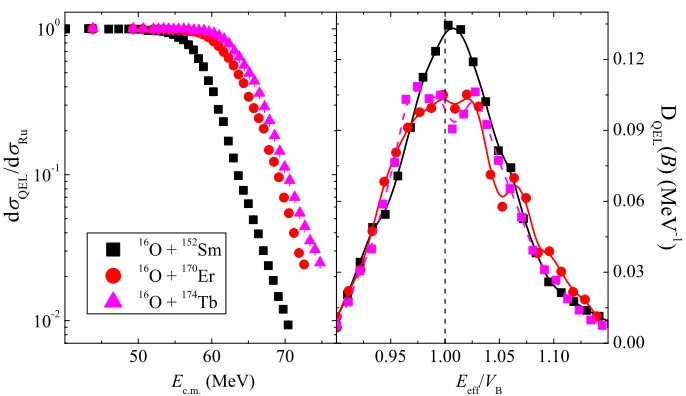
The experiment was performed based on the HI-13 tandem accelerator at China Institute of Atomic Energy (CIAE). Thin targets (50-100 μg/cm2 thick) of 152Sm, 170Er and 174Yb with a diameter of 3 mm evaporated onto 20-25 μg/cm2 carbon foils were used. The beam energy range is ELab = 40-80 MeV. The QEL particles were measured by using four silicon surface barrier detectors placed at the backward angle of θLab = 175◦. Another group of four silicon surface barrier detectors were placed symmetrically at the forward angle θLab = 41◦ relative to the beam direction as monitor detectors and also for data normalization. More details can be found in [11]. The energy window for QEL was defined to include the elastic peak and the tail corresponding to all other peripheral processes. For all reactions, the QEL counts were divided by the sum of the elastic scattering counts in the four monitor detectors, giving a quantity proportional to the ratio of the QEL cross sections to Rutherford scattering dσQEL/dσRu, where ’Ru’ denotes Rutherford scattering. The measured experimental QEL excitation functions for16O + 152Sm, 170Er and174Yb are shown in fig. 1 (left), where only statistical errors are given and the typical errors are smaller than 1%. An effective energy Eeff was used by considering the minor centrifugal energyEcentcorrection, that isEeff =Ec.m.- Ecent, in order to compare the barrier distribution DQEL(Ec.m., 175◦) with DQEL(Eeff, 180◦). The corre-sponding barrier distributions are shown in fig. 1 (right). Considering the
201
,0401 (2016)
EPJ Web of Conferences DOI: 10.1051/epjconf/201611 0401
5
117 7
NN
Figure 1: Experimental QEL excitation functions (left) for16O +152Sm,170Er and 174Yb measured atθLab= 175◦ and the extracted barrier distributions (right).
prevailing sensitivity of QEL to nuclear deformation at lower energies and to simplify the problem further by reducing the possible effect of other reaction channel couplings on the extracted β4, only the data of dσQEL/dσRu >0.7 was used in the following analysis somewhat arbitrarily.
The CC calculations were performed with a modified version of the code CCFULL [12]. A Woods-Saxon (WS) potential withr0 = 1.20 fm and a = 0.65 fm was used, the potential depthV was varied to reproduce the barrier heights. As usual, a short range imaginary potential with W = 30 MeV,
r0W = 1.0 fm, andaW = 0.4 fm was used to simulate the compound nucleus formation. The used Coulomb radius parameter isr0C= 1.1 fm, which has little influence on the calculated cross sections. The calculated results are insensitive to the parameters of the imaginary part of the potential as long as it is strong enough and well localized inside the Coulomb barrier.
Considering the coupling effect, the excitation energies of 16O are high compared with the barrier curvature, so only produces an adiabatic poten-tial renormalization, without affecting the structure of the barrier distri-bution [13]. This effect can be included in the potential and will not be considered explicitly in the CC calculations. Excitation states up to 10+ in the rotational band of the target nuclei were included.
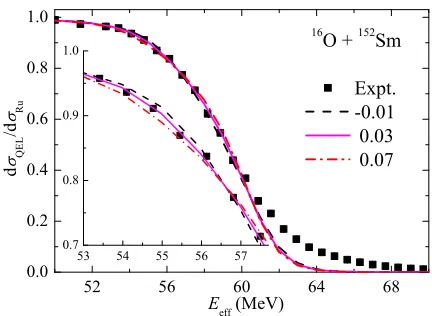
Figure 2: Experimental QEL excitation function for 16O +152Sm compared with the CC calculations by using differentβ4.
widely [14]. Figure 2 shows the present-work backward QEL excitation function (solid squares). The lines are the CC calculations which take the permanent deformation of 152Sm into account. β2 = 0.31 [15] is used and fixed for 152Sm. Different β4-values were used in the CC calculations for getting the optimal value by comparison with the experimental data. The parameter which gives the best reproduction for the lower-energy data well is β4 = +0.037 by using a chi-square analysis, the corresponding error is
±0.006 by makingχ2min/Npt = 1.1 for the optimal fit increased by 1, where ’Npt’ denotes the number of data points used in the fitting procedure. This means that the lower-energy backward QEL is indeed sensitive to higher order deformationβ4.
The extracted β4-value for 152Sm here is similar with both β4N = 0.038
± 0.007 extracted from 14-18 MeV α scattering [16] and 0.048 obtained from 50 MeVαscattering [7], but smaller than both the charge deformation parameter of β4C = 0.08 [17] and β4 = 0.07 (β2 = 0.287) [8] obtained from electron scattering.
Similar analysis was also performed for 16O +170Er and 16O +174Yb. The β4 extracted in this work are shown in fig. 3 (solid circles). Figure 3 also represents some available results for Sm, Er and Yb isotopes, which include the charge deformationβ4C(αC) extracted by means of the Coulomb excitation experiments [6, 17–19], nuclear deformationβ4N(αN) by using the interference effects [16] and inelastic scattering ofαparticles at energies well above the barrier [6, 7]. Also included in this plot are the β4 of 152,154Sm,
201
,0401 (2016)
EPJ Web of Conferences DOI: 10.1051/epjconf/201611 0401
5
117 7
NN
Figure 3: The variation ofβ4 with neutron numberN for Sm, Er and Yb isotopes by using different experimental methods and M¨oller’s theoretical prediction [10].
166Er and176Yb determined by electron scattering (e−) [8]. Deformations of the nuclear ground states calculated with a macroscopic-microscopic model (M¨oller95) [10] are also shown in fig. 3. It can be seen that the extracted
β4-values in this work qualitatively agree with this overall trend.
3
Summary
In summary, we have measured the QEL scattering excitation functions with high precision at a backward angle and extracted the barrier distributions for16O +152Sm,170Er and174Yb. The extractedβ4-values show a transition from positive for152Sm and near-zero for170Er, to negative for174Yb, which is consistent with the available trend. This means that the backward QEL at the lower-energy region, like fusion excitation function, is indeed sensitive to the higher-order deformation and especially the sign ofβ4. Of course, more precise data and more systems are needed to further check the feasibility of this method. Comprehensive data analysis is also needed in order to get a more reliable quantitative result.
Acknowledgements
and the National Natural Science Foundation of China under Grants Nos. U1432246, U1432127, and 11505293.
References
[1] Stokstad R.G. et al.,Phys. Rev. Lett.,41(1978) 465.
[2] Rhoades-Brown M.J. and Oberacker V.E., Phys. Rev. Lett.,50(1983) 1435.
[3] Dasgupta M. et al.,Annu. Rev. Nucl. Part. Sci.,48(1998) 401.
[4] Nagarajan M.A., Balantekin A.B. and Takigawa N.,Phys. Rev. C,34 (1986) 894.
[5] Lemmon R.C. et al., Phys. Lett. B,316 (1993) 32.
[6] Lee I.Y. et al., Phys. Rev. C, 12(1975) 1483.
[7] Hendrie D.L. et al., Phys. Lett. B,26(1968) 127.
[8] Cooper T. et al.,Phys. Rev. C,13(1976) 1083.
[9] Powers R.J. et al.,Phys. Rev. Lett.,34(1975) 492.
[10] M¨oller P., At. Data Nucl. Data Tables,59 (1995) 185.
[11] Jia H.M. et al.,Phys. Rev. C,90(2014) 031601(R).
[12] Hagino K., Rowley N. and Kruppa A.T., Comput. Phys. Commun., 123 (1999) 143.
[13] Hagino K. et al.,Phys. Rev. Lett.,79 (1997) 2014.
[14] Zhang Huanqiao et al.,Phys. Rev. C,57(1998) R1047.
[15] Raman S., Nestor C.W. Jr., and Tikkanen P., At. Data Nucl. Data
Tables,78(2001) 1.
[16] Br¨uckner W. et al.,Phys. Rev. Lett.,30(1973) 57.
[17] Fischer H. et al.,Phys. Rev. C,15 (1977) 921.
[18] Erb K.A. et al.,Phys. Rev. Lett.,29 (1972) 1010.
[19] Wollersheim H.J., Wilcke W. and Elze T.W.,Phys. Rev. C,11(1975) 2008.
201
,0401 (2016)
EPJ Web of Conferences DOI: 10.1051/epjconf/201611 0401
5
117 7
NN
![Figure 3: The variation of β4 with neutron number N for Sm, Er and Yb isotopesby using different experimental methods and M¨oller’s theoretical prediction [10].](https://thumb-us.123doks.com/thumbv2/123dok_us/8161732.1361750/5.482.123.339.57.219/figure-variation-neutron-isotopesby-dierent-experimental-theoretical-prediction.webp)
