International Journal of Women’s Health 2018:10 379–385
International Journal of Women’s Health
Dove
press
submit your manuscript | www.dovepress.com 379
O r I g I n a l r e s e a r c H
open access to scientific and medical research
Open access Full Text article
construct validity and factor structure of a
spanish-language social support Questionnaire
during early pregnancy
lauren e Friedman1
ana Karen Manriquez Prado2,*
gabriel Fidel santos Malavé2,*
Juan carlos Vélez3
rodrigo Winston gillibrand esquinazi4
sixto e sanchez5,6
Qiu-Yue Zhong1
Bizu gelaye1
Michelle a Williams1
1Department of epidemiology, Harvard T. H. chan school of Public Health, Boston, Ma, Usa; 2Multidisciplinary International research Training Program,
Department of epidemiology, Harvard T. H. chan school of Public Health, Boston, Ma, Usa; 3Department of rehabilitation, Hospital del Trabajador, santiago, chile; 4Department of Mental Health, Hospital del Trabajador, santiago, chile; 5Universidad Peruana de ciencias aplicadas, lima, Peru; 6asociación civil PrOesa, lima, Peru *These authors contributed equally to this work
Background: The Social Support Questionnaire – Short Form (SSQ-6) is a widely used instrument that assesses availability and satisfaction of a person’s social support. The present study aimed to evaluate the construct validity and factor structure of the Spanish language version of the SSQ-6 during early pregnancy.
Participants and methods: A total of 4,236 pregnant Peruvian women were interviewed at 10.3 ± 3.8 weeks of gestation. In-person interviewers were used to collect lifestyle, demographic, and social support characteristics. The construct validity and factorial structure of the SSQ-6 were assessed through exploratory factor analysis (EFA) and confirmatory factor analysis (CFA). The internal consistency was evaluated using Cronbach’s alpha.
Results: The mean SSQ-6 score was 39.6 ± 6.8 and Cronbach’s alpha was 0.83. EFA resulted in a three-factor solution that accounted for 60.6% of the variance. CFA results confirmed the three-factor structure and yielded measures indicating goodness of fit (comparative fit index of 0.9401) and accuracy (root mean square error of approximation of 0.0394).
Conclusion: Although the SSQ-6 was originally developed as a two-factor model, and previous studies have supported this, in our study a three-factor model was found to be more appropriate. The SSQ-6 was found to have good construct validity and reliability for assessing social support.
Keywords: social support, SSQ-6, pregnancy, validation
Introduction
Social support is broadly defined as social resources that are available or provided to individuals by non-professionals in formal support groups and informal helping
relationships.1 Social support has been associated with a higher quality of life and
well-being, and has even been found to have a buffering effect on life stressors.2
Individuals with higher levels of support have good overall mental and physical health.3 Additionally, social support is associated with better outcomes from chronic
diseases including diabetes,4 cardiovascular disease,5 and overall mortality.6 During
pregnancy, lower social support is associated with maternal mental health problems including anxiety;7 antepartum8 and postpartum depression;9 and pregnancy
complica-tions including lower Apgar scores,10 impaired fetal growth,11 and preterm delivery.12
Maternal social support during pregnancy has long-lasting impacts on both mothers and children.
Characterizing maternal social support is needed for further research and interven-tions of maternal mental health to improve maternal and perinatal outcomes. The Social Support Questionnaire – Short Form (SSQ-6) was developed as a way to assess the
correspondence: lauren e Friedman Department of epidemiology, Harvard T. H. chan school of Public Health, 677 Huntington ave, Boston, Ma 02115, Usa Tel +1 617 432 2289
email [email protected]
Journal name: International Journal of Women’s Health Article Designation: Original Research
Year: 2018 Volume: 10
Running head verso: Friedman et al
Running head recto: Social Support Questionnaire among pregnant women DOI: 160619
International Journal of Women's Health downloaded from https://www.dovepress.com/ by 118.70.13.36 on 23-Aug-2020
For personal use only.
Dovepress
Friedman et al
availability and satisfaction of a person’s social support.13
However, to our knowledge, 1) there has been only one study
assessing the SSQ-6 in a Spanish-speaking population14 and
2) one previous study has used the SSQ-6 in a population
of Japanese pregnant women.15 The objective of our study
was to evaluate the construct validity and factor structure of a Spanish-language version of the SSQ-6 among pregnant women in Lima, Peru.
Participants and methods
study population
Our study is a part of the Pregnancy Outcomes, Maternal and Infant Study (PrOMIS), a longitudinal study carried out between February 2012 and March 2014. This study was designed to examine social and behavioral maternal risk fac-tors of pregnancy outcomes among Peruvian women attend-ing the Instituto Nacional Materno Perinatal (INMP) in Lima,
Peru. The PrOMIS cohort has been described previously.16–18
Eligible participants were between 18 and 49 years old, fluent in Spanish, and had a gestational age of at least 16 weeks. Our study consisted of 4,361 pregnant women; however, 125 were excluded due to missing responses on the SSQ-6. The remaining analyzed sample consisted of 4,236 women. Excluded participants did not differ from the rest of the sample in regard to sociodemographic and lifestyle charac-teristics. Study procedures were approved by the institutional review boards of the Human Research Administration Office at Harvard T.H. Chan School of Public Health in Boston, MA, USA and INMP in Lima, Peru. All study participants provided written informed consent.
social support Questionnaire-6 (ssQ-6)
Social support was measured using a Spanish-language version of the SSQ-6, a 12-item questionnaire that assesses the availability and satisfaction of a person’s social support.13The original 27-item Sarason’s Social Support Questionnaire was developed in 1983.19 The SSQ-6 is a brief 6-question
ver-sion of the original 27-item questionnaire that was developed in 1987. Since its development, the SSQ-6 has been adapted in other languages including Russian,20 French,21 Japanese,15
and Spanish.14 The responses to the SSQ-6 are used to
cal-culate 1) a Social Support Questionnaire-6 Number Score (SSQN) and 2) a Social Support Questionnaire-6 Satisfaction Score (SSQS). Study participants were asked about social support that they received since becoming pregnant. The SSQN measures the number of available individuals that participants can turn to in different situations. The SSQN score was calculated using 6 items, which are referred to
as items 1–6. For each item, participants listed zero to nine people they felt could provide them with support in a specific scenario. The SSQN total score can range from 0 to 54. The SSQS was calculated by asking participants to rate their levels of satisfaction with the support they received in each of the six scenarios. Participants rated their satisfaction on a Likert scale from 1 (very unsatisfied) to 6 (very satisfied). The SSQS questions will be referred to as items 1–6. The total SSQS score a participant could receive ranges from 6 to 36.
Other covariates
Structured questionnaires were used to determine partici-pants’ sociodemographic and reproductive characteristics. Participants’ age was categorized as 18–19, 20–29, 30–34,
and $35 years. Other covariates examined were education
(#6, 7–12, .12 years of education), ethnicity (Mestizos of mixed Amerindian and European descent vs others), married or living with a partner (yes vs no), employed (yes vs no), difficulty paying for basics (very hard to somewhat hard vs not very hard), difficulty paying for medical care (very hard to somewhat hard vs not very hard), nulliparous (yes vs no), planned pregnancy (yes vs no), early pregnancy measured body mass index (,18.5, 18.5–24.9, 25–29.9, .30 kg/m2),
and gestational age at interview (weeks).
statistical analysis
The frequency distributions of sociodemographic, physical, and lifestyle characteristics were assessed using mean ± SD for continuous variables and numbers and percentages for categorical variables. Reliability was assessed using Cron-bach’s alpha for all 12 items, and for the SSQN and the SSQS separately. We further analyzed each item’s reliability by assessing its item-total correlation and the overall reliability when a specific item was deleted. Construct validity was assessed using an exploratory factor analysis (EFA). We first examined the data to ensure suitability for EFA. This analysis demonstrated that it was appropriate to proceed with factor analysis (Bartlett’s test of sphericity, p-value = ,0.0001,
and Kaiser’s measure of sampling adequacy = 0.779). We
conducted an EFA using principal component analysis with
varimax rotation. Factors with eigenvalues .1 were assumed
to be meaningful and retained for rotation. Rotation factor loadings of $0.4 were considered sufficient, while items with
factor loadings of $0.4 on more than one factor were
con-sidered cross-loading. A confirmatory factor analysis (CFA) was conducted to evaluate the fit of our model. CFA was done using weighted least-squares estimation. As recommended
International Journal of Women's Health downloaded from https://www.dovepress.com/ by 118.70.13.36 on 23-Aug-2020
Dovepress social support Questionnaire among pregnant women
by Brown, the following criteria were used to ensure an adequate fit: 1) standardized root mean residual (SRMR)
values #0.08; 2) root mean square error of approximation
(RMSEA) values #0.06 or below; and 3) comparative fit
index $0.95.22 To further analyze the correlation between
the 12 items, we conducted a bivariate correlation using Pearson’s coefficients. Statistical analyses were performed using SPSS Statistics, version 23.0 (IBM, Armonk, NY, USA), and Statistical Analysis System software (SAS Insti-tute, Cary, NC, USA).
Results
Table 1 shows the demographic and lifestyle characteristics of study participants. The majority of women were between the ages of 20–29 years (55.6%). Most were married or living
with a partner (81.7%) and identified as Mestizo (78.1%). About half of the women were employed (47.6%) and found that it was not very hard to pay for their basic needs (53.4%)
or medical care (52.3%). The mean SSQ-6 score was 39.6 ±
6.8, with a mean SSQN score of 8.2 ± 3.2 and mean SSQS
score of 31.4 ± 4.7 (Table 1).
The Cronbach’s alpha reliability coefficient for the SSQ-6 total score was 0.83 (Table 2). The SSQN and SSQS subscales had a Cronbach’s alpha of 0.70 and 0.83, respec-tively (Table 2). The correlations between the 12 items of the SSQ-6 are listed in Table 3. The highest item-total correlation coefficient was for item 2 of the SSQS (0.64) and the lowest was for item 3 of the SSQN (0.18) (Table 3).
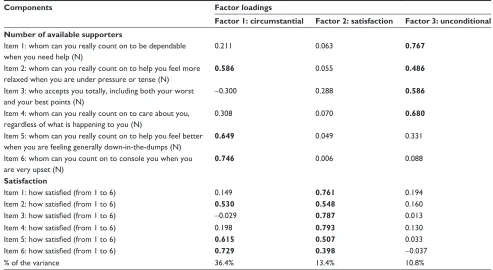
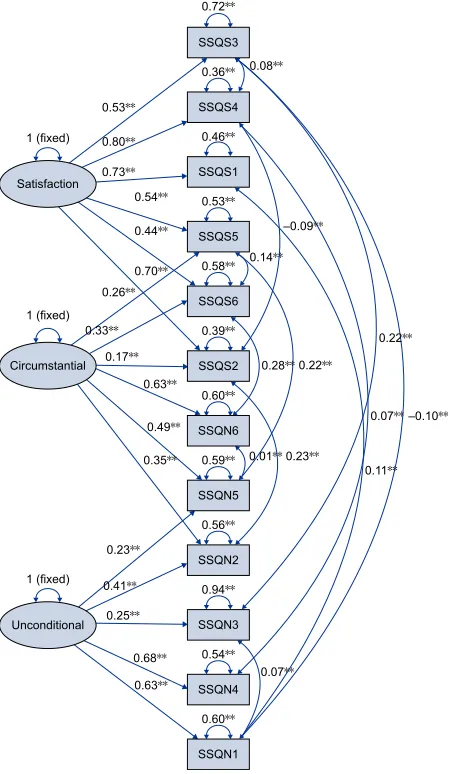
The EFA showed a three-factor solution in our population, which accounted for 60.6% of the total variance (Table 4). The SSQS items loaded to Factor 2 (satisfaction), except for questions 5 and 6 of SSQS that loaded to Factor 1 (circum-stantial). The SSQN items were distributed between Factor 1 (circumstantial) and Factor 3 (unconditional). Items 2, 5, and 6 of SSQN loaded to Factor 1 (circumstantial), while items 1, 3, and 4 loaded to Factor 3 (unconditional). Factors 1, 2, and 3 explained 36.4%, 13.4%, and 10.8% of the variance, respectively (Table 4). The results of the CFA confirmed the findings of the EFA indicating a three-factor model (Table 5; Figure 1). The first three-factor model we examined resulted in a comparative fit index (CFI) value of 0.9401, a SRMR of 0.0362, and RMSEA of 0.0394 (Table 5). Estimates of the loadings of the measures on each of the factors are presented in Figure 1. Table 6 shows the results of the bivariate correla-tions between SSQ-6 items.
Discussion
In our cohort, the SSQ-6 has good construct validity and reliability for assessing social support. We found that the Spanish-language version of the SSQ-6 had an overall Cronbach’s alpha of 0.83. The mean total SSQ-6 score was
39.6 ± 6.8, with a mean SSQN score of 8.2 ± 3.2 and mean
SSQS score of 31.4 ± 4.7. Previous studies had higher SSQN
Table 1 sociodemographic characteristics of pregnant women (n = 4,236)
Characteristics All participants (N = 4,236)
n %
age (years)a 28.1 ± 6.2
age (years)
18–19 233 5.5
20–29 2,355 55.6
30–34 914 21.6
$35 731 17.3
education (years)
#6 114 2.7
7–12 2,029 47.9
.12 2,075 49.0
Mestizo ethnicity 3,307 78.1
Married/living with a partner 3,460 81.7
employed 2,017 47.6
Difficulty paying for basics
Very hard/hard/somewhat hard 1,964 46.4
not very hard 2,261 53.4
Difficulty paying for medical care
Very hard/hard/somewhat hard 1,991 47.0
not very hard 2,216 52.3
nulliparous 2,025 47.9
Planned pregnancy 1,693 40.0
early pregnancy measured BMI (kg/m2)
,18.5 80 1.9
18.5–24.9 1,992 47.0
25–29.9 1,561 36.9
.30 558 13.2
gestational age (weeks)a at interview 10.3 ± 3.8
Total ssQ-6a 39.6 ± 6.8
ssQna 8.2 ± 3.2
ssQsa 31.4 ± 4.7
Note:aMean ± sD.
Abbreviations: BMI, body mass index; ssQ-6, social support Questionnaire – short Form; ssQn, social support Questionnaire-6 number score; ssQs, social support Questionnaire-6 satisfaction score.
Table 2 Reliability statistics – Cronbach’s alpha coefficients of reli ability of the spanish-language version of the ssQ-6 among pregnant women
Cronbach’s alpha No. of items All participants
cronbach’s alpha (total ssQ-6) 12 0.83
cronbach’s alpha ssQn 6 0.70
cronbach’s alpha ssQs 6 0.83
Abbreviations: ssQ-6, social support Questionnaire – short Form; ssQn, social support Questionnaire-6 number score; ssQs, social support Questionnaire-6 satisfaction score.
International Journal of Women's Health downloaded from https://www.dovepress.com/ by 118.70.13.36 on 23-Aug-2020
Dovepress
Friedman et al
and SSQS scores compared to our population. For example, in a French cohort of university undergraduates and unemployed
men, the mean total SSQN was 20.1 and SSQS was 28.1.21
In a study of university students in Spain, the mean was 4.96
per item for SSQN and 5.24 per item for SSQS.14
The SSQ-6 questionnaire was originally designed as a two-factor model. However, the EFA and CFA indicate that in our cohort the most appropriate model is a three-factor solu-tion. In contrast to our results, previous studies assessing the psychometric properties of the SSQ-6 reported a two-factor
Table 3 Item characteristics, item-total correlation, alpha if item deleted of the spanish-language version of the ssQ-6 among pregnant women (n = 4,236)
Components Range Mean SD Corrected
item-total correlation
Alpha if item deleted Number of available supporters
Item 1: whom can you really count on to be dependable when you need help (n) [0, 6] 1.63 0.95 0.41 0.82 Item 2: whom can you really count on to help you feel more relaxed when you are
under pressure or tense (n)
[0, 6] 1.00 0.72 0.52 0.81
Item 3: who accepts you totally, including both your worst and your best points (n) [0, 9] 2.36 1.33 0.18 0.84 Item 4: whom can you really count on to care about you, regardless of what is
happening to you (n)
[0, 6] 1.37 0.78 0.44 0.82
Item 5: whom can you really count on to help you feel better when you are feeling generally down-in-the-dumps (n)
[0, 5] 1.07 0.71 0.50 0.82
Item 6: whom can you count on to console you when you are very upset (n) [0, 4] 0.76 0.66 0.43 0.82
Satisfaction
Item 1: how satisfied (from 1 to 6) [1, 6] 5.39 0.97 0.54 0.81
Item 2: how satisfied (from 1 to 6) [1, 6] 5.05 1.21 0.64 0.80
Item 3: how satisfied (from 1 to 6) [1, 6] 5.52 0.73 0.38 0.83
Item 4: how satisfied (from 1 to 6) [1, 6] 5.42 0.89 0.57 0.81
Item 5: how satisfied (from 1 to 6) [1, 6] 5.16 1.16 0.62 0.81
Item 6: how satisfied (from 1 to 6) [1, 6] 4.86 1.30 0.61 0.81
Abbreviations: ssQ-6, social support Questionnaire – short Form; n, numbers.
Table 4 Factor loadings in exploratory factor analysis of the ssQ-6 among pregnant women (n = 4,236)
Components Factor loadings
Factor 1: circumstantial Factor 2: satisfaction Factor 3: unconditional Number of available supporters
Item 1: whom can you really count on to be dependable when you need help (n)
0.211 0.063 0.767
Item 2: whom can you really count on to help you feel more relaxed when you are under pressure or tense (n)
0.586 0.055 0.486
Item 3: who accepts you totally, including both your worst and your best points (n)
-0.300 0.288 0.586
Item 4: whom can you really count on to care about you, regardless of what is happening to you (n)
0.308 0.070 0.680
Item 5: whom can you really count on to help you feel better when you are feeling generally down-in-the-dumps (n)
0.649 0.049 0.331
Item 6: whom can you count on to console you when you are very upset (n)
0.746 0.006 0.088
Satisfaction
Item 1: how satisfied (from 1 to 6) 0.149 0.761 0.194
Item 2: how satisfied (from 1 to 6) 0.530 0.548 0.160
Item 3: how satisfied (from 1 to 6) -0.029 0.787 0.013
Item 4: how satisfied (from 1 to 6) 0.198 0.793 0.130
Item 5: how satisfied (from 1 to 6) 0.615 0.507 0.033
Item 6: how satisfied (from 1 to 6) 0.729 0.398 -0.037
% of the variance 36.4% 13.4% 10.8%
Notes: Pca with varimax rotation. Kaiser’s Msa: overall Msa = 0.77937029. Bartlett’s test of sphericity: p,0.0001. Bold entries indicate the outstanding components in Factor 1, 2, or 3 in the exploratory factor analysis.
Abbreviations: ssQ-6, social support Questionnaire – short Form; n, numbers; Pca, principal components analysis; Msa, measure of sampling adequacy.
International Journal of Women's Health downloaded from https://www.dovepress.com/ by 118.70.13.36 on 23-Aug-2020
Dovepress social support Questionnaire among pregnant women
model with all SSQS items loaded to one factor, and all SSQN items to another.20,21 An adaptation in a cohort of
Russian-speaking immigrants in Portugal (N = 555) did not account
for mean satisfaction and availability responses, but did find a two-factor structure to be the best fit and tested high for reli-ability.20 In the population of Russian-speaking immigrants,
the two factors extracted using a factor analysis were number of supporters and satisfaction with social support received.20
Similarly, in a French population of university students (N
= 348) and unemployed men (N = 304), the SSQ-6 yielded
the two factors of availability and satisfaction.21 A cohort of
Japanese pregnant women (N = 888) also showed a two-factor
model with number and satisfaction subscales.15
In our study, however, a three-factor model was more appropriate. We found the SSQ-6 number and satisfaction subscales were divided among the following three fac-tors: Factor 1 (circumstantial), Factor 2 (satisfaction), and Factor 3 (unconditional). The 6 items of SSQS all loaded to Factor 1 (circumstantial) or Factor 2 (satisfaction), and the 6 items of SSQN loaded to Factor 1 (circumstantial) or Factor 3 (unconditional). Significant portions of items 2, 5, and 6 of SSQS (How satisfied are you?) loaded to both Factor 1 (circumstantial) and Factor 2 (satisfaction) (Table 4). Corresponding items 2, 5, and 6 of the SSQN also loaded to Factor 1 (circumstantial). SSQN items 2, 5, and 6 each ask about social support during stressful or negative experi-ences (“Whom can you really count on to help you feel more relaxed when you are under pressure or tense?”, “Whom can you really count on to help you feel better when you are feeling generally down-in-the-dumps?”, and “Whom can you count on to console you when you are very upset?”). By contrast, SSQN items 1, 3, and 4 loaded to Factor 3 (unconditional) and ask about dependability and support in
6641 6641 6641 6641 6641 6641 6646 6646 6646 6646 6646 6646
8QFRQGLWLRQDO &LUFXPVWDQWLDO 6DWLVIDFWLRQ
±
±
IL[HG IL[HG IL[HG
Figure 1 Standardized regression weights for paths associated with the best fit model for the ssQ-6 (n = 4,236).
Note: **p#0.01.
Abbreviations: ssQ-6, social support Questionnaire – short Form; ssQn, social support Questionnaire-6 number score; ssQs, social support Questionnaire-6 satisfaction score.
both positive and negative circumstances (“Whom can you really count on to be dependable when you need help?”, “Who accepts you totally, including both your worst and your best points?” “Whom can you really count on to care about you, regardless of what is happening to you?”). Social support during stressful experiences may be especially impor-tant during pregnancy. Since our results are unique when compared to studies assessing the psychometric properties of the SSQ-6; additional studies should be done to analyze the factor structure in diverse obstetric populations.
Strengths and limitations
Our study has notable strengths, including a characterized study cohort and a large sample size, which allowed us to conduct a robust factor analysis. Our study
Table 5 Models evaluated for the SSQ6 and corresponding fit indices using confirmatory factor analysis (N = 4,236)
Models χ2 df CFI SRMR RMSEA all participants Two-factora 922.3322 47 0.7657 0.1032 0.0663
Three-factorb 257.9119 34 0.9401 0.0362 0.0394 Three-factorc 403.0094 36 0.9018 0.0544 0.0491 Three-factord 464.854 38 0.8858 0.0624 0.0515 Notes:aFactor 1: ssQn1, ssQn2, ssQn3, ssQn4, ssQn5, ssQn6; Factor 2:
ssQs1, ssQs2, ssQs3, ssQs4, ssQs5, ssQs6. bFactor 1: ssQn2, ssQn5, ssQn6,
ssQs2, ssQs5, ssQs6; Factor 2: ssQn1, ssQn2, ssQn3, ssQn4, ssQn5, ssQn6; Factor 3: ssQn1, ssQn2, ssQn3, ssQn4, ssQn5. cFactor 1: ssQn2, ssQn5,
ssQn6, ssQs2, ssQs5, ssQs6; Factor 2: ssQn1, ssQn2, ssQn3, ssQn4, ssQn5, ssQn6; Factor 3: ssQn1, ssQn2, ssQn3, ssQn4. dFactor 1: ssQn2, ssQn5,
ssQn6, ssQs2, ssQs5, ssQs6; Factor 2: ssQn1, ssQn2, ssQn3, ssQn4, ssQn5, ssQn6; Factor 3: ssQn1, ssQn3, ssQn4. cFa was done using weighted least-squares estimation.
Abbreviations: ssQ-6, social support Questionnaire – short Form; df, degrees of freedom; CFA, confirmatory factor analysis; CFI, comparative fit index; SRMR, standardized root mean residual; rMsea, root mean square error of approximation.
International Journal of Women's Health downloaded from https://www.dovepress.com/ by 118.70.13.36 on 23-Aug-2020
Dovepress
Friedman et al
Table 6 correlations between items of the ssQ-6 among pregnant women (n = 4,236)
Items SSQN1 SSQN2 SSQN3 SSQN4 SSQN5 SSQN6 SSQS1 SSQS2 SSQS3 SSQS4 SSQS5 SSQS6 SSQN1 1.000 0.401 0.224 0.439 0.303 0.192 0.295 0.255 0.008 0.205 0.214 0.197
SSQN2 0.401 1.000 0.084 0.403 0.431 0.385 0.209 0.554 0.081 0.211 0.312 0.339
SSQN3 0.224 0.084 1.000 0.163 0.083 0.019 0.150 0.048 0.273 0.121 0.041 0.017
SSQN4 0.439 0.403 0.163 1.000 0.353 0.253 0.203 0.272 0.088 0.275 0.232 0.241
SSQN5 0.303 0.431 0.083 0.353 1.000 0.427 0.188 0.304 0.094 0.210 0.531 0.342
SSQN6 0.192 0.385 0.019 0.253 0.427 1.000 0.148 0.281 0.093 0.160 0.299 0.593
SSQS1 0.295 0.209 0.150 0.203 0.188 0.148 1.000 0.502 0.423 0.623 0.407 0.356
SSQS2 0.255 0.554 0.048 0.272 0.304 0.281 0.502 1.000 0.339 0.491 0.543 0.524
SSQS3 0.008 0.081 0.273 0.088 0.094 0.093 0.423 0.339 1.000 0.489 0.321 0.285
SSQS4 0.205 0.211 0.121 0.275 0.210 0.160 0.623 0.491 0.489 1.000 0.479 0.394
SSQS5 0.214 0.312 0.041 0.232 0.531 0.299 0.407 0.543 0.321 0.479 1.000 0.597
SSQS6 0.197 0.339 0.017 0.241 0.342 0.593 0.356 0.524 0.285 0.394 0.597 1.000 Abbreviation: ssQ-6, social support Questionnaire – short Form; ssQn, social support Questionnaire-6 number score; ssQs, social support Questionnaire-6 satisfaction score.
also has some limitations. Given that all participants were pregnant women attending prenatal care at INMP, there is a strong possibility that our sample is not representative of other communities of pregnant women in Peru, specifically women identified as members of indigenous or rural com-munities. As a result, our study may not be generalizable to all Peruvians or other South American populations. Another limitation is that we were unable to evaluate criterion validity, as there is no diagnostic gold standard for measuring social support. Moreover, there is inherent difficulty in measuring temporal mental health, including social support. Stigma concerning the reporting mental health concerns may lead to disclosure and recall bias.
Conclusion
Our study is the first to assess the reliability and construct validity of the SSQ-6 among Peruvian pregnant women. Given the influence of social support in maternal and prenatal health, it is important to implement valid and reliable tools to measure social support. The SSQ-6 in our specific cohort resulted in a three-factor model with good construct valid-ity and reliabilvalid-ity. Additionally, the SSQ-6 may continue to serve as a research tool to measure social support among other cohorts of pregnant women, a population whose mental health is often at risk.
Acknowledgments
The authors wish to thank Ms Elena Sanchez and the dedi-cated staff members of Asociación Civil Proyectos en Salud (PROESA), Peru, and INMP, Peru, for their expert technical assistance with this research. This research was supported by awards from the National Institutes of Health (NIH), National Institute of Minority Health and Health Disparities (T37-MD-001449), and Eunice Kennedy Shriver National Institute of
Child Health and Human Development (R01-HD-059835). The NIH had no further role in study design; in the collection, analysis, and interpretation of data; in the writing of the report; and in the decision to submit the paper for publication.
Author contributions
LEF, BG, and MAW conceived and designed the study. QYZ, AKMP, GFSM, and LEF analyzed data. AKMP, GFSM, and LEF drafted the manuscript. All authors contrib-uted toward data analysis, drafting and revising the paper and agree to be accountable for all aspects of the work.
Disclosure
The authors report no conflicts of interest in this work.
References
1. Cohen S, Gottlieb BH, Underwood LG. Social relationships and health. In: Cohen S, Underwood LG, Gottlieb BH, editors. Social Support
Mea-surement and Intervention: A Guide for Health and Social Scientists.
New York, NY: Oxford University Press; 2000:1–2.
2. Orr ST. Social support and pregnancy outcome: a review of the literature.
Clin Obstet Gynecol. 2004;47(4):842–855.
3. Thoits PA. Mechanisms linking social ties and support to physical and mental health. J Health Soc Behav. 2011;52(2):145–161.
4. Strom JL, Egede LE. The impact of social support on outcomes in adult patients with type 2 diabetes: a systematic review. Curr Diab Rep. 2012;12(6):769–781.
5. Hernandez DC, Reitzel LR, Wetter DW, McNeill LH. Social sup-port and cardiovascular risk factors among black adults. Ethn Dis. 2014;24(4):444–450.
6. Mazzella F, Cacciatore F, Galizia G, et al. Social support and long-term mortality in the elderly: role of comorbidity. Arch Gerontol Geriatr. 2010;51(3):323–328.
7. Aktan NM. Social support and anxiety in pregnant and postpartum women: a secondary analysis. Clin Nurs Res. 2012;21(2):183–194. 8. Agostini F, Neri E, Salvatori P, Dellabartola S, Bozicevic L, Monti F.
Antenatal depressive symptoms associated with specific life events and sources of social support among Italian women. Matern Child Health J. 2015;19(5):1131–1141.
International Journal of Women's Health downloaded from https://www.dovepress.com/ by 118.70.13.36 on 23-Aug-2020
International Journal of Women’s Health
Publish your work in this journal
Submit your manuscript here: http://www.dovepress.com/international-journal-of-womens-health-journal
The International Journal of Women’s Health is an international, peer-reviewed open-access journal publishing original research, reports, editorials, reviews and commentaries on all aspects of women’s healthcare including gynecology, obstetrics, and breast cancer. The manuscript management system is completely online and includes
a very quick and fair peer-review system, which is all easy to use. Visit http://www.dovepress.com/testimonials.php to read real quotes from published authors.
Dovepress
Dove
press
social support Questionnaire among pregnant women
9. Heh SS. Relationship between social support and postnatal depression.
Kaohsiung J Med Sci. 2003;19(10):491–496.
10. Pagel MD, Smilkstein G, Regen H, Montano D. Psychosocial influences on new born outcomes: a controlled prospective study. Soc Sci Med. 1990;30(5):597–604.
11. Feldman PJ, Dunkel-Schetter C, Sandman CA, Wadhwa PD. Maternal social support predicts birth weight and fetal growth in human preg-nancy. Psychosom Med. 2000;63(5):715–725.
12. Hetherington E, Doktorchik C, Premji SS, McDonald SW, Tough SC, Sauve RS. Preterm birth and social support during pregnancy: a system-atic review and meta-analysis. Paediatr Perinat Epidemiol. 2015;29(6): 523–535.
13. Sarason IG, Sarason BR, Shearin EN, Pierce GR. A brief measure of social support: practical and theoretical implications. J Soc Pers Relat. 1987;4(4):497–510.
14. Martínez-López Z, Páramo Fernández MF, Guisande Couñago MA, et al. Apoyo social en universitarios españoles de primer año: propie-dades psicométricas del Social Support Questionnaire-Short Form y el Social Provisions Scale. [Social support in Spanish first year university students: Psychometrics properties of the Social Support Questionnaire-Short Form and the Social Provisions Scale]. Rev Lat
Psic. 2014;46(2):102–110. Spanish.
15. Morikawa M, Okada T, Ando M, et al. Relationship between social support during pregnancy and postpartum depressive state: a prospec-tive cohort study. Sci Rep. 2015;5:10520.
16. Friedman LE, Gelaye B, Rondon MB, Sanchez SE, Peterlin BL, Williams MA. Association of migraine headaches with suicidal ideation among pregnant women in Lima, Peru. Headache. 2016;56(4):741–749. 17. Barrios YV, Gelaye B, Zhong Q, et al. Association of childhood
physical and sexual abuse with intimate partner violence, poor general health and depressive symptoms among pregnant women. PLoS One. 2015;10(1):e0116609.
18. Gelaye B, Barrios YV, Zhong QY, et al. Association of poor subjective sleep quality with suicidal ideation among pregnant Peruvian women.
Gen Hosp Psychiatry. 2015;37(5):441–447.
19. Sarason I, Levine H, Basham R, Sarason B. Assessing social support: The Social Support Questionnaire. J Personal Soc Psychol. 1983; 44(1):127–139.
20. Monteiro AP. Psychometric properties of a Russian version of the Social Support Questionnaire (SSQ6) in eastern European immigrants.
Contemp Nurse. 2011;39(2):157–162.
21. Rascle N, Bruchon-Schweitzer M, Sarason IG. Short form of Sarason’s Social Support Questionnaire: French adaptation and validation.
Psychol Rep. 2005;97(1):195–202.
22. Brown TA. Confirmatory Factor Analysis for Applied Research. New York, NY: Guilford Press; 2006.
International Journal of Women's Health downloaded from https://www.dovepress.com/ by 118.70.13.36 on 23-Aug-2020