Delayed neutron emission near the shell-closures
Ivan Borzov1,a
1Bogoliubov Laboratory of Theoretical Physics, JINR, 141980 Dubna, Moscow region, Russia
Abstract. The self-consistent Density Functional+Continuum QRPA approach (DF+CQRPA) provides a good description of the recent experimental beta-decay half-lives and delayed neutron emission branchings for the nuclei approaching to (and beyond) the neutron closed shellsN = 28,50,82. Predictions of beta-decay properties are more reliable than the ones of standard global approaches traditionally used for ther-process modelling. An impact of the quasi-particle phonon coupling on the delayed multi-neutron emission ratesP2n,
P3n, ...near the closed shells is also discussed.
1 Introduction
The β-decay half-lives and β-delayed neutron emission probabilities of very neutron-rich nuclei are of great value for nuclear structure theory. Reliable masses and beta-rates of extremely neutron-rich nuclei are indispensable for ther-process modeling. Accurate beta-decay data on the fission products are important for safety studies of ad-vanced nuclear reactors.
A purely integral quantities,β-decay half-lives andβ -delayed neutron emission probabilities, give an insight to isospin response of nuclei far from the stability. A combined analysis of totalβ-decay half-lives and multi-neutron emission rates (Pxn-values) enables one to
recon-struct the beta-strength functions carrying back informa-tion on the nuclear density funcinforma-tional at high isospin-asymmetry regime. The beta-decay studies show that not only the neutron-halo nuclei near the drip-line reveal the features of weakly bound open quantum systems. Simi-lar effects arise in neutron-rich nuclei because of “shell-erosion” induced by proton-neutron tensor interaction.
A substantial amount of more precise β-decay data on the fission and fragmentation products are expected to come from the acting radioactive beam facilities: ISOLDE-CERN, ALTO, RIKEN, TRIUMF, NSCL, as well as constructed FAIR, Spiral-2, HIE-CERN facilities. An importance of this field has been stated in the IAEA Project of creating new data base of the beta-decay and delayed neutron emission rates [1]. It will acquire accu-rate experimental data and theoretical predictions for nu-clides beyond the reach of existing or planned facilities. In this respect, the fully microscopic models are of a special importance, as they ensure more reliable extrapolation of nuclear data to extremeN/Zratios.
Based on the self-consistent description of the ground state properties within the local energy-density functional theory [2], the approach to the large-scale continuum
ae-mail: [email protected]
quasi-particle random phase approximation (QRPA) cal-culations of the allowed Gamow-Teller (GT) and first-forbidden (FF) beta decays has been developed in [3]. In the report, the ground state properties and half-lives as well as delayed neutron-emission rates of (near) spheri-cal nuclides near the neutron closed shellsN =28,50,82 is presented and compared with the recent experimental data [4–7]. Comparison with the standard global Finite Range Droplet Model (FRDM) [8] used for the astrophys-ical modeling is also be done. An emphasis is made on the constraints imposed by the half-lives as well as delayed neutron-emission rates on the beta-decay strength func-tions. A possible impact of the quasi-particle phonon cou-pling [9, 10] on the delayed multi-neutron emission rates
P2n,P3n, ...near the closed shells is discussed as well.
2 Theoretical background
The self-consistent model for the GT and first-forbidden decays has been developed in [3] in which a detailed de-scription and comparison with existing semi-microscopic global models can be found. The DF+CQRPA model treats the ground state and β-decay properties of (quasi)spherical nuclei.
1. The ground state properties are derived self-consis-tently in the energy-density functional theory. The present framework also exploits a new functional DF3a [11] and has a provision to fix (before variation) the ground state spin-parity of the parent (daughter) isobaric compan-ion [4].
2. For excited states we follow an approximate treat-ment [3] in which the scalar and spin-isospin components of the DF can be approximately decoupled. This allows for independent nucleon-nucleon (NN) interactions in the scalar and spin-isospin channels. The strength parameters are considered as universal (A-independent) constants.
3. Theβ-strength functions are calculated within the continuum QRPA of the finite Fermi system theory. For
the spin-isospin effective NN-interaction in the p-h chan-nel a finite-rangeδ+π+ρform is assumed. The nuclear medium modified one-π and one-ρexchange terms, are important for the spin-isospin responses [3].
4. The correlations beyond the QRPA are included by re-scaling the spin-dependent multipole operators by the same energy-independent quenching factor Q1/2 =
(gA/GA). The one-pion component of the residual
inter-action is quenched by the same factorQ.
5. For the calculation of theβ-decay half-lives we have considered allowed and first-forbidden transitions treated in terms of the reduced multipole operators depending on the space and spin variables [3].
6. The DF+CQRPA framework was successfully used for calculations of the beta-decay half-lives [3] and mag-netic moments [12].
7. For a simple estimate of an impact of the np− nh configurations on the β-strength functions, we use a spreading width of excitationsΓ↓≈αωas in [13]. Also we studied an influence of quasiparticle-phonon coupling in-cluded via finite rank separable approximation (FRSA) [9, 10].
3 Results
Below the performance of the DF+CQRPA approach is exemplified. The main features of theβ-decay and multi-neutron emission rates are described for the isotopes near the magic shell-closures in the neutron-rich sector.
3.1 48Ca region
The region ofZ∼0, N>28 is of great interest in the view of new experimental possibilities opened at FLNR, JINR for exploiting the Ca beams. In Fig. 1, the integral beta-decay characteristics calculated from the DF3+CQRPA beta-strength functions are compared with the recent data for the potassium isotopes. The experimental β-decay half-lives and totalPnvalues are reasonably well described
by our model.The experimentally observed drop of thePn
value atA =50 is related to occurrence of the additional first-forbidden transitions mediated by the odd-particles in the course of filling of theN =32 and 34 subshells. Fur-ther steady increase of thePnvalue is due to the impact of
strong GT decays built on theν1f7/2-π1f7/2transitions.
3.2 Nuclei belowZ=28shell
The Co isotopes withN 50 are a clean case for which the beta-decay characteristics are defined by the Gamow-Teller strength function. In Fig. 2, we show the GT strength distribution for74Co (in terms of log(ft) values).
Importantly, the resultingT1/2andPnvalues are very
sen-sitive to the GT strength near the one-neutron separation energy.
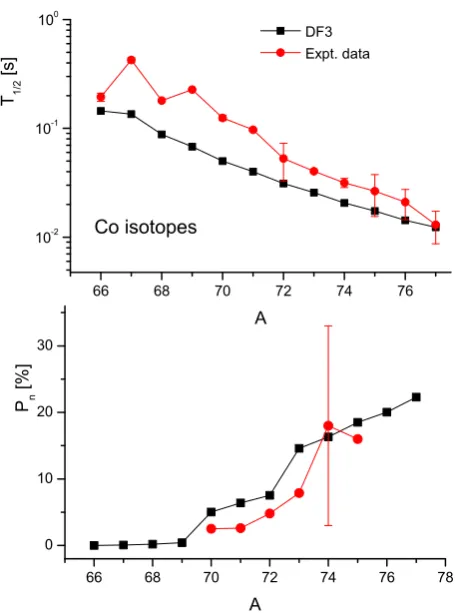
As seen from Fig. 3, our calculations underestimate the half-lives and overestimate a bit thePnvalues. In general,
a very regular A-dependence of the calculated beta-decay observables agrees with the data and confirms a predom-inantly Gamow-Teller character of the beta-decay in this isotopic chain.
Figure 1. (Color online) Beta-decay half-lives and totalPn
val-ues for the K (potassium) isotopic chain. The experimental data have been obtained from the NUBASE evaluation [14]. The data of Ref. [15] are also shown.
Figure 2. (Color online) The Gamow-Teller strength function for the decay of the74Co parent nucleus.
3.3 78Ni region
The most neutron-rich region of the nuclear chart in vicin-ity of78Ni may serve as a laboratory for exploring nuclear
structure under extreme conditions. TheZ∼28 isotopes
be-yondN=50 may be affected by weakened neutron binding due to the ground-state spin inversion and possible exis-tence of new neutron shell closuresN =56−58. An ex-istence of neutron-halo structures is not excluded reveal-ing unusual features of weakly bound open quantum sys-tem. These structural changes naturally impact the beta-strength function.
An evidence for new spherical subshell closure at
N=58 was experimentally obtained recently for 83−86Ga
isotopes [4, 5]. This subshell formed of two nearly degen-erated orbitals may originate from migration of the neu-tron 2d5/2 and 3s1/2orbitals causing a reduction ofN=50
shell gap and some weakening of the 78Ni doubly-magic
core. Another peculiarity of this region is that the
Figure 3.(Color online) Theβ-decay half-lives and totalPn
val-ues for the Co isotopic chain. Experimental data are taken from Refs. [6, 14].
proton tensor interaction triggers a crossing of the proton 2p3/2and 1f5/2 levels for nuclei beyondZ =28.
Result-ing ground-state spin inversion has well been confirmed in magnetic moment measurements for Cu isotopes (see Ref. [12]).
Studying the β-decay of very neutron-rich nuclides withN>50 in vicinity of the78Ni one meets with another
difficulty. After crossing the closed neutron shells the neu-trons fill positive parity orbitals while protons occupy neg-ative parity orbitals and the first-forbidden transitions be-come possible. The share of the FF decays to the total half-life increases substantially for isotopes beyond theN=50 shell. Clearly, in the scheme including both the GT and FF decays, the total half-lives for Ga chain atN>50 depend on the ordering of the orbitals in the neutron (N =58) as well as proton subshells. Additional measurements of the delayed multi-neutron probabilities would have provided us with important information on the beta-strength distri-butions within the sub-spaces corresponding to emission ofn=0,1,2 etc neutrons.
Below we discuss the case of 86Ga: the most
“pow-erful” 2nemitter in medium heavy nuclei region (P2n =
20±10% [16]). The "DF3a+CQRPA" model is extended to account for spin inversion in the78Ni region. The
ap-proach is consistent with the systematics of the spin-parity of the ground states of Cu isotopes (understood as driven by the neutron-proton interaction when filling theν1g9/2
Figure 4. (Color online) The Gamow-Tellerβ-decay strength functions for86Ga plotted as a function of transition energy.
shell [17]). The calculation fixing the ground state to
π1f5/2 single-particle state reproduces both 81−84Ga and
new86Ga half-lives. No local adjustment was made.
Description of thePxnvalues in86Ga is more difficult.
They are mostly determined by the GT strength function, since the FF strengths (ΔJ = 0,1,2) being concentrated at the excitation energies below S1n (transition energies
higher the Qβn). As seen from Fig. 4, our CQRPA
cal-culation shows some deficiency of the GT strength within one-neutron emission sub-space. This is due to neglect of the GT strength fragmentation which may be caused by the effects beyond the simple 1p−1hdescription and by deformation (both are not included in the DF3a+CQRPA model).
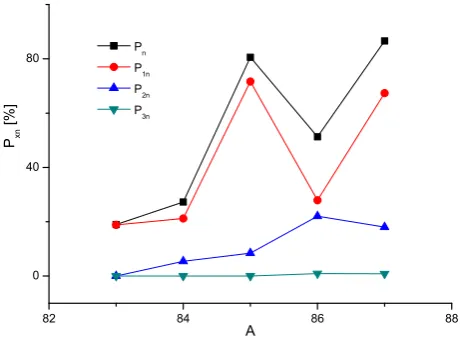
For the Ga isotope chain we estimated an impact of thenp−nhconfigurations beyond the CQRPA via spread-ing widthΓ↓ ≈ αω, as suggested in Ref. [13]. Includ-ing the spreadInclud-ing (Figs. 5-7) makes the half-lives shorter and closer to the data [5], total Pn values increase, and
the Pxn values are nowP1n = 28% > P2n = 22% [16].
This is a strong argument in favour of accounting for a quasiparticle-phonon coupling.
3.4 132Sn region
In 132Sn region the GT and FF decays contribute diff
er-ently to the beta-decay rates for theZ < 50 andZ > 50 isotopes. The intensive GT decays in the Z < 50 nu-clei mostly correspond to the (ν1g7/2,π1g9/2)
configura-tion. The high-energy GT decays contribute strongly to the total half-lives of the nuclei with Z < 50, N < 82. Then at N > 82, the high-energy first-forbidden decays become opened which are mainly related to the (ν1h11/2,
π1g9/2) configuration. In Fig. 8, we exemplify the above
said for the Pd isotopic chain. Importantly, the 1p−1h
Figure 5. (Color online) Theβ-decay half-lives for the Ga iso-topic chain calculated without and with inclusion of the spread-ing width. The experimental data are taken from Refs. [5, 14, 16].
Figure 6. (Color online) The total delayed neutron emission probabilities for the Ga isotopic chain calculated without (PnMIN)
and with inclusion of the spreading width (PnMAX).
Figure 7.(Color online) TheP1n,2n,3nand totalPnemission
prob-abilities for the Ga isotopic chain calculated with inclusion of the spreading width.
Figure 8.(Color online) Beta-decay half-lives for the Pd isotopic chain. These results are compared to the data [7, 14, 19] and half-lives based on the FRDM [8], the FRSA model including both the tensor interaction and 2p−2hconfiguration effects [10], the shell model (SM) [20].
As for nuclei beyondZ=50 theπ1g9/2orbital is fully
occupied, the GT transitions are related to low-energy (ν1g7/2, π1g7/2) configuration. Due to the phase space
effect, the higher energy forbidden transitions which are opened at N > 82 and related to the (ν2f7/2, π1g7/2),
(ν1f7/2, π2d5/2) configurations dominate the total
half-lives. Though, for nuclei withZ >52 andN>82,π1g9/2
orbital is partially de-blocked due to pairing correlations, the GT transition strength is quenched by the occupancy factor of the proton level (1−v2π1g9/2).
Probably, the most striking example of half-life reduc-tion due to high-energy forbidden transireduc-tions is the kink at134Sb (N > 82) in Fig. 9. Notice, that our calculated
half-lives are in rather good agreement with the data. For instance, in136Sb theT
1/2 = 0.80 s which is rather close
to the experimental valueT1/2 =0.923±0.014 s, as the
FRDM [8] gives a factor 5 longer half-life.
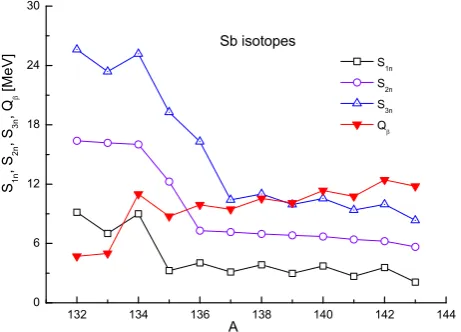
In Fig. 10, we display theQβvalues for the Sb isotopes beta-decay and neutron emission thresholds in the daugh-ter nuclei (Sxn) calculated with the DF3 functional. One
may conclude that two-neutron emission forA>135 and three neutron emission forA>138 are possible. However, compared toZ <50 isotopes, the delayed neutron emis-sion branching should be rather suppressed in the Sb iso-topes due to the fact that the dominating FF transitions undergo outside theQβnwindow. Another complication is
that thePxn values are extremely sensitive to theSxn
val-ues. Possible redistribution of the beta-strengths near the multi-neutron emission thresholds due to quasiparticle-phonon coupling is that counts. As seen from Fig. 11, in the136Sb isotope increasing theQβ
nvalue or
decreas-ing the Qβ2n thresholds by about 0.5 MeV would have
changed theP1nandP2nvalues considerably. One has to
mention that the accuracy of our calculation of the Qβxn
values is about 0.5-1 MeV. For instance, in136Sb our
Figure 9. (Color online) Beta-decay half-lives for the Sb iso-topic chain. The experimental half-lives were obtained from the NUBASE evaluation [14].
Figure 10. (Color online)Qβvalues and the neutron emission thresholds in daughter nuclei for the Sb isotopes beta-decay.
from 3.1% to 5.2%. The experimental values [14] are: Pn=16.3±0.32% andP2n =0.26±0.02%. In the
photo-fission measurements at JINR, Dubna [21] it was reported
P2n=2.0±0.2%.
4 Summary
With the universal set of the NN-interaction parameters the self-consistent approach to nuclear beta-decay [3] re-liably describes both ground-state properties and small amplitude nuclear spin dynamics of (quasi)spherical nu-clei in a wide region of the nuclear chart. Microscopic treatment of the GT and FF beta-decays within the sin-gle DF+CQRPA framework makes it possible to explain a number of peculiar effects observed in the beta-decay and delayed neutron emission of very neutron-rich nuclei beyond the closed neutron shells. Further extension of the self-consistent DF+CQRPA is related to description of de-formed nuclei [22]. Due to a deficiency in extrapolating
Figure 11.(Color online) The strength functions for the GT and FF decays in136Sb (plotted in terms of the transition energy)
the model parameters (defined near the line of stability), predictions of semi-empirical and schematic global mod-els should always be taken with some reservation for un-stable isotopes near the shell-closures.
The search for delayed multi-neutron emission at JINR, GSI, ALTO, HRIBF and RIKEN would be promis-ing in the region beyond 48Ca (K, Ca, Sc isotopes with N>30). It is expected to be more favorable (though more difficult) forZ<50 (Ag, Cd, In isotopes) than forZ50 (Sn, Sb, Te isotopes). The dedicated (β−n) and (β−n−γ) experiments at JINR, GSI, HRIBF, ALTO, RIKEN us-ing fragmentation reactions and post-accelerated beams at FRIB facilities are indispensable for testing the nuclear structure models far offstability.
References
[1] D. Abriola et al., IAEA Report, INDC(NDS)-0599 (IAEA, Vienna, 2011)
[2] S.A. Fayanset al., Nucl. Phys. A676, 49 (2000) [3] I.N. Borzov, Phys. Rev. C67, 025802 (2003) [4] J. Wingeret al., Phys. Rev. Lett.102, 142502 (2009) [5] M. Madurga et al., Phys. Rev. Lett. 109, 112501
(2012)
[6] Z.Y. Xuet al., Phys. Rev. Lett.113, 032505 (2014) [7] G. Lorussoet al., Phys. Rev. Lett.114,192501 (2015) [8] P. Mölleret al., Phys. Rev. C67, 055802 (2003) [9] A.P. Severyukhin et al., Phys. Rev. C 90, 044320
(2014)
[10] A.P. Severyukhin et al., J. Phys.: Conf. Ser. 580, 012051 (2015)
[11] S.V. Tolokonnikov and E.E. Saperstein, Phys. At. Nucl.73, 1684 (2010)
[17] J. Wingeret al., Phys. Rev. C81, 044303 (2010) [18] I.N. Borzovet al., Nucl. Phys. A814, 159 (2008) [19] F. Monteset al., Phys. Rev. C73, 035801 (2006) [20] J.J. Cuenca-García et al., Eur. Phys. J. A 34, 99
(2007)
[21] Yu.P. Gangrskyet al., JINR preprint, P3-2004-125, JINR, Dubna, 2004.
[22] S.V. Tolokonnikovet al., J. Phys. G: Nucl. Part. Phys.
42, 075102 (2015)