INFLUENCE OF FAMILY BREAKDOWN ON PRE PRIMARY SCHOOL CHILDREN’S LEARNING OUTCOMES IN KIAMBU COUNTY, KENYA
BY
GATURA PASAKA NGINA E55/0L/23097/2013
A RESEARCH PROJECT SUBMITTED IN PARTIAL FULFILLMENT OF THE REQUIREMENTS FOR THE AWARD OF DEGREE OF MASTER OF EDUCATION (EARLY CHILDHOOD EDUCATION) IN THE SCHOOL OF
EDUCATION OF KENYATTA UNIVERSITY
ii
DECLARATION
I declare that this project is my original work and has not been presented in any other university or institution for consideration. This research project has been complemented by referenced sources properly acknowledged. Where text, data, graphics, pictures or tables have been borrowed from other sources, including the internet, these are specifically accredited and references cited in accordance with anti-plagiarism regulations.
Signature: ___________________________________Date____________________ Gatura Pasaka Ngina
E55/OL//23097/2013
Supervisors: This research project has been submitted with my approval as University Supervisor.
Signature: __________________________________Date_____________________ Dr. Juliet W. Mugo
iii
DEDICATION
iv
ACKNOWLEDGEMENT
v
ABBREVIATIONS AND ACRONYMS AIDS Acquired Immune Deficiency Syndrome ECD Early Childhood Development
ECDE Early Childhood Development Education
HIV Human Immunodeficiency Virus
KCPE Kenya Certificate of Primary Education
KU Kenyatta University
MoEST Ministry of Education Science &Technology
NACADA National Council against Drug Abuse
NACOSTI National Commission for Science Technology and Innovation PTE Primary Teacher Education
vi
TABLE OF CONTENTS
DECLARATION... ii
DEDICATION... iii
ACKNOWLEDGEMENT ... iv
ABBREVIATIONS AND ACRONYMS ...v
LIST OF TABLES ...x
LIST OF FIGURES ... xi
ABSTRACT ... xii
CHAPTER ONE: INTRODUCTION AND BACKGROUND TO THE STUDY ...1
1.0 Introduction ...1
1.1 Background to the Study ...1
1.2 Statement of the Problem ...9
1.3 Purpose of the Study ...10
1.4 Objectives of the Study ...10
1.5 Significance of the Study ...11
1.6 Limitations and Delimitations of the Study ...12
1.6.1 Limitations of the Study...12
1.6.2 Delimitation of the Study ...12
1.7 Assumptions of the Study ...13
1.8 Theoretical Framework ...13
1.9 Conceptual Framework ...16
1.10 Operational Definition of Terms ...19
CHAPTER TWO: REVIEW OF RELATED LITERATURE ...20
2.0 Introduction ...20
2.1 Prevalence/ Rate of Family Breakdown ...20
2.2 Factors Responsible for Family Breakdown ...22
2.2.1 Infidelity ...22
2.2.2 Financial Hardships ...23
vii
2.2.4 Alcohol and Substance Abuse ...24
2.2.5 Domestic Violence ...25
2.3 Relationship between Family Breakdown and Children’s Learning Outcomes ...26
2.4 Extent of Family Breakdown on Learning Outcomes of Preschool Children ...30
2.5 Role of Pre-Primary School Teachers in Assisting Children affected by Family Breakdown ...31
2.6 Summary of Literature Reviewed ...32
CHAPTER THREE: RESEARCH DESIGN AND METHODOLOGY ...34
3.0 Introduction ...34
3.1 Research design ...34
3.1.1 Variables ...34
3.2 Location of the Study ...35
3.3 Target Population ...36
3.4 Sampling Technique and Sample Size ...36
3.4.1 Sampling Technique ...36
3.4.2 Sample Size ...38
3.5 Research Instruments ...38
3.5.1 Questionnaires...39
3.5.2 Interview Schedule...39
3.6 Pilot Study ...39
3.6.1 Validity ...40
3.6.2 Reliability ...40
3.7 Data Collection Techniques ...41
3.8 Data Analysis ...42
3.9 Logistical and Ethical Considerations ...43
3.9.1 Logistical Considerations...43
3.9.2 Ethical Considerations ...43
CHAPTER FOUR: RESEARCH FINDINGS AND DISCUSSIONS ...45
viii
4.2 Response Rate of Study Participants ...45
4.3 Demographic Information of Parents and Teachers ...47
4.3.1 Distribution of Parents’ by Gender ...47
4.3.2 Distribution of Parents by Occupation ...48
4.3.3 Number of Children per Parent ...49
4.3.4 Distribution of Teachers by Gender ...50
4.3.5 Distribution of Teachers by Age ...51
4.3.6 Distribution of Teachers by Training ...51
4.4 Prevalence of Broken Families in Limuru Zone, Limuru Sub-county ...52
4.5 Factors Responsible For Influencing Family Breakdown in Limuru Zone ...55
4.6 Relationship between Family Breakdown and Pre-Primary School Children’s Learning Outcomes ...59
4.7 Difference between Learning Outcomes of Boys and Girls from Broken Families ....68
4.8 The Role of Pre-Primary School Teachers in Assisting Children affected by Family Breakdown ...72
CHAPTER FIVE: SUMMARY, CONCLUSIONS AND RECOMMENDATIONS .77 5.0 Introduction ...77
5.1 Summary of Research Findings ...77
5.1.1 The Prevalence of Broken Families and Pre-Primary School Children’s Learning Outcomes ...77
5.1.2 Factors Responsible for Family Breakdown and Pre-Primary School Children’s Learning Outcomes……… 78
5.1.3 The Relationship between Family Breakdown and Pre-Primary School Children’s Learning Outcomes ...79
5.1.4 Difference in Learning Outcomes between Boys and Girls from Broken Families79 5.1.5 The Role of Pre-Primary School Teachers in Assisting Children from Broken Families ...80
5.2 Conclusions ...81
5.3 Recommendations ...82
ix
5.3.2 Recommendation for Parents ...84
5.4 Recommendations for Further Research ...84
REFERENCES ...85
APPENDICIES ...88
Appendix i: Questionnaire For Parents ...88
Appendix ii: Interview Schedule For Teachers ...92
Appendix iv: Research Authorization; Kiambu County Commissioner...98
x
LIST OF TABLES
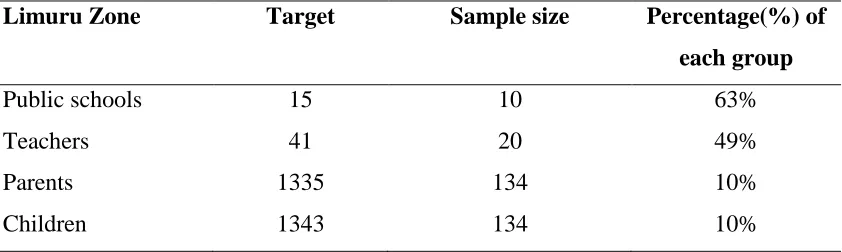
Table 3.1 : Sampling Frame ...38
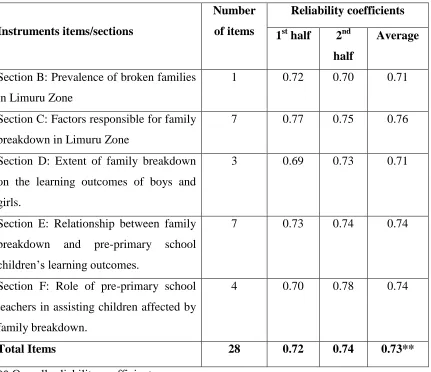
Table 3.2 : Split-Half Reliability Coefficient ...41
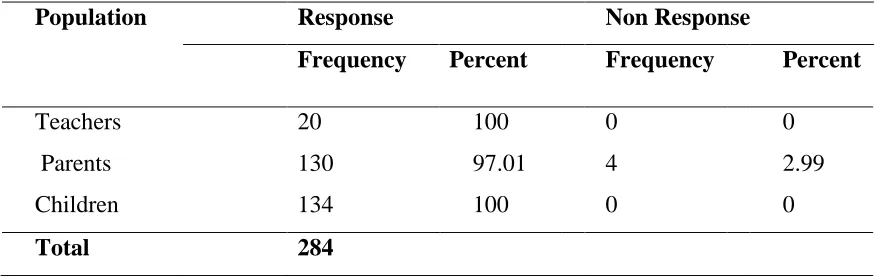
Table 4.1 : Distribution Table on Study Participants’ Response Rate ...46
Table 4.2 : Prevalence of Broken Families ...53
Table 4.3 : Teachers’ Responses on Number of Type of Families in Limuru Zone ...54
Table 4.4: Relationship between Family Breakdown and Learning Outcomes of Pre-primary School Children ...62
Table 4.5: Teachers Response on Effect of Divorce on Children’s Learning Outcomes ..63
Table 4.6 : Teachers Response on Involvement of Separated/Divorced Parents in Learning ...64
Table 4.7:Teachers Response on Level of Parental Involvement in Learning ...65
Table 4.8 : Correlation between Family Breakdown and Pre-Primary School Children’s Level of Learning Outcomes ...67
Table 4.9 : Parents Response on Effects of Family Breakdown on Boys and Girls ...68
Table 4.10: Teachers response on Learning Outcomes of Boys and Girls from Broken Families ...69
Table 4.11: Independent Samples T-test for Equality of Means by Gender ...71
xi
LIST OF FIGURES
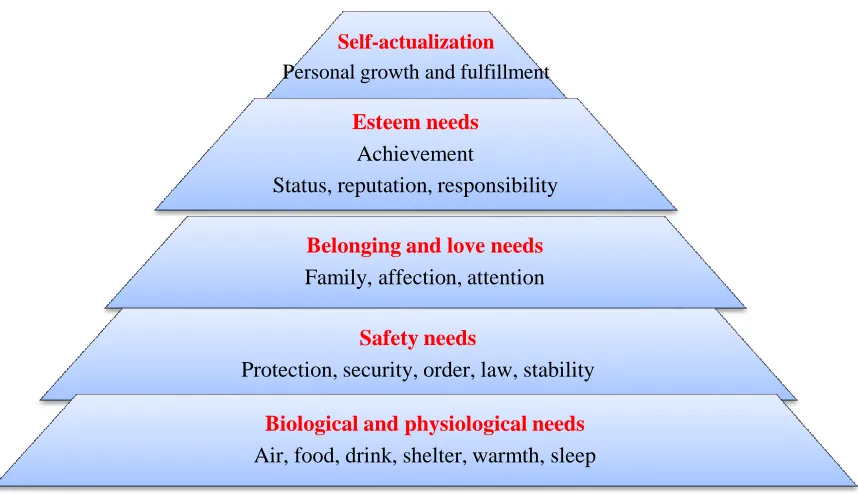
Figure 1.1 : Maslow's Hierarchy of Needs ...15
Figure 1.2: Conceptual Diagram Showing Relationship between Family Breakdown and Children’s Learning Outcomes ...17
Figure 4.1: Number of Parents of Pre Primary School Children by Gender ...47
Figure 4.2: Number of Parents’ of Preprimary School Children by Occupation...48
Figure 4.3: Number of Pre-primary School Children per Divorced/ Separated Parents ...49
Figure 4.4: Number of Pre-Primary School Teachers by Gender ...50
Figure 4.5: Pre-primary Teachers’ Age ...51
Figure 4.6 :Number of Pre-primary School Teachers by Level of Training ...52
Figure 4.7 Factors Responsible for Family Breakdown ...55
Figure 4.8: Learning Outcomes of Children in Activity Areas after Separation/Divorce .60 Figure 4.9: Role of Pre-Primary School Teachers ...72
xii ABSTRACT
1
CHAPTER ONE
INTRODUCTION AND BACKGROUND TO THE STUDY 1.0 Introduction
This chapter discusses the background to the study related to family breakdown and its influence on pre-primary school children’s learning outcomes, the Statement of the problem, purpose of the study, limitations and delimitations, assumptions of the study, theoretical frame work, conceptual frame work and operational definition of terms.
1.1 Background to the Study
2
A study on children’s adjustment in a broken family done by Fagan (1991) showed that most parents are not able to attend to the children’s needs immediately after divorce and separation as it destroys the relationship between parents and children. Sadly there is a distance created between parents and their children and the emotional distance could go into adulthood. According to Pong, Dronkers & Hampden-Thompson (2003), children in such circumstance are not likely to achieve educational attainment and are likely to show behavioral problems as well. However, children from intact families usually have greater educational attainment and are not likely to show behavioral problems in their school. Their parents are mostly concerned with their children’s school tasks and have greater expectations for them. Barona (2013) further explains that single or divorced parents however committed they may be, are not able to help their children realize their full potential in life more so in their learning. Flenderson (2009) reports that due to family conflicts and breakdown the child may be pre-occupied with worries at home and may not be able to fully get involved in school activities which negatively affect their learning outcomes.
3
to their babies. Studies on children with responsive fathers revealed that they scored higher in their socio-emotional behavior in terms of empathizing with others than those who did not have responsive fathers. Responsive fathers in intact families usually play with their children and provide a safe but challenging environment for their children, teaching them how to relate with the others and what is expected of them in the society. They are also more actively engaged in their children’s education as they help their children in doing homework. Children with fathers who offer financial assistance have a chance of getting better instructive resources and advanced opportunities to learn. This has positive impact on children’s cognitive development and thinking skills.
4
educated, low income Caucasians, family disintegration has become the norm as Barone (2013) shows.
Flenderson (2009) continues to explain that deteriorating economic conditions and decreased welfare support are responsible for undermining the family. But evidence to relate family breakdown with economic factors is decidedly mixed. Victor Fuchs and Diane Reglis (1992) suggest that when monetary growth slows down, government expenses on family interests rise, thereby extenuating to a degree at least, the financial effects on families. In the pre modernized society of the First World the weight was on the requirements of the person rather than the group. As a result, even marriage was seen as shaky. If a spouse felt their desires were not met he or she was free to terminate the marriage. The home, earlier on was a shelter from a harsh environment, which at times was found to be dangerous. Some communities felt that the presence of women into the economy has brought about family breakdown. Even if we view the extended family of the growing countries, or the nuclear family of the industrial ones, what is in both is an increase in its breakdown.
5
for women in their forties in some countries like the Dominican Republic, Ghana, Indonesia and Senegal. Divorce rates were 55:100 in the United States in 1990 and had increased twice over since 1970 in the UK, Canada, France and Germany. In 1990, children born outside marriage were 1 per cent in Japan, 27 % in Kenya, 33% in Northern Europe, and 70 % in Botswana as Diane Reglis (1992) shows.
The world’s view of the 1960s and 1970s in First World countries was that increased separation and divorce, children born out of marriage, blended families and single parents did not indicate that families were reducing. On the contrary, in the 1980s and 1990s research has shown that divorce and single parenthood does have harmful penalty for both children and women and that the family organization is a need for proper maturity of children. A research in the United States showed that children being brought up outside biological, two-parent families were most likely to have low performance in school, were twice as probable to be single parents, and one-and-a-half times certain to stay for a long period of time without a job. The findings were regardless of religion, race, intellectual level or biological age. Lack of proper parenting, was also found to be the major reason for childhood illness and accidents, teenage pregnancy and substance misuse, chronic absenteeism, poor academic performance also described as under-achievement, domestic child abuse, child stress, depression and drug abuse.
6
50% of children who are below 18 live several years with their fathers absent from their lives or in the home as Sandefur (1994) indicates. Separation and Divorce rates have been greatly on the rise since 1970 in the UK, Canada, France and Germany. Domestic violence can be easily miscalculated since statistics in developing countries are not always readily available but a survey done by a research company in 11 towns in 1989 showed that in a sample of 1,007 married women, 33% said they had encountered violence in their marriage. Out of those that were divorced, 46% had been verbally abused by their husbands and 59% had been physically abused.
7
reported by one study to be 17 times more in boys from brutal families and 10 times more in girls. Contrarily, a summary of a diverse research indicated that the progression is not certain; 26 per cent of children remained well adjusted despite living with abuse. More work showed that children can recuperate from parental violence if the violence is removed and essential bonding and opportunities are provided.
In Africa, the rate of single parenthood has been on the rise; the most affected being young women in urban settings. Many reports from African cities are indicating that women – headed families are increasing among the poor more so in the urban slums. The mobility of married husbands to towns in search of employment has resulted in high divorce and separation rates when they abandon their wives in their rural homes. Therefore these migration patterns have resulted in an increase in divorce and separation. They have encouraged men to have wives in their rural areas and sexual partners or wives/concubines in urban areas. This contributes to families breaking up which has a negative impact on children’s social, emotional and learning performance as Bigombe and Khadiagala (1996) reported.
8
of domestic violence from approximately 299 in 2006, to 412 in 2007, and then to over 400 in 2008. According to the Kenya Demographic and Health Survey of 2008-2009, 39% of the women were abused by a husband or partner.
However, the 2008 report by the Federation of Women Lawyers of Kenya said that almost 75% of women they surveyed reported having been beaten by their marriage partners. Pre-primary school children cannot adequately comprehend this abuse and they think that they are the cause of the conflict. This can make them have feelings of guilt, concern and fear yet they do not have the potential to communicate their feelings orally. As a result, the projection of the problem is often seen in change of behavior whereby the child prefers being alone, and shows regressed behaviors such as tantrums. In addition, feeding and sleeping problems, attention problems in class, indiscriminate anxiety, and headaches are frequent resulting in low learning outcomes and the child may find it challenging to have secure friendships.
9
therefore are rising in Kenya and children from such families are the most affected academically, socially, emotionally and in all aspects of development.
Limuru Zone in Kiambu County, Central Kenya is not left out on the rising cases of family breakdown but there appears to be no study focusing on family break-up and children’s learning outcomes in the Zone. This study therefore intended to find out the influence of family breakdown on pre-primary school children’s learning outcomes in Limuru Zone, Kiambu County.
1.2 Statement of the Problem
Globally, regionally and locally, many families are breaking down through separation and divorce. A family breaks down when a marriage fails to work and just before a family breakdown, the likelihood of frequent fights, spouse battering and quarrels greatly increases. Mooney et.al (2009) supports that family breakdown causes parents to be tied down with emotional issues and therefore, they may not support their children socially, emotionally and even in their education as would be expected. Many studies have been done showing how the emergence of single parent families after divorce jeopardizes a big number of children’s emotional well-being leading to behavioral problems and low learning outcomes. However despite the many studies, many families continue breaking thus negatively affecting pre-primary school children’s learning outcomes.
10
Khadiagala, 1996). Limuru Zone which is in Kiambu County in Kenya is one among many areas affected by rising cases of marital conflicts and family breakdown. However, there is no documented information showing the prevalence of family breakdown in the Zone, the factors responsible for family breakdown, the extent family breakdown has influenced children’s growth and development in the Zone, let alone their learning outcomes, the extent of family breakdown on the learning outcomes of boys and girls and the role of teachers in assisting children from such families. Consequently, there was need for the current study to be conducted.
1.3 Purpose of the Study
The purpose of the study was to find out the influence of family breakdown on the learning outcomes of pre-primary school children aged 4-8 years in Limuru Zone of Kiambu County. In addition, the study examined the prevalence of broken families, factors responsible for family breakdown and the role of the preprimary school teachers in assisting children affected by family breakdown with a view to ensure improved learning outcomes in Limuru Zone, Limuru Sub-county, Kiambu County.
1.4 Objectives of the Study The objectives of the study were:
i To find out the prevalence of broken families in Limuru Zone, Limuru Sub-county.
11
iii To find out the relationship between family breakdown and pre-primary school children’s learning outcomes in Limuru Zone, Limuru Sub-county.
iv To compare the extent of learning outcomes between boys and girls whose parents were separated/ divorced.
v To establish the role of pre-primary school teachers in assisting children affected by family breakdown in Limuru Zone, Limuru Sub-county.
1.4.1 Research Hypotheses
The following research hypotheses were formulated;
H1 Family breakdown has a significant relationship related to pre-primary school children’s level of learning outcomes.
H2 There is a significant difference in learning outcomes among boys and girls from broken families.
1.5Significance of the Study
The findings of this study may increase the existing knowledge related to the relationship between family breakdown and its effects on children’s learning outcomes. Early childhood teachers may gain more understanding concerning their roles in assisting children from broken families to have good learning outcomes.
12
of the effects of family breakdown on children’s relationship with their teachers and peers. The Ministry of Education Science and Technology may use the findings to improve and emphasize to schools the necessity of teaching some activity areas and subjects like life skills which will help a child learn to cope with conflict at home.
1.6Limitations and Delimitations of the Study
Below were the limitations and delimitations of the study.
1.6.1 Limitations of the Study
The biggest limitation in this study was that the respondents especially parents were unwilling to disclose information about their families and their breakdown. The researcher replaced the unwilling respondents and assured the others that the information was confidential. Another limitation was that the researcher had inadequate time to gather information from the respondents during school weekdays. The researcher looked for more time during weekends and during school holidays to collect the needed information.
1.6.2 Delimitation of the Study
13 1.7Assumptions of the Study
In the study, it was assumed that family breakdown is real and requires collective effort from multi-disciplinary groups to tackle it. It was also be assumed that there exists a segment of families that live in harmony in Limuru Zone which can contribute to improved learning outcomes in children. The children and parents were a representative sample of others from broken families in Limuru Zone, Limuru Sub County.
1.8Theoretical Framework
The research study was guided by Abraham Maslow’s (1970) Theory on Hierarchy of Needs in order to show the relationship between family breakdown and pre-primary school children’s learning outcomes.
In the aforementioned theory, Maslow presents an analysis about self-actualization of a person. A self-actualized person has some characteristics that include genuine care for others, autonomy, creativity, sense of humor, tolerance, acceptance of self and others, and the capacity to welcome uncertainty. Maslow divided human needs into 5 levels. The basic level is the physiological needs. These basic needs must be met before higher needs can be satisfied. The needs include food, air, drink, shelter, warmth and sleep. When children do not get these needs, they do not grow and develop as expected. The children become uncomfortable and hence will not concentrate in class.
14
time do not feel safe at home. The children fear parents can injure one another badly or harm them. When divorce occurs the children are emotionally affected. They receive little support from their parents who are straining to adjust to the divorce. Children who are emotionally disturbed due to their parents’ divorce cannot concentrate in class hence affecting their learning outcome negatively. Maslow also discussed about the love and belonging needs. This is the need to be in a family, to receive affection, attention and to be accepted by others. If children are relating well with their parents, they will feel loved. In majority of the cases, parents who have separated or divorced lack time to interact with their children making the children feel unloved.
15 Figure 1.1 Maslow's Hierarchy of Needs
Children from broken families may not progress smoothly in their growth and development as spelt out in Maslow’s theory due to deficiency in provision of their needs. For healthy growth and development in children, Bowen (1866; 1978) in his Family System’s Theory states that parents are supposed to be near or spend time with their children or families, show kindness to family members, be helpful as well as affectionate to one another, enduring and receptive particularly to their children. An interpretation of Maslow’s theory in regard to this study meant that when there was conflict in the family, there was failure to function properly. As a result, they were bound to experience inability to adequately love one another, which may cause children to be emotionally affected thereby negatively affecting their social relations with parents at home which ultimately extends to peers and teachers in school thereby leading to poor
Self-actualization
Personal growth and fulfillment
Esteem needs Achievement
Status, reputation, responsibility
Belonging and love needs Family, affection, attention
Safety needs
Protection, security, order, law, stability
16
development of cognitive skills in the different activity areas thus diminished learning outcomes as (Ndani, 2010) contends.
Maslow’s theory was found relevant for the study because failure of parents in broken families to provide basic needs namely the physiological, safety and love as well as the growth needs that cover self-esteem and actualization led to deficiencies in any of the five levels of the theory. Further, as Maslow shows, children cannot attain the higher level growth needs if their lower level basic needs have not been met thereby thwarting their progress towards self-actualization.
1.9 Conceptual Framework
17
Figure 1.2: Conceptual Diagram Showing Relationship between Family Breakdown and Children’s Learning Outcomes
Intervening variables Role of the teacher o Making school intrinsically motivating o Initiating parent-teacher conference
o Regularly notifying parents on children’s progress o Initiating parents support groups
o Organizing parenting courses for grandparents
Dependent Variable Learning Outcomes Affected by:
o Poor social relations with peers in class and parents at home. o Poor development
of cognitive skills in the different activity areas. Expected Outcomes
o Harmony at home
o Improved learning outcomes.
Independent Variable Family Breakdown o Infidelity
o Financial hardships o Communication
problems o Alcohol and
18
19 1.10 Operational Definition of Terms
Child A minor aged from 4 to 8 years and in pre-primary school.
Divorce When parents of pre-primary school children officially separate through signing legal documents. It is done through a court of law.
Domestic violence Parent of a pre-primary child abusing (physically or sexually) the other parent, the pre-primary child or other members of the family.
Family breakdown Situation where parents of a pre-primary school child separate or divorce due to conflicts.
Intrinsic motivation When a pre-primary child have a desire to perform in school out of his own impetus.
Learning outcomes Academic performance of pre-primary school children from broken families.
Pre-primary child A minor in preschool hailing from a broken family and aged between 4 to 8 years.
20
CHAPTER TWO
REVIEW OF RELATED LITERATURE 2.0Introduction
This chapter reviews literature on prevalence/rate of family breakdown, factors responsible for family breakdown, relationship between family breakdown and children’s learning outcomes, role of pre-primary teachers in assisting children affected by family breakdown and summary of literature reviewed.
2.1 Prevalence/ Rate of Family Breakdown
Walker (1999) defines a family as a complex tangle of relationships between human beings with variety and changing needs. Ndani (2010) on the other hand explains family as a group that has individuals taking up the roles of a father, mother and a child as interactionists clarify. In some cases however, relationships in families may fail to thrive, particularly or more severely in broken families. Collapse or breakdown of families in the contemporary society when compared to the traditional times is a phenomenon that is on the increase. The nuclear family is no longer the custom in some communities (Lines, 2011) and this change led to the subject of this study.
21
one parent in 2008. Ironically, roughly half of Black Caribbean (48%) and other Black (52%) families with young children were having one parent. The proportion for the White British faction resulted to 22%. Only 19% of Black Caribbean families had a married couple which was the lowest percentage of any ethnic group by 2014. About 16% of children worldwide live in a lone-parent family (Lines, 2011).
22
those below 5 years are likely to be particularly vulnerable to parental splits and consequently experience interference with their physical wellbeing but most importantly, their psychological and mental functioning thereby affecting their learning outcomes. When doing the study, time was taken to find out the prevalence of children from broken families with a view to confirm whether or not, break down of their families affects their social relationships as well as learning and to what extent.
2.2Factors Responsible for Family Breakdown
Family breakdown is a continuous progression which involves numerous factors that relate prior and after divorce (Mooney et al., 2009).Whether we look at the extended family of the developing world, or the nuclear family of the developed one, common to both is a growing tendency towards fragmentation. Conflict and war situations can have a devastating effect on family life. Families can be separated for extended and indefinite periods; there can be loss of life and injury contributing to the stresses. Political ideologies, too, sometimes wage war against the family unit. The following factors are some of the few among many that are responsible for family breakdown:
2.2.1 Infidelity
23
revenge or adverse decisions/ choices being made by the aggrieved partner or both. In recent years it has become increasingly more common for women to cheat on their husbands as well. Women share as many reasons for cheating on their spouse as men do, the only difference is that it has somewhat been considered more acceptable behavior for the men, than it is the women. In the Kenyan Society and many societies around the world, marriages today do not seem to mean nearly as much as they used to in the past, with divorce commonly being the first preferential choice in modifying a married couple’s problems or troubles. Only 31 percent of marriages survive an affair. At least one partner in more than 80 percent of marriages is likely to have an extramarital affair. Failure to resolve the conflict as Bigombe and Khadiagala further explains, eventually leads to families breaking up which has negative impact on children’s social, emotional as well as learning outcomes.
2.2.2 Financial Hardships
24 2.2.3 Communication Problems
Walker (1999) cites communication as a factor that may cause conflicts in a family. Effective communication in marriage and personal relationships is an often overlooked, but rather vital aspect of any healthy union. While upon first thought, communicating with others may seem like a natural and uncomplicated activity that requires little if any special skills, it has been shown that communication isn’t merely speaking and sending a message to someone, it also involves many variables such as tone, inflection, body language and response from others. Some styles of communication motivate conflicts and make problem solving challenging. A family that has a power assertive conflict style, where one parent controls the whole decision making process, there is a parent who will win and there is another who will lose. On the other hand families with an irrational conflict style usually have endless fights. Disagreements are uncomfortable and they cause stress. Family members may end up avoiding to address their problems directly. A successful marriage is affected by a parent’s capacity to communicate. Poor communication leads to parents experiencing emotional isolation, sexual problems and occasionally seeking intimacy outside the primary relationship all of which results to family breakdown resulting in preschoolers being negatively affected especially their learning outcomes.
2.2.4 Alcohol and Substance Abuse
25
father, he is likely to; portray violence against spouse, children, parents and grandparents, resort to illegal selling of property and have multiple sexual partners all of which can result in separation or divorce. In Kiambu where Limuru Zone is, 82 % of sampled alcohol abusers battered their spouses, 72.1% battered their own children, 80.3% sold family property without consulting other family members, 65.5% had multiple sex partners and 81.9% were separated or divorced.
2.2.5 Domestic Violence
Chebogut and Ngeno (2010) say that domestic violence is done by close relatives and caregivers of a child. It involves:
Physical abuse which involves biting, burning or corporal punishment.
Sexual abuse which involves, rape, sodomy, defilement, molesting or any other sexual activity.
Financial abuse that involves refusal to contribute financially or not providing food, shelter and clothing.
26
generation to another puts marriage at risk from the outset. Violence and abuse of power is evident in many African communities with many men viewing their wives and children as their property.
In 2008, the Federation of Women Lawyers of Kenya carried a survey and said that 75% of the sampled ladies reported being abused by their spouses or close family members. An example of abuse is highlighted in the Standard Digital (3rd Aug, 2016) where a woman’s arms were chopped off by her husband in Machakos on 23rd
July, 2016 because she could not bear him children. Chebogut and Ngeno (2010), further highlight that when domestic violence occurs, in most cases it leads to parental separation or divorce which will negatively affect a child’s learning outcomes.
2.3 Relationship between Family Breakdown and Children’s Learning Outcomes Bowen (1966; 1978) in the Family Systems Theory states that a family is a social unit made of dissimilar people who work within a familiar psycho-social margin within which are other boundaries. Ndani (2010) concurs with Bowen that the behaviour of each family member affects and is affected by others. In relation to this study, when parents’ relationship becomes sour leading to separation or divorce, it will automatically negatively affect their children’s behaviour more so their learning outcomes.
27
interactions skills of children from broken family are affected as revealed by Fagan (2009), who explains that when parents divorce, the disagreement betwen them leads them to present less affection, they become less responive towards their children making them feel emotionally insecure. As a result these children are likely to have poor social skills which leads to direct rejection by peers or the tendency to have fewer friends.
Lines (2011) supports that conflicts and violence at home can make a child model the behavior and turn out to be a bully due to imitating parents’ fights or because of not dealing with parental attachment issues resulting in few or no friends. Cognitive development of children from broken families is also affected. Fagan (1999) writes that in family life, divorce destroys the connection between parents and children. It leads to negative ways of solving conflicts. Most children who see their parents’ divorce are disturbed. When parents divorce, mini-divorce also takes place with their children. There is a decline of the relationship between parents and their children. Divorced mothers despite their efforts are less able to give the same level of emotional care than married mothers. In case where the father is denied legal custody of the children he is more likely to drift away. The relationship of children with the divorced parents change after divorce.
28
permissive. During the first years of divorce, mothers are likely to be less communicative, less affectionate, discipline them more inconsistently and more harshly. Father’s especially non-custodial fathers do not fare well with their children. The fathers contact declines over time. When there is a higher level of conflict during divorce, there is likely the possibility of having distance between the fathers and their children.
Henderson (2009) stated that an angry or a frustrated parent can result in the use of the child so as to manipulate the enemy parent to seek revenge. This is called Parental Alienation Syndrome. The angry parent will therefore speak negatively about a loving parent in presence of the child. This causes lot of pain to the child. This is a form of abuse to the child and can make them to start showing fear or unjustified anger towards the loving parent resulting in disrespect. Henderson further points that children who come from families experiencing conflict may be occupied with worries at home, usually arrive late at school, experience frequent absenteeism and displays of violent temper which makes the teacher find it difficult to control them hence resulting in lower learning performance. Dukes and Smith (2009) emphasized that children from families experiencing conflicts exhibit emotional problems. They try to seek attention at school and when the adults or a teacher around them are busy they frequently display disruptive behaviour. This makes the teacher feel unskilled and exhausted – psychologically, physically and emotionally.
29
from intact families tend to be more involved in their children’s school activities and have higher expectations for their children. They also observed that children with one parent had lesser scores in spoken and logic skills than children with two parents. Fagan (1999) further reveals that when there is family breakdown, the nonexistence of a father decreases intellectual test scores for children more so for girl’s Math scores. A girl’s verbal capacity is likely to rise when her father is present and most likely when he reads to her audibly when she is a juvenile.
30
abnormal behavior which can be misinterpreted by teachers as deliberate. Children from broken families feel that adults around them cannot be trusted. These children assume no adults including teachers can be trusted and so they behave in ways that can be very challenging. A study done by Chebogut and Ngeno (2010) in Kapkitony Sub Location, Keiyo South District, Kenya reveals that children from broken families who had experienced conflicts between parents or have themselves been mistreated by either of their parents are likely to show health and behavioral shortcomings, problems with their weight, eating and their sleep. They may have difficulty at school, exhibit truancy, try to run away or even display suicidal tendencies while in school all of which may result in low learning performance. During the study, the circumstances surrounding family breakdown and its influence on children’s learning outcomes were examined, with the view of making tangible recommendations to ease their pain and possibly mitigate the negative learning outcomes.
31
were weaker academically and they had worse interpersonal relationships than boys. Girls from these families were also found to have low self-esteem than boys from similar homes (Wanjiku, 2010). Thus this study wanted to further find out whether it is boys or girls in Limuru Zone who are adversely affected by family break up.
2.5 Role of Pre-Primary School Teachers in Assisting Children affected by Family Breakdown
When a family breakdown negatively affects the learning outcomes of children the teacher has a big role to play in helping the child to have improved learning outcomes. This includes listening to and involving children and parents. Listening to parents informally and formally (maybe in small groups) may help to reveal their concerns and fears and can be therapeutic. Parents (especially in low incomes in urban settings) may feel unsupported and unable to cope with the responsibilities of parenthood. Pre-primary teachers are experienced and trained in communicating with children and their families and helping facilitate children’s participation. More experienced teachers can also act as mentors to those with less experience so as to assist children and their parents cope with family breakdown. For example, although parents may feel that they need to work long and late in order to receive sufficient income for their family, the emotional needs of the child who is separated from parents for most of the work-week also need to be considered.
32
divorce takes place where there are children below five years of age they are mostly exposed to emotional problems due to separation of their parents. They will regularly cling more to their parents and retreat to bed-wetting and can have decreased learning performance.
Morrison (2007) adds that Pre-primary school teachers can start support groups of single parents with problems resulting from family breakdown and even organizing refresher courses to assist grandparents living with their grandchildren from breakdown families to be aware of how schooling and children have changed since the time they brought up their children. During the study, the researcher was keen to find out how well or not the pre-primary school teachers play their role in assisting children from broken families to have improved learning outcome and also make appropriate recommendations to compensate any deficits cited.
2.6 Summary of Literature Reviewed
33
34
CHAPTER THREE
RESEARCH DESIGN AND METHODOLOGY 3.0Introduction
This chapter will discuss how the research will be undertaken. The areas discussed are; research design, location of the study, population and sampling, research instruments, piloting of instruments, data collection techniques, data analysis and ethical issues.
3.1Research design
During this study the researcher employed descriptive survey design. A descriptive survey study is one in which information is gathered without altering the surroundings. It provides information about behavior and attitudes of a particular group. It is done to reveal interaction between things in the environment (Orodho & Kombo, 2002). The design therefore enabled the researcher to collect information from parents and teachers of pre-primary school children from broken families on the relationship between family breakdown and pre-primary school children’s learning outcomes. Katrina (2012) explains that descriptive survey study is used because it enables the researcher to interact with the participants. In this case therefore the researcher will be able to interact with parents and teachers of pre-primary school children from broken families.
3.1.1 Variables
35
Independent Variable - Family breakdown was determined and measured using
the following indicators:
a) Prevalence of family breakdown: This was measured in reference to the number of separated/ divorced parents in the last 6 months to 5 years during the study period.
b) Factors responsible for family breakdown: They were measured and ranked on a Likert scale from a Very Great Extent which was awarded 1 point, to a Great Extent which was awarded 2 points, then a Low Extent with 3 points and Very Low Extent with 4 points.
Dependent variable - Learning outcomes of children from broken families which
was the dependent variable was determined from parents and teachers questionnaire ratings and interviews respectively, based on a 4-point Likert scale whereby Excellent performance(E) was awarded 4 points, Good (G) = 3 points, Average (A) = 2 points and Below Average (BA) was assigned 1 point.
3.2 Location of the Study
36
behind and getting new wives in their urban work place thus abandoning their families. In a few cases this happens to women too resulting in family breakdown where children will be the ones to be affected, more so, their learning outcomes (Bigombe & Khadiagala, 1996). Therefore the rising cases of family breakdown in the Zone prompted the researcher to purposively sample Limuru Zone in Limuru Sub County as Location of the study.
3.3 Target Population
The target population of this study was all the 15 public primary schools with pre-primary schools attached to them, 41 pre-pre-primary teachers, 1348 children and 1327 parents of preprimary school children aged 4 to 8 years in Limuru Zone.
3.4 Sampling Technique and Sample Size
The techniques that were used to determine the samples for the study are described in section 3.4.1 and 3.4.2.
3.4.1 Sampling Technique
Multi-stage sampling technique which involves sampling in different stages or levels was used.
i. Stage 1: County and Zone
37
ii.Stage 2: Public Primary Schools with Preschool Units
Random sampling was used to select 10 (63%) public schools by rotary method, out of the total 15 targeted schools. Fifteen small pieces of papers with names of schools written on them were folded and placed in a container. The researcher then shuffled them and randomly picked out 10 papers each with a name of a public primary school that formed the sample.
iii. Stage 3: Pre-primary Teachers
Twenty (20) pre-primary teachers of the sampled schools were purposively sampled. Where there was more than one teacher in a school, random sampling was used to select only one.
iv. Stage 4: Children and Parents of Preschool Children
In order to get children of parents who had separated or divorced in the last 6months-5 years to participate in the selection, the teachers were also requested to provide a list of names from the 1343 children (number of children from the 10 sampled schools) of these parents in the target group. Thereafter, random samplings of 10% (134) of them were selected which translated to 13 children from each of the 10 schools.
38
find out from pre-primary school children on their family status. Thereafter, random samplings of 10% (134) of them were selected which translated to 13 parents from each of the 10 schools.
3.4.2 Sample Size
The sample size for the study is as presented in the frame work (Table 3.1). Table 3.1 Sampling Frame
Limuru Zone Target Sample size Percentage(%) of
each group
Public schools 15 10 63%
Teachers 41 20 49%
Parents 1335 134 10%
Children 1343 134 10%
As can be seen in the grid, the sample included 10 (63%) public primary schools, 20 (49%) preschool teachers and 134 (10%) parents who had divorced/ separated in the last 6 months to 5 years or so during the study period and 134(10%) children from broken families. According to Mugenda and Mugenda (2003), a sample size of as low as 10-30% is adequate for use in descriptive studies.
3.5Research Instruments
39 3.5.1 Questionnaires
The researcher used questionnaires to gather information from parents. Questionnaires were used in the study because they enabled easy collection of information from parents in a short period and also consistency of questions, thus allowing greater uniformity of information produced by each set (Kombo & Tromp, 2006). The questionnaire was used to find out the prevalence of broken families in Limuru Zone, factors responsible for family breakdown and its effect on learning outcomes on their children. The researcher left the questionnaires with the teacher who in turn would give them to the parents from broken families. The teacher was in a better position than the researcher to know how to give them out to the parents.
3.5.2 Interview Schedule
The researcher employed interview schedule when holding interviews with the pre-primary teachers. The interview schedule intended to find out the prevalence of broken families in Limuru Zone, to examine its effects on learning outcomes on preschool children and establish the role of the preprimary school teachers in assisting children affected by family breakdown.
3.6Pilot Study
40
exempted from participating in the main study to guard against familiarity with the research tools. According to Mugenda & Mugenda (2003) piloting is necessary because it helps in checking the validity of the instruments. An item that seemed vague was recognized through the feedback given by the subjects and necessary changes were done.
3.6.1 Validity
The researcher employed content validity to ensure the instruments were applicable through making considerations that all information consistent to the study’s objectives as Carter and Porter (2000) suggest to be important. In addition, content validity was used during piloting in order to gather the necessary data as well as to check the consistency of each study item in the data gathering tools.
3.6.2 Reliability
41 Table 3.2 Split-Half Reliability Coefficient
Instruments items/sections
Number of items
Reliability coefficients 1st half 2nd
half
Average
Section B: Prevalence of broken families in Limuru Zone
1 0.72 0.70 0.71
Section C: Factors responsible for family breakdown in Limuru Zone
7 0.77 0.75 0.76
Section D: Extent of family breakdown on the learning outcomes of boys and girls.
3 0.69 0.73 0.71
Section E: Relationship between family breakdown and pre-primary school children’s learning outcomes.
7 0.73 0.74 0.74
Section F: Role of pre-primary school teachers in assisting children affected by family breakdown.
4 0.70 0.78 0.74
Total Items 28 0.72 0.74 0.73**
** Overall reliability coefficient
The results in table 3.2 indicate that Spearman Rho correlation coefficients for reliability of the two sets were 0.72 and 0.74 respectively. The average for the two halves produced a reliability correlation co-efficiency of 0.73. The instruments were therefore considered reliable, as the acceptable coefficient was above 0.7 proposed before the study started.
3.7 Data Collection Techniques
42
were collected within a span of two weeks. Face to face interviews with the teachers were done through scheduling them at a time that was convenient for the teachers.
3.8 Data Analysis
Data analysis involved qualitative and quantitative methods because the two complement each other. Qualitative data was obtained through interviews as written down by sampled teachers, and then the notes were compared, categorized and organized by using different themes guided by the research objectives as well as questions. Similarly, quantitative data obtained from questionnaires answered by parents were organized taking into account both the study objectives and research questions then analyzed using means, tallies, frequencies and percentages. Tables, pie charts and bar graphs were used in presentation of the findings.
43
significance, while in the second one, T-test was used. The null hypotheses stated as follows:
H01 There is no significant relationship between family breakdown and pre-primary school children’s level of learning outcomes.
H02 There is no significant difference in learning outcomes between number of boys and girls whose parents are separated/ divorced.
3.10 Logistical and Ethical Considerations
Below are the logistical and ethical considerations that were made to enhance the study.
3.10.1 Logistical Considerations
The researcher obtained an introductory letter from K.U. Graduate School before going to the National Commission for Science, Technology and Innovation (NACOSTI) to obtain a research permit. Further permission was obtained from Kiambu County Director of Education and from Kiambu County Commissioner. The researcher then got authorization from school authorities.
3.10.2 Ethical Considerations
44
45
CHAPTER FOUR
RESEARCH FINDINGS AND DISCUSSIONS 4.1 Introduction
This chapter covers data analysis and presentation of the study findings. The findings have been discussed and presented in the sections below. The data presented covers the respondent’s demographic data including gender, age and academic qualifications. This chapter presents the study findings according to the objectives. The study objectives were:
i To find out the prevalence of broken families in Limuru Zone, Limuru Sub-county. ii To establish the factors responsible for family breakdown in Limuru Zone, Limuru
Sub-county.
iii To find out the relationship between family breakdown and pre-primary school children’s learning outcomes in Limuru Zone, Limuru Sub-county.
iv To compare the extent of learning outcomes between boys and girls whose parents are separated/divorced.
v To establish the role of pre-primary school teachers in assisting children affected by family breakdown in Limuru Zone, Limuru Sub-county.
4.2 Response Rate of Study Participants
46
school children. Table 4.1 on the study response rate shows the number of respondents reached by the study.
Table 4.1: Distribution Table on Study Participants’ Response Rate
Population Response Non Response
Frequency Percent Frequency Percent
Teachers 20 100 0 0
Parents 130 97.01 4 2.99
Children 134 100 0 0
Total 284
47
4.3 Demographic Information of Parents and Teachers
Parents demographic information in terms of their gender, age, occupation and number of children were collected while demographic information on teachers collected included their gender, age and training.
4.3.1 Distribution of Parents’ by Gender
By comparing gender distribution of the sample population it would be possible to study the gender distribution of the respondents, and find out if it was biased or there was gender parity among parents. Figure 4.1 shows the gender distribution of the respondents.
Figure 4.1 Number of Parents of Pre Primary School Children by Gender
The figure 4.1 shows that majority (70%) of the respondents were females. This implies that there was gender disparity in favor of females in the parent sample population. Male parents comprised of 20%. 8% of the parents did not mark their gender on the
20%
70%
8%
male female
48
questionnaire. Female parents are important as noted by Boadu, (2000) who stated that female parents are essential in being role models and in providing counseling.
4.3.2 Distribution of Parents by Occupation
The distribution of parents of pre-primary school children by their occupation was also considered as shown in fig 4.2
Figure 4.2: Number of Parents’ of Preprimary School Children by Occupation
Figure 4.2 shows that majority of the parents were business people (30%), casual workers (17%) and farmers (10%) in that order. 12% of the parents did not respond to the question when asked about occupation. Most parents who identified as employed do not work near their homes, others work and go home only during weekends. Thus the implication is that mobility of married husbands to towns in search of employment could
49
have resulted to high divorce and separation rates when they abandon their wives in their rural homes. This contributes to families breaking up which has a negative impact on children’s social, emotional and learning performance as Bigombe and Khadiagala (1996) purport. Therefore these migration patterns by husbands have resulted in an increase in divorce, separation and the opportunity for many partners. It encourages men to have wives in their rural areas and sexual partners or wives/concubines in urban areas.
4.3.3 Number of Children per Parent
The number of children per parent was summarized as shown in fig 4.3 below.
Figure 4.3: Number of Pre-primary School Children per Divorced/ Separated Parents
Figure 4.3 shows that majority of the parents had few children. 31% of the parents had three children, 27% had two and 19% had one child.7% of the parents did not respond to the question.
19%
27%
31, 24% 12%
5%
2% 2% 2%
7%
One
Two
Three
Four
Five
Six
Seven
50 4.3.4 Distribution of Teachers by Gender
The number of male and female teacher respondents was established in order to find out if there was gender parity among them. Figure 4.4 shows the gender distribution of the respondents.
Figure 4.4: Number of Pre-Primary School Teachers by Gender
Figure 4.4 shows that majority of the teachers who responded to the interview schedule were females. Female teachers accounted for 70% (14) of the teacher total population. Male teachers were 30% (6) of the teachers those interviewed. According to Boadu (2000), female teachers are essential as role models and in providing counseling. These results do not corroborate the assertions of Ministry of Education (2011) which posited
0% 10% 20% 30% 40% 50% 60% 70% 80%
51
that, for effective implementation of preschool projects, the inputs and instructional practices of both male and female stakeholders is paramount.
4.3.5 Distribution of Teachers by Age
The distribution of the sample population by age was established as per figure 4.5
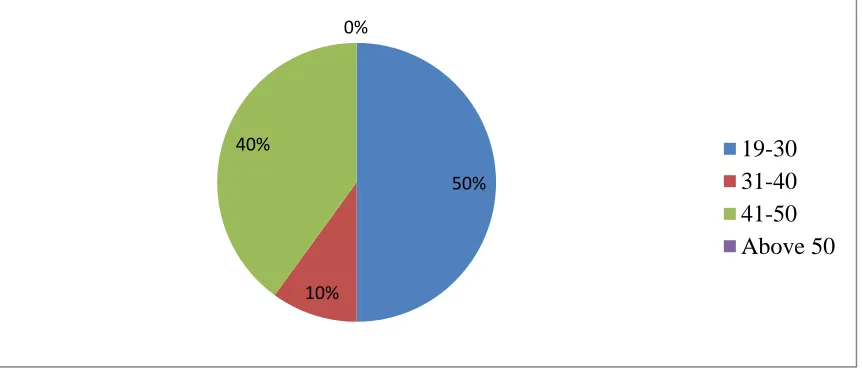
Figure 4.5: Pre-primary Teachers’ Age
Fig.4.5 Shows that majority (50%) of the teachers were aged between 19-30 years whereas 40% of them are aged between 41-50 years. 10% of them are aged between 31- 40 years. There were no teachers aged above 50 years.
4.3.6 Distribution of Teachers by Training
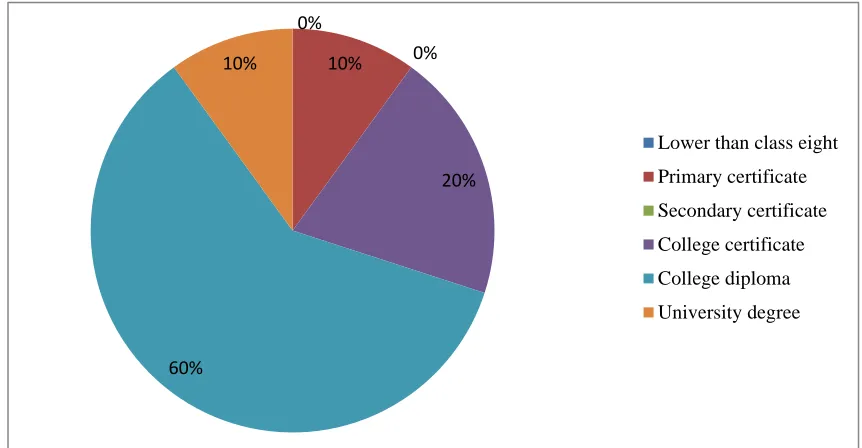
The distribution of the sample population by training was established. By comparing the training of the sample population it was be possible to find out if their responses were based on their level of training. Figure 4.6 summarize the level of training distribution of the respondent.
50%
10% 40%
0%
52
Fig 4.6 Number of Pre-primary School Teachers by Level of Training
Figure 4.6 Indicates that more than half (60.0%) of the sampled teachers had a college diploma in preschool education whereas 20.0% had a college certificate, those with a university degree and primary certificate were 10%.
4.4 Prevalence of Broken Families in Limuru Zone, Limuru Sub-county
The number one task as per the first objective of the study was to establish the prevalence of broken families. Parents were asked how long they have been divorced or separated. Their findings are presented in the table 4.2
0%
10% 0%
20%
60% 10%
Lower than class eight
Primary certificate
Secondary certificate
College certificate
College diploma
53 Table 4.2 Prevalence of Broken Families
Period
divorced/ separated
Frequency of parents Percent (%)
6months-11months 41 32
1-2yrs 48 37
3-4yrs 29 22
5-6yrs 12 9
Total 130 100
Table 4.2 Shows that majority of parents in Limuru Zone had been divorced or separated between 1-2 years (37%) and 6 months to 11 months (32%) respectively. The findings can imply that divorce and separation in Limuru Zone happens quite frequently to parents with children in pre-primary. The researcher researched on divorce duration of up to 6 years because most children in preprimary are aged 4-6 years Fewer numbers of parents had separated/divorced for as long as 5-6 years which implies that the parents with children aged 3-4 got children who are currently in pre-primary years after their divorce or separation either through a remarriage or when single after the separation. The results concur with Lines (2011) who reported that 37% of marriages registered in England and Wales were remarriages for one or both parties.
54
that there are over 600,000 street children in Kenya majority coming from broken families. Kiberenge (2013) also revealed that Kenya has one of the biggest numbers of children growing up in a one parent family. 59.5% of Kenyan women have a possibility of becoming a single mother at the time they are attaining 45 years either through getting children out of wedlock or through separation or divorce as many men leave their previous role as breadwinners for their families. When a family breaks down, it experiences failing of relationship in a family amongst its members or the entire family system experiences dis-equilibrium. Further, the 20 preprimary class teachers were interviewed about the prevalence of broken families in their classes in Limuru Zone and their responses are presented on table 4.3
Table 4.3: Teachers’ Responses on Number of Type of Families in Limuru Zone
Family type Number of children in class Percentage (%)
Intact families 147 47
Divorced and separated families
71 23
Single parent families 92 30
Total 310 10
55
of families in the contemporary society when compared to the traditional times is a phenomenon that is on the increase. These findings also concur with Sore and Oino (2013) and Kiberenge (2013) who notes that divorce is a growing in East Africa. Just like other parts of Africa and Kenya in particular, these findings concludes that the rate of family breakdown is also high in Limuru Zone.
4.5 Factors Responsible For Influencing Family Breakdown in Limuru Zone
The second objective of the study sought to establish by rank, the factors responsible for family breakdown in Limuru Zone, Limuru Sub-county. These findings were gotten from parents. The findings obtained are presented in figure 4.7.
Figure 4.7 Factors Responsible for Family Breakdown
Figure 4.7 show that there are many factors responsible for family breakdown in Limuru. The leading factors were infidelity (25%), domestic violence (19%) drug abuse (15%)
25%
19%
15% 15%
5% 3%
11%
7%
Infedility
Domestic Violence Drug Abuse Finance
Lack of Communication Illness
56
and financial problems (15%). The least causes of family breakdown were lack of communication (5%) and illness (3%). Seven (7%) of the parents did not respond to the question, when asked about causes of family breakdown they said it is hard to explain. Infidelity with (25%) which is also called unfaithfulness is the leading cause of family breakdown, the findings agree with what Bitgombe and Khadiagala (1996) say that in Africa, the rate of single parent family is increasing; the most affected being young urban women. Many reports from African cities are indicating that women-headed families are increasing among the poor more so the urban slums due to infidelity. The high percentage of infidelity being the cause of family breakdown in Limuru could be as a result of the mobility of married husbands to Limuru in search of employment when they abandon their wives in their homes and get new wives or concubines in their work places. Therefore the new migration patterns have resulted to an increase in divorce, separation and the opportunity for many partners. This has contributed to families breaking up which has a negative impact on children’s social, emotional and learning performance.
57
Alcohol and drug abuse (15%) is another major cause of family breakdown in Limuru. Fathers are mostly affected by this. Many sampled parents reported that Alcoholism in Limuru often entails the consumption of lethal illicit brews which have dire physical and social consequences on the drinker. The commonly abused drugs in Limuru are Chang’aa, Bhang and Miraa. The best reason to explain abuse of alcohol in parents and Limuru could be to unemployment, frustrations in life and even availability of cheap illicit brew like Chang’aa. According to the sampled parents who reported on alcoholism and drug abuse, many husbands force their wives from their marriage, others batter them, sell property, neglect their parental duties and others practice child abuse leading to family breakdown. This concurs with a study done by NACADA (2010), in central province in Kenya which sampled Kiambu (where Limuru is), Nyeri, Murang’a, Kirinyaga, Maragua, Nyandarua and Thika which showed that alcohol is a major cause of family break up. When a parent is abusing alcohol mostly the father, he is likely to; portray violence against spouse, children, parents and grandparents, illegal selling of property and having multiple sex partners all of which can result to separation or divorce.
58
rely on their spouses. Those with no option opted to farming, self-employment and casual laborers in tea plantations and in the nearby Bata Shoe Company. These findings agrees with Mooney et al., (2009) who found out that joblessness, low payment and the kind of paid work from permanent, employment to part time employment all result to economic challenges and the pressure it brings can result to family breakdown. Unemployment of a parent lowers self-image, brings seclusion and confines the ability of families to lead satisfying lives in the community. Consequently financial pressures and fear of being sacked, most parents are toiling for many hours thereby having little time for family. This increases the pressure on family life leading to family breakdown which results in dramatic changes in family structure, from a two parent family to a lone parent, step family or blended family.