Scholarship@Western
Scholarship@Western
Electronic Thesis and Dissertation Repository
4-8-2019 10:30 AM
Approximation Algorithms for Problems in Makespan
Approximation Algorithms for Problems in Makespan
Minimization on Unrelated Parallel Machines
Minimization on Unrelated Parallel Machines
Daniel R. Page
The University of Western Ontario Supervisor
Solis-Oba, Roberto
The University of Western Ontario Graduate Program in Computer Science
A thesis submitted in partial fulfillment of the requirements for the degree in Doctor of Philosophy
© Daniel R. Page 2019
Follow this and additional works at: https://ir.lib.uwo.ca/etd
Part of the Discrete Mathematics and Combinatorics Commons, and the Theory and Algorithms Commons
Recommended Citation Recommended Citation
Page, Daniel R., "Approximation Algorithms for Problems in Makespan Minimization on Unrelated Parallel Machines" (2019). Electronic Thesis and Dissertation Repository. 6109.
https://ir.lib.uwo.ca/etd/6109
This Dissertation/Thesis is brought to you for free and open access by Scholarship@Western. It has been accepted for inclusion in Electronic Thesis and Dissertation Repository by an authorized administrator of
A fundamental problem in scheduling is makespan minimization on unrelated parallel ma-chines (R||Cmax). Let there be a set J of jobs and a set M of parallel machines, where every
job Jj ∈ J has processing time or length pi,j ∈ Q+ on machine Mi ∈ M. The goal in R||Cmax
is to schedule the jobs non-preemptively on the machines so as to minimize the length of the schedule, the makespan. Aρ-approximation algorithmproduces in polynomial time a feasible solution such that its objective value is within a multiplicative factorρof the optimum, where
ρis called its approximation ratio. The best-known approximation algorithms forR||Cmaxhave
approximation ratio 2, but there is no ρ-approximation algorithm with ρ < 3/2 for R||Cmax
unlessP =NP. A longstanding open problem in approximation algorithms is to reconcile this hardness gap. We take a two-pronged approach to learn more about the hardness gap ofR||Cmax:
(1) find approximation algorithms for special cases ofR||Cmaxwhose approximation ratios are
tight (unless P = NP); (2) identify special cases ofR||Cmax that have the same 3/2-hardness
bound ofR||Cmax, but where the approximation barrier of 2 can be broken.
This thesis is divided into four parts. The first two parts investigate a special case ofR||Cmax
called the graph balancing problem when every job has one of two lengths and the machines may have one of two speeds. First, we present 3/2-approximation algorithms for the graph balancing problem with one speed and two job lengths. In the second part of this thesis we give an approximation algorithm for the graph balancing problem with two speeds and two job lengths with approximation ratio (√65+ 7)/8 ≈ 1.88278. In the third part of the thesis we present approximation algorithms and hardness of approximation results for two problems calledR||Cmaxwith simple job-intersection structure andR||Cmaxwith bounded job assignments.
We conclude this thesis by presenting algorithmic and computational complexity results for a generalization ofR||CmaxwhereJis partitioned into sets called bags, and it must be that no two
jobs belonging to the same bag are scheduled on the same machine.
Keywords: Theoretical Computer Science, Approximation Algorithms, Scheduling The-ory, Makespan Minimization, Unrelated Parallel Machines, Restricted Assignment Problem, Graph Balancing Problem, Job-Intersection Graph, Bounded Job Assignments, Bag Constraints
I would like to acknowledge Dr. Roberto Solis-Oba, my supervisor as a co-author of the orig-inal articles that form Chapters 3–6. I must also acknowledge Marten Maack as a co-author for some of the results in Chapter 5: Marten Maack made some suggestions to help simplify the algorithm in Chapter 5.2, provided comments on the paper, and proposed the idea for the reduction given in Chapter 5.1.
First, I must thank my supervisor Dr. Roberto Solis-Oba. His guidance, insightful ideas, detailed criticism, and honest feedback were helpful in sharpening my skills as a researcher and as a writer. I must also thank him for giving me the trust to explore my research interests in a fairly independent manner, and patiently reviewing all the drafts I would slide under his office door at odd hours of the night sometimes. Thank you so much Roberto for all your help and for giving me the opportunity to work with you.
I would like to thank Marten Maack. Marten had shared my office from late 2015 until mid 2016. He came all the way from Kiel, Germany to work with us as a part of his studies. Thank you again for the conversations and the opportunity to think about problems together.
Next, I must thank the people of the Department of Computer Science at the University of Western Ontario. The department has been nothing but friendly to me, and is full of people that I would be happy to sit down and have a chat with. While I can say I have made plenty of wonderful acquantices among my peers, I must explicitly name two people that I cannot thank enough for the time they gave me and would happily call my friends, Dr. James Hughes, and Ethan Jackson. I must especially thank James for the opportunities he has given me as a teaching assistant, and especially for the random conversations we would have. Some day guys I am sure we will actually get actual time to sit down and play games. Coming to Western was the first time I ever travelled far away from anywhere resembling home for me, so I was happy for the time we could spend together when we could.
In general, I must thank all the students I have ever taught, past or present; thank you for giving me the opportunity to teach and inspire you. In addition, I want to thank all those that helped me over the years, such as my colleagues in the Department of Computer Science at the University of Manitoba. Thank you Dr. Ben Li for first introducing me to makespan minimization on unrelated parallel machines in 2012.
I need to thank my friends, even if they are far and wide but very few. In that I want to acknowledge my friends online, the “Super Friends”; in particular, I want to thank Tor Asbjørn, Marcus Duplechan, and Jasper Valentine for all the laughs and support these years.
I would like to thank my family. Since being away from Manitoba, my family has grown with new nieces and nephews. Thank you Mom for being there for me and being strong all these years, and for supporting me in my goals even if the light at the end of the tunnel was unclear. During my program, my family lost one of our beloved dogs, Java (2006–2016). She (Java) was my “research buddy” and one of the last fragments reminding me of my Father, Michael William Page (1956–2010). My Father’s pragmatism was one of the things that inspired me to pursue research in approximation algorithms, the algorithms “equivalent” of the things he would build in his spare time to solve tangible problems for others.
Finally I must thank Char´en Rinckens. She made plenty of sacrifices by coming with me to London, Ontario since I began my journey home in Winnipeg in 2012. Our move to London in late 2014 was our first big journey together on our own. Thank you for all the hours of me asking you to patiently listening to me explain my proofs and ideas to help convince myself, and for offering an extra pair of eyes when I might have needed them sometimes.
Abstract ii
Co-Authorship Statement iii
Acknowledgements iv
List of Figures viii
List of Tables x
1 Introduction 1
1.1 Background . . . 1
1.1.1 Optimization Problems and Some Complexity Theory . . . 1
1.1.2 Approximation Algorithms . . . 2
1.1.3 Parallel Machine Scheduling Problems . . . 3
1.1.4 Aρ-Relaxed Decision Procedure . . . 5
1.2 Motivation . . . 6
1.3 Problems Investigated, Our Results, and Overview . . . 7
2 Literature Review 13 2.1 Scheduling Identical and Uniform Parallel Machines (P||CmaxandQ||Cmax) . . . 13
2.2 Scheduling Unrelated Parallel Machines . . . 14
2.2.1 Makespan Minimization on Unrelated Parallel Machines (R||Cmax) . . . 14
Earlier Research . . . 14
2-Approximation Algorithm of Lenstra, Shmoys, and Tardos . . . 14
Further Developments . . . 17
2.2.2 Restricted Assignment Problem (P|Mj|Cmax) . . . 17
The Configuration Linear Program and Better Estimates of the Opti-mum Makespan . . . 18
Scheduling Problems with Processing Set Restrictions . . . 19
2.2.3 Graph Balancing Problem (P|Mj,|Mj| ≤2|Cmax) . . . 20
7/4-Approximation Algorithm of Ebenlendr, Krˇc´al, and Sgall for the Graph Balancing Problem . . . 22
3/2-Hardness of the Graph Balancing Problem . . . 25
Graph Orientation Problem (P|Mj,|Mj|= 2|Cmax) . . . 27
2.3 Other Scheduling Problems . . . 27
and Bounded Job Assignments . . . 27
2.3.2 Scheduling with Machine Types . . . 28
2.3.3 Scheduling Parallel Machines with Bags . . . 29
2.3.4 Preemptive Scheduling . . . 29
2.3.5 Precedence-Constrained Scheduling . . . 30
3 Graph Balancing Problem with Two Job Lengths 31 3.1 First 3/2-Approximation Algorithm . . . 31
3.1.1 Step 4 . . . 32
3.1.2 Step 5.1 . . . 33
3.1.3 Step 5.2 . . . 36
3.1.4 Step 5.3 . . . 38
3.1.5 Approximation Ratio . . . 40
3.2 A Simpler 3/2-Approximation Algorithm . . . 40
4 Graph Balancing Problem with Two Speeds and Two Job Lengths 46 4.1 Approximation Algorithm for Q|Mj,pj ∈ {`s, `b}|Cmax . . . 46
4.2 Algorithm for the Graph Balancing Problem with 2 Speeds and 2 lengths . . . . 48
4.2.1 RefiningGand Preliminary Processing . . . 49
4.2.2 Step 4: Building the MultigraphG0 . . . 50
4.2.3 Step 5: Linear Programming Formulation . . . 50
4.2.4 Step 6: Rounding the Fractional Solution . . . 54
Analysis of Case 1 of Lemma 4.2.3 . . . 58
Analysis of Case 2 of Lemma 4.2.3 . . . 62
Analysis of Case 3 of Lemma 4.2.3 . . . 63
4.3 Integrality Gaps for Linear Programs LP5 and LP6 . . . 64
5 Simple Job-Intersection Structure and Bounded Job Assignments 68 5.1 Hardness of Approximation . . . 68
5.2 Approximation Results for Unrelated Scheduling . . . 70
5.3 A (2−1/(r −1))-Approximation Algorithm for Restricted Assignment with Two Job Lengths . . . 73
5.4 Inapproximability Results for Job-Intersection Graphs with Cliques . . . 74
6 Scheduling Parallel Machines with a Few Bags 76 6.1 A Couple Basic Properties . . . 76
6.2 Ab-Approximation Algorithm forR|bag|Cmax . . . 77
6.3 A PTAS forR|bag|Cmaxwith Constant Numbers of Machine Types and Bags . . 77
6.4 Ab/2-Approximation Algorithm for the Graph Balancing Problem withb ≥ 2 Bags . . . 79
6.5 Polynomial-time Solvable Problems . . . 82
6.5.1 A Polynomial-Time Algorithm forQ|bag,Mj,pj = 1|Cmax . . . 82
6.5.2 AO(mlogm)-Time Algorithm forP|bag|Cmaxwithb =2 Bags . . . 84
6.6 Inapproximability and Complexity . . . 84
6.6.3 Q|bag|Cmaxwithb= 2 Bags . . . 86
7 Conclusions 89
7.1 Summary . . . 89 7.2 Future Work and Open Problems . . . 90
Bibliography 92
Curriculum Vitae 99
List of Figures
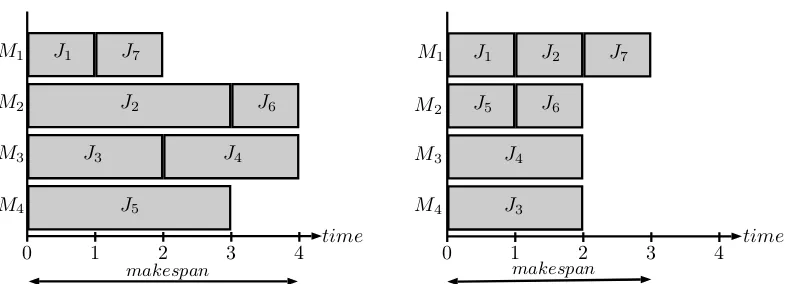
1.1 Gantt charts showing two schedules for the instance given above. The makespan of the schedules are 4 and 3, respectively. The schedule on the right is an opti-mal schedule. . . 4 1.2 An instance ofR||Cmax(left), and its job-intersection graphGJ (right). . . 8
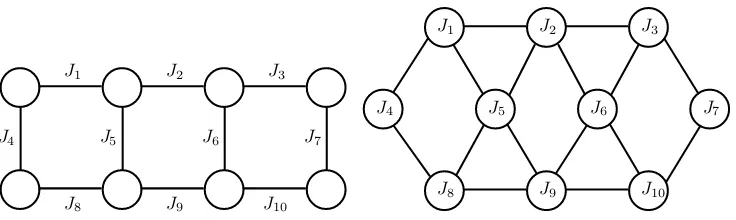
1.3 An instance of the graph balancing problem (left) and its job-intersection graph (right). . . 9
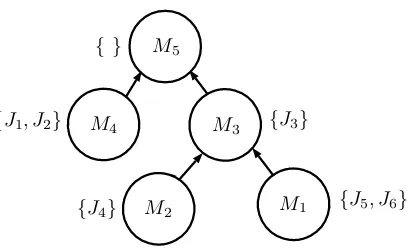
2.1 An example in-tree representing tree-hierarchical processing sets. The pro-cessing sets in this example are M1 = M2 = {M4,M5}, M3 = {M3,M5},
M4 ={M2,M3,M5}, andM5 =M6 ={M1,M3,M5}. . . 20
2.2 The processing sets from an instance ofP|Mj(inclusive)|Cmaxrepresented as an
in-tree, whereM4 ={M4},M1 =M3 ={M3,M4},M2 =M5 ={M1,M2,M3,M4}.
20
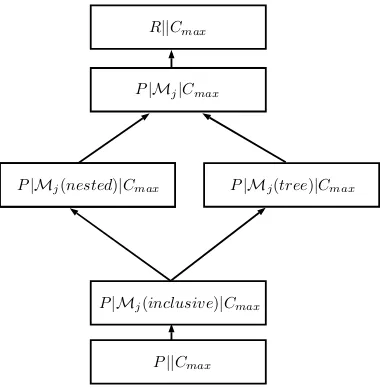
2.3 Complexity hierarchy of parallel machine scheduling problems with processing sets, where, for two scheduling problems A and B, A → B in the diagram impliesAis a special case ofB. . . 21 2.4 Assume we are given a multigraphGas shown in (i), every edge has length 1
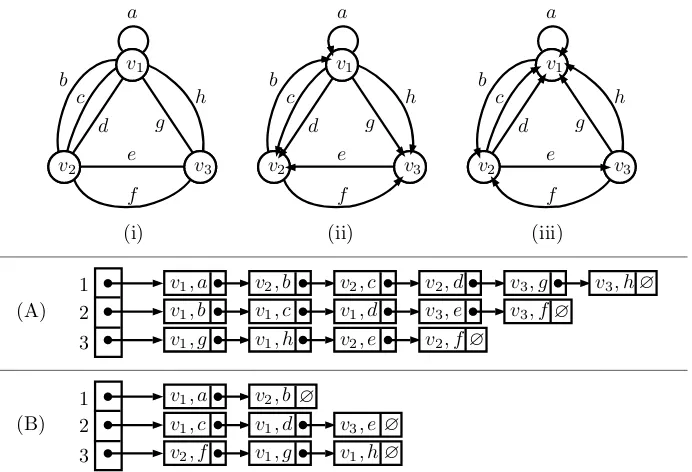
and an adjacency list representation of (i) is (A). An optimal orientation of the edges in (i) is shown in (ii). Reversing the directions of the edges in (ii) we get (iii), an adjacency list of (iii) representation is (B). . . 22 2.5 An example of a leaf assignment. Note that the edge oriented in a leaf
assign-ment can be big or small. . . 24 2.6 An example of edges being oriented in a tree assignment. The solid lines form
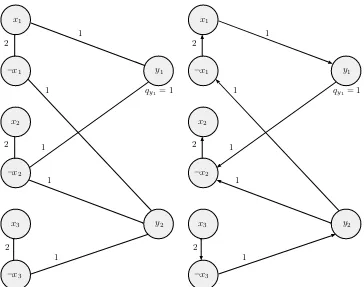
the treeT of big edges. The dashed lines represent small edges, which are not oriented by the tree assignment. . . 24 2.7 Given the formula φ = (x1 ∨ ¬x2)∧(¬x1 ∨ ¬x2 ∨ ¬x3), the resulting graph
balancing instance applying the above construction is shown on the left. Its optimal orientation is given on the right. . . 26 2.8 Summary of results forR||Cmaxwith simple intersection structure. The
job-intersection graphs restricting the machine assignments are grouped by graph class. For two graph classes A and B, “A → B” in the diagram means that any graph in A is in graph class B. Problems boxed with dashed lines are polynomial-time solvable, and problems with boxed solid lines are strongly
NP-hard. The number(s) in brackets are reference numbers, and graph classes with [*] beside them refer to computational complexity results found in this thesis. . . 28
associated with one vertex node. Arcs that are unlabelled have flow capacity 1. . 34 3.2 The modified flow network constructed for the case when 1/(k+1)< `s ≤1/k
and (k−1)/k ≤ `s < k/(k+1). Shaded nodes represent big edge nodes, and
every black node is a buffer node associated with a vertex node. Assume arcs that are unlabelled have flow capacity 1. . . 37 3.3 A bipartite flow networkN0 used to compute a fractional solution. The shaded
nodes correspond to edges of lengthk. . . 42 3.4 The flow network N00 of Kolliopoulos and Moysoglou [66]. The shaded edge
nodes representk-edges. Only nodes ofk-edges are connected to buffer nodes. The buffer nodes limit the flow so that no more than k units of flow can be received by a vertex node fromk-edges in the network. . . 43 3.5 Example bipartite graph of k-edges and vertices when k-edges send exactly
k/2 units of flow to two vertex nodes in f (left), and the assignment ofk-edge nodes to vertex nodes given with solid lines (right). In this example bipartite graph, the assignment orientse1 towardv1,e3towardv2, ande2towardv3. . . . 44
4.1 Flow networkN with sources∗and sinkt∗. The shaded vertices are big and the
non-shaded machine and job vertices are small. . . 47 4.2 Two example situations of a tree assignment: a tree assignment that starts at a
big edge (left) and a tree assignment that starts at a small twin edge (right). The pathPconsists of the edges fromu0tov. . . 59 4.3 Case 3. Small edges e1, . . . ,ek are directed towardsv by tree assignments on
big trees T1, . . . ,TK. At most one leaf assignment can occur on v through a
small edgee. Big edges are solid lines, and small edges are dashed lines. . . 60 4.4 MultigraphG0. Solid lines represent edges of length 1−, the dashed lines are
edges of length 1/3, and the black vertices are auxiliary nodes. The lightly-shaded verticesuand u0 have speed 2−3, and all others have speed 1. The auxiliary nodes have dedicated load 0, and every other vertex has dedicated load 1/3. . . 65 5.1 Machine Plan. Flow networkN is built in part by determining the appropriate
machine plan for each machine. Assume an integer valuedis provided. Unla-belled white nodes are job nodes, the black node is abuffernode of machineMi
that only allows one unit of flow to be sent from job nodes inBi, andt∗ is the
sink of N. It is worth noting that if Bi = ∅, the buffer node for the machine
plan ofMi has no incoming arcs. . . 71
5.2 The house graph. . . 75
6.1 Flow network N for the following instance: n = 4 jobs J = {J1,J2,J3,J4}
andm = 3 machines M = {M1,M2,M3}, the eligibility constraints for the jobs
areM1 = {M1,M2},M2 = {M1,M3},M3= {M1,M2,M3}, andM4 ={M2,M3},
andb =2 bags whereB1 ={J1,J2}, andB2 ={J3,J4}. . . 83
List of Tables
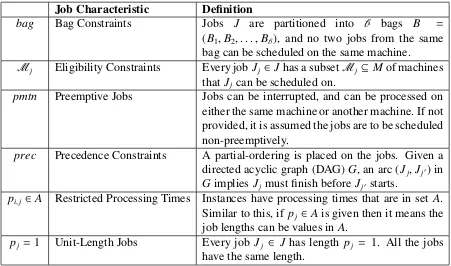
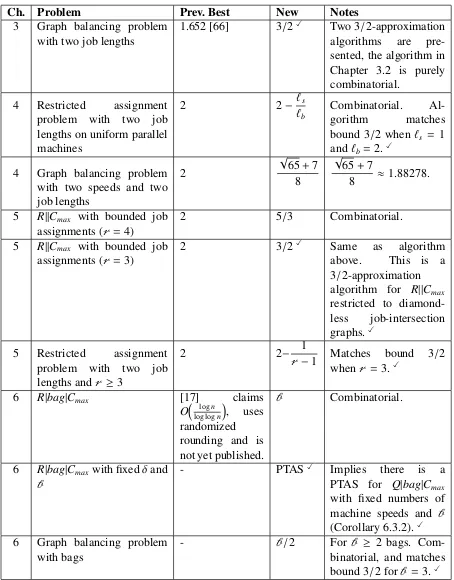
1.1 Some machine environments in Graham’s notation. Machine environments are given from most general to least. . . 4 1.2 Job characteristics. . . 5 1.3 Summary of approximation algorithm results in this thesis in the order in which
they are presented. Results indicated with “X” match the best-known inapprox-imability bounds previously established or proven in this thesis. . . 11 1.4 Summary of exact polynomial-time algorithms presented in this thesis. Results
are listed in the order in which they are presented. . . 12 1.5 Summary of complexity results presented in this thesis. For inapproximability
results, we indicate “X” when the inapproximability bound is matched by an approximation algorithm for said problem or a generalization of it. . . 12
2.1 Summary of main approximation algorithms forP|Mj|Cmaxwith processing set
restrictions. . . 21
Introduction
Parallel machine scheduling is an integral part of both industrial production and technology, especially as automated scheduling and parallel computing continue to become more relevant. Despite this, in many cases little is known mathematically as to why many hard parallel ma-chine scheduling problems are indeed as difficult as they seem to be, and there is a need for efficient algorithms that have rigourous performance guarantees in many situations. In this thesis we focus on a classic problem in scheduling theory called makespan minimization on unrelated parallel machines and several of its variants, and tread the boundaries between com-putationally tractable and intractable problems from both an exact and approximate algorithmic standpoint.
In Chapter 1.1 we provide background on optimization problems, computational complex-ity theory, approximation algorithms, parallel machine scheduling problems, and present a framework that many of the algorithms in this thesis use called aρ-relaxed decision procedure. Next, in Chapter 1.2 we provide the motivation of the research presented in this thesis, and describe the relevant core scheduling problems that serve as the basis of our work. Finally, in Chapter 1.3 we summarize the problems we investigated, our results, and give an overview of this thesis.
1.1
Background
1.1.1
Optimization Problems and Some Complexity Theory
Parallel machine scheduling problems are optimization problems. An optimization problem [67] has three parts:
• A non-empty setIofinstancesto be considered for the problem. For each instancex∈I, letSxbe the set offeasible solutionsof x.
• A computable functionν:{(x,y)|x∈I,y∈Sx} →Qcalled anobjective function. • A goal∈ {min,max} that is to either minimize (min) or maximize (max) the objective
function.
Let OPT(x) := goal{ν(x,y) | y ∈ Sx} be the optimal objective value of instance x ∈ I; as
shorthand, we often writeOPT for the optimal objective value. The goal is to find a feasible solutiony0 ∈S
xwithν(x,y0)=OPT(x) called anoptimal solution. As an example,R||Cmaxis a
minimization problem where the goal is to find a feasible schedule whose makespan (objective value) is of minimum size. Note that the decision variant of an optimization problem is a decision problem that given a valueβasks if there is a feasible solution with objective value at mostβ(for a minimization problem) or at leastβ(for a maximization problem).
For an instance x ∈ I, let|x|be itsinput size, i.e., the number of bits required to represent
x in some fixed encoding. NP is the set of decision problems that can be solved in non-deterministic polynomial time with respect to the input size. All optimization problems with decision variants inNPare calledNP-optimization problems (NPO); every problem we discuss in this thesis isNPO. An optimization problem isNP-hard if it is at least as hard as the most difficult problems in NP. That is, an optimization problem Π1 is NP-hard if all the decision problemsΠ2 inNPpolynomially reduce to it, i.e. for everyΠ2 ∈ NP, there is a polynomial-time algorithm that can take any instancex2ofΠ2and transforms it into into an instance ofΠ1;
thus, if there is a polynomial-time algorithm forΠ1, then there is a polynomial-time algorithm for Π2. Many optimization problems of both practical and theoretic importance, including
R||Cmax, areNP-hard problems.
The decision variant of aNP-hard optimization problem isNP-complete if it is inNP. The problems we study in this thesis have parameters that involve numbers e.g. job lengths, so there are two other kinds of NP-hardness to discuss. An optimization problem isstronglyNP-hard
if it remains NP-hard for instances I0 ⊆ I where, for each x0 ∈ I0, the sizes of the numbers in x0 are bounded by a polynomial in|x0|. One can similarly define NP-complete problems in the strong sense. AllNP-optimization problems that areNP-hard but not stronglyNP-hard are calledweaklyNP-hard; this is sometimes referred to asNP-hard in theordinary sense.
NP-complete problems are not polynomial-time solvable unlessP =NP[67, Section 15.7]. It is widely believed that P , NP[30], but the P vs. NPproblem still remains open. Under the assumption thatP ,NP, researchers design approximation algorithms that efficiently find approximate solutions forNP-hard optimization problems.
1.1.2
Approximation Algorithms
As all the problems we explore are minimization problems, we limit our discussion here strictly to such problems. Anapproximation algorithmis a finite step-by-step procedure that returns for all instances to a given problem an approximate solution in polynomial time. More for-mally, let ALG(x) be the objective value of a feasible solution produced by the algorithm for instance x ∈ I, and let OPT(x) be the optimum value of instance x. For any instancex ∈ I of a minimization problem, aρ-approximation algorithmproduces a feasible solution in polyno-mial time such that 1 ≤ ALG(x)/OPT(x) ≤ ρ, whereρ is called itsapproximation ratio. For instance, a 2-approximation algorithm will return a feasible solutionywith valueν(x,y), where
OPT ≤ ν(x,y) ≤ 2· OPT(x) i.e., the value of a feasible solution is always within twice the optimum. The goal is to findρ-approximation algorithms whereρis as small as possible.
Apolynomial-time approximation scheme(PTAS) is a family{A}of approximation
algo-rithms, such that algorithmA is a (1+)-approximation algorithm for every fixed >0. Note
(FPTAS) has polynomial running time also in 1/; and an efficient polynomial-time approx-imation scheme (EPTAS) has time complexity of the form f(1/)· poly(|x|), where f(1/) is some computable function that is not necessarily polynomial. Note that all FPTASs are EP-TASs, and all EPTASs are PTASs. For example, a PTAS can have running time O(n1/), but this would not be a FPTAS because its running time is exponential in 1/. Finally, it is worth noting that FPTAS do not exist for stronglyNP-hard problems, unlessP= NP[28].
1.1.3
Parallel Machine Scheduling Problems
We consider the problem of scheduling parallel machines. When jobs are scheduled on parallel machines, the jobs are processed in parallel and the machines operate independent of one another. We are interested in the case when each job is scheduled non-preemptively on a machine, i.e. if a job is scheduled on a machine, then the job must complete without being interrupted.
Let there be m machines M = {M1, . . . ,Mm}and n jobs J = {J1,J2, . . . ,Jn}, where each
jobJjis indexed j∈ {1,2, . . . ,n}and machineMiis indexedi∈ {1,2, . . . ,m}. Parallel machines
are calledunrelatedwhen given a job Jjand machine Mi, theprocessing timefor job Jj when
scheduled on machine Mi is pi,j ∈ Z+, and assume pi,j = ∞ implies Jj cannot be scheduled
on Mi. One way of representing the processing times of the jobs on the machines is using a
m×nmatrixP = (pi,j) called aprocessing matrix. For example, let there be m= 4 machines
andn= 7 jobs with the processing matrix
P=
J1 J2 J3 J4 J5 J6 J7
1 1 2 5 2 5 1 M1
2 3 2 6 1 1 2 M2
8 1 2 2 2 5 2 M3
3 2 2 3 3 5 2 M4
Job J4, for example, takes p2,4 = 6 time units on machine M2, but p3,4 = 2 time units on
ma-chineM3. We note that there are also two other widely studied parallel machine environments.
Parallel machines are calledidenticalwhen every job Jj has a length pj ∈ Z+, where its
pro-cessing time is pj on any machine. When the parallel machines areuniform, every machine
has aspeed si ∈Z+, and ifJjis scheduled on machineMi, its processing time is pj/si. Clearly,
the identical parallel machine environment is a special case of the uniform parallel machine environment, and the uniform parallel machine environment is a special case of the unrelated parallel machine environment.
Aschedule assigns each job to a machine. Given a schedule, the completion timeCj of a
jobJjthat finishes last is denoted asCmaxand it is called thelength of the scheduleormakespan.
While there are different metrics for measuring the quality of a schedule, the makespan is a core metric because typically we desire schedules that complete the jobs as early as possi-ble. More formally, the goal is to produce a schedule S : J → M such that the makespan, max1≤i≤mPJj|S(Jj)=Mi pi,j, is minimized. In Figure 1.1 we provide two examples of schedules,
time
0 1 2 3 4
M4
M3
M2
M1 J1 J7
J2 J6
J3
J5
J4
makespan
time
0 1 2 3 4
M4
M3
M2
M1 J1 J2
J5 J6
J4
J3
J7
makespan
Figure 1.1: Gantt charts showing two schedules for the instance given above. The makespan of the schedules are 4 and 3, respectively. The schedule on the right is an optimal schedule.
We adopt the scheduling-theoretic notation of Graham et al.[39]. Graham’s notation de-scribes scheduling problems by three fields,α|β|γ, whereαspecifies a machine environment,
β are the job characteristics, and γ is the optimality criterion. We summarize below in more detail the first two of these fields. The third field, theoptimality criterion, specifies the objec-tive function or goal for a scheduling problem; in this thesis we look at the makespan (Cmax),
soγ =Cmax. Below let◦denote the empty symbol.
Machine environment. A machine environmentα = α1α2 gives the type of machine α1 ∈
{◦,P,Q,R}, each defined in Table 1.1, andα2is either◦or a positive integer. That is, ifα2 =◦
then the number of machines is variable; otherwise, eitherα2is a positive integer orm:
• Ifα2is a positive integer, then there is a constant numberα2of parallel machines.
• Ifα2 = mthen the number of machines can be any number but is fixed, e.g. Rm||Cmax
is makespan minimization on unrelated parallel machines where the number of parallel machines is constant, butR||Cmaxassumesmis not a constant.
α1 Machine Environment Definition
R Unrelated Parallel Machines Processing times are given as processing ma-trix P = (pi,j). If job Jj can be scheduled on
Mi, it takes pi,j ∈Z+time units.
Q Uniform Parallel Machines Every job Jj has a length pj ∈ Z+, and every
machine Mi has a speed si ∈ Z+. If Jj can be
scheduled on Mi, its processing time ispj/si.
P Identical Parallel Machines All machines have the same speed, so that s1 =
s2 =· · ·= sm.
◦ Single Machine There ism=1 machine andα2 =1.
Job Characteristic Definition
bag Bag Constraints Jobs J are partitioned into b bags B =
(B1,B2, . . . ,Bb), and no two jobs from the same
bag can be scheduled on the same machine.
Mj Eligibility Constraints Every jobJj ∈Jhas a subsetMj ⊆ Mof machines
thatJjcan be scheduled on.
pmtn Preemptive Jobs Jobs can be interrupted, and can be processed on either the same machine or another machine. If not provided, it is assumed the jobs are to be scheduled non-preemptively.
prec Precedence Constraints A partial-ordering is placed on the jobs. Given a directed acyclic graph (DAG)G, an arc (Jj,Jj0) in
Gimplies Jj must finish beforeJj0 starts.
pi,j ∈A Restricted Processing Times Instances have processing times that are in set A.
Similar to this, if pj ∈Ais given then it means the
job lengths can be values inA.
pj =1 Unit-Length Jobs Every job Jj ∈ J has length pj = 1. All the jobs
have the same length.
Table 1.2: Job characteristics.
Job characteristics. The job characteristics specify constraints on the scheduling problem with respect to the jobs, these may generalize the problem or may even restrict the processing times of the jobs on machines1. We summarize the ones we use in Table 1.2.
We study in this thesis the problem of scheduling non-preemptively jobs on unrelated par-allel machines so as to minimize the makespan. This problem is calledmakespan minimization on unrelated parallel machines, and is abbreviated as R||Cmax. R||Cmax is a NP-hard
prob-lem [29] that has many applications such as in computer scheduling and scheduling production systems with the goal of maximizing productivity.
1.1.4
A
ρ
-Relaxed Decision Procedure
Many times the algorithms presented in this thesis use algorithms called ρ-relaxed decision procedures, these have been used in approximation algorithms for R||Cmax previously [72].
LetU ∈Z+be an upper bound on the optimum makespan. By default, we assumeU = pmaxn
where pmax = maxpi,j|pi,j,∞ pi,j and n is the number of jobs
2. We use binary search over the
interval [0,U] to determine the smallest valueτ∈Z+for which aρ-relaxed decision algorithm produces a schedule. Aρ-relaxed decision algorithm either:
1In [39] job characteristics are grouped into different categories. For brevity, we will ignore this.
• computes a schedule with makespan at mostρτ; or
• returnsFAILif there is no solution with value at mostτ.
In the binary search, if the ρ-relaxed decision algorithm returns FAILthen the value τis in-creased, and if a schedule is returned the valueτis decreased. If we keep track of the schedule with minimum makespan found, after O(logU) iterations the binary search guarantees that
τ≤ OPT and a schedule with makespan at mostτ·OPT is found. Therefore, if the overall run-ning time of theρ-relaxed decision algorithm takes polynomial time, this is aρ-approximation algorithm. Thus, it is sufficient to present aρ-relaxed decision algorithm for approximation algorithms using this framework.
1.2
Motivation
We focus our research onR||Cmax to the design of approximation algorithms and the study of
inapproximability. Unlike general heuristics, approximation algorithms guarantee that, for any instance of a given problem, the algorithm computes in polynomial time a feasible solution with a guaranteed quality with respect to the optimum called its approximation ratio. We are fundamentally interested in the existence of polynomial-time algorithms with such guarantees. This thesis is not a general expository of heuristic algorithms, for some discussion on heuristic approaches forR||Cmax we recommend the introduction section of Fanjul-Peyro and Ruiz [26]
for a brief but comprehensive summary of heuristics forR||Cmax3.
Currently the best approximation algorithms for R||Cmax have approximation ratio 2, and
it is known that there is no approximation algorithm with approximation ratio less than 3/2 unlessP = NP[72]. Thus a 3/2-to-2 hardness gap currently exists forR||Cmax. Reconciling
or narrowing this gap has remained an open problem for almost thirty years and is regarded as one of the most challenging problems in approximation algorithms today (e.g. Open Problem 10 in Williamson and Shmoys [100], Open Problem 4 in Schuurman and Woeginger [91]).
Problem Design an approximation algorithm with constant approximation ratio less than 2
for R||Cmaxor prove that there is no approximation algorithm with approximation ratio smaller
thanρ >3/2, for anyρ >3/2.
In this thesis, we are interested firstmost in shedding light on this famous problem. We study special cases ofR||Cmaxwhich, only in recent years, have become central in investigations
into the 3/2-to-2 hardness gap. Two of these problems are known as the restricted assignment problem and the graph balancing problem:
• Restricted Assignment Problem (P|Mj|Cmax). A special case of R||Cmax where the
pro-cessing matrix has every pi,j ∈ {pj,∞}, where each pj ∈Z+is the length ofJj ∈ J. This
problem can be viewed as makespan minimization on identical parallel machines with the constraint that, for each job Jj ∈ J, there is a set Mj of machines where Jj can be
scheduled; we callMjthe eligibility constraints or processing sets ofJj. Assigning each
jobJj to an eligible machine inMj is said to satisfy theeligibility constraints.
• Graph Balancing Problem(P|Mj,|Mj| ≤2|Cmax): This is a special case of the restricted
assignment problem where the number of eligible machines for each job is at most 2. An alternate way to interpret an instance of this problem is as a weighted multigraph where the jobs are edges and the machines are vertices, and every edge must be directed to one of its endpoints so as to minimize the maximum sum of the lengths of the edges directed toward a vertex. More formally, let weighted multigraphG= (V,E,p,q) where
p= (pe1, . . . ,pe|E|) are the lengthsfor the edges with pej ∈Z+andq= (qv1, . . . ,qv|V|) are
thededicated loads4whereqvi ∈Z+∪ {0}. The goal is to find anorientationσ: E → V
such that the maximal load (makespan) is minimized5, where theload of a vertex v ∈ V
isqv+Pe|σ(e)=vpe.
Note that if we refer to the above two problems “on uniform parallel machines” or “with speeds”, this simply means that the machines have speeds and a job Jj takes pj/si instead
of pj on machine Mi. Also, if we refer to problems “with two job lengths”, this means that
every job length pj ∈ {`s, `b}, where`s < `b.
1.3
Problems Investigated, Our Results, and Overview
The best-known approximation algorithm for the graph balancing problem is the algorithm of Ebenlendr et al.[21] which has approximation ratio 7/4. It has also been established that there is noρ-approximation algorithm withρ <3/2 for the graph balancing problem with two job lengths either 1 or 2, unlessP = NP[2, 21]. The graph balancing problem is one of the first-known special cases ofR||Cmaxthat shares the same 3/2-inapproximability (3/2-hardness)
bound and for which there is an approximation algorithm with approximation ratio strictly less than 2. Since then, there have been no improvements upon the approximation ratio for this problem, but there still was an outstanding 3/2-to-7/4 hardness gap for the graph balancing problem with two job lengths. In 2013, Kolliopoulos and Moysoglou [66] presented a 1. 652-approximation algorithm for the graph balancing problem with two job lengths. Our first goal was to improve upon their approximation ratio and successfully close the hardness gap for the graph balancing problem with two job lengths. In Chapter 3 we present two 3/2-approximation algorithms for the graph balancing problem with two job lengths.
Naturally, upon successfully closing the hardness gap for the graph balancing problem with two job lengths, we pursued other cases of the graph balancing problem. One aspect of the 3/2-to-2 hardness gap ofR||Cmaxthat we know very little about is if there exist approximation
algorithms with approximation ratios less than 2 when the machines are uniform. Two special cases ofR||Cmaxwe consider in Chapter 4 are the following:
• Restricted assignment problem with two job lengths on uniform parallel machines(Q|Mj,pj ∈ {`s, `b}|Cmax): a jobJjtakespi,j = pj/sitime units on machineMi ∈Mj wheresi ∈Z+is
the speed ofMiand pj ∈ {`s, `b}with`s < `b, and pi,j = ∞otherwise.
4Dedicated loads allow us to assume there are no self-loops in the multigraph. Sometimes, when explicitly stated, we will assume there are self-loops present in the multigraph, implying thatqv=0,v∈V.
• Graph balancing problem with two speeds and two weights: every vertex v ∈ V has a speed sv, where sv is one of two possible speedsss,sf ∈ Z+withss < sf, and if edgee
with length pe ∈ {`s, `b}is oriented towardsv, it contributes to the load pe/sv. Note that
the dedicated load of v contributes qv/sv to the load of v, and`s < `b. We denote the
weighted multigraphG for this problem asG = (V,E,p,q,s), where s = (sv1, . . . ,sv|V|)
are the speeds of the vertices.
We present a (2−`s/`b)-approximation algorithm for the restricted assignment problem with
two job lengths on uniform parallel machines, then we give a (
√
65+ 7)/8-approximation algorithm for the graph balancing problem with two speeds and two job lengths.
We are also interested in identifying cases with very specialized structure where we can still show that the 3/2-inapproximability of R||Cmax persists but there are 3/2-approximation
algorithms. Motivated by the work of Jansenet al.[53], we consider a job-intersection-graph-based model withR||Cmax. In Chapter 5 we study the following two problems:
• R||Cmaxwith simple job-intersection structure.Ajob-intersection graph GJ = (J,EJ) has
a vertex for each jobJj ∈ J, and for any two jobsJj,Jj0 ∈J, there is an edge{Jj,Jj0} ∈ EJ
if there is a machine Mi such that pi,j , ∞and pi,j0 , ∞. A set of restrictions on which
machines can process a job can be represented as a job-intersection graph. We study
R||Cmaxrestricted toparticular classes of job-intersection graphs. We give an example of
a job-intersection graph in Figure 1.2.
Instance:m= 3,n=4
P=
J1 J2 J3 J4
1 2 1 ∞ M1
3 5 1 ∞ M2
∞ ∞ 1 4 M3
J1
J2 J3 J4
Figure 1.2: An instance ofR||Cmax(left), and its job-intersection graphGJ (right).
• R||Cmaxwith bounded job assignments.LetJibe the set of jobs that can be processed by
machine Mi, i.e., Ji = {j ∈ J | pi,j , ∞}. Let r > 0. We considerR||Cmax restricted to
instances when, for each machineMi,|Ji| ≤r. Clearly whenr =n, it isR||Cmax.
A graph istriangle freeif it does not contain any simple cycles of length 3—triangles. Note that all bipartite graphs contain no odd-length cycles, thus all bipartite graphs are triangle free. Thediamond graphconsists of four vertices and five edges, so it is K4less one edge. We call
a graph diamondless if it does not contain the diamond graph as a subgraph. In contrast, a
diamond-free graphis defined as not having the diamond graph as an induced subgraph. An
induced subgraph H = (V0,E0) of a graph G = (V,E) is such that V0 ⊆ V and an edge e =
{u,v} ∈ E0 if both u,v ∈ V0 and e ∈ E; all diamondless graphs are diamond-free, but not all diamond-free graphs are diamondless. For example, the graph K4 is diamond free but is
J1 J2 J3
J4 J5 J6 J7
J8 J9 J10
J1 J2 J3
J4 J5 J6 J7
J8 J9 J10
Figure 1.3: An instance of the graph balancing problem (left) and its job-intersection graph (right).
In Chapter 5 we identify that the 3/2-inapproximability ofR||Cmax persists when we allow
a few eligible jobs per machine. That is, even for the graph balancing problem with r = 3 and the graph balancing problem restricted to diamondless job-intersection graphs, there is no
ρ-approximation algorithm withρ <3/2 unlessP=NP; we obtain a 3/2-approximation algo-rithm in both cases forR||Cmax, and this approximation algorithm has approximation ratios 5/3
and 1 forR||Cmaxwith r = 4 and r = 2, respectively. It is worth noting that the same
algo-rithm is also a polynomial-time algoalgo-rithm forR||Cmaxrestricted to triangle-free job-intersection
graphs. Among these results, we give a (2−1/(r −1))-approximation algorithm for the re-stricted assignment problem with two job lengths whenr ≥3, and prove thatR||Cmaxrestricted
to the following job-intersection graph classes is 3/2-inapproximable: complete graphs, thresh-old graphs, interval graphs, cographs, split graphs, and house-free graphs.
Finally, we consider a generalization ofR||Cmaxwhere the jobs are partitioned intobsetsB=
(B1,B2, . . . ,Bb) called bags, and any feasible solution must satisfy the bag constraints: no
two jobs from the same bag can be scheduled on the same machine. This problem is called
makespan minimization on unrelated parallel machines with bags, and we denote it asR|bag|Cmax.
Notice that ifb = |J|, then every job is in a distinct bag, and we get R||Cmax. As discussed in
[22], the bag constraints appear in settings such as in the scheduling of tasks for on-board com-puters in airplanes. In these systems it is required for some tasks to be scheduled on different processors so that the airplane continues to operate safely even if one of the processors were to fail. Thus, parallel machine scheduling problems with bag constraints model fault-tolerant scheduling needed in complex parallel systems where system stability is desired [17].
We study R||Cmax, the restricted assignment problem, and the graph balancing problem
when bags are introduced, with an emphasis on when the numberbof bags is small. In addition to this, we investigateR|bag|Cmaxin the setting with so-called machine types. As discussed by
Gehrkeet al.[31], a natural scenario in parallel machine scheduling is where the machines are clusters of processors where each processor in a cluster is of the same type, e.g. clusters of CPUs and/or GPUs. More formally, two machinesMi and Mi0 have the samemachine type if
pi,j = pi0,j for all Jj ∈ J. We study R|bag|Cmax with machine types, where the number δ of
machine types is constant.
R|bag|Cmaxwhen bothδandb are constant, and ab/2-approximation algorithm for the graph
balancing problem with b ≥ 2 bags. In addition, we present polynomial-time algorithms for the restricted assignment problem on uniform parallel machines with bags when all the jobs have unit length (Q|bag,Mj,pj = 1|Cmax), and P|bag|Cmaxwith b = 2 bags. To complement
our results, we prove that there is noρ-approximation algorithm withρ <3/2 for the restricted assignment and graph balancing problems withb =2 andb =3 bags, unlessP= NP, and that bothP|bag|Cmaxwithb =3 bags andQ|bag|Cmaxwithb =2 bags are stronglyNP-hard.
While we ultimately do not resolve the 3/2-to-2 hardness gap ofR||Cmax, we present some
examples of special cases ofR||Cmaxwhere 3/2-approximation algorithms do exist, and some
for broader classes of instances where there are approximation algorithms with approximation ratios less than 2; many of our algorithms use theρ-relaxed decision procedure given in Chap-ter 1.1.4. We also illustrate through our study ofR||Cmaxwith simple job-intersection structure
how, even in instances with very specific job-intersection structures, the 3/2-inapproximability forR||Cmax persists. In addition, we demonstrate the polynomial-time solvability of a variety
of scheduling problems, and present results forR|bag|Cmax.
We list our approximation algorithm results in Table 1.3, polynomial-time solvability re-sults in Table 1.4, and our computational complexity rere-sults in Table 1.5. When in the tables below we state an algorithm is combinatorial, we mean that it does not use an algorithm to solve a linear program nor does it employ methods from linear algebra or convex geometry; al-gorithms of this kind might compute flows or matchings, and comparisons and basic arithmetic operations are done over rational numbers. We make this distinction at times as algorithms in this domain employ linear programming frequently, and combinatorial algorithms tend to be simpler and easier to implement.
Most of the work presented in this thesis has been previously published. The work pre-sented in Chapter 3.1 was first published in the journalAlgorithms[84], and the work in Chap-ter 3.2 has been unpublished until now. The results presented in ChapChap-ter 4 were accepted to the
Journal of Combinatorial Optimization[85]. The results given in Chapter 5 were presented at the Twelfth International Conference on Combinatorial Optimization and Applications (CO-COA 2018) [87], and the results in Chapter 6 were presented at theTwelfth International Con-ference on Algorithmic Aspects in Information and Management(AAIM 2018) [86].
Ch. Problem Prev. Best New Notes
3 Graph balancing problem with two job lengths
1.652 [66] 3/2X Two 3/2-approximation algorithms are pre-sented, the algorithm in Chapter 3.2 is purely combinatorial.
4 Restricted assignment problem with two job lengths on uniform parallel machines
2 2− `s
`b
Combinatorial. Al-gorithm matches bound 3/2 when `s = 1
and`b =2.X
4 Graph balancing problem with two speeds and two job lengths
2
√
65+7 8
√
65+7
8 ≈1.88278. 5 R||Cmax with bounded job
assignments (r =4)
2 5/3 Combinatorial.
5 R||Cmax with bounded job
assignments (r =3)
2 3/2X Same as algorithm above. This is a 3/2-approximation algorithm for R||Cmax
restricted to diamond-less job-intersection graphs.X
5 Restricted assignment problem with two job lengths andr ≥ 3
2 2− 1
r−1 Matches bound 3/2 whenr =3.X
6 R|bag|Cmax [17] claims
Olog loglognn, uses
randomized rounding and is not yet published.
b Combinatorial.
6 R|bag|Cmaxwith fixedδand
b
- PTASX Implies there is a PTAS for Q|bag|Cmax
with fixed numbers of machine speeds and b
(Corollary 6.3.2).X
6 Graph balancing problem with bags
Ch. Problem Notes
5 R||Cmax with bounded
job assignments (r =2)
Combinatorial. This is also a polynomial-time algorithm for R||Cmax restricted to triangle-free job-intersection
graphs (includes bipartite job-intersection graphs). 6 Graph balancing
prob-lem withb ≤2
Combinatorial. TakesO(m2n+n2m) time. Implied byb/ 2-approximation algorithm, and there is a straightforward algorithm forR|bag|Cmaxwithb =1 bags (Chapter 6.1).
6 Q|bag,Mj,pj =1|Cmax Combinatorial.
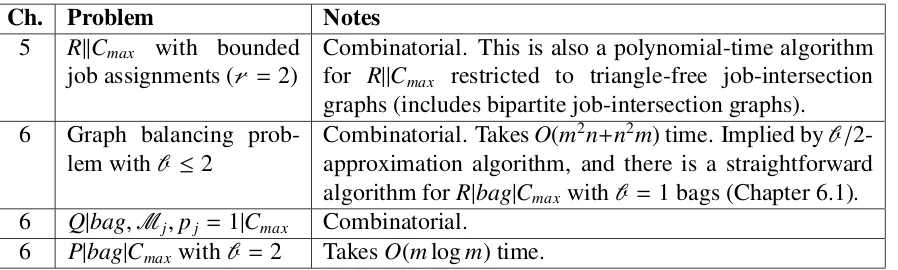
6 P|bag|Cmaxwithb = 2 TakesO(mlogm) time.
Table 1.4: Summary of exact polynomial-time algorithms presented in this thesis. Results are listed in the order in which they are presented.
Ch. Problem Result Notes
5 Graph balancing problem restricted to diamondless job-intersection graphs with job lengths either 1 or 2
3/2-hardnessX There is no ρ-approximation al-gorithm with ρ < 3/2, unless
P = NP. Implies 3/2-hardness forR||Cmaxwithr = 3.
6 Restricted assignment prob-lem with b = 2 bags with two job lengths either 1 or 2
3/2-hardness There is no ρ-approximation al-gorithm with ρ < 3/2, unless
P = NP. Prior to our results, it was known that there is no constant-factor approximation al-gorithm for arbitrary numbers of bags and job lengths [17]. When there is only one job length, it is polynomial-time solvable on uniform parallel machines (The-orem 6.5.2).
6 Graph balancing problem with b = 3 bags with two job lengths either 1 or 2
3/2-hardnessX There is no ρ-approximation al-gorithm with ρ < 3/2, unless
P =NP.
6 P|bag|Cmaxwithb =3 bags stronglyNP-hardX Independently proven by
Dokka et al. [19]. Polynomial-time solvable for b = 2 (Theo-rem 6.5.3). Previously a PTAS forP|bag|Cmaxwas known [17].
6 Q|bag|Cmaxwithb =2 bags stronglyNP-hard We also show Q|bag|Cmax with
Literature Review
Makespan minimization problems on parallel machines are some of the most studied problems in all of scheduling and combinatorial optimization. Parallel machine scheduling has numerous applications such as in mass production lines [94]. For example, Yu et al. [101] describes one major bottleneck in printed wiring board (PWB) manufacturing: scheduling the drilling operation. In the drilling operation, a group of parallel machines, the drilling machines, each with different processing speeds and operating characteristics, process lots conveyed in as a batch. For each lot, the drilling machines will drill holes as per required by the specifications of the manufacturer. Note that an individual lot may be processed by a subset of the machines, and each lot may be completed at different speeds due to characteristics between the lots and machines e.g. lot size, board layout, drill hole requirements, general machine specifications. Each time the scheduling system is started, a batch of lots is provided a time windowτto be drilled. The goal is for the system to schedule the lots to drilling machines with the smallest possible value forτ.
In this chapter we begin with makespan minimization on identical parallel machines (P||Cmax)
and uniform parallel machines (Q||Cmax) in Chapter 2.1, thenR||Cmaxand the main special cases
we are interested in within Chapter 2.2.1. Finally, in Chapter 2.3, we summarize the literature for other scheduling problems relevant to Chapters 5–6, and for the sake of completeness we include a basic discussion on preemptive scheduling and precedence-constraint scheduling.
2.1
Scheduling Identical and Uniform Parallel Machines (
P||C
maxand
Q||C
max)
It is known thatP2||CmaxisNP-hard, andP||Cmax(i.e.,mis not fixed) is stronglyNP-hard [29].
Two of the earliest-known approximation algorithms in the literature are the approximation algorithms presented by Grahamet al.[37, 38] for P||Cmax.
• Graham’s list scheduling algorithm: For j=1,2,3, . . . ,n, schedule jobJjon the machine
with least load. This algorithm has approximation ratio 2.
• Graham’s longest processing time algorithm (LPT): Sort the jobs from longest to short-est, then apply the list scheduling algorithm. Sorting the jobs in this fashion improves the approximation ratio to 4/3.
Hochbaum and Shmoys [42] introduced the dual approximation approach forP||Cmaxin order
to design a PTAS. Recently, Jansen and Rohwedder [60] presented an EPTAS forP||Cmaxwith
running time bounded by 2O((1/) log2(1/))+O(n).
There also is a PTAS for Q||Cmax due to Hochbaum and Shmoys [43], it has running
time (n/)O(1/2). In 2010, Jansen [49] presented an EPTAS for Q||C
max that has running time
bounded by 2O(1/2log3(1/))
+ poly(n). Presently the fastest-known EPTAS forQ||Cmaxis given
by Jansenet al.[50], with running time 2O((1/) log4(1/))+ poly(n).
2.2
Scheduling Unrelated Parallel Machines
Here we discuss results forR||Cmax, and for special cases ofR||Cmaxthat relate to the restricted
assignment problem and the graph balancing problem. For the sake of brevity, here we keep our discussion of the literature narrow. For example,Rm||Cmax(i.e.R||Cmaxwith a fixed number
of machines) has FPTASs [55]; thus, this section does not discuss cases in which the number of machines is constant.
2.2.1
Makespan Minimization on Unrelated Parallel Machines (
R
||
C
max)
Earlier Research
The first approximation algorithms forR||Cmaxwere given in 1977 by Ibarra and Kim [48]. Of
these, an m-approximation algorithm that does the following is given: For each job Jj ∈ J,
schedule Jj on the machine for which Jj completes the earliest. Later, Davis and Jaffe [18]
gave a 2√m-approximation algorithm forR||Cmax. This is accomplished by extending the idea
of Ibarra and Kim but adding some preprocessing to estimate potential job assignments and in-troducing thresholds that activate and deactivate the machines as a schedule is being produced, and obtaining their desired approximation ratio through a fairly technical analysis. The first constant-factor approximation algorithm forR||Cmaxwas given by Lenstraet al.[72], it has
ap-proximation ratio 2. Lenstraet al.also proved that there is noρ-approximation algorithm with
ρ <3/2 for the restricted assignment problem with two job lengthspj ∈ {1,2}unlessP =NP;
their reduction employs the 3-dimensional matching problem, similar to the one we provide in Chapter 6.6.1.
2-Approximation Algorithm of Lenstra, Shmoys, and Tardos
One common but powerful technique used in approximation algorithms forR||Cmaxand special
cases of it is linear program rounding (LP-rounding). In LP-rounding, the idea is to solve a linear program (LP) that is the relaxation of an integer program (IP) formulation of the prob-lem, then round the solution of the LP to obtain a feasible solution. The approximation ratio is usually determined using properties of the LP and the problem, and how it is rounded. To illus-trate this technique, we briefly describe the 2-approximation algorithm of Lenstraet al.[72]; this algorithm uses a 2-relaxed decision procedure.
Before we proceed, we formulate an IP formulation ofR||Cmax. Letτ ∈Z+be an estimate
indicator variables xi,j ∈ {0,1}for 1 ≤ i ≤ mand 1 ≤ j ≤ n, where xi,j = 1 means job Jj is
scheduled on machine Mi, and ifxi,j =0, then job Jj is not scheduled on machineMi.
Integer programming formulation of R||Cmax(IP1) for a given boundτ
on the makespan
m X
i=1
xi,j = 1, for j= 1,2, . . . ,n n
X
j=1
pi,jxi,j ≤τ, fori=1,2, . . .m
xi,j ∈ {0,1}, for all 1≤i≤ m, 1≤ j≤n.
The first set of constraints guarantee that a job is scheduled on one of the machines, and the second set of constraints state that the load of a machine cannot exceed the valueτ. Since every job must be scheduled on a machine and the makespan does not exceedτ, if one finds the smallest value forτfor which this IP has a feasible solution, then an optimal schedule can be obtained by scheduling each jobJjon machine Mi ifxi,j =1. Unfortunately, we knowR||Cmax
isNP-hard and the problem of solving any IP isNP-hard [62], so this approach cannot be used to yield a polynomial-time algorithm. Fortunately, a relaxation of an IP called a linear program (LP) can be solved in polynomial time [61, 63]. In thisrelaxation(called aLP-relaxation) each binary indicator variable xi,j ∈ {0,1}is replaced with a variable that satisfies 0 ≤ xi,j ≤ 1. The
algorithm described here will use a specific type of solution to a LP called an extreme point solution.
Observe that a feasible solution of a LP may have variables xi,j ∈ {0,1}, but it may also
have some variables xi,j ∈ [0,1]. To produce a feasible solution for R||Cmaxthe variables with
value 0 < xi,j < 1 need to be rounded to integer values. If one seeks out the smallest value
forτfor which the LP-relaxation of IP1 has a solution, one can show that the worst-case ratio between the optimal solutions of IP1 and its LP-relaxation, its so-called integrality gap (defined more carefully in Chapter 2.2.2) is at leastm. This can be observed by considering an instance with one job that has processing time m on any of the machines. Observe that an optimal solution of IP1 has makespan τ = m, but the LP-relaxation can find a feasible solution when
τ = 1 by assigning each xi,j value 1/m. Hence, the above LP-relaxation has an unbounded
integrality gap and so a stronger LP-formulation is desired.
A problem with the LP-formulation above is that it does not encode the fact that if pi,j > τ,
then xi,j = 0. To formulate this constraint, we only consider entries of the processing matrix
for which pi,j ≤ τ. Hence, we only consider the machines and jobs given in pairs of the
setSτ = {(i, j)|pi,j ≤ τ}. Thus, we can restrict the machines and jobs used to|Sτ|variables in
Assignment Linear Program (LP1)
X
i|(i,j)∈Sτ
xi,j =1, for j= 1,2, . . . ,n X
j|(i,j)∈Sτ
pi,jxi,j ≤τ, fori=1,2, . . .m
xi,j ≥0, for all (i, j)∈Sτ,
where
Sτ=
n
(i, j)∈ {1,2, . . . ,m} × {1,2, . . . ,n} |pi,j ≤τ o
.
LP1 is used by Lenstraet al. to design a 2-approximation algorithm forR||Cmax. A feasible
solution for LP1 is called an extreme point solution if and only if |Sτ| linearly independent
constraints in LP1 are tight (i.e., are satisfied with equality). An extreme point solution of LP1 can be found in polynomial time [40, 63]. There are n+ m+ |Sτ|constraints, so an extreme
point solution of LP1 sets at least|Sτ| −(n+m) variables in constraints of the formxi,j ≥0 to
zero. Each constraint of this form corresponds to a pair inSτ. Since there is a variable xi,j for
each pair inSτ, at most (n+m) of the variables are non-zero.
Given a feasible solutionxof LP1, a job isintegrally setifxi,j ∈ {0,1}, andfractionally set
when 0< xi,j < 1. Let us count the number of integrally set jobs and fractionally set jobs ifx
is an extreme point solution; we will denote these asφandβ, respectively. By definition, each fractionally set job is assigned to at least two machines. So inx, this corresponds to at least two non-zero variables inx. As we described above, there are at most (n+m) non-zero variables in
x; hence,φ+2β≤ n+m. By definition,φ+β =n, and thereforeφ≥ n−mandβ ≤m. Thus, if the algorithm finds an extreme point solution, then at leastn−mjobs are integrally set, and the variables for at mostmjobs still need to be rounded.
Now we can describe the 2-relaxed decision algorithm. For estimate τ, the algorithm computes an extreme point solution x of LP1. If no solution is found, there is no solu-tion for value τ and return FAIL; otherwise proceed as follows. For each integrally set job with xi,j = 1, schedule job Jj on machine Mi. Next the algorithm constructs a bipartite
graph H = (M ∪F,E), where F is the set of fractionally set jobs of x, M is the set of ma-chines, and E = {(Mi,Jj)| Mi ∈ M, Jj ∈ F, xi,j > 0}. The algorithm computes such a perfect
matchingMthat matches every vertex inFto a vertex inM; the existence of a perfect matching is proved by Lenstraet al. For each (Mi,Jj)∈M, job Jj is scheduled on machineMi.
We now determine the makespan of the schedule produced by this algorithm. Schedul-ing the integrally set jobs of x causes the load of each machine to be at most τby the con-straintsP
j|(i,j)∈Sτ pi,jxi,j ≤ τ. The perfect matching schedules at most one fractionally set job
per machine, and pi,j ≤τbecause (i, j)∈Sτ. Hence, we obtain the following result.
Theorem 2.2.1 (Lenstraet al.[72]) Let pmax = maxpi,j|pi,j≤τ(pi,j). For makespan estimate τ,
the algorithm of Lenstra et al. for R||Cmaxcomputes a schedule with makespan at mostτ+pmax,
and returnsFAILwhen there is no schedule with makespan at mostτ.
Therefore, the makespan of the schedule is at most
τ+ max
(i,j)∈Sτ
(pi,j)=τ+ max pi,j|pi,j≤τ
Now we show that the overall algorithm terminates in polynomial time. If pmax is the
largest valid entry in the processing matrix, a binary search combined with the above 2-relaxed decision algorithm performsO(logn+logpmax) many iterations. Computing an extreme point
solution to LP1, constructing the bipartite graphH, and finding a perfect matching [44] can all be done in polynomial time. Thus, the algorithm of Lenstraet al. terminates in polynomial time and is a 2-approximation algorithm forR||Cmax.
Further Developments
Since the 2-approximation algorithm of Lenstraet al.[72], there has been little improvement to this result. Shmoys and Tardos eliminate [93] the necessity of computing the extreme point solution in the 2-approximation algorithm, the most expensive step in the algorithm. They de-veloped an algorithm that takes any feasible solution of LP1 and using matching techniques produces a schedule of the same length stated in Theorem 2.2.1. By refining the rounding procedure, Shchepin and Vakhania [92] slightly improved the approximation algorithm of Lenstra et al. by reducing the approximation ratio to (2− 1/m). Later Gairing et al. [27] gave a more efficient flow-based 2-approximation algorithm forR||Cmax.
2.2.2
Restricted Assignment Problem (
P
|
M
j|
C
max)
Presently the best-known approximation algorithms for the restricted assignment problem are also those forR||Cmax. Recent developments have led to polynomial-time algorithms that can
successfully estimate the value of the optimal makespan for the restricted assignment problem within a multiplicative factor strictly less than 2. These results were made possible through employing a stronger LP than LP1 called the configuration LP, described below.
For the restricted assignment problem with two job lengths`s, `b ∈Z+,`s < `b,
Kolliopou-los and Moysoglou [66] presented a flow-based (2−`s/`b)-approximation algorithm when`s
divides`b. Later Chakrabartyet al.[10] showed there is a (2−α)-approximation algorithm for
some small value α > 0 and also gave a combinatorial (2− `s/`b)-approximation algorithm;
we generalize in Chapter 4.1 this (2−`s/`b)-approximation algorithm so that it also works for
uniform machines.
When every job has the same length, Lin and Li [79] presented an algorithm that solves the restricted assignment problem when the parallel machines are uniform (Q|Mj,pj = 1|Cmax) in
O(n3lognc) time, wherecis the least common multiple of the machine speeds.
Researchers have also considered the restricted assignment problem when the eligibility constraints Mj are not arbitrary. For example, consider an application described by Ou et
al.[83] for the so-called inclusive processing set case. Consider a vessel with cargo to load or unload using cranes, where the cranes have the same operating speeds but each can only handle a certain weight for a piece of cargo. Each piece of cargo has a weight, and it can be managed by any crane with weight capacity at least the weight of the cargo. The loading/unloading time taken by a crane to load/unload a piece of cargo is crane-independent as it depends on the size and location of the cargo on a vessel. Every crane is a machine, and each piece of cargo is a job where its eligibility constraintsMjare the machines that can lift that cargo. Problems such
The Configuration Linear Program and Better Estimates of the Optimum Makespan
Another avenue of research into the restricted assignment problem along and other special cases ofR||Cmaxhas been attempts to utilize a stronger linear program called the configuration
LP (given as LP2, below). As we discuss below, there has been partial success in breaking the approximation barrier of 2 for the restricted assignment problem using the configuration LP. In LP1, jobs are assigned to machines so that the loads of the machines do not exceed some makespanτand this relationship is captured by having variables that represent an assign-ment of jobs to machines. Instead, in LP2 the idea is to view the machines as each having a configuration of jobs, a set of jobs that cause on a machine a load at most τ, and represent-ing these configurations of jobs as the variables. Then it is just a matter of assignrepresent-ing exactly one configuration to each machine, and ensuring that each job appears in exactly one of these configurations.
Configuration Linear Program (LP2)
X
C∈Ci(τ)
yi,C =1, for allMi ∈ M X
Mi∈M X
C∈Ci(τ)|Jj∈C
yi,C =1, for allJj ∈ J
yi,C ≥0, for allMi ∈ M,C∈Ci(τ),
where the set ofconfigurationsfor machineMi are
Ci(τ)= (
C ⊆ J| X Jj∈C
pi,j ≤τ )
.
The integral version (i.e. replaceyi,C ≥ 0 withyi,C ∈ {0,1}) of LP2 indeed capturesR||Cmax:
The first set of constraints ensure that one configuration of jobs is assigned to each machine; the second set of constraints guarantees that each job appears in exactly one of the selected configurations; and each configuration of jobs must have total processing time at most τon each machine. Since there are an exponential number of possible configurations, the number of variables in LP2 is also exponential; thus, solving LP2 in polynomial time is challenging. However, givenτ, Bansal and Sviridenko [6] showed that there is a polynomial-time algorithm that either computes a solution to LP2 with value (1+ )τfor any constant > 0, or reports that there is no solution of makespan at mostτ.
As with LP1, a natural step then is to round the solutions found by solving LP2. For some instance x ∈ I of a minimization problem, let OPTIP(x) and OPTLP(x) be the values of the
optimal solutions for an IP and its LP-relaxation, respectively. Theintegrality gap for a LP-relaxation is maxx∈IOPTIP(x)/OPTLP(x). The integrality gap for LP1 is 2 [20], and forR||Cmax
Jansen and Rohwedder was also achieved later by the same authors [58] using a (weaker) LP relaxation that has polynomial numbers of variables and constraints. While these works allow us to estimate the optimal makespan better than a factor of 2, they do not produce a schedule in polynomial time. Recently [57] showed that there is an algorithm that runs in quasi-polynomial time (i.e. the running time of the algorithm is bounded by 2lognO(1)) that produces a schedule with makespan within a factor 11/6+ of the optimum for the restricted assignment problem. Let us summarize a few other integrality gap results known with respect to LP2. Eben-lendret al. [20] showed that LP2 has integrality gap 2 for the graph balancing problem with speeds. Verschae and Wiese [97] proved LP2 has integrality gap 2 for the so-called un-related graph balancing problem, which holds even in the graph balancing case when ev-ery pi,j ∈ {,1,∞} for some > 0. Finally, Jansen and Rohwedder [59] proved that LP2 has
integrality gap of at most 1.749 for the graph balancing problem.
Scheduling Problems with Processing Set Restrictions
For every job Jj ∈ J, the eligibility constraints Mj of Jj are a subset of the machines where
Jj can be scheduled. In the literature, the eligibility constraints are called various different
names, including processing sets. As discussed by Leung and Li [73, 74], there has been recent interest in instances of the restricted assignment problem where the processing sets have specific structure; the main appeal here is that in these cases we can evade the 3/2-hardness lower bound known for the general problem, and yet still produce close-to-optimal solutions for meaningful scheduling problems. The study of these classes of instances is commonly referred to asP|Mj|Cmaxwithprocessing set restrictions, and below we abbreviate each special
case (·) asP|Mj(·)|Cmax.
• Inclusive(P|Mj(inclusive)|Cmax). The processing setsM1,M2, . . . ,Mnsatisfy the
prop-erty that, for any two jobs Jj,Jj0 ∈ J, either Mj ⊆ Mj0 or Mj ⊇ Mj0. Without
loss of generality we can assume that the machines are linearly ordered so that for every job Jj ∈ J there is a positive integer 1 ≤ aj ≤ m, such that each processing
setMj = {Maj,Maj+1, . . . ,Mm}. We note that inclusive processing sets are also known as
Grade of Service (GoS) processing sets in the literature [71].
• Nested (P|Mj(nested)|Cmax). A generalization of P|Mj(inclusive)|Cmax where, for any
pair of jobs Jj,Jj0 ∈ J, only one of the following statements is satisfied: Mj ⊆ Mj0,
Mj ⊇Mj0, orMj∩Mj0 =∅. As an aside, nested processing sets form a laminar family,
a commonly studied set system.
• Tree-hierarchical(P|Mj(tree)|Cmax). Every machine Mi ∈ M is a vertex in an in-tree.
Every Jj ∈ J is associated with a machine Maj and the processing set Mj consists of
the machines along the unique path from Maj to the root of the in-tree. An example of
such an in-tree is given in Figure 2.1. P|Mj(inclusive)|Cmaxis the special case when the
in-tree is a chain; an example is shown in Figure 2.2.
In Figure 2.3, we give the complexity hierarchy for all the scheduling problems described above. Recall thatP||Cmax is stronglyNP-hard, thus all these problems are also stronglyNP
{J4}
{ } M5
{J5, J6}
M3
M2
{J3}
M1
M4
{J1, J2}
Figure 2.1: An example in-tree representing tree-hierarchical processing sets. The processing sets in this example are M1 = M2 = {M4,M5}, M3 = {M3,M5}, M4 = {M2,M3,M5}, and
M5 =M6= {M1,M3,M5}.
{J2, J5}
{J4} M4
{J1, J3} M3
M1
{ } M2
Figure 2.2: The processing sets from an instance of P|Mj(inclusive)|Cmax represented as an
in-tree, whereM4 ={M4},M1 =M3 ={M3,M4},M2 =M5 ={M1,M2,M3,M4}.
algorithms with approximation ratio ρ < 2 when the processing sets are not arbitrary. We summarize the main approximation algorithm results for these problems in Table 2.1.
2.2.3
Graph Balancing Problem (
P
|
M
j,
|
M
j| ≤
2|
C
max)
P|Mj(inclusive)|Cmax
P|Mj(nested)|Cmax
P|Mj|Cmax
P|Mj(tree)|Cmax
P||Cmax
R||Cmax
P|Mj(nested)|Cmax
Figure 2.3: Complexity hierarchy of parallel machine scheduling problems with processing sets, where, for two scheduling problemsAandB,A→ Bin the diagram impliesAis a special case ofB.
Problem Result References
P|Mj(inclusive)|Cmax PTAS Ouet al.[83],
Li and Wang [76] (allows job release times), and
Epstein and Levin [23] (speed-hierarchical model).
P|Mj(nested)|Cmax 7/4-approximation Huo and Leung [46].
5/3-approximation Huo and Leung [47]. PTAS Muratoreet al.[81], and
Epstein and Levin [23].
P|Mj(tree)|Cmax 4/3-approximation Huo and Leung [46], and
Leung and Ng [75] (speed-hierarchical model for trees). PTAS Epstein and Levin [46].
Table 2.1: Summary of main approximation algorithms for P|Mj|Cmax with processing set
restrictions.
minimizing the maximum load of the multigraph if all the edges have unit length: compute an optimal orientation then simply reverse all the directions of the edges in the orientation. See Figure 2.4 for an example. It is not hard to see that when the edges are weighted and these weights represent a priority (e.g., frequency of use), higher-priority vertices for vertex-adjacency operations can be placed in shorter lists.