A Reflection on the Security of Two-Party Key
Establishment Protocols
Qiang Tang
DIES, Faculty of EEMCS University of Twente, the Netherlands
Abstract. Two-party key establishment has been a very fruitful research area in cryptography, with many security models and numerous protocols proposed. In this paper, we take another look at the YAK protocol and the HMQV proto-cols and present some extended analysis. Motivated by our analysis, we reflect on the security properties that are desired by two-party key establishment protocols, and their formalizations. In particular, we take into account the in-terface between a key establishment protocol and the applications which may invoke it, and emphasize the concept ofsessionand the usage ofsession identi-fier. Moreover, we show how to design a two-party key establishment protocol to achieve both key authentication and entity authentication properties in our security model.
Keywords:key establishment, key authentication, entity authentication
1
Introduction
The history of two-party key establishment goes back a long way, although the modern study of key establishment protocols can be traced back to the seminal work of Need-ham and Schroeder [24]. Particularly, since the seminal work of Diffie and Hellman [11], key establishment has been a very fruitful area in cryptography. So far, numerous protocols have been proposed, as surveyed in Chapter 3 of Tang’s PhD thesis [27] and the book by Boyd and Mathuria [5]. The standardization bodies, such as ISO and IEEE, have also created a number of key establishment standards [15,16,17,18,19]. Among these protocols, a large proportion are based on the concept of Diffie-Hellman key exchange [11].
for the construction of authenticated key establishment protocols. They also proposed the first simulatability-based security model for key establishment. Shoup [25] refined the simulatability-based security model and proposed a model which works under three different corruption assumptions. Later, Bellare, Canetti, and Krawczyk [2,6] further extended the concept, and proposed another security model for two-party key establishment protocols in the universally composable security framework. Hitch-cock, Boyd, and Nieto [14] optimised the Bellare-Canetti-Krawczyk model. A number of papers have been devoted to discussing the validation of, and relationships between, these various security models, e.g. [7,8,9].
1.1 Motivation and Contribution
In the literature, there have been a lot attacks on two-party key establishment pro-tocols. Some of them are feasible because the target protocols lack rigorous security analysis, while others are feasible because they fall beyond the security model or are carried out in some unperceived execution scenarios. Motivated by some recent attacks against the provably secure HMQV protocols [13], we consider it to be an interesting task to reflect on the security of two-party key establishment protocols.
In this paper, we revisit two-party key establishment protocols, which exploit asymmetric key cryptography for security guarantees. This category of two-party protocols is of interest to us, because it provides better scalability than the category of protocols using symmetric key cryptography for security guarantees while provides stronger security than the category of protocols using passwords for security guaran-tees. Specifically, our contribution can be summarized as follows.
1. First, we take another look at the YAK protocol proposed by Feng [13] and HMQV protocols [20,21] and present some extended analysis. In particularly, we show that, contradicting Feng’s claim, the YAK protocol does not achieve forward secrecy. The YAK protocol and the HMQV protocols do not achieve unknown key share resilience in some execution scenarios. In addition, we show that the 3-pass HMQV protocol is vulnerable to a key compromise impersonation attack, when the adversary has access to a user’s long-term and short-term private keys. 2. Second, we re-examine two-party key establishment protocols from a number of
4. Last, we present a two-party key establishment protocol which achieves both key authentication and entity authentication properties in our security model.
Arguably, by requiring the underlying applications to adopt some extra security mechanisms, a protocol proven secure in any existing security model could possibly achieve the same level of security in practice as a protocol proven secure in our security model. However, we believe it is important to use a comprehensive security model without relying on the underlying applications.
1.2 Organization
The rest of the paper is organised as follows. In Section 2, we analyse the YAK protocol and the HMQV protocols. In Section 3, we look at different aspects of two-party key establishment protocols. In Section 4, we categorize the security properties for two-party key establishment protocols and formalize them. In Section 5, we present a two-party key establishment protocol which is secure in our security model. In Section 6, we conclude the paper.
2
Review of YAK and HMQV
Throughout the paper, we use x ∈R X to denote that x is chosen from the set X
uniformly at random, and usex||y to denote the concatenation ofxandy.
2.1 Review of the YAK Protocol
The YAK protocol, proposed by Feng [13], is a two-party key establishment protocol. Note that this protocol has not been rigorously analysed in a security model. Let Alice and Bob be two users who trust TTP in common. The algorithms are defined as follows.
1. System Setup: Alice and Bob agree on a groupGof prime orderq, a generatorg
ofG, and a hash functionH. Alice selectsa∈RZq as her private key. Alice sends
ga to the TTP with a proof about her knowledge on a, and receives a certificate
on her public keyga from the TTP if the proof is valid. The proof of knowledge
is a non-interactive protocol described in [23], defined as follows.
(a) Alice sendsX =gaand{Alice, OtherInfo, V =gv, r=v−a·h} to the TTP,
where v ∈R Zq, h = H(g, V, X,“Alice”, OtherInfo), and OtherInfo includes
some auxiliary information.
(b) The TTP checksX has the prime orderqandV =grXh.
In a similar way, Bob generates his private keyb∈RZq and obtains a certificate
2. Key establishment: The key establishment protocol is as follows.
(a) Alice selects x∈R Zq, and sends gxand prf1 to Bob. Theprf1 is a proof of
knowledge ofx, where
prf1={“Alice”,OtherInf o1, V1=gv1, r1=v1−x·h1},
v1∈RZq, h1=H(g, V1, gx,“Alice”,OtherInf o1).
In the meantime, Bob selectsy ∈R Zq, and sends gy and prf2 to Alice. The
prf2 is a proof of knowledge ofy, where
prf2={“Bob”,OtherInf o2, V2=gv2, r2=v2−y·h2},
v2∈RZq, h2=H(g, V2, gy,“Bob”,OtherInf o2).
OtherInf o1 andOtherInf o2 include some auxiliary information.
(b) If Alice accepts Bob’s proof, she computes the session key asH((gy·gb)a+x).
Similarly, if Bob accepts Alice’s proof, he computes the session key asH((gx·
ga)b+y).
Vulnerability against forward secrecy. From the description, we note that the key establishment protocol is one round and the proof of knowledge of ephemeral private key is non-interactive. In addition, Bob is not required by Alice to prove his knowledge of the long-term private key b. This results in the fact that, in a session, an adversary can selectr∈RZq, and sendgr andprf2 to Alice. Theprf2 is a proof
of knowledge ofr, where
prf2={“Bob”, OtherInfo, V2=gv2, r2=v2−r·h2},
v2∈RZq, h2=H(g, V2, gr,“Bob”,OtherInf o2).
Clearly, Alice will accept the adversary’s message and generate a session keyK=
H((gr·gb)a+x). Consequently, we have the following attack scenario.
Suppose Alice has initiated the key agreement process to generate a session key to send Bob some data M. Then, after the key establishment process success-fully finishes, Alice may just send Encrypt(M, K) to Bob and end the session afterwards, where Encrypt is a symmetric key encryption algorithm. Later on, at any time, if the adversary can corrupt Bob’s long-term private key, it can generate the same session key K and recover M.
Vulnerability against unknown key share resilience. Suppose Alice has two devices, sayLaptopandWorkstation, and two applications which result in communi-cations between these two devices. Consider a scenario where the applicommuni-cations run the YAK protocol to establish session keys to protect the communications simultaneously. In the absence of attacks, the protocol executions will perform as in Fig. 1.
Session 1 Session 2
(application I) (application II)
Laptop Workstation Laptop Workstation
x0 ∈RZq , prf10 x00 ∈RZq , prf100 gx0, prf10
→ gx
00 , prf100 →
y0 ∈RZq , prf20 y00 ∈RZq , prf200 gy0, prf20
← gy
00 , prf200 ←
Fig. 1.Concurrent Sessions of YAK
In more details, the four knowledge proofs, namely prfi0 (1 ≤ i ≤ 2) and prfi00
(1≤i≤2) are defined as follows.
– prf10 ={Laptop, OtherInf o01, V10 =gv
0 1, r0
1 =v01−x0·h01}, wherev01∈RZq, h01=
H(g, V10, gx
0
,Laptop, OtherInf o01).
– prf20 = {Workstation, OtherInf o02, V20 = gv
0 2, r0
2 = v20 −y0 ·h02}, where v20 ∈R
Zq, h02=H(g, V20, gy0,Workstation, OtherInf o0
2).
– prf100={Laptop, OtherInf o001, V100=gv
00 1, r00
1 =v001−x00·h001}, wherev001 ∈RZq, h001=
H(g, V100, gx
00
,Laptop, OtherInf o001).
– prf200 = {Workstation, OtherInf o002, V200 = gv
00 2, r00
2 = v002 −y00·h002}, where v002 ∈R
Zq, h002 =H(g, V200, gy00,Workstation, OtherInf o00
2).
With respect to the above descriptions, we note thatLaptop’s proofs, namelyprf0
1 and prf100, are generated based on the same identity Laptop. Similarly, we note that
Workstation’s proofs, namelyprf20 andprf200, are generated based on the same identity
Workstation. Therefore, an adversary can swap messages in the two concurrent sessions and mount anunknown key share attack. The attack is shown in Fig. 2.
It is straightforward to verify thatLaptop’s session 1 and Workstation’s session 2 will compute the same session key, namelyH((gx0·ga)b+y00
). While,Laptop’s session 2 andWorkstation’s session 1 will compute the same session key, namelyH((gx00·ga)b+y0
).
The consequence of the attack is that the adversary can swap messages in the two applications without being noticed. For example, if in application I,Laptopsends
Session 1 Session 2
(application I) (application II)
Laptop Workstation Laptop Workstation
x0 ∈RZq , prf10 x00 ∈RZq , prf100
gx00,prf100
→ gx
0
,prf10
→
y0 ∈RZq , prf20 y00 ∈RZq , prf200
gy00,prf200
← gy
0
,prf20
←
Fig. 2.unknown key share attack against YAK
2.2 Review of the HMQV Protocols
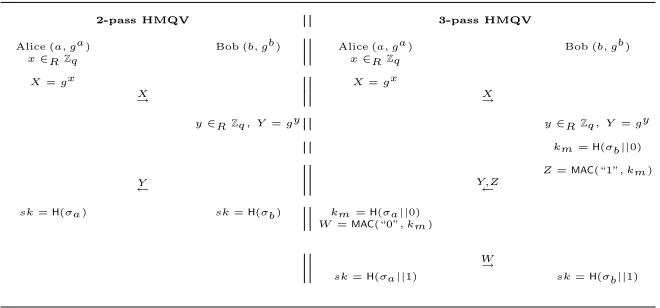
The HMQV family consists of a number of protocols, and we describe the 2-pass and 3-pass protocols below. Let Alice and Bob be two users who trust TTP in common. Alice and Bob agree on a group Gof prime orderq, a generatorg ofG, and a hash
functionH. Alice selects her long-term private keya∈R Zq and lets the TTP certify
the public key ga, and Bob selects his long-term private key b ∈
R Zq and lets the
TTP certify the public keygb. The protocols are shown in Fig. 3.
2-pass HMQV 3-pass HMQV
Alice (a, ga) Bob (b, gb) Alice (a, ga) Bob (b, gb)
x∈RZq x∈RZq
X=gx X=gx
X
→ →X
y∈RZq , Y=gy y∈RZq , Y=gy
km=H(σb||0)
Z=MAC(“1”, km) Y
← Y,Z←
sk=H(σa) sk=H(σb) km=H(σa||0) W=MAC(“0”, km)
W →
sk=H(σa||1) sk=H(σb||1)
Fig. 3.The HMQV Protocols
The valueσa andσb are defined as follows.
d= ¯H(X||“Bob”), e= ¯H(Y||“Alice”), σa= (Y gbe)x+da, σb= (Xgad)y+eb,
where ¯H outputs the first ` bit of the input of the hash function H given that the security parameter is`. It is straightforward to verify that
σa=σb =g(x+ad)(y+be).
could obtain Bob’s long-term private key b. These attacks have exploited the fact that, in the protocol specification, it is not mandatory for Alice and Bob to verify that both long-term and short-term keys are generated from the right subgroup. Feng [13] showed that the 2-pass protocol is vulnerable to unknown share attacks if the same user executes the protocol between different devices. Furthermore, we have the following observations.
1. We show a key compromise impersonation attack in which, if the adversary knows Alice’s long-term and ephemeral private keysaandx, it can impersonate Bob to Alice. We skip the details since it is straightforward to verify that the attack works.
Alice (a, ga) Adversary (a, ga , gb , x) x∈RZq
X=gx X →
y∈RZq , Y=gy σb=g(x+ad)y·(gb)(x+ad)e
km=H(σb||0) Z=MAC(“1”, km) Y,Z
←
km=H(σa||0) W=MAC(“0”, km)
W →
sk=H(σa||1) sk=H(σb||1)
Fig. 4.Attack against the 3-pass HMQV Protocol
2. Both protocols are vulnerable to the type of unknown key share attacks shown in the case of the YAK protocol. Nonetheless, we note that this kind of attack is beyond the security model used in [20,21].
3. Feng [13] presented a so called ”invalid public key attack”. To mount the attack, Bob lets the TTP certify a long-term public key without generating any private key. Due to the deliberate selection of his public key, Bob can still successfully establish a session key with Alice. Since the public key is weak, any entity can impersonate Bob to Alice so that it causes authentication and repudiation “prob-lems”. However, this kinds of problems apply to all protocols, if a user does not follow the protocol specification and chooses weak keys on purpose.
3
Overview of Two-Party Key Establishment
3.1 The workflow
A two-party key establishment protocol generally involves two types of entities.
– One type is users, any two of which may run the key establishment protocol to establish a session key with each other. Throughout the paper, we assume that the users that may run a key establishment protocol are denoted asUi (1≤i≤N),
where N is the maximum of user population. Furthermore, we assume that Ui
possesses the identityIDi. Ifi6=j,Ui andUj are different users.
– The other type of entity is a Trusted Third Party (TTP) which help users vali-date their long-term public keys, usually of some public-key encryption or digital signature schemes.
Generally, we consider the following execution scenarios for a two-party key es-tablishment protocol.
1. Two users, sayUiandUj (i6=j), may use the same protocol and the same
long-term key to negotiate session keys for many applications. The applications may reside in different devices ofUiandUj. For example, they may run the protocol to
between their laptops to protect their chatting contents and between their work PCs to protect their work documents.
2. The same user, sayUi, may have multiple devices, any two of which use the same
protocol and the same long-term key to negotiate session keys for for many appli-cations. For example, Alice may have separate applications to remotely transfer medical files and sensitive work documents from her laptop to her PC in her company.
3. For each application, the protocol may be executed multiple times to establish cryptographic keys. We denote each execution of the protocol to be a session. We further assume that multiple sessions can be initiated simultaneously.
We useSto denote the application identifier set which contains the application iden-tifiers of all users.
In our setting, asession denotes an execution of the key establishment protocol, invoked by an application of two users. Informally, a session is associated with a set {IDi,IDj, appid} and some execution-specific information (such as the message
Remark 1. In fact, the concept of session has been used in the existing models, e.g. [3,6]. However, it has not been advocated that a session identifier should be out-putted to the invoking application, together with the session key, e.g. in [3]. In [6], it assumed that a session identifier should be supplied by the invoking application as an input, however, this will require the two participants of an application to negotiate an identifier in advance securely. Arguably, this is an undesirable assumption.
Ui (P Ki, SKi;IDj, P Kj, appid) Uj (P Kj, SKj;IDi, P Ki, appid)
m1 −→
m2 ←−
· · ·
mx−1 −→
mx ←−
(sid, sk) (sid, sk)
Fig. 5. Workflow of a Two-party Key Establishment Protocol
The workflow of a two-party key establishment protocol follows the style shown in Fig. 5. The inclusion of identifiersIDi and IDj in the input to the key
establish-ment protocol states that the users know their intended partners, and this is always implicitly assumed in other works. Here, we have two new features.
1. One is that the key establishment protocol takes an application identifier appid
as input. This reflects our consideration that the protocol can be invoked by multiple applications from the same user. We require that, for a user, its different applications hold different identifiers. Furthermore, if an application is between
Ui andUj (say, transfering friles between these users), then these two users hold
the same identifier for the application.
2. The key establishment protocol returns a (session identifier, session key) pair, instead of a session key only as in most existing protocols.
These features are used to distinguish the key establishment sessions invoked by different applications, and subsequently they enable us to avoid the type of unknown key share attacks shown in Section 2.
Remark 2. About the protocol execution, we also make the following assumptions. BothUiandUj know how to validate the public keys of each other. At the beginning
of a session, it may be required thatUisendsm1toUjfirst beforeUj sendsm2back,
namely there is an order of message exchange. In such case, we sayUiis theinitiator
while Ui is the responder. If there is no such order requirement, we simply say both
3.2 The long-term and ephemeral private keys
In a session of a two-party key establishment protocol, each participant makes use of two types of secrets.
1. One is its long-term private key1, which guarantees the integrity and/or confiden-tiality of messages sent to the other participant. In some protocols, the long-term private key is also used to derive the session key. Without using a long-term private key, a two-party key establishment protocol will suffer from a man-in-the-middle attack, for example in the case of Diffie-Hellman [11].
2. The other is the ephemeral private key, which is the randomness locally gener-ated by a random number generator or a pseudo-random number generator. The ephemeral private key is mainly used to derive a fresh session key, and it makes the session keys unique.
In practice, both types of private keys could be compromised. For the long-term private key, the user must store it somewhere and may also make some backups. Therefore, an adversary may obtain the long-term private key if it gains access to any one of the storage devices. With respect to the ephemeral private key, since it is generated locally by a computing device (normally a computer), an adversary may gain access to it by a number of means. For example, the adversary could install some trojan horse in the participant’s computing device to steal the secrets, or it could make use of the imperfectness of the pseudo-random number generator in use.
In practice, a user may attempt to use its long-term private key for other purposes. For example, a user may use the signature key pair (assuming such a key pair is used in the key establishment protocol) to authenticate itself to a website. This kind of extended usage of the same private key is extremely risky. To demonstrate our point, we present a toy example of a key establishment protocol in Fig. 6 and a toy authentication protocol in Fig. 7, whereris a random string, (pk2, sk2) is a sign/verify key pair ofU2.
U1 U2
r
−→
Sign(r,sk2) ←−
· · ·
Fig. 6. Key Establishment Protocol
U2 Server
r
←−
Sign(r,sk2) −→
Fig. 7.Authentication Protocol
Since U1 can make U2 sign a nonce in the key establishment protocol, so that
U1 can impersonate U2 in the authentication protocol trivially. We emphasize that
extended usage of the same private key should be avoided in practice. To formulate the security properties, we assume the user’s long-term private key is only used in executing a two-party key establishment protocol.
4
Formalization of Security Properties
In this section, we formalize the security properties desired by a two-party key estab-lishment protocol. Further remarks are provided in the Appendix A.
4.1 The threat model
With respect to the relevant trust relationships in a two-party key establishment protocol, we make the following assumptions.
1. If a TTP is required, it is semi-trusted in the following sense. The TTP will honestly follow the protocol specification. For example, it will honestly certify users’ public keys, but will not generate a forged certificate for either an existing identity or a new identity (which is different fromIDi (1≤i≤N)).
2. Any user, say Ui, is semi-trusted by any other user Uj (j 6= i) in the following
sense.
(a) Suppose Uj is engaged in a session withUi, it may be possible that Ui will
deviate from the protocol specification in order to obtain more information aboutUj’s long-term and short-term private keys. For example,Ui may try
to impersonateUj to another user in another session, by taking advantage of
the harvested information.
(b) Suppose Uj is engaged in a session with Ui, besides the possible malicious
activities described in (a),Ui will do nothing else malicious. For example, Ui
will not disclose the shared session key withUj to any other entity.
(c) Suppose Uj is engaged in a session with Uk, Ui is treated as a malicious
adversary.
Since a key establishment protocol is normally used in a distributed environment, namely the two participants communicate through an open network. Therefore, it is essential to assume the adversary to be an active one. In other words, the adversary can not only eavesdrop on the communication network but also manipulate (delete, insert, replace, delay, etc) the messages at its will.
As a basic requirement, a two-party key establishment protocol should always be sound. Formally the soundness property is defined as follows.
1. In the absence of an adversary, the two users obtain the same (session identifier, session key) pair at end of a session.
2. For any two sessions of Ui, carried out with Uj for an application appid, the
probability that the session identifiers are identical is negligible, regardless of the coin flips ofUj.
3. Suppose thatUi successfully ended a session withUi for the applicationappid and
Uk successfully ended a session withUl for the application app0id. Given that the
sets{IDi,IDj, appid}and{IDk,IDl, app0id}are not identical, the probability that the
session identifier ofIDi and the session identifier ofIDk are identical is negligible,
regardless of the coin flips of all users.
In the literature, many properties have been identified for key agreement proto-cols, and a summary of them can be found in the work by Menezes, Oorschot, and Vanstone [23], Boyd and Mathuria [5], and Tang [27]. In this paper, we categarize the desirable properties for a key establishment protocol into two categories, namely key authentication and entity authentication.
4.2 The Key Authentication Property
The Key authentication property2 states that a user U
i has completed a successful
protocol execution in one session (let it be denoted with session identifiersid∗) with
Uj, it can be assured that onlyUj is capable of compute the same session key. It is
worth noting that this property does not guarantee thatUjactually possess the same
session key. In fact, it does not even guarantee that Uj actually knows there is such
a key establishment session.
When analysing the key authentication property, in the above threat model, we need to assume an active adversary which can access to the long-term private keys of all users exceptUiandUj. In fact, we often need to assume a more powerful adversary
in the following attack scenarios.
1. known session key attack: In this case, the adversary is assumed to be able to compromise the session keys in all sessions except that identified by sid∗. The concept was first mentioned by Denning and Sacco [10] in a limited way, in which the adversary can compromise all past session keys.
2. forward secrecy attack: In this case, the adversary is assumed to be able to com-promise the long-term private keys ofUi or Uj after the session with identifier
sid∗has ended. If both private keys are compromised by the adversary, it is said
to be aperfect forward secrecy attack.
3. known master key attack: In this case, the adversary is assumed to be able to compromise TTP and obtain its long-term private keys. In addition, if the TTP stores also other secret information then the adversary can obtain it as well. 4. unknown key-share attack: The notion of unknown key-share attacks were first
discussed by Diffie, van Oorschot and Wiener [12]. It is defined to be the property that an honest user Ui never ends up believing it shares a key with user Uj,
although it actually shares the session key with another user Uu (u 6= j). We
further require that one application should not share the same the session key with another application when the protocol is run by the two applications of the same pair of users.
5. key-compromise impersonation attack: This attack makes sense only when i6=j, namely the two users in the session are different. In this case, the adversary is assumed to be able to compromise the long-term private key ofUi. Note that this
attack scenario is also considered in evaluating the entity authentication property.
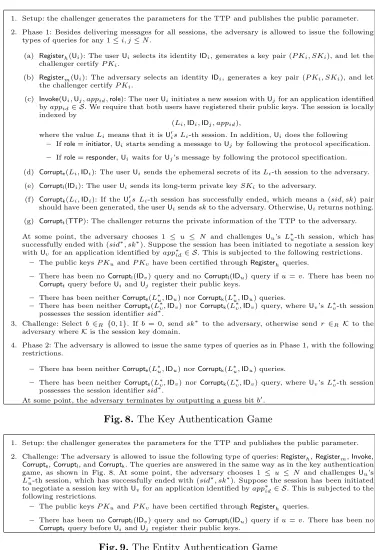
Formally, the key authentication property is evaluated by the attack game between a challenger and an adversary, as shown in Fig. 8, where the adversary’s advantage is defined to be |Pr[b=b0]−1
2|. For the simplicity of description, we use the notations
Ui for some 1≤i≤N in a few places, although the challenger will actually simulate
all these activities.
Definition 2. A two-party key establishment protocol achieves the key authentication property, if any polynomial-time adversary has only negligible advantage in the key authentication game.
4.3 The Entity Authentication Property
The entity authentication property states that, if from the view of a user Uj it has
successfully completed a key establishment session (identified by the session identifier sid∗) with Uj, thenUj should have actually engaged in a key establishment session
(identified by the session identifier sid∗) with Ui. Typically, we need to assume an
active adversary which can access to the long-term private keys of all users except
Ui andUj. Similar to the situation in analysing the key authentication property, we
often also consider some extended attack scenarios.
1. key-compromise impersonation attack: This attack makes sense only when i6=j, namely the two users in the session are different. In this case, the adversary is assumed to be able to compromise the long-term private key ofUi. In addition,
we also allow the adversary to compromise all the ephemeral secrets ofUi.
2. key confirmation: In this case, if, from the view of a userUi, it has successfully
completed a key establishment session (identified by the session identifiersid∗) withUj, thenUj should have engaged in a key establishment session (identified
by the session identifiersid∗) withUi and has computed the same session key as
that ofUi.
Formally, the entity authentication property is evaluated by the attack game be-tween a challenger and an adversary, as shown in Fig. 9, where the advantage is defined to be the probability that the userUv does not have a session with the identifiersid∗
and session key sk∗. For the simplicity of description, we use the notations U i for
1. Setup: the challenger generates the parameters for the TTP and publishes the public parameter.
2. Phase 1: Besides delivering messages for all sessions, the adversary is allowed to issue the following types of queries for any 1≤i, j≤N.
(a) Registerh(Ui): The userUiselects its identityIDi, generates a key pair (P Ki, SKi), and let the
challenger certifyP Ki.
(b) Registerm(Ui): The adversary selects an identity IDi, generates a key pair (P Ki, SKi), and let
the challenger certifyP Ki.
(c) Invoke(Ui,Uj, appid,role): The userUiinitiates a new session withUjfor an application identified
byappid∈ S. We require that both users have registered their public keys. The session is locally
indexed by
(Li,IDi,IDj, appid),
where the valueLimeans that it isU0is Li-th session. In addition,Uidoes the following – Ifrole=initiator,Uistarts sending a message toUj by following the protocol specification.
– Ifrole=responder,Uiwaits forUj’s message by following the protocol specification.
(d) Corrupte(Li,IDi): The userUisends the ephemeral secrets of itsLi-th session to the adversary.
(e) Corruptl(IDi): The userUisends its long-term private keySKito the adversary.
(f) Corruptk(Li,IDi): If theU0is Li-th session has successfully ended, which means a (sid, sk) pair
should have been generated, the userUisendsskto the adversary. Otherwise,Uireturns nothing.
(g) Corruptt(TTP): The challenger returns the private information of the TTP to the adversary.
At some point, the adversary chooses 1 ≤ u ≤ N and challenges Uu’s L∗u-th session, which has
successfully ended with (sid∗, sk∗). Suppose the session has been initiated to negotiate a session key withUv for an application identified byapp∗id∈ S. This is subjected to the following restrictions.
– The public keysP KuandP Kvhave been certified throughRegisterhqueries.
– There has been noCorruptl(IDv) query and noCorruptl(IDu) query ifu=v. There has been no Corrupttquery beforeUiandUj register their public keys.
– There has been neitherCorrupte(L∗u,IDu) norCorruptk(L∗u,IDu) queries.
– There has been neitherCorrupte(L∗v,IDv) norCorruptk(L∗v,IDv) query, whereUv’sL∗v-th session
possesses the session identifiersid∗.
3. Challenge: Selectb∈R {0,1}. Ifb= 0, sendsk∗ to the adversary, otherwise sendr∈RK to the
adversary whereKis the session key domain.
4. Phase 2: The adversary is allowed to issue the same types of queries as in Phase 1, with the following restrictions.
– There has been neitherCorrupte(L∗u,IDu) norCorruptk(L∗u,IDu) queries.
– There has been neitherCorrupte(L∗v,IDv) norCorruptk(L∗v,IDv) query, whereUv’sL∗v-th session
possesses the session identifiersid∗.
At some point, the adversary terminates by outputting a guess bitb0.
Fig. 8.The Key Authentication Game
1. Setup: the challenger generates the parameters for the TTP and publishes the public parameter.
2. Challenge: The adversary is allowed to issue the following type of queries:Registerh,Registerm,Invoke, Corrupte,Corruptl, andCorruptk. The queries are answered in the same way as in the key authentication
game, as shown in Fig. 8. At some point, the adversary chooses 1≤ u ≤ N and challengesUu’s L∗u-th session, which has successfully ended with (sid∗, sk∗). Suppose the session has been initiated to negotiate a session key withUv for an application identified byapp∗id∈ S. This is subjected to the
following restrictions.
– The public keysP KuandP Kvhave been certified throughRegisterhqueries.
– There has been noCorruptl(IDv) query and noCorruptl(IDu) query ifu=v. There has been no Corrupttquery beforeUiandUj register their public keys.
Fig. 9. The Entity Authentication Game
5
A Secure Two-Party Key Establishment Protocol
5.1 The Proposed Protocol
We assume the usersUi (1≤i≤N) agree on a groupGof prime orderq, a generator
g of G, and a hash function H : {0,1}∗ → {0,1}L where L is a polynomial in the
security parameter`. We assumeK={0,1}Lis the session key domain. Every userU i
generates a key pair (P Ki, SKi) for a digital signature scheme (KeyGen,Sign,Verify)
which is existentially unforgeable under an adaptive chosen message attack [22], and lets the TTP certify P Ki. The application identifier set isS ={0,1}∗. IfUi andUj
want to establish a session key, they follow the protocol shown in Fig. 10.
Ui (P Ki, SKi,IDj, P Kj, appid) Uj (P Kj, SKj,IDi, P Ki, appid)
x∈RZq, X=gx y∈RZq, Y =gy
X
−→
Y
←− W =P Ki||IDi||P Kj||IDj||appid||X||Y
σ1=Sign(0||W||H(Yx), SKi) σ2=Sign(1||W||H(Xy), SKj) σ1
−→
σ2 ←− sid=H(W), sk=H(W||Yx)
sid=H(W), sk=H(W||Xy)
Fig. 10.The Proposed Key Establishment Protocol
In the protocol execution, Ui validates P Kj and σ2 and aborts if any of the
validations fails, andUj validatesP Ki andσ1 similarly.
The proposed protocol achieves all properties defined in our security model, namely soundness, key authentication, and entity authentication. The prrofs appear in Ap-pendix B.
Theorem 1. The proposed protocol is sound if the hash functionHis collision resis-tant.
Theorem 2. The proposed protocol achieves entity authentication property, given that the digital signature scheme(KeyGen,Sign,Verify)is existentially unforgeable un-der an adaptive chosen message attack.
authen-tication game, the probability that the Diffie-Hellman parameter Y is not generated by Uv is negligible.
Recall that the computational Diffie-Hellman (CDH) assumption holds for the group Gif given gx, gy where x, y ∈
R Zq an adversary can only output gxy with a
negligible probability.
Theorem 3. The proposed protocol achieves key authentication property based on the CDH assumption in the random oracle model, given that the digital signature scheme (KeyGen,Sign,Verify) is existentially unforgeable under an adaptive chosen message attack.
5.2 A Further Remark
In Section 3.1, we state a special case of executing a two-party key establishment protocol, i.e. a user, say Ui, runs the protocol between its devices while using the
same long-term key pair for security guarantee. Though the proposed protocol in Section 5.1 is secure in this case, there is a higher probability that the long-term private key could be compromised since it needs to be deployed in many devices. To mitigate such risks, we can apply the following trick. Suppose thatUihas two devices
LaptopandWorkstation, it can use the long-term key pair to certify two signature key pairs for (P Ki0, SKi0) and (P Ki00, SKi00) for the devices, respectively. ThenLaptopand
Workstationcan use these key pairs to run the key establishment protocol.
6
Conclusion
In this paper, we have revisited the YAK protocol and the HMQV protocols and shown their potential weaknesses. We have presented a comprehensive model for key establishment protocols, which has taken into account the interface between a key es-tablishment protocol and the applications which may invoke it. We have emphasized the concept of session and the usage ofsession identifier. Moreover, we have shown how to design a two-party key establishment protocol to achieve both key authen-tication and entity authenauthen-tication properties in our security model. We foresee the following interesting future works. The security model can be made even stronger by allowing the adversary to access more ephemeral secrets. For example, in the key au-thentication game, the adversary is allowed to obtain the ephemeral secrets in section sid∗. The security model can be extended in other ways. For example, similar
References
1. J. Alwen, Y. Dodis, and D. Wichs. Leakage-resilient public-key cryptography in the bounded-retrieval model. In S. Halevi, editor, Advances in Cryptology — CRYPTO 2009, volume 5677 of Lecture Notes in Computer Science, pages 36–54. Springer, 2009. 2. M. Bellare, R. Canetti, and H. Krawczyk. A modular approach to the design and analysis
of authentication and key exchange protocols (extended abstract). InProceedings of the thirtieth annual ACM symposium on Theory of computing, pages 419–428, 1998. 3. M. Bellare and P. Rogaway. Entity authentication and key distribution. In D. R.
Stinson, editor,Advances in Cryptology — CRYPTO 1993, volume 773 ofLecture Notes in Computer Science, pages 110–125. Springer, 1993.
4. S. Blake-Wilson, D. Johnson, and A. Menezes. Key agreement protocols and their security analysis. In M. Darnell, editor, Proceedings of Cryptography and Coding, 6th IMA International Conference, volume 1355 ofLecture Notes in Computer Science, pages 30–45. Springer, 1997.
5. C. Boyd and A. Mathuria.Protocols for Authentication and Key Establishment. Springer, 2004.
6. R. Canetti and H. Krawczyk. Analysis of key-exchange protocols and their use for build-ing secure channels. In B. Pfitzmann, editor,Advances in Cryptology — EUROCRYPT 2001, volume 2045 ofLecture Notes in Computer Science, pages 453–474. Springer, 2001. 7. K. R. Choo, C. Boyd, and Y. Hitchcock. Errors in computational complexity proofs for protocols. In B. Roy, editor,Advances in Cryptology — ASIACRYPT 2005, volume 3788 ofLecture Notes in Computer Science, pages 624–643. Springer, 2005.
8. K. R. Choo, C. Boyd, and Y. Hitchcock. Examining indistinguishability-based proof models for key establishment protocols. In B. Roy, editor, Advances in Cryptology — ASIACRYPT 2005, volume 3788 ofLecture Notes in Computer Science, pages 585–604. Springer, 2005.
9. K. R. Choo and Y. Hitchcock. Security requirements for key establishment proof models: Revisiting bellare-rogaway and Jeong-Katz-Lee protocols. In C. Boyd and J. Nieto, editors, Information Security and Privacy, 10th Australasian Conference, Proceedings, volume 3574 ofLecture Notes in Computer Science, pages 429–442. Springer, 2005. 10. D. Denning and G. Sacco. Timestamps in key distribution protocols. Commun. ACM,
24(8):533–536, 1981.
11. W. Diffie and M. Hellman. New directions in cryptography. IEEE Transactions on Information Theory, IT-22(6):644–654, 1976.
12. W. Diffie, P. Oorschot, and M. Wiener. Authentication and authenticated key exchanges.
Des. Codes Cryptography, 2(2):107–125, 1992.
13. H. Feng. On robust key agreement based on public key authentication (short paper). In Proceedings of 14th International Conference on Financial Cryptography and Data Security, FC 2010, 2010.
14. Y. Hitchcock, C. Boyd, and J. Manuel Gonz´alez Nieto. Modular proofs for key exchange: rigorous optimizations in the canetti-krawczyk model. Appl. Algebra Eng. Commun. Comput., 16(6):405–438, 2006.
15. Institute of Electrical and Electronics Engineers, Inc. IEEE P1363 Standard Specifica-tions for Public-Key Cryptography, 2000.
16. Institute of Electrical and Electronics Engineers, Inc.IEEE P1363.2 draft D20, Standard Specifications for Password-Based Public-Key Cryptographic Techniques, March 2005. 17. International Organization for Standardization. ISO/IEC FCD 11770–2, Information
technology — Security techniques — Key management — Part 2: Mechanisms Using Symmetric Techniques, 1996.
19. International Organization for Standardization. ISO/IEC 11770–4, Information tech-nology — Security techniques — Key management — Part 4: Mechanisms based on weak secrets, 2006.
20. H. Krawczyk. HMQV: A high-performance secure diffie-hellman protocol. In Victor Shoup, editor,Advances in Cryptology — CRYPTO 2005, volume 3621 ofLecture Notes in Computer Science, pages 546–566. Springer, 2005.
21. H. Krawczyk. HMQV: A high-performance secure diffie-hellman protocol. Cryptology ePrint Archive: Report 2005/176, 2005.
22. A. Menezes. Another look at HMQV. Journal of Mathematical Cryptology, 1:47–64, 2005.
23. A. J. Menezes, P. C. van Oorschot, and S. A. Vanstone. Handbook of Applied Cryptog-raphy. CRC Press, 1997.
24. R. Needham and M. Schroeder. Using encryption for authentication in large networks of computers. Commun. ACM, 21(12):993–999, 1978.
25. V. Shoup. On formal models for secure key exchange. Technical report, IBM Research Report RZ 3120, 1998.
26. V. Shoup. Sequences of games: a tool for taming complexity in security proofs. http://shoup.net/papers/, 2006.
27. Q. Tang. Key establishment protocols and timed-release encryption schemes. Royal Holloway, University of London, Mathematics Department Technical Report RHUL-MA-2007-9, 2007. PhD Thesis.
Appendix A. Remarks on the Security Model
The key authentication game, shown in Fig. 8, covers the extended attack scenarios listed in Section 4.2.
1. A known session key attack is covered because the adversary is allowed to ob-tain the available session keys (except that in the sessionsid∗) throughCorrupt
k
queries.
2. A perfect forward secrecy attack is covered because the adversary is allowed to obtain bothSKi andSKj throughCorruptlqueries in Phrase 2.
3. A known master key attack is covered because the adversary is allowed to obtain the TTP’s private information through aCorruptt query.
4. Anunknown key-share attack is covered because the adversary is allowed to ob-tain the available session keys (except that in the sessionsid∗) throughCorrupt
k
queries.
5. A key-compromise impersonation attack is covered because the adversary is al-lowed to obtain bothSKi throughCorruptlqueries in Phrase 1.
In addition, the possibility of ephemeral secret leakage has been covered since the adversary is allowed to issueCorrupte queries
1. A key-compromise impersonation attack is covered because the adversary is al-lowed to obtain both SKi through Corruptl queries and the ephemeral secret
through aCorrupte query.
2. A attack against key confirmation is covered because the adversary wins if the two users do not have the same session identifier and share the same session key.
Appendix B. Proof of Theorems
Proof sketch of Theorem 1.Briefly, we show that the three requirements in Defi-nition 1 are satisfied.
1. It is straightforward to verify that, at the end of a session, the two users obtain the same (sid, sk) pair.
2. For Ui, the session identifier is computed partially with the input gx, where x
is randomly chosen in every session. Clearly, given that the hash function H is collision resistant, two sessions ofUi, carried out withUjfor an applicationappid,
the probability that the session identifiers are identical is negligible.
3. For a session betweenUi andUjfor the applicationappid, the session identifier is
computed partially with the input
P Ki||IDi||P Kj||IDj||appid.
For a session betweenUk and Ul for the application app0id, the session identifier
is computed partially with the input
P Kk||IDk||P Kl||IDl||app0id.
Clearly, given that the sets{IDi,IDj, appid}and{IDk,IDl, app0id}are not identical
and the hash functionHis collision resistant, the probability that the session iden-tifier ofIDi and the session identifier ofIDk are identical is negligible, regardless
of the coin flips of all users.
The theorem now follows. ut
Proof sketch Theorem 2.Suppose that Uu successfully ended with a session with
withUvfor the applicationapp∗id. Suppose also thatUu obtains (sid∗, sk∗) at the end
of the session. Based on the protocol specification,Uu has received a valid signature
of the form
σ2=Sign(1||W||H(YlogXg ), SKv), where
sid∗=H(W) andW =P Ku||IDu||P Kv||IDv||appid||X||Y.
Now, suppose the user Uv does not have a session with the session identifier sid∗
and session key sk∗ = H(W||XlogY
g), then the probability that Uv has generated a
signature equalling toσ2 is 0. Note that the adversary is not allowed to compromise SKv in the game. As a result, the adversary has forged the signatureσ2, which has
existentially unforgeable under an adaptive chosen message attack. The theorem now
follows. ut
Proof sketch Theorem 3.Suppose that there are at most T Invoke oracle queries in Phase 1 of the key authentication game. Since we only consider a polynomial-time adversary,T is a polynomial in the security parameter `. Let’s the adversary’s advantage be in the key authentication game, shown in Fig. 8. The rest of the security proof is done through a sequence of games [26].
Game0: At the beginning of this game, the challenger makes a prediction on the
session that the adversary would challenge in the game. The guess is correct im-plies that it is a Uu’s L∗u-th session with Uv for an application app∗id. If the guess
is incorrect, the challenger aborts. Otherwise, the challenger faithfully simulates the protocol execution and answers the oracle queries from the adversary A. Let 1 be the probability that the challenger does not abort and the adversary wins the game. Clearly, the probability that the challenger does not abort is 1
T, in which case the
adversary’s advantage is(in this case,Game0is equivalently the key authentication
game). Therefore,1= T.
Game1: In this game, the challenger perform in the same way as inGame0except
the session key is computed as
sid∗=H(W), sk∗=R, R∈ {0,1}L
, W =P Ku||IDu||P Kv||IDv||app∗id||X||Y.
Let 2 be the probability that the challenger does not abort the game and the ad-versary wins the game. Clearly, the probability that the challenger does not abort is
1
T, in which case the adversary’s advantage is exactly 0 since the challenger returns a
random message, regardless the coin flipb. Therefore,2= 0
T.
If the hash function is modeled as a random oracle, then Game1 is identical to
Game0unless the adversary has queries the random oracleHwith the inputW||Ylog X g ,
which has a negligible probability based on Corollary 1 and the CDH assumption. We have|2−1|, namely
T, is negligible from the Difference Lemma in [26]. SinceT is
a polynomial in the security parameter`, the valueis negligible. The theorem now