and
Grøstl-256
and Studies on Several Truncation Patterns for
AES
-like Compression Functions (Full Version)
?Bingke Ma1,2,3, Bao Li1,2, Ronglin Hao1,2,4, and Xiaoqian Li1,2,3
1State Key Laboratory of Information Security, Institute of Information Engineering,
Chinese Academy of Sciences, Beijing, 100093, China 2
Data Assurance and Communication Security Research Center, Chinese Academy of Sciences, Beijing, 100093, China
{bkma,lb,xqli}@is.ac.cn
3University of Chinese Academy of Sciences, Beijing, China 4
Department of Electronic Engineering and Information Science, University of Science and Technology of China, Hefei, 230027, China
Abstract. In this paper, we present improved preimage attacks on the reduced-round GOST hash
function family, which serves as the new Russian hash standard, with the aid of techniques such as the rebound attack, the Meet-in-the-Middle preimage attack and the multicollisions. Firstly, the preimage attack on 5-round GOST-256is proposed which is the first preimage attack for GOST-256 at the hash function level. Then we extend the (previous) attacks on 5-roundGOST-256and 6-roundGOST-512to 6.5 and 7.5 rounds respectively by exploiting the involution property of theGOSTtransposition operation. Secondly, inspired by the preimage attack onGOST-256, we also study the impacts of four representa-tive truncation patterns on the resistance of the Meet-in-the-Middle preimage attack againstAES-like compression functions, and propose two stronger truncation patterns which make it more difficult to launch this type of attack. Based on our investigations, we are able to slightly improve the previous pseudo preimage attacks on reduced-roundGrøstl-256.
Keywords: hash function, cryptanalysis, preimage,GOST,Grøstl-256, the Meet-in-the-Middle
preim-age attack, truncation patterns
1
Introduction
Cryptographic hash function is one of the fundamental building blocks in modern cryptography. A hash function takes a message of arbitrary length as input and outputs a bit string of fixed length. For a secure hash function, three classical security properties are mainly concerned, namely, the collision resistance, the second preimage resistance, and the preimage resistance. Many state-of-the-art hash functions divide the input messages into short blocks and process each block with the compression function iteratively, such as the classical Merkle-Damg˚ard [14,38] construction. Due to the generic attacks on the Merkle-Damg˚ard construction [25,28,27], several new domain extension schemes are proposed to fix the inherent weaknesses of the Merkle-Damg˚ard construction. One popular instance of these new constructions is theHAIFAframework proposed by Biham and Dunkelman in [9]. It adds a salt value and a counter which denotes the number of message bits hashed so far as extra input parameters to the compression function, thus makes each compression iteration distinct and is believed to resist certain generic attacks [28,27]. In practice, it has been adopted by severalSHA-3candidates includingBLAKE[5],ECHO[7],SHAvite-3[10], and also the new Russian hash standardGOST R 34.11-2012, to name but a few.
The oldGOST R 34.11-94hash function [17] was theoretically broken in 2008 [35,36]. As a consequence, the new GOST R 34.11-2012 hash function [15,18,26] has replaced GOST R 34.11-94as the new Russian national hash standard since January 1, 2013, and it is also included by IETF as RFC 6986 [16]. The newGOST
hash function family consists of two members:GOST-256and GOST-512, which correspond to two different output lengths. It adopts theHAIFAconstruction with a unique output transformation, and its compression
?
function contains two parallel AES-like permutations in the Miyaguchi-Preneel mode, which is very similar to the Whirlpool hash function [6,23]. Several cryptanalytic results have already been presented since the announcement of the newGOSThash function. Interesting results on theGOSTcompression function are shown in [1,43], but they seem to have limited impacts on theGOST hash function. The first cryptanalytic result at the hash function level was given by Zouet al. at Inscrypt 2013 [45], which presented collision attacks on 5-roundGOST-256/512 and a preimage attack on 6-round GOST-512. The recent preimage attack in [2] is similar to the one in [45]. Maet al.proposed several improved attacks onGOST [33], including improved (memoryless) preimage attacks on 6-roundGOST-512, collision attacks on 6.5/7.5-roundGOST-256/512, and the limited-birthday distinguisher [24] on 9.5-round GOST-512. More recently, Guo et al.presented generic second preimage attacks on the fullGOST-512hash function [22] by exploiting the misuse of the counter in the HAIFA mode of GOST. However, their attacks cannot be extended to preimage attacks which allow to invert the hash function. Due to the truncation, their attacks do not work forGOST-256either.
To the best of our knowledge, there are no preimage attacks on the GOST-256hash function except for the trivial brute-force attack. One of the crucial reasons that prevent the preimage attack on GOST-256is the ChopMD-like mode adopted in the GOST-256 output transformation. The ChopMD mode [12], which truncates a fraction of the final output chaining value, is proven to be indifferentiable from a random oracle [12,11]. However, the specific truncation patterns in it have not been well studied yet. Many instances in practice just truncate the MSBs (or LSBs) of the chaining value as the digest, such as some of the most acknowledged hash functions SHA-3 [8], SHA-224/384 [39], GOST-256, Grøstl [20] and many otherSHA-3
candidates. Although this type of truncation pattern is convenient to be implemented in both software and hardware, its concrete impacts on the security properties of the hash functions are less evaluated in literature. Hence, evaluating different truncation patterns and seeking for an optimal one is a very meaningful issue in cryptographic research.
Our Contributions. Firstly, we present improved preimage attacks on the reduced-roundGOSThash func-tion family. With the aid of the Meet-in-the-Middle (MitM) preimage attack [4] and the multicollisions [25] which are constructed with dedicated collisions, we overcome the obstacle of the ChopMD mode and present a preimage attack on 5-roundGOST-256. Furthermore, by exploiting the weaknesses of theGOSTtransposition operation, if the MixRow operation of the last round is omitted, we are able to extend the 5-round preimage attack onGOST-256and the previous preimage attack on 6-roundGOST-512[33] to 6.5 rounds and 7.5 rounds respectively. Although it is not natural to omit the MixRow operation in a single round for a hash function likeGOSTbecause it certainly disturbs the wide trail strategy [13], these attacks are theoretically meaningful since they show that any operations with the involution property (i.e., the matrix transposition operation of
GOST) would facilitate the attackers with more attacked rounds, thus further demonstrate that such opera-tions with the involution property should be cautiously considered as candidates for achieving transposition in AES-like hash primitives. The results are summarized in Table 1. However, due to the limited number of rounds attacked, our results do not pose any threats to the practical use of theGOSThash function family.
Secondly, motivated by the preimage attack on GOST-256, we discuss the impacts of the truncation patterns on the resistance of the MitM preimage attack against AES-like compression functions with the ChopMD mode. We investigate four representative truncation patterns, and show that two of them certainly make it more difficult to launch this type of attack. Moreover, the last pattern studied even resists the 6-round MitM preimage attack for certain digest sizes. Based on the investigations, we are able to slightly improve the previous pseudo preimage attacks on the reduced-roundSHA-3finalistGrøstl-256.
Organization of the Paper. In Section 2, we give brief descriptions of theGOSThash function. Section 3 presents the improved preimage attacks on the reduced-roundGOSThash function family. Section 4 discusses the impacts of four representative truncation patterns on the resistance of the MitM preimage attack against
AES-like compression functions. Section 5 concludes and summarizes the paper. [34].
2
The
GOST
Hash Function Family
TheGOST hash function takes any message up to 2512 bits as input, and outputs a 256- or 512-bit digest,
Table 1.Summary of previous and our (second) preimage attacks onGOST
Target Rounds Time Memory Reference
Attacked
GOST-256 (12 Rounds)
5 2
192
264
Section 3
2208 § 212
6.5† 2232 2120
GOST-512 (12 Rounds)
6
2505 2256 [2]
2505 264 [45]
2496 264
[33]
2504 § 211
7.5† 2
496 264
Section 3
2504 § 211
Full‡ 2x·2
512−x
, forx <178.67 Not given
[22] 2523−x, forx <259 Not given
†: Require the omission of the last MixRow operation.
‡: Only work as second preimage attacks.
§: The memory minimized attacks.
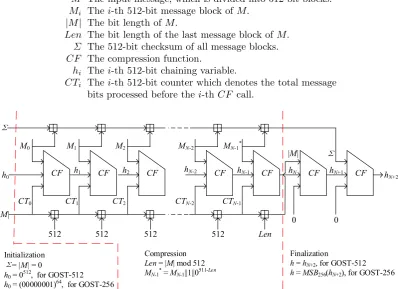
values, and GOST-256 only preserves the 256 MSBs of the final 512-bit chaining value as the digest. As depicted in Fig. 1, the GOST hash function family adopts the HAIFA construction with a unique output transformation. The hash computation contains three stages. Before we give specific descriptions of each stage, we define several notations.
A||B The concatenation of two bit stringsAandB.
M The input message, which is divided into 512-bit blocks. Mi Thei-th 512-bit message block ofM.
|M| The bit length ofM.
Len The bit length of the last message block ofM. Σ The 512-bit checksum of all message blocks. CF The compression function.
hi Thei-th 512-bit chaining variable.
CTi Thei-th 512-bit counter which denotes the total message bits processed before thei-thCF call.
CF h0
M0
Σ
|M|
M1
CF
h1 h2 CF
M2
CF hN-2 MN-2
512
512 512 512
CF hN-1 MN-1*
Len
CF hN
0
CF hN+1
0
hN+2
Initialization
Σ= |M| = 0
h0 = 0512, for GOST-512
h0 = (00000001)64, for GOST-256
Compression Len = |M| mod 512 MN-1* = MN-1||1||0511-Len
Finalization
h = hN+2, for GOST-512
h = MSB256(hN+2), for GOST-256
|M| Σ
CT0 CT1 CT2 CTN-2 CTN-1
In the initialization stage, M is padded into a multiple of 512 bits, i.e., M||1||0∗ is the padded mes-sage, which is then divided into N 512-bit blocks M0||M1||...||MN−1. h0 is assigned to the predefined IV
of GOST-256 or GOST-512. |M|, Σ and CT0 are assigned to 0. In the compression stage, each block Mi
is processed iteratively, i.e., hi+1 = CF(hi, Mi, CTi) for i = 0,1, ..., N −1. After each computation of
the compression function, |M|, Σ and CTi+1 are updated accordingly. In the finalization stage, the
out-put chaining value of the last message block hN goes through the output transformation, i.e., hN+1 =
CF(hN,|M|,0), hN+2 =CF(hN+1, Σ,0). For GOST-512(resp.GOST-256),hN+2 (resp.M SB256(hN+2)) is
the digest ofM.
The compression functionCF(hi, Mi, CTi) can be seen as anAES-like block cipherEKused in a Miyaguchi-Preneel-like mode,i.e., CF(hi, Mi, CTi) =Ehi⊕CTi(Mi)⊕Mi⊕hi. As for the block cipherEK, the 512-bit
internal state is denoted as an 8×8 byte matrix. For the key schedule part,hi⊕CTi is assigned as the key K, thenK0 is computed fromK as follows:
K0=L◦P◦S(K).
The round keysK1, K2, ..., K12are generated as follows:
Kj+1=L◦P◦S◦XC(Kj)f or j= 0,1,2, ...11,
whereK12is used as the post-whitening key:
– AddRoundConstant(XC): XOR a 512-bit constant predefined by the designers.
– SubBytes(S):process each byte of the state through the SBox layer.
– Transposition(P):transpose thek-th column to be thek-th row fork= 0,1,2, ...,7,i.e., transposition of the state matrix.
– MixRows(L):multiply each row of the state matrix by an MDS matrix.
For the data processing part, Mi is the plaintext, and is assigned to the initial stateS0. Then the state is
updated 12 times with the round function as follows:
Sj+1=L◦P◦S◦X(Sj), f or j= 0,1,2, ...11,
whereAddRoundKey(X)XOR the state with the round keyKj. Finally, the ciphertextEK(Mi) is com-puted withS12⊕K12.
3
Improved Preimage Attacks on Reduced-Round
GOST
This section illustrates improved preimage attacks on the reduced-roundGOST hash function family. Firstly, we present the preimage attack on 5-round GOST-256. This attack overcomes the obstacles of the output transformation and the truncation operation ofGOST-256by combining the dedicated collision and preimage attacks on the compression function, and is the first preimage attack on GOST-256 in literature except for the trivial brute-force attack. Then by exploiting the weaknesses of the GOST transposition operation P, if the MixRow operation L in the last round is omitted, we are able to extend the 5-round preimage attack on GOST-256and the previous 6-round preimage attack on GOST-512to 6.5 rounds and 7.5 rounds respectively. Although such an omission seems unnatural for a construction like GOST since it certainly disturbs the wide trail strategy1, the improved preimage attacks with more attacked rounds are of some
theoretical interests since they further demonstrate that any operations with the involution property should be cautiously considered to achieve transposition in AES-like hash primitives from the aspect of preimage resistance, as similar deductions have already been presented from the aspect of collision-like attacks in [33].
3.1 Overview of the Preimage Attack on 5-RoundGOST-256
Based on the preimage attacks on 6-roundGOST-512[33], a very straightforward strategy is to find a (pseudo) preimage2 on the last compression function call of the output transformation, and convert it to a preimage
1 Actually, similar observations have already been adopted [40], in which preimage attack on 7-roundAEShashing modes was constructed by omitting the last MixColumn operation, but it is natural for AES since there is no MixColumn operation in the last round of AES. However, the omission of MixColumn/MixRow in the last round is mainly adopted by block ciphers to achieve implementation advantage in the decryption algorithm, but such omission might be improper under the hash function setting since inverse computation is commonly not required for hash functions.
2
attack on theGOST-256hash function with the aid of tactfully constructed multicollisions. However, if the multicollisions are constructed with cascaded collisions which are generated with the birthday attack, the time complexity would be worse than the brute-force preimage attack on GOST-256. Moreover, the final truncation operation of GOST-256also makes it more complex to launch the MitM preimage attack on the last compression function call of the output transformation.
To overcome the first obstacle, we could use dedicated methods to generate the collisions rather than the birthday attack, and construct the multicollisions with these dedicated cascaded collisions with unique structures. For the second problem, by a deeper look into the original MitM preimage attack framework on AES-like compression functions, we are able to find the optimal attack parameters for reduced-round
GOST-256 although it performs the final truncation. Motivated by the preimage attack on reduced-round
GOST-256, more studies on the MitM preimage attack forAES-like compression functions with truncation are discussed in Section 4.
Phase 1. Build 21024-multicollisions M2
M2' h1 h2
M1 M0
M0'
h0=IV h3
M3i+2
M3i+2' h3i+1 h3i+2
M3i+1 M3i
M3i'
h3i h3i+3
M1535
M1535' h1534 h1535
M1534 M1533
M1533'
h1533 h1536 hX
Phase 2. MitM preimage attack M1536
h1537|M| h1538Σ(M)
Phase 3. Solve the checksum
M3i - M3i' = M3i+2' - M3i+2+ 2511-i
Fig. 2.Three phases of the preimage attack on reduced-roundGOST-256
As depicted in Fig. 2, the preimage attack on 5-round GOST-256 consists of three phases. We briefly introduce the main thoughts of each phase which help to understand the whole attack.
Phase 1. 21024-multicollisions are constructed with 512 cascaded 4-multicollisions pairs, namely,
(M3i, M30i)||M3i+1||(M3i+2, M30i+2) fori = 0,1, ...,511. We choose a 3-block message pair from each of
the 4-multicollisions,i.e.,
(M3i||M3i+1||M3i+2, M30i||M3i+1||M30i+2) fori= 0,1, ...,511, which satisfy that
M3i+M3i+2=M30i+M30i+2+ 2511−i. (1)
Since the size of the message checksum is 512 bits, and 4-multicollisions are required for each i = 0,1, ...,511 to make Equation (1) hold, thus we need to build 21024-multicollisions. Any possible value of the message checksum can be constructed with the 512 3-block message pairs fori= 0,1, ...,511 selected from the 21024-multicollisions due to the unique structures of the collision pairs. In order to build the cascaded collisions which form the multicollisions, we utilize the dedicated collision attacks on 5-round
GOST-256compression function [45] which will be illustrated later.
Phase 2. With the output chaining value of the 21024-multicollisionsh
1536, we randomly choose one more
message block M1536 which satisfies padding and derive the message bit length|M| as well. The value
of h1538 can then be computed. Let hX denote the given target, the last compression function call of
the output transformation is then inverted with the MitM preimage attack, and the preimage Σ(M) generated in this phase is the message checksum desired. Since the collision attack in phase 1 can only reach 5 rounds, we only focus on the preimage attack on 5-roundGOST-256compression function. The exact procedures of this phase will be provided later as well.
Phase 3. After phase 1 and phase 2, we get hold of the 21024-multicollisions, and also have the message
checksum desired. In order to produce the desired checksum, we make use of the methods of [19,33], which first write the desired checksum in binary form and then use the unique structure of the cascaded collision pairs to produce each item of the binary expression. We refer to [33] for details of this phase.
After all three phases succeed, we manage to generate a preimage for 5-roundGOST-256.
3.2 Phase 1. Construct the Multicollisions
This phase needs to generate 21024-multicollisions which can be decomposed into 512 pairs of 4-multicollisions,
we need to utilize the collision attack on 5-round GOST-256 compression function in [45]. The truncated differential trail is depicted in Fig. 3, and the rebound attack [37] is used to derive the collisions. The layers of the inbound phase, which are covered with the SuperSBox technique [21,32], are denoted in red, while the layers of the outbound phase are denoted in blue. We refer to [45] for more descriptions, and only present the results: it requires 2120 time and 264 memory to find a collision, and the expected number of collisions with a fixed input chaining value is 28.
Now we show how to generate the 4-multicollisions
(M3i, M30i)||M3i+1||(M3i+2, M30i+2) for a specifici. As depicted in Fig. 2, the exact procedures are as follows:
1. From the chaining valueh3i, with the aid of the rebound attack and the SuperSBox technique, we find a collision pair (M3i, M30i) on 5-roundGOST-256 at the cost of 2120 time and 264 memory. Notice that the only difference betweenM3i andM30i lies in a single cell whose exact position is determined by the value ofi, and the difference can take at most 28 possible values.
2. From h3i+1, we randomly choose the value ofM3i+1 and compute the output chaining valueh3i+2.
3. From h3i+2, we find a collision pair (M3i+2, M30i+2) on 5-round GOST-256. Then we check whether
M3i−M30i =M30i+2−M3i+2+ 2511−iholds. Note that the only difference betweenM3i+2andM30i+2 lies
in the same active cell as well, thus this condition holds with probability 2−8.
4. From a fixedh3i+2, 28 collision pairs (M3i+2, M30i+2) can be generated, thus we expect to find one such
pair which makes Equation (1) hold. However, if no desired pair is found for the fixed h3i+2, we can
utilize the two-block strategy, and go to step 2 with another value of M3i+1, then redo step 3. As a
result, step 3 will eventually succeed and the 4-multicollisions can be constructed.
S
4S
5S
0S
1S
2S
3X S P L
X S
P L
X S P L
X S P L
X
S P L
r
0r
1r
2r
3r
4Fig. 3.Collision attack on 5-roundGOST-256compression function
Since the position of the active cell can be placed in any cell from the 64 possible positions, we can generate the 4-multicollisions for any item 2511−i wherei= 0,1, ...,511. For instance, the differential trail in Fig. 3 is adopted to generate the 4-multicollisions for the item 2511−i wherei= 0,1, ...,7. Finally, after enumerating all 64 positions of the active cell and repeating the above procedures 512 times, the 21024-multicollisions are
constructed with 512×(2120+ 2120+8)≈2137time and 264 memory.
3.3 Phase 2. Invert the Output Transformation
As depicted in Fig. 2, given the target digesthX and the chaining value h1538, this phase inverts the last
compression function call of the output transformation and derives the value of the message checksumΣ(M). In order to do so, we utilize the MitM preimage attack onAES-like compression functions. Due to the close relevances, we give brief descriptions of the MitM preimage attack onAES-like compression functions. Then we discuss how the truncation pattern of GOST-256 influences our attack. Finally, we provide the optimal attack parameters derived.
The MitM Preimage Attack Framework onAES-like Compression Functions.The MitM preimage
attack was first introduced by Aoki and Sasaki in [4]. The basic idea of this technique, which is known as
splice-and-cut, aims to divide the target cipher into two sub-ciphers which can be computed independently. Several advanced techniques to further improve the basic attack are developed, such aspartial matching[4],
initial structure [41],indirect partial matching [3],bicliques[30] and differential MitM attack [31].
and the best attack parameters can be easily derived through an exhaustive search. In [42], Sasaki et al. introduced theguess-and-determine approach to extend the basic attack by one more round. Based on these previous results, the basic MitM preimage attack framework onAES-like compression functions is achieved.
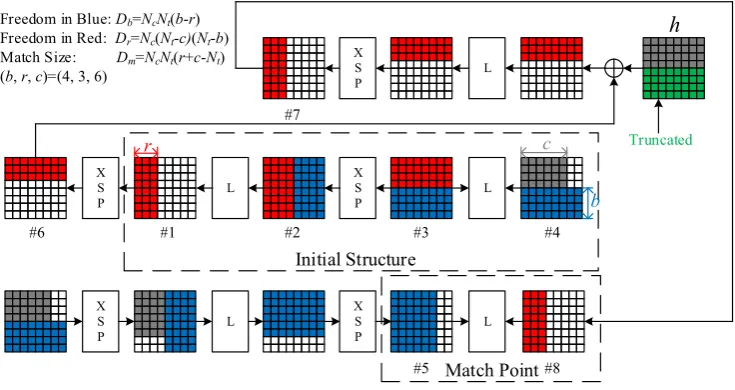
As shown in Fig. 4, without loss of generality, we use the chunk separation of 5-roundGOST-256in order to further illustrate the details of the attack framework. We first define several necessary notations which are used throughout this paper. These notations are also depicted in Fig. 4 for instance.
n Bit size of the digest. Nc Bit size of the cell.
Nt Number of columns (or rows) in the state.
b Number of blue rows (or columns) in the initial structure. r Number of red rows (or columns) in the initial structure.
c Number of constant cells in each row (or column) in the initial structure. g Number of guessed rows (or columns) in the backward (or forward)
computation, which are denoted in purple. See Fig. 6 for instance. Db Freedom degrees of the blue chunk in bits.
Dr Freedom degrees of the red chunk in bits. Dg Bit size of the guessed cells.
Dm Bit size of the match point.
TIME Time complexity of the preimage attack.
MEMORY Memory requirement of the preimage attack.
The attack procedures can be further divided into five steps which are illustrated as follows, and the interested readers are referred to [40,44] for more details of the construction of the initial-structure and indirect-partial-matching through the MixRow layer, and [42] for the illustrations of the guess-and-determine strategy.
L X
S P
L X
S P
Initial Structure
Match Point
L X
S P
h
L X
S P
L X
S P
Truncated
b
c
r
Freedom in Blue: Db=NcNt(b-r)
Freedom in Red: Dr=Nc(Nt-c)(Nt-b)
Match Size: Dm=NcNt(r+c-Nt)
(b, r, c)=(4, 3, 6)
#1 #2 #3 #4
#5 #8
#7
#6
Fig. 4.Preimage attack on 5-roundGOST-256compression function
Step 1. Initial Structure.Choose random values for the constants which are used in the transformations between states #1 ↔ #2, and states #3 ↔ #4. Following the linear relations of the MixRow operation, compute the values for the forward chunk (in blue) which hasDbfreedom degrees and the backward chunk (in red) which hasDrfreedom degrees. After this step, the compression function is divided into two independent chunks thanks to the initial structure.
Step 2. Forward Computation. For all the blue and grey cells at state #4, the forward chunk can be
computed forwards independently until state #5.
Step 3. Backward Computation. For all the red cells at #1, the backward chunk can be computed
the truncation pattern through the feed-forward operation during the backward computation phase will be discussed later.
Step 4. Indirect-Partial-Matching through the MixRow Layer. The indirect-partial-matching is
performed between states #5 ↔ #8 with partial known information of the red and blue cells from both directions by exploiting linear relations of the MixRow operation.
Step 5. Recheck. Check whether the guessed cells of the partial match derived in step 4 are guessed
correctly. If so, check whether the partial match is also a full match. Repeat the above steps 1-5 until a preimage is found.
Deriving the Attack Parameters. As discussed in previous works, the attack parameters,e.g., the free-dom degrees of the forward chunkDband the backward chunkDrcan be easily represented and enumerated with several predefined integer parameters (b, r, c) as shown in Fig. 4. However, the size of the match point Dmis rather ad-hoc, and needs to be treated carefully mainly due to impacts introduced by the truncation operation and the feed-forward operation.
On the Match Point. For narrow pipe constructions, the state size equals with the digest size, and
the indirect-partial-matching contributes to the match of the entire digest. As studied in previous works [40,44,42], the complexities can be denoted as follows (ndenotes the digest size):
TIME= 2n(2−Dr+ 2−Db+ 2−Dm),
MEMORY=min{2Dr,2Db}. (2)
However, sinceGOST-256is a wide pipe design which adopts the ChopMDmode, we have to ensure that the indirect-partial-matching operation between the forward blue chunk and the backward red chunk is only carried on the preserved grey cells at state #9, and is not related to the truncated green cells at state #9. As can be seen from Fig. 4, the red cells at state #7 are fully determined after the feed-forward operation of state #6 and state #9, and only the grey preserved cells at state #9 are involved in this feed-forward process, while the green truncated cells are totally irrelevant. Consequently, only the grey preserved cells of the digest at state #9 are matched through the indirect-partial-matching layer, and the attack complexities for narrow pipe constructions still hold for the GOST-256 case. Hence, for the GOST-256 case, the attack complexities can still be represented as Equation (2).
Impacts of the Truncation. As depicted in Fig. 4, the truncation operation has direct influences on
the matching part of the attack. More precisely, in the backward computation of the red chunks, the feed-forward operation can be conducted at state #6 or #7, and different selections will result in different attacks. However, note that the attack complexities still depend on the quartets,i.e., (n, Dr, Db, Dm), and thus the expressions of the complexities are the same as Equation (2).
Case 1. Feed-forward at State #6. After the feed-forward operation with state #6, all information of
ther red rows at #6 will be preserved due to the row-wise truncation as long asr≤4. Consequently, the backward computation would proceed by one more round and the original attack framework would still work as long as r≤4 is satisfied. We exhaustively search all possible attack parameters for case 1, and the optimal parameters offer the attack with time complexity 2192which is optimal.
Case 2. Feed-forward at State #7. After the feed-forward operation with state #7, only the first four rows of therred columns at #7 will be preserved due to the truncation. Although the number of attacked rounds remains unchanged, the size of the match point3 is reduced by half which might have negative
impacts on the overall complexity. Actually, we exhaustively search all possible attack parameters for case 2, and the optimal parameters offer the attack with time complexity 2208 which is not optimal.
3
Optimize Phase 2. Based on the previous discussions on the generic attack framework and the impacts introduced by the truncation, we choose state #6 as the position where the feed-forward operation is per-formed. Because (Db, Dr, Dm) can be represented with (b, r, c), we can easily enumerate all possible values of (b, r, c) and search for the optimal attack parameters. The optimal chunk separation for 5-round GOST-256
is denoted in Fig. 4. Since the size of the target digesthX is 256 bits, and we have 512 bits freedom degrees inΣ(M), phase 2 will succeed with probability 1. Finally, according to the specific attack parameters in Fig. 4, we need 2192time and 264 memory to generate a preimage for 5-roundGOST-256compression function.
3.4 Phase 3. Generate the Preimage
We omit the details of this phase, since it follows almost the same procedures of the preimage attack in [33]. Note that this phase only needs several simple operations, thus the complexities are negligible.
3.5 Summarize the 5-Round Attack
Minimize the Memory Requirement. We can also minimize the memory requirement after a deeper look
into the above attack. Since we have to store the 21024-multicollisions, the memory requirement is at least
212 512-bit blocks. We can launch the memoryless MitM preimage attack [29,42] in phase 2, and generate a
preimage with 2208time and negligible memory using the parameters (b, r, c) = (5,4,6)4. As for phase 1, the
standard time/memory tradeoff can be utilized to reduce the memory requirement of the inbound phase as stated in [32, Appendix]. More precisely, referring to Fig. 3, the exact attack steps are as follows:
1. We choose 2sdifferences atS
4and propagate the differences toP−1◦L−1(S4), then save the 2sdifferences
in sorted lists for each SuperSBox.
2. We choose a random difference of P−1◦L−1(S
3), and compute the corresponding difference of X(S3).
3. For each specific SuperSBox, we enumerate all 264 values according to the difference of X(S 3), and
compute the corresponding output differences. There are 2s differences in the saved list, thus we expect to generate 2ssolutions (one solution average for each difference in the list) for this SuperSBox since we need to match a 64-bit difference. We can repeat step 3 for each SuperSBox independently.
Finally, we can generate 2ssolutions for the inbound phase with 264 time and 2smemory, or equivalently a single solution can be generated with 264−s time and 2s memory. Combining the outbound phase, it takes 264−s+120 = 2184−s time and 2s memory to derive a 5-round collision. The standard SuperSBox technique setss= 64, and we could find a solution for the inbound phase with average time complexity one. But now we sets= 12, and we need 264 time to find 212solutions for the inbound phase and 2172time for a 5-round collision. Finally, in order to build and store the 21024-multicollisions, we need 512×(2172+ 2172+8)≈2189 time and 212 memory which is still not the bottleneck of the time complexity.
Complexity Analysis. Combining the complexities of the three phases, the preimage attack on 5-round
GOST-256requires 2192 time and 264 memory. If we aim to minimize the memory requirement, the attack requires 2208time and 212memory.
3.6 Extend the Preimage Attack to More Rounds
The transposition operation P of GOST is an involution, namely, P(St) = P−1(St) holds for any 512-bit stateSt. The collision and distinguishing attacks onGOSTin [33] benefits from this fact with more attacked rounds. Now we show that the preimage attacks can also be extended by 1.5 more rounds by exploiting this property. More precisely, if we omit the MixRow operation L in the last round, due to the fact that the other round operations, namely,X, S, P are cell-independent operations, the backward computation can be further extended by 1.5 more rounds, and we are able to launch preimage attacks on 6.5-round GOST-256
and 7.5-round GOST-512. Although these improved attacks require the omission of the MixRow operation L in the last round which seems inappropriate for a primitive like GOST, they are worth mentioning since they further clarify that any operations with the involution property are not optimal candidates as the transposition operation of AES-like hash primitives. As a counter-example, we cannot extend the previous preimage attacks on 6-roundWhirlpool[42] to 7.5 rounds by omitting the last MixRow operation, because the ShiftColumn operation of Whirlpoolis not an involution.
4
Preimage Attack on 6.5-Round GOST-256. There are three phases in the preimage attack on 6.5-round
GOST-256. The main ideas of each phase are identical to the 5-round attack, thus we only provide brief descriptions of the attack, and omit more specified details.
In phase 1, we generate 21024-multicollisions which can be decomposed into 512 pairs of 4-multicollisions similar to the 5-round preimage attack. In order to do so, we need to utilize the collision attack on 6.5-round
GOST-256 compression function in [33]. The truncated differential trail is depicted in Fig. 5. By choosing different locations of the active column, we can build the 21024-multicollisions with 512×2184= 2193 time and 264 memory by repeating the collision attack on the compression function 512 times.
S4 S5 S6
S0 S1 S2 S3 S6P
X S P L X S P L X S P L X S P L X S P L X S P L X S P
r0 r1 r2 r3 r4 r5 r5.5
Fig. 5.Collision attack on 6.5-roundGOST-256compression function
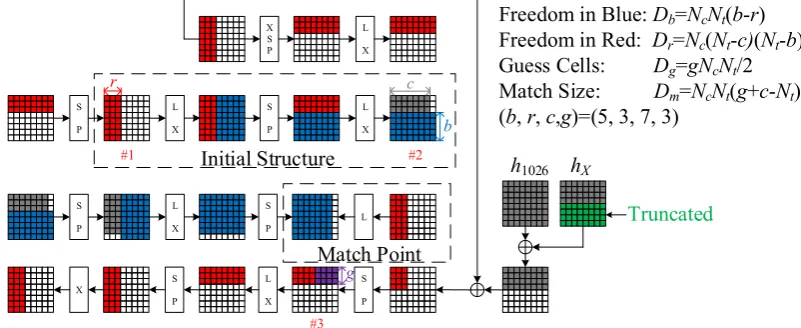
In phase 2, we invert the last compression function call in the output transformation. We remove the MixRow operationLin the last round, and the optimal chunk separation for the 6.5-round MitM preimage at-tack is depicted in Fig. 6, and we can find a preimageΣ(M) with complexities (TIME,MEMORY) = (2232,2120). Phase 3 is the same as the third phase of the 5-round preimage attack. Combining all 3 phases, it would require 2232time and 2120memory to generate a preimage for 6.5-roundGOST-256. It is notable that although there exists a collision attack on 7.5-roundGOSTcompression function [33] which can be utilized to build the 21024-multicollisions adopted in phase 1, we are not able to launch a preimage attack on 7.5-round
GOST-256
due to its truncation operation.
L X S P L X S P c b
h1026 hX
L X X S P Initial Structure Match Point
Freedom in Blue: Db=NcNt(b-r) Freedom in Red: Dr=Nc(Nt-c)(Nt-b) Guess Cells: Dg=gNcNt/2 Match Size: Dm=NcNt(g+c-Nt) (b, r, c,g)=(5, 3, 7, 3)
#2 #1 r L X S P S P L X L S P S P X g #3 Truncated
Fig. 6.Preimage attack on 6.5-roundGOST-256compression function
Preimage Attack on 7.5-RoundGOST-512. The preimage attack on 7.5-roundGOST-512consists of three
phases as well. The first and the last phases are the same as [33], while the improvement is carried out on the second phase. We remove the MixRow operation Lin the last round, and the chunk separation for the second phase is depicted in Fig. 7. Finally, It requires 2496time and 264memory to generate a preimage for
7.5-roundGOST-512. We can also launch a memoryless variant of this attack following the methods in [33], and it requires 2504time and 211memory to generate a preimage for 7.5-round GOST-512.
4
Discussions: Impacts of the Truncation
L
X c
b
h1026 hX Initial Structure
Match Point
Freedom in Blue: Db=NcNt(b-r) Freedom in Red: Dr=Nc(Nt-c)(Nt-b) Guess Cells: Dg=gNc(Nt-r) Match Size: Dm=NcNt(g+c-N) (b,r,c,g)=(6,5,7,2)
#2
L
X S
P
#3
L
X S
P g L
X X
S P
r
L
X S
P
S
P L
X S
P
L
X
S
P
#1
S
P
Fig. 7.Preimage attack on 7.5-roundGOST-512compression function
and the ChopMD mode). We need to stress that only the truncation patterns which truncate 512-bit chaining values to 224, 256 or 384 bits digests are considered, since they are recommended by NIST in the SHA-3
competition, and have many instances in practice. For each investigated truncation pattern, we choose carefully the position of the feed-forward operation in order to maximize the match point and derive the optimal attack. As applications of our investigations, we slightly improve the previous pseudo preimage attacks on reduced-roundGrøstl-256.
4.1 The Generic MitM Preimage Attack Framework on AES-like Compression Functions
AES-like Compression Functions. We first define what we call anAES-like block cipher (or permutation). AnAES-like block cipher appliesNrrounds of a round function to update a plaintext represented as a matrix of Nt columns and Nt rows, where each of the Nt2 cells has a size of Nc bits. Since the key of the block cipher is always fixed in the presented analysis model, we omit specification of the key schedule and denote the round keys as constants. The round function consists 4 sequent operations, the AddRoundConstant operation (AC), the SubBytes operation (SB) which applies aNc×Ncnonlinear bijective SBox to each cell, the ShiftRow operation (SR)5which rotationally moves each cell in thex-th row byxpositions to the left in
its own row, and the MixColumn operation (MC) which mixes all the columns with an MDS matrix. Note that for theAES-like block ciphers considered in this paper, Nt= 8, Nc= 8.
When anAES-like block cipher is adopted as the underlying block cipher to build a compression function with the PGV modes, we call such a compression function anAES-like compression function.
The Attack Model. We have checked that for all the 12 PGV modes, either a preimage or a pseudo
preimage attack on the specificAES-like compression function can be derived with the MitM preimage attack. Hence, without loss of generality, we only study the pseudo preimage resistance of AES-like compression functions with the Davies-Meyer mode. Similar analyses can be carried on the remaining PGV modes.
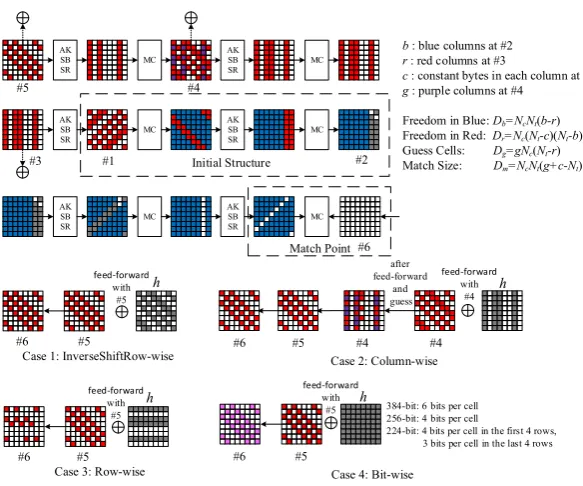
As briefly summarized in Section 3.3, the MitM preimage attack on AES-like compression functions can reach 5 and 6 rounds combining several techniques like initial structure, the guess-and-determine strategy and indirect-partial matching. We first focus on the 6-round MitM preimage attack, and the typical chunk separation for the 6-round attack is depicted in Fig. 8. If the size of the digest is n bits, then the time complexity for the 6-round attack is computed as follows:
T= 2n(2−Dr+ 2Dg−Db+ 2Dg−Dm).
5
MC AK SB SR MC AK SB SR MC AK SB SR MC AK SB SR Initial Structure Match Point MC AK SB SR MC AK SB SR #1 #2
b : blue columns at #2
r : red columns at #3
c : constant bytes in each column at #2
g : purple columns at #4
Freedom in Blue: Db=NcNt(b-r)
Freedom in Red: Dr=Nc(Nt-c)(Nt-b)
Guess Cells: Dg=gNc(Nt-r)
Match Size: Dm=NcNt(g+c-Nt)
#3 #5
#6
Case 4: Bit-wise
feed-forward with #5 #6 h #4
384-bit: 6 bits per cell
256-bit: 4 bits per cell
224-bit: 4 bits per cell in the first 4 rows, 3 bits per cell in the last 4 rows
#5 h
feed-forward
with #5
Case 1: InverseShiftRow-wise #6 #5
Case 3: Row-wise
feed-forward with #5 #5 h #6 feed-forward with #4
Case 2: Column-wise #4 h #5 #6 after feed-forward and guess #4
Fig. 8.MitM preimage attack on 6-roundAES-like compression function
Assessment Criterion. In order to measure the impacts of different truncation patterns on the resistance of the MitM preimage attack, we definethe advantage Advof the time complexity for the dedicated
MitM preimage attack over the brute-force attackas follows:
Adv=log(TMitM)−log(TBrute).
Thus, the advantage for the 6-round attack can be denoted as follows:
Adv=min{Dr, Db−Dg, Dm−Dg}.
If no truncation is performed, the corresponding advantage is denoted withAdvFull
6R . We search for all possible chunk separations, and derive thatAdvFull
6R = 16.
For an AES-like compression function truncating from 512 bits to n bits, we denote the corresponding advantage for the 6-round attack withAdvn6R. For a specific truncation pattern, ifAdvn6R <AdvFull6R holds, it certainly narrows (even eliminates) the gap between the brute-force attack and the dedicated MitM preimage attack, thus strengthens the compression function in terms of the resistance of this type of attack. Based on this observation, we expect to find the optimal truncation patterns among all the possible patterns. However, the search space is to large6, and we do not come up with advanced techniques to significantly reduce the search space at the moment. Instead of enumerating all possible truncation patterns, we study 4 representative patterns which are convenient in both software and hardware implementations, and show that 2 of the 4 patterns provide extra strength against the MitM preimage attack.
4.2 Case Study: Preimage Resistance of Four Truncation Patterns
Firstly, we would like to point out two observations which are crucial in our analyses as shown in Fig. 8. The first observation comes from the simple fact that the actual positions of the red cells can be freely chosen to a certain extent in the backward computation. For instance, the attacker can freely choose the positions of therred columns from the eight columns at state #3. The second observation comes from the fact that the feed-forward operation can be performed at the start of any round in the backward computation. In fact, these observations have already been adopted in our preimage attack on 5-roundGOST-256.
6
For example, if we truncate from 512 bits to 256 bits, there are a total C256512≈2 507
Observation 1. As depicted in Fig. 8, if there arer(resp.g) red (resp. purple) columns at state #3(resp.
#4), then ther (resp. g) red (resp. purple) columns can be randomly chosen from the Nt columns of state
#3 (resp. #4), and there are overall CNr
t (resp. C
g
Nt) possible patterns for the positions of the red (resp.
purple) columns.
Observation 2. In the chunk separation denoted in Fig. 8, the feed-forward operation can be carried out at the begining of any round in the backward computation, namely, state#3,#4or #5.
Security Analyses of the Four Representative Truncation Patterns. The 4 truncation patterns
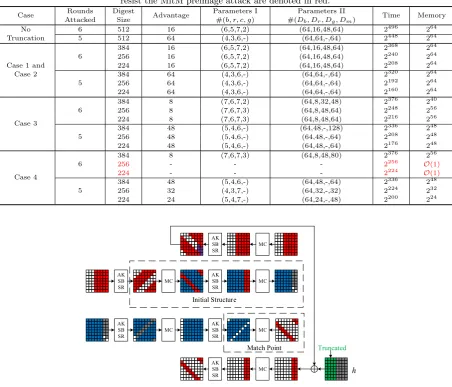
considered are denoted in Fig. 8. For the first three cases, the grey cells ofhare preserved while the white cells ofhare truncated. For the last case, only partial bits of each cell ofhare preserved while the remaining bits are truncated. Due to the space limit, we only provide detailed analyses of the situation where the 512-bit state is truncated to the 256-512-bit digest. The 384-512-bit and the 224-512-bit cases can be analyzed analogously, and the details are hence omitted. The overall results are summarized in Table 2.
Case 1 performs theInverseShiftRow-wise truncation, and there are overallCNt/2
Nt specificInverseShiftRow
-wise truncation patterns. As depicted in Fig. 8, according to Observation 2, if the feed-forward operation is carried out at state #5, no information of the red cells will be lost after the feed-forward, and the backward computation can proceed to the match point at state #6. One may say that there are CNt/2
Nt truncation
patterns for the InverseShiftRow truncations, and a different selection of these patterns may not preserve this property. However, as identified in Observation 1, if Nt/2 ≥ g, we can choose the positions of the purple columns at state #4 according to the specific truncation pattern adopted, so that we do not miss any information of the red cells after the feed-forward. In other words, since the positions of the purple columns can be adaptively chosen, all the InverseShiftRow-wise truncation patterns are equivalent in this sense. Consequently, the values of (Db, Dr, Dg, Dm) for theInverseShiftRow truncations remain unchanged as the case when no truncation is performed, and we can directly conclude that
Adv256Case1,6R=Adv Full 6R = 16.
The truncation patterns of case 1 do not narrow the gap between the 6-round MitM preimage attack and the brute-force attack.
Case 2 performs theColumn-wise truncation. Similar to case 1, if the feed-forward operation is carried out at state #4, we can adaptively choose the corresponding positions of the purple columns at state #4 from allCNg
t patterns according to the specific truncation pattern, and make sure that no information of the red
cells will be lost after the feed-forward ifNt/2≥g. Then we are able to proceed the backward computation by one more round to the match point at state #6 (which is also state #5 in this case). We conclude that
Adv256Case2,6R=AdvFull6R = 16,
and the truncation patterns of case 2 do not narrow the gap between the 6-round MitM preimage attack and the brute-force attack either.
Case 3 performs theRow-wise truncation. The feed-forward should be carried out at state #5 instead of state #4 and #3, since it requires full columns to compute a full round backwards, and the feed-forward operation certainly disturbs the full columns. By easily and exhaustively enumerating the values of (b, r, c, g), we can directly compute the values of (Db, Dr, Dg). However, the matching part is affected by the truncation, and therefore the size of the match pointDmis rather ad-hoc. More precisely, as can be seen from Case 3 of Fig. 8, we lose partial information of the red cells at state #6 compared to state #5 due to the truncation after the feed-forward operation at state #5. Luckily, the overall number of the positions for the purple columns of state #4 is onlyCNg
t which can be exhaustively searched. Moreover, since the purple columns of
state #4 can be adaptively chosen, all theCNt/2
Nt Row-wise truncation patterns are equivalent. Consequently,
maximum size of the match pointDm, and then compute the corresponding time complexity for the specific quartet (b, r, c, g). After testing all valid values of (b, r, c, g), we obtain the optimal chunk separations and the minimized time complexity which are summarized in Table 2, and derive that
Adv256Case3,6R= 8<Adv Full 6R = 16.
Based on this result, it is obvious that all the truncation patterns of case 3 do narrow the gap between the 6-round MitM preimage attack and the brute-force attack, thus provide extra strength against this type of attack.
Case 4 performs the Bit-wise truncation, i.e., 4 bits are selected from each cell. Due to the same reason in case 3, the feed-forward should be carried out at state #5, and the backward computation proceeds until reaching the match point at state #6. We denote the known cells at #6 in pink since only partial bits are preserved due to the bit-wise truncation. The size of the match point7 can be denoted asNt(gNc/2 +cNc−
NtNc) ifgNc/2 +cNc−NtNc >0, otherwise no match point will be derived. We search for all possible values of (b, r, c, g), and compute the corresponding time complexities. However, no chunk separation is obtained which would make the MitM preimage attack faster than exhaustive search. Thus we conclude that
Adv256Case3,6R= 0,
and the truncation pattern of case 4 effectively prevents the 6-round MitM preimage attack for the 256-bit digest.
Influences on Other Types of Attacks. A wide range of collision-like attacks onAES-like hash primitives are based on multi-block procedures, and mainly focus on the prior message blocks. The collisions of these attacks are derived by appending identical message blocks which satisfy padding to the previous colliding message blocks. However, the truncation operation is normally performed only once at the last message block, and therefore have no impacts on these collision-like attacks which mainly target prior message blocks. Thus, the stronger truncation patterns discussed above do not weaken the resistance against these typical collision-like attacks. Regarding other types of attacks, the discussions seem to be rather ad-hoc, and depend on the specific structures of the underlying primitives. However, we find that the stronger truncation patterns do not weaken the security properties ofGOST-256,Grøstl-256and the truncated variants of Whirlpoolwith respect to existing attacks on these primitives, and we believe this fact should hold for a wide range of other primitives with similar structures.
Overview of the Four Cases. Due to the fact that the truncation operation is normally much simpler than the compression functions, and is most commonly processed only once at the end of the hash computation, the extra efforts to implement these stronger truncation patterns are negligible (especially when processing long input messages). Taking both security properties and implementation issues into account, the truncation patterns of case 3 and case 4 are promising alternatives in future designs of AES-like hash primitives where truncation needs to be performed.
Applications toGrøstl-256. ForGrøstl-256, the column-wise truncation operation in the output trans-formation corresponds to case 2. As depicted in Fig. 9, we can carry out the feed-forward operation earlier in the backward computation without losing any information of the red cells. As a result, the time complexity of the previous 6-round (resp. 5-round) attack can be decreased from 2248 [46] (resp. 2208 [44]) to 2240 (re-sp. 2192) output transformation computations. The complexities of the pseudo preimage attacks on 5- and 6-roundGrøstl-256in [44,46] can also be slightly improved, we omit these details. Based on these slightly improved attacks, we recommendGrøstl-256to perform the stronger row-wise or bit-wise truncations.
7
Table 2.Summary of the results for the four truncation cases, the truncation patterns which
resist the MitM preimage attack are denoted in red.
Case Rounds Digest Advantage Parameters I Parameters II Time Memory
Attacked Size #(b, r, c, g) #(Db, Dr, Dg, Dm) No
Truncation
6 512 16 (6,5,7,2) (64,16,48,64) 2496 264
5 512 64 (4,3,6,-) (64,64,-,64) 2448 264
Case 1 and Case 2
6
384 16 (6,5,7,2) (64,16,48,64) 2368 264
256 16 (6,5,7,2) (64,16,48,64) 2240 264
224 16 (6,5,7,2) (64,16,48,64) 2208 264
5
384 64 (4,3,6,-) (64,64,-,64) 2320 264
256 64 (4,3,6,-) (64,64,-,64) 2192 264
224 64 (4,3,6,-) (64,64,-,64) 2160 264
Case 3
6
384 8 (7,6,7,2) (64,8,32,48) 2376 240
256 8 (7,6,7,3) (64,8,48,64) 2248 256
224 8 (7,6,7,3) (64,8,48,64) 2216 256
5
384 48 (5,4,6,-) (64,48,-,128) 2336 248
256 48 (5,4,6,-) (64,48,-,64) 2208 248
224 48 (5,4,6,-) (64,48,-,64) 2176 248
Case 4
6
384 8 (7,6,7,3) (64,8,48,80) 2376 256
256 - - - 2256 O(1)
224 - - - 2224 O(1)
5
384 48 (5,4,6,-) (64,48,-,64) 2336 248
256 32 (4,3,7,-) (64,32,-,32) 2224 232
224 24 (5,4,7,-) (64,24,-,48) 2200 224
MC AK
SB
SR MC
AK SB SR Initial Structure
Match Point MC
AK SB
SR MC
AK SB SR
MC AK
SB SR
MC AK
SB
SR h
Truncated
Fig. 9.Pseudo preimage attack on 6-roundGrøstl-256output tansformation
5
Conclusion and Open Problems
In this paper, we present improved preimage attacks on the reduced-round GOST hash function family by combining the dedicated collision attack and the MitM preimage attack on theGOSTcompression function. As far as we know, our result is the first preimage attack onGOST-256at the hash function level. We also investigate the impacts of four representative truncation patterns on the resistance of the MitM preimage attack against AES-like compression functions, and propose two strengthened truncation patterns, which make it more difficult to launch the MitM preimage attack.
However, due to the large search space, we are not able to study the impacts of all possible truncation patterns at the moment. An interesting and open problem is to seek for advanced approaches to efficiently enumerate all possible truncation patterns, and investigate their impacts on various security properties of manyAES-based hash primitives.
References
2. AlTawy, R., Youssef, A.: Preimage Attacks on Reduced-Round Stribog. In: Pointcheval, D., Vergnaud, D. (eds.) AFRICACRYPT 2014. LNCS, vol. 8469, pp. 109–125. Springer International Publishing (2014)
3. Aoki, K., Guo, J., Matusiewicz, K., Sasaki, Y., Wang, L.: Preimages for Step-Reduced SHA-2. In: Matsui, M. (ed.) ASIACRYPT 2009. LNCS, vol. 5912, pp. 578–597. Springer, Heidelberg (2009)
4. Aoki, K., Sasaki, Y.: Preimage Attacks on One-Block MD4, 63-Step MD5 and More. In: Avanzi, R., Keliher, L., Sica, F. (eds.) SAC 2008. LNCS, vol. 5381, pp. 103–119. Springer, Heidelberg (2009)
5. Aumasson, J.P., Henzen, L., Meier, W., Phan, R.C.W.: SHA-3 Proposal BLAKE. Submission to NIST (Round 3) (2010),http://131002.net/blake/
6. Barreto, P., Rijmen, V.: The Whirlpool Hashing Function. Submitted to NESSIE (September 2000) (2000), http://www.larc.usp.br/~pbarreto/WhirlpoolPage.html
7. Benadjila, R., Billet, O., Gilbert, H., Macario-Rat, G., Peyrin, T., Robshaw, M., Seurin, Y.: SHA-3 Proposal: ECHO. Submission to NIST (updated) (2009),http://crypto.rd.francetelecom.com/ECHO/
8. Bertoni, G., Daemen, J., Peeters, M., Van Assche, G.: The Keccak Reference. Submission to NIST (Round 3) (2011),http://keccak.noekeon.org/Keccak-reference-3.0.pdf
9. Biham, E., Dunkelman, O.: A Framework for Iterative Hash Functions - HAIFA. Cryptology ePrint Archive, Report 2007/278 (2007),http://eprint.iacr.org/2007/278
10. Biham, E., Dunkelman, O.: The SHAvite-3 Hash Function. Submission to NIST (Round 2) (2009),http://www. cs.technion.ac.il/~orrd/SHAvite-3/
11. Chang, D., Nandi, M.: Improved Indifferentiability Security Analysis of chopMD Hash Function. In: Nyberg, K. (ed.) FSE 2008, LNCS, vol. 5086, pp. 429–443. Springer, Heidelberg (2008)
12. Coron, J.S., Dodis, Y., Malinaud, C., Puniya, P.: Merkle-Damg˚ard Revisited: How to Construct a Hash Function. In: Shoup, V. (ed.) CRYPTO 2005. LNCS, vol. 3621, pp. 430–448. Springer, Heidelberg (2005)
13. Daemen, J., Rijmen, V.: The Wide Trail Design Strategy. In: Honary, B. (ed.) IMACC 2001, LNCS, vol. 2260, pp. 222–238. Springer, Heidelberg (2001)
14. Damg˚ard, I.B.: A Design Principle for Hash Functions. In: Brassard, G. (ed.) CRYPTO 1989. LNCS, vol. 435, pp. 416–427. Springer, New York (1990)
15. Dolmatov, V., Degtyarev, A.: GOST R 34.11-2012: Hash Function (2013)
16. Dolmatov, V., Degtyarev, A.: Request for Comments 6986: GOST R 34.11-2012: Hash Function. Internet Engi-neering Task Force (IETF) (2013),http://www.ietf.org/rfc/rfc6986.txt
17. Information Protection and Special Communications of the Federal Security Service of the Russian Federation: GOST R 34.11-94, Information Technology Cryptographic Data Security Hashing Function (1994), in Russian 18. Information Protection and Special Communications of the Federal Security Service of the Russian Federation:
GOST R 34.11-2012, Information Technology Cryptographic Data Security Hashing Function (2012), http: //www.tc26.ru/en/GOSTR3411-2012/GOST_R_34_11-2012_eng.pdf
19. Gauravaram, P., Kelsey, J.: Linear-XOR and Additive Checksums Don’t Protect Damg˚ard-Merkle Hashes from Generic Attacks. In: Malkin, T. (ed.) CT-RSA 2008. LNCS, vol. 4964, pp. 36–51. Springer, Heidelberg (2008) 20. Gauravaram, P., Knudsen, L.R., Matusiewicz, K., Mendel, F., Rechberger, C., Schl¨affer, M., Thomsen, S.S.:
Grøstl–a SHA-3 Candidate. Submission to NIST (Round 3) (2011),http://www.groestl.info/Groestl.pdf 21. Gilbert, H., Peyrin, T.: Super-Sbox Cryptanalysis: Improved Attacks for AES-like Permutations. In: Hong, S.,
Iwata, T. (eds.) FSE 2010. LNCS, vol. 6147, pp. 365–383. Springer, Heidelberg (2010)
22. Guo, J., Jean, J., Leurent, G., Peyrin, T., Wang, L.: The Usage of Counter Revisited: Second-Preimage Attack on New Russian Standardized Hash Function. In: Joux, A., Youssef, A. (eds.) SAC 2014, LNCS, vol. 8781, pp. 195–211. Springer International Publishing (2014), also available athttp://eprint.iacr.org/2014/675 23. International Organization for Standardization: ISO/IEC 10118-3:2004: Information technology - Security
tech-niques - Hash-functions - Part 3: Dedicated hash-functions (2004)
24. Iwamoto, M., Peyrin, T., Sasaki, Y.: Limited-Birthday Distinguishers for Hash Functions. In: Sako, K., Sarkar, P. (eds.) ASIACRYPT 2013. LNCS, vol. 8270, pp. 504–523. Springer, Heidelberg (2013)
25. Joux, A.: Multicollisions in Iterated Hash Functions. Application to Cascaded Constructions. In: Franklin, M. (ed.) CRYPTO 2004. LNCS, vol. 3152, pp. 306–316. Springer, Heidelberg (2004)
26. Kazymyrov, O., Kazymyrova, V.: Algebraic Aspects of the Russian Hash Standard GOST R 34.11-2012. Cryp-tology ePrint Archive, Report 2013/556 (2013),http://eprint.iacr.org/2013/556
27. Kelsey, J., Kohno, T.: Herding Hash Functions and the Nostradamus Attack. In: Vaudenay, S. (ed.) EUROCRYPT 2006. LNCS, vol. 4004, pp. 183–200. Springer, Heidelberg (2006)
28. Kelsey, J., Schneier, B.: Second Preimages onn-bit Hash Functions for Much Less than 2n Work. In: Cramer, R. (ed.) EUROCRYPT 2005. LNCS, vol. 3494, pp. 474–490. Springer, Heidelberg (2005)
29. Khovratovich, D., Nikoli´c, I., Weinmann, R.P.: Meet-in-the-Middle Attacks on SHA-3 Candidates. In: Dunkelman, O. (ed.) FSE 2009. LNCS, vol. 5665, pp. 228–245. Springer, Heidelberg (2009)
31. Knellwolf, S., Khovratovich, D.: New Preimage Attacks against Reduced SHA-1. In: Safavi-Naini, R., Canetti, R. (eds.) CRYPTO 2012, LNCS, vol. 7417, pp. 367–383. Springer, Heidelberg (2012)
32. Lamberger, M., Mendel, F., Rechberger, C., Rijmen, V., Schl¨affer, M.: Rebound Distinguishers: Results on the Full Whirlpool Compression Function. In: Matsui, M. (ed.) ASIACRYPT 2009. LNCS, vol. 5912, pp. 126–143. Springer, Heidelberg (2009)
33. Ma, B., Li, B., Hao, R., Li, X.: Improved Cryptanalysis on Reduced-Round GOST and Whirlpool Hash Func-tion. In: Boureanu, I., Owesarski, P., Vaudenay, S. (eds.) ACNS 2014. LNCS, vol. 8479, pp. 289–307. Springer International Publishing (2014), full version available athttp://eprint.iacr.org/2014/375
34. Ma, B., Li, B., Hao, R., Li, X.: Improved (Pseudo) Preimage Attacks on Reduced-RoundGOSTandGrøstl-256 and Studies on Several Truncation Patterns forAES-like Compression Functions (Full Version). Cryptology ePrint Archive (2015)
35. Mendel, F., Pramstaller, N., Rechberger, C.: A (Second) Preimage Attack on the GOST Hash Function. In: Nyberg, K. (ed.) FSE 2008, LNCS, vol. 5086, pp. 224–234. Springer, Heidelberg (2008)
36. Mendel, F., Pramstaller, N., Rechberger, C., Kontak, M., Szmidt, J.: Cryptanalysis of the GOST Hash Function. In: Wagner, D. (ed.) CRYPTO 2008, LNCS, vol. 5157, pp. 162–178. Springer, Heidelberg (2008)
37. Mendel, F., Rechberger, C., Schl¨affer, M., Thomsen, S.S.: The Rebound Attack: Cryptanalysis of Reduced Whirlpool and Grøstl. In: Dunkelman, O. (ed.) FSE 2009. LNCS, vol. 5665, pp. 260–276. Springer, Heidelberg (2009)
38. Merkle, R.C.: One Way Hash Functions and DES. In: Brassard, G. (ed.) CRYPTO 1989. LNCS, vol. 435, pp. 428–446. Springer, New York (1990)
39. National Institute of Standards and Technology (NIST): FIPS PUB 180-3: Secure Hash Standard. Federal Information Processing Standards Publication 180-3, U.S. Department of Commerce (October 2008), http: //csrc.nist.gov/publications/fips/fips180-3/fips180-3_final.pdf
40. Sasaki, Y.: Meet-in-the-Middle Preimage Attacks on AES Hashing Modes and an Application to Whirlpool. In: Joux, A. (ed.) FSE 2011. LNCS, vol. 6733, pp. 378–396. Springer, Heidelberg (2011)
41. Sasaki, Y., Aoki, K.: Finding Preimages in Full MD5 Faster Than Exhaustive Search. In: Joux, A. (ed.) EURO-CRYPT 2009. LNCS, vol. 5479, pp. 134–152. Springer, Heidelberg (2009)
42. Sasaki, Y., Wang, L., Wu, S., Wu, W.: Investigating Fundamental Security Requirements on Whirlpool: Improved Preimage and Collision Attacks. In: Wang, X., Sako, K. (eds.) ASIACRYPT 2012. LNCS, vol. 7658, pp. 562–579. Springer, Heidelberg (2012)
43. Wang, Z., Yu, H., Wang, X.: Cryptanalysis of GOST R Hash Function. Cryptology ePrint Archive, Report 2013/584 (2013),http://eprint.iacr.org/2013/584
44. Wu, S., Feng, D., Wu, W., Guo, J., Dong, L., Zou, J.: (Pseudo) Preimage Attack on Round-reduced Grøstl Hash Function and Others. In: Canteaut, A. (ed.) FSE 2012. LNCS, vol. 7549, pp. 127–145. Springer, Heidelberg (2012) 45. Zou, J., Wu, W., Wu, S.: Cryptanalysis of the Round-Reduced GOST Hash Function. In: Lin, D., Xu, S., Yung,
M. (eds.) Inscrypt 2013. LNCS, vol. 8567, pp. 309–322. Springer International Publishing (2014)