be in order when viewing per- emptory statements that no additional commercial use re- strictions on public lands are warranted in aid of outdoor re- creation.
This is a good time to examine carefully all relevant facts and factors in each proposed land use adjustment and consider the al- ternatives and countervailing adjustments that are realistically available under the circum- stances.
A common expression has been that the final goal of range management is efficient produc- tion of livestock - to help the stockman provide a living for his family. This expression has a place, but only within a broader perspective. Range management and the other professions dealing with wildlands must also try to bring about the greatest good for the greatest number of citizens generally in the use of wildland resources.
LITERATURE CITED CLAWSON, MARION. 1963. Land for
Americans. Rand McNally and Co., Chicago, Ill. 151 pp.
CLAWSON, MARION, R. BTJRNELL HELD, AND CHARLES H. STODDARD. 1960. Land for the Future. The Johns Hopkins Press, Baltimore, Md. 570 PP.
DANA, SAMUEL TRASK, AND MYRON KRUEGER. 1958. California Lands. The American Forestry Associa- tion, Washington,, D.C. 308 pp. FEDERAL COUNCIL FOR SCIENCE AND
TECHNOLOGY. 1963. Research and Development on Natural Re- sources. (Mimeographed). Wash- ington, D.C. 172 pp.
LANDSBERG, HANS H., LEONARD L. FISCHMAN, AND JOSEPH L. FISHER. 1963. Resources in America’s Fu- ture. The Johns Hopkins Press. Baltimore, Md. 1017 pp.
SAUNDERSON, MONT H. 1950. West- ern Land and Water Use. The University of Oklahoma Press. 217 PP.
STODDART, L. A., AND C. WAYNE COOK. 1964. Management of Public and Private Lands to Meet Demands of Changing Times. American Cattle Producer, June 1964. p. 8.
U.S. DEPARTMENT OF THE INTERIOR, BUREAU OF LAND MANAGEMENT. 1962. Program for the Public Lands and Resources. 40 pp. U.S. DEPARTMENT OF THE INTERIOR,
BUREAU OF LAND MANAGEMENT. 1963. Vale Project. 25 pp.
U.S. DEPARTMENTS OF AGRICULTURE AND THE INTERIOR. 1962. A Trial Program of Public Land Range Appraisal. Washington, D.C. 35 PP.
U.S. OUTDOOR RECREATION RESOURCES REVIEW COMMISSION. 1962. Out- door Recreation for America. U.S. Government Printing Office, Washington, D.C. 246 pp.
UNIVERSITY OF MICHIGAN, SCHOOL OF NATURAL RESOURCES, AND U.S. DE- PARTMENT OF THE INTERIOR, BUREAU OF OUTDOOR RECREATION. 1963. Na- tional Conference on Outdoor Rec- reation Research. Ann Arbor Pub- lishers, Ann Arbor, Michigan. 240 PP.
UNIVERSITY OF WYOMING, COLLEGE OF COMMERCE AND INDUSTRY. 1959. A Study of the Resources, People, and Economy of Teton County, Wyoming. A Publication of the Wyoming Natural Resources Board, Laramie, Wyoming. 36 pp.
Effect of Range Condition and Utilization on
F?utritive Intake of Sheep on Summer Ranges
C. WAYNE COOK, MERWYN KOTHMANN, AND LORIN E. HARRIS
Research Professor and Research Assistant, Department of Range Management and Research Professor, Depart- ment of Animal Husbandry, Utah State Agricultural Ex- periment Station, Logan
Highlight
Total protein. ash, lignin, and other carbohydrates were somewhat higher in forage from poor range6 while ether extract, cellulose, and gross energy were slightly higher in forage from good ranges. The digesfi- bilifies of cellulose, other carbohy- drates, and gross energy in forage from both good and poor ranges de- creased with heavier utilization.
The mountainous ranges of the West are commonly grazed from about June 15 until September 15. These summer ranges display various stages of range condition with respect to their full poten- tial as forage producing lands. The productivity of these ranges
greatly affects the economy of the livestock industry since they produce marketable animals. It is frequently stated that ranges in poor condition produce poorer animal gains than ranges in good condition. This assumes that ranges in poor condition provide lower nutritive levels than do ranges in good condition or that animals eat less on poor ranges.
Little work has been done to determine the nutritive content and digestibility of forage con- sumed on ranges in different conditions, or the effect of graz- ing intensity upon the nutritive content and digestibility of for-
age consumed on mountainous summer ranges.
Cook et al. (1953, 1962) and Piper et al. (1959) found that the nutrient intake on desert ranges decreased with increasing inten- sity of grazing. This was a result of both reduced daily consump- tion and decreased digestibility of the nutrients ingested. It was found that the nutrient content in herbage on poor range was as desirable and was as highly di- gested as the nutrient content in herbage on good range when comparable degrees of utilization were made on both condition classes.
70 COOK, KOTHMANN AND HARRIS The present study was done on
typical mountainous summer range between 6,000 and 7,000 feet elevation in northern Utah on the Cache National Forest. The annual precipitation aver- ages about 22 inches with about one-fourth of it coming during the winter months. Maximum temperatures of 80 degrees F. are reached during the summer. Frost occurs frequently in late June and again during the latter part of August and September.
Methods and Procedures
Five study areas were selected where existing fences marked obvious differences in range con- dition on opposite sides (Figure 1). The study areas were pre- dominately sagebrush grass in- termixed with mountain brush and aspen types. In all cases the adjacent sides represented poor and good range condition as clas- sified by the procedures outlined by the U. S. Forest Service
(1962).
The areas to be grazed were fenced with equal quantities of herbage on both the poor and the good side. Enough forage was enclosed in each paddock to fur- nish feed for a 3-day adjustment period and two consecutive 6-day digestion trails for 7 wether sheep and 4 esophageal fistulated sheep. The first six days repre- sented light use and the second six days represented moderate to heavy use. The first area was grazed starting about June 8 and the fifth was grazed starting about September 1 each year during the three-year study pe- riod (1960-1962). The areas were grazed in the same order each year.
Herbage production and diets were calculated by the method used by Edlefsen et al. (1960). Fourteen paired wether sheep were equipped with harnesses and bags for collecting feces. In addition, eight paired sheep equipped with esophageal-fistula cannulae were used to collect
Figure 1. A fence line contrast in a condition on left and poor range
sagebrush-grass type showing good condition on right.
range
forage samples. At the beginning of each trial one sheep of each pair was assigned to good or poor ranges at random. All fourteen wether sheep used for fecal col- lections were weighed on and off each study area.
The chemical analyses of the forage samples collected from fistulated sheep were corrected for ash and phosphorus content of the saliva by the procedure outlined by Cook (1964).
Fecal collections were begun 24 hours after the first forage collections were made, and were terminated 24 hours after the last forage collections for each period on each area. Fecal col- lection bags were emptied twice daily. At the end of each 6-day period, collections of both feces and forage were cornposited for chemical analysis.
The total daily forage intake and digestibility coefficients were determined by the lignin- ratio technique (Cook et al., 1951).
Resulfs and Discussion
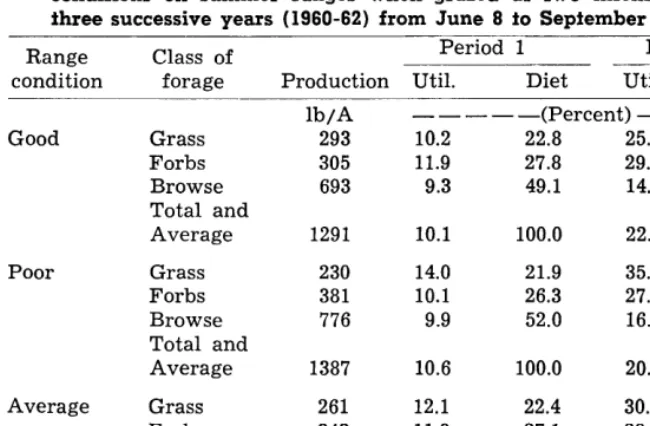
Production, Utilization and Diets.-A total of 16 grasses, 33 forbs and 11 browse species were
found on the 5 areas studied during the years 1960-62. Slightly less total herbage was produced on good range than on poor range (Table 1).
Good range produced more grass than poor range but utiliza- tion of grasses was higher on poor range. However, grass made up slightly more of the diet on good range (Table 1). The pro- duction of forbs was higher on poor range but utilization of forbs was higher on good range. As a result, good and poor range had about equal amounts of forbs in the diet. Production and utili- zation of browse were slightly higher on poor ranges and thus, the browse was higher in the diet of sheep grazing poor ranges.
Percentages of grass and forbs increased in the diet with in- creased intensity of grazing, but browse decreased (Table 1).
pared to those on poor ranges (Table 2). This could be a result of having more grass in the diet on good range since grasses are higher in this constituent than are forbs or browse (Table 1). The other carbohydrate fraction was slightly higher in poor range than in good range diets. Percent cellulose in the diet increased with increased grazing intensity on both good and poor range but the percent of other carbohy- drates decreased.
Gross energy in the diet was somewhat higher on good range than on poor range and, like ether extract, total protein, and other carbohydrates, it decreased in the diet as utilization in- creased.
The effect of intensity of graz- ing upon cellulose, other carbo- hydrates, and gross energy in the diet was not statistically signifi- cant (P< .05). Neither range condition nor intensity of graz- ing had any significant effect on the content of phosphorus in the diet (Table 2).
Digestibility and Nutritive In- take.-The digestibility of ether extract constituents was signifi- cantly affected (P< .05) by range condition. The average di- gestibility of ether extract ma- terial on good range was 2.3 per- cent and on poor ranges, -14.7 percent. This difference can be explained only on the basis of the actual material making up the Table 1. Average production, utilization and diet from good and poor range
conditions on summer ranges when grazed af fwo intensifies during three successive years (1960-62) from June 8 to September 10.
Range condition
Class of Period 1 Period 2
forage Production Util. Diet Util. Diet lb/A ---(Percent) ---
293 10.2 22.8 25.6 33.1
305 11.9 27.8 29.5 39.3
693 9.3 49.1 14.7 27.6
1291 230 381 776
10.1 100.0 22.7 100.0
14.0 21.9 35.1 28.9
10.1 26.3 27.7 40.0
9.9 52.0 16.6 31.3
1387
261 343 735
10.6 100.0 20.7 100.0
12.1 22.4 30.4 31.0
11.0 27.1 28.6 39.7
9.6 50.6 15.7 29.0
1339 10.4 100.0 21.7 100.0
ference between grazing inten- sities.
A highly signif icant decrease (P< .Ol) in the percentage of total protein in the diet was as- sociated with increased intensity of utilization on both good and poor ranges during all three years of study (Table 2). This was believed to result from in- creased consumption of coarser portions of the plant with heav- ier grazing. Total protein in the diet was slightly higher on poor range than on good range during all three years but the difference was not statistically significant. This was no doubt a result of more browse in the diet on poor
range, browse being higher in protein than grasses or forbs.
There was a highly significant increase in the ash content of forage as utilization increased. This may have resulted from a change in parts of the plants consumed and to more dirt ad- hering to the lower portion of the plants.
The percentage of lignin in the diet was somewhat higher under heavy utilization on both good and poor range. Increased con- sumption of coarser parts of the plants could account for this.
The percent cellulose was sig- nificantly higher (P< .05) in the sheeps diet on good ranges com- Good
Poor
Average
Grass Forbs Browse Total and Average Grass Forbs Browse Total and Average
Grass Forbs Browse Total and Average
Table 2. Average chemical content of ingested material from fence line contrasts on mountainous summer range fhaf displayed good and poor condition. Data from five separate areas grazed at two intensifies. each year for three years (1960-62): dry matter basis.
Range Grazing Ether Total
Condition period extract protein Ash Lignin
Other
Cellu- carbo- Phos- Gross lose hydrates phorus energy ----
Good 1 3.7
2 3.7
Average 3.7
Poor 1 3.5
2 3.1
Average 3.3
Average 1 3.6
2 3.4
-_-- ---
12.0 11.2 11.4 11.6 11.7 11.4
(Percent) 10.1 10.4 10.2
- ---- ----
21.8 41.5 22.2 40.8 22.0 41.2
-- (kcal/lb) 0.30 1954.5 0.30 1945.1 0.30 1949.8
13.0 11.6 10.2 19.7 42.4 0.30 1941.6
11.9 12.2 10.8 20.2 41.8 0.29 1929.7
12.4 11.9 10.5 19.9 42.1 0.30 1935.7
12.5 11.4 10.0 20.8 42.0 0.30 1948.1
72 COOK, KOTHMANN AND HARRIS
ether extract content of ingested forage on poor and good ranges. It might be attributable to the two browse species (Chryso- thamnus viscidiflorus and Pur- shia tridentata) which differed materially in the diet on poor and good range (Table 1). The material included in the ether extract fraction for each of the two species could be markedly different.
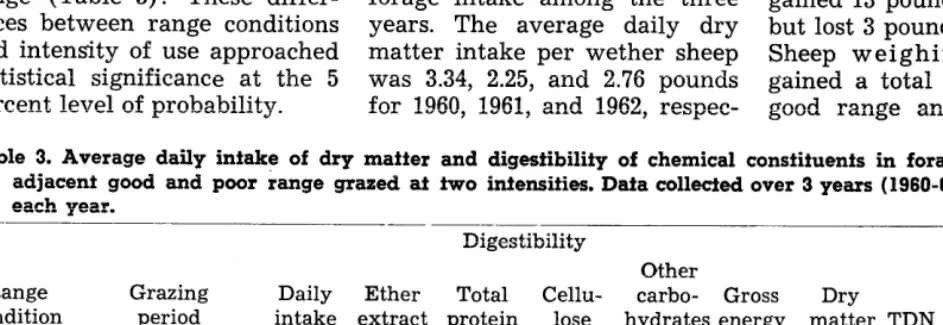
The digestibility of the protein in the diets differed significantly among years and among the five areas within years. The digesti- bility coefficient for protein was somewhat higher on poor range than on good range. This differ- ence was not statistically signifi- cant, however. The interaction between range condition and in- tensity of use had a significant effect on the digestibility of pro- tein. On good range the digesti- bility of the protein in the diet increased slightly the second period, while on poor range the digestibility decreased during the second period (Table 3).
Percent digestible protein was higher in forage consumed from poor range compared to forage from good range, and it de- creased as intensity of utilization increased on both poor and good range (Table 3) . These differ- ences between range conditions and intensity of use approached statistical significance at the 5 percent level of probability.
The digestibility of cellulose was significantly higher in for- age from good ranges compared to that from poor ranges, and it decreased significantly with heavier utilization on both good and poor range.
The digestibility of “other car- bohydrates” decreased signifi- cantly (P< .05) with heavier utilization but was not affected by range condition.
The digestibilities of gross energy and dry matter were somewhat lower for forage from poor ranges than for forage from good ranges. Digestibility coeffi- cients for these constituents de- creased slightly with heavier utilization on both good and poor range condition (Table 3). These differences were not of sufficient magnitude to be statistically sig- nificant.
The total digestible nutri- ents and digestible energy in the diets compared rather closely with the digestibility of dry mat- ter. All three were somewhat lower in diets on poor ranges than in diets on good ranges and all three decreased with in- creased utilization.
Daily Intake .-A highly signif- icant difference (P < .Ol) was observed in the average daily forage intake among the three years. The average daily dry matter intake per wether sheep was 3.34, 2.25, and 2.76 pounds for 1960, 1961, and 1962, respec-
tively. The forage in 1960 and 1962 remained green longer and as a result was more palatable over a longer period. Differences in the characteristics of forage growth are believed to be the major factor accounting for the difference in daily intake among years. There was a significant difference (P < .05) in average daily intake among the different areas. This was a result of many factors such as species composi- tion, stage of plant growth, and weather conditions. Neither range condition nor intensity of grazing had a significant effect on daily intake, but the inter- action effect between range con- dition and intensity of grazing approached significance (P< .05). The daily intake of forage increased slightly with heavier utilization on good range, but on poor range the daily intake de- creased slightly with heavier uti- lization.
Weight Changes.-During 1960 the experimental sheep weigh- ing approximately 120 pounds to start gained 54 pounds on good range areas and 37 pounds on poor range areas from June 10 until September 6. During the summer of 1961 sheep weighing approximately 152 pounds gained 13 pounds on good range but lost 3 pounds on poor range. Sheep weighing 138 pounds gained a total of 14 pounds on good range and 17 pounds on
Table 3. Average daily intake of dry maffer and digestibility of chemical constituents in forage consumed from adjacent good and poor range grazed ai two intensifies. Data collected over 3 years (1960-62) af five locations each year.
Range
condition Grazing period intake Daily
Digestibility
Other
Ether Total Cellu- carbo- Gross extract protein lose hydrates energy Dry
Dig. Digestible matter TDN protein energy
Good
Poor
Average
1 2 Average
1 2 Average
1 2
(lbs) 2.8 3.0 2.9
2.7 2.6 2.7 2.8 2.8
_ - _ _ _ _ (percent) _ _ - _ _ - 2.1 44.2 56.7 74.2 49.1 2.5 44.5 55.4 72.3 48.0 2.3 44.4 56.1 73.3 48.5
- Per&t - (Kcal/lb.) 52.6 48.7 5.4 956.7 52.1 47.5 5.1 930.8 52.4 48.1 5.3 943.7
-14.2 46.5 55.5 75.4 48.0 -15.2 44.7 51.6 71.2 46.9 -14.7 45.6 52.5 73.3 47.5
-6.0 45.3 56.1 74.8 48.5
-6.4 44.6 53.5 71.7 47.4
52.3 49.0 6.2 932.3 50.1 45.0 5.5 903.3 51.2 47.0 5.9 917.8
poor range during the summer grazing season of 1962.
Summary and Conclusions During three summers from 1960 to 1962 a study was con- ducted on mountainous summer ranges of northern Utah to de- termine the effect of range con- dition and intensity of grazing upon the daily intake, nutritive content, and digestibility of the grazing sheep’s diet.
Five areas displaying fence-line contrasts of good and poor range condition were selected and fenced so that each side included equal amounts of herbage. Seven wethers equipped with fecal col- lecting bags and four sheep equipped with esophageal-f istula cannulae were grazed on each side of the fence. Each paddock was grazed for two 6-day peri- ods; the first represented light use, and the second represented moderate to heavy use. The first area was grazed during the mid- dle part of June each year and the fifth area was grazed during the first part of September. Daily intake and digestibility were determined by the lignin- ratio technique.
Ranges in poor condition pro- duced slightly more total herb- age than adjacent ranges in good condition. Good ranges produced more grass but utilization of grasses was higher on adjacent poor ranges. Both production and utilization of browse were greater on poor ranges than on good ranges.
Grass and forbs increased in the diet with increased utiliza- tion, but browse decreased in the diet as degree of range utiliza- tion increased.
Total protein, other carbohy- drates, and gross energy in the diet decreased with increased grazing intensity; whereas, ash, cellulose, and lignin contents in- creased. These trends were more pronounced on poor range than on good range. Total protein, ash, lignin, and other carbohy- drates were somewhat higher in forage from poor ranges, while ether extract, cellulose, and gross energy were slightly higher in forage from good ranges. This was believed a re- sult of more browse being in- cluded in the diet on poor ranges and the grass content being higher in the diet on good ranges. Browse, in general, are higher in protein, ash, and lig- nin, and grasses are higher in cellulose.
The average digestibilities of cellulose, other carbohydrates, and gross energy in forage from both good and poor ranges de- creased with heavier utilization. On good range the digestibility of total protein was not affected by increased utilization, but on poor range it decreased signifi- cantly.
Total digestible nutrients in the forage decreased on both good and poor ranges with in- creased utilization, but the de- crease was much less on good range.
Daily forage intake increased slightly during the second graz- ing period on good range but de- creased somewhat during the second period on poor range. Range condition had no signifi- cant influence on daily intake. Wether sheep weighing about 135 pounds at the beginning of
the trials gained an average of 28 pounds for the summer graz- ing season on good range and only 17 pounds on poor range.
LITERATURE CITED
COOK, C. WAYNE, LORIN E. HARRIS,
AND L. A. STODDART. 1951. Meas-
uring consumption and digestibil- ity of winter range plants by sheep. J. Range Mgt. 4:335.
COOK, C. WAYNE, L. A. STODDART, AND LORIN E. HARRIS. 1953. Effects of grazing intensity upon the nu- tritive value of range forage. J. Range Mgt. 6:51-54.
COOK, C. WAYNE, KENT TAYLOR, AND LORIN E. HARRIS. 1962. The effect of range condition and intensity of grazing upon daily intake and nutritive value of the diet on desert ranges. J. Range Mgt. 15: l-6.
COOK, C. WAYNE. 1964. Collecting forage samples representatives of ingested material of grazing ani- mals for nutritional studies. J. Animal Sci. 23: 265-270.
EDLEFSEN, JAMES L., C. WAYNE COOK, AND JOSEPH T. BLAKE. 1960. Nu- trient content of the diet as de- termined by hand plucked and esophageal fistula samples. J. Ani- mal Sci. 19: 560-567.
GOBEL, CARL J. AND C. WAYNE COOK, 1960. Effect of range condition on plant vigor, production, and nutri- tive value of forage. J. Range Mgt. 13: 307-313.
HUTCHINGS, S. S. 1954. Managing winter sheep range for greater profit. U. S. Department Agr. Farmer’s Bul. 2067.
PIPER, REX, C. WAYNE COOK, AND LORIN E. HARRIS. 1959. Effect of in- tensity of grazing upon nutritive content of the diet. J. Animal Sci. 18: 1031-1037.
RENNER, F. G. AND E. A. JOHNSON. 1942. Improving range conditions for wartime livestock production. U. S. Dept. Agr. Farmer’s Bul. 1921.