Available online: https://edupediapublications.org/journals/index.php/IJR/ P a g e | 1486
Heterogeneous Wireless Sensor Network Deployment and
Topology Control Based On Irregular Sensor Model
Kancherla Swetha
Assistant Professor, Teegala Krishna Reddy Engineering College
Sudarshan Bandi
Assistant Professor, Teegala Krishna Reddy Engineering College
Swamy Polgoni
Assistant Professor, Teegala Krishna Reddy Engineering College
Abstract. Heterogeneous wireless sensor network (heterogeneous WSN) consists of sensor nodes with different ability, such as different computing power and sensing range. Compared with homogeneous WSN, deployment and topology control are more complex in heterogeneous WSN. In this paper, a deployment and topology control method is presented for heterogeneous sensor nodes with different communication and sensing range. It is based on the irregular sensor model used to approximate the behavior of sensor nodes. Besides, a cost model is proposed to evaluate the deployment cost of heterogeneous WSN. According to experiment results, the proposed method can achieve higher coverage rate and lower deployment cost for the same deployable sensor nodes.
Keywords: Wireless sensor network, heterogeneous sensor deployment, topology control, sensor coverage, irregular sensor model.
INTRODUCTION
Available online: https://edupediapublications.org/journals/index.php/IJR/ P a g e | 1487
low-end ones are much cheaper and with limited computation and communication/sensing abilities. A mixed deployment of these nodes can achieve a balance of performance and cost of WSN. For example, some low-end sensor nodes can be used to replace high-end ones without degrading the network lifetime of WSN. Many research works have been proposed to address the deployment problem of heterogeneous WSN [3] [5].
To achieve a satisfying performance, the deployment of heterogeneous WSN is more complicated than homogeneous WSN. Deployment simulation is essentialbefore actual installation of sensor nodes, since different deployment configurations can be tested without considering the cost of real node deployment. However, to reflect the behavior of WSN correctly is a major challenge of sensor nodes deployment simulation. In many research works, disk model is commonly used [6] [7] [8]. However, a fixed communication or sensing range is not practical to a realistic senor node. Moreover, node deployment in heterogeneous WSN has to consider the topology control between different types of sensor nodes. For example, to maintain a symmetric communication, the distance between high-end and low-end sensor nodes cannot be larger than the maximum communication range of the lowend one.
Besides, if the sensor nodes have different detection range, the sensor coverage area of low-end node cannot be fully covered by the high-end node. In this paper, a heterogeneous sensor deployment and topology control method is presented. It aims to deal with the deployment problem of heterogeneous sensor nodes with different communication and sensing range. In addition, an irregular sensor model is proposed to approximate the behavior of sensor nodes. According to experiment results, the proposed method can achieve higher coverage rate under the same deployable sensor nodes. Besides, the deployment cost is much lower with different configurations of sensor nodes.
EXISTING SYSTEM
Available online: https://edupediapublications.org/journals/index.php/IJR/ P a g e | 1488
lifetime of network significantly. In addition, the cost-effectiveness analysis shows that hybrid sensor network is financially cost efficient for a large case. In many research works [6] [7] [8], unit disk graph (UDG) is a commonly used sensor model to reflect the correct behavior of sensor node. It assumes the effective communication and sensing region of sensor node is a circle with fixed radius.
However, a constant communication and sensing range is not practical for a realistic senor node. In [2], He et al., propose a model with an upper and lower bound on signal propagation. If the distance between a pair of nodes is larger than the upper bound, they are out of communication range. If within the lower bound, they are guaranteed to be within communication range. The parameter DOI (degree of irregularity) is used to denote the irregularity of the radio pattern. It is the maximum radio range variation per unit degree change in the direction of radio propagation. When the DOI is set to zero, there is no range variation, resulting in a UDG model. Zhou et al. [12] extended the previous DOI model as radio irregularity model (RIM) based on the empirical data obtained from the MICA2 and MICAZ platforms.
VALIDATION RESULTS
Available online: https://edupediapublications.org/journals/index.php/IJR/ P a g e | 1489
Fig. 5. Coverage rate of Test Case I
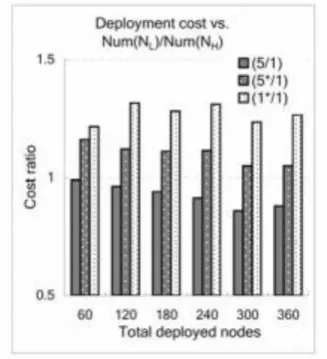
Fig. 6. Deployment cost of Test Case I
Test Case I is the coverage rate and deployment cost under different deployment ratio, where Num(NL):Num(NH) = 5:1 or 1:1. Besides, the ratio of communication/sensing range between NH and NL (RH : RL) is 1.5:1, and the ratio of communication and sensing range for NH / NL (RC : RS) is 1.5:1. We also compare the results with sensor deployment without topology control (case 2* and 5*).
Available online: https://edupediapublications.org/journals/index.php/IJR/ P a g e | 1490
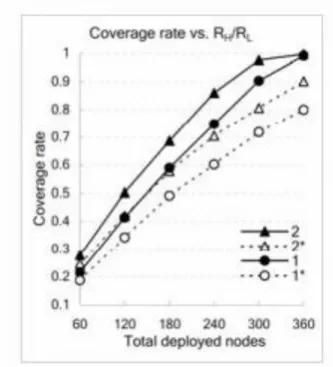
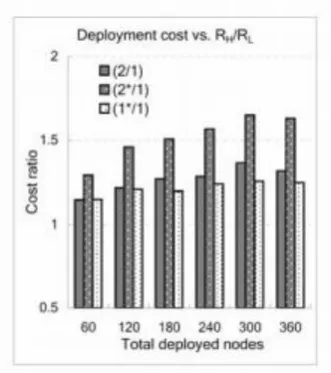
can achieve higher coverage rate with the help of more highend nodes. In addition, the reduction of deployment cost is significant for the deployment method with topology control. When deployment ratio is 5:1, it has higher coverage rate and lower deployment cost than the deployment method without topology control under the same deployment ratio. Test Case II is the coverage rate and deployment cost under different ratio of the communication/sensing range between NH and NL (RH : RL), where RCH : RSH = RCL : RSL = 1.5:1, and deployment ratio of NH and NL is fixed to 5:1. Other configurations are identical to the Test Case I. Figure 7 and Figure 8 are experiment results. If RH /RL = 1, it can be regarded as homogeneous deployment since both NH and NL have the same communication and sensing range. With the help of high-end sensor nodes, the heterogeneous deployment can get higher coverage rate, but the homogeneous deployment has lower deployment cost. The deployment method without topology control still has higher deployment cost under the same ratio of RH and RL.
Available online: https://edupediapublications.org/journals/index.php/IJR/ P a g e | 1491
Fig. 4. Deployment cost of Test Case II
CONCLUSIONS
In this paper, we propose a heterogeneous WSN deployment method based on irregular sensor model. It aims to deal with the deployment problem of heterogeneous sensor nodes with different communication and sensing range. In addition, an irregular sensor model is proposed to approximate the behavior of sensor nodes. The deployment process is starting from sink node, and new nodes are deployed to the region centered with it. In neighbor-info collection step, the information of adjacent sensor nodes is used to decide the deployment ratio of different types of sensor nodes. In the scoring step, a scoring mechanism based on the irregular sensor model is applied to candidate positions. At least, a new sensor node is placed to the position with the most coverage gains while maintaining the communication connectivity to center node. Above process is running repeatedly until all eligible sensor nodes are processed. According to experiment results, the proposed method can achieve higher coverage rate under the same deployable sensor nodes. Besides, the deployment cost is much lower with different configurations of sensor nodes. In the future work, a sensor node model considering environmental factors and individual behavior is needed. Besides, considering the interactions between different types of sensors is important. At least, the proposed method will be extended as the topology control protocol for heterogeneous WSN.
REFERENCES
Available online: https://edupediapublications.org/journals/index.php/IJR/ P a g e | 1492
2. He, T., Huang, C., Blum, B. M., Stankovic, J. A., and Abdelzaher, T.: Range-free localization schemes for large scale sensor networks. In Proceedings of the 9th Annual international Conference on Mobile Computing and Networking (MobiCom). (2003) 81- 95
3. Hu, W., Chou, C.T., Jha, S., and Bulusu, N.: Deploying Long-Lived and Cost-effective Hybrid Sensor Networks. Elsevier Ad-Hoc Networks, Vol. 4, Issue 6. (2006) 749-767
4. Krishnamurthy, L., Adler, R., Buonadonna, P., Chhabra, J., Flanigan, M., Kushalnagar, N., Nachman, L., and Yarvis, M.: Design and deployment of industrial sensor networks: experiences from a semiconductor plant and the North Sea. In Proceedings of the 3rd international conference on Embedded networked sensor systems (SenSys). (2005) 64-75
5. Lee, J.J., Krishnamachari, B., Kuo, C.C.J.: Impact of Heterogeneous Deployment on Lifetime Sensing Coverage in Sensor Networks (IEEE SECON). (2004)
6. Li, L., Halpern, J. Y., Bahl, P., Wang, Y.-M., and Wattenhofer, R.: Analysis of cone-based distributed topology control algorithms for wireless multi-hop networks. In Proceedings of ACM Symposium on Principle of Distributed Computing (PODC). (2001)
7. Li, X.-Y., Wan, P.-J., Wang, Y., and Frieder, O.: Sparse power efficient topology for wireless networks. In Proceedings of IEEE Hawaii International Conference on System Sciences (HICSS). (2002)
8. Ramanathan, R. and Rosales-Hain, R.: Topology control of multihop wireless networks using transmit power adjustment. In Proceedings of the 20th Annual Joint Conference of the IEEE Computer and Communications Societies (INFOCOM). (2000)
9. Wikipedia contributors, “Normal distribution,” Wikipedia, The Free Encyclopedia. (http://en.wikipedia.org/w/index.php?title=Normal_distribution&oldid=93201679)
10. Werner-Allen, G., Lorincz, K., Welsh, M., Marcillo, O., Johnson, J., Ruiz, M., and Lees, J.: Deploying a Wireless Sensor Network on an Active Volcano. IEEE Internet Computing 10(2) (2006) 18-25