Communication Systems
Elena Dubrova1 and Martin Hell2 1
Royal Institute of Technology, Electrum 229, 164 40 Stockholm, Sweden
Lund University, Box 117, SE-221 00 Lund, Sweden
Abstract. The demand for more efficient ciphers is a likely to sharpen with new generation of products and applications. Previous cipher de-signs typically focused on optimizing only one of the two parameters - hardware size or speed, for a given security level. In this paper, we present a methodology for designing a class of stream ciphers which takes into account both parameters simultaneously. We combine the ad-vantage of the Galois configuration of NLFSRs, short propagation delay, with the advantage of the Fibonacci configuration of NLFSRs, which can be analyzed formally. According to our analysis, the presented stream ci-pher Espresso is the fastest among the cici-phers below 1500 GE, including Grain-128 and Trivium.
Keywords: Stream cipher, encryption, FSR, wireless, 5G
1
Introduction
The importance of designing efficient and secure cryptographic systems is hard to overestimate. On one hand, with the growth of Internet-of-Things applications, more everyday-life products become security-critical and require high levels of assurance. On the other hand, these products typically have very limited re-sources available for the implementation of security mechanisms. In addition, the required computational effort and data rates are expected to significantly increase with new generations of products. The 5G is envisioned to have 1000 times higher traffic volume compared to current LTE deployments while provid-ing a better quality of service [1]. Consumer data rates of hundreds of Mbps are expected to be available in a general scenario and multi-Gbps in specific scenar-ios [2]. Furthermore, 5G needs to support a low latency of a few milliseconds to address use cases such as safety or control mechanisms in the process industry, in the electrical-distribution grid, or for traffic safety [2].
(e.g. Trivium [4]) for a given security level. Thus, they optimize only one of the two important parameters - hardware size or speed. In this paper, we present a methodology for designing a class of stream ciphers which takes into account both parameters simultaneously, thus minimizing the hardware footprint and maximizing the throughput of the design. We combine the advantage of the Galois configuration of NLFSRs, short propagation delay, with the advantage of the Fibonacci configuration of NLFSRs, which can be more easily analyzed formally. A careful choice of taps for the output Boolean function allows us to perform a security analysis for linear approximation attacks. According to our evaluation, the presented stream cipher is the fastest among the ciphers below 1500 GE, including Grain-128 and Trivium.
The paper is organized as follows. Section 2 gives basic notation used in the sequel. Section 3 describes previous work. Section 4 presents the new stream cipher Espresso. Section 5 analyses its hardware cost. Section 6 presents the security analysis. Section 7 concludes the paper.
2
Preliminaries
Throughout the paper, we use ”⊕” and ”·” to denote addition and multiplication in GF(2), respectively.
The Boolean functionsGF(2n)→GF(2) are represented using theAlgebraic
Normal Form (ANF)which is a polynomial overGF(2) of type
f(x) = 2n
−1 X
i=0
ci·xi00·x
i1 1 ·. . .·x
in−1
n−1,
whereci∈ {0,1}, (i0i1. . . in−1) is the binary expansion ofiandx= (x0, x1, . . .
, xn−1) [5].
Ann-bitFeedback Shift Register (FSR)consists ofnbinary storage elements, called stages. Each stage i ∈ {0,1, . . . , n−1} has an associated state variable
xi which represents the current value of the stage i and a feedback function fi:GF(2n)→GF(2) which determines how the value ofiis updated.
Astate of an FSR is a vector of values of its state variables. At each clock cycle, the next state of an FSR is determined from its current state by simul-taneously updating the value of each stagei to the value of the corresponding feedback function fi,∀i∈ {0,1, . . . , n−1}.
Theperiod of an FSR is the length of the longest cyclic output sequence it produces.
If all feedback functions of an FSR are linear, then it is called a Linear Feedback Shift Register (LFSR). Otherwise, it is called a Non-Linear Feedback Shift Register (NLFSR).
every stage. Thus, the Fibonacci configuration is a special case of the Galois configuration. Due to its conceptual simplicity, the Fibonacci configuration has been studied much more thoroughly.
Two NLFSRs are calledequivalentif sets of their output sequences are equal.
3
Previous Work
For encryption purposes, there are two types of ciphers, namelyblockandstream ciphers. Block ciphers have been studied for over 50 years [7]. Collected knowl-edge about their design and cryptanalysis made it possible to develop the Ad-vanced Encryption Standard (AES) algorithm which is widely accepted and has strong resistance against various kind of attacks [8].
On the other hand, an active public investigation of stream ciphers began only about 20 years ago [9]. A common type of stream cipher is thebinary additive stream cipher, in which the keystream, the plaintext, and the ciphertext are binary sequences. The keystream is produced by a keystream generator which takes a secret key and an initial value (IV) as a seed and generates a long pseudo-random sequence of 0s and 1s. The ciphertext is then obtained by the bit-wise addition of the keystream and the plaintext.
In the eSTREAM initiative, many stream ciphers, including Grain [3] and Trivium [4], were designed following the belief that stream ciphers can be made both faster and smaller than block ciphers. In recent years, however, several block ciphers have been presented which are comparable in size to Grain and Trivium. Some well-known examples include KATAN [10], LED [11], KLEIN [12], PRESENT [13], Piccolo [14] and TWINE [15]. The throughput for these is often given for 100KHz clock frequency since this is typical for RFID tags [16]. Yet, they can often be clocked faster and [17] reports some implementations reaching about 1Gbps using slightly more than 3000 GE and 90nm CMOS technology. For higher throughput and more compact design it appears that stream ciphers are the best choice.
However, the confidence in stream ciphers’ security has been tapered by many broken systems. For example, the popular stream ciphers A5/1 and A5/2 used in the Global System for Mobile communications (GSM) standard and E0 used in Bluetooth have been found susceptible to a number of attacks [18]. As a result, A5/1 was replaced by a block cipher based A5/3 and A5/2 was prohibited. Another well-known stream cipher RC4 used in the original IEEE 802.11 standard to secure wireless networks has been shown especially vulnerable when the beginning of the output keystream is not discarded, non-random or related keys are used, or a single keystream is used twice [19]. As a result, it was replaced by the AES in the newest standard, IEEE 802.11i.
to make design choices for the size of internal state and the output function (number and position of inputs, nonlinearity, resiliency, algebraic degree, etc) so that the resulting filter generator is resistant to known attacks with a sufficient security margin [21–23]. Techniques that can guarantee long FSR period are also known [24, 25]. Examples of stream ciphers based on the idea behind filter generators include Grain [3] and Trivium [4].
4
Design Description
This section motivates and describes the presented stream cipher Espresso.
4.1 Design Methodology
The Grain family of stream ciphers [3] uses FSRs in the Fibonacci configura-tion. This adds simplicity to the security analysis, but has a drawback that the propagation delay through the feedback function is large due to the large size of the function. Trivium [4] uses much simpler feedback functions, but it has 288 flip-flops which are more area consuming compared to gates.
First, by using FSRs implemented in the Galois configuration, we can make the feedback functions smaller. This allows us to reduce the propagation delay compared to Grain while at the same time decrease the size compared to Triv-ium. Due to the large number of feedback functions in the presented design, its maximum degree of parallelization cannot be made as high as in both Grain and Trivium. Still, by carefully choosing feedback functions, we are able to guarantee the maximum degree of parallelization 4 and a maximum-length FSR.
Second, to enable security analysis of the presented design, we transform the original Galois NLFSR to an NLFSR whose configuration resembles the Fi-bonacci configuration. The core idea of our method is to assure that all of the most biased linear approximations of the output Boolean function take inputs only from those stages of the Galois NLFSR which have a corresponding equiv-alent stage in the transformed NLFSR. As a result, traditional cryptanalysis techniques can be applied to our design as well.
4.2 Design Details
The two main building blocks of Espresso are a 256-bit NLFSRGin the Galois configuration and a 20-variable nonlinear output function. To avoid confusion between the feedback functions of G and the feedback functions of the trans-formed NLFSRF introduced later, we denote a feedback function of the stagei
The feedback functions of the NLFSRGare specified as follows:
g255(x) =x0⊕x41x70
g251(x) =x252⊕x42x83⊕x8
g247(x) =x248⊕x44x102⊕x40
g243(x) =x244⊕x43x118⊕x103
g239(x) =x240⊕x46x141⊕x117
g235(x) =x236⊕x67x90x110x137
g231(x) =x232⊕x50x159⊕x189
g217(x) =x218⊕x3x32
g213(x) =x214⊕x4x45
g209(x) =x210⊕x6x64
g205(x) =x206⊕x5x80
g201(x) =x202⊕x8x103
g197(x) =x198⊕x29x52x72x99
g193(x) =x194⊕x12x121
All remaining feedback functions ofGare of typegi(x) =xi+1.
The output functionz(x) is specified as follows:
z(x) =x80⊕x99⊕x137⊕x227⊕x222⊕x187⊕x243x217⊕x247x231
⊕x213x235⊕x255x251⊕x181x239⊕x174x44⊕x164x29
⊕x255x247x243x213x181x174
The function z(x) consists of a linear function of 6 variables and a bent function of 14 variables. Therefore, z(x) is balanced, has nonlinearity 26(213− 26) = 520192 and resiliency 5. The algebraic degree ofz(x) is 6 since its largest ANF monomial contains 6 variables.
Inz(x), 15 out of 20 indexes of variables are taken from the following full positive difference set3:
{255,247,243,227,222,213,187,181,174,164,137,99,80,44,29}.
In seven two-variable monomials ofz(x), the difference between the first and the second indexes of variables is taken from the following full positive difference set:
{26,16,22,4,58,130,135}.
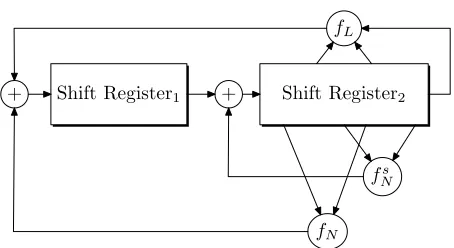
NLFSRs in the Fibonacci configuration are much more studied and crypt-analyzed compared to the NLFSRs in the Galois configuration. To make use of the accumulated knowledge, we can transform the NLFSR G into an equiva-lent NLFSR F whose configuration resembles the Fibonacci configuration (see Figure 1) and therefore is easier to cryptanalyze. The NLFSR F has only two
3
Shift Register1 Shift Register2
+ +
fL
fN fs
N
Fig. 1.The structure of the transformed NLFSRF.
non-trivial feedback functions:
f255(x) =x0⊕x12⊕x48⊕x115⊕x133⊕x213⊕x41x70⊕x46x87
⊕x52x110⊕x55x130⊕x62x157⊕x74x183⊕x87x110x130x157
f217(x) =x218⊕x3x32⊕x8x49⊕x14x72⊕x17x92⊕x24x119⊕x36x145
⊕x49x72x92x119
and all remaining feedback functions are of type fi(x) =xi+1. We can see that
the function f255(x) of F is of type f255(x) = fL(x)⊕fN(x) where fL(x) is
a linear function of 6 variables and fN(x) is a nonlinear bent function of 12
variables. The function f217(x) is of typef217(x) =x218⊕fNs(x) wherefNs(x)
is the ”shifted” version offN(x), in which each variablexi is replaced byxi−38.
fs
N(x) cancels the effect of non-linearity introduced byfN(x). So, stages 217 to
0 ofF generate the linear sequence induced by the primitive polynomial 1 +x12+x48+x115+x133+x213+x256 (1) which is induced by the functionfL(x). It is known that NLFSRs constructed
in this way have the period 2n−1 wherenis the size of the state [24].
The equivalence of G and F can be shown by applying the Fibonacci-to-Galois transformation [6]. The set of sequences generated by the stage 231 ofG
is equivalent to the set of sequences generated by the stage 255 ofF. The set of sequences generated by the stage 193 ofGis equivalent to the set of sequences generated by the stage 217 ofF. SinceGis equivalent toF, its period is 2256−1. The function f255(x) is balanced, has nonlinearity 26(211−25) = 129024, resiliency 5, and algebraic degree 4. SinceF andGare equivalent, the function
g231(x) ofGhas the same properties.
Indexes of variables offL(x) form the full difference set
{0,12,48,115,133,213}
and indexes of variables offN(x) form the full difference set
4.3 Key and IV Initialization
The cipher Espresso is initialized as follows. Letki denote the bits of the keyk,
0≤i≤127, andIVi denote the bits of the initialization valueIV, 0≤i≤95.
The key and IV bits are loaded into the shift register as follows:
xi =ki, 0≤i≤127 xi =IVi−128, 128≤i≤223
xi = 1, 224≤i≤254 xi = 0, i= 255
The initialization phase consists of clocking the cipher 256 times, XORing the produced output bit with the stages x255 and x217. Thus, in this phase the feedback functions g255(x) andg217(x) of the NLFSR Gare given by
g255(x) =x0⊕x41x70⊕z(x)
g217(x) =x218⊕x3x32⊕z(x)
After initialization, the cipher is clocked for three more cycles (due to the pipelin-ing of the output function and additional logic required for switchpipelin-ing between the initialization and the keystream generation phases, as explained in Section 5) and then the keystream is produced.
5
Hardware Cost Analysis
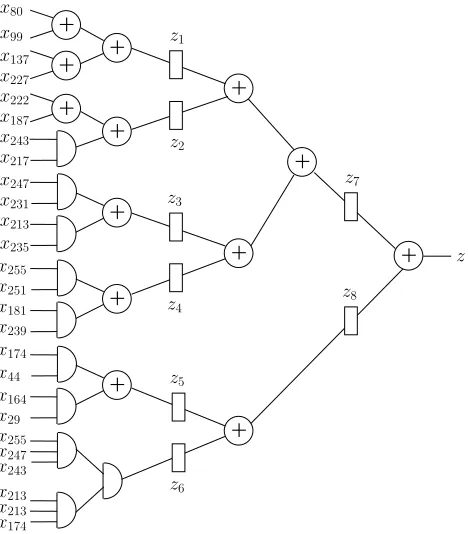
In order to reduce the propagation delay of the circuit implementing the output function z(x), we can pipeline it as follows:
z1(x) =x80⊕x99⊕x137⊕x227
z2(x) =x222⊕x187⊕x243x217
z3(x) =x247x231⊕x213x235
z4(x) =x255x251⊕x181x239
z5(x) =x174x44⊕x164x29
z6(x) =x255x247x243x213x181x174
z7(x) =z1(x)⊕z2(x)⊕z3(x)⊕z4(x)
z8(x) =z5(x)⊕z6(x)
z(x) =z7(x)⊕z8(x)
A circuit diagram implementing the pipelined version of z(x) is showed in Fig-ure 2. As a consequence of the pipelining, the output of the stream cipher is delayed by two clock cycles, increasing the latency. In addition, the pipelining increases the area by 8 flip-flops. However, it allows us to increase the through-put 1.7 times. In our opinion, the substantial gain in throughthrough-put outweighs the minor increases in areas and latency.
In order to further reduce the propagation delay of the presented design, we apply de Morgan rule to re-express ANFs of the feedback functionsg235andg197 of the NLFSR Gas follows:
g235(x) =x236⊕x67x90x110x137=x236⊕((x67x90)′+ (x110x137)′)′
+
+
+
+
+
+
+
+
+
+
+
+
+
x80x187
x243
x217
x247
x231
x213
x235
x255
x251
x181
x239
x174
x44
x164
x29
x255
x174
x213
x247
x243
x222
x227
x137
x99
z z2
z4
z6
z1
z3
z5
z7
z8
x213
Fig. 2.A circuit implementing the pipelined version ofz(x).
where x′ denotes the Boolean complement of x (defined as x′ = x⊕1), and
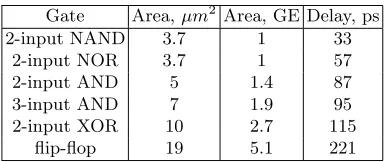
”+” denotes the Boolean OR. From Table 1, the reader can see that, in CMOS technology, NAND or NOR are much smaller and faster than AND. Therefore, we can decrease both, the area and the delay, by replacing a 4-input AND as shown above.
Finally, we need to take care of the propagation delay of the feedback func-tionsg255 andg217 during the initialization phase. In this phase, the functions
g255(x) andg217(x) are computed as
g255(x) =x0⊕x41x70⊕z(x)
g217(x) =x218⊕x3x32⊕z(x)
Figure 3 shows how switching between the initialization and the keystream gen-eration phases can be implemented forg255 without increasing the critical path (a circuit for the functiong217is similar). The output ofz(x) needs to be multi-plexed and pipelined. Note that while the function describing a regular 2-input multiplexer (MUX) isa·b+a′·c, a multiplexer in which one input is fixed to 0
can be implemented as
+
+
initialization x41
x70
g255
x0
z
Fig. 3. A circuit implementing the switching between the initialization and the keystream generation phases.
Gate Area,µm2
Area, GE Delay, ps
2-input NAND 3.7 1 33
2-input NOR 3.7 1 57
2-input AND 5 1.4 87
3-input AND 7 1.9 95
2-input XOR 10 2.7 115
flip-flop 19 5.1 221
Table 1.Parameters of gates and flip-flops for a typical 90nm CMOS technology.
Therefore, an AND gate can be used to implement the multiplexing of z(x), as shown in Figure 3. Since the delay of an AND is smaller than the delay of an XOR, the proposed switching scheme does not increase the overall delay. However, it increases the latency by one clock cycle.
After these modifications, the NLFSRGrequires 12 2-input ANDs, 4 2-input NANDs, 2 2-input NORs, 19 2-input XORs and 256 flip-flops to be implemented. The output functionz(x) requires 8 2-input ANDs, 2 3-input ANDs, 13 2-input XORs and 8 flip-flops. The additional logic for switching between the initial-ization and the keystream generation phases requires 2 ANDs, 2 XORs and 2 flip-flops.
If we use 90nm CMOS technology for implementing this NLFSR (see Table 1 for parameters of gates), then we can approximate the area and the propagation delay of the presented stream cipher Espresso as
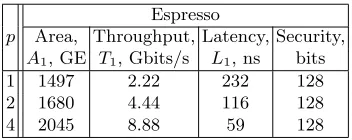
Area of (22 2-input ANDs + 2 3-input ANDs + 4 2-input NANDs + 2 2-input NORs + 34 XORs + 266 flip-flops) = 5540µm2 = 1497 GE Delay of (2 XORs + flip-flop) = 451 ps.
Espresso
p Area, Throughput, Latency, Security,
A1, GE T1, Gbits/s L1, ns bits
1 1497 2.22 232 128
2 1680 4.44 116 128
4 2045 8.88 59 128
Table 2.Hardware parameters of Espresso; p= degree of parallelization (number of bits generated per one clock cycle).
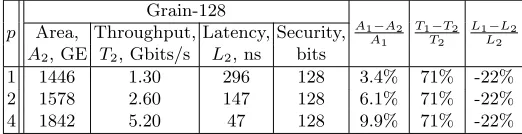
For a comparison, the area and propagation delay of the stream cipher Grain-128 [3] are given by:
Area of (22 ANDs + 34 XORs + 258 flip-flops) = 5352µm2 = 1446 GE Delay of (AND + 4 XORs + flip-flop) = 768 ps.
We assume that a logic similar to the one shown in Figure 3 is used for switching between the initialization and the operational phases. Otherwise, the delay of Grain-128 is considerably higher. Grain-128 can be parallelized to produce up to 32 bits per clock cycle. For the degree of parallelization one, its latency is 296 ns (computed as (128 + 256 + 1) clock cycles×768 ps).
For the stream cipher Trivium [4] we have:
Area of (3 ANDs + 11 XORs + 288 flip-flops) = 5597µm2 = 1513 GE Delay of (AND + 2 XORs + flip-flop) = 538 ps.
Trivium can be parallelized to produce up to 64 bits per clock cycle. For the degree of parallelization one, its latency is 663 ns (computed as (80 + 4×288) clock cycles×538 ps).
Note that, in all three ciphers, the latency can be reduced if the key and IV are loaded in parallel rather than sequentially. However, such a technique requires the addition of a MUX to each flip-flip of the FSRs, implying the increase in area by at least 3 GE ×FSR size. Furthermore, the propagation delay of the presented design and Trivium would increase by at least twice the delay of a NAND, implying a reduction in the maximum data rate of 283 Mbits/s for the presented design and of 203 Mbits/s for Trivium.
Grain-128
A1
−A2
A1 T1
−T2
T2 L1
−L2
L2
p Area, Throughput, Latency, Security,
A2, GE T2, Gbits/s L2, ns bits
1 1446 1.30 296 128 3.4% 71% -22%
2 1578 2.60 147 128 6.1% 71% -22%
4 1842 5.20 47 128 9.9% 71% -22%
Table 3.Comparison of Espresso with Grain-128.
Trivium
A1
−A3
A1 T1
−T3
T3 L1
−L3
L2
p Area, Throughput, Latency, Security,
A3, GE T3, Gbits/s L3, ns bits
1 1513 1.86 663 80 -1.0% 19% -65%
2 1547 3.72 332 80 7.9% 19% -65%
4 1614 7.43 166 80 21.1% 19% -65%
Table 4.Comparison of Espresso with Trivium.
6
Security Analysis
This section will give a security analysis of the presented stream cipher Espresso. Both attacks on the running key stream and attacks on the initialization proce-dure are discussed.
6.1 Linear Approximations
Attacks using linear approximations were successful against the initial version of Grain, resulting in key recovery attacks. Being an NLFSR with a nonlinear output function, the current design has similarities with Grain. This makes it important to determine the resistance against these attacks.
The security against linear attacks will be analyzed using the equivalent transformed configuration F of the shift register G. Note that there are no linear terms in any shift register stages that do not have an equivalent in both configurations, so the analysis is valid also for the Galois configuration. For clarity of the presentation, we divide the state register into two separate parts. The state variables in the nonlinear part (Shift Register1in Figure 1) are denoted
b and the state variables in the linear part (Shift Register2 in Figure 1) are denoted by s. Furthermore, let B and S denote the size of the nonlinear part and the linear part of the shift register respectively. Thus, we have
bi =si+S 0≤i < B. (2)
which is induced by the polynomial (1). Define the biasε of an approximation asε= 2·Pr(X =Y)−1, simply written asX =ε Y. Then, the nonlinear output function can be approximated with a linear function and we can write
z(t)ε1
=M
i
b0(t+φi)⊕
M
j
s0(t+θj). (3)
Denote the number ofb-variables in the output functionwb(z), i.e., 0≤i < wb(z)
in (3). Similarly, the nonlinear feedback function can be approximated by a linear function in bits fromssince there are nob-variables in the feedback in order for the nonlinear compensation tosS−1 to work properly. Thus, we can also write
bB−1(t+ 1) =b0(t+B) ε2
=M
k
s0(t+µk) (4)
Combining (3) and (4), we can write the output as a sum of only variables from the linear part of the shift register,
z(t)ε1
=M
i
b0(t+B−(B−φi))⊕
M
j
s0(t+θj) (5)
ε1ε
wb(z) 2
= M
i
M
k
s0(t+µk−(B−φi))⊕
M
j
s0(t+θj), (6)
where the piling-up lemma has been used to combine linear approximations. Thus, an output variable can always be written as a biased sum of s-variables, which in turn satisfy a linear recurrence relation. If we denote the weight of this recurrence relation byw(LR), we get a distinguishing attack with total bias
εtot=
ε1εw
b(z)
2
w(LR)
. (7)
From this it is clear that the complexity of the attacks relies on the biases of the two approximations and on the number ofb-variables that are used in the linear approximation of the output function. Looking at the design, we have
ε1= 2−7andε2= 2−6andwb(z) = 6 for all biased linear approximations. From
this it follows that the approximation (6) has bias 2−43 which makes an attack similar to the one in [26] inefficient. Also, if we use a weight 3 multiple of the linear recurrence relation the number of samples needed would be in the order of 1/ε2
tot = 243·3·2 = 2172 (with distance 2218/2 = 2109 between first and last keystream bit in each sample [27, 28]).
6.2 Algebraic Attacks
bits using initial state bits. Due to the linearity of the shift register, the algebraic degree of these equations will never exceed the degree of the output function. With enough equations, linearization, or other more advanced methods [31–33], can be used to recover the internal state. Moreover, annihilators [34] can be used to lower the degree of the functions even more. With a part of the state being nonlinearly updated, these attacks are no longer applicable since several nonlinear register stages are used in the output function. The degree of the equations in initial state bits will increase and is not limited by the degree of the output function.
6.3 Time-Memory-Data Trade-off Attacks
TMTO attacks on stream ciphers can be divided into two categories, those that attempt to reconstruct the internal state, see e.g., [35–37] and those that attempt to recover the key, see e.g., [38]. The algorithms used in the latter attacks are the same as those in the former, they just use a different one-way function as target of the attack. The algorithm used in [35, 36] simply records input/output combinations and uses enough data in order to have a collision with a recorded value. The trade off curve is given byT M =N,T =D, andP =M =N/D. The algorithm used in [37] instead created tables similar to those used by Hellman in [39] and has the trade-off given byT M2D2=N2, 1≤D2≤TandP=N/D. Both algorithms uses the observation that an increased amount of data can lower the precomputation time. Since the size of the internal state is 22k, it is clear
that recovering the internal state is not possible withT <2kandM <2k using
any of the algorithms. On the other hand, recovering the key would be possible with e.g., T = 2112, M = 2112 and D = 256 but will require a precomputation time ofP = 2168. Some might argue that this would be a valid (academic) attack while some would claim that P = 2168 is too large to be interesting when key size is 128 bits.
an attack will far exceed that of brute force and a parallelized brute force [42] is likely to be much more efficient.
6.4 Chosen IV Attacks
The complexity of the initialization function does not affect the attack complex-ities in the TMTO attacks. In this section we consider attacks that do depend on the initialization function. In a chosen IV scenario, the adversary can choose the initialization vector used in the initialization step. This is the basis for the Cube attack [43] and AIDA attack [44] and can lead to key recovery if the initialization is not carefully designed. The number of iterations in the initialization should be chosen such that all key and IV bits affect the keystream bits in a complex way.
To determine the resistance against these types of attacks, maximum degree monomial tests have been performed. Any keystream bit can be written as a function of key and IV bits
zi =fi(k0, . . . , k127, iv0, . . . , iv95). (8) All key bits are fixed to zero and a subset of the IV bits are fixed as well. Thus, running through all possible combinations of the non-fixed bits, the truth table of the functionfi is obtained, which can in turn be used to compute the ANF.
This will lead to ad-monomial test [45] as we could check the presence of mono-mials of degreedand compare it to the expected number for a random Boolean function. Intuitively, the maximum degree monomial only exists if all bits have been properly mixed by the initialization function, so we focus on this mono-mial. The total number of bits that can be used is 96 requiring a complexity of 296in order to determine the presence of the monomialiv
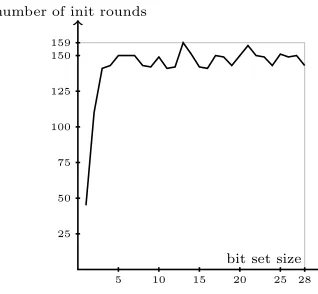
0, . . . , iv95. This is not feasible, and we instead adopt the test in [46] in order to find a monomial with manageable degree and that will be absent for as many initialization rounds as possible. The algorithm starts with just a few bits and exhaustively finds the monomial that is absent the maximum number of rounds. Then it greedily adds one more bit to the set and continues. All non-used key and IV bits are set to zero. For a conservative estimate the algorithm is allowed to use also key bits. This turns the Chosen IV attack into a less powerful nonrandomness detector since an attacker is not assumed to be able to choose key bits. Figure 4 shows the number of initialization rounds that can be broken using a particular degree (bit set size) for the monomial.
bit set size number of init rounds
5 10 15 20 25 28 25
50 75 100 125 150 159
Fig. 4. The maximum number of initialization rounds that do not pass a maximum degree monomial test for a given monomial degree.
7
Conclusion
We presented a new stream cipher Espresso targeting 5G wireless communication systems. Its 1-bit per cycle version has 1497 GE area, 2.22 Gbits/sec throughput and 232 ns latency, meeting requirements of most 5G applications envisioned today. It is resistant to known attacks, including linear approximations, algebraic attacks, time-memory-data trade off attacks and chosen IV attacks.
8
Acknowledgements
This work carried out during the research visits of authors at the security group at Ericsson Research in 2013-2014 and supported by the grants SM12-0005 and SM12-0025 from the Swedish Foundation for Strategic Research. The authors would like to thank Mats N¨aslund and Ben Smeets from Ericsson Research for their help with this work, for sharing their expertise and providing many valuable comments and suggestions on the design.
References
1. M. Olsson, C. Cavdar, P. Frenger, S. Tombaz, D. Sabella, and R. Jantti, “5green: Towards green 5g mobile networks,” in Int. Conf. on Wireless and Mobile Com-puting, Networking and Communications, pp. 212–216, Oct 2013.
2. Ericsson White Paper, “5G radio access,” June 2013. http://www.ericsson.com/ res/docs/whitepapers/wp-5g.pdf.
3. M. Hell, T. Johansson, A. Maximov, and W. Meier, “The Grain family of stream ciphers,” New Stream Cipher Designs: The eSTREAM Finalists, LNCS 4986, pp. 179–190, 2008.
5. R. Lidl and H. Niederreiter,Introduction to Finite Fields and their Applications. Cambridge Univ. Press, 1994.
6. E. Dubrova, “A transformation from the Fibonacci to the Galois NLFSRs,”IEEE Transactions on Information Theory, vol. 55, pp. 5263–5271, November 2009. 7. B. Schneier,Applied cryptography (2nd ed.): protocols, algorithms, and source code
in C. New York, NY, USA: John Wiley & Sons, Inc., 1995.
8. J. Daemen and V. Rijmen, “AES proposal: Rijndael,” April 2003. National Insti-tute of Standards and Technology.
9. M. Robshaw, “Stream ciphers,” Tech. Rep. TR - 701, July 1994.
10. C. De Canni`ere, O. Dunkelman, and M. K. zevi´c, “KATAN and KTANTAN — a family of small and efficient hardware-oriented block ciphers,” inCryptographic Hardware and Embedded Systems—CHES 2009, vol. 5747, pp. 272–288, Springer, 2009.
11. J. Guo, T. Peyrin, A. Poschmann, and M. Robshaw, “The led block cipher,” in Cryptographic Hardware and Embedded Systems, CHES 2011 (B. Preneel and T. Takagi, eds.), vol. 6917 of Lecture Notes in Computer Science, pp. 326–341, Springer Berlin / Heidelberg, 2011.
12. Z. Gong, S. Nikova, and Y. Law, “Klein: A new family of lightweight block ciphers,” in RFID. Security and Privacy(A. Juels and C. Paar, eds.), vol. 7055 ofLecture Notes in Computer Science, pp. 1–18, Springer Berlin Heidelberg, 2012.
13. A. Bogdanov, L. R. Knudsen, G. Leander, C. Paar, A. Poschmann, M. J. B. Rob-shaw, Y. Seurin, and C. Vikkelsoe, “PRESENT: An Ultra-Lightweight Block Ci-pher,” inCryptographic Hardware and Embedded Systems—CHES 2007, vol. 4727 of Lecture Notes in Computer Science, pp. 450–466, Springer Berlin Heidelberg, 2007.
14. K. Shibutani, T. Isobe, H. Hiwatari, A. Mitsuda, T. Akishita, and T. Shirai, “Pic-colo: An ultra-lightweight blockcipher,” inCryptographic Hardware and Embedded Systems - CHES 2011(B. Preneel and T. Takagi, eds.), vol. 6917 ofLecture Notes in Computer Science, pp. 342–357, Springer, 2011.
15. T. Suzaki, K. Minematsu, S. Morioka, and E. Kobayashi, “TWINE: A lightweight block cipher for multiple platforms,” inSelected Areas in Cryptography—SAC 2012
(L. Knudsen and H. Wu, eds.), vol. 7707 of Lecture Notes in Computer Science, pp. 339–354, Springer Berlin Heidelberg, 2013.
16. A. Juels, “RFID security and privacy: a research survey,”Selected Areas in Com-munications, IEEE Journal on, vol. 24, pp. 381–394, Feb. 2006.
17. J. Borghoff, A. Canteaut, T. Gneysu, E. Kavun, M. Knezevic, L. Knudsen, G. Le-ander, V. Nikov, C. Paar, C. Rechberger, P. Rombouts, S. Thomsen, and T. Yaln, “Prince a low-latency block cipher for pervasive computing applications,” in Ad-vances in Cryptology ASIACRYPT 2012(X. Wang and K. Sako, eds.), vol. 7658 of Lecture Notes in Computer Science, pp. 208–225, Springer Berlin Heidelberg, 2012.
18. E. Biham and O. Dunkelman, “Cryptanalysis of the A5/1 GSM stream cipher,” in
INDOCRYPT ’00: Proceedings of the First International Conference on Progress in Cryptology, (London, UK), pp. 43–51, Springer-Verlag, 2000.
19. E. Tews, R.-P. Weinmann, and A. Pyshkin, “Breaking 104-bit wep in under a minute.” Cryptology ePrint Archive, Report 2007/120, 2007. http://eprint.iacr.org/.
20. S. Golomb,Shift Register Sequences. Aegean Park Press, 1982.
22. A. Braeken and J. Lano, “On the (im)possibility of practical and secure nonlinear filters and combiners,” inProceedings of the 12th international conference on Se-lected Areas in Cryptography, SAC’05, (Berlin, Heidelberg), pp. 159–174, Springer-Verlag, 2006.
23. T. W. Cusick and P. Stˇanicˇa,Cryptographic Boolean functions and applications. San Diego, CA, USA: Academic Press, 2009.
24. E. Dubrova, “A scalable method for constructing Galois NLFSRs with period 2n
−1
using cross-join pairs,” IEEE Transactions on Information Theory, vol. 1, no. 59, pp. 703–709, 2013.
25. E. Dubrova, “A method for generating full cycles by a composition of nlfsrs,”
Design, Codes and Cryptography, 2012.
26. C. Berbain, H. Gilbert, and A. Maximov, “Cryptanalysis of Grain,” inFast Soft-ware Encryption 2006(M. Robshaw, ed.), vol. 4047 ofLecture Notes in Computer Science, pp. 15–29, Springer, 2006.
27. D. Wagner, “A generalized birthday problem,” in Advances in Cryptology— CRYPTO 2002(M. Yung, ed.), vol. 2442 ofLecture Notes in Computer Science, pp. 288–303, Springer, 2002.
28. J. D. Goli´c, “Computation of low-weight parity check polynomials,” Electronic Letters, vol. 32, no. 21, pp. 1981–1982, 1996.
29. N. Courtois and W. Meier, “Algebraic attacks on stream ciphers with linear feed-back,” inAdvances in Cryptology—EUROCRYPT 2003(E. Biham, ed.), vol. 2656 ofLecture Notes in Computer Science, pp. 345–359, Springer, 2003.
30. F. Armknecht and M. Krause, “Algebraic attacks on combiners with memory,” in Advances in Cryptology—CRYPTO 2003(D. Boneh, ed.), vol. 2729 ofLecture Notes in Computer Science, pp. 162–176, Springer, 2003.
31. N. Courtois, A. Klimov, J. Patarin, and A. Shamir, “Efficient algorithms for solv-ing overdefined systems of multivariate polynomial equations,” in Advances in Cryptology—EUROCRYPT 2003 (B. Preneel, ed.), vol. 1807 ofLecture Notes in Computer Science, pp. 392–407, Springer, 2000.
32. N. Courtois and J. Pieprzyk, “Cryptanalysis of block ciphers with overdefined systems of equations,” inAdvances in Cryptology—ASIACRYPT 2002(Y. Zheng, ed.), vol. 2501 ofLecture Notes in Computer Science, pp. 267–287, Springer, 2002. 33. J.-C. Faug´ere and A. Joux, “Algebraic cryptanalysis of Hidden Field Equation (HFE) cryptosystems using Gr¨obner bases,” inAdvances in Cryptology—CRYPTO 2003(D. Boneh, ed.), vol. 2729 ofLecture Notes in Computer Science, pp. 44–60, Springer, 2003.
34. W. Meier, E. Pasalic, and C. Carlet, “Algebraic attacks and decomposition of Boolean functions,” inAdvances in Cryptology—EUROCRYPT 2004, vol. 3027 of
Lecture Notes in Computer Science, pp. 474–491, Springer, 2004.
35. J. Goli´c, “Cryptanalysis of alleged A5 stream cipher,” inAdvances in Cryptology— EUROCRYPT 1997 (W. Fumy, ed.), vol. 1233 ofLecture Notes in Computer Sci-ence, pp. 239–255, Springer, 1997.
36. S. Babbage, “A space/time tradeoff in exhaustive search attacks on stream ci-phers,” in European Convention on Security and Detection, no. 408 in IEE Con-ference Publication, 1995.
37. A. Biryukov and A. Shamir, “Cryptanalytic time/memory/data tradeoffs for stream ciphers,” in Advances in Cryptology—ASIACRYPT 2000 (T. Okamoto, ed.), vol. 1976 ofLecture Notes in Computer Science, pp. 1–13, Springer, 2000. 38. J. Hong and P. Sarkar, “New applications of time memory data tradeoffs.,” in
39. M. Hellman, “A cryptanalytic time-memory trade-off,”IEEE Transactions on In-formation Theory, vol. IT-26, pp. 401–406, July 1980.
40. M. J. Mihaljevic, S. Gangopadhyay, G. Paul, and H. Imai, “Internal state recovery of Grain-v1 employing normality order of the filter function,” IET Information Security, vol. 6, no. 2, pp. 55–64, 2012.
41. M. J. Mihaljevic, S. Gangopadhyay, G. Paul, and H. Imai, “Generic cryptographic weakness ofk-normal Boolean functions in certain stream ciphers and cryptanalysis of Grain-128,”Periodica Mathematica Hungarica, vol. 65, no. 2, pp. 205–227, 2012. 42. D. J. Bernstein, “Understanding brute force.” eSTREAM, ECRYPT Stream
Ci-pher Project, Report 2005/036, 2005. http://www.ecrypt.eu.org/stream.
43. I. Dinur and A. Shamir, “Cube Attacks on Tweakable Black Box Polynomials,” in
Advances in Cryptology—EUROCRYPT 2009(A. Joux, ed.), vol. 5479 of Lecture Notes in Computer Science, pp. 278–299, Springer, 2009.
44. M. Vielhaber, “Breaking ONE.FIVIUM by AIDA an Algebraic IV Differential attack.” Available at: http://eprint.iacr.org/2007/413/, 2007.
45. M.-J. O. Saarinen, “Chosen-IV statistical attacks on eStream stream ciphers,”
Proc. Stream Ciphers Revisited (SASC’06), 2006.
46. P. Stankovski, “Greedy distinguishers and nonrandomness detectors,” inProgress in Cryptology—INDOCRYPT 2010(G. Gong and K. C. Gupta, eds.), vol. 6498 of