Cryptographic Resource
Masahito Hayashi12and Takeshi Koshiba3
1 Graduate School of Mathematics, Nagoya University [email protected]
2 Centre for Quantum Technologies, National University of Singapore 3
Faculty of Education and Integrated Arts and Sciences, Waseda University [email protected]
Abstract. We propose a new cryptographic resource, which we call
modulo zero-sum randomness, for several cryptographic tasks. The mod-ulo zero-sum randomnessX1, . . . , Xm is distributed randomness among
mparties, whereX1, . . . , Xmare independent of each other but
∑ Xi=
0 holds. By using modulo zero-sum randomness, we show that multi-party secure computation for some additively homomorphic functions is efficiently realized without the majority honest nor secure communi-cation channels (but public channel). We also construct secret sharing protocols without secure communication channels. Moreover, we consider a new cryptographic taskmulti-party anonymous authentication, which is realized by modulo zero-sum randomness. Furthermore, we discuss how to generate modulo zero-sum randomness from some information theoretic assumption. Finally, we give a quantum verification protocol of testing the property of modulo zero-sum randomness.
Keywords: cryptographic resource, public channel, multi-party secure compu-tation, secret sharing, authentication, quantum verification
1
Introduction
In cryptography, we often focus on cryptographic resources such as secure agreed keys and common randomness: secure agreed keys play an important role for message authentication and common reference strings are essential for the uni-versal composable security. In this paper, we propose yet another cryptographic resource, which we call modulo zero-sum randomness. When m players exist, secure modulo zero-sum randomness is given as random numbers Xi in Fcq for
i= 1, . . . , mas follows. The relation∑mi=1Xi= 0 holds and anym−1 variables amongX1, . . . , Xmare independent of each other. Player ihas the randomness
Xiand does not know any other random variables except for the above zero-sum condition.
two players [11, 3]. For example, secure multi-party secure computation for homo-morphic functions can be realized without majority honesty, it requires so many secure communication channels [4]. Also, any existing secret sharing protocol re-quires many secure communication channels [23, 15, 1, 22, 26, 27, 21, 13]. In this paper, using the secure modulo zero-sum randomness, we propose protocols to realize these tasks without secure communication channels (but public channel). That is, based on secure modulo zero-sum randomness, we construct a protocol for multi-party secure computation for some additively homomorphic functions without the majority honesty nor secure communication channels. Also, based on the secure modulo zero-sum randomness, we construct secret sharing protocols without secure communication channels.
As an alternative approach to realize multi-party secure computation with-out the majority honesty nor secure communication channels, we can take se-cure message transmission [6, 2, 18, 25]. Sese-cure message transmission is a crypto-graphic protocol between two parties, between which there are several channels, to send messages privately and reliably. Secure message transmission protocols can simulate a secure communication channel between the two parties. In the standard setting of secure message transmission, the majority honesty over the channels is required. If the public channel is available in secure message trans-mission, then such a barrier can be overcome [7, 24, 17] and multi-party secure computation can be realized by using secure message transmission with the pub-lic channel [8]. However, the respective simulations of the secure communication channels are quite inefficient.
As another application, we propose multi-party anonymous authentication, which is a new cryptographic task. Consider the case when a certain project requires the approvals from all the players. We are required to verify that all the players approve the project by confirming the contents of the project. Addi-tionally, we might require the anonymity for this approval due to the following reason. This is because if a person disagreeing to the project can be identified, a player might hesitate to disagree to it even when he/she does not agree on it in his/her mind. In this paper, using secure modulo zero-sum randomness, we construct a protocol to realize multi-party anonymous authentication without secure communication channel.
Indeed, secure modulo zero-sum randomness can be generated by multi-party secure computation for modulo sum. In this sense, the generation of secure mod-ulo zero-sum randomness can be regarded as an equivalent task to multi-party secure computation for modulo sum. In addition, we also discuss several methods to generate secure modulo zero-sum randomness.
se-cure modulo zero-sum randomness. While, in general, it is difficult to examine the property of secure modulo zero-sum randomness, Section 7 shows that if we are allowed to use quantum algorithms it is possible to verify that the resource satisfies the property of secure modulo zero-sum randomness.
2
Secure Modulo Zero-Sum Randomness, its Variant
Tasks and Reducibilities among them
First, we give the rigorous definition of secure modulo zero-sum randomness for the random numbers Xi ∈ Fcq with i = 1, . . . , m. The random numbers
Xi ∈Fcq with i= 1, . . . , m is called secure modulo zero-sum randomness when the following conditions hold.
(1) Modulo zero condition: The relation∑mi=1Xi= 0 holds.
(2) Independence condition: Any m−1 variables among X1, . . . , Xm are inde-pendent of each other.
(3) Secrecy condition: Playeri has the randomnessXi and does not know any other random variables except for the modulo zero condition. LetWibe the information of Playeriexcept forXi. Then, the relationI(X1, . . . , Xm;XiWi) =
I(X1, . . . , Xm;Xi) holds.
We address some tasks of secure computation, which are variants of modulo zero-sum randomness and show reducibilities among them.
The tasks are to evaluate functions with multiple inputs without revealing the information for respective inputs when these inputs are given by different players. As typical example, we focus on the secure modulo sum, i.e., a task to calculate the modulo sumY1+· · ·+Ymas a function withminputsYi∈Fcq. Here, them inputs are given bymdifferent players, and it is required to calculate the output without informing their inputs to other players. It is known that secure multi-party computation for modulo sum is possible without the majority honesty [4]. That is, even when the majority of players do not behaves honestly, the secrecy of each input can be guaranteed. However, it requires secure communication channels.
When no secure communication channel is available, to realize the above task only with public channels, it is natural to employ cryptographic resources.
Now let us define two tasks related to secure modulo zero-sum randomness.
TaskA : Playermmust calculate the modulo sumY1+· · ·+Ym−1, where Player
ihas the secret inputYi∈Fcq fori= 1, . . . , m−1.
TaskB : All the players must calculate the modulo sumY1+· · ·+Ym.
Theorem 1. When public channels are freely available and there aremhonest players, secure modulo zero-sum randomness, TaskA, and Task Bare reducible to each other.
Proof. First, we show that Task Ais reducible to the secure modulo zero-sum randomness. When the m players have secure modulo zero-sum randomness
Xi∈Fcq fori= 1, . . . , m, TaskAcan be realized as in Protocol 1.
Second, we show that Task B is reducible to Task A. After the execution of TaskA, Player m sends Y1+· · ·+Ym−1+Ym to all the remaining players. Since Task A is done by m honest players, the resulting protocol satisfies the requirements for TaskB.
Finally, we show that the secure modulo zero-sum randomness is reducible to TaskB. After the execution of TaskB, PlayerisetsXito beYifori= 1, . . . , m−1 and PlayermsetsXmto beYm−(Y1+· · ·+Ym−1+Ym). Since TaskBis done bymhonest players, the resulting randomness satisfies the requirements for the
secure modulo zero-sum randomness. ⊓⊔
Protocol 1 Secure Modulo Sum Protocol without Secure Communication
STEP 1: Playerisends the informationZi:=Yi+Xito Playermvia public channel. STEP 2: PlayermcalculatesXm+
∑m−1
i=1 Zi, which equals ∑m
i=1Yi.
3
Secure Multi-party Computation of Homomorphic
Functions
The discussion in the previous section can be extended to a homomorphic func-tion with respect to addifunc-tion. Letf : (Fc
q)m→Fcq be an additively homomorphic function whose value can be determined by a linear combination of inputs. That is,
f(Y1, . . . , Ym) = ˜f(α1Y1+· · ·+αmYm),
where α1, . . . , αm are all in Fcq and ˜f : Fcq → Fcq is a some function. For the security, we also assume that f is sensitive in the sense that the image of f
distributes uniformly at random when some argument is chosen uniformly at random and the other arguments are fixed.
The task can be realized in Protocol 2, which employs secure modulo zero-sum randomnessXi∈Fcq fori= 1, . . . , m.
Theorem 2. Suppose that the adversary collapses at mostm−1players. Then Protocol 2 securely computesf.
non-interactive, what the adversary A can do is just sending a fake value Zi′
instead ofZi for Playeri. Then, the adversaryA’s view is described as {X1, . . . , Xm−1, Y1, . . . , Ym−1, Z1′, . . . , Zm′ −1, Zm, f(Y1, . . . , Ym)}.
Now, we constructe a simulator S which takes Xm, Ym, ˜f(Xm+αmYm) and
f(Y1, . . . , Ym) as inputs. S can compute Z1′, . . . , Zm′ −1 as A does. Also S can computeZmas
Zm=f(Y1, . . . , Ym)− m∑−1
i=1 ˜
f(Xi+αiYi).
Thus, we can say that the simulator S perfectly simulatesA’s view.
Next, we consider the case thatAcollapses Players 1, . . . , k, wherek < m−1. In this case, we can similarly construct a simulatorS. The difference is thatS can compute Z = Zk+1 +· · ·+Zm instead of Zm. Since ˜f is sensitive, we can take random values from the image of ˜f for Zk+1, . . . , Zm−1. S can set
Zm=Z−(Zk+1+· · ·+Zm−1). This is also a perfect simulation ofA’s view. ⊓⊔
Protocol 2 Secure Computation for an additively homomorphic functionf
STEP 1: Player i computes Zi := ˜f(Xi+αiYi) and distributes it to all the other
players via public channel.
STEP 2: Each player collects allZ1, . . . , Zmand computes
∑m
i=1Zi, which equals m
∑
i=1 ˜
f(Xi+αiYi) = ˜f
(m ∑
i=1 Xi+
m
∑
i=1 αiYi
)
=f(Y1, . . . , Ym).
4
Secret Sharing without Secure Communication
Channel
4.1 Basic Protocol
While there are many secret sharing protocols, they requires secure communica-tion channel in the dealing phase [23]. Now, we propose a secret sharing protocol without use of secure communication channel. Assume that there aremplayers and Player 1 has a secret messageY ∈Fc
q. Our task is the following without use of secure communication channel. Player m can decode the secret message Y
only when all them−1 players except for Player 1 collaborate for the decoding. A conventional secret sharing protocol does not achieve this requirement because it employs secure communication channels in the dealing step.
When themplayers have secure modulo zero-sum randomness Xi ∈Fcq for
Protocol 3 Secret Sharing without secure communication channel
STEP 1: [Dealing] Player 1 sends the informationZ:=X1+Y to Playermvia public channel.
STEP 2: Players 2, . . . , m−1 send their randomnessX2, . . . , Xm−1 to Playermvia
public channel.
STEP 3:∑ [Reconstruction] Player m reconstructs the original information Z +
m
i=2Xi, which equalsY.
4.2 Cheater Detectable Protocol
However, this protocol cannot detect whether Players 2, . . . , m−1 send incorrect information. To resolve this problem, we propose the following protocol (Protocol 4), which employs secure modulo zero-sum randomnessXi∈Fcq fori= 1, . . . , m. In this protocol, the information Y transmitted from Player 1 is a non-zero element ofFq. Hence,Y is subject to the uniform distribution onFq\{0}. When the size of information to be transmitted is large, we use algebraic extension. We identify the vector spaceFc
q with the finite filedFq′ withq′ =qc by considering algebraic extension.
Protocol 4 Cheater Detectable Secret Sharing without secure communication channel
STEP 1: Players 2, . . . , m−1 send their randomnessX2, . . . , Xm−1 to Playermvia
public channel.
STEP 2: [Dealing] Player 1 sends the informationZ :=X1Y to Playermvia public channel.
STEP 3: [Reconstruction] If Z ̸= 0, Playerm define Y′ := −Z(∑mi=2Xi)−1. If Y′
belongs toFq⊂Fq′, Playermconsiders that there is no cheating andY′ equals the
original informationY. IfY′ does not belong toFq ⊂Fq′, Playermconsiders that
there is cheating and discardY′.
Now, we analyze the performance of Protocol 4. If Players 2, . . . , m−1 use the information in the dealing phase, these players can make a cheat. Hence, it is essential to put the transmission of the random variablesX2, . . . , Xm−1before the dealing phase. The performance with all the honest players can be analyzed as follows. WhenX1̸= 0, Playermreconstructs the original informationY. This probability is 1−q−c.
Next, as an attack, we assume that at least one of Players 2, . . . , m−1 makes Player mto decode a different information from Y that belongs toFq. We call this attack the modification attack. For simplicity, we consider the case when all of Players 2, . . . , m−1 collude for the modification attack.
Proof. WhenX1̸= 0, to succeed this attack, the sum V′ of variables sent from Players 2, . . . , m−1 tomneeds to satisfy the condition−X1−1(V′+Xm)∈Fq\ {1}. When we denote the sum∑mi=2−1XibyV, the above condition is equivalent to the following condition. There exists an element A(̸= 1) ∈ Fq such that
V′−V −X1 = −AX1, i.e., V′ = V + (1−A)X1. Since X1 is subject to the uniform distribution onFq′\{0}, the variable (1−A)X1is subject to the uniform distribution onFq′\{0}. Since the number ofA(̸= 1)∈Fq isq−1, the probability to satisfy the condition required toV′ is qq′−−11. ⊓⊔
Indeed, there exist so many secret sharing protocols with dishonest players. Some of them can identify the cheating players [15, 1, 22, 26, 27, 21, 13]. However, all the existing protocols require secure communication channels in the dealing phase. The advantage of this protocol is unnecessity of secure communication channels due to use of secure modulo zero-sum randomness.
5
Multi-party Anonymous Authentication
5.1 Basic Protocol
Suppose that a certain project written as the variable Y ∈ Fd
q requires the approvals from all ofmplayers. Our requirement is the following. We verify that all m players approve the project by confirming the contents Y. Additionally, we require anonymity for this approval.
We consider the following simple protocol by using secure modulo zero-sum randomness Xi ∈ Fcq for i = 1, . . . , m. If the i-th player agrees the project, he/she sends his/her random variableXito the other players via public channel. Otherwise, he/she sends another variable to the other players via public channel. Then, each player calculates the sum of the received variable and his/her own variable. If the sum is zero, the project can be considered to be approved.
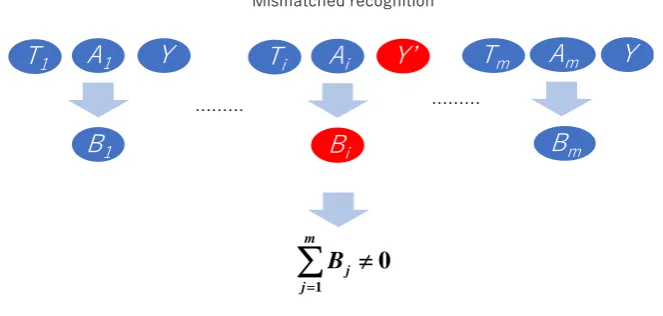
However, this protocol has the following problem. There is a possibility that Player i incorrectly receives a different information Y′ from Y as the project. This case is called a mismatched recognition. In fact, when the secrecy of the information Y is required, it might be distributed via secure communication channel priorly. This assumption is natural because it is usual to require the secrecy of the contents of the project. Hence, we need to be careful about a mismatched recognition. That is, we need to verify that each player makes the decision based on the correct informationY.
elements of Fq. In the following, we also assume that the variable Y ∈ Fdq de-scribing the project has been distributed to all the players priorly while there is a possibility of a mismatched recognition.
0LVPDWFKHGUHFRJQLWLRQ
7
$
<
%
7
L$
L<b
%
Lʞʞʞ ʞʞʞ
7
P$
P<
%
P1
0
mj j
B
=≠
¦
Fig. 1.Mismatched recognition.
Protocol 5 Multi-party Anonymous Authentication
STEP 1: [Voting] Player isends Bi ∈ Feq to the remaining players via public
chan-nel. If Player iagrees the project described byY, he/she choosesBi asTiY +Ai.
Otherwise, he/she choosesBisubject to the uniform distribution onFeq.
STEP 2: [Verification] Each player calculates ∑ni=1Bi. If it is zero, the project can
be considered to be approved.
5.2 Analysis with honest players
When all the players send TiY +Ai based on the same variable Y, we have
∑n i=1Bi=
∑n
i=1TiY +Ai= (
∑n
i=1Ti)Y + (
∑n
i=1Ai) = 0Y + 0 = 0 and all the players find that all of them approve the project written byY. Hence, for security analysis, we need the analysis on the case when at least one player disagrees the project and/or at least one player recognizes a different information fromY. For this aim, we have the following two theorems.
Theorem 4. When at least one player i′ disagrees the project, the probability of ∑ni=1Bi = 0isq−e.
Proof. SinceBi′ is subject to the uniform distribution onFeq, the probability of
∑n
Theorem 5. When all the players agree the project and at least there one player
i recognizes the information Yi that is different from the information Y1
recog-nized by Players1, the probability of∑ni=1Bi= 0 isq−e.
This theorem ensures that if the project is approved by this protocol, all the players confirm no mismatched recognition.
Proof. Assume that playersi1, . . . , ik recognize the informationYi1, . . . , Yikthat
is different from the information Y1 recognized by Players 1. Also assume that other players recognize the same information Y1 recognized by Players 1. We define the variableVij :=Yij −Y1forj= 1, . . . , k. Then, we have
n
∑
i=1
Bi= k
∑
j=1
TijVi,j. (1)
Since Vi,j ̸= 0, the variable TijVi,j is independently subject to the uniform
distribution onFe
q. Hence,
∑k
j=1TijVi,jis also subject to the uniform distribution
onFeq. Therefore, we obtain the desired statement. ⊓⊔
5.3 Analysis with malicious player
Now, we consider the case with a malicious player. When malicious Player
j makes rushing, Player i can realize the situation ∑ni=1Bi = 0 by sending −∑i̸=jBi unless all the player do not approve the same variable Y. Hence, when we employ Protocol 5, we need to trust all the players. To avoid such an attack, we proposed another protocol (Protocol 6), which trust Player 1.
Protocol 6 Secure Multi-party Anonymous Authentication
STEP 1: [Voting] Playerisends Bi ∈Feq to Player 1 via public channel. If Playeri
agree the project described byY, he/she choosesBiasTiY+Ai. Otherwise, he/she
choosesBisubject to the uniform distribution onFeq.
STEP 2: [Verification] Player 1 calculates∑ni=1Bi, whereB1 :=T1Y +A1. If it is
zero, the project can be considered to be approved.
STEP 3: [Notification] Player 1 sends the above result to other players.
Theorem 6. Malicious Playersl, . . . , msucceed the above attack with probabil-ityq−e.
Proof. To realize this situation,∑mi=lBi needs to be−
∑l−1
i=1TiYi+Ai, which is calculated as
− l−1
∑
i=1
TiYi+Ai=− l−1
∑
i=2
Ti(Yi−Y1)− l−1
∑
i=1
TiY1+Ai
=− l−1
∑
i=2
Ti(Yi−Y1) + m
∑
j=l
TjY1+Aj.
We define the set {i1, . . . , ik} := {i ∈ [2, l −1]|Yi ̸= Y1}. Then, Ti1(Yi1 −
Y1), . . . , Tik(Yik−Y1) are independently subject to the uniform distribution on
Fe
q. SinceAi is subject to the uniform distribution onFeq fori= 2, . . . , l−1,Bi is independent of TiYi. Hence, Players l, . . . , mcannot obtain any information
TiYifrom Bi for 2, . . . , l−1. Thus, letting
V := (B2, . . . , Bm−1, Tl, . . . , Tm, Al, . . . , Am, Y1, . . . , Yl−1),
we obtain
I(− l−1
∑
i=2
Ti(Yi−Y1) + m
∑
j=l
TjY1+Aj;V)
=I(− l−1
∑
i=2
Ti(Yi−Y1);V) = 0. (2)
Since−∑mi=2−1Ti(Yi−Y1) is subject to the uniform distribution, Playersl, . . . , m can make the situation∑ni=1Bi= 0 with probabilityq−e. ⊓⊔
6
How to Generate Module Zero-Sum Randomness
6.1 From secure agreed random numbers
6.2 Asymptotically approximated generation from information theoretical assumption
Secure modulo zero-sum randomness among m players can be generated from information theoretical assumption with asymptotically negligible error. A se-quence of random variables Xi,n ∈ Fcqn is called secure modulo zero-sum ran-domness with asymptotically negligible error when
D(PX1,n, . . . , Xm,n, PX˜1,n,...,X˜m,n)→0 (3)
whereDis the variational distance and ˜X1,n, . . . ,X˜m,nis a secure modulo zero-sum randomness among m players. Here, limn→∞cn
n is called the generation rate.
For example, secure modulo zero-sum randomness amongm players can be generated with asymptotically negligible error when the multiple access channel satisfies a certain condition and they can use the multiple access channelntimes. The detail construction will be given in [14]. Also, with asymptotically negligible error, it can be extracted from then-fold independent and identical distribution of a certain joint distribution ofmrandom variablesZ1, . . . , Zmonly with public communication when the joint distribution satisfies a certain condition [14].
7
Quantum Verification Protocol
In the classical case, we have no method to verify the distribution of the random-nessX1, . . . , Xm satisfies the condition of secure modulo zero-sum randomness amongmplayers. However, when we can use quantum system, we have such a de-sired method as follows. First, we generatempair of secure secret keys required in Section 6.1 by using quantum key distribution. Then, we apply the protocol given in Section 6.1. This method certainly generates secure modulo zero-sum randomness. However, since this method goes through the conventional quan-tum key distribution, this method is not a direct method to generate this kind of resource. Hence, we propose a direct verifiable construction by using the GHZ state as follows.
For this aim, we introduce the phase basis state. The phase basis{|z⟩p}z∈Fq
is defined as [12, Section 8.1.2]
|z⟩p:= 1 √q ∑
x∈Fq
ω−trxz|x⟩,
where|x⟩expresses the computational basis,ω:= exp2πi
p and try fory∈Fq is TrMy whereMy denotes the multiplication mapx7→yxwith the identificiation of the finite fieldFq with the vector spaceFtp.
Then, we define the phase GHZ state|GHZ⟩p := √1q
∑
x∈Fq|x, . . . , x⟩p on
the composite system ofmcopies of the quantum system spanned by{|x⟩}x∈Fq.
initial state is |GHZ⟩p, the outcome satisfies the conditions of secure modulo zero-sum randomness. If they have 2n1+n2 copies of the same stateρ, it can be verified as Protocol 7.
Protocol 7 Verified Generation of Secure Modulo Zero-Sum Randomness
STEP 1: [Phase basis check] They randomly choosen1 copies, and apply the mea-surement of the phase basis. If their outcomes are the same, the test is passed.
STEP 2: [Computational basis check] They randomly choose n1 copies, and apply the measurement of the computational basis. If the modulo sums of their outcomes are zero, the test is passed.
STEP 3: [Generation] They apply the measurement of the computational basis to the remainingn2copies. The outcomes are used asn2secure modulo zero-sum random-ness.
Theorem 7. Assume that α > 2n1
1+n2. If the test is passed, with significance level α, we can guarantee that the resultant state σ on each remaining system satisfies
Trσ|GHZ⟩p p⟨GHZ| ≥1− 1
α(2n1+ 1)
. (4)
Proof. Let P1 andP2 be the projections to the subspaces accepting the phase basis check and the computational basis check, respectively. We randomly choose one remaining system. Let A be the random permutation of P⊗n1
1 ⊗P⊗ n1
2 ⊗
(I− |GHZ⟩p p⟨GHZ|), which expresses the event that they accept the test and the state on the remaining system is orthogonal to the state|GHZ⟩p p⟨GHZ|. SinceP1≥ |GHZ⟩p p⟨GHZ|and P2≥ |GHZ⟩p p⟨GHZ|, the similar discussion to [19, Appendix] yields that ∥A∥ ≤ 2n1
1+1. Hence, any initial state satisfies
TrA≤ 1 2n1+1.
Now, we assume that the probability accepting the test is less thanα. Then, under the condition that they accept the test, the probability of the event or-thogonal to the state (|GHZ⟩p p⟨GHZ|)⊗n2 is upper bounded by α1 · 2n1
1+1.
Hence, we obtain the desired statement. ⊓⊔
[Note that the significance level is the maximum passing probability when malicious Bob sends incorrect states so that the resultant stateαdoes not satisfy Eq. (4).] The proof of the theorem is given below. From the theorem and the relation between the fidelity and trace norm [40][(6.106)], we can conclude the verifiability: if they passed the test, they can guarantee that
∥σ− |GHZ⟩p p⟨GHZ|∥1≤
1
√
α(2n1+ 1)
(5)
References
1. A. Adhikari, K. Morozov, S. Obana, P. S. Roy, K. Sakurai, and R. Xu: Efficient threshold secret sharing schemes secure against rushing cheaters, in Proc. the 9th International Conference on Information Theoretic Security (ICITS 2016), Lecture Notes in Computer Science 10015, pp.3–23, Springer (2016).
2. S. Agarwal, R. Cramer, and R. de Haan: Asymptotically optimal two-round per-fectly secure message transmission, Advances in Cryptology — CRYPTO 2006, Lecture Notes in Computer Science 4117, pp.394–408, Springer (2006).
3. M. Ben-Or, S. Goldwasser, and A. Wigderson: Complete theorem for non-cryptographic fault-tolerant distributed computation, in Proc. the 20th Annual Symposium on Theory of Computation (STOC’88), pp.1–10 (1988).
4. B. Chor and E. Kushilevitz: A communication-privacy tradeoff for modular ad-dition,Information Processing Letters, 45(4):205–210 (1993).
5. B. Chor and N. Shani: The privacy of dense symmetric functions,Computational Complexity, 5(1):43–59 (1995)
6. D. Dolev, C. Dwork, O. Waarts, and M. Yung: Perfectly secure message trans-mission,J. ACM40(1):17–47 (1993).
7. M. Franklin and R. N. Wright: Secure communication in minimal connectivity models,J. Cryptology13(1):9–30 (2000).
8. J. A. Garay and R. Ostrovsky: Almost-everywhere secure computation,Advances in Cryptology — EUROCRYPT 2008, Lecture Notes in Computer Science 4965, pp.307–323, Springer (2008).
9. R. M. Gray: Toeplitz and circulant matrices: A review, Foundations and Trends in Communications and Information Theory, Vol.2, No.3, pp.155–239 (2006). 10. O. Goldreich:Foundations of Cryptography, Volume 2: Basic Applications,
Cam-bridge University Press (2009).
11. O. Goldreich, S. Micali, and A. Wigderson: How to play any mental game or a complete theorem for protocols with honest majority, in Proc. the 19th Annual ACM Symposium on Theory of Computation (STOC’87), pp.218–229 (1987). 12. M. Hayashi:Group Representation for Quantum Theory, Springer (2017). 13. M. Hayashi and T. Koshiba: Universal construction of cheater-identifiable
se-cret sharing against rushing cheaters without honest majority, to appear inProc. 2018 IEEE Symposium on Information Theory (ISIT 2018). Also available in arXiv:1701.04470 (2017).
14. M. Hayashi, in preparation.
15. Y. Ishai, R. Ostrovsky, and H. Seyalioglu: Identifying cheaters without an hon-est majority, in Proc. the 9th Theory of Cryptography Conference (TCC 2012), Lecture Notes in Computer Science 7194, pp.21–38, Springer (2012).
16. H. Krawczyk: New hash functions for message authentication,EUROCRYPT’95, Lecture Notes in Computer Science 921, pp.301–310, Springer (1995).
17. T. Koshiba and S. Sawada: Public discussion must be back and forth in secure message transmission, inProc. the 13th International Conference on Information Security and Cryptology (ICISC 2010), Lecture Notes in Computer Science 6829, pp.325–337, Springer (2011).
18. K. Kurosawa and K. Suzuki: Truly efficient 2-round perfectly secure message transmission scheme, IEEE Transactions on Information Theory 55(11):5223– 5232 (2009).
20. U. M. Maurer: A unified and generalized treatment of authentication theory, in Proc. the 13th Annual Symposium on Theoretical Aspects of Computer Sci-ence (STACS’96), Lecture Notes in Computer Science 1046, pp.387–398 Springer (1996).
21. T. Rabin and M. Ben-Or: Verifiable secret sharing and multiparty protocols with honest majority, in Proc. the 21st Annual ACM Symposium on Theory of com-puting (STOC 1989), pp.73–85 (1989).
22. P. S. Roy, A. Adhikari, R. Xu, K. Morozov, and K. Sakurai: An efficientt-cheater identifiable secret sharing scheme with optimal cheater resiliency, Cryptology Eprint Archive 2014/628 (2014).
23. A. Shamir: How to share a secret,Communications of the ACM, 22(11):612–613 (1979).
24. H. Shi, S. Jiang, R. Safavi-Naini, and M. A. Tuhin: On optimal secure mes-sage transmission by public discussion,IEEE Transactions on Information Theory
57(1):572–585 (2011).
25. G. Spini and G. Z´emor: Perfectly secure message transmission in two rounds,
Proc. the 14th Theory of Cryptography Conference (TCC2016-B), Lecture Notes in Computer Science 9985, pp.286–304, Springer (2016).
26. R. Xu, K. Morozov, and T. Takagi: On cheater identifiable secret sharing schemes secure against rushing adversary, in Proc. the 8th International Workshop on Security (IWSEC 2013), Lecture Notes in Computer Science 8231, pp.258–271, Springer (2013).