Scalable Multi-party Computation for zk-SNARK Parameters in
the Random Beacon Model
Sean Bowe [email protected]
Ariel Gabizon [email protected]
Ian Miers [email protected]
May 3, 2019
Abstract
We present MMORPG, a built system for zero-knowledge succinct non-interactive arguments of knowledge zk-SNARK parameter generation. zk-SNARKs are compact, ecient, and publicly veri-able zero-knowedge proofs for arbitrary computation. They have emerged as a valuveri-able tool for veriveri-able computation, privacy preserving protocols, and blockchains. Currently practical schemes require a com-mon reference string (CRS) to be constructed in a one-time setup for each statement. Corruption of this process leads to forged proofs and for applications such as cryptocurrencies, potentially billions of dollars in theft. Ben-Sasson, Chiesa, Green, Tromer and Virza [9] devised a multi-party protocol to securely compute such a CRS, and an adaptation of this protocol was used to construct the CRS for the Zcash cryptocurrency [16]. The trustworthiness of these protocols is obstructed by the need for a precommitment phase which forces the selection of a very small number of participants in advance and requires them to secure their secret randomness throughout the duration of the protocol. Our primary contribution is a more scalable multi-party computation (MPC) protocol, secure in the random beacon model, which omits the precommitment phase. We show that security holds even if an adversary has limited inuence on the beacon. Next, we apply our main result to obtain a two-phase protocol for com-puting an extended version of the CRS of Groth's zk-SNARK [27]. We show that knowledge soundness is maintained in the generic group model when using this CRS. Finally, we implement and evaluate our system.
1 Introduction
Zero-knowledge succinct non-interactive arguments of knowledge (zk-SNARKs) [12, 15, 24, 2729, 32, 33, 35, 36] have seen increased usage both in the literature and the real world, ranging from publicly veriable computation, to deployed usage for anonymous payment systems such as Zerocash [11] and Zcash [3] and smart contract systems such as Ethereum.1
Despite the power of zk-SNARKs, challenges stand in the way of their widespread use. Most signicantly, these schemes are secure in the common reference string (CRS) model, which assumes a trusted setup of parameters used for constructing and verifying proofs. The generation of this CRS is a major challenge, given that corruption or subversion of the parameters means the proof systems are no longer sound i.e. proofs can be forged. The existence of trusted setup parties is often assumed in academic work; in practice these parties are hard to nd, even harder to get a large and diverse group to agree on, and potentially untrustworthy in the face of the tangible monetary gains that arise in real world deployment.
The current approach for deployed systems is for the CRS to be generated via a multi-party computation protocol [9,16] built from scratch for the task of computing a CRS. These protocols guarantee soundnessi.e. that proofs cannot be forged when at least one participant is honest, and guarantee zero-knowledge even if none of the participants are honest. [22] However, these protocols fundamentally cannot scale beyond a handful of participants, and can even be too expensive to perform for just one or two participants in some
settings. This is not an engineering and optimization issue. Fundamentally, it is a cryptographic issue: because of restrictions required to deal with adaptive attackers, participants in the current MPC schemes must commit to their share of the parameters up front and maintain availability and security throughout the entire duration of the protocoleven after the majority of their individual computation is completed. If a single participant abort, the entire protocol must restartand so care must be taken to exclude attackers who could trivially disrupt the generation process.
The net result of these cryptographic limitations is that the participants must be carefully preselected in advance, in extremely limited number, and they must remain online throughout the entire duration of the protocol. This not only increases the surface area of attacks, but also raises practical problems as participants are required to maintain custody of the hardware for the duration of the protocol. Even with only six participants, this process took 2 days [37].
While MPC moves the setting for zk-SNARKs away from trust me with a single trusted party, it arguably doesn't go far enough given the stakes: for example, corrupting the zk-SNARK CRS in Zcash could allow an attacker to counterfeit millions of dollars of the currency. In these circumstances, assuming one of a hundred or a thousand people is honest would be far more compelling then assuming one of six or ten. Even if thousands of participants were possible, the fact that they need to be selected before the protocol starts is both a logistic challenge and itself a trust issue: who picks the people and who decides when enough have been picked? For zk-SNARKs to be used in many of their most compelling applications, we need a protocol that can be practically ran in the real world, that scales to hundreds or thousands of participants, and does not require pre-organization or selection. This paper presents an ecient and implemented protocol which does exactly that.
The appeal of zk-SNARKs zk-SNARKs give publicly veriable constant size zero-knowledge proofs of correct computation. Proofs are extremely small (between 160 [27] and 288 [36] bytes depending on imple-mentation even for very large programs) and take less than10ms to verify.In contrast, the best approaches
that do not require trusted setup have proof sizes measured in the tens to hundreds of kilobytes [4] or even megabytes [10] and verication times on the order of hundreds of milliseconds to seconds [4,10]. This makes zk-SNARKs a uniquely powerful tool in settings where computations needs to be veried quickly many times and space is at a premium.
zk-SNARKs have a variety of uses ranging from traditional cryptographic applications including veri-able outsourced computation [36] and the construction of cryptographic primitives [26], to applications for blockchains, cryptocurrencies, and so called smart contracts. Forgery of proofs via a subverted setup pro-cess is problematic in any of these settings. But as we will see later, the risks of subversion are particularly high for blockchain applications.
zk-SNARKs for blockchains zk-SNARKs fulll the promise of prove once, verify everywhere for (nearly) free. This has garnered them considerable interest [3,14,19,31,38] for use in blockchains and related technol-ogy because each of the thousands of peers maintaining a blockchain must receive, validate, and permanently and publicly store every transaction, raising serious scalability and privacy issues. Not only can zk-SNARKs drastically improve the eciency and cost of maintaining the blockchain itself [14, 19], they can be used to build sophisticated systems on top of a blockchain [?,20,31] and to resolve the major privacy and conden-tiality issues associated with many blockchain based applications [3,20, 31].
Crowd-scale parameter generation for high-value applications The MPC protocol produces an honest CRS if at least one of the participants is honest. To ensure the CRS is honest, we want to include as many participants as possible. The need for this scales with the consequences of proof forgery and the incentives for subverting the CRS generation process. With millions or billions of dollars at stake in systems which assume most actors are adversarial, trusting one of a few people to be honest is not satisfying.
they will be incredibly lucrative. The value of forging proofs in a blockchain is of course itself speculative. But even the potential for billions of dollars of gains will both motivate attacks against the CRS generation process and stimulate skepticism as to the trustworthiness of the participants.
Moreover, systems worth billions of dollars currently use zk-SNARKs. Zcash, which uses zk-SNARKs for private transactions, has nearly $1 Billion worth of currency which could be stolen with forged proofs. Ethereum, with a market cap of roughly $40 Billion, just added much anticipated support for zk-SNARKs [38] in smart contracts. Moreover, Ethereum's current proposal for scaling uses succinct proofs [19] and a failure there would no doubt be very costly.2
Random Beacons Our protocol makes use of a random beacon. Although we do not detail the precise construction in this paper, we also cannot simply assume one exists or we would be no better o than assuming a CRS. A random beacon produces publicly available and veriable random values at xed intervals. Moreover, our protocol even allows for the adversary to tamper with a small number of bits of the beacon. The beacon itself can be a delayed hash function [18] (e.g. 240 iterations of SHA256 [1] ) evaluated on some high entropy and publicly available data. Possible sources of data include but are not limited to: the closing value of the stock market on a certain date, the output of a selected set of national lotteries, or the value of a block at a particular height in one or more blockchains. E.g. the hash of the 50,000th Bitcoin block (which as of this writing is some 22 days in the future).
Random Beacons vs. Random Oracles We stress for clarity, that the dierence between random beacons and the much more well-known random oracles, is that their values are not available until certain time slots. That means we can assume a given random beacon value is independent of values output by an adversary in previous time slots. (Or in the case of the adversary having inuence on the beacon, beacon values have lots of entropy conditioned on previous values output by the adversary.)
This is completely dierent from a random oracle value, that can have entropy zero conditioned on adversary messages (e.g. if the adversary simply queries and outputs that RO value).
1.1 Our results
In this paper, we design, implement, and evaluate a scalable open participation multiparty computation protocol for generating zk-SNARK parameters. We aim to make zk-SNARKs suitable for wide-scale usage by providing a new zk-SNARKs scheme and MPC system for CRS generation suitable for real world usage. We oer three contributions:
Player-exchangeable MPC Our primary contribution is a new kind of multi-party computation pro-tocol, a player-exchangeable MPC (px-MPC) and an ecient and implemented px-MPC protocol for CRS generation.3
A px-MPC is described by a sequence of messages players are supposed to send; however, importantly, there is no restriction on the identity of the sender of each message. In particular, although we will discuss multi-phase protocols where in each phase all players participate in a round-robin process, there is no need to assume the same players participate in dierent phases. Since there is no private state between messages, players may be swapped out or removed after every message.
Player exchangeability avoids the issues of pre-selection of participants, the need to select reliable partici-pants who do not abort, and the need for participartici-pants to maintain custody of sensitive hardware for extended periods of time. The only requirement is that at least one of the participants in each phase honestly follows the protocol and does not collude with other players. As a result, the protocol can scale to a practically
2The authors explore the use of a variety of non-interactive compact proofs precisely because of the setup issues with zk-SNARKs
unbounded4 number of participants and do so dynamically during protocol execution. I.e. the protocol is online and open.
The key to this new approach is the use of random beacons to support a proof of security which places fewer restrictions on the protocol. We prove security even if an adversary has limited inuence on this beacon.
zk-SNARKs with an ecient and amortized px-MPC CRS generation process To realize this scheme in practice, we must pick a specic zk-SNARK and provide a protocol for generating its CRS. Groth's zk-SNARK [27] is the current state of the art protocol, using only 3 group elements for the proof and 3 pairings for verication. We prove the security of Groth's zk-SNARK with an extended CRS which allows for a two phase px-MPC protocol. More signicantly, the rst phase is agnostic to the statement5, and so can be performed once for all statements up to some large (but bounded) size. The second phase is statement-specic, but signicantly cheaper and requires each player to a far smaller amount of work. This allows the bulk of the cost of setup to amortized over many circuits
MMORPG, a built system for zk-SNARK parameter generation and BLS12-381, a new secure curve for zk-SNARKs As a nal contribution, we oer MMORPG, a built system for massively multi-party open reusable parameter generation for our modied version of of Groth's zk-SNARK. We evaluate its performance and show that for a circuit size up to 221 multiplication gates, participants in the rst round
must receive a 1.2GB le, perform a computation that lasts about 13 minutes on a desktop machine, and produce a 600MB le. The second round is statement-specic, but signicantly cheaper. This allows the bulk of the cost of setup to amortized over many circuits.
In order to implement our protocol we must pick an elliptic curve to use. Existing zk-SNARK imple-mentations, such as those used in Zcash and Ethereum, use a pairing-friendly elliptic curve designed to be ecient for zk-SNARKs [13] which originally targeted the 128-bit security level. However, recent op-timizations to the Number Field Sieve algorithm [30] have degraded this security, and so we adopt a new pairing-friendly elliptic curve called BLS12-381 which targets 128-bit security with minimal performance impact. We provide a stable implementation of this new elliptic curve, written in Rust, with competitive performance, well-dened serialization, and cross-platform support.
1.2 Outline
This paper is structured as follows. In section 2 we give an overview of our approach. In section 3 we give cryptographic preliminaries, notation, and supporting lemmas. In section 4 we detail our MPC protocol. In section 5 we detail a proof of security. In section 6 we instantiate our protocol using Groth's zk-SNARK|. Finally, in section 9 we evaluate our implementation.
2 Overview of our approach
Our goal is to build a practical protocol betweennplayers and an untrusted coordinator that:
• Gives a zk-SNARK CRS where proofs cannot be forged if at least one of thenplayers is honest.
• Places no limits onn, the number of participants
• Does not require players to be selected in advance
• Does not require players to pre-commit to their random coins and therefore keep them secure
through-out the protocol.
4Formally, as seen in Theorem 5.1, the number of participants can be any polynomial in the security parameterλ, when assuming ecient attacks on our curve have success probabilitynegl(λ).
The key to achieving these goals is removing the pre-commitment phase used in previous protocols [9,16]. To do this, we design our protocol around the use of a random beacon, a source of public randomness that is not available before a xed time. To illustrate our approach, we now show how to construct a protocol for a toy CRS and detail the challenges that arise, why a commitment was necessary for previous work, and how we remove it.
A toy CRS For exposition, we consider a CRS that consists only of the elements s·g1, andαP(s)·g1
where g1 is a generator of a groupG1 of orderp; sand αare uniform elements inF∗p; andP is the degree
one polynomialP(x) := 3x+ 5overFp. To illustrate the main ideas, we only analyze a two party case where
the rst party, Alice, is honest and the second, Bob, is malicious. At the end of the protocol, neither Alice nor Bob should knowsor α.
A 2 phase protocol The protocol consists of 2 round-robin phases. In phase one, each participant communicates with the other to compute s·g1. In between phase 1 and 2, the untrusted coordinator
computesP(s)·g1. Finally, in phase 2, a (potentially distinct) set of participants compute αP(s)·g1. In
each phase, participants send one message and receive one message.
Phase 1 In phase one, Alice and Bob need to computes·g1 for a uniforms∈F∗p unknown to either of
them.
A natural protocol proceeds as follows: Alice chooses a uniform s1 ∈ F∗p, and sends M = s1 ·g1 to
Bob. Now, Bob is requested to multiply M by a uniform s2 ∈ F∗p. The protocol output is dened as
s2·M =s1s2·g1.
The problem is that as Bob is malicious he can adaptively choose a value s2 ∈ F∗p based on Alice's
message, to manipulate the nal output values1s2·g1. For this reason, in [9,16] a precommitment phase is
added, where both Alice and Bob commit to their values s1, s2. In the next phase, Alice and Bob will run
the natural protocol, but add a proof that they are using the valuess1, s2they committed to (the proofs will
not expose the valuess1, s2). This prevents Bob from choosings2 adaptively. However, the precommitment
phase has the above mentioned drawbacks:
1. Most obviously, it adds a round to the protocol.
2. The participating players need to be dened in advance.
3. The players need to choose their secret elements in advance and protect them for a while (at least until broadcasting their messages in all subsequent phases).
The main observation in this paper, is that assuming a public source of randomness that no player has control over, i.e. a random beacon, we can omit the precommitment phase and still prevent adaptive attacks. Moreover, we can do so even when the attacker has some control over the random beacon.
With the random beacon, a simplied version of our protocol, when again, the rst party is honest, and second malicious, will proceed as follows.
1. Alice chooses randoms1∈F∗p and broadcastsM =s1·g1.
2. Bob chooses (somehow) a values2∈F∗p and broadcastsM0 =s1s2·g1.
3. The coordinator invokes the random beacon is to obtain a uniform s3 ∈F∗p, and the protocol output
is dened ass3·M0=s1s2s3·g1.
Note that the protocol output iss·g1for uniforms∈F∗pregardless of Bob's choice ofs2. You may ask, why
not skip both players and just outputs3·g1withs3∈F∗p being the beacon's output? The point is that it is
important no player, or more generally, no group of colluding players that precludes at least one player, will know s. This means we cannot use the public random beacon to select the secret s, we can only use it to
randomize the choice ofs. You might also ask why we need not trust the coordinator. The answer is simple,
Phase 2 Note that, after Phase 1,P(s)·g1is a linear combination
P(s)·g1= 3·(s·g1) + 5·g1
of the public valuess·g1, g1. Thus, the cooridnator can eciently computeP(s)·g1.
Phase 2 can now proceed analogously to phase 1: Alice chooses a random α1 ∈ F∗p and broadcasts
M = α1P(s)·g1. Bob and the coordinator proceed as they did in Phase 1. We end up with a value
αP(s)·g1; whereα2 is chosen by Bob andα3is chosen by the random beacon.
Finally, we stress that in the proof it is enough to assume the random beacon has low co-entropy; thus the protocol works in the case where the adversary has limited inuence on the beacon.
We refer to Theorem 5.1 for precise details.
3 Preliminaries
3.1 Notation
We will be working over bilinear groups G1, G2, and GT each of prime order p, together with respective
generatorsg1,g2andgT. These groups are equipped with a non-degenerate bilinear pairinge:G1×G2→GT,
with e(g1, g2) = gT. We write G1 and G2 additively, and GT multiplicatively. For a ∈ Fp, we denote
[a]1:=a·g1,[a]2 :=a·g2. We use the notationG:=G1×G2 and g:= (g1, g2). Given an element h∈G,
we denote by h1(h2) theG1(G2)element of h. We denote by G∗1,G∗2 the non-zero elements of G1,G2 and
denoteG∗:=G∗1×G∗
2.
We assume that we have a generatorGthat takes a parameterλand returns the three groups above having
prime orderpat least super polynomial in λ, together with uniformly chosen generatorsg1 ∈G∗1, g2 ∈G∗2.
We assume group operations inG1 andG2, and the mapecan be computed in timepoly(λ). When we say
an event has probability γ, when mean it has probability γ over the randomness of G, in addition to any
other randomness explicitly present in the description of the event.
When we say a party A is ecient, we mean it is a non-uniform sequence of circuits, indexed byλ, of
size poly(λ). When we say A is an ecient oracle circuit we mean it is ecient in the above sense, and
during its execution may makepoly(λ) queries to an oracleR, taking as input strings of arbitrary length
and outputting elements ofG∗2.
We assume such parties Aall have access to the same oracle Rduring the protocol, whose outputs are
uniform independent elements ofG∗2.
For a∈Fp and C∈G, we denote bya·C the coordinate-wise scalar multiplication ofC bya; that is,
a·C := (a·C1, a·C2)∈G. We also allow coordinate-wise operations of vectors of the same length. For
example, fora∈Ftp andx∈Gt1, a·x:= (a1·x1, . . . , at·xt).
We think of acc and rej as true and false. Hence when we say check that f(x) for a function f and
inputx, we mean check thatf(x) =acc.
We use the acronym e.w.p. to mean except with probability; i.e., e.w.p. γ means with probability at
least1−γ.
We assume a synchronous setting where we have positive integer slots of time; we assert that in slotJ,
parties know what messages were sent (and by whom) in slots1, . . . , J−1.
3.2 Random beacons
We assume we have at our disposal a random beacon RBthat outputs elements inF∗p. We think ofRBas a function receiving a time slotJ, and positive integerk; and outputtingkelementsa1, . . . , ak ∈F∗p. It will
be convenient to assumeRBis dened only for a subset of valuesJ as its rst input. We sayRBis resistant toA, if for any positive integersJ andkfor whichRBis dened: for any random variableXgenerated byA
before timeJ - i.e. using calls toRB(J0, k0)forJ‘< J, and calls to the oracleRin caseAis an oracle circuit
and messages H of honest players following a protocol Ais designed to participate in; the distribution of
We now generalize this denition to model adversaries that have limited inuence on the value of the beacon. We sayRBis u-co-resistant to A, if for any positive integers J andk: for any random variableX
generated by Abefore timeJ as described above, the distribution of RB(J, k)conditioned on any xing of (randA, X)has co-min-entropy at mostu(i.e. min-entropy at leastk·log|F∗p| −u).
Our protocols are always of a round-robin nature, where playerPi sends a single message in each phase
following player Pi−1, and RB is invoked at the end of each phase at the time slot after PN's message.
Thus, we implicitly assume the protocol denes that the time slot for Pi to send his phase ` message is
J = (`−1)·(N+ 1) +i. In this context, it will be convenient to assumeRB(J, k)is dened if and only ifJ
is a multiple ofN+ 1.
3.3 Input domains
We assume implicitly in all method descriptions that if an input is not in the prescribed range the method outputs rej. This means that in an implementation of the protocol a method expecting input in G∗2 (for example) checks that the received input is indeed in this range and outputrejotherwise.
3.4 Player-exchangeable protocols and adaptive adversaries
We assume there areN players P1, . . . , PN in each phase of the protocol. Though we use this notation for
each phase, we do not assume it is the same player Pi in each phase, nor that the identity of the player,
or equivalently, their behavior in the protocol, was determined before the time slot where they send their message. In particular, it is possiblePi simply aborts adding nothing to the transcript.
When we discuss an adversary A controlling K players in the protocol, for1 ≤K≤N, we mean that
A can adaptively choose a dierent subset of K players to control in each phase. That is, in time slot
(`−1)·(N+ 1) +ithey can choose whether to control Pi in phase` if they have not chosenK players so
far in phase`.
We denote bytranscript`,ithe transcript of the protocol up to the point where player isent his message
in phase`.
3.5 Preliminary claims
The following claim is not hard to show.
Claim 3.1. LetA, B be two random variables such that for any xing aof A,B|A=ahas co-min-entropy
at mostu. LetP be a predicate with range {acc,rej}. Let B0 be a random variable independent ofA that is
uniform on the range of B. Then
Pr(P(A, B0) =acc)≥2−u·Pr(P(A, B) =acc).
3.6 Auxiliary methods
We dene some methods to check whether certain ratios between elements hold, using the pairing function
e. The following denition and claim are from [16].
Claim 3.2. Given A, B ∈G∗1 and C, D ∈G2∗, SameRatio((A, B),(C, D)) =acc if and only if there exists
s∈F∗
Algorithm 1 Determine ifx∈F∗
p exists such thatB =A·x, andD=C·x.
Require: A, B∈G1 andC, D∈G2 and none ofA, B, C, Dare the identity. 1: function SameRatio((A, B),(C, D))
2: if e(A, D) =e(B, C)then
3: returnacc
4: else
5: returnrej
6: end if
7: end function
Algorithm 2 Check whether the ratio betweenAandB is thes∈F∗
p that is encoded inC
Require: A, B∈G21 orA, B∈G 2. C∈
G∗2 orC∈(G∗2) 2. 1: function Consistent(A, B, C)
2: if C∈(G∗2)2then
3: r←SameRatio((A1, B1),(C1, C2))
4: else
5: r←SameRatio((A1, B1),(g2, C)) 6: end if
7: if A, B ∈G1 then
8: returnr
9: else
10: returnrANDSameRatio((A1, B1),(A2, B2)) 11: end if
12: end function
We later use the suggestive notationconsistent(A−B;C)for the above function with inputsA, B, C. We
further overload the notationconsistent(a−b;c)in the casec∈G, to meanconsistent(a−b;c2).
3.7 Proofs of Knowledge
We will use a discrete log proof of knowledge scheme based on the Knowledge of Exponent assumption. Denition 3.3 (Knowledge of Exponent Assumption (KEA)). For any ecientA there exists an ecient
deterministic χ such that the following holds. Consider the following experiment. A is given an arbitrary
auxiliary information string z, together with a uniformly chosenr∈G∗2, that is independent ofz. He then
generates x∈G∗1 andy ∈G∗2. χ, given the same inputsr andz and the internal randomness of A, outputs
α∈F∗
p. The probability that both
1. A succeeded, i.e.,SameRatio((g1, x),(r, y)),
2. χ failed, i.e., x6= [α]1, isnegl(λ).
Remark 3.4. Let's see that the assumption is the standard KEA assumption, besides the partition of the elements to G1 and G2: Suppose that r = [γ]2 and x = [α]1. Then SameRatio((g1, x),(r, y)) implies y =
[α·γ]2. Thus(x, y)is a pair of `ratio'γ, generated from the given pair (g1, r) also of ratioγ; and the KEA
states to create such a pair we must know the ratio with the original pair, namely α.
Algorithm 3 Construct a proof of knowledge ofα
Require: α∈F∗p
1: function POK(α, stringv)
2: r← R([α]1, v)∈G∗2 3: return ([α]1, α·r)
4: end function
Algorithm 4 Verify a proof of knowledge ofα
Require: a∈G∗1,b∈G∗2
1: function CheckPOK(a, stringv,b)
2: r← R(a, v)∈G∗2
3: returnSameRatio((g1, a),(r, b)) 4: end function
Claim 3.5. Under the KEA assumption, for any ecient oracle circuit A, there exists an ecientχ such
that the following holds. Fix any string z that was generated without queries to R. Given z and random
oracle replies r1, . . . , r`, Aproduces a∈ G1, y ∈G2 and a string v; andχ, given the same inputs together
with the internal randomess used by A, producesα∈F∗p. The probability that both
1. A succeeds, i.e.,CheckPOK(a, v, y) =acc, 2. χ failed, i.e., a6= [α]1,
isnegl(λ).
Proof. FixAandzsuch that givenzand oracle access toR,Aproduces a paira∈G1, y∈G2and stringv.
Let`= poly(λ)be the number of oracle callsAmakes toR. We can think ofAas a deterministic function of
z, the sequence r=r1, . . . , r`of replies fromR, and its internal randomnessrandA. Fori∈[`], we construct
Ai, that givenz andr∈G2 does the following. It invokes Aon(z,r,randA), whererj is chosen uniformly
forj 6=i, andri =r; andrandAis chosen uniformly. Let(a, v, y) :=A(z,r,randA)and letq1, . . . , q` be its
sequence of queries to R. Let Di be the set of (r,randA)such that qi= (a, v)andiis the rst such index.
If (r,randA)∈/ Di, Ai aborts. Otherwise,Ai outputs(a, y). By the KEA, there exists an ecientχi such
that the probability over uniform r,randAthat both 1. SameRatio((g1, a),(r, y)),
2. χi givenz,r,randA didn't outputαsuch thata= [α]1,
is negl(λ). We can think ofAi as a deterministic function Ai(z,r,randA), that takes ri as its input r and
r1, . . . , ri−1, ri+1, . . . , r` as its randomness for answering the calls toR forj 6=i. We can think of χi as a
functionχi(z,r,randA)in the same way.
Now we construct an ecient χ as follows. χ determines the sequence q1, . . . , q` of queries to Rmade
by A(z,r,randA) and its output (a, v, y). Suppose that (r,randA) ∈ Di for some i ∈ [`], then χ returns
α:=χi(z,r,randA); otherwiseχ aborts. Now suppose that(r,randA)∈Di and Abeatsχ. That is,
1. CheckPOK(a, v, y) =acc.
2. χ(z, v,r,randA) =αwhere a6= [α]1.
We haveR(a, z) =ri, andχi(z,r,randA) =χ(z,r,randA). Hence, 1. SameRatio((g1, ri),(a, y)).
But this can only happen for anegl(λ)fraction of(r,randA). Also, if(r,randA)∈/ Di for anyi∈[`], the
value ofR(a, v)is yet unknown and uniformly distributed and thus the probability thatCheckPOK(a, v, y) isnegl(λ).
A union bound overi∈[`]now gives the claim.
4 Multi-party Computation for Parameter Generation
We now describe our protocol.4.1 The circuit structure
We assume we have an arithmetic circuit C overFp with the following structure, which while it may seem
ad-hoc, allows us to simplify the protocol design of [9] and is satised for a circuit computing the extended CRS of [27] described in Section 6.
The circuit consists of alternate multiply/divide layersC1, . . . , Cd, and linear combination layersL1, . . . , Ld.
We calldthe depth of the circuit.6 (A layer can have depth larger than one in the regular sense.) The circuit
inputs x are partitioned into disjoint sets x1, . . . ,xd corresponding to the layers. Specically, we think of x` as the inputs of the multiply/divide layerC`, and at times use the notationx∈C` to meanx∈x`. We
think ofxand x` as enumerated sets, and use them as input vectors to functions. A multiply/divide layer
C satises the following:
1. All gate outputs in Care outputs of the circuit.
2. C=C`has an input gate for each of its inputsx∈x`. When another gate wishes to use one of these
inputs, it uses a wire from the corresponding input gate (i.e. there are no direct input wires). In particular, every input is part of the circuit output.
3. All gates in C, besides the input gates, are division and mutiplication gates of fan-in two. The left
input is a gate fromCor previous layers; and the right input is an input gate belonging toC.7 In case
of a division gate, the right input is always the denominator.
A linear combination layerLconsists of linear combination gates of unbounded fan in, whose inputs are
gates fromLor previous layers.
4.2 The protocol coordinator
In addition to messages of the players, the protocol description includes messages that are to be sent by the protocol coordinator. These messages are a deterministic function of the protocol description and the transcript up to that point. In practice, it can be helpful to have a computationally strong party ll this role. However, there is no need to trust this party, and anyone can later verify that the protocol coordinator's messages in the protocol transcript are correct. In particular, the role of the protocol verier will include, in addition to the steps explicitly described, to compute the protocol coordinator's messages independently and check they are correct.
4.3 The MPC
The goal of the protocol is to compute C(x)·gfor uniformly chosen x ∈(F∗p)t, where t is the number of
C's inputs. More specically, we will havex=x1· · ·xN·x0 (recall this product is dened coordinate-wise),
wherexi∈(F∗p)tis the input ofPi, andx' is a random beacon output.
6This notion is similar toS-depth in [9], though we have not determined the precise relation.
7In fact, we can allow the right input to be any gate that is `purely' fromC; meaning that the directed tree of gates leading to the right input only contains gates fromC. But for the Groth circuit [27] which is our main usecase, we can assume the
Denote the layers of C by C1, L1, . . . , Cd, Ld. The protocol consists of d phases corresponding to the
layers.
4.4 The phase structure
We x a layer ` ∈ [1..d] and denote C = C`, L =L`. We assume that for all gates g in previous layers
-C1, L1, . . . , C`−1, L`−1, we have already computed an output value[g]∈G.
Note that the output of every gate g ∈C, is a Laurent monomial (i.e. ratio of two monomials) inC's
inputs, possibly multiplied by an output of some gateg' from a previous layer. Denote this monomial Mg,
and the output from the previous layer bygsrc; if no such output exists letgsrc:=g.
1. Forj∈[N], Player j does the following.
(a) For each inputxused in C, output[xj]1, andyx,j :=POK(xj, v), wherev=transcript`,j−1is the
protcol transcript before the current player. (b) For each gateg∈C:
• Ifj= 1, output[g]1:=Mg(x`1)·gsrc.
• Otherwise, whenj >1, output [g]j:=Mg(x`j)·[g]
j−1.
2. Let J −1 be the time slot on which PN was supposed to broadcast in this phase. The protocol
coordinator computes and outputsx0`:=RB(J, t
`), and [g] :=Mg(x0`)·[g]N for each g∈C.
3. Finally, the protocol coordinator computes and outputs, in the same time slot, the values [g] for all gates gin the linear combination layerL=L`.
Verication:
For eachj ∈N, the protocol verier does the following.
1. For each input x∈C, letrx,j=R([xj]1,transcript`,j−1)check that
CheckPOK([xj]1,transcript`,j−1, yx,j); andconsistent([x]
j−1
−[x]j; (rx,j, yx,j)).
2. LetgLandgR be the inputs ofg. 3. IfgL∈C then
• Ifg is a multiplication gate check thatconsistent([gL]j−[g]j; [gR]j)
• Ifg is a division gate check thatconsistent([g]j−[gL]j; [gR]j) 4. IfgL is from a previous layer, then
• Ifg is a multiplication gate check thatconsistent([gL]−[g]
j
; [gR]
j
)
• Ifg is a division gate check thatconsistent([g]j−[gL] ; [gR]
j
)
5 Security Proof
We denote by CS a random variable equal to the encoded output of the circuit C with uniformly chosen
input. That is,CS:= [C(s)]for uniforms∈(F∗p)t.
random variables that are a function of A's randomness randA, the honest player's inputs - which consist of uniformly distributed independent elements ofF∗p, the random oracleR's outputs - which are uniformly
distributed elements of G2; and the random beacon's outputs randbeacon (which are elements of F∗p, over
whichAmay have some limited inuence).
For a predicateP with range{acc,rej}, we dene
advA,P := Pr(P(CA,z) =acc).
Note that advA,P depends on RB and the amount of inuence Ahas on RB. We think ofRB as xed
and thus don't use it as an extra parameter.
Theorem 5.1. Fix any ecient oracle circuitAandu >0. Fix a number of playersN withN(λ) = poly(λ). There exists an ecientB such that ifRBisu-co-resistant toA, then for every predicateP
Pr(P(CS,B(CS)) =acc)≥2−ud·advA,P −negl(λ).
Suppose P is a predicate that runs a zk-SNARK verier with some xed public input, using its rst
input as the zk-SNARK parameters, and the second as the proof; take a constantdandu=O(logλ). The theorem implies that ifAcannot construct a correct proof with non-negligible probability for independently
generated parameters, it cannot do so for parameters generated in the protocol in which it participated. Proof. Denote byH the set of inputs of the honest player in each phase. Denote byrandbeacon the replies of the random beacon to the protocol coordinator at the end of each phase. Denote byrandoracle the replies of the random oracle to the honest player (when computing POK(x, z) for x ∈ H) and to A's queries.
The circuit output CA and the string z A outputs after the protocol can be viewed as a function of x = (randA, H,randoracle,randbeacon). Call this function F; i.e. F(x) = (CA(x),z(x)). Let X be the set of suchx's. We have d calls to RB- one at the end of each phase corresponding to the string randbeacon= randbeacon1, . . . ,randbeacond. AsRBis u-co-resistant to A, we know that during the protocol randbeacon` has
co-min-entropy at mostu conditioned on any xing ofrandA, H,randoracle,randbeacon1, . . . ,randbeacon`−1. In
particular,
advA,P = Pr(P(CA(A, B),z(A, B)) =acc).
for a uniformly distributedAon the possible values of(randA, H,randoracle), and a random variableB having co-min-entropy at mostudconditioned on any xing of A, describing the value ofrandbeacon. It now follows from Claim 3.1 that
Prx←X(P(CA(x),z(x)) =acc)≥2−ud·advA,P.
(wherex← X refers to a uniform choice ofx.)
Given A we constructB with the following property. B receives[C(s)]which is an output value of the random variableCS. Given[C(s)]it produces an output z(x), forxsuch that
1. xis uniform inX (over the randomness ofs∈(F∗p)tand the randomness ofB).
2. The values xfor whichBdoes not produce an outputz(x)withCA(x) = [C(s)]have densitynegl(λ). It follows that
Pr(P(CS,B(CS)) =acc)≥
Prx←X(P(CA(x), z(x)) =acc)−negl(λ)≥ 2−ud·advA,P −negl(λ).
We have[C(s)] ={[g(s)]}g∈M
C, whereMCis the set of all gates in all multiply/divide layers ofC. Bruns
the protocol with Aas follows. We think of B as running an internal oracle circuitB∗ that makes queries toR. WhenB∗ makes a new query toR,B answers uniformly in
G∗2, and otherwise it answers consistently
with the previous answer. If B∗ aborts in the description below, B outputs z(x0) for some xed arbitrary stringx0.
B∗ in turn runsAas follows.
1. B∗intializes an empty tableT of exceptions to responses ofR.
2. WheneverAmakes a queryqtoR,B∗checks if the replyR(q)is present inT; if so it answers according to that, otherwise according toR. It answers queries toRBas specied below.
3. For each`∈[1..d], it emulates the`'th phase as follows.
(a) Let j be the index of the honest player in phase `.8 Let C := C`. Recall thatx` denotes the
inputs belonging toC. B∗begins by executing the phase up to playerP
j−1by invokingAon the
transcript from previous phases. For each 1≤j0 < j such thatP0
j aborted or wrote an invalid message that the protocol verier
rejected, B sets x`j0 = (1, . . . ,1) ∈ (F∗p)t`. Otherwise, for eachx∈ x`j0, Pj0 has output [x]1 and y ∈G2 withCheckPOK([x]1,transcript`,j0−1, y). Letχ be the extractor obtained from Claim 3.5
when taking thereAto be a variant ofB∗that uses the same random string and runs identically to
B∗but stops when reaching this point and outputs[x]1,transcript`,j−1, y; and taking z= [C(s)].
B∗computesx∗=χ(z,r,rand
B∗)where r is the sequence of replies to B∗from Rup to the point
of outputting [x]1, y. If χ's output x∗ is not equal to x, B∗ aborts. (This can be checked by checking if[x∗]1= [x]1.)
(b) IfB∗has not aborted it has obtainedx`
1, . . . ,x`j−1. B∗now chooses uniformb∈(F∗p)t`, and denes
x`j := bs
`
x`
1· · ·x`j−1
.
Note that asB∗doesn't knowsit can't computex`
j. However, it has
s`as part of
[C(s)], where
s` is the restriction ofsto the inputsx` ofC. Thus it can compute
x`j
= b·
s`
x`
1· · ·x`j−1
Note thatx`1· · ·x`j =bs`. So, for eachg∈C,B∗can compute and broadcast[g]j
=Mg(x`1· · ·x ` j)·
gsrc=Mg(b)Mg(s`)·gsrc=Mg(b)·[g(s)].Where ([g(s)]is given as part of[C(s)].) Thus,B∗ can correctly play the role of Pj with this value ofx`j in Step 1b of Section 4.4 and produces a valid
message.
(c) What is left is generating POK([x]1,transcript`,j−1) for x ∈ x`j as in step 1 of Section 4.4. If
R([x]1,transcript`,j−1)has been queried byAit aborts. Otherwise,B∗chooses randomr∈F∗pand
adds the query(([x]1,transcript`,j−1),[r]2)to the exceptions tableT. It outputsy:=r·[x]2. Note that if we hadR([x]1,transcript`,j−1) = [r]2)then we would haveCheckPOK([x]1,transcript`,j−1, y); so fromA's point of view this is a correct message givenH andrandoracle.
(d) NowB∗ usesAto run the parts ofP
j+1, . . . , PN in phase `. Again, for any j+ 1≤j0≤N such
that Pj0 did not output a valid message,x`j0 is set to the vector (1, . . . ,1).
8Note thatjmay only be determined byAafter the message ofP
(e) Similary to before, for anyj+ 1≤j0 ≤N such that Pj0 did broadcast a valid message, for each x ∈ x`j0 Pj0 has output [x]1 and y ∈ G2 with CheckPOK([x]1,transcript`,j0−1, y). Let χ be the
extractor obtained from Claim 3.5 when taking thereAto be a variant ofB∗that runs up to this point and outputs [x]1, y; and takingz = [C(s)]. B∗ computesx∗ =χ(z,r,randA) =xwhere r is the sequence of replies to B∗ fromRup to the point of outputting[x]
1, y. Ifχ's output is not
equal tox, Baborts.
(f) IfB∗ has not aborted it has obtainedx`
j+1, . . . ,x`N. It denesx0`:= 1 b·x`
j+1···x`N; and outputs
x0`
as the beacon outputRB(J, t`). Note that if we have reached this point without aborting we have
x`1· · ·x`N ·x0 `=s`.
4. FinallyB∗ outputsA's outputz at the end of the protocol.
We proceed to prove the rst property - we need to show that the elements (randA,H,randbeacon,randoracle) used in the protocol are uniform and independent of each other.
• randA-B∗ runsAwith a uniform choice of its random coins, sorandAis uniformly distributed.
• randoracle-Bchoses the outputs ofRuniformly and independent of any other event. The other elements
of randoracle are the elements [r]2 chosen in step 3c which are uniform inG∗2 and independent of any
other variable here.
• H- the honest inputx`
j of each layerC` is chosen as b·s `
a whereais the product of inputs in the same
layer by the players controlled by Aparticipating before the honest player. bands` are both uniform
in (F∗p)t`; and independent from each other, aand the same variables from other layers. Hence H is
uniform and independent from previous variables.
• randbeacon- the part of randbeacon from layerC=C` is of the form a1·b, wherea contains inputs of the
players controlled by Afollowing the honest player. The only other place b appears in is inx`j. But
even xingx`j leavesb, and hence the part ofrandbeaconfrom phase`, uniform.
To prove the second property we note we note that the valuesxfor which the protocol output as described will not be[C(s)]are those that cause an abort in steps 3a,3e or 3c. An abort in steps 3a,3e happens for a negl(λ)fraction ofx∈ X according to Claim 3.5; aborting in step 3c happens only when Achose in advance
to queryRin a later uniformly chosen input in a domain of size at least|G∗2|, and thus happens only for a
negl(λ)fraction ofx∈ X.
6 Reducing the Depth of Groth's CRS
In this section we assume familiarity with Quadratic Artihmetic Programs [23] and the work of Groth [27]. As in [27] we rst describe the Non-Interactive Linear Proof (NILP) from which the zk-SNARK is built.
The extended Groth CRS: Let{ui, vi, wi}i∈[0..m]∪ {t}be the polynomials of a degreenQAP overFp,
where tis the degreen target polynomial of the QAP and the other polynomials have degree smaller than n. Suppose that1, . . . , ` < m are the indices of the public input.
Forα, β, δ, x∈F∗p,Groth(α, β, δ, x)is dened as the set of elements:
β, δ,
xi i
∈[0..2n−2],
αxi i
∈[0..n−1],
βxi i
∈[1..n−1],
xi·t(x)/δ i∈[0..n−2],
βu
i(x) +αvi(x) +wi(x)
δ
i∈[`+1..m]
The additional elements, compared to [27] are
xi i∈[n..2n−2],αxi i∈[1..n−1],βxi i∈[1..n−1]. On the
other hand the elements
βui(x) +αvi(x) +wi(x)
γ
i∈[0..`]
, γ
that appear in the CRS of [27] have disappeared here; they were needed there to enable the verifer to compute
` X
i=0
ai(βui(x) +αvi(x) +wi(x));
which can be computed as a linear combination of above CRS with our added elements.
We claim that Groth can be computed by a depth two circuit according to the denition of depth in
Section 4.1:
• C1: The layer inputs arex1={x, α, β}. The layer computes
xi i∈[0..2n−2],αxi i∈[0..n−1],βxi i∈[0..n−1],
which are all products of inputs inx1.
• L1: We compute
xi·t(x) i∈[0..n−2] that are linear combinations ofxi i∈[0..2n−2] sincet has degree n. We also compute{βui(x) +αvi(x) +wi(x)}i∈[0..m], which are linear combinations of elements from
the rst layer.
• C2: The layer input isx2={δ}. Computeδ, nβu
i(x)+αvi(x)+wi(x) δ
o
i∈[`+1..m],
xit(x)/δ
i∈[0..n−2].
Groth prover and verier: Fix public input a1, . . . , a`. The prover chooses random r, s ∈ Fp and
computes from the CRS and her witnessa`+1, . . . , am; the elements
A=α+
m X
i=0
aiui(x) +rδ, B=β+ m X
i=0
bivi(x) +sδ
C=
Pm
i=`+1ai(βui(x)+αvi(x)+wi(x))+h(x)t(x)
δ +As+Br−rsδ.
The verier, givenA, B, C, checks that:
A·B =α·β+
` X
i=0
ai(βui(x) +αvi(x) +wi(x)) +C·δ.
Proving knowledge soundness From [27] it is enough to prove that we can extract a witness for the QAP given A, B, C that are linear combinations of the CRS elements such that the verication equation
holds as a polynomial identity. That is, we assume we are given
A=Aα(x)α+Aβ(x)β+Aδδ+A(x)
+
m X
i=`+1
Ai·(βui(x) +αvi(x) +wi(x))
δ +Ah(x) t(x)
δ
whereAα, Aβare known polynomials of degree at mostn−1,Ais a polynomial of degree at most2n−2,Ah
is of degree at mostn−2andAi,{Ai}i∈[`+1..m], Aδ are known eld elements. BandCare dened similarly.
And we assume for these given polynomials and constants that
A·B≡α·β+
` X
i=0
as rational functions inx, α, β, δ. Let us denote byC∗ the right hand of the equation for a givenC; i.e,
C∗:=α·β+
` X
i=0
ai(βui(x) +αvi(x) +wi(x)) +C·δ
and denote the part withoutC inC∗ byC0; i.e
C0:=α·β+ ` X
i=0
ai(βui(x) +αvi(x) +wi(x))
Thus, we are assuming here thatA·B≡C∗≡C0+C·δas rational functions inα, β, δ, x.
When we discuss monomials from now on we mean the quotient of two monomials inα, β, δ, xthat have
no common factors; e.g. α
δ. For a monomial M let us use the notation M ∈A to meanM has a non-zero
coecient inA; i.e., when writingAas (the unique) linear combination of monomials inα, β, δ, x,M appears
with non-zero coecient. Use the same notation forB, C, A·B, C0, C∗.
When we say a monomial is in the CRS, we mean it is present with non-zero coecient in one of the elements of the CRSgroth(α, β, δ, x)when writing that element as a combination of monomials.
Our focus is to show the new monomials we have added to the CRS -
xi
i∈[n..2n−2],
αxi
i∈[1..n−1],
βxi
i∈[1..n−1]are not used inA, B, C; this will imply correctness using [27], as there it is proven that given
A, B, C that are linear combinations of the original CRS elements for which verication holds, a witness can
be extracted.
As αβ ∈A·B we must haveα∈A, β ∈B - or β ∈ A, α∈B. Assume the rst option w.l.g. Assume
that βxi ∈A for somei ≥0, and let i be maximal such that this holds. Let j ≥0 be maximal such that
βxj∈B. Letk:=i+j.
Then β2xk ∈A·B ≡C∗. This means that eitherβ2xk/δ ∈C - but the monomial doesn't exist in the
CRS for any integerk; or thatβ2xk ∈C
0 which is false. Thus no suchiexists.
An analogous argument shows αxi∈/B for any integeri.
Now let i ≥ 0 be maximal such that αxi ∈ A, and j ≥ 0 be maximal such that βxj ∈ B. Then
αβxi+j ∈A·B and soαβxi+j ∈C∗. Since αβxk/δ is not in the CRS for anyk, and αβxk ∈C
0 only for
k= 0, we havei+j= 0and soi, j= 0.
Now assumeαxi∈C- thenαxiδ∈A·B which meansαxi is inAorB; and we have seen this is possible
only fori= 0. Same holds whenβxi ∈C. In summary, we have shown the new terms
αxi, βxi
i∈[1..n−1]
do not appear in the proof.
Now, letibe maximal such that xi∈A. Thenβxi∈C∗, which means either
• βxi/δ∈C, which can only hold fori≤n−1 as such monomials only appear potentially in the CRS
elementsnβui(x)+αvi(x)+wi(x) δ
o
i∈[`+1..m] all involving at most an
n−1'th power ofx. Or
• βxi∈C0 which only holds potentially fori≤n−1as part of the elementP `
i=0ai(βui(x) +αvi(x) +
wi(x))ofC0.
Similarly, letjbe maximal such thatxj∈B. Thenαxj∈C∗which means eitherαxi/δ∈Corαxi∈C0,
both of which can only hold fori≤n−1.
If xi ∈ C it implies xiδ ∈ A·B, which meansxi ∈ A or xi ∈ B, and thus i < n. Therefore, the new
terms
xi
i∈[n..2n−1] are not used in the proof.
7 Multi-party Computation for Groth's zk-SNARK
The output will have the form
xi i∈[0..n−1],xi1
i∈[n..2n−2],
αxi1
i∈[0..n−1],
[β],
βxi
1 i∈[1..n−1],
xi·t(x)/δ
1 i∈[0..n−2],
βu
i(x) +αvi(x) +wi(x)
δ
1
i∈[`+1..m]
Notice that some outputs are given only in G1, whereas the protocol description in Section 4 gave all
outputs in both groups. It's straightforward to see that if this is the case only for outputs later used as inputs only for other outputs given only inG1 as well, the security proof goes through the same way.
In the protocol below, ifM is an output inG1,G2 orGthat we want to compute, andj∈[N], we will
denote by [M]j, the partial M after playersP1, . . . , Pj have contributed their shares. [M]0 will be set to
some initial value as part of the protocol description. We assumegis publicly known.
7.1 Round 1: `Powers of
τ
'
We need to compute
M1=
(
xi
i∈[0..n−1],
xi
1 i∈[n..2n−2],
αxi1 i
∈[0..n−1],[β],[δ]
βxi1 i
∈[1..n−1] )
Initialization: We initialize the values 1. [xi]0:=g,i∈[1..n−1].
2. [xi]0:=g1,i∈[n..2n−2].
3. [αxi]0:=g
1,i∈[0..n−1].
4. [β]0:=g.
5. [βxi]0:=g
1,i∈[1..n−1].
Computation: Forj∈[N],Pj outputs:
1. [αj]1,[βj]1,[xj]1
2. yα,j:=POK(αj,transcript1,j−1)
3. yβ,j:=POK(βj,transcript1,j−1)
4. yx,j:=POK(xj,transcript1,j−1)
5. For eachi∈[1..2n−2], [xi]j:=xi j·[xi]
j−1
6. For eachi∈[0..n−1],[αxi]j:=α
jxij·[αxi]
j−1
7. For eachi∈[0..n−1],[βxi]j:=βjxij·[βx i]j−1
LetJ−1be the time-slot wherePN sends their message. Let(x0, α0, β0) :=RB(J,3). We dene
1.
xi
:=x0i·[xi]N,i∈[1..2n−2].
2.
αxi
:=α0x0i·[αxi]N,i∈[0..n−1].
3.
Verication: The protocol verier computes for each j ∈ [N] rα,j := R([αj]1,transcript1,j−1), rβ,j :=
R([βj]1,transcript1,j−1), rx,j :=R([xj]1,transcript1,j−1),and checks for eachj∈[N]that
1. CheckPOK([αj]1,transcript1,j−1, yα,j),
2. CheckPOK([βj]1,transcript1,j−1, yβ,j),
3. CheckPOK([xj]1,transcript1,j−1, yx,j),
4. consistent([α]j−1−[α]j; (rα,j, yα,j)),
5. consistent([β]j−1−[β]j; (rβ,j, yβ,j)),
6. consistent([x]j−1−[x]j; (rx,j, yx,j)),
7. For eachi∈[1..2n−2], consistent([xi−1]j−[xi]j; [x]j), 8. For eachi∈[1..n−1],consistent([xi]j
1−[αxi]
j
; [α]j), 9. For eachi∈[1..n−1],consistent([xi]j1−[βxi]j; [β]j).
7.2 Linear combinations between phases
Fori∈[0..n−2], we compute as linear combinations ofxi
1 i∈[0..2n−2] the element
Hi0 :=
t(x)xi 1.
Let ω ∈ Fp be a primitive root of unity of order n = 2t; n is typically the rst power of two larger or
equal to the circuit size.
For i∈[1..n], we dene Li to be thei'th Lagrange polynomial over the points
ωi i∈[1..n]. That is, Li
is the unique polynomial of degree smaller thann, such thatLi(ωi) = 1andLi(ωj) = 0, forj ∈[1..n]\ {i}.
Forx∈F∗
p, we denote byLAGx∈Gn the vector
LAGx:= ([Li(x)])i∈[1..n].
LAGx can be computed in an FFT usingO(nlogn)group operations from
xi
i∈[0..n−1], as decribed
in Section 3.3 of [16]. Similarly, since the FFT is linear, using exactly the same operations, but only on theG1 coordinate and starting from
αxi1 i
∈[0..n−1] and
βxi1 i
∈[0..n−1], we obtain (α·LAGx)1 and
(β·LAGx)1.
Now, as the QAP polynomials {ui, vi, wi}i∈[0..m] are typically9 each a linear combination of at most
three dierent Li, we can now compute using O(m) group operations the elements {[βui(x)]1}i∈[0..m],
{[αvi(x)]1}i∈[0..m] and{[wi(x)]1}i∈[0..m].
Finally, we compute as linear combinations, for i∈[`+ 1..m], the element
Ki0 := [βui(x) +αvi(x) +wi(x)]1.
We also output, as linear combinations of LAGx the elements{[ui(x)]1}i∈[0..m] and{[vi(x)]2}i∈[0..m] (To
allow faster prover computation. It's not hard to see that adding linear combinations of CRS elements does not alter the security).
2
122
162
212
02
32
62
92
12Time (seconds)
Phase 1
2
122
162
21Circuit size (gaites)
2
22
42
62
82
102
12Intermediate FFT
2
122
162
212
22
02
22
42
62
8Phase 2
prove
verify
Figure 7.1: Performance of MMORPG protocol phases. Averages taken over 5 iteration. Costs for phase 1 and 2 given for both prove and verication time. Individual participants need not run the verication function. Proving times take less than 16 minutes for all circuit sizes. Verication takes less then 55 minutes. We stress that verication is not run by individual users, it is done by the coordinator and anyone who wishes to verify the transcript of the protocol after completion.
7.3 Round two
Fori∈[`+ 1..m], denoteKi:=
βui(x) +αvi(x) +wi(x)
δ .
Fori∈[0..n−2], denote
Hi:=
t(x)xi
δ .
We need to compute
M2= n
[δ],{[Ki]1}i∈[`+1..m],{[Hi]1}i∈[0..n−2] o
.
Initialization: We initialize 1. [Ki]
0
:=Ki0,i∈[`+ 1..m]. 2. [Hi]
0
:=H0
i, i∈[`+ 1..m].
3. [δ]0:=g.
Computation: Forj∈[N],Pj outputs
1. [δj]1.
2. yδ,j:=POK(δj,transcript2,j−1).
3. [δ]j:= [δ]j−1/δj.
4. For eachi∈[`+ 1..m],[Ki]j:= ([Ki]j−1)/δj.
5. For eachi∈[0..n−2],[Hi]
j
:= ([Hi]
j−1
In the end, we dene LetJ−1be the time-slot wherePN sends their message.
Letδ0:=RB(J,1). We dene 1. [δ] := [δ]N/δ0.
2. [Ki]1:= [Ki]
N
/δ0.
3. [Hi]1:= [Hi]
N
/δ0.
Verication: The protocol verier computes for eachj∈[N]
rδ,j:=R([δj]1,transcript2,j−1),
and for eachj∈[N]checks that
1. CheckPOK([δj]1,transcript2,j−1, yδ,j).
2. Forj∈[N], consistent([δ]j−1−[δ]j; (rδ,j, yδ,j)).
3. For eachi∈[`+ 1..m],j∈[N],consistent([Ki]
j −[Ki]
j−1
; [δj]).
4. For eachi∈[0..n−2],j∈[N],consistent([Hi]
j −[Hi]
j−1
; [δj]).
8 BLS12-381
The most common pairing-friendly elliptic curve construction used in zk-SNARK software is a Barreto-Naehrig [8] (BN) construction with a 254-bit base eld and group order, as designed in [13]. That construction equipts Fp with a large 2n root of unity for ecient polynomial evaluation. Although the construction
originally targeted the 128-bit security level, recent optimizations to the Number Field Sieve algorithm [30] have reduced its concrete security.
Subsequent analysis [34] recommended that BN curves and Barreto-Lynn-Scott (BLS) curves [7] with embedding degree k = 12 have approximately 384-bit base elds in order to target 128-bit security. BN curves are thus not ideal for our purposes, as these larger base elds are accompanied by similarly larger group orders, which substantially increases the cost of multi-exponentiation and fast-fourier transforms and harms the usability of protocols that use Fp to encode keying material. BLS12 curves with 384-bit base
elds, in contrast, give rise to 256-bit group orders, making them ideal for use with zk-SNARKs. In more conservative contexts, the larger constructions proposed in [6] are recommended.
BLS curves withk= 12are parameterized by an integerx. The existing BN curve has228|p−1to ensure a 228 root of unity is available. We target the same by ensuring that214|x. We target primepof less than
2255 in order to accomodate ecient approximation algorithms and reductions. We desire ecient extension
eld towers and twisting isomorphisms, following recommendations from [5]. In addition, we desire x of
small Hamming weight for optimal pairing eciency.
The largest construction with smallest Hamming weight that meets our requirements is x = −263−
262−260−257−248−216, which we name BLS12-381. This curve exists within a subfamily of curves, as
in [21], which have immediately determined curve parameters. We provide an implementation of this curve in Rust. [2]
9 Implementation and Experiments
Because the performance of our protocol is independent of the number of participants, our experimental setup is exceedingly simple. We need only measure the performance of a single user in each phase.
The statements proven by a zk-SNARKs are represented by an arithmetic circuit. The size of the circuit, in terms of multiplication gates, corresponds to the complexity of the statement that is proven. Our experimental setup consists of running MMORPG for three dierent circuit sizes 210,217,221. gates and
measuring runtime and bandwidth. 221 is the size of the largest circuit publicly generated using [16] and
corresponds to approximately 60 SHA256 invocations. 217 corresponds to the size of the proposal for the
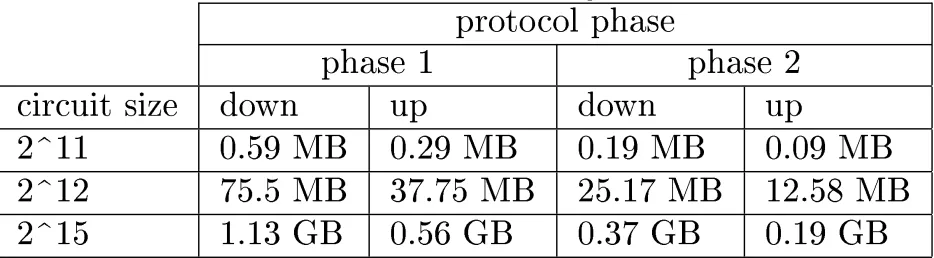
next generation of zcash [17] and 210 is a very small circuit. Performance numbers are given in g. 7.1.
Bandwidth numbers for each phase and selected circuit sizes are given in table 1.
Table 1: Bandwidth used in each phase
protocol phase
phase 1
phase 2
circuit size down
up
down
up
2^11
0.59 MB 0.29 MB
0.19 MB
0.09 MB
2^12
75.5 MB 37.75 MB 25.17 MB 12.58 MB
2^15
1.13 GB
0.56 GB
0.37 GB
0.19 GB
For completeness we also prole the interphase computation by the coordinator. This step is costly. We stress that this computation does not involve secret data and need only be done one once. In practice a large AWS EC2 instance would be rented for this computation.
These results show that the protocol is practical. A user need only spend 15 minutes doing a computation and after that need no longer participate. This means participation requires low investment and does not require the user to maintain a heightened state of security for hours or days. Moreover, it is a X improvement on the per user computation time of the real world execution of [16]. We stress that this is not a result of moving to the new curve, since that curve has a higher computational complexity and would, for identical implementations,be slower than the BN128 used in [16]. Instead it is the result of both avoiding the need for pre-commitment phase and resulting idle time and of protocol and software optimizations that improve the actual computation time.
Acknowledgements
We thank Paulo Barreto for helpful feedback about the BLS12-381 elliptic curve. We thank Daniel Benarroch, Daira Hopwood and Antoine Rondelet for helpful comments. We thank the anonymous reviewers of S&P 2018 for their comments.
References
[1] Joseph bonneau - personal communcation.
[2] Pairing library. url=https://github.com/ebfull/pairing. [3] Zcash. url=hhttps://z.cash.
Conference on Computer and Communications Security, CCS 2017, Dallas, TX, USA, October 30 -November 03, 2017, pages 20872104, 2017.
[5] Diego F. Aranha, Laura Fuentes-Castaneda, Edward Knapp, Alfred Menezes, and Francisco Rodriguez-Henriquez. Implementing pairings at the 192-bit security level. Cryptology ePrint Archive, Report 2012/232, 2012. http://eprint.iacr.org/2012/232.
[6] Razvan Barbulescu and Sylvain Duquesne. Updating key size estimations for pairings. Cryptology ePrint Archive, Report 2017/334, 2017. http://eprint.iacr.org/2017/334.
[7] Paulo S. L. M. Barreto, Ben Lynn, and Michael Scott. Constructing elliptic curves with prescribed embedding degrees. Cryptology ePrint Archive, Report 2002/088, 2002. http://eprint.iacr.org/ 2002/088.
[8] Paulo S. L. M. Barreto and Michael Naehrig. Pairing-friendly elliptic curves of prime order. Cryptology ePrint Archive, Report 2005/133, 2005. http://eprint.iacr.org/2005/133.
[9] E. Ben-Sasson, A. Chiesa, M. Green, E. Tromer, and M. Virza. Secure sampling of public parameters for succinct zero knowledge proofs. In 2015 IEEE Symposium on Security and Privacy, SP 2015, San Jose, CA, USA, May 17-21, 2015, pages 287304, 2015.
[10] Eli Ben-Sasson, Iddo Bentov, Alessandro Chiesa, Ariel Gabizon, Daniel Genkin, Matan Hamilis, Evgenya Pergament, Michael Riabzev, Mark Silberstein, Eran Tromer, and Madars Virza. Computational in-tegrity with a public random string from quasi-linear pcps. In Advances in Cryptology - EUROCRYPT 2017 - 36th Annual International Conference on the Theory and Applications of Cryptographic Tech-niques, Paris, France, April 30 - May 4, 2017, Proceedings, Part III, pages 551579, 2017.
[11] Eli Ben-Sasson, Alessandro Chiesa, Christina Garman, Matthew Green, Ian Miers, Eran Tromer, and Madars Virza. Zerocash: Decentralized anonymous payments from bitcoin. In 2014 IEEE Symposium on Security and Privacy, SP 2014, Berkeley, CA, USA, May 18-21, 2014, pages 459474, 2014. [12] Eli Ben-Sasson, Alessandro Chiesa, Daniel Genkin, Eran Tromer, and Madars Virza. SNARKs for
C: verifying program executions succinctly and in zero knowledge. In Proceedings of the 33rd Annual International Cryptology Conference, CRYPTO '13, pages 90108, 2013.
[13] Eli Ben-Sasson, Alessandro Chiesa, Daniel Genkin, Eran Tromer, and Madars Virza. Snarks for c: Verifying program executions succinctly and in zero knowledge. Cryptology ePrint Archive, Report 2013/507, 2013. http://eprint.iacr.org/2013/507.
[14] Bryan Bishop. Review of bitcoin scaling proposals. In Scaling Bitcoin Workshop Phase, volume 1, 2015. [15] Nir Bitansky, Alessandro Chiesa, Yuval Ishai, Rafail Ostrovsky, and Omer Paneth. Succinct non-interactive arguments via linear non-interactive proofs. In Proceedings of the 10th Theory of Cryptography Conference, TCC '13, pages 315333, 2013.
[16] S. Bowe, A. Gabizon, and M. D. Green. A multi-party protocol for constructing the public parameters of the pinocchio zk-snark. IACR Cryptology ePrint Archive, 2017:602, 2017.
[17] Sean Bowe. Cultivating sapling: Faster zk-snarks. https://z.cash/blog/ cultivating-sapling-faster-zksnarks.html, September 2017.
[18] Benedikt Bunz, Steven Goldfeder, and Joseph Bonneau. Proofs-of-delay and randomness beacons in ethereum. In S&B '17: Proceedings of the 1st IEEE Security & Privacy on the Blockchain Workshop, April 2017.
[20] Alessandro Chiesa, Matthew Green, Jingcheng Liu, Peihan Miao, Ian Miers, and Pratyush Mishra. Decentralized anonymous micropayments. In Advances in Cryptology - EUROCRYPT 2017 - 36th Annual International Conference on the Theory and Applications of Cryptographic Techniques, Paris, France, April 30 - May 4, 2017, Proceedings, Part II, pages 609642, 2017.
[21] Craig Costello, Kristin Lauter, and Michael Naehrig. Attractive subfamilies of bls curves for implement-ing high-security pairimplement-ings. Cryptology ePrint Archive, Report 2011/465, 2011. http://eprint.iacr. org/2011/465.
[22] Georg Fuchsbauer. Subversion-zero-knowledge snarks. Cryptology ePrint Archive, Report 2017/587, 2017. http://eprint.iacr.org/2017/587.
[23] R. Gennaro, C. Gentry, B. Parno, and M. Raykova. Quadratic span programs and succinct nizks without pcps. In Advances in Cryptology - EUROCRYPT 2013, 32nd Annual International Conference on the Theory and Applications of Cryptographic Techniques, Athens, Greece, May 26-30, 2013. Proceedings, pages 626645, 2013.
[24] Rosario Gennaro, Craig Gentry, Bryan Parno, and Mariana Raykova. Quadratic span programs and succinct NIZKs without PCPs. In Proceedings of the 32nd Annual International Conference on Theory and Application of Cryptographic Techniques, EUROCRYPT '13, pages 626645, 2013.
[25] Yossi Gilad, Rotem Hemo, Silvio Micali, Georgios Vlachos, and Nickolai Zeldovich. Algorand: Scaling byzantine agreements for cryptocurrencies. In Proceedings of the 26th Symposium on Operating Systems Principles, Shanghai, China, October 28-31, 2017, pages 5168, 2017.
[26] Sha Goldwasser, Yael Kalai, Raluca Ada Popa, Vinod Vaikuntanathan, , and Nickolai Zeldovich. How to run turing machines on encrypted data. Cryptology ePrint Archive, Report 2013/229, 2013. https://eprint.iacr.org/2013/229.
[27] J. Groth. On the size of pairing-based non-interactive arguments. In Advances in Cryptology - EURO-CRYPT 2016 - 35th Annual International Conference on the Theory and Applications of Cryptographic Techniques, Vienna, Austria, May 8-12, 2016, Proceedings, Part II, pages 305326, 2016.
[28] Jens Groth. Short pairing-based non-interactive zero-knowledge arguments. In Proceedings of the 16th International Conference on the Theory and Application of Cryptology and Information Security, ASI-ACRYPT '10, pages 321340, 2010.
[29] Joe Kilian. A note on ecient zero-knowledge proofs and arguments (extended abstract). In Proceed-ings of the 24th Annual ACM Symposium on Theory of Computing, May 4-6, 1992, Victoria, British Columbia, Canada, pages 723732, 1992.
[30] Taechan Kim and Razvan Barbulescu. Extended tower number eld sieve: A new complexity for the medium prime case. Cryptology ePrint Archive, Report 2015/1027, 2015. http://eprint.iacr.org/ 2015/1027.
[31] Ahmed Kosba, Andrew Miller, Elaine Shi, Zikai Wen, and Charalampos Papamanthou. Hawk: The blockchain model of cryptography and privacy-preserving smart contracts. In Security and Privacy (SP), 2016 IEEE Symposium on, pages 839858. IEEE, 2016.
[32] Helger Lipmaa. Progression-free sets and sublinear pairing-based non-interactive zero-knowledge ar-guments. In Proceedings of the 9th Theory of Cryptography Conference on Theory of Cryptography, TCC '12, pages 169189, 2012.