Distributed Algorithms Made Secure:
A Graph Theoretic Approach
Merav Parter∗ Eylon Yogev†
Abstract
In the area of distributed graph algorithms a number of network’s entities with local views solve some computational task by exchanging messages with their neighbors. Quite unfortunately, an inherent property of most existing distributed algorithms is that throughout the course of their execution, the nodes get to learn not only their own output but rather learn quite a lot on the inputs or outputs of many other entities. This leakage of information might be a major obstacle in settings where the output (or input) of network’s individual is a private information (e.g., distributed networks of selfish agents, decentralized digital currency such as Bitcoin).
While being quite an unfamiliar notion in the classical distributed setting, the notion of se-cure multi-party computation (MPC) is one of the main themes in the Cryptographic commu-nity. The existing secure MPC protocols do not quite fit the framework of classical distributed models in which only messages of bounded size are sent on graph edges in each round. In this paper, we introduce a new framework forsecure distributed graph algorithmsand provide the firstgeneral compilerthat takes any “natural” non-secure distributed algorithm that runs in rrounds, and turns it into a secure algorithm that runs inOe(r·D·poly(∆)) rounds where∆
is the maximum degree in the graph andDis its diameter. A “natural” distributed algorithm is one where the local computation at each node can be performed in polynomial time. An interesting advantage of our approach is that it allows one to decouple between the price of locality and the price ofsecurityof a given graph function f. The security of the compiled al-gorithm is information-theoretic but holds only against a semi-honest adversary that controls a single node in the network.
This compiler is made possible due to a new combinatorial structure calledprivate neigh-borhood trees: a collection of n trees T(u1), . . . ,T(un), one for each vertex ui ∈ V(G), such
that each tree T(ui) spans the neighbors ofui without going through ui. Intuitively, each tree
T(ui)allows all neighbors ofui to exchange asecretthat is hidden fromui, which is the basic
graph infrastructure of the compiler. In a (d,c)-private neighborhood trees each tree T(ui)
has depth at most d and each edge e ∈ G appears in at most c different trees. We show a construction of private neighborhood trees with d = Oe(∆·D)and c = Oe(D), both these
bounds areexistentiallyoptimal.
Contents
1 Introduction 1
1.1 Our Results . . . 3
1.2 Applications for Known Distributed Algorithms . . . 4
1.3 Related Work . . . 5
2 Our Approach and Techniques 6
2.1 From Security Requirements to Graph Structures . . . 6
2.2 Constructing Private Neighborhood Trees . . . 10
3 Preliminaries 12
3.1 Distributed Algorithms. . . 12
3.2 Cryptography with Perfect Privacy. . . 14
4 Private Neighborhood Trees 14
5 Secure Simulation via Private Neighborhood Trees 17 5.1 Our Framework . . . 17
5.2 Secure Simulation of a Single Round. . . 18
5.3 The Final Secure Algorithm . . . 21
1
Introduction
In distributed graph algorithms (or network algorithms) a number of individual entities are
con-nected via a potentially large network. Starting with the breakthrough by Awerbuch et al. [AGLP89], and the seminal work of Linial [Lin92], Peleg [Pel00] and Naor and Stockmeyer [NS95], the area of distributed graph algorithms is growing rapidly. Recently, it has been receiving considerably more theoretical and practical attention motivated by the spread of multi-core computers, cloud computing, and distributed databases. We consider the standard synchronous message passing model (theCONGEST model) where in each round O(logn)bits can be transmitted over every edge wherenis the number of entities.
The common principle underlying all distributed graph algorithms (regardless of the model specification) is that the input of the algorithm is given in adistributed format, and consequently the goal of each vertex is to compute itsown part of the output, e.g., whether it is a member of a computed maximal independent set, its own color in a valid coloring of the graph, its incident edges in the minimum spanning tree, or its chosen edge for a maximal matching solution. In most distributed algorithms, throughout execution, vertices learn much more than merely their own output but rather collect additional information on the input or output of (potentially) many other vertices in the network. This seems inherent in many distributed algorithms, as the output of one node is used in the computation of another. For instance, most randomized coloring (or MIS) algorithms [Lub86, BE13, BEPS16, HSS16, Gha16, CPS17] are based on the vertices exchanging their current color with their neighbors in order to decide whether they are legally colored.
In cases where the data is sensitive or private, these algorithms may raise security concerns. To exemplify this point, consider the task of computing the average salary in a distributed net-work. This is a rather simple distributed task: construct a BFS tree and let the nodes send their salary from the leaves to the root where each intermediate node sends to its parent in the tree, the sum of all salaries received from its children. While the output goal has been achieved, privacy has been compromised as intermediate nodes learn more information regarding the salaries of their subtrees. Additional motivation for secure distributed computation include private medical data, networks of selfish agents with private utility functions, and decentralized digital currencies such as the Bitcoin.
The community of distributed graph algorithms is commonly concerned with two main chal-lenges, namely, locality (i.e., communication is only performed between neighboring nodes) and congestion (i.e., communication links have bounded bandwidth). Security is usually not speci-fied as a desired requirement of the distributed algorithm and the main efficiency criterion is the round complexity (while respecting bandwidth limitation).
Albeit being a rather virgin objective in the area of distributed graph algorithms, the notion of security in multi-party computation (MPC) is one of the main themes in the Cryptographic community. Broadly speaking,secureMPC protocols allow parties to jointly compute a function
assumptions, the adversary is either semi-honest or malicious1and in might collude with several parties.
Most MPC protocols are designed for the clique networks where each two parties have a secure channel between them. The works that do consider general graph topologies usually take the following framework. For a given function f of interest, design first a protocol for securely computing f in the simpler setting of a clique network, then “translate” this protocol to any given graph G. Although this framework yields protocols that are secure in the strong sense (e.g., handling collusions and a malicious adversary), they do not quite fit the framework of distributed graph algorithms, and simulating these protocols in theCONGEST model results in a large overhead in the round complexity. It is important to note that the blow-up in the number of rounds might occur regardless of the security requirement; for instance, when the desired function f is non-local, its distributed computation in general graphs might be costly with respect to rounds even in the insecuresetting. In the lack of distributed graph algorithms for general graphs that are both secure and efficient compared to theirnon-secure counterparts, we ask:
How to design distributed algorithms that are bothefficient(in terms of round complexity)
andsecure(where nothing is learned but the desired output)?
We address this challenge by introducing a new framework for secure distributed graph algo-rithms in theCONGESTmodel. Our approach is different from previous secure algorithms men-tioned above and allows one to decouple between the price of locality and the price of security of a given function f. In particular, instead of adopting a clique-based secure protocol for f, we take the best distributed algorithmAfor computing f, and then compileAto a secure algorithm
A0. This compiled algorithm respects the same bandwidth limitations, relies on no setup phase
nor on any computational assumption and works for (almost) any graph. The price of security comes as an overhead in the number of rounds. Before presenting the precise parameters of the secure compiler, we first discuss the security notion used in this paper.
Our Security Notion. Consider a (potentially insecure) distributed algorithmA. Intuitively, we say that a distributed algorithmA0securelysimulatesAif (1) both algorithms have the exact same
output for every node (or the exact same output distribution if the algorithm is randomized) and (2) each node learns “nothing more” than its final output. This strong notion of security is known as “perfect privacy” - which provides pure information theoretic guarantees and relies
and no computational assumptions. The perfect privacy notion is formalized by the existence of
an (unbounded) simulator [BGW88, Gol09,Can00, AL17], with the following intuition: a node learns nothing except its own output y, from the messages it receives throughout the execution of the algorithm, if a simulator can produce the same output distribution while receiving onlyy
and the graphG.
Assume that one of the nodes in the network is an “adversary” that is trying to learn as much as possible from the execution of the algorithm. Then the security notion has some restrictions on the operations the adversary is allowed to perform: (1) The adversary is passive and only listens to the messages but does not deviate from the prescribed protocol; this is known in the literature assemi-honestsecurity. (2) The adversary isnotallowed to collude with other nodes in the network. As will be explained next, if the vertex connectivity of the graph is two, then this is
1A semi-honest adversary does not deviate from the described protocol, but may run any computation on the
the strongest adversary that one can consider. (3) The adversary gets to see the entire graph. That is, in this framework, the topology of the graph Gis not considered private and is not protected by the security notion. The private bits of information that are protected by our compiler are: the
inputsof the nodes (e.g., color) and the randomness chosen during the execution of the algorithm;
as a result, theoutputsof the nodes are private (see Definition1for precise details).
A Stronger Adversary: From Cliques to General Topology. The goal of this paper is to lay down the groundwork, especially the graph theoretic infrastructures for secure distributed graph algorithms. As a first step towards this goal, we consider the largest family of graphs for which secure computation can be achieved in the perfect secure setting. This is precisely the family of two-vertex connected graphs.
Handling this wide family of graphs naturally imposes restrictions on the power of the ad-versary that one can consider. In particular, we cannot hope to handle that standard adad-versary assumed in the MPC literature, which colludes with Ω(n) other parties. A natural limit on the adversarial collusion is the vertex connectivity of the graph. Indeed, if the graph is onlyt-vertex connected, then an adversary that colludes withtnodes can receive all messages from one part of the graph to the other. That is, a security for such a graph will imply a secure two-party computa-tion, where each party simulates one connected component of the graph. Such two-party secure protocols where shown to be impossible for merely any interesting function [Kus89]. Thus, for 2-vertex connected graphs, one cannot achieve a secure simulation with an adversary that colludes with more than a node. Moreover, the works of [Dol82] combined with [DDWY93] show that if the adversary is maliciousand colludes with t nodes then graph must be (2t+1)connected for security to hold.
We believe that the framework provided in this paper, and the private neighborhood trees in particular, serve the basis for stronger security guarantees in the future, for highly connected graphs.
1.1 Our Results
Our end result is the first general compiler that can take any “natural” (possibly insecure) dis-tributed algorithm to one that has perfect security. A “natural” disdis-tributed algorithm is one where the local computation at each node can be performed in polynomial time. Through the paper, theOe(·)notation hides poly-logarithmic terms in the number of verticesn. Recall, that G
is 2-vertex connected (or bridgeless) if for allu∈ Vthe graphG0 = (V\ {u},E)is connected.
Theorem 1(Secure Simulation, Informal). Let G be a 2-vertex connected n-vertex graph with diameter
D and maximal degree∆. Let A be anatural distributed algorithm that runs on G in r rounds. Then,
Acan be transformed to an equivalent algorithmA0 with perfect privacy which runs in
e
O(rD·poly(∆))
rounds.
We note that our compiler works for any distributed algorithm rather than only on natural ones. The number of rounds will be proportional to the space complexity of the internal com-putation functions of the distributed algorithm (an explicit statement for any algorithm can be found in Remark1).
neigh-Low-Congestion Cycle Covers [PY18]
Private Neighborhood Trees (Theorem2)
Secure Distributed Algorithm (Theorem1)
Figure 1: An illustrated summary of our results.
borhood tree of a 2-vertex connected graph G = (V,E)is a collection of n trees, one per node
ui, where each tree T(ui) ⊆ G\ {ui} contains all the neighbors of ui but does not contain ui.
Intuitively, the private neighborhood trees allow all neighborsΓ(ui)of all nodes ui to exchange
a secret without ui. Note that these covers exist if and only if the graph is 2-vertex connected.
We define a (d,c)-private neighborhood trees in which each treeT(ui)has depth at mostdand
each edge belongs to at mostcmany trees. This allows the distributed compiler to use all trees simultaneously inOe(d+c)rounds, by employing the random delay approach [LMR94,Gha15].
Theorem 2(Private Neighborhood Trees). Every2-vertex connected graph with diameter D and
max-imum degree∆has a(d,c)-private neighborhood trees withd=Oe(D·∆)and c=Oe(D).
Our secure compiler assumes that the nodes in the graph know the private neighborhood trees. That is, each node knows its parent in the trees it participates in. Thus, in order for the whole transformation to work, the network needs to run a distributed algorithm to learn the cycle cover. This can be achieved by performing a prepossessing phase to compute the private trees and then run the distributed algorithm.
Since the barrier of [Kus89] can be extended to a cycle graph, the linear dependency inD in the round complexity of our compiler is unavoidable.
The flow of our constructions are summarized in Figure1.
1.2 Applications for Known Distributed Algorithms
Theorem 1 enables us to compile almost all of the known distributed algorithms to a secure version of them. It is worth noting thatdeterministicalgorithms for problems in which the nodes
donot have any inputcannot be made secure by our approach since these algorithms only depend
Our approach captures global (e.g., MST) as well as many local problems [NS95]. The MIS algorithm of Luby [Lub86] along with our compiler yields Oe(D·poly(∆)) secure algorithm
ac-cording to the notion described above. Slight variations of this algorithm also gives theO(logn) -round(∆+1)-coloring algorithm (e.g., Algorithm 19 of [BE13]). Combining it with our compiler we get a secure(∆+1)-coloring algorithm with round complexity ofOe(D·poly(∆)). Using the
Matching algorithm of Israeli and Itai [II86] we get an Oe(D·poly(∆)) secure maximal
match-ing algorithm. Finally, another example comes from distributed algorithms for the Lov´asz local lemma (LLL) which have received a lot of attention recently [BFH+16,FG17,CP17] for the class of bounded degree graphs. Using [CPS17], most of these (non-secure) algorithms for defective coloring, frugal coloring, and list vertex-coloring can be made secure withinOe(D)rounds.
1.3 Related Work
There is a long line of research on secure multiparty computation. The most general results are [Yao82, GMW87, BGW88, CCD88] which provide a protocol for computing any function
f(x1, . . . ,xn)overninputs. The significance of these results is that they work for any function and
provide strong security (either assuming computational assumptions, or information-theoretic as is considered in this work). More specifically, these results can tolerate the adversary colluding witht nodes as long ast< n/2 and achieve security in the semi-honest model. If the adversary is malicious (i.e., she can deviate from the prescribed protocol) then the protocols can handle
t < n/3. These general results assume that every two parties have a secure direct channel between them, that is, they assume that the interaction pattern is a clique.
General Graph Topologies. As opposed to general MPC, there are not many protocols that work for general graph interaction patterns. The works of [HIJ+16, HIJ+17] provide secure protocols for any function f and for any graph pattern, however, they have a few drawbacks. First, they both assume some form of a setup phase (recall that our solution assumes no such setup). The work of [HIJ+16] assumes a setup of correlated randomness and provides several protocols with information-theoretic security. Even the most efficient protocol (one for symmetric functions) must send more than n2 bits on each edge. In the CONGEST model, this would take n2/ logn
rounds which is a non interesting regime for this model (for other functions the communication complexity is much worse). The work of [HIJ+17] assumes a public-key infrastructure (PKI)
setup together with a common random string, and moreover provides only solutions based on (heavy) computational assumptions. More importantly, the number of rounds is not a parameter they optimize, and will be at least O(n2) even for simple functions. Such protocols where also
implicitly considered in [GGG+14,BGI+14] but suffer from similar drawbacks.
MPC with Locality Constraints. Other MPC works study protocols with small locality, that is, that parties communicate only with a small number of other parties. The work of [BGT13] (followed by [CCG+15]) provides a secure MPC protocol for general functions where fornparties each party is only required to communicate with at mostpolylog(n)other parties usingpolylog(n)
MPC for Bounded Degree Graphs. The works of [GO08, CGO10] consider MPC protocols for bounded degree graphs. Except for the graph restriction, they consider arbitrary interaction pattern, information-theoretic security and no setup phase (similar to our setting). They provide a protocol for computing any function f while “giving up” on security for some nodes (i.e., the adversary might learn the private inputs of these nodes). While they have some restrictions on the adversary, their security notion is stronger then ours (as we do not allow collusions). However, their protocol is not round nor bandwidth efficient with respect to our parameters. They simulate the general MPC protocol of [BGW88], by replacing each message sent from player i to player
j, one-by-one, with a distributed broadcast protocol that takes more than n rounds by itself. Thus, the overall protocols will require at leastn2 rounds and enters the uninteresting regime of parameters for the CONGEST model.
The Key Differences to Our Approach. Our approach is quite different from the algorithms mentioned above. In particular, instead of taking some function f and trying to build the best secure protocol for it, our compiler takes the bestdistributedalgorithm for computing f, and then compiles it to a secure one. This makes us competitive, in terms of the number of rounds, with the non-secure distributed algorithm. In the MPC approach, it is harder to decouple between the price of locality and the price of security as adopting a clique-protocol for computing a function
f to a general graph might blow up the number of rounds, regardless of the security constraint. One exception is the work of [KTW07] who showed how to compile a distributed algorithm for a specific task of Belief Propagation to a secure one. The compiler is designed specifically for this task and does not work for others. Moreover, the security that is achieved is based on computational assumption and specifically public-key encryption with additional properties.
Finally, we note that a compiler that works for even a weaker adversary was proposed in [PY18]. In their setting, the adversary can listen to the messages of a singleedge where in our setting the adversary listens to all messages received by a singlenode. Thus, the adversary gets messages from∆ different edges in additional to getting the private randomness chosen by the node itself.
2
Our Approach and Techniques
We next describe the high level ideas of our secure compiler. In section2.1, we describe how the secure computation in the distributed setting boils down into a novel graph theoretic structure, namely, private neighborhood trees. The construction of private trees is shown in Section4.
2.1 From Security Requirements to Graph Structures
In this section, we give an overview of the construction of a secure compiler and begin by showing how to compile a single round distributed algorithm into a secure one. This single-round setting already captures most of the challenges of the compiler. At the end of section, we describe the additional ideas required for generalizing this to arbitraryr-round algorithms.
Secure Simulation of a Single Round. LetGbe ann-vertex graph with maximum degree∆, and for any node u let σu be its initial state (including its ID, and private input). Any single round
algorithm can be described by a function f that maps the initial stateσu of u and the messages
As a concrete running example, letAbe a single round algorithm that verifies vertex coloring in a graph. In this algorithm, the initial state of a node includes a colorcu, and nodes exchange
their color with their neighbors and output 1 if and only if all of their neighbors are colored with a color that is different than cu. It is easy to see that in this simple algorithm, the nodes
learn more than the final output of the algorithm, namely, they learn the color of their neighbors. Our goal is to compile this algorithm to a secure one, where nothing is learned expect the final output. In particular, where nodes do not learn the color of any other node in the network. This fits the model of Private Simultaneous Messages (PSM) that we describe next. We stress that other MPC protocols might be suitable here as well (e.g., [Yao82, GMW87, BGW88]), however, the star topology of PSM model makes the best fit in terms of simplicity and parameters.
The PSM model was introduced by Feige, Kilian and Naor [FKN94] (and later generalized by [IK97]) as a “minimal” model of MPC for securely computing a function f. In this model, there arekclients that hold inputsx1, . . . ,xkwhich are all connected to a single server (i.e., a star
topology). The clients share private randomnessRthat is hidden from the server. The goal is for the server to compute f(x1, . . . ,xk)while learning “nothing more” but this output. The protocol
consists of a single round where each client isends a message to the server that depends on its own inputxi and the randomnessR. The server, using these messages, computes the final output
f(x1, . . . ,xk). In [FKN94], it was shown that any function f admits such a PSM protocol with
information-theoretic privacy. The complexity measure of the protocol is the size of the messages (and shared randomness) which are exponential in the space complexity of the function f (see Definition2and Theorem5for precise details).
Turning back to our single round distributed algorithmA, the secure simulation ofAcan be based on the PSM protocol for securely computing the function f, the function that characterizes algorithmA. In this view, each node uin the graph acts as a server in the PSM protocol, while its (at most∆) neighbors in the graph act as the clients.
In order to simulate the PSM protocol of [FKN94] in the CONGEST model, one has to take care of several issues. The first issue concerns the bandwidth restriction; in theCONGESTmodel, every neighborvi can send onlyO(logn)bits touin a single round. Note that the PSM messages
are exponential in the space complexity of the function f, and that in our setting the total input of f hasO(∆logn)bits. Thus, in a na¨ıve implementation only functions f that are computable in logarithmic space can be computed with the desired overhead ofpoly(∆)rounds. Our goal is to capture a wider family of functions, in particular the class of natural algorithms in which f
is computable in polynomial time. Therefore, in our final compiler, we do not compute f in a single round, but rather compute it gate-by-gate. Since in natural algorithms f is computed by a circuit of polynomial size, and since a single gate is computable in logarithmic space, we incur a total round overhead that is polynomial in∆. In what follows, assume that f is computable in logarithmic space.
Another issue to be resolved is that in the PSM model, the server did not hold an input whereas in our setting the function f depends not only on the input of the neighbors, but on the input of the node u as well. This subtlety is handled by having u secret share2 its input to the
neighbors.
How to Exchange Secrets in a Graph? There is one final critical missing piece that requires hard work: the neighbors of u must share private randomness R that is not known to u. Thus, the secure simulation of a single round distributed algorithm can be translated into the following
2A secret share ofxtokparties is a random tupler
problem:
How to share a secret Rubetween the neighbors of each node u in the graph while hiding it
from u itself?
Note that this task should be done for all nodes u in the graph G simultaneously. That is, for every node u, we need the neighbors of u to share a private random string that is hidden from
u. Our solution to this problem is information theoretic and builds upon specific graph struc-tures. However, we begin by discussing a much simpler solution, yet, based on computational assumptions.
A Solution Based on Computational Assumptions. In order to get a computationally based solution, we assume the existence of a public-key encryption scheme. For simplicity, we assume that our public-key encryption scheme has two properties: (1) the encryption does not increase the size of the plaintext, and (2) the length of the public-key isλ– the security parameter of the
public-key scheme. We next describe anOe(∆+λ)protocol that computes the secret Rwhich is
shared by all neighbors ofuwhile hiding it fromu, under the public-key assumption.
Consider a nodeu and letv1, . . . ,v∆ be its neighbors. For simplicity, assume that∆ is power
of 2. First,v1computes the random stringR, this string will be shared with allvi’s nodes in log∆
phases. In each phasei ≥ 0, we assume that all the vertices v1, . . . ,vki forki = 2
i know R. We
will show that at the end of the phase, all vertices v1, . . . ,vki,vki+1, . . . ,v2ki knowR. This is done
as follows. Each vertex vki+j sends its public-key to vj via the common neighbor u, vj encrypts
R with the key of vki+j and sends this encrypted information to vki+j via u. As the length of
the public-key is λ and the length of the encrypted secret R needed by the PSM protocol has
O(∆logn) bits, this can be done in Oe(∆+λ) rounds. It is easy to see that u cannot learn the
secretRunder the public-key assumption.
Using this protocol with the PSM machinery yields a protocol that compiles any r-round algorithmA(even non-natural one) into a secure algorithmAwithr0 =Oe(r(∆+λ))rounds. We
note that it is not clear what isλ as a function of the number of nodesn. Clearly, ifλ = Ω(n),
this overhead is quite large. The benefit of our perfect security scheme is that it relies on no computational assumptions, does not introduce an additional security parameter and as a result the round complexity of the compiled algorithms depends only on the properties of the graph, e.g., number of nodes, maximum degree and diameter. Finally, the dependencies on these graph parameters is existentially required.
Our Information-Theoretic Solution. Suppose two nodes,v1,v2, wish to share information that
is hidden from a node u in the information-theoretic sense. Then, they must use a v1-v2 path
in G that is free from u. Hence, in order for the neighbors of a node u to exchange private randomness, they must use a connected subgraph H of G that spans all the neighbors of u but does not includeu. (This in particular explains our requirement forGto be 2-vertex connected.) Using this subgraph H, the neighbors can communicate privately (without u) and exchange shared randomness.
edge that is common toΩ(n)trees. This is undesirable as it might lead to a blow-up ofΩ(n)in the round complexity of our compiler.
Towards this end, we define the notion of private neighborhood trees which provides us the communication backbone for implementing this distributedPSM protocol in general graph topologies for all nodes simultaneously. Roughly speaking, a private neighborhood tree of a 2-vertex connected graph G = (V,E) is a collection of n trees, one per node ui, where each
tree T(ui) ⊆ G\ {ui} contains all the neighbors of ui but does not contain ui. A (d,c)-private
neighborhood trees in which each tree T(ui) has depth at most dand each edge belongs to at
mostc many trees. This allows us to use all trees simultaneously and exchange all the private randomness inOe(d+c)rounds.
LetGbe a 2-vertex connected graph and let Dbe the diameter ofG. By the discussion above, achieving (d,c)-private neighborhood trees withd = O(∆·D) andc = n is easy, but yields an inefficient compiler. We show how to construct(d,c)-private neighborhood trees ford=Oe(D·∆)
andc = Oe(D), these parameters are nearly optimal existentially. The construction builds on a
simpler and more natural structure called cycle cover. Using these private neighborhood trees, the neighbors of each node ucan exchange theO(∆logn)bits of Ru inOe(∆·D)rounds. This is
done for all nodesusimultaneously using the random delay approach.
Note that unlike the computational setting, here the round complexity is existentially optimal (up to poly-logarithmic terms) and only depends on the parameters of the graph.
Secure Simulation of Many Rounds. We have described how to securely simulate single round distributed algorithms. Consider anr-round distributed algorithmA. In a broad view,Acan be viewed as a collection of r functions f1, . . . ,fr. At round i, a node u holds a state σi and needs
to update its state according to a function fi that depends onσi and the messages it has received
in this round. Moreover, the same function fi computes the messages that u will send to its neighbors in the next round. That is,
fi(σi,mv1→u, . . . ,mv∆→u) = (σi+1,mu→v1, . . . ,mu→v∆).
Assume that the final state σr is the final output of the algorithm for node u. A first attempt is
to simply apply the solution for a single round for r many times, round by round. As a result, the nodeulearns all internal states σ1, . . . ,σr and nothing more. This is of course undesirable as
these internal states,σi fori≤r−1, might already reveal much more information than the final
output. Instead, we simulate the computation of the internal states σ1,σ2, . . . ,σr, in an oblivious
manner without knowing anyσi except forσr which is the final output of the algorithm.
Towards this end, in our scheme, the node u holds an “encrypted” state, bσi, instead of the
actual stateσi. The encryption we use is a simple one-time-pad where the key is a random string
Rσi such that bσi ⊕Rσi = σi. The key Rσi will be chosen by an arbitrary neighbor v of u. In
addition to the state, the nodeu should not be able to learn the messagesmu→v1, . . . ,mu→v∆ sent
to the neighbors in the original algorithm. Thus, each neighbor vj holds the key Ru→vj that is
used to encrypt its incoming message to u. Overall, at any given round i, any node u holds an encrypted statebσi, and encrypted outgoing messagesmbu→v1, . . . ,mbu→v∆; the neighbors of uhold
the corresponding decryption keys. To compute the new state and the messages that u sends to its neighbors in the next round, we use the PSM protocol as described in a single round but with respect to a function fi0 which is related to the function fi and is defined as follows. The
decrypts the encrypted input to get the original state and the messages sent from its neighbors (i.e., the input for function fi). Then, the function fi0 applies fi to get the next state σi+1 and
new outgoing messages fromu to its neighbors. Finally, it uses new encryption keys to encrypt the new output and finally outputs the new encrypted data (states and messages to be sent). A summary of the algorithm for a single node u is given in Figure2. The full proof is given in Section5.
AlgorithmAu:
1. For each roundi=1 . . .rdo:
(a) uholds the encrypted stateσbi.
(b) The neighborvof usamples new encryption keys.
(c) Run aPSMprotocol withuas the server to compute the function fi0: i. usends its stateσbi to a neighborv
0 6=v.
ii. Neighbors share private randomness via theprivate neighborhood trees. iii. ulearns its new encrypted statebσi+1.
2. vsends the final encryption key tou.
3. Using this key,ucomputes its final output σr.
Figure 2: The description of the simulation of algorithmAwith respect to a node u.
2.2 Constructing Private Neighborhood Trees
Our construction of private neighborhood trees is based on the construction of low-congestion
cycle-covers from [PY18]. For a bridgeless graph G = (V,E), a low congestion cycle cover is a
decomposition of graph edges into cycles which are both short and almostedge-disjoint. Formally, a (d,c)-cycle cover of a graphGis a collection of cycles in G in which each cycle is of length at most d, and each edge participates in at least one cycle and at most c cycles. In [PY18] the following theorem was proven:
Theorem 3 (Low Congestion Cycle Cover, [PY18]). Every bridgeless graph3 with diameter D has a
(d,c)-cycle cover whered= Oe(D)andc= Oe(1). That is, the edges of G can be covered by cycles such
that each cycle is of length at mostOe(D)and each edge participates in at mostOe(1)cycles.
To prove Theorem2we show how to use the construction of a(d,c)-cycle cover C to obtain a
(d·∆,c·D·log∆)private neighborhood trees N. Using the construction of(Oe(D),Oe(1))cycle
covers of Theorem3yields the theorem.
Consider a nodeuwith only two neighborsv1,v2. Then, a cycle cover of the graph must cover
the edge (u,v1)by using a cycle containing the nodev2. Thus, the cycle induces a path between
v1 and v2 that does not contain u. We get a private neighbor tree for u, a short path from v1
to v2 that does not go through u and has low congestion. We use this idea, and show how to
generalize it to nodes with arbitrary degree.
The construction of the private neighborhood trees N consists ofO(log∆) phases. In each phase, we compute a low-congestion cycle cover in some auxiliary graph using Theorem3. We begin by each node u holding an empty forest F0(u)consisting only of u’s neighbors. We then
compute a cycle cover in the graph G. Let v1, . . . ,v∆ be the neighbors of u. Then, the cycles of
the cycle cover provide short paths between pairs(vi,vj)that avoidu. We add these paths to the
forest of u. By doing this, we reduced the number of connected components in the forest of u
by half. Importantly, since we added paths of a cycle cover, we know that we can add all these paths for all nodesuin the graph, while keeping the edge congestion per edge bounded.
The high level idea is to repeat this process for log∆ iteration, until u’s forest contains only one connected component: the output private treeT(u)for the nodeu. In order to run the next iteration, we must force the cycle cover to find different cycles than the ones it has computed in the previous iteration.
Towards that goal, the algorithm uses an auxiliary graph G0 defined as follows. First, we add all the nodes in G to G0 (but not the edges). Consider the collection of connected components of a node u. We add a virtual node uj to G0 for each of the connected components of u, and
connectuj to u. Finally, every edge(u,v)in Gis replaced by an edge (uj,vi)inG0 where vis in
the jth connected component ofuanduis in theith connected component ofv. See Figure3for
an illustration.
𝑢
𝑢
𝑢𝑗
𝑣𝑖
𝑣
𝑣
Figure 3: Left: Illustration of a node uwith two connected components in the original graph G. Right: The auxiliary graphG0 and a new cycle found by the cycle cover inG0 (dashed line). One can observe how this new cycle now connects the two connected components.
Now, we run the cycle cover algorithm on G0. The only way to cover an edge(u,uj)is to use
another virtual nodeui fori6= j. That is, we found a path between thejthconnected component
graph G0, the next step translates theseG0-paths intoG-paths. This is done as follows. An edge
(u,uj)is simply replaced byu. An edge(uj,vi)is replaced by the edge(u,v)inG. We then use
the fact that the cycles computed inG0 have low congestion inG0, to show that also the translated paths have low congestion in G. To bound the depth of the private tree, observe that the depth of the connected components increases by an additive term ofOe(D)in each iteration, and thus
we get a final depth of Oe(D∆). The detailed description and analysis of this construction are
provided in Section4.
3
Preliminaries
Unless stated otherwise, the logarithms in this paper are base 2. For an integern∈Nwe denote by [n] the set{1, . . . ,n}. We denote by Un the uniform distribution over n-bit strings. For two
distributions (or random variables) X,Ywe write X≡Y if they are identical distributions. That is, for anyx it holds that Pr[X= x] =Pr[Y=x].
Graph Notations. For a tree T ⊆ G, let T(z)be the subtree of T rooted atz. LetΓ(u,G)be the neighbors of u in G, and deg(u,G) = |Γ(u,G)|. When G is clear from the context, we simply writeΓ(u)and deg(u).
3.1 Distributed Algorithms
The Communication Model. We use a standard message passing model, the CONGESTmodel [Pel00], where the execution proceeds in synchronous rounds and in each round, each node can send a message of sizeO(logn)to each of its neighbors. In this model, local computation at each node is for free and the primary complexity measure is the number of communication rounds. Each node holds a processor with a unique and arbitrary ID ofO(logn) bits. Throughout, we make an extensive use of the following useful tool, which is based on the random delay approach of [LMR94].
Theorem 4([Gha15, Theorem 1.3]). Let G be a graph and let A1, . . . ,Ambe m distributed algorithms in
theCONGESTmodel, where each algorithm takes at mostdrounds, and where for each edge of G, at most
cmessages need to go through it, in total over all these algorithms. Then, there is a randomized distributed
algorithm (using only private randomness) that, with high probability, produces a schedule that runs all
the algorithms in O(c+d·logn)rounds, after O(dlog2n)rounds of pre-computation.
A Distributed Algorithm. Consider an n-vertex graph Gwith maximal degree ∆. We model a distributed algorithm Athat works inrrounds as describingrfunctions f1, . . . ,fras follows. Let
ube a node in the graph with inputxuand neighborsv1, . . . ,v∆. At any roundi, the memory of
a node uconsists of a state, denoted by σi and∆ messages mv1→u. . . ,mv∆→u that were received
in the previous round.
Initially, we set σ0 to contained only the input xu of u and its ID and initialize all messages
to ⊥. At roundi the node u updates its state to σi+1 according to its previous state σi and the
message from the previous round, and prepares∆ messages to send mu→v1, . . . ,mu→v∆. To ease
notation (and without loss of generality) we assume that each state contains the ID of the node
u, thus, we can focus on a single update function fi for every round that works for all nodes. The
next state and outgoing message:
(σi,mu→v1, . . . ,mu→v∆)← fi(σi−1,mv1→u, . . . ,mv∆→u,si).
At the end of therrounds, each nodeuhas a stateσrand a final output of the algorithm. Without
loss of generality, we assume thatσris the final output of the algorithm (we can always modify
fraccordingly).
Natural Distributed Algorithms. We define a family of distributed algorithms which we call
natural, which captures almost all known distributed algorithms. A natural distributed algorithm
has two restrictions for any roundi: (1) the size the state is bounded by|σi| ≤∆·polylog(n), and
(2) the function fi is computable in polynomial time. The input for fi is the stateσi and at most
∆message each of length logn. Thus, the input lengthmfor fi is bounded bym≤∆·polylog(n),
and the running time should be polynomial in this input length.
We introduce this family of algorithms mainly for simplifying the presentation of our main result. For these algorithms, our main statement can be described with minimal overhead. How-ever, our results are general and work for any algorithm, with appropriate dependency on the size of the state and the running time the function fi (i.e., the internal computation time at each
nodeuin roundi).
Notations. We introduce some notations: For an algorithm A, graphG, input X = {xv}v∈G we
denote by Au(G,X) the random variable of the output of node u while performing algorithm
A on the graph G with inputs X (recall that A might be randomized and thus the output is a random variable and not a value). Denote byA(G,X) ={Au(G,X)}u∈Gthe collection of outputs (in some canonical ordering). LetViewAu(G,X)be a random variable of the viewpoint ofuin the running of the algorithm A. This includes messages sent to u, its memory and random coins during all rounds of the algorithm.
Secure Distributed Computation. Let Abe a distributed algorithm. Informally, we say that A0
simulates Ain a secure manner if when running the algorithm A0 every nodeu only learns its
final output in Aand “nothing more”. This notion is captured by the existence of a simulator and is defined below.
Definition 1(Perfect Privacy). LetAbe a distributed (possibly randomized) algorithm, that works in r
rounds. We say that an algorithmA0 simulatesAwith perfect privacy if for every graph G, every u∈ G
and it holds that:
1. Correctness:For every input X ={xv}v∈V: A(G,X)≡ A0(G,X).
2. Perfect Privacy: There exists a randomized algorithm (simulator) Sim such that for every input
X= {xv}v∈V it holds that
ViewAu0(G,X)≡Sim(G,xu,Au(G,X)).
3.2 Cryptography with Perfect Privacy
One of the main cryptographic tools we use is a specific protocol for secure multiparty compu-tation that has perfect privacy. Feige Kilian and Naor [FKN94] suggested a model where two players having inputs x and y wish to compute a function f(x,y) in a secure manner. They achieve this by each sending a single message to a third party that is able to compute the output of the function f from these messages, but learn nothing else about the inputs x and y. For the protocol to work, the two parties need to share private randomness that is not known to the third party. This model was later generalized to multi-players and is called the Private Simultaneous Messages Model [IK97], which we formally describe next.
Definition 2(ThePSMmodel). Let f: ({0, 1}m)k → {0, 1}mbe a k variant function. APSMprotocol
for f consists of a pair of algorithms(PSM.Enc,PSM.Dec)wherePSM.Enc: {0, 1}m× {0, 1}r→ {0, 1}t
andPSM.Dec: ({0, 1}t)k → {0, 1}m such that
• For any X = (x1, . . . ,xk)it holds that:PrR∈{0,1}r[PSM.Dec(PSM.Enc(x1,R), . . . ,PSM.Enc(xk,R))
= f(x1, . . . ,xk)] =1.
• There exists a randomized algorithm (simulator)Simsuch that for X =x1, . . . ,xkand for R sampled
from{0, 1}r, it holds that
{PSM.Enc(xi,R)}i∈[k] ≡Sim(f(x1, . . . ,xk)).
The communication complexity of the PSM protocol is the encoding length t and the randomness
complex-ity of the protocol is defined to be|R|=r.
Theorem 5 (Follows from [IK97]). For every function f : ({0, 1}m)k → {0, 1}` that is computable
by an s = s(m,k)-space TM there is an efficient perfectly secure PSM protocol whose communication
complexity and randomness complexity are O(km`·22s).
We describe two additional tools that we will use, secret sharing and one-time-pad encryp-tion.
Definition 3 (Secret Sharing). Let x ∈ {0, 1}nbe a message. We say x issecret shared to k shares by
choosing k random strings x1, . . . ,xk ∈ {0, 1}n conditioned on x = Lk
j=1xj. Each xj is called a share,
and notice that the joint distribution of any k−1shares is uniform over({0, 1}n)k−1.
Definition 4 (One-Time-Pad Encryption). Let x ∈ {0, 1}n be a message. A one-time pad is an
ex-tremely simple encryption scheme that has information theoretic security. For a random key K ∈ {0, 1}n
the “encryption” of x according to K isbx=x⊕K. It is easy to see that the encrypted messagex (withoutb
the key) is distributed as a uniform random string. To decrypt bx using the key K we simply compute
x =xb⊕K. The key K might be references as the encryption key or decryption key.
4
Private Neighborhood Trees
The graph theoretic basis for our compiler is given byPrivate Neighborhood Trees, a decomposition of the graph G into (possibly overlapping) treesT(u1), . . . ,T(un)such that each tree T(ui)
ui a way to communicate privately without their root ui. The goal is to compute a collection of
trees (or clusters) with small overlap and small diameter. Thus, we are interested in the existence
of alow-congestionprivate neighborhood trees.
Definition 5(Private Neighborhood Trees). Let G = (V ={u1, . . . ,un},E)be a2-vertex connected
graph. The private neighborhood trees N of G is a collection of n subtrees T(u1), . . . ,T(un)in G such
that for every i ∈ {1, . . . ,n} it holds that Γ(ui)\ {ui} ⊆ T(ui), but ui ∈/ T(ui). An (d,c) private
neighborhood treesN satisfies:
1. Diam(T(ui))≤dfor every i ∈ {1, . . . ,n},
2. Every edge e ∈E appears in at mostctrees.
Note that since the graph is 2-vertex connected, all the neighbors of uare indeed connected in G\ {u} for every node u. The main challenge is in showing that all n trees can be both of small diameter and with small overlap.
Theorem2(Private Trees). For every2-vertex connected graph G with maximum degree∆and diameter
D, there exists a(d,c)private trees withd=O(D·∆·logn)andc=O(D·log∆·log3n).
Proof. The construction of the private neighborhood trees N consists of ` = log∆ phases. In
each phase, we compute an (O(Dlogn),O(log3n)) cycle cover in some auxiliary graph using [PY18]. We begin by having each nodeuholding an empty forestF0(u) = (Γ(u,G),∅)consisting
only of u’s neighbors. Then, in each phase we add edges to these forests such that the number of connected components (containing the neighbors Γ(u,G)) is reduced by factor 2. After log∆ phases, we have a single connected component, that is, we have that everyu∈Vhas a treeT(u)
inG\ {u}that spans all neighborsΓ(u,G). LetC0be a cycle cover ofG. For everyi∈ {0, . . . ,`}, letCCi(u)be the number of connected components in the forestFi(u). Note thatCC0(u) =deg(u)
for all nodesu.
In each phasei≥1, we have a collection of forestsNi−1={Fi−1(u1), . . . ,Fi−1(un)}that satisfy
the following for everyuj:
1. Fi−1(uj)⊆G\ {uj}(the forest avoids uj).
2. Γ(uj)⊆V(Fi−1(uj))(the forest contains all neighbors ofuj).
3. Fi−1(uj)hasCCi−1(uj)≤deg(uj)/2i−1 connected components.
It is easy to see that these conditions are met for i = 0 when we have the empty forest that simply contains all the neighbors of uj. The goal of phase i is to add edges to each Fi−1(uj) in
order to reduce the number of connected components by factor 2. The algorithm uses the current collection of forestsNi−1to define an auxiliary graphGeiwhich contains the nodes ofGand some
additional “virtual” nodes and a different set of edges.
For every u ∈ V, we add to Gei a set of k = CCi−1(u) virtual nodes ue1, . . . ,uek. We connect
u to each of its virtual copies uej. Let (u,v) ∈ E be an edge such that v is in the j
th connected
component of u, and uis in the ithconnected component of v. Then we add the edge (u
j,vi)to
the graphG0. The graphGei hasO(m)nodes, O(m)edges and diameter at most 3D. To see this,
Next, we compute an (O(Dlogn),O(log3n))-cycle coverCei for the edges ofGei. To map these
virtual cycles to real cyclesCi inG, we simply replace a virtual nodeuej with the real nodeu. An
edge(u,uj)we be contracted to justu, and edge(uei,vei)will be replaced by(u,v).
Let Gi(u) be the forestFi−1(u)obtained by adding to it all the edges of the cycles in Ci that
intersectu, but avoiding the nodeu. That is, we define
Gi(u) =Fi−1(u)∪ {C | C∈ Ci, u∈C} \ {u}.
Moreover, let Fi(u) ⊆ Gi(u) be a forest that spans all the neighbors of u. This forest can be
computed, for instance, by running a BFS from a neighbor u in each connected component of
Gi(u). This completes the description of phase i. The final private tree collection is given by
N ={F`(u1), . . . ,F`(un)}. We now turn to analyze this construction and prove Theorem2.
Small Diameter Trees. We begin by showing that the diameter of each tree T(ui) is bounded
byO(∆D·logn). Note that this bound is existentially tight (up to logarithmic factors) as there are graphsG with diameter Dand a nodeuwith degree ∆ such that the diameter ofG\ {u}is
O(∆D).
Claim 1. For every i ∈ {0, . . . , log∆}and for every u ∈V the number of connected components satisfies
CCi(u)≤∆/2i.
Proof. The lemma is shown by induction on i. The case ofi = 0 holds vacuously. Assume that
the claim holds up toi−1 and consider phasei. By construction, for eachu, the auxiliary graph
e
Gi containsCCi−1(u)virtual nodesuej that are connected tou.
The cycle coverCei forGei covers all these virtual edges(u,uej)by virtual cycles, each such cycle
connects two virtual nodes. Since every two virtual nodes ofuinGei are connected to neighbors of
uthat belong to different components inGi−1(u), every cycle that connects two virtual neighbors
is mapped into a cycle that connects two of u’s neighbors that belong to a different connected component in phase Gi−1(u). Hence, the number of connected components in the forest Fi(u)
has been decreased by factor at least 2 compared to that of Fi−1(u).
Claim 2. The diameter of each tree T(ui)∈ N is O(∆·D·logn).
Proof. We first claim that the diameter of each component in the forest Fi(u) is bounded by
O(∆·D·logn) for every u ∈ V and every i ∈ {1, . . . ,`}. To see this, note that the forest Fi(u)
is formed by a collection of O(Dlogn)-length cycles that connect u’s neighbors. Hence, when removingu, we get paths of lengthO(Dlogn). Consider the process where in each phasei, every two u’s-neighbors that are connected by a cycle in Ci are connected by a single “edge”. By the Proof of Claim 1, after log∆ phases, we get a connected tree with deg(u) nodes, and hence of “diameter” deg(u). Since each edge corresponds to a path of lengthO(Dlogn)in G, we get that the final diameter ofF`(u)isO(deg(u)·D·logn).
Congestion.We analyze the congestion of the construction.
Claim 3. Each edge e appears on O(Dlog3n)different subgraphs T(ui)∈ N.
Proof. We first show that the cycles Ci computed in G have congestion O(log3n) for every i ∈
{1, . . . ,`}. Clearly, the cycles Cei computed in Gei have congestion of O(log3n). Consider the
and hence there is no real edge in the cycle. Edges of the type (uej,vei) are replaced by (u,v).
Since there is only one virtual node ofuthat connects tov, and since(uej,vei)appears inO(log
3n)
many cycles, also(u,v)appears inO(log3n)many cycles (i.e., this conversion does not increase the congestion).
Note that the cycle C of each edge (u,v) joins the Gi subgraphs of at most D nodes since
in our construction a cycleC might cover up to D edges. In addition, each edge e0 appears on different cycles inCi.
We now claim that each edgee appears onO(ilog3n·D)graphs Gi(u). For i=1, this holds
as the cycle Cof an edge(u,v)joins the subgraphs G1(x)andG1(y)for every edge (x,y)that is
covered byC. Assume it holds up toi−1 and consider phasei. In phasei, we add to theGi(u)
graphs the edges of Ci. Again, each cycle C0 of an edge (u,v) joins D graphs Gi(x),Gi(y) for
every(x,y)that is covered byC0. Hence each edgee appears onO(D·log3n)of the subgraphs
Gi(uj)\Gi−1(uj). By induction assumption, each e appears on(i−1)log3n·Dgraphs Gi−1(uj)
and hence overall each edge e appears onO(ilog3n)graphs Gi(uj). Therefore we get that each
edge appears onO(log∆·log3n·D)trees inN.
The above proof actually shows a slightly stronger statement: a construction of (d,c)-cycle covers yields a(d0,c0)private neighborhood trees ford0 =O(d·∆)andc0 =O(c·d·log∆).
The distributed construction of private neighborhood trees is in AppendixA.
5
Secure Simulation via Private Neighborhood Trees
In this section we describe how to transform any distributed algorithmAto a new algorithmA0
which has the same functionality as A (i.e., the output for every node u in Ais the same as in
A0) but has perfect privacy (as is defined in Definition1). Towards this end, we assume that the combinatorial structures required are already computed (in a preprocessing stage described in AppendixA), namely, a private neighborhood tree in the graph. The output of the preprocessing stage is given in a distributed manner. The (distributed) output of the private neighborhood trees for each nodeu, is such that each vertexvknows its parent in the private neighborhood tree ofu
(if such exists).
Theorem 1. Let G be an n-vertex graph with diameter D and maximal degree ∆. Let A be a natural
distributed algorithm that works on G in r rounds. Then, A can be transformed to a new algorithmA0
with the same output distribution and which has perfect privacy and runs in Oe(rD·poly(∆)) rounds
(after a preprocessing stage).
As a preparation for our secure simulation, we provide the following convenient view of distributed algorithm.
5.1 Our Framework
We treat the distributed r-round algorithm A from the view point of some fixed node u, as a collection ofrfunctions f1, . . . ,fras follows. LetΓ(u) ={v1, . . . ,vk}. At any roundi, the memory
ofuconsists of a state, denoted byσi and∆messagesmv1→u. . . ,mv∆→uthat were received in the
Initially, we setσ0 to be a fixed string and initialize all messages to NULL. At roundi the node
u updates its state to σi+1 according to its previous state σi and the messages that it got in the
previous round. It then prepares k messages to send mu→v1, . . . ,mu→v∆. To ease notation (and
without loss of generality) we assume that each state contains the ID of the node u. Thus, we can focus on a single update function fi for every round that works for all nodes. The function
fi gets the stateσi, the messagesmv1→u. . . ,mv∆→u, and the randomnesss. The output of fi is the
next stateσi+1, and at mostk outgoing messages:
(σi,mu→v1, . . . ,mu→v∆)← fi(σi−1,mv1→u, . . . ,mv∆→u,s).
Our compiler worksround-by-roundwhere each roundiis replaced by a collection of rounds that “securely” compute fi, in a manner that will be explained next. The complexity of our
algorithm depends exponentially on the space complexity of the functions fi. Thus, we proceed
by transforming the original algorithmAto one in which each fican be computed in logarithmic
space, while slightly increasing the number of rounds.
Claim 4. Any natural distributed algorithmAthe runs in r rounds can be transformed to a new algorithm
b
A with the same output distribution such that Ab is computable in logarithmic space using r0 = r·
poly(∆+logn)rounds.
Proof. Let t be the running time of the function fi. Then, fi can be computed with a circuit of at
mosttgates. Note that sinceAis natural, it holds thatt≤poly(∆, logn).
Instead of letting u computing fi in round i, we replace the ith round by t rounds where
each round computes only a single gate of the function fi. These new rounds will have no communication at all, but are used merely for computing fi with asmallamount of memory.
Let g1, . . . ,gt be the gates of the function fi in a computable order where gt is the output of
the function. We define a new state σi0 of the form σ0 = (σi,g1, . . . ,gt), where σi is the original
state, and gj is the value of the jth gate. Initially, g1, . . . ,gt are set to ⊥. Then, for all j∈ [t]we
define the function
fij(σi,g1, . . . ,gj−1,⊥, . . . ,⊥) = (σi,g1, . . . ,gj−1,gj,⊥, . . . ,⊥).
In the jth round we compute fij, until the final gt is computed. Note that fij can be computed
with logarithmic space, and since t ≤ poly(∆, logn) we can compute fij with space O(log∆+
log logn). As a result, ther-round algorithm A is replaced by anrt-round algorithm Ab, where
t ≤poly(∆, logn). That is, we have thatr0 ≤poly(∆, logn).
As we will see, our compiler will have an overhead ofpoly(∆, logn)in the round complexity and hence the overhead of Claim 4 is insignificant. Thus, we will assume that the distributed algorithmAsatisfies that all its functions fi are computable in logarithmic space (i.e., we assume that the algorithm is already after the above transformation).
5.2 Secure Simulation of a Single Round
In the algorithmAeach nodeucomputes the function fi in each roundi. In our secure algorithm
A0 we want to simulate this computation, however, onencrypteddata, such thatudoes not get to
data, we mean a “one-time-pad” (see Definition 4). That is, we merely refer to a process where we the data is masked by XORing it with a random string R. Then, R is called the encryption (and also decryption) key. Using this notion, we define a related function fi0 that, intuitively, simulates fi on encrypted data, by getting encrypted state and messages as input, decrypting
them, then computing fi and finally encrypting the output with a new key. We simulate every
round of the original algorithmAby aPSMprotocol for the function fi0.
The Secure Function fi0. The function fi0 gets the following inputs (encrypted elements will be denoted by theb·notation):
1. An encrypted state bσi−1and encrypted messages{mbvj→u}∆j=1.
2. The decryption key Rσi−1 of the state bσi−1 and the decryption keys {Rvj→u}∆j for the
mes-sages{mbvj→u}∆j=1.
3. Shares for randomness{Rjs}∆j=1for the function fi.
4. Encryption keys for encrypting the new stateRσi and messages{Ru→vj}∆j=1.
The function fi0 decrypts the state and messages and runs the function fi (using randomness
s =L
Rjs) to get the new stateσi and the outgoing messagesmu→v1, . . . ,mu→v∆. Then, it encrypts
the new state and messages using the encryption keys. In total, the function fi0 hasO(∆) input bits. The precise description of fi0 is given in Figure4.
The description of the function fi0.
Input: An encrypted statebσi−1, encrypted messages n
b
mvj→u
o∆
j=1, keys for decrypting the input
Rσi−1,
n
Rvj→u
o∆
j , randomness n
Rsj o∆
j=1 and keys for encrypting the outputRσi,
n
Ru→vj
o∆
j=1.
Run:
1. Computeσi−1←bσi−1⊕Rσi−1 ands←
L∆
j=1R
j s
.
2. Forj=1 . . .∆: computemvj→u←mbvj→u⊕Rvj→u.
3. Runσi,mu→v1, . . . ,mu→v∆ ← f(σi−1,mv1→u, . . . ,mv∆→u,s).
4. Computeσbi ←σi⊕Rσi.
5. Forj=1 . . .∆: computembu→vj ←mu→vj⊕Ru→vj.
6. Outputσbi,mbu→v1, . . . ,mbu→v∆.
Figure 4: The function fi0.
Recall that in thePSMmodel, we havekpartiesp1, . . . ,pkand a servers, where it was assumed
that all parties have private shared randomness (not known to s). Our goal is to compute fi0
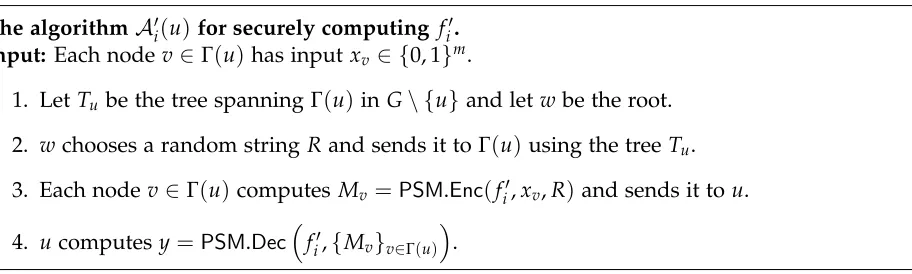
The compiler securely computes fi0 by simulating the PSM protocol for fi0, treatingu as the
serverand its immediate neighborhood as the parties. In order to exchange the private
random-ness, we use the notion of private neighborhood trees.
A private neighborhood tree collection consists of n trees, a tree Tu for every u, that spans
all the neighbors of u (i.e., the parties) without going through u, i.e., Tu ⊆ G\ {u}. Using this
tree, all the parties can compute shared private random bits R which are not known to u. For a single nodeu, this can be done inO(Diam(Tu) +|R|)rounds, where Diam(Tu)is the diameter
of the tree and R is the number of random bits. Clearly, our objective is to have trees Tu with
small diameter. Furthermore, as we wish to implement this kind of communication in all n
trees, Tu1, . . . ,Tun simultaneously, a second objective is to have small overlap between the trees.
That is, we would like each edgee to appear only on a small number of trees Tu (as on each of
these trees, the edge is required to pass through different random bits). These two objectives are encapsulated in our notion of private-neighborhood-trees. The final algorithm A0i(u) for securely computing fi0 is described in Figure 5.
The algorithmA0
i(u)for securely computing fi0.
Input: Each nodev∈Γ(u)has inputxv ∈ {0, 1}m.
1. LetTu be the tree spanningΓ(u)inG\ {u}and letwbe the root.
2. wchooses a random stringRand sends it toΓ(u)using the treeTu.
3. Each nodev∈Γ(u)computes Mv=PSM.Enc(fi0,xv,R)and sends it tou.
4. ucomputes y=PSM.Decfi0,{Mv}v∈Γ(u)
.
Figure 5: The description of the distributedPSMalgorithm of nodeufor securely computing the function fi0.
In what follows analyze the security and round complexity of AlgorithmA0
i.
Round Complexity. Let f : {0, 1}m·|Γ(u)| → {0, 1}` be a function with |Γ(u)| ≤ ∆ inputs, where
each input is of length m bits. The communication complexity of the PSM protocol depends on the input and output length of the function and also on the memory required to compute
f. Suppose that f is computable by an s-space Turing Machine (TM). Then, by Theorem 5 the communication complexity (and randomness complexity) of the protocol is at mostO(∆m`·22s). In the first phase of the protocol, the rootwsends a collection of random bits RtoΓ(u)using the private neighborhood trees, where|R|=O(∆·m·`·22s). By Theorem2, the diameter of the tree is at most Oe(D∆)and each edge belongs to Oe(D) different trees. Therefore, there are total
ofOe(D· |R|)many bits that need to go through a single edge when sending the information on
all trees simultaneously. Using the random delay approach of Theorem 4, this can be done in
e
O(D∆+D· |R|) =Oe(∆·D·m·`·22s)rounds. This is summarized by the following Lemma:
Lemma 1. Let f : ({0, 1}m)∆ → {0, 1}` be a function over ∆ inputs where each is of length at most
m and that is computable by a s-space Turing Machine. Then, there is a distributed algorithmA0i(u)(in
theCONGEST model) with perfect privacy where each node u outputs f evaluated on Γ(u). The round
complexity ofA0
5.3 The Final Secure Algorithm
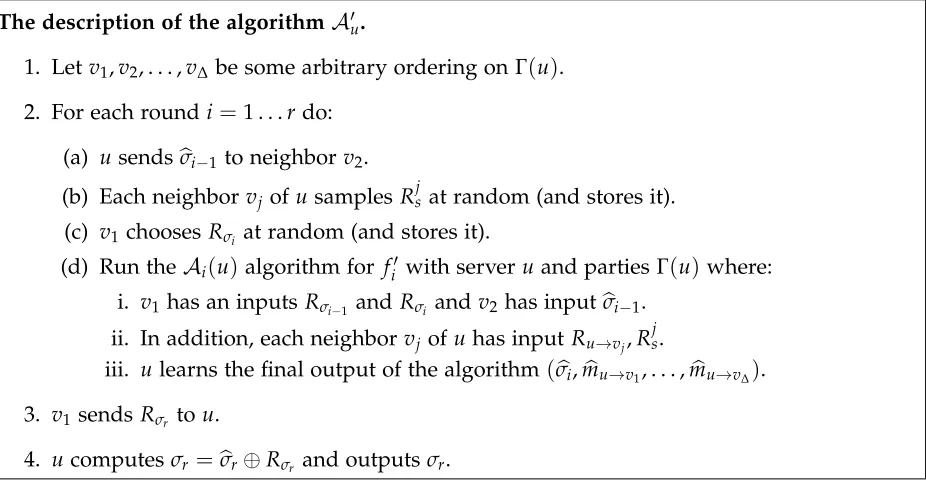
Using the function fi0, we define the algorithmA0
ufor computing the next state and messages of
the nodeu. We describe the algorithm for anyuin the graph and at the end we show that all the algorithms{A0u}u∈Gcan be run simultaneously with low congestion.
The algorithm A0
u involves running the distributed algorithm A0i(u) for each round i ∈
{1, . . . ,r}. The secure simulation of round i starts by letting the root of each tree Tu (i.e., the
tree connecting the neighbors of u in G\ {u}) sample a key Rσi for encrypting the new state of
u. Moreover, each neighborvj of u samples a share of the randomness Rjs used to evaluate the
function fi, and a key Ru→vj for encrypting the message sent fromuto vj.
Then they run A0
i(u) algorithm with u as the server and Γ(u) as the parties for computing
the function fi0 (see Figure5). The node u has the encrypted state and message, the neighbors of u have the (encryption and decryption) keys for the current state, the next state and the sent messages, and moreover the randomness for evaluating fi0. At the end of the protocol, u
computes the output of fi0 which is the encrypted output of the function fi.
After the final round, u holds an encryption of the final state σbr which contains only the
output of the original algorithm A. At this point, the neighbors ofu send it the decryption key for this last state,u decrypts its state and outputs the decrypted state. Initially, the stateσ0 is a
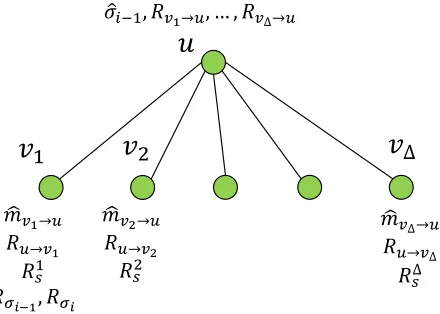
fixed string which is not encrypted, and the encryption keys for this round are assumed to be 0. The description is summarized in Figure6. See Figure7for an illustration.
The description of the algorithmA0u.
1. Letv1,v2, . . . ,v∆ be some arbitrary ordering onΓ(u).
2. For each roundi=1 . . .rdo:
(a) usendsbσi−1 to neighborv2.
(b) Each neighborvj ofusamplesRjsat random (and stores it).
(c) v1chooses Rσi at random (and stores it).
(d) Run theAi(u)algorithm for fi0 with serveruand partiesΓ(u)where: i. v1 has an inputsRσi−1 andRσi andv2has inputbσi−1.
ii. In addition, each neighborvj of uhas inputRu→vj,R j s.
iii. ulearns the final output of the algorithm(σbi,mbu→v1, . . . ,mbu→v∆).
3. v1sends Rσr tou.
4. ucomputes σr=bσr⊕Rσr and outputsσr.
Figure 6: The description of the AlgorithmA0u. We assume that in “round 0” all keys are initial-ized to 0. That is, we letRσ0 =0, and initially set Rvj→u=0 for all j∈ [∆].
Finally, we show that the protocol is correct and secure.
𝑢
𝑣
1ො
𝜎𝑖−1, 𝑅𝑣1→𝑢, … , 𝑅𝑣Δ→𝑢
ෝ 𝑚𝑣1→𝑢 𝑅𝑢→𝑣1
𝑅𝑠1
𝑅𝜎𝑖−1, 𝑅𝜎𝑖 ෝ 𝑚𝑣2→𝑢
𝑅𝑢→𝑣2 𝑅𝑠2
𝑣
2𝑣
Δෝ 𝑚𝑣Δ→𝑢
𝑅𝑢→𝑣Δ 𝑅𝑠Δ
Figure 7: The information held byuand its neighbors in phaseiof the algorithm.
of the algorithm. In the compiled algorithmA0, for each roundiof Aand every nodeuthe
sub-algorithmA0i(u)computes σbi, whereσbi =σi⊕Rσi where v1holds Rσi. Thus, after the last round,
uhasσbr andv1hasRσr. Finally, ucomputesbσr⊕Rσr =σr and outputsσras required.
Round Complexity. We compute the number of rounds of the algorithm for any natural algo-rithmA. The algorithm consists ofr0 =r·poly(∆+logn)iterations. In each iteration, every ver-texuimplements algorithmA0
i for the function fi0 (there are other operations in the iteration but
they are negligible). We know that fi can be computed ins-space wheres=O(log∆+log logn),
and thus we can bound the size of each input to fi0 bypoly(∆)·polylog(n). Indeed, the state has this bound by the definition of a natural algorithm, and thus also the encrypted state (which has the exact same size), the messages and encryption keys for the messages have length at most logn, and the randomness shares are of size at most the running time of fi which is at most 2s
where s is the space of fi and thus the bound holds. The output length shares the same bound
as well.
Since fi can be computed ins-space wheres=O(log∆+log logn), we observe that fi0 can be
computed ins-space as well. This includes running fi in a “lazy” manner. That is, whenever the
TM for computing fi asks to read a theithbit of the input, we generate this bit by performing the
appropriate XOR operations for theith bit of the input elements. The memory required for this is only storing indexes of the input which is log(∆·poly(logn))bits and thuss bits suffice.
Then, by Lemma 1 we get that algorithm A0i(u) for fi0 runs in Oe(D·poly(∆)) rounds, and
the total number of rounds of our algorithm isOe(rD·poly(∆)). In particular, if the degree ∆is
bounded bypolylog(n)then we getOe(rD)number of rounds.
Remark 1 (Round complexity for non-natural algorithms). If Ais not a “natural” algorithm then we can bound the number of rounds with dependency on the time complexity of the algorithm. If each
function fi (the local computation of the nodes) can be computed by a circuit of size t then the number of
rounds of the compiled algorithm is bounded byOe(rDt·poly(∆)).
Security. We begin by describing the security of a single sub-protocol A0