Farfalle: parallel permutation-based cryptography
Guido Bertoni
3, Joan Daemen
1,2, Seth Hoffert,
Michaël Peeters
1, Gilles Van Assche
1and Ronny Van Keer
11STMicroelectronics
2Radboud University
3Security Pattern
Abstract.In this paper, we introduceFarfalle, a new permutation-based construction for building a pseudorandom function (PRF). The PRF takes as input a key and a sequence of arbitrary-length data strings, and returns an arbitrary-length output. It has acompression layerand anexpansion layer, each involving the parallel application of a permutation. The construction also makes use of LFSR-likerolling functionsfor generating input and output masks and for updating the inner state during expansion. On top of the inherent parallelism, Farfalle instances can be very efficient because the construction imposes less requirements on the underlying primitive than, e.g., the duplex construction or typical block cipher modes. Farfalle has anincremental
property: compression of common prefixes of inputs can be factored out. Thanks to its input-output characteristics, Farfalle is really versatile. We specify simple modes on top of it for authentication, encryption and authenticated encryption, as well as a wide block cipher mode. As a showcase, we present KRAVATTE, a very efficient instance of Farfalle based on KECCAK-p[1600,nr]permutations and formulate concrete security claims against classical and quantum adversaries. The permutations in the compression and expansion layers of KRAVATTEhave only 6 rounds apiece and the rolling functions are lightweight. We provide a rationale for our choices and report on software performance.
Keywords:pseudorandom function·permutation-based cryptography·KECCAK
1
Introduction
Until recently, symmetric cryptography was dominated by block ciphers. With the excep-tion of some dedicated stream ciphers, standards and commercial products performed encryption, authentication, authenticated encryption on top of a block cipher, often the AES [23], and even hashing is done with block-cipher-based modes. For a couple of decades, a lot of innovation has been brought to block cipher-based cryptography in the form of the definition of new modes, particularly for authentication and authenticated encryption.
Upon closer inspection of these modes, one can see a tendency towards modes that do not use the inverse mapping of the block cipher. Remarkably, the support for this inverse mapping imposes a separation of the processing of theb=k+nbits of the input, withk
the key length andnthe block size. Namely, the key is processed in a key schedule and the data in the data path, and there can be no diffusion from the data path to the key schedule. This strongly limits the potential diffusion as illustrated by the birthday bounds in both
length) andkey length(security against multi-target attacks in absence of global nonces is only 2k/2withkthe key length). So we think using a block cipher in a mode that does not use its inverse is a waste. Well-known examples of block cipher-based functions that do not use the inverse mapping are counter mode encryption and any block cipher-based authentication. In addition, the NIST hash function standards SHA-1 and SHA-2 [47,48] can be seen as building on top of block ciphers without the need of the inverse mapping.
As opposed to block ciphers, cryptographic permutations do not make a distinction between key and data input and hence do not suffer from this limitation. Their use gained popularity in the years 2000, in particular during the SHA-3 competition, as several candidates were based on this type of primitive. Furthermore, the selection of the permutation-based KECCAKsponge function as the SHA-3 standard gave increased visibility to this type of cryptographic primitive [12,49]. We introduced the concept of sponge functions in 2007, initially aimed at hashing, although soon after we developed modes for efficient encryption, authentication and authenticated encryption. For the latter we had to do some refactoring, leading to the (full-state) keyed duplex construction [22]. Today, sponge-based cryptography has become a full-fledged alternative to its block cipher-based counterpart.
Yet, the sponge and duplex constructions are inherently serial. The bulk of the compu-tation consists of the repeated evaluation of a permucompu-tation, and for every evaluation we need the output of the previous one. Modern high-end CPUs are so powerful that evaluatingnpermutations simultaneously is faster than evaluating them in sequence. For hashing, optimal performances can be obtained by using tree hashing. A concrete example of a hash function that can exploit a high degree of parallelism is KANGAROOTWELVE[16].
For separate authentication or encryption, similar techniques can be applied. However, for duplex-based authenticated encryption, the amount of available parallelism must be known in advance. An example of a mode for authenticated encryption that supports configurable parallelism is Motorist, the mode underlying KEYAK[15].
Also, the sponge and duplex constructions limit the number of output bits per evaluation of the permutation tor=b−c, withbthe width of the permutation andca parameter, called thecapacity, that determines the security strength. Depending on the mode of use and the adversary’s capabilities, in order to achievesbits of security, one must takec
somewhere betweensand 2s. Consequently, for a security strength of 128 bits, the rate
ris 128 to 256 bits smaller than the permutation width. This restricts the underlying permutation to have some minimum width, and for relatively small widths the efficiency is not optimal.
To address these concerns, we set out to define a parallelizable counterpart for sponge-based cryptography. The ambition quickly became to have permutation-sponge-based modes for all keyed operations in symmetric cryptography that can exploit arbitrary parallelism and that can make use of permutations as small as the birthday bound (b=2s). We called the resultFarfalle.
Similarly to sponges, the Farfalle offering is built around a (composite) primitive and modes on top of it. This primitive is a pseudorandom function (PRF) that takes as input a key and a string (or a sequence of strings), and produces an arbitrary-length output. To an adversary not knowing the key, these output bits look like independent uniformly-drawn random bits. Such a PRF is a powerful primitive that can readily be used as a message authentication codes (MAC), a stream cipher or a key derivation function. With some very simple modes, one can turn it into an authenticated encryption scheme and even a block cipher supporting variable block length.
of permutations possibly with different numbers of rounds. The constructed PRF takes as input a key and a sequence of length data strings, and it generates an arbitrary-length output. It consists of amask derivation, acompression layerand anexpansion layer, each of them involving the parallel application of a permutation. The compression layer applies one of the permutations to input blocks, each blinded with arolling b-bit input mask, and it (bitwise) adds their outputs in ab-bitaccumulator. For the expansion layer, the accumulator is subject to a permutation and then used as a rolling state to generate the output. Each output block is the sum of the output mask and the result of a permutation applied to the rolling state.
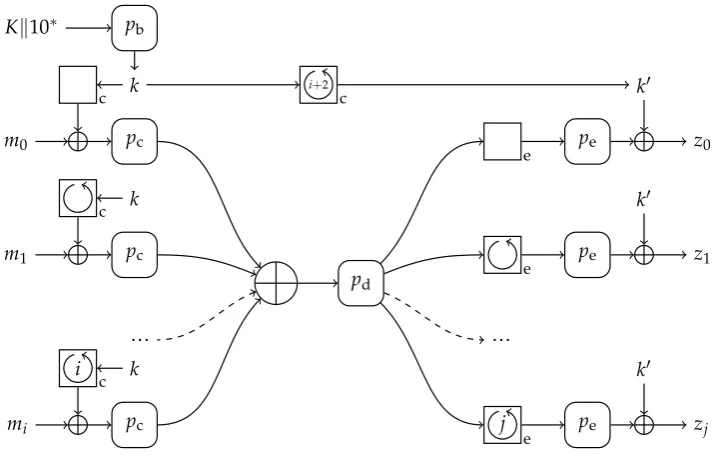
We depict the compression and expansion stages of Farfalle in Figure1. The construction aims for simplicity and efficiency and has some features in common with the sponge construction [8]. As in sponges, the inverse of the permutation is not used. Another inter-esting feature it has in common with sponges is the ability to compute it for incremental inputs. While in sponges this is modeled by the duplex construction [10], in Farfalle this is achieved by the fact that the contribution of input strings to the accumulator only depends on their value and position in the input.
Farfalle can be seen as a parallelizable counterpart of the sponge for keyed applications. In particular, its permutation calls can be performed in parallel as soon as the input masks have been generated. This can be exploited on many platforms, including on modern processors with single-instruction multiple-data (SIMD) units. Moreover, it can be made very efficient as the number of rounds in the permutations can be taken much smaller than in sponge-based modes, thanks to the fact that in Farfalle an adversary never has access to both the input and the output of a permutation call.
Thanks to its input-output characteristics, Farfalle is really versatile. We specify concrete modes on top of it for authentication, encryption and authenticated encryption, as well as a wide block cipher mode.
Farfalle can be instantiated with any cryptographic permutation. In particular, we in-stantiate it with the KECCAK-ppermutations and with a rolling function similar to those proposed in [29], attach concrete security claims to it and call the result KRAVATTE. Refer-ence and optimized code for KRAVATTEis available in KECCAKTOOLSand in the KECCAK
code package, respectively [13,17].
1.1
Overview of the paper
After introducing our notation and the main components of Farfalle in Section2, we specify the Farfalle construction in Section 3. In Section 4we define (authenticated) encryption modes: a session-supporting mode for authenticated encryption (AE), a synthetic initial value (SIV) AE mode and a wide block cipher. Section5gives a rationale for the basic construction and Section 6discusses some prior art for Farfalle and its modes. In Section7we specify KRAVATTE, a concrete instance of Farfalle making use of KECCAK-p, the permutation underlying KECCAK, make a security claim and provide some rationale. Finally, Section8is dedicated to an analysis of linear rolling functions that can be used in conjunction with any permutation with low algebraic degree.
2
Notation and components
2.1
Strings
Farfalle operates on strings of bits, that we will just callstringsin the following. Inside Farfalle, strings are processed in chunks ofbbits, wherebis the width of the underlying permutations. We use uppercase characters for arbitrary-length strings and lowercase characters forb-bit strings.
We denote the length of a stringXby|X|. The set of strings of lengthnisZn2and the set of strings of any length isZ2∗.
When applied to strings, the+operator is the bitwise addition, a.k.a. modulo 2 addition or exclusive-or (XOR). The||operator is the concatenation.
Converting an input string to an array ofb-bit strings requires a padding rule. We use simple padding that appends a single 1-bit followed by the minimum number of 0-bits resulting in a string with a length that is a multiple ofb. We writeP=pad10∗(M). The stringPcan be seen as an array ofb-bit blockspi. It is convenient to have indexistart
from a value of our choiceI. We denote this asP= pI,pI+1. . .pI+n−1, withndenoting
the number ofn-bit blocks inP.
A sequence of m strings M(0) to M(m−1) is denoted M(m−1)◦ · · · ◦M(1)◦M(0). The notation deliberately reminds of the composition of functions. The set of all sequences of at least one string is(Z2∗)+.
Farfalle yields a PRF that returns a string of arbitrary output length. In our notation, we let the length of this string be determined by the context. In particular,X+FK(M)means
that the required output length ofFK(M)is|X|. In some cases it is convenient to skip the
firstqbits of the output. For this we use the notationX+FK(M)qto indicate that we
take the output starting from offsetq, i.e., the bitsqtoq+|X| −1 of the output produced byFK(M).
2.2
Permutations
Farfalle makes use of four cryptographic permutations, each operating onb-bit strings:
pb for deriving the initial mask from the keyK
pc in the compression layer
pd between the compression and expansion layer
pe in the expansion layer
Specific security requirements apply for each of them, see Section5. It is however not a security requirement that they are different. One may specify instances of Farfalle where the four permutations are the same. We think the way to instantiate the most efficient Farfalle instances is by taking a permutation with a variable number of rounds and tuning the rounds for the four different cases to optimize the ratio efficiency vs. safety margin.
2.3
Rolling functions
Arolling function, denoted as roll, is a permutation ofZ2b. Farfalle makes use of two rolling functions, each operating onb-bit strings:
rolle to update the internal state during expansion
We write roll(k)for the result after applying the rolling function once and rolli(k)for the result after applying ititimes.
Typically, rollcis a lightweight linear function with huge order, like updating functions of
linear feedback shift registers. The main security requirement is the following. Informally, an adversary not knowingkshall not be able to predict the mask value rollic(k)for anyiin
a reasonable range nor the difference between any pair of mask values rollic(k) +roll j c(k)
for anyi6=jin that range. The combination with permutations of low algebraic degree introduces an additional security requirement: the set{rollic(k)|0 ≤ i < n}shall not contain high-dimensional affine spaces forna reasonable value (see Section8.1).
The requirements for the rolling function rolledepend on the algebraic degree ofpe. If
the algebraic degree is relatively high, a function that qualifies as rollcalso qualifies as
rolle. However, ifpehas a relatively low algebraic degree, rollemust be non-linear due to
the existence of certain attacks (see Section5.3for a more in-depth discussion). Naturally, rolleshould have a negligible amount of states in short cycles (preferably none) as they
would lead to periodic output sequences. The absence of high-dimensional affine spaces remains a requirement, but for a non-linear rolling function it is very unlikely that these exist.
Finally, with the eye on parallelizability, we wish the computation of both rollcand rolle
to be lightweight and allow the computation of several iterations simultaneously.
3
Specification of Farfalle
We define Farfalle, a PRF construction that takes as input a variable-length secret keyK
and a data string sequence, and returns an extract of the output stream at a desired offset and for a desired length. It makes use of four permutations and two rolling functions. Informally, Farfalle consists of three parts. First, the key derivation computes ab-bit mask
kfrom the keyK. Then, the compression layer computes ab-bitaccumulatorfrom the data string sequence using the maskk. And finally, the expansion layer computes ab-bit
rolling statefrom the accumulator and then generates the output from the rolling state and a mask derived fromk. We provide the definition in Algorithm1and an illustration in Figure1.
The compression layer applies a permutationpctob-bit blocks, each the sum of a data
block and a rolling mask rollic(k)withithe index of the block in the sequence and (bitwise)
adds them into the accumulatorx. It enjoys a rather powerfulincremental property. The block indexionly depends on the length and number of input blocks accumulated already. Clearly, if multiple Farfalle computations share the same data blockxwith the same block index, their contribution to the accumulator is the same andpc(x+rollic(k))needs to be
computed only once. A special case of this is Farfalle applied to multiple string sequences with a common prefix and the same initial maskk.
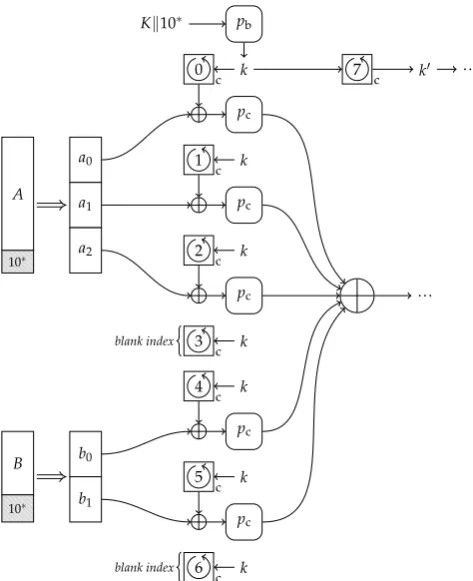
Note that to separate input strings, the value of the index for the first block ofM(j)is 2 higher than that for the last block ofM(j−1). There is hence a block index value for which there is no contribution to the accumulator. We call this ablank index, a concept elucidated in Figure2.
pc
c
m0
k
pc
c
m1
k
…
pc
i
c
mi
k
pe
e z0
k′
pe
e z1
k′
…
pe
j
e zj
k′ K∥10∗ pb
i+2 c
pd
Figure 1: The Farfalle construction.
Algorithm 1Definition of Farfalle[pb,pc,pd,pe, rollc, rolle]
Parameters:b-bit permutationspb,pc,pdandpeand rolling functions rollcand rolle. Input:
keyK∈Z∗
2,|K| ≤b−1
input string sequenceM(m−1)◦ · · · ◦M(0)∈(Z2∗)+ requested lengthn∈Nand offsetq∈N
Output:stringZ∈Zn 2
K0=pad10∗(K)
k←pb(K0){mask derivation}
x←0b
I←0
forjrunning from 0 tom−1do
M=pad10∗(M(j))
SplitMinb-bit blocksmItomI+µ−1
x←x+∑i=II+µ−1pc(mi+rollic(k))
I←I+µ+1 {skip the blank index}
k0 ←rollcI(k)
y←pd(x)
whileall the requestednbits are not yet produceddo
produceb-bit blocks aszj= pe(rollje(y)) +k0
Z←nsuccessive bits from concatenation ofz0||z1||z2. . . starting from bit with indexq.
return Z=0n+FK
pc 0
c k
pc 1
c k
pc 2
c k
3 c k blank index
pc 4
c k
pc 5
c k
6 c k blank index
K∥10∗ pb
k′ …
7 c
a0
a1
a2
b0
b1 A
10∗
B
10∗
…
Figure 2: A closer look at the compression of example string sequenceB◦Ain Farfalle.
been formed and rollic(k)is available. Hence if rollcis relatively lightweight, the main
part of the computation, namely the evaluations ofpc, can be done in parallel.
The compression and expansion layers of Farfalle require a secret maskkof exactly b
bits. We wish to accommodate variable-length keys and for that purpose we generate the initial maskkby applyingpbto the padded user keyK.
The expansion layer computes the rolling statey from the accumulator x simply by applying a permutationpdand uses the rolling state in a stream generator. For an output
block with indexj, it applies a permutationpeto the rolling state rollje(y)and (bitwise)
adds the maskk0to the result before presenting it at the output.
4
Modes of use
Farfalle can be readily used for MAC computation, key derivation and keystream genera-tion. It allows amortizing the computation ofkamong different computations with the same keyK.
We now define three (authenticated) encryption modes on top of Farfalle.
independently. In other words, we claim no security for different mode instances with the same key or with different modes with the same key.
4.1
Session-supporting authenticated encryption scheme
In many use cases where one wishes confidentiality, authentication is required too and it makes sense to offer a scheme that provides both: an authenticated encryption scheme. Doing this with a PRF is simple: one enciphers the plaintext by adding to it the output of a PRF applied to a nonce and computes a tag on the ciphertext (and possibly metadata). Often, one does not only want to protect a single message, but rather asessionwhere multiple messages are exchanged, such as in the Transport Layer Security (TLS) protocol [27] or the Secure Shell (SSH) protocol [52]. Examples of session-supporting authenticated encryption schemes are the CAESAR submissions KEYAK[15] and KETJE[14]. They
require only a nonce at the startup of the session and each tag authenticates all messages already sent in the session.
We define a session-supportingauthenticated encryption schemesimilar to the Motorist mode defined in [15]. The session keeps track of ahistorythat is presented to an (incrementable) PRF for generating tags and keystream. Starting a session initializes the history to a nonce
N. From then on, it supports messages consisting of metadataAand/or plaintextP. The wrapping of a message consists of three phases. First, Farfalle-SAE adds to the plaintext, if non-empty, the output of the incremental PRF applied to the history in order to generate the ciphertext. Second, it appends the metadata and/or ciphertext to the history. Finally, it generates the tag by applying the PRF to the history. Note that a tag authenticates the complete history of the session. Unwrapping is similar.
Farfalle-SAE has two parameters: the tag lengthtand an alignment unit length`. It reserves the first tbits of the PRF output for tags and takes keystream from the PRF output stream from an offset that is the smallest multiple of`not shorter thant. Moreover, Farfalle-SAE applies domain separation between metadata and ciphertext strings in the history to skip the first phase for plaintext-only messages or the second phase for metadata-only or even empty messages. We provide a formal specification in Algorithm2.
Clearly, this mode requires the PRF to have the incremental property. When instantiated with Farfalle, the mask derivation must be done only once and in every call to Farfalle only the recently appended string must be compressed. Like in Motorist [15], the initialization returns a tag that can be sent along with the nonce (sender) or verified at the beginning of a session (receiver).
4.2
SIV authenticated encryption scheme
Algorithm 2Definition of Farfalle-SAE[F,t,`]
Parameters:PRFF, tag lengtht∈Nand alignment unit length`∈N
Initializationtaking keyK∈Z∗
2and nonceN∈Z∗2, and returning tagT∈Zt2
offset=`t
`
: the smallest multiple of`not smaller thant
history←N
T←0t+FK(history) return T
Wraptaking metadataA∈Z∗
2and plaintextP∈Z∗2, and returning ciphertextC∈Z |P| 2
and tagT∈Zt 2
C←P+FK(history)offset if|A|>0 OR|P|=0then
history←A||0◦history
if|P|>0then
history←C||1◦history
T←0t+FK(history) return C,T
Unwraptaking metadataA∈Z∗2, ciphertextC ∈Z2∗and tagT ∈Zt
2, and returning
plaintextP∈Z|C|
2 or an error
P←C+FK(history)offset if|A|>0 OR|C|=0then
history←A||0◦history
if|C|>0then
history←C||1◦history
T0 ←0t+FK(history) ifT0=Tthen
return P
else
proposed to the Internet Research Task Force (IRTF) and the Crypto Forum Research Group (CFRG) as specified in a RFC [31].
Farfalle-SIV takes as input a secret keyK, an arbitrary-length plaintextPand arbitrary-length metadataAand returns a ciphertextCwith the same length as the plaintext and a fixed-length tagT. It first computes the tag by applying a PRF toP◦Aand enciphersP
by adding to it the output of the PRF applied toT◦A. We provide a formal specification in Algorithm3.
Algorithm 3Definition of Farfalle-SIV[F,t]
Parameters:a PRFFand tag lengtht∈N
Wraptaking metadataA∈Z∗2and plaintextP∈Z∗2, and returning ciphertextC∈Z|2P| and tagT∈Zt
2
T←0t+FK(P◦A)
C←P+FK(T◦A) return C,T
Unwraptaking metadataA∈Z∗
2, ciphertextC ∈Z2∗and tagT ∈Z2t, and returning
plaintextP∈Z|2C|or an error
P←C+FK(T◦A)
T0 ←0t+F
K(P◦A) if T0=T then
return P
else
return error!
The security of this mode relies on Farfalle to be a PRF. For confidentiality, it requires that all messages that are enciphered with the same key and that have the same metadataA
result in a different tagT. Two distinct messages with colliding tags will use the same keystream to encipher their plaintexts and hence the sum of their ciphertexts will be equal to the sum of their plaintexts. For a chosen value of the parametert, the probability of a tag collision occurring innmessages is upper bounded byn2/2t+1. For example, if in an application it is reasonable to assume that only 240messages with the same (or empty) metadata and the same key will be processed, and one is willing to accept a risk of a collision up to 2−40, tags of length 128 bits will do the job. For tag collisions between messages with different metadataAthere is no security problem as the keystream also depends on the metadataA.
When instantiated with Farfalle, the mask derivation and the compression ofAthat are in common to both calls toFK()must be done only once, thanks to the incremental property.
4.3
Wide block cipher
We define atweakable wide block cipherbased on two PRFs. The global construction is an instantiation of the HHFHFH mode as presented by Dan Bernstein at the Symmetric Cryptography Dagstuhl seminar in January 2016 [6], that is in turn based on work of Naor and Reingold [46], that is based on a paper by Stefan Lucks [42], that builds further on work of Luby and Rackoff [41].
It takes as input a secret keyK, an arbitrary-length plaintextPand an arbitrary-length tweakWand returns a ciphertextCof same length as the plaintext. It performs a 4-round Feistel network to the plaintext. The latter is split into a left and a right part, with length determined by the function split[b,`]. This function takes the block lengthnand returns the length of the left partnL, which is a multiple of the given alignment unit length`.
The functionG(corresponding toF◦Hin HHFHFH) used in the two middle rounds must be a PRF and takes as input part of the intermediate result and the tweak. The functionHused in the first and last round does not necessarily have to be a PRF but must be differentially uniform. We provide a formal specification of the split function in Algorithm4and of the Feistel network in Algorithm5. A rationale for the split function is given at the end of this section.
A (tweakable) wide block cipher can be converted to an authenticated encryption scheme by applying a very simple mode [34]. The metadata is used as tweak and as encipherment input one uses the plaintext with some agreed verifiable redundancy, such as 8 bytes equal to zero appended to the end. The cryptogram is the encipherment output. One can authenticate the cryptogram by verifying that the decipherment output ends in the agreed fixed string. This verification process can be performed before full decipherment is completed, allowing for early rejection of unauthentic cryptograms. As observed in [3], in comparison to SIV, a wide block cipher mode has the advantage of smaller overhead for the same forgery resistance. We provide a formal specification in Algorithm6.
The wide block cipher in principle supports any length. However, the generic security it can achieve is limited by the ability to generate collisions in the left or right part of the intermediate result. Such collisions become likely as soon as the number of processed blocks reaches 2min(nL,nR)/2 ≤ 2n/4. For this reason, one cannot claim a security level
higher than the width divided by 4 and hence the width cannot be taken too small.
When instantiatingHandGwith two instances of Farfalle that have the same permutation forpb, the mask derivation can be pre-computed. Similarly, the compression of the tweak
Wcan be shared among the computations ofGK(R||1◦W)andGK(L||0◦W).
4.3.1 Rationale for the split function
The function split[b,`]returns a valuenLthat minimizesmL+mR, wheremLis the number
ofb-bit blocks to hold theLstring in Algorithm5andmRis defined similarly forR. We
further require thatLis aligned on`bits, i.e., thatnLis a multiple of`. More precisely,
the number of blocks at the left ismL = ln
L+2 b
m
, since Algorithm5requires appending one frame bit for domain separation and Farfalle adds one bit of padding. As`≥2 and we want thatnL|`, these two bits are absorbed in a buffer of at least`bits that ensures
the alignment, and we can equivalently writemL = ln
L+` b
m
. Similarly, the number of
blocks at the right ismR= ln
R+2 b
m
. Because of the domain separation bits, padding bits and buffer for alignment, the total number of blocksmL+mRis at leastqas defined in
Algorithm4. An optimal solution meansmL+mR=q.
Algorithm 4 Definition of split[b,`]
Parameters: permutation widthb ∈ Nand alignment unit length` ∈ N, satisfying
`≥2 and`|b
Input:block lengthn∈N
ifn≤2b−(`+2)then
nL =` j
n+`
2`
k
else
q=ln+`b+2m, i.e.,qis smallest multiple ofbthatn+`+2 fits in
x=blog2(q−1)c, i.e.,xis largest integer such that 2x<q nL = (q−2x)b−`
return nL =split(n)
Algorithm 5Definition of encryption in Farfalle-WBC[H,G,`]
Parameters:two PRFsHandGand alignment unit length`∈N
Encipher taking keyK ∈ Z∗2, tweakW ∈ Z∗2 and plaintextP ∈ Z∗2 and returning ciphertextC∈Z|P|
2
Lgets first split(|P|)bits ofPandRthe remaining ones
R0←R0+HK(L||0), withR0the first min(b,|R|)bits ofR
L←L+GK(R||1◦W)
R←R+GK(L||0◦W)
L0←L0+HK(R||1), withL0the first min(b,|L|)bits ofL return C← the concatenation ofLandR
Algorithm 6Definition of Farfalle-WBC-AE[H,G,t,`]
Parameters:two PRFsHandG, the expansion lengtht∈Nand alignment unit length
`∈N
Wrap taking keyK ∈ Z∗2, metadata A ∈ Z∗2 and plaintextP ∈ Z2∗, and returning ciphertextC∈Z|2P|+t
P0 ←P||0t
return C←Encipher(K,A,P0)
Unwraptaking keyK∈Z∗2, metadataA∈Z∗2and ciphertextC∈Z∗2, and returning plaintextP∈Z|2C|−tor an error
Lgets first split(|C|)bits ofCandRthe remaining ones
L0←L0+HK(R||1), withL0the first min(b,|L|)bits ofL
R←R+GK(L||0◦A) if |R| ≥b+t then
if the lasttbits ofR6=0t then returnerror!
L←L+GK(R||1◦A)
R0←R0+HK(L||0), withR0the firstbbits ofR else
L←L+GK(R||1◦A)
R0←R0+HK(L||0), withR0the first min(b,|R|)bits ofR if the lasttbits ofL||R6=0t then returnerror!
P0 ←L||R
not too small, to take into account the difference uniformity ofHKwith output truncated
tonLornRbits. The function split distinguishes between two cases.
• Forn ≤ 2b−(`+2), we have mL = mR = 1. The function split maximizes
min(nL,nR)within the constraint thatnLis a multiple of`. More precisely, it is easy
to show that|nL−nR| ≤`.
• Forn>2b−(`+2), we first translate the requirement on the lengths to min(nL,nR)≥
b−`. Algorithm4realizes this by takingnL =mLb−` ≥b−`for some number
of blocksmL ≥1 on the left side. For the right side, we haveq≥3, so thatmR≥2
andnR≥b−1. Second,nLis a multiple of`bits sincebis a multiple of`. Then, we
reach optimality sincenR=n−(mLb−`)and thusmR= ln
R+2 b
m
=q−mL. (Note
that this works independently of the choice ofmL.) Finally, the function splits these
qblocks into the largest power of two forR. As the parallelism degree is often a power of two, this enables its optimal exploitation.
5
Rationale for Farfalle
A Farfalle function loaded with a secret keyK can be distinguished from a random function in several ways. We list here the types of attack that have played an important role in shaping Farfalle and that impose criteria on the used permutations and rolling functions:
1. accumulator collision: finding two input strings leading to identical accumulators;
2. weaknesses in the mask derivation;
3. distinguishing the output for a single input from a random string
• retrieving rolling state and mask using algebraic attacks
• detecting bias in the output sequence using higher-order differentials
• detecting bias in the output sequence using correlation propagation
4. distinguishing the output for multiple inputs from random strings;
5. finding the values of y and k from input-output pairs.
We discuss these attacks in the following subsections.
5.1
Accumulator collision
Recall that the accumulator is the valuexthat sums the contributions ofpc(mi+rollci(k)).
Finding two string sequencesMandM0leading to the same value of the accumulator can be used to attack Farfalle. The difficulty of finding collisions in the accumulator is based on the differential propagation properties ofpcand is helped by the fact that before
being subject topc, each input blocksmiis whitened with the rolling input mask rollic(k)
5.1.1 Sets of input blocks that contribute 0 to the accumulator
The simplest method, at least conceptually, is to formM0by appending a block at the end ofMand hope itsb-bit contribution to the accumulator is zero. Succeeding in doing this is equivalent to successfully guessingk.
One may try to append two blocks where the input to the permutation is equal: mi+
rollic(k) =mi+1+rolli+1c (k). The ability of the adversary to do this critically relies on her
ability to predict rollic(k) +rolli+1c (k), imposing the requirement for the rolling function
that it shall be hard to predictk+roll(k)for unknownk. This attack can be generalized by not only appending blocks toM, but also putting input blocks inM0where there are blank indices inM. Then it shall be hard to predictk+rollδ
c(k)for unknownkand any
offsetδin a reasonable range.
Appending multiple blocks and saying something meaningful on their joint contribution to the accumulator is possible if the permutation has sufficiently low algebraic degree and the rolling function allows predicting mask differences. Basically, if one chooses the input blocks such that the corresponding inputs topcform an affine space of sufficient
dimension, their joint contribution is zero. We refer to Section8.1for more explanation. This imposes a requirement on the rolling function that a sequence of masks with reason-able index values shall not contain an affine space of dimension higher than the algebraic degree of the permutation.
5.1.2 Input block variants swapping pc inputs
One may try to construct M0 from Mby modifying two input blocksmi and mj into
m0i andm0j, such that the input to pcformi equals that ofm0jand vice versa. This will
just swap the contribution of blocks i and j to the accumulator. As the addition is commutative, the joint contribution is the same in both cases. This boils down to finding
mi+rolli(k) = m0j+roll
j(k)and a similar expression form
jandm0i. The ability of the
adversary to come up with such input blocks again critically depends on her ability to predictk+rollδ(k)for unknownkand any offset
δin a reasonable range.
5.1.3 High-probability differentials in pc
Another approach exploits high-probability differentials inpc. One applies two different
inputs Mand M0 that have the same length but differ in a limited number of blocks, denoted asactive. Due to the invertibility ofpc, the smallest number of active blocks that
may lead to a collision is 2. Let the difference in the first block be∆and that in the second block∆0. We have a collision if these differences propagate to the same difference through the permutation. Assuming the adversary does not know the mask values for the active blocks, the probability of a collision is
Pr(collision) =
∑
γDP(∆,γ)DP(∆0,γ), (1)
with DP(x,y)the differential probability of differential(x,y)over pc. The differential
probabilities DP(∆,γ)for fixed∆and varyingγcan be seen as a vector with 2b
yielding:
Pr(collision) =
∑
γDP2(∆,γ). (2)
This presents a clear criterion forpc.
In the initial rounds an adversary may try to guide the difference propagation by making assumptions on the masks rolli(k)and rollj(k)and choose the corresponding message blocksmiandmjto satisfy certain conditions in the propagation. If the number of bits
to be guessed is smaller than the number of conditions to be satisfied, this may result in some gain. This hence presents a criterion for the rolling function.
5.2
Properties of the mask derivation
To derive the maskk, we apply thepbpermutation to a variable-size keyKafter padding
it in a reversible way. This ensures that no collision can happen between different keys, even with different sizes.
We would like to highlight two properties that we expect from the mask derivation.
• As explained in Section5.1, the adversary should have no effective way to predict the value ofk+rollδ
c(k)for reasonable values ofδ. Otherwise, she can easily produce
accumulator collisions, e.g., by swapping input blocks.
• Regarding differential attacks, the input topc, namely,mi+rollic(k), should look
sufficiently random to an adversary, so as to prevent her from choosing input values that significantly decreases the workload to propagate a difference according to a differential trail.
To satisfy these properties, we express the requirement onpbthat for every matrixMof
rankr, the min-entropy ofM×kis close to the minimum ofrand the min-entropy of the keyK. This encompasses the first property when rollcis a linear function, our preferred
option as illustrated by KRAVATTE(see Section7.4.2), by choosingM=I+rollδ
c, withIthe
identity matrix. For the second property, whenpcemploys a degree-two round function
(also our preferred choice), the conditions on the absolute values for the propagation of differences are linear. Hence, by choosingMaccordingly, this requirement ensures that the difference cannot be propagated with a higher probability than expected.
5.3
Distinguishing the output from a random string (single input)
Clearly, one may have a collision in the sequence of rollje(y)values if there is a short cycle
or if different accumulator valuesx andx0 lead to rolling state valuesy = pd(x)and
y0 =pd(x0)such that rollδe(y0) =yfor some reasonably small value ofδ. As a consequence,
the rolling function rollemust be chosen such that the states are in very long cycles.
Every output block depends on an output mask and a rolling state. Hence, it requires at least two output blocks to determine the value of the rolling state and/or the output mask. When performing an algebraic attack using two output blocks, the adversary must solve a system of equations with unknown variables spread over two full instances of the permutationpe.
block would introduce many additional variables. However, as pointed out by a team of cryptanalysts who reported to us their attacks [2] on a preliminary version of KRAVATTE, the following techniques can be applied:
Meet-in-the-middle They express bits of the intermediate state afterqrounds ofpe as
polynomials of bits of the rolling state rollej(y)on the one hand and as polynomials
of the output maskk0on the other, using the knowledge of an output blockzj. This
gives rise to a set of polynomial equations with monomials in bits ofyand in bits of
k0. The number of monomials inyis limited by the algebraic degree ofqrounds ofpe,
and the number of monomials ink0is limited by the algebraic degree ofn−qinverse rounds ofpe. Thanks to the fact that the bits of rollej(y)can be expressed linearly as
bits ofy, more equations can be obtained without introducing new monomials by repeating this for many output blockszj.
Linearization The non-linear equations can be converted to a system of linear equations by considering the monomials as independent variables (let us call them the monomial variables) and solving the system of equations using linear algebra.
Elimination of monomials by exploiting linear recurrence If rolle is linear, the bits of
rollej(y)satisfy a linear recurrence equation. Referring to prior art in the
crypt-analysis of filtered LFSRs, the attackers show that the monomials in rolle satisfy
the same linear recurrence relations and hence so do the monomial variables. This allows eliminating the monomial variables in rollje(y)from the system of linear
equations above, leaving only monomial variables ink0. This dramatically reduces the complexity of the attack.
Although this requires a substantial amount of output blocks and takes a considerable effort even for choices ofpethat have a relatively small degree, it still may be feasible
with data and computational complexity that would break a reasonable security claim. One may protect against this attack by adopting a permutationpewith higher algebraic
degree, e.g., by taking more rounds, but this has a negative impact on the efficiency of the expansion phase.
Taking a closer look at the attack techniques, we see that they strongly rely on the linearity of rolle. First of all, generating more equations for more output blocks does not introduce
new monomials because the bits of rollie(y)are linear functions of the bits ofy. Second,
the elimination of monomials inyalso requires rolleto be linear. This strongly suggests
that using a non-linear rolling function for rolle would provide protection against the
described attacks, without the need to take a higher-degree permutationpe. Moreover,
it is very likely that even a very small amount of non-linearity in rolle is sufficient for
reasonable choices of pe. The attacks described in [2] require huge numbers of output
blocks and hence imply many iterations of the rolling function rolle. For this reason, we
recommend adopting a lightweight non-linear rolling function for rolle.
Another method to distinguish the output is to find biases in linear combinations (parities) of output bits using the correlation properties of the permutation. Consider the case where these bits are spread across two blocks. The output block with indexi+jis completely determined by the output block with index j and the output mask: pe−1(zi+j+k) =
rollie(pe−1(zj+k)), or equivalently
zi+j=k+
pe◦rollie◦pe−1
(zj+k).
amplitude is independent ofkand equal to the absolute value of
∑
w
Corrpe◦rolli
e(u,w)Corrpe(v,w).
If rolleis non-linear, it is likely that the accumulated non-linearity in rollie(w)will make
this harder to exploit with increasingi. This comes down to a joint criterion forpeand
rolle.
5.4
Distinguishing the output from a random string (multiple inputs)
We now describe a distinguishing attack that requires 2dchosen input strings withd−1 the algebraic degree ofpe◦pd. For a given keyK, we compute Farfalle for 2dinput strings,
each consisting ofdinput blocks and one block of padding. Each string has the form
m(λ) =mλ00||m1λ1||. . .||mλd−d−11, whereλ∈Z2dandm0i 6=m1i for alli.
If we denoteri =pc(m0i +rolli(k))andr∗i =pc(m1i +rolli(k))andr0i =ri+r∗i 6=0, then
the value of the accumulator for the input string with labelλisx=∑iri+∑iλir0i. Over
the space of input strings, this is an affine space. So summing the Farfalle outputs for these input strings corresponds to taking thed-th derivative of the function applied to the accumulator. If this function has degree less thand, this sum becomes zero. Hence, we can use this to distinguish the Farfalle output from a random string. Clearly, this imposes a criterion on the algebraic degree ofpe◦pd. Note that this works independently from
the algebraic degree ofpcand of the concrete values of the blocksm0i andm1i.
In [33] Jian Guo and Ling Song published an attack on the Farfalle instance KRAVATTE
that improves upon the one described above. By guessing a number of bits ofk0one can partially peel off the non-linear step of the last round ofpe, and thus strongly reduce
the number of inputs. Later, this attack was extended in [2] by partially peeling off two non-linear layers. These improvements illustrate that one should take some margin in the choice ofpe◦pd: one should consider the algebraic degree forpe◦pdtaking into account
that it may be possible to peel off some rounds ofpe.
5.5
Finding the value of
k
from input-output pairs
Finally, finding the value ofkfrom input-output pairs can be seen as a variant to doing key retrieval in an Even-Mansour [28] cipher, where the permutation ispe◦pd◦pc. Here the
complete spectrum of classical block cipher attacks can be applied. The main differences are that in Farfalle an adversary has the additional degree of freedom of exploiting rollie(y)
to alter the rolling state that forms the intermediate state afterpd◦pcrounds, and that in
most Even-Mansour use cases an adversary can query the inverse cipher, which is not the case for Farfalle.
A key point for Farfalle is that the marginal cost for processing an input block is executing
pc, for generating an output block is executingpebut that an adversary performing an
attack using input-output pairs must spanpe◦pd◦pc.
6
Comparison with prior art
Section6.3and finally for the wide block cipher in Section6.4.
6.1
Farfalle
The Farfalle construction reminds of the keyed sponge construction, with most efficient version the full-width keyed sponge [9,1,45,22]. It differs in that the keyed sponge is strictly serial while Farfalle consists of two main layers that are by themselves parallel. The keyed sponge can be duplexed, i.e., incremental inputs can be processed, with consequence that the partial input and output to an underlying permutation fare available to the adversary. Duplexing works in Farfalle too but in a slightly different manner and never leads to the input and output of a single call to pc, pd or pe being available to
the adversary. This implies that for equal safety margins in Farfalle one can afford to take permutations with less rounds than in the keyed sponge. Moreover, in the sponge construction the (squeezing) rate is limited tob−cwithcthe capacity. As the capacity determines the security strength, the sponge construction tends to become less efficient for small permutation widths. In Farfalle, one can plug in much smaller permutations for the same target security strength. The size is basically limited by the birthday bound on having collisions in the input topcorpe.
Farfalle can readily be used for MAC computation, keystream generation, key derivation and as building blocks in more elaborate schemes. Its computational cost is a single permutationpbfor setting up the key, the single call topdand then one execution ofpcper
input block and one execution ofpeper output block. We compare to some similar MAC
modes (setting aside the fact that these modes do not support arbitrary-length outputs):
Protected counter sum This is a method proposed in [4] to build an unpredictable func-tion with arbitrary-length input from an unpredictable funcfunc-tion with fixed-length input. The Farfalle mode, with its output restricted to a single block, can be seen as an instantiation of this method. In Farfalle, the unpredictable function with fixed-length input is implemented with a permutation, where the rolling function (implicitly) codes the block index. The permutationspdandpeand the whitening
of the output with a mask take the place of the final call of the unpredictable func-tion in the protected counter sum. Farfalle has several key ideas in common with protected counter sums, but there are also some differences. The most important differences are that Farfalle has an arbitrarily extendable output and that Farfalle has the ambition to be unpredictable (in the terminology of [4]) even if the underlying building blocks are not unpredictable as such.
PMAC This is a block cipher mode for MAC computation proposed in [18] and a variant of protected counter sum. The random function is instantiated by a block cipher and it has a specific coding for the counter block in the inputs. The compression layer of Farfalle is similar to PMAC as it performs the block cipher calls in parallel and (bitwise) adds their outputs. In PMAC the input blocks arebbits and before applying the block cipher, their value is offset by a rolled version (with rolling function based on a Gray code) of ab-bit secretkderived from the user keyKwith a block cipher call. The tag is obtained by offsetting the accumulator with a rolled version ofkand applying the block cipher to the result.
in f drastically compared to more generic modes such as CBC-MAC or C-MAC. Moreover, the output length of Alred is limited to the width of the underlying block cipher and it does not support multiple input strings.
MARVIN This is a mode for MAC computation proposed in [36,35] that was inspired at the same time by Alred and by PMAC and uses both a block cipher and a permutation. The compression layer of Farfalle is similar to that of MARVIN that applies a permutation to the input blocks in parallel and (bitwise) adds their outputs in an accumulator. The input blocks to the permutation calls are formed in a way similar to PMAC, but here a variant of Hugo Krawczyk’s cryptographic CRC [37] is used for rolling. In MARVIN, all input blocks pass through the permutation before being added into the accumulator. Moreover, the tag is obtained by applying the block cipher to the accumulator offset with the secretkand some constants coding message and tag lengths.
We can also compare to some stream cipher modes (setting aside the fact that these modes do not support arbitrary-length inputs):
Counter mode of a block cipher In counter mode, a priori no distinction is made be-tween the long-termnonce and the short-term block index. Depending on the size of the nonce, an adversary can apply differences of large choice and observe corresponding outputs.
Mode underlying Salsa and ChaCha These stream ciphers proposed in [5] can be con-sidered as a mode on top of a permutation. This is very close to counter mode of a block cipher, where the block cipher is rather of type Even-Mansour. The adversary can partially choose the input of the expanding permutation while in Farfalle the chosen input first passes throughpcandpd.
Finally, we can compare to the pseudorandom function HS1 that is used in the CAE-SAR submission HS1-SIV [38]. This pseudorandom function uses two strongly different functions for compression and for expansion: a differentially uniform hash function for compression and ChaCha (in a non-standard mode) for expansion. The expansion part is purely parallel but the compression part has only limited parallelizability. Farfalle has the advantages that it can be constructed with a single cryptographic permutation and that it takes sequences of input strings rather than a single one, simplifying the modes built on top of it.
6.2
Session-based authenticated encryption mode
For Farfalle-SAE a comparison with duplex-based session-supporting authenticated en-cryption seems appropriate. The most recent mode realizing this is the Motorist mode underlying KEYAK[15]. Functionally, Farfalle-SAE and Motorist are almost the same. The
difference is in the way this is realized. Motorist supports parallelism but it is limited and must be determined or negotiated at session setup. Farfalle-SAE on the other hand is fully parallel for each metadataAor plaintextP.
cannot be achieved with Farfalle-SAE but, in the conclusions, we sketch how a Farfalle variant could be built that would achieve similar protection.
6.3
SIV authenticated encryption mode
Our mode Farfalle-SIV is a close variant of the SIV construction [51]. The SIV construction was proposed mostly for the purpose of key wrapping and that was later adopted in the CAESAR submission HS1-SIV [38] for authenticated encryption. The main advantage of Farfalle-SIV in comparison to these two examples is the following. In the original SIV construction, the input consists of only metadataAand plaintextP. These are subject to a first keyed PRF that results in a tag (called IV) that serves as input to a second keyed PRF for generating the keystream. In case the two inputs have colliding tags, the same keystream is used to encipher two different plaintexts. In HS1-SIV this is addressed by having an additional nonce that is input to both PRFs and having a tag collision is only problematic if also the same nonce is used for both messages.
In contrast, Farfalle-SIV has no dedicated nonce, but the metadataAare input in both PRFs. So now there is only a problem if there is a tag collision and if the two message have the same metadataA. Thanks to the incremental property of Farfalle, the only cost this incurs is the caching of the contribution of the metadata to the accumulator.
6.4
Wide block cipher
The novelty of Farfalle-WBC with respect to HHFHFH [6] is that thanks to the incremental property of Farfalle, the compression of the tweak must be done only once.
Another tweakable wide block cipher construction is AEZ-Core proposed in the CAESAR submission AEZ [34]. It is not easy to compare Farfalle-WBC with AEZ-Core, as the former is based on permutations and the latter on tweakable block ciphers. Although it is hard to measure simplicity, we feel that Farfalle-WBC is a significantly simpler construction than AEZ-Core.
7
Kravatte: Farfalle based on Keccak-
p
In this section, we present a Farfalle instance based on KECCAK-p, the permutation underlying KECCAK, KEYAKand KETJEand standardized in FIPS 202 [12,14,15,49].
Definition 1. KRAVATTEis Farfalle[pb,pc,pd,pe, rollc, rolle]with the following
parame-ters:
• pb =pc=pd=pe =KECCAK-p[1600,nr=6],
• rollcas specified below, and
• rolleas specified below.
The rolling function rollcapplies a linear transformation to the five lanes of the plane
y=4 of the KECCAK-pstate and leaves the other 20 lanes unchanged. If we denote the
five lanes before the transformation by(x0,x1,x2,x3,x4)then the transformation maps
them to(x1,x2,x3,x4,x5)with
where≪denotes a cyclic shift (or rotation) to the left anda shift to the right.
The rolling function rolleapplies a non-linear transformation to the ten lanes of the planes
y =4 andy=3 of the KECCAK-pstate and leaves the other 15 lanes unchanged. If we denote the ten lanes before the transformation by(x0,x1,x2,x3,x4,x5,x6,x7,x8,x9)then
the transformation maps them to(x1,x2,x3,x4,x5,x6,x7,x8,x9,x10)with
x10= (x0≪7) + (x1≪18) +x2·(x11),
where “·” denotes bitwise multiplication in GF(2).
In the standard KECCAK-pnotation, with arithmetic onztaken modulo 64, rollccan be
expressed as follows:
a[x][4]←a[x+1][4] ∀x6=4
a[4][4][z]←a[0][4][z−7] +a[1][4][z] +a[1][4][z+3] ∀z≤60
a[4][4][z]←a[0][4][z−7] +a[1][4][z] ∀z>60
Similarly, rollecan be expressed as follows:
a[x][3]←a[x+1][3] ∀x6=4
a[4][3]←a[0][4]
a[x][4]←a[x+1][4] ∀x6=4
a[4][4][z]←a[0][3][z−7] +a[1][3][z−18] +a[2][3][z]a[1][3][z+1] ∀z≤62
a[4][4][z]←a[0][3][z−7] +a[1][3][z−18] z=63
7.1
Security claim
We make the following security claim on KRAVATTE.
Claim 1. LetK= (K0, . . . ,Ku−1)be an array of u secret keys, each uniformly and independently
chosen fromZκ
2withκ ≤ 320. Then, the advantage of distinguishing the array of functions
KRAVATTEKi(·)with i∈Zufrom an array of random oraclesRO(i,·), is at most
uN+ (u2)
2κ +
N
2256+
M
2137+
√
uN0
2κ/2−1 +
N0
2127. (3)
Here,
• N is thecomputational complexityexpressed in the (computationally equivalent) number of executions ofKECCAK-p[1600,nr =6],
• N0is thequantum computational complexityexpressed in the (equivalent) number of quantum oracle accesses toKECCAK-p[1600,nr=6], and
• M is theonlineordata complexityexpressed in the total number of input and output blocks processed byKRAVATTEKi(·).
In (3), the first term accounts for the effort to find one of theusecret keys by exhaustive search, and for the probability that two keys are equal. The second term expresses that the complexity of recovering the accumulator or any rolling state inside KRAVATTEmust be
in the accumulator. The number 137 in the denominator follows the lower bound on differential trails inside KECCAK-pas detailed in Section7.4.1.
The fourth and fifth terms only apply if the adversary has access to a quantum computer. The fourth term accounts for a quantum search (or quantum amplification algorithm) to find aκ-bit key amongupossibilities [30,20]. The probability of success afterN0iterations
is sin2((2N0+1)θ)withθ=arcsin
√
u/2κ. We upper bound this as 2N0√u/2κ. The fifth term similarly accounts for a quantum search over 256 secret bits.
Note that we assume that KRAVATTEis implemented on a classical computer. In other words, we do not make claims w.r.t. adversaries who would make quantum superposi-tions of queries to the device implementing KRAVATTEand holding its secret key(s).
We limit ourselves to fixed-length keys that are chosen uniformly and independently to keep our claim simple. As the rolling function rollcoperates on 320 bits of the state, its
support, and leaves the remaining 1280 bits invariant, one could craft a distribution ofK
such thatkalways has a particular key-independent value in the support of rollc. This
would allow switching blocks as the difference between the masks of two different blocks,
k+rollδ
c(k), is known for anyδ. Despite the fact that this key distribution would be fairly
artificial and involves the definition ofpb−1, it is non-trivial to express a security claim
that would only exclude pathological cases like the described example. So although we expect the construction to be secure for nonuniformly chosen and variable-length keys too, we restrict the claim to randomly drawn keys.
In the multi-user setting, we require the keys to be independently drawn. If an adversary can manipulateK, such as in so-calledunique keysthat consist of a long-term key with a counter appended, we recommend hashing the key and the counter with a proper hash function such as KANGAROOTWELVE[16].
7.2
Kravatte-SIV and -SAE
Functions and schemes based on KRAVATTEfollow the same naming conventions as for Farfalle and adopt specific values for the parameters. In particular:
• KRAVATTE-SIV hast=256,
• KRAVATTE-SAE hast=128 and`=8.
7.3
Kravatte-WBC and -WBC-AE
The wide block cipher and the authenticated encryption scheme based on it make use of two Farfalle instances: one for Hand one for G. In KRAVATTE-WBC, the latter is instantiated with KRAVATTEand the former is a variant of KRAVATTEthat we call SHORT -KRAVATTE. SHORT-KRAVATTE has the same parameters as KRAVATTE, with the sole exception ofpdthat is the identity function instead of KECCAK-p[1600,nr =4]. In
addi-tion, we set the following parameters:
• KRAVATTE-WBC has`=8,
• KRAVATTE-WBC-AE hast=128 and`=8.
Making joint use of KRAVATTEand SHORT-KRAVATTEis not something we support in
general, as it is specific to the definition of KRAVATTE-WBC. We make a dedicated security
Claim 2. LetK= (K0, . . . ,Ku−1)be an array of u secret keys, each uniformly and independently
chosen fromZκ
2withκ≤320and let PKi(·)with i∈Zube instances of KRAVATTE-WBC. Each
of these instances support two interfaces:
Encipherment denoted as C=PKi(W,P)taking as input a tweak and a plaintext and returning
a cryptogram;
Decipherment denoted as P = PKi−1(W,C)taking as input a tweak and a cryptogram and
returning a plaintext.
We express asAdvsprpthe probability of distinguishing PKi(W,·)from an array of uniformly and
independently drawn random permutationsπi,W,nindexed by the key index i, the value of W and
the length n=|P|=|C|, where the adversary can query the inverse permutations.
Let nminbe the minimum length n among all the queries. When nmin ≥ 512bits,Advsprpis
claimed to be upper bounded by
(3)+ M
2
2nmin/2−4. (4)
Here, N, N0and M are as in Claim1, except that M also counts the number of input and output blocks processed bySHORT-KRAVATTE.
The terms in (4) are those of Claim1and an additional term. This additional term covers the case of an adversary attempting a collision in one of the branches of the Feistel network. For small values ofnmin, we believe there are no better attacks than generic ones.
In particular, whenn<3184, the size of either branch is at leastn−2` bits, thanks to the definition of split[b,`]function, and this explains the additional term. We do not explicitly care about the casenmin≥3184, as this additional term becomes negligible compared to
the term inMin (3).
7.4
Rationale for the design choices
7.4.1 The number of rounds in pc
The choice of taking 6 rounds forpcis motivated by the difficulty of generating collisions
in the accumulator. Our investigations of differential propagation in KECCAK-pprovide evidence that differentials with high DP over a small number of rounds are dominated by a single trail [12,11]. For our reasoning in this paragraph, we explicitly assume that this is the case for all differentials with relatively high DP over 5 and 6 rounds of KECCAK-p. Hence, for any such differential(∆,γ)there exists one trailQfrom∆toγ
with DP(∆,γ)≈DP(Q) =2−w(Q). We will denote such a dominant trail byQ(∆,γ).
Using our assumption, we can substitute the differentials in Equation (2) in Section5.1by trails, yielding:
Pr(collision)≈
∑
γDP2(Q(∆,γ)) =
∑
γ
2−2w(Q(∆,γ)).
In iterated primitives with a round function of degree 2 such as KECCAK-p, the DP of a round differential (or equivalently, its weight) only depends in the difference pattern at the input of a round. Let us apply this to our 6-round trailsQ(∆,γ):
Q=∆χ◦π◦ρ◦θ−→ q1 χ◦π◦ρ◦θ
−→ q2 χ◦π◦ρ◦θ
−→ q3 χ◦π◦ρ◦θ
−→ q4 χ◦π◦ρ◦θ
−→ q5 χ◦π◦ρ◦θ
−→ γ.
The weight of its last-round differential(q5,γ)is fully determined by q5and we can
the round function. There are exactly 2w(q5)output differences that can be reached from
q5, with exactly the same DP. Hence, for each trailQ(∆,γ), the 2w(q5)−1 other trails with
the same first five difference patterns have the same weight. The set of 2w(q5)six-round
trails that have the same sequence of differences asQ(∆,γ), except the last one, have the
same weight. In [21,44] such sets of trails are calledtrail prefixes. For the weight of a trail prefix, we take the weight of any trail in it. Clearly,Q(∆,γ)is in trail prefixQ0(∆,q5). For
our approximation of the collision probability above, we can now write:
Pr(collision)≈
∑
γcompatible withq5
2−2w(Q(∆,γ)) (5)
=2w(q5)2−2w(Q0(∆,q5))
=2−2w(Q0(∆,q5))+w(q5)
=2−w(Q0(∆,q5))−w(Q0(∆,q4)).
Summarizing, Equation (5) gives the probability of a collision if we apply two messages that differ in two blocks, with the same difference∆, making the following assumptions:
• There is a single differenceq5such that DP(∆,q5)≫DP(∆,a)for anya6=q5,
• The differential DP(∆,q5)is dominated by a single trail.
If we applynmessage pairs to KRAVATTEwith the given difference, the probability to have an accumulator collision within at least one such pair is close tontimes the expression of Equation (5). However, there can also be collisions between members of different pairs. Due to the symmetry in KECCAK-p, we can increase the total collision probability significantly by choosing the values of the pairs in a careful way.
For difference propagation, the round function of KECCAK-pis invariant with respect
to translation in the direction of the z-axis. If the round differential(a,b) has some weight w(a), then any round differential(a≪τ,b≪τ)has the same weight, where
(a ≪τ,b ≪τ)denotes(a,b)circularly shifted (or rotated) alongzby some offsetτ.
This carries over to trails and hence ifQ0(∆,q5)has some weight,Q0(∆≪τ,q5≪τ)
has the same weight.
We can use this to boost the collision probability in the following way. As a starter, we apply four messages M, M0, M00 and M000 such that Mi+Mi0 = M00i +Mi000 = ∆ and
Mi+M00i = M0i+M000i =∆≪1 and the same for blocks with indexj. This set has two
pairs with difference∆, two with difference∆≪1 and two with difference(∆≪1) +∆. The former four pairs each have a collision probability given by Equation (5). The latter two pairs have an input difference(∆≪1) +∆that typically does not have a low-weight 5-round trail prefix starting from it. Hence, this structure of 4 inputs has a collision probability four times that of Equation (5). The two differences∆and∆≪1 can be seen as basis vectors of a two-dimensional vector space. We can generalize this by adding ∆ ≪ 2, ∆ ≪ 3, etc. as additional basis vectors. Each additional basis vector adds another difference and hence in a hypercube of dimensiond there are in totald2d−1 pairs with collision probability of Equation (5). This technique reaches its limit when we have exhausted all shift offsets, i.e., whend = 64. A 64-dimensional vector space has 26364=269pairs with each a collision probability given by Equation (5).
Applyingninputs withn = n0264 for an integern0 and with the inputs structured in vector spaces described as above, gives rise to the following collision probability:
Pr(collision)≈n02692−w(Q0(∆,q5))−w(Q0(∆,q4))=n25−w(Q0(∆,q5))−w(Q0(∆,q4)).
It is easy to see that w(Q0(∆,q5)) +w(Q0(∆,q4))is lower bounded by the sum of the
for the weight of trails in KECCAK-p[1600,nr=5]and of 92 in KECCAK-p[1600,nr =6]
are directly applicable [21]. Taking these would result in an estimation of the collision probability ofn2−92−50+5 = n2−137. Note that no trails have been found of the given weights and that it is likely that the best trails have much higher weight, leading to an even lower collision probability.
7.4.2 The rolling function rollc
The rolling function rollcrestricted to the last plane is a linear transformation of
maximum-order. As a consequence, each mask value with non-zero last plane will be in a cycle of length 2320−1. Mask values with a last plane equal to zero form fixed points for our rolling function. We think the probability that a user keyKmaps to such a mask value is negligible.
As the new value ofx4only depends onx0andx1, this allows the parallel computation of
four subsequent iterations.
Examining Equation (5) reveals that the weight of the first round differential in the trails
Q0contributes twice to the exponent. This is based on the assumption that the absolute values of the inputs are randomized sufficiently by the (unknown) mask difference so that there is not exploitable overlap in guessing bits at the input ofχfor the two active
blocks. To achieve this, the rolling function rollcoperates on a full plane and the difference
between any two inputs to pcis spread over the full plane. The application ofθ,ρand πspreads this difference over all bits of the state at the input of the non-linear stepχof
the first round. Hence, the conditions imposed by the first round differentials translate to conditions on different bit parities of thepcinput.
An important purpose of rollcis to avoid affine spaces of large dimensions. This aspect is
discussed in more details in Section8.5.
7.4.3 The rolling function rolle
The choice of rolle is motivated by the need to counter the attack described in [2] and
summarized in Section5.3.
It is a lightweight non-linear invertible function written as a recursion on ten lanes of 64 bits. The non-linear term is the bitwise product of two lanes, one of which is shifted by one position to remove symmetry along thezaxis. Linear diffusion is achieved by two additional terms in the recursion. Because of its lightness, the diffusion takes several iterations, but it should be enough to counteract the aforementioned attack that requires a very large number of output blocks.
Compared to rollc, the support rolleis on 10 lanes. As the new value ofx9only depends
onx0,x1andx2, this allows the parallel computation of eight subsequent iterations. If the
support was only on 5 lanes, this would have either restricted the parallelism of rolleor
the choice of the recursion.
7.4.4 Short-Kravatte
The requirement for SHORT-KRAVATTE is that for any differential(∆,σ), its mean (or
expected) DP over all keysK, denoted as EDP(∆,σ), is below some limite. Clearly, if the
output 1600−8 bits,eis below 2−137. We base this conjecture on the fact that SHORT -KRAVATTEhas 12 rounds between its input and output, and it is likely that the best attack is to try constructing a collision in the accumulator. For block length of the block cipher below 3184 bits the output of SHORT-KRAVATTEis truncated to roughly half this block length and for block cipher width below 274 bitsewill inevitably be larger than 2−137.
7.4.5 The number of rounds in pd and pe
Forpewe estimate that taking 6 rounds is sufficient. The difference between any pair of
rolling state values is unknown and can cover two full planes. Moreover, this difference is very likely to be outside the column parity kernel and hence it will quickly propagate to high-weight differences [12]. As for the attacks described in [2], we believe the 6 rounds ofpecombined with the non-linearity of rolleprovides a non-negligible safety margin.
Moreover, with respect to the attack exploiting many messages that form an affine space in the accumulator, the fact that pe◦pdhas 12 rounds would require peeling off quite
some rounds to reduce the dimension of the affine space to values that correspond to reasonable data complexity.
The result is that between any input and any output of KRAVATTE, there are always 18 rounds. We believe this to be sufficient to resist known types of cryptanalysis.
7.5
Implementations
Reference and optimized code for KRAVATTEare available in KECCAKTOOLSand in the KECCAKcode package, respectively [13,17].
Following a similar work we did for the KANGAROOTWELVEextendable output func-tion [16], we report on the speed of our current optimized implementation on the IntelR
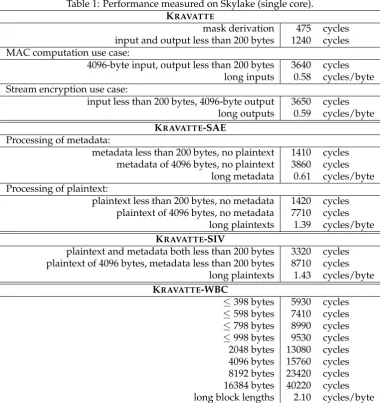
CoreTMi5-6500 (Skylake). This processor supports the AVX2 instruction set with bitwise operations on 256-bit registers. Using these instructions, we can exploit the parallelism present in KRAVATTEand efficiently evaluate 4 instances of the KECCAK-ppermutation at once on a single core.