Efficient Slide Attacks
⋆Achiya Bar-On1, Eli Biham2, Orr Dunkelman3, and Nathan Keller1
1
Department of Mathematics, Bar-Ilan University, Israel [email protected],[email protected]
2
Computer Science Department, Technion, Israel [email protected]
3
Computer Science Department, University of Haifa, Israel [email protected]
Abstract. The slide attack, presented in 1999 by Biryukov and Wagner,
has already become a classical tool in cryptanalysis of block ciphers. While it was used to mount practical attacks on a few cryptosystems, its practical applicability is limited, as typically, its time complexity is lower bounded by 2n (wheren is the block size). There are only a few
known scenarios in which the slide attack performs better than the 2n bound.
In this paper we concentrate onefficientslide attacks, whose time com-plexity is less than 2n. We present a number of new attacks that apply in
scenarios in which previously known slide attacks are either inapplicable, or require at least 2noperations. In particular, we present the first known
slide attack on a Feistel construction with a3-roundself-similarity, and an attack with practical time complexity of 240
on a 128-bit key variant of the GOST block cipher withunknown S-boxes. The best previously known attack on the same variant, with known S-boxes (by Courtois, 2014), has time complexity of 291
.
1
Introduction
Most modern block ciphers are constructed as a cascade of repeated keyed com-ponents, called rounds. The effectiveness of the standard cryptanalytic tech-niques (e.g., differential cryptanalysis [5], linear cryptanalysis [34], Square at-tack [14]) usually reduces drastically as the number of rounds increases. Hence, increasing the number of rounds is considered a cheap and efficient way to en-hance the cipher’s security.
Only a few cryptanalytic techniques are independent of the number of rounds. Arguably, the best known of these is the slide attack, introduced in 1999 by
⋆A preliminary version of the paper including only Sections 4.1 and 5.3 appeared in
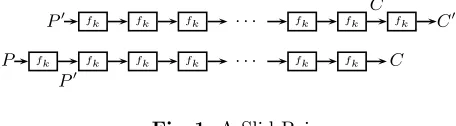
P′ fk fk fk · · · fk fk fk C′
fk fk fk fk · · · fk fk
P C
C
P′
Fig. 1. A Slid Pair.
Biryukov and Wagner [8].1 The original slide attack targets ciphers that are a cascade ofℓidentical functions, i.e.,
Ek =fkℓ=fk◦fk◦ · · · ◦fk,
wherefk is a “relatively weak” keyed permutation.
The idea behind the attack is rather simple. The adversary seeks to find a
slid pair, a pair (P, P′) of plaintexts such that P′ = f
k(P), as demonstrated in Figure 1. Due to the structure of Ek, the corresponding ciphertexts C =
Ek(P), C′ = Ek(P′) must satisfy C′ = fk(C). Hence, if a slid pair (P, P′) is given, the adversary can use the “simplicity” offk to solve the system of equa-tions:
P′=f
k(P),
C′=f
k(C), (1)
and thus to retrieve the secret keyk.
As the adversary does not know which plaintext pair is a slid pair, she sim-ply takes O(2n) random pairs (that can be constructed from O(2n/2) known plaintexts) and tries to solve (1) for each of them. It is expected that at least one of the checked pairs is a slid pair, and then the solution of (1) yields the secret key with a high probability. (For all but a few other plaintext pairs, the equation system is expected to be inconsistent.) The data complexity of the at-tack isO(2n/2) known plaintexts and the time complexity isO(t·2n), wheretis the time required for solving system (1) (that is, to break fk given two known input/output pairs).
The original slide attack can be used only whenfk is “simple”, i.e., can be broken efficiently using only two known input/output pairs. Subsequent papers (e.g., [9,23]) provided methods to apply the technique in cases wherefk is more complex, usually at the expense of higher data and time complexities (or when the attacked cipher has a very unique structure).
The slide attack was studied in numerous papers (e.g., [1,9,16,19]) and ap-plied to a few ciphers (most notably, the block cipher Keeloq [1]) and a few
1
hash functions (see [26]). However, its applicability has been limited, as the time complexity of O(t·2n) is usually impractically high, and in many cases even higher than that of exhaustive key search.
Only a few general scenarios are known in which the slide attack, or its variants, have time complexity significantly smaller than 2n. Usually, this hap-pens when there exists an efficient way to detect the slid pairs, so that the adversary does not have to check O(2n) random plaintext pairs until a slid pair is found. These scenarios include Feistel constructions with 2-round and 4-round self-similarity (i.e., with round keys of the forms (k1, k2, k1, k2, . . .) and (k1, k2, k3, k4, k1, k2, k3, k4, . . .), respectively), possibly surrounded by key whiten-ings (see [9,16]), the Even-Mansour [20] construction (i.e., Ek1,k2(P) = k2⊕ f(k1⊕P), wheref is a public permutation andk1, k2are secret keys) and some of its variants (see [19]).
In this paper we concentrate onefficientslide attacks, that is, slide attacks with complexity lower than 2n. We present four new classes of attacks:
1. Efficient slide attacks on SP Networks (SPNs) with self-similarity.
We present, for the first time, efficient slide attacks on SPNs with self-similarity (this is in contrast to Feistel constructions with self-similarity that were studied in numerous works, see below).
Consider 1K-AES, a variant of AES [15] in which all round subkeys are replaced by the same subkey (with no round constants). It seems clear that this variant is “bad”, being vulnerable to the slide attack. However, the classical slide attack on it requires 264 known plaintexts and has a time complexity of 2128 encryptions – no less than exhaustive key search! This raises the question whether the slide attack is really a threat for this variant.
We present a simple efficient slide attack on this variant with data and time complexities of 264, confirming the intuition that it is completely insecure. Our attack applies to a wide class of SP networks with 1-round self similarity, yielding an attack with data and time complexities ofO(2n/2). We also show that in the specific case of AES, one can also break 2K-AES and 3K-AES much with an efficient slide attack, using the somewhat slow diffusion of the linear permutation of AES.
In addition, we study the more general class of SASA. . . SA structures [7] with 1-round self-similarity. We show that when the linear layer A is known (like in the secret S-boxes variant of AES [39]), the cipher can be broken in
O(s·2s·2n/2) data and time, when the S-box size issbits.
it appears that they do not yield an attack faster than 2non constructions with
3-round self-similarity. We present the first known attack faster than 2n on a wide class of such constructions, with data and time complexities of O(25n/6) and memory complexity ofO(22n/3). Specifically, our attack is applicable for all so-called Feistel-2 structures [30], i.e., when the round function is of the form
fk(x) =g(x⊕k) for some keyless function g(·).
When the round functionfk(x) is more structured (specifically, for all Feistel-3 structures, including a Feistel-3-round self-similar variant of DES itself), we present an improved attack that requiresO(2n/2) known plaintexts andO(23n/4) time.
3. A slide attack using the cycle structure of fk; application to
24-round GOST. We present a new variant of the slide attack that finds the
slid pairs directly using comparison between the cycle structures ofEk andfk. While the data and time complexities of the attack are close to 2n, it applies even if fk is very complex (in which case a standard slide attack, if at all possible, would have time complexity significantly higher than 2n). We apply the new technique to a 24-round variant of the Russian encryption standard GOST [27] with unknown S-boxes. Our attack recovers the secret S-boxes and the secret key with data and time complexity of about 263. A slide attack on the same variant can be mounted using Furuya’s technique [23], however it would require the entire codebook and time complexity of about 2100 encryptions. We note that similar ideas can be used in the case where the encryption algorithm is implemented by a quantum computing device, where one can use Simon’s algorithm to find the cycle efficiently (as observed in [2,31]).
4. An efficient slide attack using the cycle structure and reflection;
application to a 128-bit key variant of GOST.We show that in cases where
the round keys of a Feistel cipher are palindromic, our cycle-structure attack can be combined with a reflection property (see [32]) into a powerful attack with data and time complexity of onlyO(2n/2). We apply the new attack to a 128-bit key variant of GOST in which the “full” 256-bit key has the palindromic structure (k1, k2, k3, k4, k4, k3, k2, k1). While weaknesses of this variant were pointed out in previous works (e.g., [9]), the best known attack on it, presented by Courtois [12], is rather complex and has time complexity of 291, when the S-boxes are known to the adversary. Our attack breaks this variant with practical complexity of 240,
even if the S-boxes are secret.
GOST is a Feistel construction with 1-round self-similarity (which is widely known to be very weak).
A comparison of our results with the best previous results on the same vari-ants is presented in Table 1.
Primitive Reference Data Time Memory
AES with 1-round [8] 2n/2
KP 2n 2n/2
self similarity Section 2.1 2n/2
KP 2n/2
2n/2
SASA. . . SA with 1-round
self similarity (knownA) Section 2.2s·2s·2n/2
KPs·2s·2n/2
s·2s·2n/2
DES with 3-round [8] 2n/2
KP 2n 2n/2
self similarity Section 3 25n/6
KP 25n/6
22n/3
24-round GOST with [23] 264
KP 2100
264
unknown S-boxes Section 5.3 263
ACP 263
263
Palindromic GOST with [12]∗ 232
CP 291
232
unknown S-boxes Section 5.4 240
ACP 240
240
Table 1. Comparison of our attacks with the best previously known results on
the same variants.
KP – known plaintexts, CP – chosen plaintexts, ACP – adaptively chosen plain-texts.
∗ – the attack of [12] assumes that the S-boxes are known.
This paper is organized as follows. In Section 2 we present efficient slide attacks on SPNs with self-similarity. In Section 3 we present the new attack on 3K−DES. The cycle-structure attacks are presented in Section 4. Finally, the applications to variants of GOST are given in Section 5.
2
Efficient Slide Attacks on Substitution-Permutation
Networks with Self Similarity
In this section we study efficient slide attacks on SP networks (SPNs) with r -round self-similarity. A specific example is a variant of the encryption standard AES [15] in which the round keys are replaced by the sequencek1, k2, . . . , kr, k1,
k2, . . . , kr, . . ., that may be calledrK-AES. Unlike Feistel constructions with self-similarity that have been thoroughly-studied in the context of slide attacks (see Section 3 below), SPNs with self-similarity have not been studied specifically in previous works. Probably, the reason for that is rK-AES being much more immune to slide attacks thanrK-DES.
L SB SR MC L
k1
SB SR MC L
k1
. . . L
k1
L
k1
SB SR MC L
k1
Fig. 2. The Structure of 1K-AES.
efficient slide attack with data and time complexities of 264(or, more generally, 2n/2 forn-bit blocks). We then turn our attention to a more complex type of 1-round self-similarity represented by so-called SASA. . . SA structures (as defined in [7]), either with a known linear layer or even with a key-dependent linear layer. Finally, in the specific case of AES-like structures we present efficient attacks on variants with 2-round and even 3-round self similarity, exploiting the slow diffusion of the AES round function.
2.1 A Simple Efficient Slide Attack on 1K-AES
The Structure of 1K-AES The AES [15] is the most widely used block cipher.
We briefly recall a few details that are relevant to our attack (the interested reader can look at [15] for a complete description). The block size of AES is 128 bits, and the key size is 128/192/256 bits. AES is an iterated cipher composed of 10/12/14 almost identical rounds. Each round consists of four operations: SubBytes (SB), ShiftRows (SR), MixColumns (MC) – operations on the state that do not depend on the key, followed by AddRoundKey (ARK) – bitwise XOR of the state with an 128-bit subkey. In the real AES, there is an additional AddRoundKey operation before the first round, and the MC operation is omitted in the last round. We define 1K-AES to have a similar structure (with a whitening key before the first round) but the same round key in all rounds, as depicted in Figure 2. Thus,
Ek(P) =fk◦fk◦ · · · ◦fk(P⊕k),
wherefk(x) =ARKk◦M C◦SR◦SB denotes a single round of AES. We claim that Ek can be broken with 264 known plaintexts and 264 time, using a simple variant of the slide attack.
The Attack Algorithm The idea behind the attack is simple. Assume that
(P, P′) is a slid pair for E
k, i.e., that fk(P) = P′. We have P =k⊕(SB−1◦
SR−1◦M C−1(P′)). Hence, denoting ¯P′=SB−1◦SR−1◦M C−1(P′), we have
P⊕P¯′=k. (2)
Algorithm 1A Slide Attack on 1K-AES
Ask for the encryption of 264
known plaintexts (Pi, Ci).
forEach plaintext/ciphertext pair (Pi, Ci)do Compute the value ¯Ci=M C◦SR◦SB(Ci),
Compute the valuePi⊕C¯i,
Store in a hash table the pairs (Pi⊕C¯i, Pi), indexed by the first coordinate.
end for
forEach plaintext/ciphertext pair (Pj, Cj)do
Compute the value ¯Pj=SB−1◦SR−1◦M C−1(Pj),
Compute the value ¯Pj⊕Cj,
Check for entries in the hash table whose first coordinate matches it. end for
forEach collision in the table (Pi⊕C¯i= ¯Pj⊕Cj)do Test the key candidatek=Pi⊕P¯j.
end for
we have
C′⊕C¯ =k. (3)
Combining (2) and (3), we get
P⊕C¯= ¯P′⊕C′. (4)
This relation allows to mount the attack described in Algorithm 1, inspired by the slide-with-a-twist attack of [9].
By the birthday paradox, it is expected that the data set contains a slid pair, i.e., a pair satisfying fk(Pi) =Pj, with a non-negligible probability. For a random pair (Pi, Pj), the probability that Pi⊕C¯i = ¯Pj ⊕Cj is 2−128, and thus, only a few collisions are expected in the table. These collisions include the collision induced by the slid pair, which suggests the correct value ofk. The data complexity of the attack is 264known plaintexts, and the time and memory complexities are 264operations, as asserted.
We note that the collision we are looking for is of the formPi⊕C¯i= ¯Pj⊕Cj. Given that each side of the equation depends on a single plaintext/ciphertext pair, one can easily transform the attack into a memoryless one, as follows:
Define g1(Pi) =Pi⊕C¯i and g2(Pj) = ¯Pj ⊕Cj. Use a memoryless collision finding algorithm (such as [22]) to find a collision betweeng1(·) andg2(·). As such algorithms take aboutO(2n/2) queries tog1(·) andg2(·), the time complexity of the attack isO(2n/2). The main change is that the data requirement becomes an adaptive chosen plaintext one (following the way memoryless collision algorithms operate), in exchange for the reduction of the memory complexity.
non-key dependent operations. The data and time complexities remain the same —
O(2n/2).
2.2 An Efficient Slide Attack on SASA. . . SA
We now turn our attention to more general SPN structures known as the SASA. . . SA constructions. First analyzed by Biryukov and Shamir in [7], such constructions have layers of bijective nonlinear S-boxesS (the S-boxes may be different) fol-lowed by invertible affine layersA. Both types of layers may be key-dependent. We consider SASA. . . SA constructions with 1-round self-similarity, i.e., where the same combinationA◦S is appliedr times sequentially. The generic attack of Algorithm 1 obviously cannot be applied to this constructions, due to the complex key-dependent operations.
We first consider the case when theAlayer is not key-dependent (like in the AES variant studied in [39]), and present a simple attack with data and time complexities ofO(s·2s·2n/2) for ans-bit S-box. We then extend the attack to the case when Ais key-dependent, with data complexity ofO(s·2s·2n/2) and time complexity of O(n3·2n). (The latter attack falls a bit out of our scope, requiring more than 2n operations. We chose to present it, as it uses similar techniques like the previous attacks and is much faster than the best one can get with a classical slide attack on the same variant.)
Attacking SASA. . . SA when A is not key-dependent LetP′ =A◦S(P),
i.e., (P, P′) is a slid pair. As observed in [23], if (P, P′) is a slid pair, then so is (Ek(P), Ek(P′)), as well as (Eki(P), Eki(P′)) for any i. Hence, using adaptive plaintext queries, one can generate as many slid pairs as needed out of a single slid pair.
In the data collection phase of the attack we take 2n/2 plaintexts, and gen-erate from each of them a sequence of plaintexts, i.e.,P, Ek(P), Ek2(P), Ek3(P),
. . . , Et
k(P) for a parameter t we shall choose later. Then, we detect the slid pairs (P, P′) (and their encryptions) efficiently using the following observa-tion: If in the chain P, Ek(P), Ek2(P), Ek3(P), . . . , Ekt(P) the same value enters one of the S-boxes twice (e.g., in E1
k(P) and Ek8(P)) then the outputs of the respective S-boxes in the sequence generated by P′ are equal (i.e., we have
A−1(E1
k(P′)) = A−1(Ek8(P′))). This observation allows an immediate identifi-cation of the slid pairs (without the need of comparing all sequences to all other sequences). After finding the slid pairs, the adversary obtains a large number of input/output pairs for each of the S-boxes, which is sufficient to identify the S-boxes. The attack is depicted in Algorithm 2.
2
Algorithm 2A Slide Attack on SASA. . . SA
Pick 2n/2
plaintexts Pi and for each of them ask for the encryption of the chain
Pi, Ek(Pi), Ek2(Pi), . . . , Etk(Pi).
forEach plaintext chainPi, Ek(Pi), Ek2(Pi), . . . , Etk(Pi)do
Find all the locations for which the same S-box has the same value.
Store the list of locations along with the chain in a hash table indexed by the list of locations.2
end for
forEach plaintext chainPi, Ek(Pi), Ek2(Pi), . . . , Etk(Pi)do Compute the chainA−1
(Pi), A− 1
(Ek(Pi)), A− 2
(E2
k(Pi)), . . ..
Find all the locations for which the same S-box has the same output value ac-cording to the computed chain.
Check for entries in the hash table whose list of locations matches the found locations.
end for
for Each collision in the locations (chains Pi, Ek(Pi), . . . and
A−1
(Pj), A− 1
(Ek(Pj)), . . .)do
Collect for each S-box the input/output pairs defined by the chains, and deduce the S-boxes.
end for
The value of t depends on two factors: The length of the chains required to ensure that enough collisions exist, and the length of the chains required to ensure that we can recover the full S-box. A pair of chains of lengtht contains
t pairs of plaintexts (Ea
k(Pi), Eka(Pj)), each with n/sS-boxes that can collide. As we have to obtain an n-bit filtering condition, and as each collision offers an s-bit filtering condition, we need t· n
s ·2 −s ≥ n
s, i.e., t ≥ 2
s. At the same
time, obtaining 2s different inputs to each and every S-box (where the inputs are chosen at random), requires ln 2·s·2sinputs (due to the coupon collector’s nature of the problem), i.e., we needt=O(s·2s). Therefore, the data and time complexities of the attack areO(s·2s·2n/2).
Attacking SASA. . . SA when A is key-dependent In this case, we need
As there are 2n pairs of candidates chains, and as solving the set ofnlinear equations takes O(n3) operations, the total time complexity of the attack is
O(n3·2n). The memory and data complexity areO(s·2s·2n/2).
2.3 Efficient Slide Attack on Specific Instances of 2K-AES and
3K-AES
A slight modification of the above attack presented in Section 2.2 can be used to attack rK-AES withr >1, if the diffusion in the linear layer is not full. We demonstrate it in the case of the AES, for which we can attack variants with 2-round and 3-round self similarity. We denote these variants below by 2K-AES and 3K-AES and alert the reader that unlike the attack on 1K-AES presented in Section 2.1, these attacks do exploit the specific structure of the AES.
We start with an attack on 2K-AES. Consider a slid pair (P, P′) such that
P′=M C◦SR◦SB◦ARK
k2◦M C◦SR◦SB◦ARKk1(P). The second round’s SB, SR, M C operations can be easily inverted, by computing ˜P′ = SB−1◦
SR−1◦M C−1(P′) and obtaining ˜P′ =ARK
k2◦M C◦SR◦SB◦ARKk1(P).
Moreover, asM C and SRare linear operations which can be easily exchanged with theARK operation (by applying the inverse operations to the key), ˜P′can be re-written as:
˜
P′ =M C◦SR◦ARK
SR−1◦MC−1(k
2)SB◦ARKk1(P).
Hence, for a givenP′ we compute ¯P′ defined as
¯
P′=SR−1◦M C−1( ˜P′) =SR−1◦M C−1◦SB−1◦SR−1◦M C−1(P′).
As a result, when (P, P′) is a slid pair (and thus, the chains that are generated from them are slid chains), two bytes with the same input in the chain of P
must have the same output in the chain of ¯P′. This immediately allows to apply Algorithm 2. Moreover, note that there is no need to recover the full S-box, as once the slid chain is found, it is trivial to extract k1 and SR−1◦M C−1(k2). Therefore, a slightly lower data/time complexity is needed for this attack: Only 269 adaptive chosen plaintext and ciphertext pairs are needed, as well as 269 time.
3
Efficient Slide Attacks on Feistel Constructions with
3-round Self-Similarity
Historically, a main target of the slide attack and its generalizations has always been a Feistel construction with r-round self-similarity, i.e., whose sequence of round functions is f1, f2, . . . , fr, f1, f2, . . . , fr, . . .. A specific example is a vari-ant of the former encryption standard DES [35] in which the round keys are replaced by the sequence k1, k2, . . . , kr, k1, k2, . . . , kr, . . . (where k1, . . . , kr are independent of each other), called in [8]rK-DES.
In [8], Biryukov and Wagner showed that 2K-DES (and more generally, a Feistel construction with n-bit blocks and 2-round self-similarity) can be bro-ken withO(2n/2) adaptively chosen plaintexts andO(2n/2) time using the slide attack. In [9], Biryukov and Wagner presented the complementation slide and
slide with a twisttechniques and used them to break 2K-DES inO(2n/4) chosen plaintexts andO(2n/4) time, and also to break 4K-DES with the same complex-ity. In [19], Dunkelman et al. introduced themirror slidexattack and used it to break 2K-DES surrounded by key whitenings inO(2n/2) known plaintexts and
O(2n/2) time. Finally, Dinur et al. [16] were able to break 4K-DES surrounded by key whitenings inO(n2n/2) known plaintexts andO(n2n/2) time usingenhanced
reflection.
Neither of these attacks seems to apply to 3K-DES, i.e., a Feistel construc-tion with 3-round self similarity depicted in Figure 3. Hence, the best one can currently do is to apply the standard slide attack, which results in data com-plexity of O(2n/2) known plaintexts and time complexity ofO(t·2n) wheret is the time required for breaking 3-round DES given two input/output pairs.
In this section we present a new attack on this construction with a lower time complexity ofO(25n/6), at the expense of a higher data complexity ofO(25n/6). Our attack exploits slid pairs of a specific type and uses ideas developed in the attacks presented in Section 2.
In addition, for a more specific class of round functions which contains the round function of DES itself, we present a slide attack on 3K-DES with data complexity ofO(2n/2) known plaintexts and O(23n/4) time.
3.1 The Structure of 3K-DES and Notations
P
g
L L
g
L L
g
L L
g
L L
. . .
g
L L
g
L L
C k1
k2
k3
k1
k2
k3
X0L X0R
X3mL X3mR
Fig. 3. The Structure of 3K-DES.
consists of four operations: a linear expansion functionEthat expands the state to 48 bits, XOR with a 48-bit subkey, an S-box layerS which shrinks the state to 32 bits and a permutationP. The only key-dependent operation infi is the XOR with a subkey.
In our attack, we consider the following natural abstraction of 3K-DES (called “Feistel-2 construction with 3-round self-similarity”, according to the terminol-ogy of [30]). Letk1, k2, k3 be independent (n/2)-bit subkeys. LetEk1,k2,k3 be a
3m-round Feistel construction with n-bit blocks, in which the round function
fki has the form fki(x) =g(ki⊕x), where ki :=k(imod 3)+1 and g is a public keyless function. The structure ofE is demonstrated in Figure 3.
encryption process ofC (assuming that it is encrypted) byYi(e.g., C=Y0), as shown in Figure 3. Note that if (P, P′) is a slid pair forE (i.e., if P′ =h(P)), thenP′ =X
3andC′=Y3. We also useXL to denote the left half ofX andXR to denote the right half ofX.
3.2 The Observations Behind the Attack
The basic idea of the attack is to search for slid pairs that satisfy the following additional property:
Y1L=X1L. (5)
We use a few observations. Assume that (5) holds for some slid pair (P, P′). Then we can deduce the following:
1. The outputs of the second round functionfk2in the encryptions ofP andC
are equal. By the Feistel structure, this impliesX0L⊕X2L =Y0L⊕Y2L. As
X2L=PR′ andY2L=CR′ , we obtainPL⊕PR′ =CL⊕CR′ , or equivalently,
PL⊕CL=PR′ ⊕CR′. (6)
Conversely, if the keyless function g is invertible then (6) implies (5), and even if g is a random function, (6) implies that (5) holds with a constant non-negligible probability.
2. By the Feistel construction, (5) implies X0R⊕fk1(X0L) =Y0R⊕fk1(Y0L),
or equivalently, X0R⊕Y0R = fk1(X0L)⊕fk1(Y0L). Now, consider the
ap-plications ofg as part of fk1 in the encryptions of P andC. We know that
the input difference between these two applications isX0L⊕Y0L(as the key addition does not change the difference), and that the output difference is
X0R⊕Y0R.
For a random functiong, given an input differenceαand an output difference
β, there exists one pair of inputs (x, x′) on average such thatx⊕x′=αand
y⊕y′=β. Moreover, given the full Difference Distribution Table (DDT) ofg and the input/output differences (α, β), one can obtain instantly all possible
actual valuesof the input pairs (x, x′) that correspond to those differences, whose total number is usually very small.
Hence, if we could pre-compute the full DDT of the functiong, our knowledge would be sufficient to recover the actual values (X0⊕k1, Y0⊕k1), and hence, to get a suggestion for the subkeyk1. As we cannot keep in memory the full DDT (since it requires 2nspace) or even compute it (since this also takes 2n time), we will exploit this observation in a more subtle way.
3. By the same argument, applied withP′, C′ instead ofP, C, if (5) holds then we know the input and output differences in the applications ofgas part of
fk3 in the encryptions of P and C. This would be sufficient for recovering k3, could we pre-compute and store the full DDT ofg.
3.3 The Attack Algorithm
A na¨ıve way to exploit the above observations in a slide attack is to go over many random pairs (P, P′), and for each pair assume that it is a slid pair that satis-fies (5), use the above observations to get candidates for the subkeysk1, k2, k3 and check them by trial encryption. However, as the probability of a random plaintext pair to be a slid pair that satisfies (5) is 2−n·2−n/2= 2−3n/2, such a na¨ıve attack has time complexity ofΩ(23n/2).
Instead, we use relation (6) to check many candidate plaintext pairs simul-taneously, and construct “slices” of the DDT that are sufficient for our purposes instead of the full DDT in order to save time and space. The attack algorithm is given in Algorithm 3.
3.4 Analysis of the Attack
The data complexity of the attack isO(25n/6) known plaintexts. Each plaintext enters tablesT1 orT2with probability 2n/3−n/2= 2−n/6, i.e., the expected size of the tables T1, T2 is 22n/3. Hence, the total number of candidate slid pairs the attack may analyze is 24n/3. Of these pairs, the attack identifies the pairs (P, P′) satisfying P
L ⊕CL, PR′ ⊕CR′ ∈ L. Given that the size of L is 2n/3, the probability that (6) holds is 2−n/3 (since this is the probability of collision between two random elements in a set of size 2n/3). Hence, the probability that a pair (P, P′) examined in the attack is a slid pair satisfying (6) is 2−n·2−n/3= 2−4n/3. Therefore, with a constant non-negligible probability, the data contains a slid pair that satisfies (6), and hence satisfies (5) (again, with a constant probability). As any slid pair suggests the correct subkeys (possibly, along with a few additional subkey candidates), the attack recovers the secret key with a constant probability. The success probability can be easily increased by enlarging the data complexity by a fixed constant (i.e., examining additional plaintexts).
The time complexity of the first external loop is 25n/6, dominated by en-crypting the plaintexts. The second external loop is repeated for 2n/3 values of α and its complexity is dominated by computing a row in the difference distribution table that requires 2n/2 operations for each value of α. (The first internal loop takes 2n/3operations for eachα, and the second internal loop takes 2n/6 encryptions, since the expected number of collisions with the table T
3 is 2n/3·2n/3·2−n/2= 2n/6.) Therefore, the total time complexity of the attack is
O(25n/6) encryptions.
The memory complexity isO(22n/3), dominated by the storage required for the tables T1, T2. (Note that the plaintext/ciphertext pairs themselves, that do not enter tablesT1 andT2can be discarded.) AsT3 is built for each value ofα independently, and as each αvalue is expected to correspond to 2n/3 pairs in
Algorithm 3A Slide Attack on 3K-DES
Choose an arbitrary listLof 2n/3
n/2-bit values. Collect 25n/6
known plaintext/ciphertext pairs (Pi, Ci).
Initialize three empty hash tablesT1, T2, andT3.
forAll plaintext/ciphertext pairs (Pi, Ci)do if PiL⊕CiL∈Lthen
Add (PiL⊕CiL, PiL) toT1(which is indexed byPiL⊕CiL)
end if
if PiR⊕CiR∈Lthen
Add (PiR⊕CiR, PiR) toT2 (which is indexed byPiR⊕CiR)
end if
end for
forAllα∈Ldo
Compute the row of the DDT ofgthat corresponds to the input differenceα. forAll entries ofT1satisfyingPiL⊕CiL=αdo
Assume that (5) holds and use the above observations to instantly obtain a suggestion for the subkeyk1.
Using k1, partially encrypt P through the first round, and store the pair
(Xi1L, Xi1R) in the hash tableT3.
end for
forAll entries ofT2satisfyingPjL′ ⊕CjL′ =αdo
Assume that (5) holds and use the above observations to instantly obtain a suggestion for the subkeyk3.
Using k3, partially decrypt Pj′ through the third round to compute
(X′
j2L, Xj′2R).
Search for entries in the tableT3 whose first coordinate (i.e.,Xi1L) matches
X′
j2R.
for All matching entries (Xi1L, Xi1R) and (X2′jL, X2′jR)do
Use the valuesXi1R andXi2Lto extractk2 fromfk2.
Check the resulting suggestion (k1, k2, k3) by a trial encryption.
end for
end for
end for
3.5 Attack on 3K-DES Using the Structure of the Round Function
Let us assume now that the round functionF in the Feistel construction has the following specific form (sometimes referred to as Feistel-3, as opposed to the more general Feistel-2 structure we considered above): first, the input ofF is divided intos-bit chunks that are independently processed through an S-box layer, and then a linear transformation is applied to the entire state. This structure is satisfied by DES, with |s| = 6 (up to the “linear expansion” operation, which changes the analysis only slightly and thus is omitted here), and by many other Feistel ciphers. In this case, we present an improved slide attack that takes only
Consider a candidate pair (P, P′) and their corresponding ciphertexts (C, C′), respectively. For such a pair, we know that P′ = f
k3(fk2(fk1(P))) and C
′ =
fk3(fk2(fk1(C))), which allows for a simple meet in the middle attack.
Namely, it is possible to guess the part ofk1 that allows partial encryption of a single S-box for P and forC. Similarly, one can guess the part of k3 that allows partial decryption of a single S-box forP′and forC′. Hence, by guessing
skey bits fromk1andsfromk3, we obtain a 2s-bit filter condition (due to the existence of two “input/output” pairs to 3 rounds of DES). Obviously, one can extend the attack to find more key bits by targeting the other S-boxes, resulting in a simple attack on 3 rounds of DES.
This simple meet in the middle attack can be exploited in a slide attack as well. First of all, we generate from each plaintext a chain of a few encryptions
P, Ek(P), Ek(Ek(P)), . . .. It is easy to see that each of the 3-round DES instances that need to be attacked uses the same order of subkeys, and thus, guessingn/4 bits of k1allows for the partial encryption of all the values in the chain by one round.
The attack is thus very simple: For each chainP, Ek(P), Ek(Ek(P)), . . ., we guessn/4 bits of subkey material fork1, and store in the table the resulting par-tial encryptions of the chain values (under all k1 guesses). Similarly, for each chain P′, E
k(P′), Ek(Ek(P′)), . . . we try n/4 bits of k3, and perform partial decryption to search in the table for collisions. Each such collision suggests a candidate slid chain as well as candidate keying material. Once a slid chain is identified, it is easy to extract the remaining bits ofk1 andk3, and to use them to retrievek2.
For a chain of lengtht, we obtaint·n/4 filtering bits for the meet in the middle parts. There are 2n/2+n/4= 23n/4 candidate chains from each side, resulting in 23n/2possible chains. By having a 3n/2-bit filtering, we can immediately identify the slid chains, suggesting thatt= 6 is sufficient.
The resulting data complexity is 6·2n/2 adaptive chosen plaintexts and ci-phertexts. The memory and time complexities are bothO(23n/4).
4
Efficient Slide Attacks using the Cycle Structure of
Permutations
In this section we present a new variant of the slide attack that exploits the relation between the cycle structures of the entire cipherEk=fkℓand the round functionfk to detect slid pairs efficiently. First, we present a generic attack with data and time complexities of 2n−1 that applies even whenf
Then, we show that for Feistel constructions with a palindromic key schedule the complexity of the generic attack drops toO(2n/2), using a reflection property.
4.1 A Generic Attack Using the Cycle Structure
Facts and observations First we recall several facts regarding the cycle
struc-ture of permutations that are used in our attack. Let g : GF(2n) → GF(2n) be a random permutation. For everyx∈GF(2n) we denoteCycleLength(x) = min{k >0|gk(x) =x}. Following the classical results of [24,25] on the distribu-tion of cycle sizes in random permutadistribu-tions (see also [21, p. 596]), we expect that the largest cycleCyclemax has an expected size of (1−1/e)·2n, and for every
x∈GF(2n), Pr[x∈Cycle
max]≈1−1/e. Moreover, we expect that the second largest cycle has a size of 1/e·(1−1/e)·2n, and generally, the size of the i-th largest cycle is (1/e)i−1·(1−1/e)·2n.
The main observation used in our attack is the following: Let P be an arbitrary plaintext. We consider the cycles of P with respect to fk and Ek, denoted by Cyclefk(P) and CycleEk(P), respectively. Denote the length of
Cyclefk(P) by m1, i.e., m1 = min{t > 0|fkt(P) = P}. Similarly, denote the length of CycleEk(P) by m2. As Ek = fkℓ, the relation E
m2
k (P) = P can be written as fl·m2
k (P) =P. It clearly follows that m1|ℓ·m2. On the other hand,
m2 = min{t > 0|Ekt(P) = P} = min{t > 0|f
(t·ℓ) modm1
k (P) = P}. Combining these two statements, we getm2= min{t >0|tℓ= 0 modm1}, or equivalently,
m2=m1/gcd(m1, ℓ). (7)
In particular, if gcd(m1, ℓ)=1, thenm1=m2.
If gcd(m1, ℓ) = 1 we can use Euclid’s extended algorithm to find 1≤d1 ≤
ℓ−1 and d2such thatd1·m1=ℓ−1 (modℓ) =d2·ℓ−1. For thosed1, d2, we have
fd1·m1+1
k (P) =fk(P), and fkd1·m1+1(P) =f d2·ℓ
k (P) =E d2
k (P).
Hence, the pair (P, Ed2
k (P)) is a slid pair forEk.
It is important to note that the adversary does not have access tofk, and thus, cannot compute m1. Only m2 can be computed, by sequential encryp-tion using Ek. However, the adversary may assume that gcd(m1, ℓ) = 1 and then use the valuem1=m2 to compute d1, d2 and find the candidate slid pair (P, Ed2
k (P)). If the assumption gcd(m1, ℓ) = 1 is correct, the found pair must be a slid pair. Furthermore, as observed in [9], this implies that for everyt, the pairs (Et
k(P), E d2+t
The attack algorithm and its analysis Based on the above observations, we can mount the following attack.
1. Fix an arbitrary plaintext P0.
2. Ask for a sequential encryption of P0 through Ek, i.e., for the sequence
Ek(P0), Ek2(P0) = Ek(Ek(P0)), E3k(P0), . . ., until E m2
k (P0) = P0 is encoun-tered for the first time.
3. Use Euclid’s algorithm to findd1, d2 such thatd1·m2=d2·ℓ−1. 4. Deduce that (P, Ed2
k (P)) is a candidate slid pair, and check the guess by attackingfk using{(Ekt(P), E
d2+t
k (P))}t≥0 as input/output pairs.
For a random value ofx, E[CycleLength(x)] = (1−1/e)·2n, and thus, we
expect to get about (1−1/e)·2npairs of the form{(Et
k(P), Ekd2+t(P))}t≥0. This amount is sufficient for most possible attacks onfk, including adaptive chosen plaintext and ciphertext attacks. Hence, Step 4 is expected to succeed even for fairly complex functionsfk (e.g.,fk being the full 16-round DES).
The attack succeeds if (m1, ℓ) = 1. For a random permutationfk, this occurs with probability ϕ(ℓ)/ℓ, where ϕ(ℓ) = |{1 ≤ d ≤ (ℓ−1) : gcd(d, ℓ) = 1}| is Euler’s function. In case of failure, we can apply the attack again with another plaintextP1that is not included in the sequenceEki(P0). If the attack fails again, we can take a new plaintextP2etc. Afterkapplications of the attack, the total success probability is 1−(1−ϕ(ℓ)/ℓ)k, which approaches 1 quickly.
The data complexity of the attack is very large — the attack requiresc·2n adaptively chosen plaintexts for a constant c < 1 (as the expected length of
CycleEk(P0) is (1−1/e)2n)). We note that the attack can be transformed into a known plaintext attack that requires almost the entire code book. In that case, we expect that a few long cycles are found, suggesting a large amount of slid pairs.
The advantage of the attack over a standard slide attack is the time com-plexity —O(2n−1+t), wheretis the time required for breakingf
kwithO(2n−1) known input/output pairs (compared toO(2n·t) for the standard slide attack). Hence, the attack is advantageous in cases where fk is very complex, so thatt is large. In Section 5 we exemplify this technique with an attack on 24-round GOST with unknown S-boxes, where the functionfk is 8-round GOST with un-known S-boxes. Due to the complexity offk, our attack is 236times faster than the best previously known slide attack on the same variant.
encrypted to an entangled state composed of all possible outputs). After finding the cycle length, one can either exploit a standard cryptanalytic attack, or use some advanced quantum attack algorithms, e.g., those presented in [2,31].
4.2 An Efficient Attack on Feistel Constructions with a Palindromic
Key Schedule
The attack algorithm described above does not depend on the exact cycle struc-tures ofEkandfk, apart from its success probability (that depends on Pr[gcd(m1, ℓ) = 1]). Hence, if for some cipherEk the cycle structure deviates from random, such that shorter cycles are more likely to occur, the same attack holds with a lower complexity (as the complexity is dominated by the computation ofCycleEk(P0)).
A notable case in which such a reduction occurs is Feistel ciphers with a palin-dromic key schedule, i.e., round subkeys of the formk1, k2, . . . , kr, kr, kr−1, . . . , k1 for some r. Let fk be such a construction, and let Ek = fkℓ as before (so that Ek consists of 2rℓ Feistel rounds). Consider a sequential encryption of a plaintext P0, as performed in the attack described above, and denote the in-put of thej’th round in the encryption process ofEi
k(P0) byX[2rℓ·i+j] (for
j= 0,1, . . . ,2rℓ−1).
We use the following observation, introduced in [32] and called reflection property. Assume that for somei∈Nand for some 0≤m≤ℓ−1, the
interme-diate valueX =X[2rℓ·i+ 2rm+r] satisfiesXL=XR. In such a case, by the palindromic Feistel structure, we haveX[2rℓ·i+ 2rm] =X[2rℓ·i+ 2r(m+ 1)]. Furthermore, the reflection property can be extended all the way in both direc-tions to obtain
P0=X0=X[2rℓ·2i+ 2r(2m+ 1)]. (8)
This intermediate value is not seen by the adversary who sees only values of the formEkj(P0) =X[2rℓ·j]. However, if we denotec=gcd(2mℓ+1,ℓ), then (8) implies
P0=X[c(2rℓ·2i+ 2r(2m+ 1))] =X
2rℓ·(2ic+ 2m+ 1 gcd(2m+ 1, ℓ))
=E2ic+
2m+1
gcd(2m+1,ℓ)
k (P0).
It follows that in such a case,
CycleLengthEk(P0)≤2ic+
2m+ 1
gcd(2m+ 1, ℓ). (9)
Furthermore, the same argument holds if someX′ = X[2rℓ·i+ 2rm] satisfies
X′
L=XR′ , and in such a case,
CycleLengthEk(P0)≤2ic′+ 2m
gcd(2m, ℓ), (10)
We now analyze the expectation of the right hand sides of (9) and (10). By standard randomness assumptions, for each i∈ Nand 0 ≤m≤ℓ−1, the
probability thatX =X[2rℓ·i+ 2rm+r] satisfiesXL=XRis 2−n/2. The same holds for the probability that X′ =X[2rℓ·i+ 2rm] satisfiesX′
L =XR′. Hence, it is expected that the smallest index for which (8) or the respective statement forX′ holds is X[j], forj=O(r·2n/2). Therefore, in expectation (9) and (10) yield
E[CycleLengthEk(P0)]≤O
r·2n/2·2· ℓ gcd(2m+1,ℓ) 2rℓ
!
≤O(2n/2). (11)
It follows that when we apply the attack algorithm described above toEk, the expected data complexity is as small as O(2n/2). In Section 5 we apply this attack to a 128-bit key variant of the block cipher GOST, to get an attack which is 251 times faster than the best previously known attack of [12] on an even weaker variant.
It should be noted that as CycleLengthEk(P0) becomes smaller, the task of breakingfk using the candidate slid pairs becomes more complex, since the cycle contains at most O(2n/2) known input/output pairs for f
k. Combining many cycles together is problematic since each candidate slid pair is correct only with probabilityϕ(ℓ)/ℓ, so the probability that all examined cycles suggest correct slid pairs may be very low. A possible way to overcome this obstacle is to devise an efficient distinguishingattack on fk that requires at mostO(2n/2) known input/output pairs. Using the distinguishing attack, the adversary can check which of the suggested slid pairs are correct ones, and then combine verified slid pairs suggested by different cycles to breakfk with a more data-consuming attack.
5
Application to the GOST Block Cipher
In this section we apply the new slide attacks presented in Section 4 to variants of the block cipher GOST – the Russian encryption standard.3First we present the structure of GOST and a brief account of previous results on the cipher. Then we present new efficient attacks on 8-round GOST with unknown S-boxes that will be used as subroutines in the slide attacks. Finally, we present the new slide attacks on 24-round GOST and on a 128-bit key variant of the cipher considered in [9,12].
3
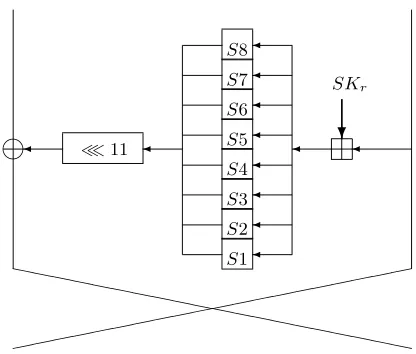
✛ ✛ ✛ ✛ ✛ ✛ ✛ ✛ ✛ ✛ S1 S2 S3 S4 S5 S6 S7 S8 ✛ ≪11 ✛ ✐ ✥✥ ✥✥✥✥ ✥✥✥ ✥✥✥ ✥✥✥ ✥✥✥ ✥✥ ❵ ❵ ❵ ❵ ❵ ❵ ❵ ❵ ❵ ❵ ❵ ❵ ❵ ❵ ❵ ❵ ❵ ❵ ❵ ❵ ❄ SKr
Fig. 4.The Round Function of GOST.
5.1 The structure of GOST and previous results
The Russian encryption standard GOST [27], designed in 1989, is a 64-bit block and 256-bit key cipher with a Feistel structure of 32 rounds. The round function accepts an input and a subkey of 32 bits each. The input and the subkey are added (modulo 232), and the outcome is divided into eight sets of four bits each. Each such set enters a different S-box, where the least significant set entersS1 and the most significant set enters S8. A central feature of GOST is that the actual S-boxes that are used are kept secret, and are assigned by the government to a given set of users in each industry.4The outputs of all S-boxes are combined to 32 bits, which are then rotated to the left by 11 bits. Figure 4 describes one round of GOST.
The key schedule algorithm takes the 256-bit key and treats it as eight 32-bit words, i.e.,K=K1, . . . , K8. The subkeykr of roundris
kr=
K(r−1) mod 8+1 r∈ {1, . . . ,24};
K33−r r∈ {25, . . . ,32}.
Most of the previous results on GOST consider a variant withknown S-boxes, using as a specific example the set of S-boxes used in the Russian banking indus-try that has leaked and appears in [37]. In this mode, Isobe [29] was the first to publish an attack on the full cipher in 2010. Later on, several improved attack were presented by Dinur et al. [17], and a multitude of attacks using various techniques were presented by Courtois [10,11,13].
4
The results obtained so far on GOST with unknown S-boxes are by far less impressive. A related-key distinguisher for the entire cipher that requires only two related-key chosen plaintexts is presented in [33]. In [9,19] a slide-with-a-twist attack on a 20-round variant of GOST is described, and in [16] an efficient enhanced reflection attack on 18-round GOST is given. Finally, a weak key class consisting of 232 keys of the form (K, K, K, K, K, K, K, K) identified using a slide attack is presented in [23], and in [36] it is shown that for a key in this weak key class, an adversary can recover the secret S-boxes with a chosen-key attack. To summarize, the only known attacks on more than 20 rounds of GOST with secret S-boxes are either related-key attacks or attacks that apply for only 232of the 2256keys.
In our attacks on variants of GOST presented below, we use the following notations. The plaintext and the ciphertext are denoted, as usual, byP, C, re-spectively. The input to round i is denoted byXi, so P = X1. For any state
X, the left and right halves ofX are denoted byXL andXR, respectively. Bits
j, j+ 1, . . . , ℓ of a stateX are denoted byX[j–ℓ]. Finally, a difference between two encryptions in the intermediate stateX is denoted byX′.
5.2 Efficient known-plaintext attacks on 8-round GOST with
unknown S-boxes
We now present two new attacks on 8-round GOST with unknown S-boxes. The first is a simple distinguishing attack with data complexity of 236 known plain-texts. The second attack is more complex, but allows to recover the unknown S-boxes and the secret key with data complexity of 236.5 known plaintexts and time complexity of 236.5. Both attacks will be used as subroutines in the slide attacks presented in Sections 5.3 and 5.4. (For reasons described below, both are needed.)
A distinguishing attack on 8-round GOST with unknown S-boxes The
distinguishing attack is a simple truncated differential attack which uses the 8-round differential characteristic depicted in Figure 5. The characteristic exploits the weak diffusion of the GOST round function to predict the difference in 17 bits of the state after 8 rounds with probability (1/2)8·(3/4)8 = 2−11.32. As can be seen, for each S-box whose input difference is Li ∈ {0,1, . . . ,7}, with probability of at least 3/4, the key addition operation does not result in carry to the next S-box (and so, the next S-box remains inactive5), and with probability of 1/2, the LSB of the output difference is zero, so that after the rotation, only one S-box is affected and not two. In the last three rounds of the characteristic,
5
we allow some of the active S-boxes to affect two S-boxes in the next round in order to increase the probability of the characteristic.
P′= 00 0L
100 00 00 00 00 00x
A′= 00 00 00 00 a′= 00 00 00 00 p= 1
B′=L
20 00 00 00 b′= 00 0L100 00x p= 1 2·
3 4 ROL11(00 0? 00 00)
C′= 00 00 0L300 c′=L20 00 00 00 p= 1 2 ROL11(?0 00 00 00)
D′=L
40L50 00 00 d′= 00 0L10L300 p= ( 1 2)
2 ·(3
4) 2
ROL11(00 0? 0? 00)
E′= 00 00 0L70L8 e′=L60L50 00 00 p= ( 1 2)
2 ·(3
4) ROL11(?0 ?0 00 00)
F′=L
100L11? ?0 00 f′= 00 0L10L90L8 p= ( 1 2)
2 ·(3
4) 2
ROL11(00 0? 0? ??)
G′=??U10 0L14U2L15 g′=L120L13? ?0 00 p= 3 4 ROL11(?0 ?? ?0 00)
H′=?U
3L18? ?? ?? h′=??U1L10L16U2L17 p= 3 4 ROL11(?? ?? 0? ??)
T′=?U3L19? ?? ?? ??U1L10L16U2L17 F F F F F F F F
? denotes an unknown value.
Ui∈ {0,8x}, Li∈ {0,1x, . . . ,7x}
Fig. 5.An 8-Round Differential of GOST with Probability (1
2) 8·(3
4)
8= 2−11.32.
plain-texts contain 22·37−1= 273 pairs, out of which 273·7·2−64≈211.8 pairs satisfy the input difference of the characteristic. Hence, it is expected that for 8-round GOST, at least one of them satisfies also the output difference of the charac-teristic. On the other hand, for a random permutation, the probability that the output difference of the characteristic is obtained for a given pair is 2−17, and thus with a very high probability there are no pairs that satisfy the character-istic’s input and output differences. This allows to distinguish 8-round GOST from a random permutation with a high probability.
The data complexity of the attack can be slightly reduced to 236 known plaintexts, by using variants of the differential characteristic in which the input difference is rotated cyclically byknibbles (fork= 1,2, . . . ,7). It can be checked that each of these characteristics holds with probability of at least 2−12.57, and so, 271pairs (formed from 236plaintexts) are sufficient to have a right pair with respect to one of the 8 characteristics with a high probability.6Finally, the attack can be performed efficiently by inserting all plaintexts into a hash table indexed by the right half of the input and the 8 MSBs of the nibbles in the left half of the input (i.e., a total of 40 bits), and checking only colliding pairs in the table as candidates for satisfying the characteristic. In this way, the time complexity is dominated by encrypting the plaintexts.
A 7-round truncated differential and a key-recovery attack on 8-round
GOST with unknown S-boxes The basic 7-round truncated differential we
use is depicted in Figure 6. It exploits the weak diffusion of the GOST round function to predict the difference in 4 bits of the intermediate state after 7 rounds with probability 0.242.
As in the 8-round differential presented above, we require that in all “active” S-boxes (i.e., S-boxes with a non-zero input difference), the key addition does not result in carry into the next S-box. The probability of this event is either 7/8 (if the difference in the S-box isW1) or 3/4 (if the difference is Li). This time, we always allow the output difference to affect two S-boxes in order to maximize the probability of the characteristic.
We use the differential in rounds 2–8 of the encryption process and analyze the first round. Denote its input difference by α, i.e., we look for pairs with differenceX′
2=α. For such pairs, the input difference of the round function in round 1 isP′
1L= 00 00 00 0W1. With probability 7/8, this implies that only one S-box in round 1 is active and the output difference is of the form 00 00L1U100. If this is the case, then there are only 16 possible plaintext differences (which are all P′ such thatP′
R[0–10,15–31] = 0) that lead to difference αin the input of round 2. Denote the set of these 16 possible differences ofP′
R byS.
6
P′=α= 00 00 00 0W1 00 00 00 00x
A′= 00 00 00 00 a′= 00 00 00 00 p= 1
B′= 00 00L1U100 b′= 00 00 00 0W1 p= 7/8
ROL11(00 00 00 0?)
C′= 0L
2?U200 00 c′= 00 00L1U100 p= 3/4 ROL11(00 00 ?? 00)
D′=?U
300L4U4L3? d′= 0L2?U200 0W1 p= (7/8)·(3/4) ROL11(0? ?? 00 0?)
E′= 0L6?? ?? ?U6 e′=?U300L5U5L3? p= 3/4
ROL11(?? 00 ?? ??)
F′=?? ?? ?U7L8? f′= 0L7?? ?? ?U1 p= 3/4
ROL11(0? ?? ?? ??)
G′=?? ?? ?? ?? g′=?? ?? ?U8L9? p= 1
ROL11(?? ?? ?? ??)
T′=β=?? ?? ?? ?? ?? ?? ?U8L9? F
F
F
F
F
F
F
? denotes an unknown value.
Ui∈ {0,8x}, Li∈ {0,1x, . . . ,7x}, W1∈ {1x,2x,3x}, U1∈ {1x,2x,3x,9x, Ax, Bx}
Fig. 6. A 7-Round Differential of GOST with Probability (7
8) 2·(3
4)
4= 0.242.
In the attack, we examine 236.5plaintexts, and out of the 272 possible plain-text pairs that they compose we keep only those that satisfy three conditions:
1. P′
L= 00 00 00 0W1, forW1∈ {1x,2x,3x}. 2. P′
R∈S (which means thatPR′[0–10,15–31] = 0). 3. C′ ∈β (which means thatC′[7–10] = 0000).
3·2−64, and we expect 272·3·2−64= 768 random pairs to satisfy all three condi-tions. Independently, out of the 272pairs, a fraction of 3·2−64satisfy the input differenceαat the entrance to the second round. Each of these 272·3·2−64= 768 pairs has probability 0.242 to satisfy the differential characteristic (i.e., to have the output difference C′ ∈β). This suggests that about 768·0.242 = 184 right pairs exist in the data. We note that with probability 7/8 a pair with input difference α to the second round has only one active S-box in the first round (Condition 2), i.e., we expect about 184·7/8 = 161 right pairs to exist in the data set (along 768 random pairs which satisfy the input/output differences).
Therefore, after the initial filtering we are left with about 160 “right” pairs that satisfy the truncated differential and 768 “random” pairs. We now need to identify the right pairs and use them appropriately.
Observation 1 Let (P1, P2) and (P1∗, P2∗) be two right pairs satisfying
Con-dition 2. If P1L[0–3] = P1∗L[0–3] (the input bits to the single active S-box in
round 1) andP2L[0–3] =P2∗L[0–3](which imply that the input differencesPL′, P ′∗ L
are equal), then the output differences of the first round function are equal in both pairs, and thus, and necessarily P′
R[11–14] =P ′∗
R[11–14].
This observation can be used to distinguish 8-round GOST from a random permutation, as follows: We divide the≈900 pairs (out of which about 160 are right pairs) that satisfy the three conditions into 48 sets, according to the value of (PL[0–3], PL′[0,1]). (Note thatPL′[0,1] has only three possible values.) In each set, check how many times each value ofP′
R[11–14] is encountered. For a random cipher (or when the pairs are random), the values of P′
R[11–14] in each set are distributed uniformly among the 16 possible values. In particular, the probability that in more than a few sets a value ofP′
R[11–14] appears at least four times is fairly low. On the other hand, for 8-round GOST, in each of the 48 sets, all right pairs have the same value ofP′
R[11–14]. As each set contains 3.33 right pairs on average, it is expected that at least 10 sets have a value ofP′
R[11–14] appearing at least four times, or at least two sets have a value ofP′
R[11–14] appearing at least five times.
Formally, we define the distinguisher based on whether at least 10 sets have a value ofP′
R[11–14] appearing at least four times or at least two sets have a value of P′
R[11–14] appearing at least five times. Otherwise, we decide that the ex-amined cipher is a random permutation. A straightforward computation shows that the success probability of this distinguisher is very high. We experimen-tally verified this by running 10,000 experiments with right pairs (all of which were identified correctly). We also run 100,000 experiments with a random per-mutation (all of which were identified correctly as well). The algorithm of the distinguisher is presented below.
2. Insert the plaintext/ciphertext pairs into a hash table T1 indexed by bits
PL[2–31], PR[0–10,15–31], C[7–10].
3. Collect all pairs colliding in T1(all satisfying Conditions (1)–(3)).
4. Insert the colliding pairs into a second hash table, T2 indexed by the value of (PL[0–3], PL′[0,1]).
5. In each entry of T2, find the maximal number of times that a P′
R[11–14] value appears. Count how many times this maximum is 4 or at least 5. If the number of times 4 appears as the maximum is 10 or more, or if the number of times 5 (or more) appears as the maximum is 2 or more, output “8-round GOST”. Otherwise, output “random permutation”.
The data and time complexities of the above distinguisher are 236.5.
Recovering the Subkeys and the S-boxes The algorithm described above
allows not only to distinguish 8-round GOST from a random permutation, but also to detect the right pairs, and using them, to recover the subkeys and the secret S-boxes. For each of the 48 sets considered above, with a very high proba-bility the right pairs are those which correspond to the most frequently proposed value ofP′
R[11–14].
We start the analysis by using the right pairs from each set to determine the least significant nibble of k1. Right pairs that passed our analysis do not have the second S-box active, and thus, subkey suggestions that cause overflow and activate the second S-box can be discarded. After analyzing all 48 sets, we expect only the correct value ofk1 to remain.
We also note that one can apply the attack from the ciphertext side (by reversing the order of rounds in the differential characteristic and using it in rounds 1–7). This allows finding the least significant nibble ofk8 using the same technique.
At this point, we know various input pairs to S1 and their corresponding output differences. While it allows using techniques such as those discussed in [6], a more subtle analysis is needed. The S-box recovery as well as the related subtleties are given in Appendix A.
After recovering the first S-boxS1, as well as the least significant nibbles of
5.3 A Slide Attack on 24-Round GOST with Unknown S-boxes
An efficient slide attack on a reduced round variant of GOST which consists of the first 24 rounds of the cipher can be mounted by combining the generic technique of Section 4.1 with the attack on 8-round GOST of Section 5.2.
Indeed, by the structure of GOST, its first 24 rounds can be written as
Ek = (fk)3, wherefkis 8-round GOST with subkeysK1, K2, . . . , K8. This allows to apply the attack of Section 4.1 to retrieve a set of≈263slid pairs, which are input/output pairs tofk. Given these input/output pairs (and actually, 236.5 of them are sufficient), the secret S-boxes and the secret key K1, K2, . . . , K8 can be recovered using the attack of Section 5.2.
The attack complexity is dominated by the complexity of the generic attack of Section 4.1, which requires 263 adaptively chosen plaintexts (or almost 264 known plaintexts) and has time complexity of 263. The success probability is close to 1 as if the attack fails for one cycle ofEk(which happens with probability 1−ϕ(3)/3 = 1/3, asℓ= 3 in our case), we can repeat it for other cycles.
5.4 An efficient slide attack on an 128-bit key variant of GOST
Consider a weak-key class of GOST of size 2128in which the 256-bit key is
palin-dromic, i.e., has the formK1, K2, K3, K4, K4, K3, K2, K1 whereK1, K2, K3, K4 are 32-bit words. This weak-key class was mentioned in [9], where it was re-marked that under such keys GOST is an involution, and thus, has 232 fixed points. However, this is clearly not sufficient for attacking it efficiently. In [12], Courtois analyzed two natural 128-bit key variants of GOST. One of these vari-ants is our “palindromic key schedule” variant, and for this variant Courtois presents a fixed-point attack which requires 232 chosen plaintexts and 291 en-cryptions, assuming that the S-boxes are known. We present an efficient slide attack on this variant, which has a practical complexity of about 240, even if the S-boxes are secret.
For keys of the formK1, K2, K3, K4, K4, K3, K2, K1, the full 32-round GOST can be written as Ek =fk4, wherefk is 8-round GOST with unknown S-boxes. Furthermore,fk is a Feistel construction with a palindromic key schedule, and thus, we can apply toEk the efficient slide attack of Section 4.2. In this case, we haven= 64,ℓ= 4, andr= 4, and thus, the expected length ofCycleEk(P0) is 231. By the attack of Section 4.2, this would be sufficient to break Ek with 231 plaintexts and time, could we break 8-round GOST with 231known plaintexts. As our best attack on 8-round GOST requires 236.5 known plaintexts, we have to work a little more.
candidate pairs yielded by it are correct slid pairs isϕ(4)/4 = 1/2. Hence, the probability that all pairs we collect aresimultaneouslycorrect is extremely low. To overcome this problem, we first use the distinguishing attack of Section 5.2 to detect the cycles that yield correct slid pairs, and then apply the key recovery attack of Section 5.2 to the “correct” pairs.
Specifically, we start with 240 adaptive plaintexts (collected from≈512 dif-ferent cycles) and detect all plaintext pairs that satisfy the truncated difdif-ferential presented in Section 5.2. As described above, the pairs can be detected efficiently (i.e., in time that is negligible compared to the encryption of the plaintexts) using a hash table. Among the 279 plaintext pairs, about 277 result from correct slid pairs (as this happens exactly when both plaintexts belong to cycles that yield correct slid pairs). Hence, about 64 pairs are expected to satisfy the truncated differential characteristic . In addition, it is expected that 279·2−64·2−17·7·8≈16 pairs satisfy the input and output differences of the characteristics by chance. Despite the “false alarms”, we treat all found pairs as “right” pairs, and for each of them, we assume that both cycles from which the elements of the cycle were taken contain “correct” slid pairs. Thus, we obtain about 27 “correct” cycles, which are used in the subsequent key recovery attack.
In the key recovery attack, we are given about 231·27 = 238 plaintexts, that form 275 pairs. However, out of these pairs only 275·(4/5)2 ≈274.31 are real plaintext/ciphertext pairs, while the rest are “random” pairs taken from the “false alarm” cycles. As a result, the signal/noise ratio of the truncated differential attack presented in Section 5.2 is reduced by a factor of (4/5)2. However, it can be easily seen that as the total number of plaintexts is increased by a factor of 2, the attack still succeeds to recover the key and the secret S-boxes with a high probability.
To summarize, we obtain an attack on the ‘palindromic key schedule’ variant of GOST with data, memory, and time complexity of 240. It seems plausible that the complexity of the attack can be reduced even further (say, to about 235), by devising an attack on 8-round GOST with a smaller data complexity.
![Table 1. Comparison of our attacks with the best previously known results onthe same variants.KP – known plaintexts, CP – chosen plaintexts, ACP – adaptively chosen plain-texts.∗ – the attack of [12] assumes that the S-boxes are known.](https://thumb-us.123doks.com/thumbv2/123dok_us/7950200.1319417/5.612.150.466.194.324/comparison-attacks-previously-variants-plaintexts-plaintexts-adaptively-assumes.webp)