Secure Computation with Low Communication from
Cross-checking
S. Dov Gordon George Mason University
Samuel Ranellucci University of Maryland George Mason University
Xiao Wang University of Maryland
Abstract
We construct new four-party protocols for secure computation that are secure against a single malicious corruption. Our protocols can perform computations over a binary ring, and require sending just 1.5 ring elements per party, per gate. In the special case of Boolean circuits, this amounts to sending 1.5 bits per party, per gate. One of our protocols is robust, yet requires almost no additional communication. Our key technique can be viewed as a variant of the “dual execution” approach, but, because we rely on four parties instead of two, we can avoid any leakage, achieving the standard notion of security.
1
Introduction
As secure multi-party computation (MPC) is transitioning to practice, one setting that has moti-vated multiple deployments is that of outsourced computation, in which hundreds of thousands, or millions of users secret share their input among some small number of computational servers. In this setting, the datasets can be extremely large, while the number of computing parties is small. The use of secure computation in such settings is often viewed as a safeguard that helps to reduce risk and liability. While companies and government agencies are increasingly choosing to deploy this safeguard, it is a security / performance tradeoff that many are not yet willing to make.
One important notion related to the security of an MPC protocol is the choice of adversarial threshold: a higher threshold means that the protocol can tolerate more corrupted parties, and is thus more secure. However, requiring a higher threshold usually results in feasibility and efficiency obstacles. For example, the earliest results in the field demonstrated key distinctions between t ≥ n/2, t < n/2, and t < n/3 corruptions [RBO89, BMR90, GMW87, BOGW88], including whether fairness could be guaranteed (t < n/2), whether a broadcast channel is needed (t > n/3), and whether cryptographic assumptions are necessary (t > n/3). More recently, when t > n/2, there are results showing how to reduce the bandwidth to just a constant number of field elements per party, per gate [FY92, DIK+08, DIK10]. In contrast, when t≥n/2, our best protocols require expensive preprocessing, with communication cost that grows quadratically in n.
In this work, we develop a new protocol in the honest majority setting, tailored to the case where n = 4. Our protocol is secure against a single malicious corruption, consistent with the requirement that t < n/2. Focusing on this domain, we are able to construct extremely efficient protocols.
NNOB12]. If we are willing to relax the setting by assuming that a malicious adversary can only corrupt one out of three parties, then we can further reduce the cost to 7 bits per party per gate [ABF+17]. Our protocol further reduces the cost significantly: our four-party protocol requires only 1.5-bits of communication per party. Furthermore, the results just cited for the two-party and three-party settings are for 40-bit statistical security, and their costs per gate increase for higher statistical security. Our protocol has no dependence on a statistical security parameter, and has only an additiveO(κ) term (where κ is a computational security parameter).
We also note that we can achieve 1-bit communication per party in the six-party setting. For these previous works as well as the protocol in this paper, all computation can be hardware accel-erated and thus communication complexity is the most suitable indicator of real performance.
Contributions. We now summarize our contributions. Our main result is summarized in the theorem below. The construction and proof of security appear in Sections 3 and 4. An additional improvement appears in Section 5.
Theorem 1. In the four party setting, it is possible to construct a protocol for securely computing a circuit of size |C|whose total communication complexity is 6|C|log|F|+O(κ). In particular, for a Boolean circuit, this amounts to 1.5 bits per player, per gate.
Binary Rings. An interesting result of our work is that we can securely evaluate an arithmetic function over binary rings, such as (Z232,+,∗), where (+,∗) denotes modular addition and multi-plication. Note that most MPC protocols do not work over rings that are not fields. In particular, MAC-based protocols based on SPDZ [DPSZ12] do not work over Z232, as the multiplicative in-verse is necessary for constructing linear MAC schemes. The security of our protocol only relies on additive maskings, so we do not need a multiplicative inverse. The correctness of our protocol when computing over a binary ring follows from the distributivity property of rings. A similar observation, in the semi-honest setting, was recently made by Mohassel and Zhang [MZ17].
Robustness. We construct a robust variant of our protocol, guaranteeing that the honest parties always receive correct output. The cost of adding robustness is free if nothing goes wrong, and requires an additional O(κlog|C|log|F|) overhead when a player misbehaves (Section 6).
1.1 Technical Overview
From a high-level view, the construction of our protocol starts with a semi-honest protocol,π1, for
two-party computation in the preprocessing model. We would like two participants in the protocol to execute π1. There are two main tasks towards our final goal:
1. Generating the preprocessing data for π1 with malicious security.
2. Strengthening the security ofπ1 from semi-honest to malicious security.
Our solutions to these challenges rely heavily on the fact that we work in the four-party setting with only one corruption. In order to generate maliciously secure preprocessing, we ask the other two parties to locally emulate the preprocessing ideal functionality, both using the same randomness. To ensure that the computation of the preprocessing is done correctly, each of the parties executing π1 verifies that he was sent two identical copies of the preprocessing.
generic zero-knowledge proof, which is impractical for most cases; 2) Using certain forms of MACs on each parties’ share to ensure honest behavior. This approach has been made practical, but it requires preprocessing data of size (at least) Ω(ρ) bits per gate, to achieve 2−ρstatistical security. 3) In the honest majority setting, one can use Shamir secret sharing, but our π1 is a two-party
protocol, where one can be malicious. Instead, our approach is based on a technique called “dual-execution” [MF06, HKE12], which is known to have one-bit leakage in general. However, we show that in the four-party setting, by performing a special cross checking protocol at the end, we are able to eliminate the leakage without any penalty to the performance. Details follow below.
Dual execution without leakage. In order to accommodate dual execution, we require that π1 has certain special properties. Intuitively, the outcome of π1 should leave both parties with
“masked wire values” for all wires in the circuit, together with a secret sharing of the masks. This property can be satisfied by many protocols, e.g. the modified Beaver triple protocol [Bea92] as we used in the paper, as well as the semi-honest version of TinyTable [DNNR17].
Now we are in the setting, where, say, P1 and P2 have generated the preprocessing, and each
hold the full set of wire masks, namely λ1. P3 and P4 have executed π1, and recovered masked
values, namely m1. Our dual execution is done by letting P1 and P3 switch roles with P2 and P4.
As a result, P1 and P2 will obtain m2, while P3 and P4 will obtain λ2 in the second execution.
Conceptually, our cross-checking compares, for all wire values in the circuit, whether
λ1+m2=λ2+m1.
Note that the above holds if both executions are honest, since both sides of the equation are equal to the true wire values, masked by both masks (λ1 and λ2). For details of the protocol, see Section 3.
Readers that are familiar with the dual execution paradigm in the two-party setting, from garbled circuits, might wonder how we remove the bit of leakage. There are two key insights here. First, when using garbled circuits, it seems difficult to check the consistency of internal wires, whereas the masked wires of the form just described allows us to easily check the consistency ofall
wires in the two evaluations. This eliminate the possibility of input inconsistency, and also prevents the adversary from flipping a wire value to see if it has any impact on the output. Second, in a garbled circuit implementation, the adversary can fix the output of a particular gate arbitrarily, creating a “selective failure attack”: the change goes undetected if the output he chooses is consistent with the true output on that wire, and would otherwise cause an abort. With these masked wire evaluations, the adversary cannot fix a wire value arbitrarily; he is limited to adding some value to the wire, changing it in all cases, and always causing an abort. In particular, then, whether he is caught cheating no longer depends on any private value. By exploiting the structure of masks and masked values, checking for inconsistencies requires onlyO(κ) bits of communication.
evaluation. However, the adversary can still learn sensitive information from the result of his own
comparison with a member of the other evaluation. Instead, we can use any honest-majority, four-party protocol for comparing these two hash values. The circuit for this comparison has onlyO(κ) gates, so this introduces very little overhead. Nevertheless, in Section 5 we show how to bootstrap this comparison, removing the reliance on other protocols.
Related work. Maliciously secure protocols, tailored for the three-party setting, have been studied in many works. Choi et al. [CKMZ14] studied the dishonest majority setting based on garbled circuits. Araki et al. [ABF+17], Mohassel et al. [MRZ15], Furukawa et al. [FLNW17] studied the honest majority setting. However, we are not aware of any MPC protocol tailored for the four-party setting.
Other protocols that work in the four-party setting include honest majority protocols [BDNP08, DGKN09, DI05, DI06, LN17] and dishonest majority protocols [IPS08, BDOZ11, DPSZ12, NNOB12, LPSY15, WRK17b]. These protocols can be used for MPC with more parties, but when applied in the four-party setting, their concrete performances are worse than our protocol.
2
Preliminaries
In this paper, we mainly consider arithmetic circuits C with addition gates and multiplication gates. Each gate in the circuit is represented as (a, b, c, T), where T ∈ {+,×} is the operation; a and bare the input wire indices; and c is the output wire index.
We denote the set of wires asW, the set of input wires asWinput, the set of output wires of all addition gates as Wplus, the set of output wires of all multiplication gates asWmult.
Masked evaluation. One important concept that we use in the paper is masked evaluation. Intuitively, every wire w in the circuit, including each input and output wire, is associated with a random mask, namely λw. The masked evaluation procedure works in a way such that for each gate two parties, holding masked input and some helper information, are able to obtain the masked output. All parties hold only secret shares of λw, namely hλwi, therefore obtaining masked wire values does not reveal any information. We will use mw to denote the masked wire value on wire w. That is, mw =λw+x, assuming that the underlying wire value on wirew isx.
Secure evaluation-masking two-party protocol. A secure two-party protocol for computing circuit C is an evaluation-masking scheme if (1) the protocol uses preprocessing, (2) the prepro-cessing assigns to the circuitC a masking λ(3) the players evaluate the gates of the circuit layer by layer; if a gateg is in layer L, then the evaluation ofLallows both players to learn the masked values for the given layer, (4) if an adversary starts deviating from the protocol, the adversary should not learn any information about the computation unless the output is revealed. (5) any misbehavior from the adversary for a given wire is equivalent to him adding a fixed value to the wire that can be computed from his misbehavior. This type of attack is described as an additive attack in the work of [GIP+14]. They showed that certain MPC protocols have this property.
Committing encryption. A public-key encryption scheme is committing if the ciphertexts serve as commitments.
• Completness A person who encrypts a message m resulting in a ciphertext c needs to be able to prove thatc is indeed an encryption ofm.
• Soundness If the player who generated c can prove that c is an encryption of m then
dec(sk, c) =m.
• VerifiabilityGiven the public-key, it is easy to determine if a ciphertext is valid.
Theorem 2. (Informal) From any secure evaluation-masking two-party protocolπ1, secure against
a semi-honest adversary, we can construct a protocol π2 for four parties that is secure against a
malicious adversary corrupting at most one player.
3
Our Main Construction
A quick summary of our idea is that we run two executions of a two-party, semi-honest protocol in the preprocessing model, and verify consistency between these two executions through a strategy that we call cross-checking. We start by partitioning the players into two evaluation groups with two players in each group. Each group prepares preprocessing for the other. They leverage the fact that there is at most one corruption to verify that the preprocessing was done correctly. Then, each group evaluates the circuit using that preprocessing. As the outcome of the evaluation, each party holds masked wire values for all wires in the circuit. Finally, the two groups check the consistency of the two evaluations using their masked wire values and masks. Since one of the evaluations is guaranteed to be correct, any cheating will be caught in this step. Below we provide the details of each of these steps as well as why it is secure. A formal description of the protocol appears in Fig. 1, and in the other figures referenced from there.
Pre-processing. Recall that we partition four parties into two equal-sized groups. We first let one group create preprocessing material, and distribute the preprocessing to the other group. This procedure is then repeated with the roles reversed; we describe it only for one group. We will often refer to the group that is performing the pre-processing step asD1 and D2, and to the group that
uses the preprocessing in the evaluation phase as E1 and E2, recognizing that one party plays the
role of (say) D1 in one execution while playing E1 in the other execution. An ideal functionality
for the pre-processing appears in Fig. 2.
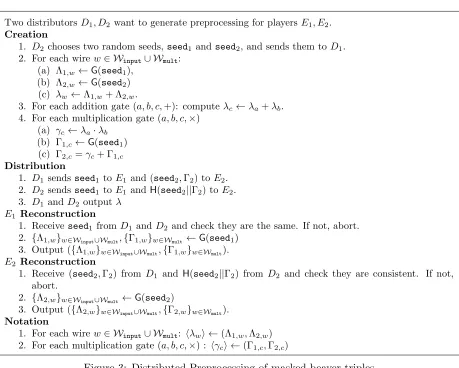
To generate the preprocessing material, D2 chooses a random string and sends it toD1. They
then each use this randomness to locally generate preprocessing, choosing mask values for every wire in the circuit as follows. They select a random field element for every wirew∈ Winput∪ Wmult
(that is, for every input wire, and every wire that is the output of a multiplication gate). We refer to these mask values as λ1, and the ones generated by the other 2 parties, in the second
pre-processing execution, are denoted by λ2. For the output wire of addition gate (a, b, c,+), suppose the input wiresa and bhave already been assigned mask values λa and λb. Then the output wire of the gate is assigned the mask value λa+λb. Note that all circuit wires now have well defined masks. For each multiplication gate (a, b, c,×), the two parties additionally compute γc=λa·λb. We let γ1 ={γc}c∈Wmult. D1 and D2 use their shared random string to construct secret sharings λ1 = Λ
The main protocol takes input from all 4 parties, and outputs the evaluation of C on those inputs. It makes use of the 3 components: Fpre,πeval, andπcross.
Pre-processing
1. The four parties make two calls to Fpre (Fig. 2). In the first call, P1 and P2 receive the output
hλ2i,hγ2ifor E
1 and E2 respectively, while P3 and P4 receiveλ2, the output of D1, D2. In the
second call, they reverse their roles, withP1 andP2receivingλ1, the output ofD1 andD2, and P3andP4 receivehλ1i,hγ1i, the output ofE1 andE2.
Evaluation
1. The four parties run two instances of πeval (Fig. 4). In the first instance, the playersP1 and P2
take the role of evaluatorsE1 and E2 usinghλ2i,hγ2i. Letm1 denote the resulting masked wire
values. In the second instance P3 and P4 take the role of evaluatorsE1 and E2 usinghλ1i,hγ1i.
Letm2denote the resulting masked evaluation. Cross Checking
1. The four parties runπcross(Fig. 5) whereP1, P2 each inputm1, λ2whileP3, P4both inputm2, λ1.
2. Ifπcross outputs 0, then abort.
3. We defineλ1
outto be output masks for the first evaluation. 4. We definem1
outto be the masked output wires for the first evaluation.
5. PlayerP1, P2broadcast m1out, if their broadcasts disagree then all players abort 6. PlayerP3, P4broadcast λ1out, if their broadcasts disagree then all players abort. 7. Players compute the output by usingm1
out andλ
1
out.
Figure 1: Main protocol in the hybrid model
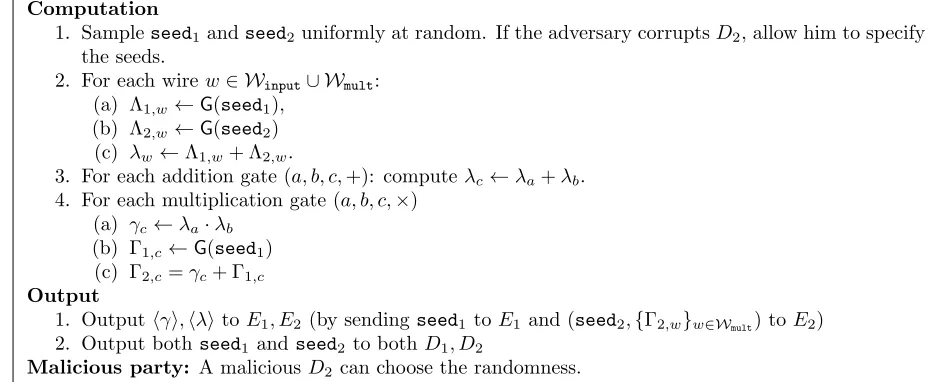
This 4-party, randomized functionality is called by two distributors and two evaluators. No parties contribute any input. The functionality generates a vector of random masks as output for the distributors, and a secret-sharing of these masks for the evaluators.
Input: None. Computation
1. Sampleseed1andseed2uniformly at random. If the adversary corruptsD2, allow him to specify
the seeds.
2. For each wirew∈ Winput∪ Wmult: (a) Λ1,w ←G(seed1),
(b) Λ2,w ←G(seed2)
(c) λw←Λ1,w+ Λ2,w.
3. For each addition gate (a, b, c,+): computeλc←λa+λb. 4. For each multiplication gate (a, b, c,×)
(a) γc←λa·λb (b) Γ1,c←G(seed1)
(c) Γ2,c=γc+ Γ1,c Output
1. Outputhγi,hλito E1, E2 (by sendingseed1to E1and (seed2,{Γ2,w}w∈Wmult) toE2)
2. Output bothseed1andseed2 to bothD1, D2
Malicious party: A maliciousD2 can choose the randomness.
Figure 2: Fpre: Ideal functionality for preprocessing
They both send Λ1 and Γ1 to E1, and they both send Λ2 and Γ2 to E2. E1 and E2 each verify
Two distributorsD1, D2want to generate preprocessing for playersE1, E2.
Creation
1. D2 chooses two random seeds,seed1 andseed2, and sends them toD1.
2. For each wirew∈ Winput∪ Wmult: (a) Λ1,w ←G(seed1),
(b) Λ2,w ←G(seed2)
(c) λw←Λ1,w+ Λ2,w.
3. For each addition gate (a, b, c,+): computeλc←λa+λb. 4. For each multiplication gate (a, b, c,×)
(a) γc←λa·λb (b) Γ1,c←G(seed1)
(c) Γ2,c=γc+ Γ1,c Distribution
1. D1 sendsseed1 toE1 and (seed2,Γ2) toE2.
2. D2 sendsseed1 toE1 andH(seed2||Γ2) toE2.
3. D1 andD2 outputλ E1 Reconstruction
1. Receiveseed1from D1 andD2 and check they are the same. If not, abort.
2. {Λ1,w}w∈Winput∪Wmult,{Γ1,w}w∈Wmult ←G(seed1)
3. Output ({Λ1,w}w∈Winput∪Wmult,{Γ1,w}w∈Wmult). E2 Reconstruction
1. Receive (seed2,Γ2) from D1 and H(seed2||Γ2) from D2 and check they are consistent. If not,
abort.
2. {Λ2,w}w∈Winput∪Wmult←G(seed2)
3. Output ({Λ2,w}w∈Winput∪Wmult,{Γ2,w}w∈Wmult).
Notation
1. For each wirew∈ Winput∪ Wmult: hλwi ←(Λ1,w,Λ2,w) 2. For each multiplication gate (a, b, c,×) : hγci ←(Γ1,c,Γ2,c)
Figure 3: Distributed Preprocessing of masked beaver triples
D2 require no further communication with each other. Because one of the parties must be honest,
the equality checks performed by E1 and E2 suffice to catch any malicious behavior. Note that
this idea shares some similarity with the one by Mohassel et al. [MRZ15] in the three-party setting based on garbled circuit.
We do not present the pre-processing protocol in quite the way that was just described. Instead, an optimized variant with reduced communication complexity is presented in Fig. 3. First, instead of choosing and sending random strings of length O(|C|), the two parties choose two short seeds for a PRG: we let Λ1=G(seed1), and Λ2 =G(seed2). As before,λ1= Λ1+ Λ2. Since the value of γ1 depends on λ1, we cannot do the same thing there, but we can generate the shares Γ1 from the
sameseed1, and then fix Γ2 appropriately, usingO(|Wmult|) bits. This reduces the communication
cost for each of the parties from (2|F|+ 1)· |Wmult|to 2κ+|F| · |Wmult|. Recall thatD1 andD2 send
identical copies of these values to an evaluator; we further reduce the communication by having one party send only a single hash of the pre-processing, which suffices for allowing each evaluator to verify the consistency of what he has received. Finally, note that this last optimization causes the communication costs to become unbalanced. Although we do not present it, note that we can re-balance the cost by having one party send the first half of Γ2 together with a hash of the second
half, while the other party sends the second half of Γ2 together with a hash of the first half.
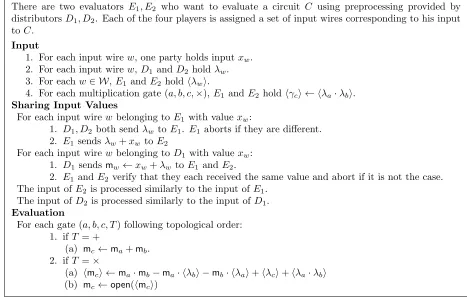
There are two evaluators E1, E2 who want to evaluate a circuit C using preprocessing provided by
distributorsD1, D2. Each of the four players is assigned a set of input wires corresponding to his input
toC. Input
1. For each input wirew, one party holds inputxw. 2. For each input wirew,D1 andD2 holdλw. 3. For eachw∈ W,E1 andE2hold hλwi.
4. For each multiplication gate (a, b, c,×),E1and E2holdhγci ← hλa·λbi. Sharing Input Values
For each input wirewbelonging toE1 with valuexw:
1. D1, D2 both sendλw toE1. E1 aborts if they are different.
2. E1 sendsλw+xw toE2
For each input wirewbelonging toD1 with valuexw: 1. D1 sendsmw←xw+λw toE1 andE2.
2. E1 andE2verify that they each received the same value and abort if it is not the case.
The input ofE2 is processed similarly to the input ofE1.
The input ofD2 is processed similarly to the input ofD1.
Evaluation
For each gate (a, b, c, T) following topological order: 1. ifT = +
(a) mc ←ma+mb. 2. ifT =×
(a) hmci ←ma·mb−ma· hλbi −mb· hλai+hλci+hλa·λbi (b) mc ←open(hmci)
Figure 4: πeval: Two-party Masked Evaluation
proceed to perform a mask-evaluation of the circuit, layer by layer. To begin, they first need masked input values for every input wire; these are of the form mw ←λw+xw. For an input wire wheld byE∈ {E1, E2},D1 andD2sendλw toE. E verifies that they each sent the same value: if not, he aborts. Otherwise, he computes λw+xw and sends it to the other evaluator. For input wirewbelonging toD∈ {D1, D2},Dsends λw+xw toE1 and E2. The evaluators compare values
and abort if they don’t agree.
For every gate (a, b, c,+), E1 and E2 both locally compute mc = ma+mb. For every gate (a, b, c,×), they locally computehmci ←ma·mb−ma· hλbi −mb· hλai+hλci+hλa·λbi. (Recall, they can compute the last term using hγci.) They then compute mc←open(hmci) by exchanging their shares of mc. At the conclusion of evaluation phase, one set of evaluators holds m1, which is the set of masked values of all wires in the circuit, and the other group of parties hold m2 after their evaluation phase.
Cross-checking. Note that during the evaluation phase, a malicious evaluator can modify the value on any w ∈ Wmult simply by changing his share of mw before reconstructing the value. Therefore, before either group recovers output from their computation, they first compare their masking with the masking of the other evaluation. Of course, they cannot reveal the values on any wires while doing this check. Instead, for wire w that carries value x, each set of evaluators uses the masking from their evaluation, together with the masks that they generated for the other group during pre-processing, to compute
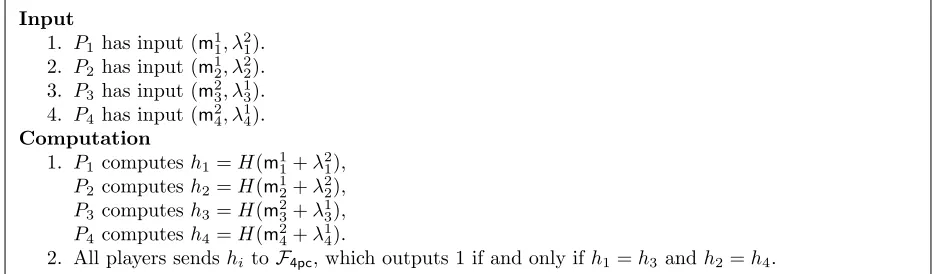
Input
1. P1has input (m11, λ21).
2. P2has input (m12, λ22).
3. P3has input (m23, λ13).
4. P4has input (m24, λ14).
Computation
1. P1computesh1=H(m11+λ21), P2computesh2=H(m12+λ22), P3computesh3=H(m23+λ13), P4computesh4=H(m24+λ
1 4).
2. All players sendshi to F4pc, which outputs 1 if and only ifh1=h3 andh2=h4.
Figure 5: πcross: Cross Checking
They then compare these “doubly masked” values for consistency.
As in the case of pre-processing, we use a hash function where possible, in order to reduce the communication cost. Each party begins by computing a hash of the doubly masked wire values described above; forPi, we denote this hash byhi. The four parties then call an ideal functionality,
Feq, which takes inputhi, and outputs 1 if and only ifh1 =h3, and h2 =h4.
Taking P1 as example, he obtains m11 during evaluation and λ21 when acting as a D. He will
then compute h1 = H(m11 +λ21). For the other three parties, it is defined similarly as follows:
superscripts denote the index of the masked evaluation and subscripts denote the identity of the party.
h2 =H(m12+λ22), h3 =H(m23+λ13), h4 =H(m24+λ14)
To see why this suffices for providing security, suppose P1 changes some masking during
evalu-ation, effectively changing a wire value for him andP2. In this case, the doubly masked evaluations
of P2 and P4 are inconsistent, and Feq will return 0; intuitively, comparing these hash values is
equivalent to checking the masked values wire by wire.
3.1 Concrete Performance
Here we briefly discuss the concrete performance of our protocol against the most related state-of-the-art protocol by Araki et al. [ABF+17]. As mentioned previously, our protocol requires 1.5 bits of communication per gate per party, a 4.5×improvement over their protocol. Let’s see if the same applies to the computation cost. Note that in the protocol by Araki et al., the heaviest part of the computation is random shuffling, due to the use of the random bucketing technique in their paper. The rest are AES and hash computation, which can be hardware accelerated or very fast. Compared to their protocol, our protocol is much simpler and more efficient in terms of computation cost. The bulk of our computation is in the evaluation phase, where we do not need any random shuffling. For each 128 AND gates, each party only needs 6 calls to fix-key AES to implement the PRG, and roughly one call to a hash function. Araki et al. have a higher computational cost than we do, because of their random shuffle; since they are able to fill a 10Gbps LAN, our protocol will certainly have no problem filling the same pipe. We believe the computation cost will not be the bottleneck for any reasonable hardware configuration.
performs two equality computations on strings of length O(κ). Nevertheless, in Section 5, we also demonstrate how we can bootstrap this functionality, communicating just a small constant number of bits, and using almost no computation.
3.2 Achieving one bit of communication using six parties
We note that if we use six players, we can maintain of the overhead of 6 bits communicated in total, thereby requiring each player to communicate just one bit per wire (on average). The idea is very simple. Two people agree on randomness for the preprocessing, and then each communicates the preprocessing material to two of the remaining four players. Those four parties now carry out two identical evaluations, in parallel, and cross check them with one another at the end. The communication overhead is still six bits per gate, but it is now divided among all six players.
4
Security Proof
4.1 Proof of Security for Preprocessing
Lemma 4.1. The protocol in Fig. 3 for distributed pre-processing securely realizes the functionality of Fig. 2.
Proof. Due to symmetry, we only prove the lemma for the following two cases: 1) D1 is corrupt
and 2) E1 is corrupt.
Corrupted D1. We will first describe our simulator S.
1. S queries Fpre and obtains seed1,seed2. If the A chooses to input randomness, use A’s
choice.
2. S acts as honestD2,E1 and E2 for the rest of the protocol using the seeds obtained above.
If an honestE1 orE2 would abort, S sends aborttoFpre.
Note that none of the parties in the protocol have input. Therefore the indistinguishability of the ideal-world protocol and the real-world protocol is immediate, given the observation that the protocol aborts in the real world protocol if and only if it aborts in the ideal world protocol.
CorruptedE1. Note thatE1 performs only local computation after receiving messages from other
parties. The simulator queries Fpre and receives the seeds. He then simulates honest D1 and D2,
sending seed1 on their behalf. If E1 aborts, the simulator will send abort to Fpre and aborts.
Indistinguishability from the real-world protocol is immediate.
4.2 Proof of Security of the Main Protocol
Theorem 3. Assuming H is a random oracle, our main protocol, in Fig. 1, securely realizes F4pc
in the (Fpre,Feq)-hybrid model.
Proof. In the following, we will prove the security of our main protocol assuming thatP1is corrupted
1. S honestly simulates the execution ofFpre. He sendsP1 his resulting output, and records the
simulated mask values: λ1, which will mask the wire values in the evaluation of P
3 and P4,
and λ2, which will mask the wire values in the evaluation ofP1 and P2.
2. S simulates the masking of input values 0 fromP2, P3 and P4 for use inP1’s evaluation with P2, using mask values from λ2. He receives three maskings of P1’s input: one for each of P3
and P4 for use in their evaluation, using mask values fromλ1, and one using values from λ2,
sent to P2 for his own evaluation with P1. If the values sent to P3 and P4 are not equal, S
sends abort to F4pc and terminates the simulation. Otherwise, S extracts the input sent to
P2, and the one sent toP3andP4, using his knowledge of the masks; he notes ifP1misbehaves
by using inconsistent values in the two evaluations.
3. S acts honestly as P2, P3 and P4 in both executions of the masked evaluations. S obtains
m1 by interacting honestly withP1 on behalf of P2 for the remainder of their evaluation. He
obtainsm2 by simulating (internally) the remainder of the evaluation ofP3 and P4. S notes
ifP1 misbehaved in the masked evaluation produced by P1 andP2.
4. S collects P1’s input to Feq. If P1 sends the wrong input, if he misbehaved during input
masking, or during his evaluation, S returns 0 from Feq to P1, and sends abort to F4pc.
Otherwise, he returns 1 from Feq toP1.
Comment: In Section 5, we describe a more efficient, interactive protocol,πvcc, which replaces
the use of Feq. To simulate our protocol when using πvcc, we would proceed as follows, in
place of the previous step. If S noted that that P1 misbehaved during evaluation, or when
sending his masked input, thenS runsπvcc, simulating the messages ofP2 andP4 when using
different (random) inputs from one another. Otherwise, he runs πvcc as though P2, P3 and P4 all use input m1⊕λ2. If πcross outputs 0,S sends aborttoF4pc.
5. S uses the input extracted in Step 2 and sends it to F4pc. He receives y and computes
λ∗ =m1out+y. S acts asP3 andP4 sending λ∗ toA.
Now we will show that the joint distribution of the output from A and honest parties in the ideal world are indistinguishable from these in the real world protocol.
1. Hybrid1: Same as the hybrid protocol with S plays the role of honest players using their true input. (The resulting distribution is equivalent to that of the real world execution.)
2. Hybrid2: Same as Hybrid1, except that S obtains m1 and λ1 and compute x1 =m1in+λ1in. S
sendsx1toF4pc, which returnsy. In step 5,S acts asP3 andP4and broadcastsλ∗ =m1out+y.
3. Hybrid3: Same as theHybrid2 except that all honest parties uses 0 instead of their true input.
5
Cross Check from Veto
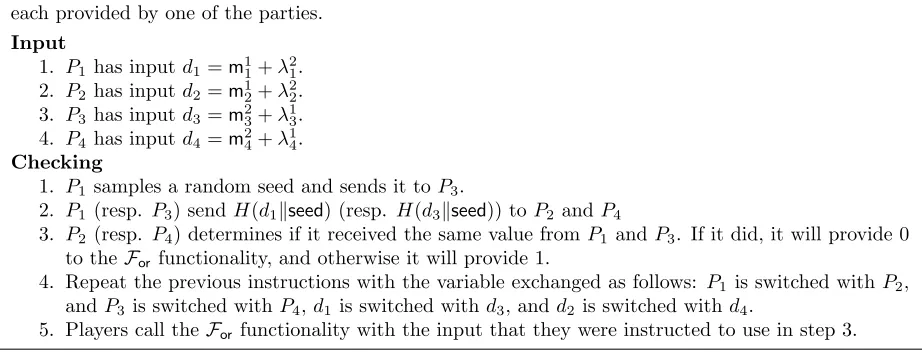
In this section, we will demonstrate how to construct an efficient cross checking protocol based on a functionality for 4-party, logical OR,For. We sometimes call this aveto functionality, as the parties
The protocol assumes access to an ideal functionality,For, for computing the logical OR of 4 input bits,
each provided by one of the parties. Input
1. P1has inputd1=m11+λ 2 1.
2. P2has inputd2=m12+λ 2 2.
3. P3has inputd3=m23+λ13.
4. P4has inputd4=m24+λ14.
Checking
1. P1samples a random seed and sends it toP3.
2. P1(resp. P3) sendH(d1kseed) (resp. H(d3kseed)) toP2andP4
3. P2(resp. P4) determines if it received the same value fromP1 andP3. If it did, it will provide 0
to theFor functionality, and otherwise it will provide 1.
4. Repeat the previous instructions with the variable exchanged as follows: P1 is switched with P2,
andP3is switched withP4,d1is switched with d3, andd2 is switched withd4.
5. Players call theFor functionality with the input that they were instructed to use in step 3.
Figure 6: Cross check protocol from veto
from Section 3 required a 4-party computation of Feq, which compared 2 pairs of strings, each κ
bits long. The improved cross checking protocol based on veto requires each party to compare two hashes locally, and then input a single bit to the veto functionality. While the cost of either of these protocols is small compared to the evaluation phase, the simplicity of the protocol here makes it hard to pass up. We also describe how to bootstrap For, using a variant of the protocol from
Section 3, and requiring just 6 bytes of communication per party. Perhaps one of the nicest features of this bootstrapping, from a practical standpoint, is that it allows us to avoid any dependence on other MPC implementations.
Naive implementation of cross checking. A naive way of implementing cross checking is to have the two verifiers exchange their doubly masked evaluations, and compare them for inconsisten-cies. Unfortunately, this approach fails because the adversary can modify the values carried on any of the wires in his own evaluation, and determine precisely how the change impacted the evaluation of the circuit by subtracting his doubly masked evaluation from the other. The differences between these two doubly masked evaluations reveals the differences in the values carried on each wire in the two evaluations of the circuit.
Achieving secure and efficient cross checking. Our main observation for simplifying the cross check protocol is that, in the attack just described,P1 will always cause the verification run byP2
and P4 to fail. This is because the evaluation of P2 was also modified on wire w, but he will not
modifyλ1w the wayP1 did. If the output of the equality test betweenP1 and P3 were hidden from P1, shown only to P2 and P4, and, symmetrically, if P1 only saw the result of their verification
(which he already knows), then we can remove the bit of leakage. Specifically, each Pi learns a single bit, bi, indicating whether theother verifying set passed the equality test. The four parties then run a secure protocol that computes the logical OR of these 4 bits. They can do this using any existing 4-party protocol.
they receive are the same.
Note that For is a constant size circuit, and it likely does not matter which four party secure computation we use to realize it. Still, it is interesting to note that we can actually bootstrap this computation with another variant of our own protocol. In the protocol just previously described, letting di,w denote the doubly masked value held byPi for wirew, the parties effectively compute
W
w∈W(d1,w 6=d3,w)∨Ww∈W(d2,w 6= d4,w), where the hash value received by P1 and P3 (resp. P2
andP4) reveals the first (resp. second) disjunction of size|W|toP1 andP3 (resp.P2 andP4). The
disjunction in the middle is where we use For. Following the same discussion above, the reader can verify that it is also secure to compute W
w∈W((d1,w 6=d3,w)∨(d2,w6=d4,w)). This can be
achieved by having the four parties check the equality of gates in topological order by immediately exchanging the results of every equality check, rather than “batching them” with a hash function at the end of the evaluation. Removing the hash function in this way increases the communication toO(|C|), so we would not want prefer to use this as our cross-checking protocol. But to bootstrap
For, which has just 3 gates, there is no need for the use of a hash function.
Security of Veto Cross Check
(Sketch.) Our main protocol is secure if we replace the cross checking in the main protocol with the cross checking described in this section.
If the adversary acted maliciously during the masked evaluation, then it is clear that the verifi-cation group that does not contain the corrupt player (i.e. the honest verifiverifi-cation group) will have inconsistent evaluations. As a result, the simulator can run the cross checking on behalf of the honest players as though the player in the honest verification group had inconsistent evaluations. In this case, the honest player in the same validation group as the corrupt player will always provide a veto. As a result, the simulator can safely always provide a simulated output of veto from For, sends aborttoF4pc, and the result is indistinguishable from a real execution.
If instead the corrupt player only misbehaves in the cross checking, the only possible deviation is to send the wrong hash value. In this case, the simulator can compute whether the corrupt player misbehaved by analyzing the hash value that he sent, together with the seed. The simulator knows that both players in the honest verification group will veto. As a result, the simulator can simply provide a simulated output of veto fromFor, submitaborttoF4pc, and the result is indistinguishable from a real execution.
Finally, if the adversary never deviates from the protocol, the simulator accepts the adversary’s input to For and sends it back to him as the output of For. If this value is a veto, the simulator sends abort to F4pc, and otherwise, he submits the adversary’s input to F4pc, and simulates the
opening of the output just as in Section 4.
The view in the real and ideal world are indistinguishable since (1) the simulator can always determine if there is a veto or not for the functionality based on the behavior of the adversary and (2) the random oracles hides inputs from the other verification group.
6
Adding Robustness
Two distributors D1, D2want to generate preprocessing for players E1, E2. We assumeD1holds a key
pair for a public key, committing encryption scheme, and that both hold key pairs for a digital signature scheme. The 3 public keys are known by all parties. We let (pk,sk) denote the encryption/decryption keys ofD1, and (vki,ski) denote the verifying/signing keys ofDi.
Protocol
1. D2 chooses (seed1,seed2,rcom) at random and broadcasts enc(pk,seed1||seed2||rcom). If he fails
to do so, or if he broadcasts an invalid ciphertext, the other 3 parties run a 3-party, semi-honest protocol, whereD1 generates the preprocessing.
2. D1 recovers (seed1,seed2,rcom).
3. EachDi computes the preprocessing that was described in Fig. 3.
4. Each Di computes commit({λw}w∈Woutput;rcom). He includes these commitments in the
prepro-cessing material.
5. Each Di signs the preprocessing material: σ1,i =sign(ski;seed1) and σ2,i =sign(ski;seed2||Γ2).
He sends (seed1, σ1,i) toE1, and (seed2,Γ2, σ2,i) toE2.
6. Ej receives (mj,1, σj,1) and (mj,2, σj,2). He checks whether vrfy(pk1, σj,1) = vrfy(pk2, σj,2) = 1,
and whethermj,1=mj,2.
• If one of the signatures does not verify,Ejcontinues the protocol using only the preprocessing material that was validly signed.
• If both signatures verify, butmj,16=mj,2,
– Ej broadcasts the two signed messages.
– D2 broadcasts (seed1,seed2), together with the encryption randomness used in the
Step 1. All honest parties can now determine whether D1 or D2 misbehaved. They
eliminate the guilty party and execute a 3-party, semi-honest protocol.
• Ej outputsmj,1.
Figure 7: Robust Preprocessing
aborts after learning the output masks, his partner can still reveal the output for the other two evaluators. The only necessary modification is to prevent the malicious distributor from changing his output masks, revealing output values that conflict with what his partner reveals. This is easily handled by having all parties commit to their output masks prior to the evaluation: if the two distributors use the same randomness in their commitments, the evaluators can verify that they have both committed to the same mask value.
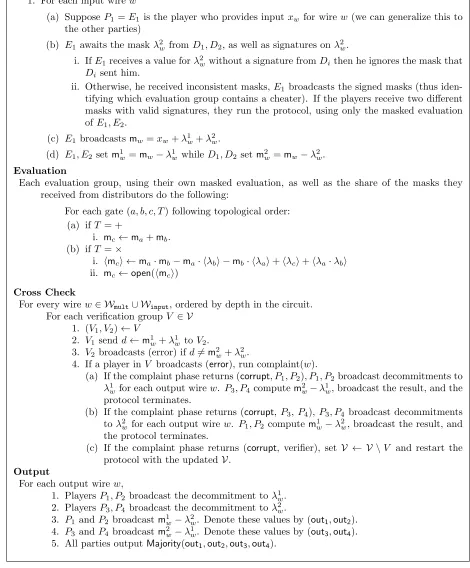
Input phase
1. For each input wirew
(a) SupposeP1=E1 is the player who provides input xw for wire w(we can generalize this to the other parties)
(b) E1 awaits the maskλ2wfrom D1, D2, as well as signatures onλ2w.
i. IfE1receives a value forλ2wwithout a signature fromDi then he ignores the mask that
Di sent him.
ii. Otherwise, he received inconsistent masks,E1 broadcasts the signed masks (thus
iden-tifying which evaluation group contains a cheater). If the players receive two different masks with valid signatures, they run the protocol, using only the masked evaluation ofE1, E2.
(c) E1 broadcastsmw=xw+λ1w+λ2w.
(d) E1, E2 setm1w=mw−λ1w whileD1, D2 setm2w=mw−λ2w. Evaluation
Each evaluation group, using their own masked evaluation, as well as the share of the masks they received from distributors do the following:
For each gate (a, b, c, T) following topological order: (a) ifT = +
i. mc←ma+mb. (b) ifT =×
i. hmci ←ma·mb−ma· hλbi −mb· hλai+hλci+hλa·λbi ii. mc←open(hmci)
Cross Check
For every wirew∈ Wmult∪ Winput, ordered by depth in the circuit. For each verification groupV ∈ V
1. (V1, V2)←V
2. V1 sendd←mw1 +λ1wto V2.
3. V2 broadcasts (error) ifd6=m2w+λ2w.
4. If a player inV broadcasts (error), run complaint(w).
(a) If the complaint phase returns (corrupt, P1, P2), P1, P2broadcast decommitments to λ1wfor each output wirew. P3, P4computem2w−λ
1
w, broadcast the result, and the protocol terminates.
(b) If the complaint phase returns (corrupt, P3,P4),P3, P4 broadcast decommitments
to λ2w for each output wirew. P1, P2 computem1w−λ2w, broadcast the result, and the protocol terminates.
(c) If the complaint phase returns (corrupt, verifier), set V ← V \V and restart the protocol with the updatedV.
Output
For each output wirew,
1. PlayersP1, P2broadcast the decommitment toλ1w. 2. PlayersP3, P4broadcast the decommitment toλ2w.
3. P1andP2 broadcastm1w−λ2w. Denote these values by (out1,out2).
4. P3andP4 broadcastm2w−λ1w. Denote these values by (out3,out4).
5. All parties output Majority(out1,out2,out3,out4).
parties that contains the adversary.1 Input sharing, evaluation, and robust cross checking are fully described in Fig. 8. We give a detailed overview of these changes below.
Robust preprocessing: To make the preprocessing robust, one of the two distributors, D2,
starts by committing to the randomness that will be used in the preprocessing. This commitment is constructed by broadcasting a committing encryption under the public key ofD1. The randomness
used in the preprocessing is denoted by (seed1,seed2,rcom): seed1 and seed2 are used to create
masks, just as in Section 3. rcom is used to construct a commitment to the output masks, which is
then included in the preprocessing output.
After generating the preprocessing material, D1 and D2 each sign a copy of the output before
sending it toE1 andE2. If they send conflicting values toE1, the signatures allow E1 to convince
the other honest parties that one of D1 or D2 is malicious. The honest one of the two can now
be exonerated: D2 broadcasts the randomness used to encrypt the preprocessing randomness. E1
broadcasts their view, and the honest parties can check the validity of of the messages sent byD1
and D2. After removing the malicious party, the remaining three parties can run a semi-honest
protocol in which one party supplies the preprocessing, the other two perform the evaluation, and no checking needs to be performed.
One other case of note deserves mention: suppose E1 receives nothing2 from, say, D1. In this
case, because there is no signature,E1 cannot prove thatD1 orD2is malicious: it is equally possible
thatE1 is himself malicious, and that he made the problem up. In this case, though, E1 does need
to persuade anybody. BecauseE1 knows thatD1 is malicious,E1 can simply continue the protocol
using the preprocessing he received from D2.
Robust input sharing: Let P1 and P2 perform distribution for P3, P4, and vice versa. Recall
that Section 3, P1 shares input xw on wire w with P3, P4 by using the mask λ1w that he and P2
generated together. He shares his input with P1, for their own evaluation, by using λ2w, which he receives fromP3, P4. As written, nothing prevents him from sharing inconsistent values among the
parties, and nothing prevents those parties from pretending he did so. To fix this, we first require P3, P4 to each signλ2w, which allowsP1to broadcast a proof of inconsistency when necessary. Then, P1 signs and broadcasts his doubly masked input: mw =xw+λ1w+λ2w. P2 computes mw−λ1w for use in his evaluation with P2. P3, P4 each computemw−m2w for use in their evaluation.
Robust cross checking: Instead of cross checking the hashes of the full circuit maskings, the parties instead cross check gate by gate, starting at the input layer, and proceeding topologically through the circuit. This protocol begins with a pass over the circuit, one layer at a time, with the parties comparing their doubly masked values to locate the first gate at which the two evaluations depart from one another. Consider the case where P3 decides that the two masked evaluations of
some gate are inconsistent, and initiates a complaint. This can be due to one of the following cases: 1. The masked evaluation performed byP1 andP2 is invalid.
2. The masked evaluation performed byP3 andP4 is invalid.
3. Both evaluations were executed correctly, but either P1 modified his input to cross-checking
(i.e. his reported masked evaluation), orP3 complained for no valid reason.
1
To reduce communication of the robust cross checking, we can iteratively apply our cross check protocol from Section 5, performing a binary search on the masked circuit layers until we find the problematic layer. We then repeat that, performing a binary search within the problematic layer to find the problematic gate. This would yield a worst-case communication cost ofO(κlog|C|). For simplicity, we describe the protocol as operating gate per gate.
2
Complaint Subprotocol
Thecomplaint subprotocol is initiated for output wirew for a multiplication gategwwhen a player C
has complained that the two masked evaluations were inconsistent on that wire. We denote byV ∈ Vthe verification group that contains C. This subprotocol allows the parties to identify either an evaluation group or a verification group that contains a cheater.
Complaint
1. E1← {P1, P2}, E2← {P3, P4}, D1← {P3, P4}, D2← {P1, P2}
2. Players run the validation functionality for wire w using E1 as the evaluators and D1 as the
distributors.
3. Players run the validation functionality for wire w using E2 as the evaluators and D2 as the
distributors.
4. If any of the calls to the validation functionality results in the functionality returning (corrupt,Pi,Pj), return the same. Otherwise, return (corrupt, verifier).
Validation
E1, E2, D1 andD2want to verify that the masked evaluation of E1, E2 was done correctly for the gate gw with output wirew.
Input
1. E1, E2 each input their masked evaluation for the 3 wires ofgw: (ma,mb,mc). 2. D1, D2 each input the masks that they generatedgw: (λa, λb, λc).
Functionality
1. IfE1 andE2provided distinct inputs, return (corrupt,E1,E2) and halt.
2. IfD1 andD2 provided distinct inputs, return (corrupt,D1,D2) and halt.
3. If (ma−λa)·(mb−λb) +λc=mc, then output (valid). Otherwise output (corrupt,E1,E2).
Figure 9: Complaint
If the honest players know that the first case holds, then the corrupt player is eitherP1 orP2. They
can therefore use the evaluation of P3 and P4 to determine their output. By the same argument,
if the players know that the second case holds, they can all safely use the evaluation of P1 and P2 to produce the output. Finally, if the players know they are in the third case, they know that
the malicious party is either P1 or P3. In this case, they do not dismiss either evaluation, but
they continue the cross checking using only between P2 and P4; since P2 and P4 are honest, their
cross-checking suffices for ensuring a valid computation.
When someone detects an inconsistency in the cross checking of a gate, the parties execute a
functionality indicates this, and the parties conclude that either the party that raised the alarm is malicious, or his partner in the cross-checking is malicious (case 3 above).
6.1 Robust Evaluation Simulator
Theorem 4. If the robust evaluation protocol is instantiated using a CCA-Secure public-key com-mitting encryption scheme then it securely realizes F4pc in the random oracle model. In addition, the protocol is robust.
Simulator for robust preprocessing when D2 is corrupt.
1. Await that D2 broadcast the ciphertext c. If the ciphertext is invalid then the simulator
submits a default input value toF4pc on behalf of the adversary, and terminates. (This cor-responds to the honest parties removing the adversary from the computation, upon agreeing that he is malicious.)
2. Recover (seed1kseed2krcom)←Dec(sk, c).
3. The simulator computes the preprocessing and broadcasts
commit({λw}w∈Woutput;rcom) on behalf ofD1.
4. Simulator awaits thatD2sends the preprocessing material and signatures on the preprocessing
material to each player. Then,
(a) For each evaluator, ifD2 sent an invalid signature to the given evaluator, the simulator
ignores whatD2 sent.
(b) Otherwise, ifD2 sent invalid preprocessing to either evaluator, then simulate the
broad-cast from the given evaluator of the the signed preprocessing and determining thatD2
misbehaved. The simulator notes thatD2 was identified as a cheater.
Simulator for robust preprocessing when D1 is corrupt. Same as the simulation for D2
except that the simulator broadcasts the encryption of the randomness toD1.
Simulator for robust preprocessing when an evaluator is corrupt. The simulator chooses randomness and simulates the three honest players. If an evaluator sends a message claiming he received inconsistent preprocessing, but the signed messages he forwards do not substantiate his claim, the simulator sends a default input toF4pcand terminates. (Technically, we did not describe in our protocol that the other parties remove the evaluator when he does this, because we felt it would unnecessarily complicate the protocol description.)
Indistinguishability of robust preprocessing.
2. The only message sent by an evaluator is (possibly) to complain about inconsistent prepro-cessing. If the evaluator is corrupt, then in both the ideal and real world, the complaint would be ignored (due to the unforgeability of the underlying signature scheme).
Simulator for input sharing.
1. If the corrupt player is providing input as an evaluator,
(a) The simulator provides the signed masks from the other distributors.
(b) The simulator awaits that the corrupt player broadcasts a double masking mw. The simulator then computes the input of the corrupt player from the masks that were produced in the preprocessing and the double masking that the corrupt player sent.
2. If the corrupt player is a distributor, and the input wire belongs to an evaluator,
(a) The simulator awaits that the corrupt player sends out a mask to the evaluator. If the mask is signed with the corrupt player’s signature, and is not the value produced in the preprocessing, then the simulator produces a broadcast of the conflicting, signed masks. The simulator provides the default value to F4pc on behalf of the corrupt player and terminates.
3. If the corrupt player is an evaluator, and the input wire belongs to the other evaluator, the simulator broadcasts the doubly masked input.
Indistinguishability of input phase. We argue that since the view until the end of the prepro-cessing phase in the ideal world is indistinguishable from the view until the end of the preproprepro-cessing phase in the real world, then the views are also indistinguishable up through the end of the input phase. In the real and ideal world, when the distributor is corrupt, any deviation would either be ignored, or would result in the dealer being caught and eliminated from the computation. If the evaluator is corrupt, and he broadcasts an invalid complaint, he is eliminated due to the unforge-ability of the underlying signature scheme.
Simulator for evaluation. The simulator of the evaluation step follows the same steps as the simulator for the masked evaluation in the main protocol. In particular, the simulator stores if the corrupt player misbehaved during his evaluation. We argue that since the view until the end of the input phase in the ideal world is indistinguishable from the view until the end of the input phase in the real world, then the views are also indistinguishable up through the end of the evaluation phase.. This holds from the fact that our main protocol (in particular the masked evaluation part) is secure.
Simulator for cross check. For every multiplication wirew∈ Wmult,
1. if the corrupt evaluator had previously sent a wrong value in the evaluation of wirew,
(b) The simulator receives (λa, λb, λc) and (ma,mb,mc) from the adversary, intended for the first and second calls to the validation functionality, respectively (and without loss of generality). If (λa, λb, λc) are inconsistent with the values simulated during prepro-cessing, the simulator implicates the adversary (and his partner) when simulating the output of the first call to the validation functionality. In either case he implicates the adversary (and his partner) in the simulated output of the second call to the validation functionality.
The simulator then runs the protocol on behalf of the honest players using the honest evalu-ation group’s masked evaluevalu-ation.
2. Otherwise:
(a) if simulating V1, the simulator checks to see if the adversary sends a wrong doubly
masked value to his partner: m1w+λ1w.
(b) if simulating V2, the simulator checks to see if the adversary broadcasts (error).
The simulator receives (λa, λb, λc) and (ma,mb,mc) from the adversary, intended for the first and second calls to the validation functionality, respectively (and without loss of generality). If (λa, λb, λc) are inconsistent with the values simulated during preprocessing, the simulator implicates the adversary (and his partner) when simulating the output of the first call to the validation functionality. If (ma,mb,mc) are inconsistent with simulated masked values of the evaluation phase, the simulator implicates the adversary (and his partner) when simulating the output of the second call to the validation functionality. If he is not implicated in either instance, then any future messages he might send during cross checking are ignored.
Indistinguishability of cross check. We argue that since the view until the end of the evaluation phase in the ideal world is indistinguishable from the view until the end of the evaluation phase in the real world, then the views are also indistinguishable up through the end of the cross check. If the corrupt player’s evaluation group is deemed corrupt, then the protocol in the real world would dictate that the corrupt player no longer receive messages during the cross check phase. Therefore, it is clear that after the elimination has taken place, the views in the real and ideal world are indistinguishable.
We now claim that the validation function eliminates the adversary’s evaluation set in the real world, if and only if the simulator implicates the adversary’s evaluation set in the ideal world. Note that the simulator can detect if the adversary has modified any wire in the evaluation, as well as whether his input to the validation function is inconsistent with his partner’s input. The reader can verify by inspection that the claim holds. Since the complaint phase consists of just two calls to the validation functionality, it follows that the adversary’s view in the complaint phase is identically distributed in the two worlds. By the previous note, after this point, the cross check in the real and ideal worlds would be indistinguishable.
Simulator for output phase. The output phase is the easiest to simulate.
1. First the simulator queries the ideal functionality with the adversary’s input and receives an output.
2. The simulator selects masks for the honest evaluation group so that the sum of the output and the masks of the honest evaluation group is equal to the masked evaluation of the cor-rupt player. The simulator then “broadcasts” decommitments to the masks of the honest evaluation group.
3. The simulator selects masked evaluation for the honest evaluation group so that the sum of the output and the masks of the corrupt player add up to the masked evaluation. The simulator then “broadcasts” the masked evaluations.
Indistinguishability of output phase. We now argue that the output distribution, conditioned on the adversary’s view, is indistinguishable in the two worlds. We have already argued that the adversary is caught if he ever manipulates his evaluation. The reader can verify that whenever a transcript results in the use of a default adversarial input in the real world, the simulator submits default input in the ideal world. If the adversary never changes the masked values, then the input used in both worlds is the one he committed to in the input sharing phase.
References
[ABF+17] Toshinori Araki, Assi Barak, Jun Furukawa, Tamar Lichter, Yehuda Lindell, Ariel Nof, Kazuma Ohara, Adi Watzman, and Or Weinstein. Optimized honest-majority MPC for malicious adversaries - breaking the 1 billion-gate per second barrier. In2017 IEEE Symposium on Security and Privacy, pages 843–862, San Jose, CA, USA, May 22–26, 2017. IEEE Computer Society Press.
[BDNP08] Assaf Ben-David, Noam Nisan, and Benny Pinkas. FairplayMP: a system for secure multi-party computation. In Peng Ning, Paul F. Syverson, and Somesh Jha, editors,
ACM CCS 08, pages 257–266, Alexandria, Virginia, USA, October 27–31, 2008. ACM Press.
[BDOZ11] Rikke Bendlin, Ivan Damg˚ard, Claudio Orlandi, and Sarah Zakarias. Semi-homomorphic encryption and multiparty computation. In Kenneth G. Paterson, editor,
EUROCRYPT 2011, volume 6632 ofLNCS, pages 169–188, Tallinn, Estonia, May 15– 19, 2011. Springer, Heidelberg, Germany.
[Bea92] Donald Beaver. Efficient multiparty protocols using circuit randomization. In Joan Feigenbaum, editor,CRYPTO’91, volume 576 ofLNCS, pages 420–432, Santa Barbara, CA, USA, August 11–15, 1992. Springer, Heidelberg, Germany.
[BOGW88] Michael Ben-Or, Shafi Goldwasser, and Avi Wigderson. Completeness theorems for non-cryptographic fault-tolerant distributed computation (extended abstract). In20th ACM STOC, pages 1–10, Chicago, IL, USA, May 2–4, 1988. ACM Press.
[CKMZ14] Seung Geol Choi, Jonathan Katz, Alex J. Malozemoff, and Vassilis Zikas. Efficient three-party computation from cut-and-choose. In Juan A. Garay and Rosario Gennaro, editors,CRYPTO 2014, Part II, volume 8617 ofLNCS, pages 513–530, Santa Barbara, CA, USA, August 17–21, 2014. Springer, Heidelberg, Germany.
[DGKN09] Ivan Damg˚ard, Martin Geisler, Mikkel Krøigaard, and Jesper Buus Nielsen. Asyn-chronous multiparty computation: Theory and implementation. In Stanislaw Jarecki and Gene Tsudik, editors, PKC 2009, volume 5443 of LNCS, pages 160–179, Irvine, CA, USA, March 18–20, 2009. Springer, Heidelberg, Germany.
[DI05] Ivan Damg˚ard and Yuval Ishai. Constant-round multiparty computation using a black-box pseudorandom generator. In Victor Shoup, editor, CRYPTO 2005, volume 3621 of LNCS, pages 378–394, Santa Barbara, CA, USA, August 14–18, 2005. Springer, Heidelberg, Germany.
[DI06] Ivan Damg˚ard and Yuval Ishai. Scalable secure multiparty computation. In Cynthia Dwork, editor,CRYPTO 2006, volume 4117 ofLNCS, pages 501–520, Santa Barbara, CA, USA, August 20–24, 2006. Springer, Heidelberg, Germany.
[DIK+08] Ivan Damg˚ard, Yuval Ishai, Mikkel Krøigaard, Jesper Buus Nielsen, and Adam Smith. Scalable multiparty computation with nearly optimal work and resilience. In David Wagner, editor,CRYPTO 2008, volume 5157 ofLNCS, pages 241–261, Santa Barbara, CA, USA, August 17–21, 2008. Springer, Heidelberg, Germany.
[DIK10] Ivan Damg˚ard, Yuval Ishai, and Mikkel Krøigaard. Perfectly secure multiparty com-putation and the comcom-putational overhead of cryptography. In Henri Gilbert, editor,
EUROCRYPT 2010, volume 6110 ofLNCS, pages 445–465, French Riviera, May 30 – June 3, 2010. Springer, Heidelberg, Germany.
[DNNR17] Ivan Damg˚ard, Jesper Buus Nielsen, Michael Nielsen, and Samuel Ranellucci. The TinyTable protocol for 2-party secure computation, or: Gate-scrambling revisited. LNCS, pages 167–187, Santa Barbara, CA, USA, 2017. Springer, Heidelberg, Germany.
[DPSZ12] Ivan Damg˚ard, Valerio Pastro, Nigel P. Smart, and Sarah Zakarias. Multiparty com-putation from somewhat homomorphic encryption. In Reihaneh Safavi-Naini and Ran Canetti, editors,CRYPTO 2012, volume 7417 ofLNCS, pages 643–662, Santa Barbara, CA, USA, August 19–23, 2012. Springer, Heidelberg, Germany.
[FY92] Matthew K. Franklin and Moti Yung. Communication complexity of secure compu-tation (extended abstract). In 24th ACM STOC, pages 699–710, Victoria, British Columbia, Canada, May 4–6, 1992. ACM Press.
[GIP+14] Daniel Genkin, Yuval Ishai, Manoj Prabhakaran, Amit Sahai, and Eran Tromer. Cir-cuits resilient to additive attacks with applications to secure computation. In David B. Shmoys, editor, 46th ACM STOC, pages 495–504, New York, NY, USA, May 31 – June 3, 2014. ACM Press.
[GMW87] Oded Goldreich, Silvio Micali, and Avi Wigderson. How to play any mental game or A completeness theorem for protocols with honest majority. In Alfred Aho, editor,19th ACM STOC, pages 218–229, New York City, NY, USA, May 25–27, 1987. ACM Press.
[HKE12] Yan Huang, Jonathan Katz, and David Evans. Quid-Pro-Quo-tocols: Strengthening semi-honest protocols with dual execution. In2012 IEEE Symposium on Security and Privacy, pages 272–284, San Francisco, CA, USA, May 21–23, 2012. IEEE Computer Society Press.
[IPS08] Yuval Ishai, Manoj Prabhakaran, and Amit Sahai. Founding cryptography on oblivious transfer - efficiently. In David Wagner, editor,CRYPTO 2008, volume 5157 ofLNCS, pages 572–591, Santa Barbara, CA, USA, August 17–21, 2008. Springer, Heidelberg, Germany.
[LN17] Yehuda Lindell and Ariel Nof. A framework for constructing fast MPC over arithmetic circuits with malicious adversaries and an honest-majority. In ACM CCS 17, pages 259–276. ACM Press, 2017.
[LPSY15] Yehuda Lindell, Benny Pinkas, Nigel P. Smart, and Avishay Yanai. Efficient constant round multi-party computation combining BMR and SPDZ. In Rosario Gennaro and Matthew J. B. Robshaw, editors, CRYPTO 2015, Part II, volume 9216 of LNCS, pages 319–338, Santa Barbara, CA, USA, August 16–20, 2015. Springer, Heidelberg, Germany.
[MF06] Payman Mohassel and Matthew Franklin. Efficient polynomial operations in the shared-coefficients setting. In Moti Yung, Yevgeniy Dodis, Aggelos Kiayias, and Tal Malkin, editors,PKC 2006, volume 3958 ofLNCS, pages 44–57, New York, NY, USA, April 24–26, 2006. Springer, Heidelberg, Germany.
[MRZ15] Payman Mohassel, Mike Rosulek, and Ye Zhang. Fast and secure three-party compu-tation: The garbled circuit approach. In Indrajit Ray, Ninghui Li, and Christopher Kruegel:, editors, ACM CCS 15, pages 591–602, Denver, CO, USA, October 12–16, 2015. ACM Press.
[MZ17] Payman Mohassel and Yupeng Zhang. SecureML: A system for scalable privacy-preserving machine learning. In2017 IEEE Symposium on Security and Privacy, pages 19–38, San Jose, CA, USA, May 22–26, 2017. IEEE Computer Society Press.
pages 681–700, Santa Barbara, CA, USA, August 19–23, 2012. Springer, Heidelberg, Germany.
[RBO89] Tal Rabin and Michael Ben-Or. Verifiable secret sharing and multiparty protocols with honest majority (extended abstract). In 21st ACM STOC, pages 73–85, Seattle, WA, USA, May 15–17, 1989. ACM Press.
[WRK17a] Xiao Wang, Samuel Ranellucci, and Jonathan Katz. Authenticated garbling and effi-cient maliciously secure two-party computation. In ACM CCS 17, pages 21–37. ACM Press, 2017.