Gendered Inequalities, Conflict and Militarization, the Global Food System, and Environment. (Under the direction of Dr. Edward L. Kick).
This study offers a synthetic analysis of global hunger from the perspective of global and national theories of development within the sociological discipline—namely world-systems/dependency and modernization theories. Additionally, this research integrates virtually isolated themes on global hunger present in the current body of literature. These are identified as gender inequality, conflict and militarization, the global food system, and the environment. Using structural equation modeling techniques, this dissertation analyzes a new and comprehensive indicator of global hunger among 70 developing countries—the Global Hunger Index (2010). Results indicate that global hunger is conditioned in an
interrelated fashion by each of these themes. Global positions of power, positions within the world-system more closely associated with the core, have a strong and favorable impact on national modernization levels, which in-turn is one of the most important factors found to reduce hunger among countries included in the sample. On the other hand, a history of violent conflict and gender political inequality both impede national modernization levels and indirectly serve to worsen hunger. In a similar vein, military spending in the forms of arms imports and number of soldiers, as well as food import dependency worsen hunger directly. Interestingly, neither militarization nor military participation rates have apparent pay-offs for national modernization as theorized by military Keynesians. However,
by
Gretchen Hardee Thompson
A dissertation submitted to the Graduate Faculty of North Carolina State University
in partial fulfillment of the requirements for the degree of
Doctor of Philosophy
Sociology
Raleigh, North Carolina 2012
APPROVED BY:
_______________________________ ______________________________
Edward L. Kick, PhD. Sarah Bowen, PhD.
Committee Chair
________________________________ ________________________________
DEDICATION
BIOGRAPHY
I was born in the summer of 1975 in Greenville, NC to Pansy Sue Hardee and Wayland Jerome Hardee. I grew up in rural eastern North Carolina just outside of Ayden, NC as the daughter of dairy farmers caught in the midst of the great agricultural transition of the 1980’s. I spent my formative years enjoying the southern countryside, playing outside in the fields behind my home with my dogs and horses. I attended a small community
elementary school, Chicod, where I had nurturing mentors and teachers, many of whom I remember fondly today. I went to high school at D.H. Conley and graduated in 1993. Following high school, I enrolled at the local university, East Carolina University, intent on becoming a veterinarian. Although I could no longer inherit my mother and father’s dairy farm, I strove to recreate the romanticized pastoral life of a farmer through my desires to become a large animal veterinarian.
Thankfully, the liberal arts education that I received during my undergraduate studies awoke in me a social consciousness that propelled me towards my currently chosen
discipline, even if my path was somewhat circuitous. In 1996 I married John Thompson and transferred to North Carolina State University (NCSU) in Raleigh, NC. My two children, the absolute lights of my life, were born during my studies at NCSU, Nora Lace Thompson (1999) and Eva Sue Thompson (2007).
My substantive, academic interests focus primarily on Rural and Community Sociology and Global Social Change and Development. As a scholar, I am intensely
ACKNOWLEDGMENTS
I once heard Dr. Ron Wimberley, a dear mentor of mine and an exemplary sociologist, begin an award acceptance speech with the words, “I feel like the proverbial turtle on a fence post. I didn’t get here by myself.” This colloquialism fits my situation to a “T.” I most certainly would not have been able to complete this project without the
invaluable support, mentorship, and patient guidance of a number of people, many of whom are dedicated mentors and teachers at my current institution, North Carolina State University. I have also had the distinct privilege and pleasure to participate in an intellectual community of colleagues and friends who have provided seemingly endless amounts of collaboration, encouragement, and camaraderie. Also counted among my support networks are friends and family who helped me juggle so many of life’s glass balls while I conducted my research and completed my studies. I feel as if I should offer my apologies for the long
acknowledgements that follow, except that these words are woefully inadequate to pay homage to the people that have helped me bring this project to its fruition.
his guidance, and co-teaching with him. I have also benefitted immeasurably from bantering with him for numerous hours during office visits discussing, and often debating, the
multitude of scientific questions that interest us. I simply could not have asked for a more engaged, caring, and dedicated advisor and chair than Dr. Kick. Thank you from the absolute bottom of my heart. I look forward to our continued work and collaborations.
Also important in the development of my present research are my other committee members: Dr. Sarah Bowen, Dr. Brett Clark, and Dr. Theodore Greenstein. Each of you has offered your time and thoughtful comments to my project. You have spent hours reading the dissertation and contributed to making it a generally better and more relevant product. You all have offered insightful critiques and challenged me to think more comprehensively about the debates I engage in my research and the present day applications of these debates. You have helped me to situate my own voice in the work that I am doing. Your reviews have also helped to ensure the integrity and quality of the research developed in this project. Thank you for your time and efforts.
Other faculty members at North Carolina State have been crucial to my professional development. In particular, Dr. Robert L. Moxley, my research assistantship advisor and early mentor, was in his own words “responsible for getting me in this mess.” Thank you for that. My life has been immeasurably changed because of it, and for the better. Another valued mentor and teacher, Dr. Ron Wimberley provided thoughtful, compassionate
mentorship and guidance for me early in my studies, setting me more firmly on the trajectory to complete my present research. His untimely death has been a painful loss for me
chair, Dr. Bob Patterson provided an invaluable guiding hand in helping find a direction to pursue my interests in global development and hunger early in my graduate studies. I am a better sociologist and a better person for having known and studied with each of these exemplary scholars. This project would not have unfolded in the same way without their input.
Beyond supportive faculty mentors, I have had the pleasure of joining a community of graduate student colleagues at North Carolina State where a culture of support and
encouragement abounds. Central to this community for me is the cohort of 2003-2004. Dear friends—Dr. Olena Antonaccio, Brandy Farrar, Kendra Jason, Kylie Parrotta, Sarah Rusche, R.V. Rikard, Dr. Elizabeth Seale, and Heather Shay—I could not have done this without you. Our shared laughter, tears, frustrations, and triumphs have marked so many of the critical milestones that have led to the culmination of this project. You have been my village. Thank you. Also, I would like to thank my dear friends and colleagues Dr. Gregory
Fulkerson and Dr. Karl Jicha. Our numerous conversations and research collaborations have been a source of great joy and intellectual fulfillment for me. Dr. Laura McKinney, your generosity and collaboration has helped me immeasurably as well dear friend. Thank you all. I am genuinely moved by my good fortune to have gotten to know each of you through my work over the past several years.
fierce love and devotion to me while she was living undoubtedly gave me the courage and confidence to begin and complete this journey. I miss her immeasurably. My father, Wayland Hardee, helped to develop in me a healthy dose of critical thinking and skepticism which currently serves me well, even though I know there were many times the curiosity and boldness that it inspired proved to be a challenge. My sister, Kristy Whitford, has always been one of my biggest cheerleaders. Your optimism and enthusiasm have been contagious when I have needed it most. My dear and closest friend, Nancy Hulbert, without you and your girls I would have never made it through. You all have been so many things for me through this journey from proof-reader (sorry!), to baby sitter, to sounding board, to therapist. The glass balls that I juggle in my life would be scattered shards if not for my family and friends. Thank you all.
TABLE OF CONTENTS
LIST OF TABLES ...x
LIST OF FIGURES ... xi
CHAPTER ONE INTRODUCTION AND PROJECT OVERVIEW ...1
Global Hunger and the World Food Crisis ...5
Prominent Themes in Sociological Research on Global Hunger...8
Contributions and Outline of the Present Study ...13
CHAPTER TWO LITERATURE REVIEW ...17
The Production vs. Distribution Debate...17
Development Debates and Macro-comparative Examinations of Hunger ...22
Modernization Theories of Social and Economic Development ...24
Dependency and World-Systems Theories of Social and Economic Development ...32
Gender Inequality and Hunger ...42
Conflict, Militarization, and Hunger ...46
The Global Food Regime and Hunger ...51
Ecological Context and Hunger ...55
CHAPTER THREE DATA AND METHODS ...60
Sample of Nations ...61
Analytical Technique ...61
Variables Used in the Analyses ...62
CHAPTER FOUR ANALYSES ...71
Gender Inequality Model ...71
Militarization and Conflict Models ...74
Global Food System Model ...76
Synthetic, Trimmed Model ...78
CHAPTER FIVE DISCUSSION AND CONCLUSIONS ...80
General Methodological and Substantive Contributions ...80
Insights on Gender Inequality and Hunger ...84
Insights on Conflict, Militarization, and Hunger ...86
Insights on the Global Food Regime and Hunger ...89
Insights on Ecological Context and Hunger ...92
Insights from the Trimmed Model ...93
Broader Implications for the Study of Hunger ...94
LIST OF TABLES
LIST OF FIGURES
CHAPTER 1
INTRODUCTION AND PROJECT OVERVIEW
Nearly 1 billion people worldwide currently experience hunger (World Food Programme 2012). This population is roughly equal to the combined population of North America and Europe (World Food Programme 2012). This means that early one-seventh of humanity on a daily basis experiences the hunger pangs of not having enough to eat, the malnutritional deficiencies and associated ailments from not having good nutritious foods to eat, and the perpetual fear of not knowing from where and when their next meal will come. It is the world’s number one health risk, killing more than AIDS, tuberculosis, and malaria combined (World Food Programme 2012).
Protracted hunger has a number of biological consequences for those who suffer including starvation, developmental stunting, and even death. The associated problems are particularly acute for children, and one-quarter of all children in developing countries are presently underweight (World Food Programme 2012). Children who are severely
undernourished are more susceptible to disease and less likely to achieve their full physical and cognitive development potential. As Russel (2005: 180) states, “When an adult is hungry, it happens in the present tense. When a child starves there is another dimension. It also happens in the future. For a child is potential, in the act of becoming.” As a social problem, hunger not only has dire consequences for societies presently, it also represents a threat and a barrier to the future development of nations.
2007). Human bodies ravaged by starvation are imprinted on the minds of many world citizens through media representations of famine crises, such as those in Ethiopia during the 1970s and 1980s, and current famines sweeping across the Horn of Africa (Rice 2011). Horrific photographs of the Victorian era Bengal famine remain reminders of the perils of colonialism and severe hunger (Davis 2002; Vernon 2007). Also fueling the contemporary hunger debates are the current famines unfolding across many parts of sub-Saharan Africa, including the countries of Somalia, Ethiopia, and Kenya (Rice 2011). These nations are notably caught in political and ecological turmoil, experiencing political corruption, violent conflict, and record droughts. Factors which I will explain later in this dissertation are integral causes to global hunger.
Hunger is a part of the fabric of human history and remains an enduring and intractable global problem. It has been examined by classical theorists such as Malthus (1798), Marx (1867), and Kautsky (1899). More recently, Jean Zieglar (2002: 9) observed that, “In the world today, it is an affront to human dignity that many people starve to death, or live a life not worthy of the name, in conditions of squalor and unable to escape, with minds and bodies that are not whole.” It is clear that the condition of hunger is intimately tied to global inequality and processes that prohibit or promote the national development of nations (Buttel 2000). As such, social scientists need to further examine the uneven
distributions across the global system that reproduces the conditions of squalor, hunger, and death to which Zeiglar (2002) refers. Sociologists need to empirically establish the
global capitalist system, core agricultural exports, and global economic inequality have been previously identified as important causes of hunger (Cleaver 1977). What is needed,
however, is a synthetic analysis that ties these and other important determinants of hunger together. Social research must model together the interdependent causes of hunger as they are drawn from the more ad hoc explanations that now characterize much of the literature. A careful integrative approach would provide a more holistic examination of the global hunger problem, better suited for public policy decision making. Such an approach also answers the call from many sociologists to integrate what they view as a currently fractured sociological discipline (Merton 1968; Giddens 1979; Ritzer 1981; Tittle 1995; Turner 1991).
When the literature on hunger is taken as a whole, it is clear that a variety of causal antecedents to hunger are specified, including non-sociological ones that relate to the natural environment. Yet, there remains a gap in the literature of how the antecedent processes to hunger unfold across the global system and in an integrated fashion. Put another way,
current theorizations fail to adequately contextualize the interdependent national processes as they situated within the current global political and economic system (e.g. Jenkins and Scanlan 2001; Jenkins, Scanlan, and Peterson 2007; Scanlan 2004, 2003, 2001a, 2001b; Wimberley and Bello 1992). It is customary among most of the sociological research on development and hunger to frame the debate between modernization and
synthetically, through an examination of global hunger. As such, this study moves present theorizations on hunger forward by presenting a synthetic model of global hunger that also accounts for each of the themes presently found in the literature and discussed subsequently. This type of exercise is touted by theory constructionists as a fundamental way in which science progresses (Tittle 1995: 89), and as such marks a major contribution of the present study.
More specifically, the quantitative cross-national literature on hunger does not
adequately address the theoretical implications of supra-national processes, especially as they are related in an integrated fashion to the global organization of food production and
consumption, the nature and origins of violent conflict and militarization, and gender inequality structures across the modern world system.
Those studies that examine the impacts of a global food system and regime
Global Hunger and the World Food Crises
In 2011 the world entered another global food crisis1, marked by escalating food prices and rates of hunger, just three years after the global food crisis of 2008 (Brown 2011). The State of Food Insecurity in the World (2008) Food and Agriculture report says that world hunger has increased dramatically during recent years. Roughly 150 million people
transitioned into extreme poverty and hunger as a result of the 2008 and 2011 global food crises (World Bank 2011). This accumulation is in addition to an existing nearly one billion hungry people world-wide. In January 2011 the Food and Agriculture Organization reported that its food price index for December 2010 hit an all-time high, indicating the potential severity of the 2011 crisis (Brown 2011). Given recent trends, global hunger is clearly one of the most important issues of the present day. As Josette Sheeran, director of the World Food Programme, stated in January 2011, “We’re in an era where the world and nations ignore the food issue at their peril (Bjerga 2011).” The rise of urban hunger riots, in nations such as Egypt, Cameroon, Haiti, and Burkina Faso, are examples of the instabilities that emanate from food crises which could potentially spill over national boundaries and have global impacts (Food and Agriculture Organization 2008).
Although the escalation in hunger rates related to the recent global food crises appear to be episodic in nature, they are largely conditioned by more enduring rates of
malnourishment and under-development across the developing regions of the world. It is no accident that the famine sweeping across the horn of Africa (Rice 2011)—a direct result of the most recent global food crisis—is transpiring in a part of the world’s most peripheral and
impoverished zones. Thus, to understand episodic and severe hunger and starvation, we should begin by further analyzing the more endemic social problem of prolonged hunger and malnourishment. As we gain a deeper understanding of the global and national development processes that contribute to more prolonged hunger we begin to get a better handle on the larger foundation of the problem, including its acute manifestations in the form of famines. As an analogy, examining prolonged hunger (as measured by the Global Hunger Index in this study) enables researchers to know better the larger foundation of the proverbial ice-berg that supports its peak. Famines may represent the peak of the iceberg above the water
conspicuously jutting high into the air, but the underlying problem is much more expansive and perhaps not as easily seen.
hunger; additionally, many parts of South and Central America, as well as some nations in Eastern Europe, continue to face the threat of hunger.
The map shown in figure 1 depicts the distribution of hunger across the world using data gathered from the 2010 Global Hunger Index (Global Hunger Index), the measure employed in the current study (International Food Policy and Research Institute 2010). Note that the severity of hunger clusters throughout the developing world, and especially on the African sub-continent. Examining the geographical distribution of modern hunger reveals a spatial association with former colonial regions, thus by extension a spatial inequality between the global North and global South. It is also concentrated in tropical zones. The recent outbreak of severe hunger and starvation across the Horn of Africa occurred, not coincidentally, in one of the world’s most socially, economically, and politically vulnerable locales throughout the global periphery. As such, the global positioning and related under-development of nations experiencing pronounced hunger is a central, organizing theme of the present study.
[Figure 1 about here]
food and fiber production for their livelihood, yet many of them starve. Marginalized, female-headed households bear the brunt of food crises such as those that have recently unfolded (International Fund for Agricultural Development 2011). Women are critically vulnerable to hunger because they often lack adequate access to income, education, and land all of which are important in ensuring food security (von Grebmer et al. 2009; von Braun 2008). Importantly, when women are denied adequate nutrition and resources children are more likely to also suffer as well (Scanlan 2004). Given the demographics and geography of hunger (de Castro 1952) what then does the current literature contribute to our understanding of this grave global social problem?
Prominent Themes in Research on Global Hunger
Macro-comparative studies analyzing global hunger primarily consider the causal role of global development and dependency processes (e.g. Kick, McKinney and Thompson 2011; Jenkins and Scanlan 2001; Wimberley and Bello 1992). These comprise the
foundation for the unequal distribution of food across the global system (Cleaver 1977). As such, indicators of global development constitute the most exogenous factors affecting hunger across nations. These effects are theorized as both direct and indirect. There are also a number of theoretically specified mediating factors identified in the literature that moderate the impact of global development on national hunger rates. These factors could be
and Otero 2010; Weis 2007), and (4) ecological context (Diamond 1997, 2005; Ponting 2007). These are treated serially in the ensuing passages.
The first theme identified and subsequently analyzed in the present research is the role of gender inequality. The gendered disparity in hunger discussed earlier points to deeper, more systemic socio-cultural, economic, and political processes that cause hunger, in part, by perpetuating gender inequality and its resulting impacts on development and hunger (Dunaway 2000; Dunaway and Macabuac 2007; Shiva 2001, 1989). The International Food Policy Research Institute’s 2010 Global Hunger Index report (International Food Policy and Research Institute 2010: 29) concludes that gender inequality and hunger go “hand in hand.” The World Food Programme (2011) reports that women and girls are more likely to suffer chronic hunger, comprising roughly 60% of the global undernourished. Women are also more likely to die from hunger during times of disaster, such as the current global food crisis (Neumayer and Plumper 2007). This is true despite the fact that women cultivate and/or harvest an estimated 60-80 percent of the food in most developing countries (Food and Agriculture Organization 2011). These higher rates of undernourishment and
malnourishment adversely affect the entire population of nations, as women who experience nutritional deficiencies often have birth complications and are more likely to have children suffering from nutritional deficiencies (World Food Programme 2011). Specifically, across all nations, malnourished mothers are much more likely to give birth to underweight babies who are, in turn, 20 percent more likely to die before the age of five (World Food
and Agriculture Organization 2011; Scanlan 2004, 2010). Recent sociological research demonstrates the importance of accounting for gender in development studies, especially those concerning hunger and child mortality (Scanlan 2004; 2010). Based on these findings, gender inequality one of the main themes examined in this dissertation.
examined in this dissertation as an important theme. In addition to militarization and conflict, the global food system is another important theme.
The emergence of a global food system and/or regime (Freidmann and McMichael 1989; Weis 2007), including its impact on the contemporary global food crises and hunger, has recently gained attention in the media (Brown 2011; World Bank 2011). Some have described this global system of production and trade in agriculture and food as creating an environment where hunger now persists despite adequate surpluses in global food production (Araghi 2000; Weis 2007; Ziegler 2002). In particular, a study of the 2008 food crises found that the global integration of food production and trade contributed to nations’ vulnerability to food prices shocks and undermined their food security (Heady and Fan 2010).
Dependency on food imports has been identified as one of the primary culprits in
contemporary global food crises (Heady and Fan 2010; World Bank 2010). As such, the third theme examined in the present study includes the impact of food import dependency on hunger, drawing especially on the global food regime literature (e.g. Pechlaner and Otero 2010; McMichael 2009). This literature suggests that the increasing rates of globalization in agricultural trade resulting from neoliberal development policies integrate the production and distribution of food globally but, oftentimes, at the expense of food security among
hunger (Heady and Fan 2010). In addition to a global food regime, ecological context is the fourth and final theme treated in this dissertation.
Related and recent macro-comparative research has begun to take into account the impact of ecological context, including biogeography2 and climate, on social outcomes and processes (e.g. Jorgenson and Clark 2010; McKinney et al. 2010; York, Rosa, and Deitz 2003), including hunger (Davis 2002, Kick et al. 2011). This is, in part, an answer to the call for a shift to a new ecological paradigm by environmental sociologists who seek to
re-integrate the natural environment into the sociological research lexicon (Dunlap and Catton 1979). As well, prior theorizing has expressly linked social-ecological environmental antecedents and consequences to social development and human well-being (Duncan 1961; Hawley 1950). More recently, Diamond (1997; 2005) innovatively identifies the impacts that ecological conditions can have on development trajectories, showing that the horizontal physical orientation and temperate latitude of Northern hemisphere nations contributed to their long-term and contemporary advantages, both globally and nationally in a variety of ways ranging from diet to conquest. These advantages accumulate over time, resulting in today’s highly unequal, spatially-associated state of development across nations.
Consequentially, lower levels of contemporary development and social sustainability persist in much of the global South and are clustered in tropical zones. Ecological context also impacts growing conditions and food production which have a direct impact on hunger. Agricultural research examining the effects of climate and environmental change on food production indicates these are important factors that affect food availability, a component of
food insecurity (Alteri 2009, 1996; Lal 2004; Gregory, Ingram, Brklacich 2005; Uphoff 2002). Also, given that much of the rural periphery relies on agricultural production for both sustenance and income, this is a crucial aspect of understanding food insecurity because environmental degradation often destroys arable land and undermines productive capacity (Burns, Kick and Davis 2003; Jorgenson and Kuykendall 2008; Longo and York 2008). In addition to these connections, some sociologists have indicated militarization and conflict across the world system leads to environmental degradation, potentially eroding the
ecological foundation needed for food production, referred to as the treadmill of destruction (Hooks and Smith 2004, 2005; Jorgenson and Clark 2009).
In accordance with the works of earlier theorists (Duncan 1961; Hawley 1950) and recent macro-comparative sociologists (e.g. Jorgenson and Clark 2009; Kick et al. 2011b; McKinney et al. 2010), I also examine the impacts of ecological context across all three thematic models—(1) gender inequality, (2) conflict and militarization, (3) the global food system. Thus, while this is identified as a fourth and important theme in the global
development literature and extended to hunger here, it is not analyzed separately but across all models in accordance with recent research and the call for a new ecological paradigm (Dunlap and Catton 1979).
Contributions and Outline of the Present Study
accounts for both the prevalence of undernourishment as well as the associated child mortalities. As such, it is able to address the spread of hunger as well as the severity of hunger for those nations studied.
This study also makes unique contributions to the development and hunger literatures by quantitatively examining a contemporary global social problem—hunger—as it is
embedded within structures of gender inequality, the global food system, contemporary militarization and conflict processes, and biogeographical environment. Prior studies on hunger have not analyzed the themes identified here in a systematic or synthetic way, nor have they employed the analytic technique used here, which, as discussed later, is superior relative to others for this type of inquiry.
Substantively, this research makes a number of contributions. The present analysis extends central debates in development sociology by testing the tenets of modernization and dependency/world-system approaches synthetically (McKinney et al. 2010; Kick et al. 2011). As such, a number of hypothesized relationships between global positions of power and dependency are able to emerge as they related to national development, and ultimately hunger. Consistent with the new ecological paradigm within environmental sociology, I examine the impact of ecological context in these analyses, thus contributing to the
outcomes, quantitative, macro-comparative research on the sociology of hunger has not fully connected these processes to the global organization of food production and trade. My introduction of food import dependency as a determinant of hunger, a posited leading cause in the 2008 food crisis (Heady and Fan 2010), addresses this gap. The current research also contributes to the literature on conflict, militarization, and development by introducing a theoretically nuanced measure of conflict, battle deaths, that captures the intensity of violence rather than the duration alone, as is typically the case in studies such as the present one (see Kick et al. 2011; Jenkins et al. 2007). I also identify the importation of arms and military participation as driving forces behind the militarization of developing countries, both which deleteriously impact hunger.
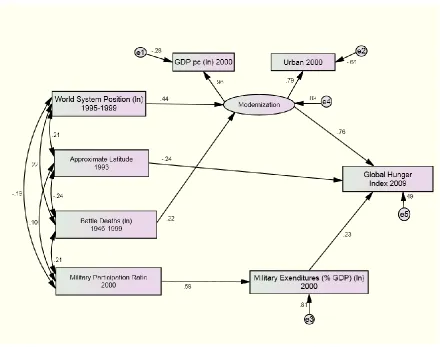
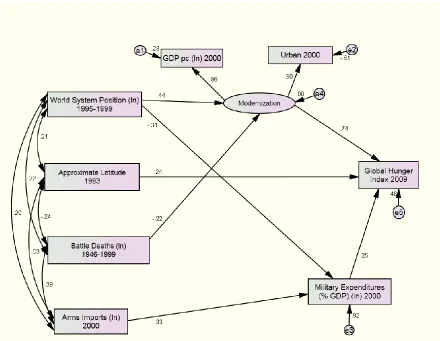
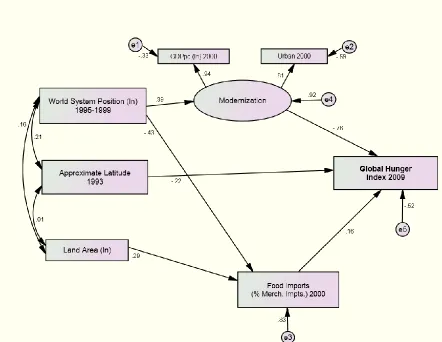
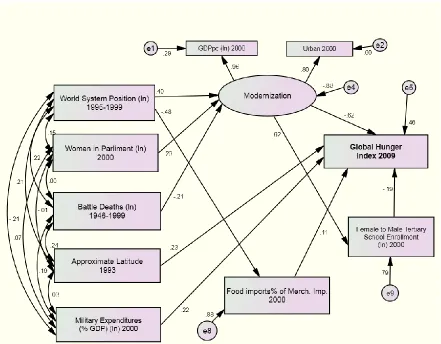
I extend the macro-comparative literature on hunger by testing an integrated theorization of the impacts of societal development, including world-system position and national modernization. Thus, each theme presented subsequently is most broadly situated within the sociology of development literature. Individually, the analyses examining the impacts of gender inequality, the global food system, and conflict and militarization are presented as deductive models derived from their relevant literatures. Then a final, trimmed model that is optimally robust is presented that integrates each of these themes into one comprehensive model.
CHAPTER 2 LITERATURE REVIEW
This study is situated within the broader literature on development and hunger while identifying four primary themes within the hunger literature in particular. Debates central to this literature include the production versus distribution debate on the primary causes of global hunger. Also important, is the long-standing debate on the causes and consequences of global development and national modernization. Both of these debates can be seen in the global hunger literature that will be subsequently reviewed. As such, I begin by reviewing each of them. Following this, the identified themes within the hunger literature (gender, war and conflict, globalized food system, and bio-geographical environment) are examined.
The Production vs. Distribution Debate
It is important to address the historical context within which hunger has been debated and policies addressing it have emerged, including especially the Green Revolution. After World War II, the Rockefeller and Ford Foundations developed new plant breeding
primarily operated through subsidized production in United States and other developed nations where industrialized agricultural practices were wide-spread (Freidman and McMichael 1989).
My review of the development of the Green Revolution is largely informed by critical appraisals (Brown 2005; Pilcher 2006). However, there were a number of positive outcomes, including primarily the substantial increase in world food production on a scale that enabled vast numbers of people to escape persistent hunger (Conway 1997; Pilcher 2006). In fact, the leading plant biologist most often attributed with discovering the benefits of hybridized seeds, Norma Borlaug was the recipient of a Nobel Peace Prize (Pilcher 2006).
Unfortunately, it is often overlooked that his discoveries were made possible by prior
generations of peasant farmers and their cultivation practices (Pilcher 2006). Borlaug’s work represents the productionist argument that global hunger is a result of declining or inadequate food production. However, one of the most influential studies on hunger includes Sen’s (1981) analysis of the Bengali famine. In his study, he makes a strong case, albeit from a methodological individualist approach of microeconomics (Tauger 2003), that famine and hunger emanate from inadequate access too food, not too little production.
An important component of Green Revolution and associated efforts included domestic modernization through agricultural industrialization in peripheral zones
encompassed the implementation of centers for agricultural development, such as the Consultative Group on International Agricultural Research, promoted an anti-poverty and anti-hunger agenda (Consultative Group on International Agricultural Research 2012).
Much of the Green Revolution efforts, not by coincidence, were fueled by the Cold War and US foreign policy strategy to stave-off a “red revolution”3 by creating a preemptive “Green Revolution” (Athanasiou 1998; Das 2002, 1998; Ehrlich and Holden 1971; Foster
1998a; Freebairn 1995; Liodakis 1997). The Green Revolution provided the ideal complement to U.S. cold-war foreign policy directed at the U.S.S.R. It entailed national economic and agricultural policies that sought to promote domestic national development based on agricultural industrialization and an organized production of a surplus food aid regime (Freidmann 1982; McMichael 2009). Essentially, surplus food produced in the U.S. was exported to developing countries as part of the PL 480 program, and was used as leverage to avert socialist uprisings (Winders 2004). This significantly transformed the production and trade of food on a global level. Friedmann (1982) argues that the
international food regime in the post WWII era was responsible for the emergence of the global organization of agricultural production, trade, and consumption in today’s world capitalist system.4 Based on the foundation of supporting surplus agricultural production in the center (in particular, the U.S.), global grain trade in the form of feedstuffs to Europe and food aid to developing countries created the conditions for the emergence of a globalized agricultural and food system or global food regime (Bonnano and Constance 2006;
3 Here, my reference to “red revolution” highlights the efforts by the U.S. to politically gain leverage in developing countries through agricultural and food aid. The fear was that through assisting these countries, and by fueling peasant uprisings, the USSR would facilitate the emergence of communist (red) regimes in
Freidmann 1982; Freidmann and McMichael 1989; Heffernan 1998; Murphy 2009; Weis 2007).
Under the global food regime, newly agricultural countries have been increasingly competing in global food markets, Brazil and the growth in soybean production being a prime example (Llambi 1993). Friedland (2004) outlines the emergence of a new
globalization in agriculture as the production of fresh produce for the permanently in-season market in the global North.5 Thus, an important factor contributing to the transformation of global agrarian structures is export production and concentration in high value commodities, such as fruits and vegetables. For globalization scholars, the global food regime marks the transition from a nationally-based Green Revolution that focuses on grains and basic food stuffs, to internationally-based global restructuring of agriculture that focuses on production for trade, thereby altering local agricultural production practices and outcomes (Bowen and Gerritsen 2007). This has a direct impact on hunger as will be later discussed.
Many have argued that the dependency on chemicals and irrigation technologies and advancements in agriculture have created ecological problems—ranging from water pollution to soil salinization—that potentially may offset production gains (Alteri 1996, 2000;
Jorgensen and Kuykendall 2008). However, global grain production increased threefold in the latter part of the 20th century, while fertilizer and pesticide use increased more than tenfold during the same period as a result of the spread of high-yield seed varieties and their associated production technologies (Ehrlich et al. 1993; Jorgenson and Kuykendall 2008). The effects of these technological and industrial changes has been well documented in
studies on US agriculture, broadly describing a transition in agriculture from small farm, labor intensive production to large farm, machine and chemical intensive production (for a review see Lobao and Meyer 2001). Research on these transitions provides conclusive evidence that the Green Revolution marks the most capital and chemical intensive structure of agricultural production in the history of humankind (Mazoyer and Roudart 2007).
Although the genetic or bio-revolution has begun to alter agricultural production structures, it has not eliminated the reliance on capital-intensive and ecologically destructive inputs
(Buttel, Kenny, and Kloppenberg 1985; Newell 2009). While agroecological production developments, such as urban and small scale agricultural strategies implemented in Cuba (Koont 2009) or agroforestry in Africa (Sanchez 1995), provide some promise for more sustainable production practices (Alteri 1996, 2000; Uphoff 2003; Lal et al. 2004), these have yet to be adopted widely. In fact, many conclude that technological development alone will not be sufficient if world poverty and hunger is to be reduced by half by 2015 (Uphoff 2002).
On the one hand, proponents of Western-led development, or modernization theorists, suggest that global agricultural production and trade improves human well-being and
be situated within the broader historical context of national and global development agendas, as well as other determinants of hunger identified in the literature. The evolution of these development approaches draws upon classical theories of social change and their
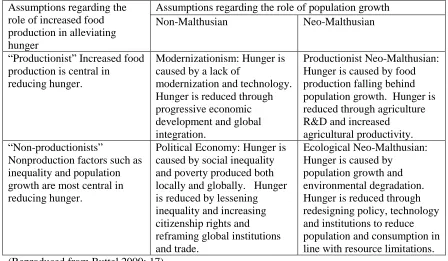
explanations of the emergence, spread, and contradictions within the global capitalist system. Let me now turn to these theories of global social change as they relate to hunger and the present research. Table 1 presents these debates using Buttel’s (2000) framework, based on the assumptions about the role of production and distribution in agriculture and food.
[Table 1 about here]
Development Debates and Macro-comparative Examinations of Hunger
Theoretical explanations for variation in modernization in development among nations have been widely discussed within the sociological literature (e.g. Brady, Kaya, and Beckfield 2007; Chase-Dunn 1977, 1989, 2006; Chirot and Hall 1982; Dixon and Boswell 1996a and 1996b; Firebaugh 1996; Snyder and Kick 1979; Tsai 2007; Wimberley and Bello 1992). Prominent theories of global development, modernization and dependency/world-systems theories, also provide the theoretical framework for the vast majority of macro-comparative studies on hunger in the literature (Jenkins and Scanlan 2001; Jenkins et al. 2007; Kicket al. 2011; Michalache-O’Keefe and Li 2010; Scanlan 2001, 2002, 2004; Wimberley and Bello 1992).
example, specifically related to food insecurity, Wimberley and Bello (1992) found that FDI deleteriously affects food supply, while Jenkins and Scanlan (2001) discovered a net positive effect on food supply in the absence of domestic investment. The famous Firebaugh and Dixon/Boswell debate in American Journal of Sociology during the 1990’s also emphasized competing views of FDI in relation to economic growth and human well being. Firebaugh (1996) asserted that FDI was better than no investment at all in developing countries, and he argued that viewing it as only a pernicious effect was narrow sighted. Dixon and Boswell (1996), in contrast, emphasized the relative impact of FDI is structured so that disadvantaged countries lose from global development patterns because economic benefits are
disproportionately captured by the core. While surely it is important to consider why these findings are contradictory, it is also important to keep our analysis firmly grounded
theoretically.
Modernization Theories of Social and Economic Development
Modernization theory explains development based on the progression of human values, culture, technology, and the Westernization of developing societies, which are processes predominantly internal to nation-states. Theorists in this tradition observe that developed economies are more likely to have modern values, work ethics, and superior technologies (Inkles and Smith 1974; Rostow 1960). Modernization theorists have considered Western nations as the blue-prints for how nations should industrialize and develop modern economies. This is because from the modernization perspective Western societies had “achieved” levels of development and industrialization that were valued as superior compared to non-Western societies (Rostow 1960).6 Modernization theory’s origins can be traced back to the classical writings of Comte (1842), Durkheim (1893), Smith
(1776), Ricardo (1817) and Spencer (1887) among others, whose work focused on the evolutionary characteristics of social change, often viewed as linear and as progressing from less to more advanced.
Early formulations of modernization theory have much of their roots in the structural functionalist approach which grew out of the liberal economics of Ricardo (1817) and
classical theories of social development based on biological analogies (Comte 1824; Spencer 1887), as well as conceptions of rationalization (Weber 1904). In The Division of Labor in Society, Durkheim (1893) observed, while crediting Smith (1776), a transition from
mechanical to organic solidarity that emerges from increasing population growth and a more highly complex division of labor. Later, Parsons (1964) picked up Spencer’s and
Durkheim’s evolutionary thinking and proposed that societies followed through a process of increasing differentiation, interdependence, and adaptive capacity. Similarly, Rostow (1955) proposed stages of economic growth through which societies would progress and develop. More recently Nolan and Lenski (1996) outlined a generalized theory of social change from an evolutionary perspective that identifies several stages of development that increase in level of complexity based on the advancement of technology and economic production. Structural functionalism is most notably identified as the theoretical root to more contemporary modernization theories (Peet and Hartwick 2006; So 1990). This theorization, most notably proposed by Talcott Parsons (1964), combines the work of classical thinkers such as Comte (1824), Durkheim (1893), and Spencer (1882), who employed an organismic analogy to societal change, with the work of Weber (1904), whose approach to social change focuses on bureaucracy, rationality, and culture as the basis for human agency.
In response, more recent modernization studies have sought to account for these critiques, as in the case of Huntington’s (1984) study of democratic development in Third World countries; yet they still do not adequately account for the effects of global economic and political structures. Other examples of modernization studies examining the
development of societies include Mol’s and Spaargaren’s (2000) research on ecological modernization, Inglehart’s and Wezel’s (2005) study of world values, and studies on the developmental potential of global integration by World Bank scholar’s Goldin and Reinert (2006). Additionally, Crenshaw, Ameen and Christensen (1997) examine the role of population growth and dependency on economic development, finding that baby boomers contribute to increased development as a labor resource. Recent globalization studies, following a neoliberal theorization that posits unfettered global economic integration, often via free-trade, promotes societal development. These studies have found positive impacts of FDI on economic development, namely income (Bollen and Appold 1993; Firebaugh 1996). Although these studies were largely framed as analyzing the impact of globalization on societies, the organizing theme and causal mechanisms identified have clear connections to earlier renditions of modernization theory.
Modernization theories of development have varied based on their conceptualization of the relationship between the economy and the state. Recent neoliberal versions of
modernization development theory have emphasized a removed role of the state and the rein of the free market. This economic policy has been coined the Washington Consensus (Gore 2000) and began with the fall of the Bretton-Woods agreement under the Nixon
Regan-Thatcher era as an economic development principle, and strongly influenced the development and lending policies of multi-lateral agencies such as the World Bank and International Monetary Fund (Chase-Dunn 2006). By capitalizing on a nation’s comparative advantage, a proposition drawn directly from the pages of Adam Smith’s The Wealth of Nations (1776: 22), neoliberal theories of development have sought to promote development of the Third World through unfettered global trade and integration and the ultimate removal of the state from the economic infrastructure and regulatory framework (Appelbaum and Robinson 2005; Chase-Dunn 2006; Krugman 2009; Turner and Babones 2006). More recently, as a result of the failure of neoclassical theories of economics and the global financial crisis of 2008-2009 (Krugman 2009), modernization strategies of development have returned to Keynesian policies, as evidenced by President Obama’s fiscal stimulus plan. These may mark the re-emergence of state-centered development (Krugman 2009), and these new Keynesian policies may very well mark the return to structural-functionalist models of development as old-ideas continue to be recycled. Furthermore, with Greece facing a national debt default (Papadimas 2011), the way in which loans will be restructured in the face of a revival of the Keynesian approach will surely be an interesting turn of events if not a struggle between political powers.
like broader theories of development, agricultural development theories have mirrored the transition from the development to globalization project (McMichael 2004) within the modernization theoretical camp. This includes the transition from a primary focus on agricultural technological development, such as in the early development of the Green Revolution technologies, to agricultural free-trade production strategies and, more recently, Bio-Revolution genetic technologies (Buttel et al. 1985; Perlancher and Otero 2010). The basic premise of this project is that by adopting Western technologies, and by industrializing production in agriculture, national economies could develop. This has now been extended to include export oriented production strategies for development (Frieden and Lake 2000).
Early agricultural development approaches, steeped in modernization theory, proposed that increasing food availability would be achieved through technological
innovation and adoption of Green Revolution agricultural technologies, and, indeed, Green Revolution technologies increased productivity. This increased agricultural production also potentially increases demand for food and overall national economic growth as rural incomes and infrastructures modernized (Mellor 1966; Lipton 1977). Therefore, countries that
adopted the new high yield seed varieties (grains such as rice, corn, and wheat) and the technological packages required to produce these Green Revolution varieties were predicted to develop much the same way that countries of the West had developed—through a
biofuel products over subsistence or domestic oriented production. Neoliberal agricultural development policies also set the foundation for food import dependence, as food grown for domestic consumption declines. These types of policies set the foundation for structures of food and fiber production that do not necessarily ensure the nutritional health of those who are the direct producers.
Modernization theorists (Durkheim 1893; Rostow 1955; Inkeles and Smith 1974) view hunger in the non-core resulting from domestic dynamics where inadequate economic, technological, and infrastructure development leads to hunger (Buttel 2000; Scanlan 2003; Firebaugh 1996; World Bank 2007). In the specific context of food production and
distribution, agriculture and rural infrastructure are both influenced by domestic
modernization; meaning the connections between national modernization and rural and agricultural development are important considerations in studies of hunger (Fan and Rosengrant 2008; Timmer 2005).
(Fan and Rosengrant 2008; World Bank 2007), since natural capital abounds outside the core, and the core is willing to pay, often dearly, for it.
The comparative advantage tenet of the modernization perspective is employed to promote neoliberal trade policies, under the guise of what McMichael terms the
“Globalization Project” (2004), whereby peripheral nations are encouraged, indeed required
via austerity and structural adjustment policies (Stiglitz 2002), to integrate into global free-trade structures. In response, many developing countries have lowered agricultural free-trade barriers through global and regional trade agreements increasing economic and trade
globalization precipitously (McMichael 2004). As a result of this de-regulation, a number of peripheral countries have become net food importers despite having vast natural endowments for domestic food production (Pechlaner and Otero 2010). These processes are deemed as part of the solution to global hunger according to modernizationist arguments, which contend food security is best met through agricultural production for global trade rather than local consumption because this is what best promotes domestic economic growth (McMicheal 2005:6; Pechlaner and Otero 2010; World Bank 2007).
(Firebaugh 1996). Similarly, Jenkins and Scanlan (2001) find that economic globalization, via foreign investment and modernization, improves both caloric availability and child hunger. Precipitous increases in domestic incomes, coupled with dramatic increases in agricultural productivity levels, indeed enabled much of humanity to escape the threat of starvation, especially in Europe, Asia and parts of Latin America (Fan and Rosengart 2008; Fogel 2004; Johnson 1997). Thus, national modernization has a ameliorative impact on hunger. However, the relationship between modernization and hunger must be
contextualized within its global context. Political economic theories directly address this issue.
Understanding the relationship between modernization and dependency/world-systems theorizations of development, as well as resulting explanations of hunger, is an important task for sociological research on hunger. On the one hand historical analyses have revealed the importance of technological modernization in increasing food supply (Conway 1997; Ehrlich 1993; Pilcher 2006; Scanlan 2001), economic modernization in increasing household incomes to purchase food (Devereux 2007; International Food Policy and Research Institute 2011; Sen 1981; 1999), and political modernization (democratization) in increasing access to food (Jenkins and Scanlan 2001; Jenkins et al 2007; Sen 1981, 2001; Sen and Drez 1989). This suggests that there are important and consistent positive effects of modernization on hunger.
On the other hand, these developments were not without notable costs, such as
areas that exacerbates vulnerability (Araghi 1995, 2000; Bryceson 2009; 2000; Moyo and Yeros 2007), increasing conflict and militarization in semi-peripheral and peripheral areas (Kick 1980, 1983, 1987), and the growing gap of global inequalities as global capitalism expands (Milanovic 20007). The aforementioned developments take place within the world capitalist system where core countries, and the corporations based in these countries,
organize global trade and production to maximize their own economic gain. As such, it is critical to examine the relationship between modernization and hunger within its global context. This is best done through a review of the dependency/world-systems literature that can be subsequently employed to inform an integrative and synthetic theorization and empirical analysis.
Dependency and World-Systems Theories of Social and Economic Development
Political economy theorists counter many of the claims and research findings of modernization scholars. They originate from a conflict perspective on social change and development most heavily influenced by classical scholars such as Marx (1867), Kautsky (1899), and Lenin (1917). Dependency (Amin 1976; Frank 1966) and world-systems (Chase-Dunn 1989; Wallerstein 1974) theories explain inequitable power relationships among nations resulting from unjust trading relations and access to the global economy. Dependency scholars theorize the world as consisting of core and peripheral zones (Amin 1976; Cardoso and Faletto 1979; Frank 1966). Building on this, Wallerstein (1974) amended these zones by suggesting a three tiered world system of core, semi-peripheral, and
cheap labor and raw materials from the periphery, thus enabling economic and social development for core countries, while the non-core experiences economic and social
underdevelopment (Amin 1976; Frank 1967). As a result of unfair trading relationships with the core, peripheral nation-states are less able to promote development from within through domestic savings and taxation (Chase-Dunn 1989). In turn, limited domestic funds hinder the amount of investment that can go into social welfare, including investments to promote development, resulting in severe social problems, such as hunger and poverty (Baran 1957; Evans 1979; Chase-Dunn 1989).
Dependency and world-systems studies have most explicitly linked development to global economic and political structures. Originating in Latin America and in the Economic Commission for Latin America (ECLA) dependency theorists (Cardoso and Falleto 1979; Dos Santos 1971; Frank 1969) posited that the economic, political, social, and cultural
institutions of underdeveloped countries were the result of capitalist exploitation rather than a lack of modernizing values and technologies. Early research focused on the dualism of traditional and modern sectors of national economies, asserting that capitalism undermined social systems even as it developed globally (Frank 1969).
Abu-Lughod 1989). World-systems research has found that trade and investment integration generally has negative effects for economic development in semi-peripheral and peripheral countries, especially when compared to domestic investment (e.g. Bergesen and Bata 2002; Chase Dunn 1989; Dixon and Boswell 1996a and 1996b; Kentor and Boswell 2003). While a great many world-systems scholars emphasize the important of economic exchanges that benefit the core, other theorists within this tradition emphasize political arrangements, such as imperialism (Galtung 1979), that afford the core uneven global power and influence over peripheral nations. Thus, political and economic processes taken together contribute to the underdevelopment of the non-core.
Most recently, critical globalization scholars have pointed out how the effects of foreign economic and political domination have been increasing and are more directly affecting sub-national localities around the globe (Harvey 2005; Robinson 2004; Sassen 2007; Sklair 2005). McMichael (2004) has outlined the transition from the “development project” to the “globalization project” as a transition from nationally led economic
development to a globally organized economic system controlled by multinational
corporations and centered on global markets of production and consumption. As a whole, these two projects can be seen as the further spread and integration of global capitalist systems and the accompanying retreat of the nation state. Critical globalization researchers (e.g. Harvey 2005; McMichael 2004; Winant 2005) have asserted that the military
imperial project, based primarily on the quest for control over natural resources, especially oil, suggests that nations who are naturally endowed will be disproportionately subjected to imperial occupation, influence, and/or violence (Harvey 2005; Thompson 2000; Winant 2005). These exploitative processes are expected to worsen as climate change and the global energy crisis ensues (Foster 2002; Roberts and Park 2007). Each of these factors affects global hunger.
Political economic research has linked human well-being measures to global structures of capitalism, as well as to structures of agriculture production and trade. Wimberley (1990) found that peripheral countries were more likely to have higher rates of infant mortality, often used as an indicator of basic social development. Also, research has indicated that peripheral countries are more likely to have agriculturally dependent
economies (Jorgenson and Kuykendall 2008; Lonogo and York 2008; Moore 2003, 2008). In a cross-national study of peripheral countries (non-OECD) Burns et al. (2003) found that export commodity concentration had an indirect effect on infant mortality via organic water pollution. Thus, not only has world-system position been linked to development indicators, but also to the scale of the agricultural sector. These theorizations suggest that the impacts of economic and political globalization on peripheral zones are at best modest gains compared to the core, and at worst core gains are achieved at the expense of peripheral nations (Arrighi 1994; Chase-Dunn 1989; Kick et al. 2011; Moore 2003; Snyder and Kick 1979; Wallerstein 1974). These uneven development outcomes result in unequal environmental, social,
Political economic theoretical perspectives conclude that hunger is an outcome of uneven development processes inherent in the operation of the modern global capitalist system. An excellent point of departure for this approach is Wallerstein’s (1974) three-tiered system, where semi-peripheral and peripheral countries are integrated into a global system of production supporting consumption and economic growth in the core. Furthermore, the very nature of global agricultural production in the periphery undermines the developmental outcomes in these nation-states, including hunger, while simultaneously enabling luxury and excessive food consumption in the core (Shiva 2001; Rosset 2009). Some indicate that this has resulted in a “hunger/obesity paradox” (Dinour, Berger, Yeh 2009). Devereux (2007) reports that modern famines are a consequence of increased vulnerability due to globalization processes of integration and marginalization. Furthermore, food import dependent
economies are increasingly vulnerable to commodity price fluctuations. This vulnerability is heightened in severely marginalized regions, in particular sub-Saharan Africa, experiencing exceedingly high levels of poverty and political instability that contribute to endemic hunger and famines (Devereux 2007). Each of these new vulnerabilities due to globalization is further aggravated by global economic and political structures, causing peripheral nations to suffer the most extreme cases of hunger. Because the effects of modernizing technologies, economic institutions, and democratic governance are conditioned by international political economic structures, sociological research on hunger must account for this theoretically and empirically.
hunger, as resultant of capitalist exploitation of the periphery by the core (e.g. Dixon and Boswell 1996a, 1996b; McMichael 2004; Moore 2008; Wallerstein 1974; Wimberley and Bello 1992). Global integration of peripheral nations serves to promote development in the core while coterminously creating development deficits in the non-core (Amin 1976; Wallerstein 1974). Thus, while the core experiences food surpluses and permanently in-season markets, peripheral nations experience chronic hunger (Bello and Bavaria 2009; McMichael 2009b; Murphy 2009). In contrast to modernization policies that promote global integration as a strategy to combat hunger, political-economic policy implications suggest that hunger is best addressed through reducing global and domestic inequality perpetuated by uneven structures of power and dependency across the world-system.
Not coincidentally, proponents of this perspective often decry the impacts of liberalized trade agreements. They point out that “free trade” agreements, a form of
economic globalization, reduce trade barriers, and that this occurs on a very uneven playing field of international actors where more economically and political powerful nations
via dumping. By the mid 1990’s, half of the foreign exchange of the Food and Agriculture Organization’s eighty-eight low-income deficit countries went to food imports (emphasis added) (McMichael 2005: 8).”
The relationship between dependency and hunger has been inconsistent in the empirical literature. Some studies find that global integration and dependency deleteriously impact hunger outcomes (Mihalache-O’keef and Li 2011; Wimberley and Bello 1992), while others have found a favorable relationship (Firebaugh and Beck 1994) or null associations (Jenkins and Scanlan 2001).7 More recently, Kick et al. (2011) find that the impacts of world-system position condition the positive effects of national modernization. Thus, they find support for the inclusion dependency/world-systems perspectives in empirical analyses, and further demonstrate the utility of synthetic theorizing and analyses.
Modernization and dependency/world systems perspectives on hunger and global inequality are not by necessity polar opposites. In fact, one could theoretically relate the two by accounting for the effects of each on a development outcome such as hunger. To
accomplish this endeavor, I plan to analyze the way in which modernizing processes— largely internal to countries—are conditioned by world-system properties within each of the
7 Most of these studies employ foreign direct investment (FDI) as an indicator. However, there are a number of methodological difficulties with using this measure in the present study. First, the data for net FDI inflows are highly skewed and kurtotic, yielding a nearly one-modal distribution for the present sample. Even log-transforming this measure does not effectively yield a distribution close to normal, violating a central assumption of most multiple regression techniques. Substantively, a number of authors have indicated the importance of accounting for the sector (tertiary, secondary, or primary) within which FDI is flowing
(Jorgenson and Kuykendall 2008; Mihalache-O’keff 2011). However, these data are too sparse for a structural analysis and are only applicable in macro-comparative studies (where the population size is only 213) to the extent that multiple observations over three or more time points are used to increase sample size in a
longitudinal design. Furthermore, FDI is but one dimension of global dependency that is more comprehensively captured by measuring world system position as is done in the present analysis. Arguably studies that
identified themes. Thus, world-system position is seen as the most exogenous causal indicator while modernization and other identified internal processes operate as endogenous predictors of hunger. This follows the theorization set forth by political economic scholars, while also accounting for the positive impacts of societal modernization posited by
modernization and neoliberal economic scholars. Internal pathways specify mediating factors and processes that condition the effects of global processes on local outcomes. Urbanization and economic growth, food import dependency, gender inequality, environment, and conflict, militarism and militarization are connected to hunger, and mediate the effects of the global capitalist structure on national rates of hunger. In this respect hunger is comparable to other measures of global inequality, such as economic development, life expectancy, or infant mortality (e.g. Brady, Kaya and Beckfield 2007). Looking at these processes through the lens of the identified pathways allows a more illuminating investigation of the world capitalist system and global organization of trade as it affects human well-being. It also highlights the paths through which the international hierarchy of nations indirectly, as well as modernization and other natural attributes directly affect hunger the world over.
structural location within the world system, as it is comprised by international linkages of power and dependency (Kick, McKinney, McDonald and Jorgenson 2011a). Taken together, these linkages constitute a global hierarchy that plays an important role in the development of nations across multiple dimensions, including national food security and hunger (Galtung 1971; Kick et al. 2011; Snyder and Kick 1979). Scanlan (2003: 88) states that food security is embedded within structures of the international political economy making it “keenly sociological” and well suited to macro-comparative inquiry.
To summarize, comparative examinations of hunger have consistently found that modernization processes, as indicated by per capita income levels (among others), improve food availability and reduce child hunger (Jenkins et al. 2007; Jenkins and Scanlan 2001; Scanlan 2001a, 2001b, 2004; Scanlan and Jenkins 2001). However, the relationship between dependency and hunger has been inconsistent in the empirical literature. Some studies find that global integration and dependency deleteriously impact hunger outcomes (Mihalache-O’Keef and Li 2011; Wimberley and Bello 1992), while others have found a favorable relationship (Firebaugh and Beck 1994) or null associations (Jenkins and Scanlan 2001).
Scanlan and Jenkins 2001), but it has only been examined as a predictor of societal
development by Kick et al. (2011). Similarly, the present study accounts for the impact of violent conflict on development directly and hunger indirectly using a theoretically relevant measures.
Women have for quite some time been identified as central to both development and the alleviation of hunger (Boserup 1970; Mies 1986; Momsen 2010; von Grebemer et al. 2009). Women play central roles in both food production and preparation across the globe (Acosta-Belen and Bose 1990; Sachs 1996, 2002; Scanlan 2004), but they are more likely to experience hunger than their male counterparts (von Grebemer 2009). Shiva (1989)
identifies ways in which technological advances in agricultural production, served to
undermine women’s roles in food production further exacerbating hunger. The food security literature broadly accounts for gender inequality, but the macro-comparative quantitative analyzes have only recently included its impacts (Scanlan 2004). He found a significant and favorable impact of female empowerment, measured primarily as contraceptive prevalence, on child hunger and mortality (Jenkins et al 2007; Scanlan 2004, 2010). A further
examination of the impact of gender on hunger globally, including what I argue are more theoretically relevant measures of gender inequality (access to political power and educational resources), is warranted to extend these findings.
I explore these and other connections identified in the hunger literature further in the following sections that examine hunger from the perspective of the four primary organizing themes—gender inequality; conflict and militarization; and the global food system.
developing nations that examines each of these themes separately, then comprehensively in a final trimmed model. Based on these analyses, I then discuss the results and draw
conclusions relevant to the sociological literature on development and global hunger.
Gender Inequality and Hunger
The gendered disparity in hunger rates discussed earlier points to globally systemic processes that serve to disadvantage women at the expense of society as a whole. Although some social researchers identify a convergence in regards to gender inequality trends (e.g. Dorius and Firebaugh 2010; Firebaugh and Goesling 2004; Sala-i-Martin 2006; Wilson 2001), a gap between the well-being of women and men remains (Momsen 2010). Women experience higher rates of hunger largely due to discrimination in access to educational, economic, and political resources (Food and Agriculture Organization 2008; International Fund for Agricultural Development 2011; Shiva 1989, 2001). The highest rates of gender inequality are located throughout the African and Asian continents (von Grebemer et al. 2006). The International Food Policy and Research Institute (von Grebemer et al. 2009: 21) estimates that if the status between men and women were equalized throughout South Asia and Sub-Saharan Africa the number of malnourished children would be reduced by over 14 million.