INVESTIGATION
Next-Generation Mapping of Complex Traits
with Phenotype-Based Selection and Introgression
Eric J. Earley1and Corbin D. Jones
Department of Biology and Carolina Center for the Genome Sciences, University of North Carolina, Chapel Hill, North Carolina 27599-3280
ABSTRACT Finding the genes underlying complex traits is difficult. We show that new sequencing technology combined with traditional genetic techniques can efficiently identify genetic regions underlying a complex and quantitative behavioral trait. As a proof of concept we used phenotype-based introgression to backcross loci that control innate food preference inDrosophila simulansinto the genomic background ofD. sechellia, which expresses the opposite preference. We successfully mappedD. simulansintrogression regions in a small mapping population (30 flies) with whole-genome resequencing using light coverage (1·). We found six loci contributing toD. simulansfood preference, one of which overlaps a previously discovered allele. This approach is applicable to many systems, does not rely on laborious marker development or genotyping, does not require existing high quality reference genomes, and needs only small mapping populations. Because introgression is used, researchers can scale mapping population size, replication, and number of backcross generations to their needs. Finally, in contrast to more widely used mapping techniques like F2bulk-segregant
analysis, our method produces near-isogenic lines that can be kept and reused indefinitely.
C
OMPLEX traits are inherently difficult to dissect genet-ically. Quantitative trait loci (QTL) studies, genome-wide association studies (GWAS), and forward and reverse genet-ics are all powerful tools; however, each technique has in-herent weaknesses that limit ability tofind causal loci (Mackayet al. 2009; Manolioet al. 2009). New methods using next-generation sequencing (NGS) technology have successfully captured single loci underlying Mendelian traits generated from mutagenesis screens (Sarin et al. 2008; Blumenstiel
et al. 2009; Flibotte et al.2010; Laitinen et al.2010; Sarin
et al.2010; Xiaet al.2010; Zurynet al.2010); recombinant inbred lines (RILs) (Huang et al.2009; Schneeberger et al.
2009); and backcross populations using dominant markers (Andolfattoet al.2011). However, we lack a time- and cost-effective method that maps multiple loci simultaneously with-out a priori knowledge of their location, number, or effect size.
Mapping complex traits is more challenging than mapping Mendelian traits. QTL studies in the past decades have uncovered a plethora of loci underlying complex traits, but QTL methods lack the power to resolve candidate regions to individual genes (Mackayet al.2009). New NGS approaches have the potential to capture multiple causative loci; however, these methods may also lack sufficient power. Huanget al.
(2009) proposed “whole-genome resequencing” (WGR), and Bairdet al.(2008) proposed“restriction site associated DNA”(RAD) genotyping, which both use NGS-based mapping on bulk segregant populations (Michelmore et al. 1991). These methods require large mapping populations to detect multiple loci of weak effect (e.g.,Ehrenreich et al. 2010). Andolfattoet al.(2011) developed a“multiplex shotgun gen-otyping”(MSG) method, yet MSG also relies on large back-cross populations, and it is not clear if their approach can track quantitative or additive loci of relatively weak effect or if closely linked loci can be isolated.
We have developed a new approach that efficiently maps multiple loci contributing to a complex trait. Our method uses phenotype-based selection andintrogression followed by whole-genome resequencing (PSIseq). Our method can be easily scaled from rough mapping of a single small pop-ulation to fine-scale mapping of large and replicated popu-lations. With minimal replication, low cost, and few genomic
Copyright © 2011 by the Genetics Society of America doi: 10.1534/genetics.111.129445
Manuscript received April 11, 2011; accepted for publication September 10, 2011 Supporting information is available online at http://www.genetics.org/content/ suppl/2011/09/21/genetics.111.129445.DC1.
resources, we can map any complex trait divergent between any two interfertile populations. This approach takes advan-tage of the statistical power of window-based mapping algo-rithms on NGS data (Huang et al. 2009) and the ease of using relatively small mapping populations. Because intro-gression is used instead of F2bulk segregant analysis,
map-ping populations can be treated as near isogenic lines and be reused indefinitely.
Materials and Methods
Overview
Populations with a divergent complex trait are hybridized and then selected for a specific phenotype across multiple generations of backcrosses. Our proof of concept uses a species-level phenotype, but this method can work on any two interfertile populations. The trait of interest is selected for each generation, and offspring are mated to the other parental line expressing the unselected phenotype (introgression and backcrossing). Over multiple generations of selection and backcrossing this hybrid population becomes homozygous for the majority of the unselected parent’s genome while loci from the selected parent, which contribute to the selected trait, remain. Using high-through-put sequencing, we map the breakpoints of these introgres-sions and, therefore, map the regions harboring genes influencing the trait. This scheme is analogous to introgres-sion-based mapping approaches that use marked transpos-able elements or molecular markers (Trueet al.1996; Laurie
et al.1997; Desjardinset al.2010). A recessive trait may also be introgressed, although this would require an extra in-breeding step following each backcross.
Phenotype-based selection and introgression
We tested our method on a putative complex behavioral trait divergent between two Drosophila sister species:
D. simulans(c167.4) andD. sechellia(SynA).D. sechellia is an island-endemic and phytophagous specialist that prefers the smell and taste of Morinda citrifolia (Morinda) fruit (Jones 2005; Matsuo et al. 2007; R’Kha et al. 1991).
D. simulans avoids the fruit and dies when in proximity to it and its constituent organic acids (Jones 1998; R’Khaet al.
1991). As a proof of concept, we introgressed D. simulans Morindaaversion behavior into theD. sechelliagenome over 15 generations of backcrossing and selection. For systems with longer generation times where 10+ generations of backcrossing is not a viable option, one can easily reduce the number of backcross generations (e.g., one tofive) while increasing introgression replication (seeResultsand Figure 2 for a discussion of how to balance replication sizevs. back-cross generation number).
Virgin D. simulans females were mated to D. sechellia
males to create a large population of fertile F1 females.
These hybrids expressD. simulansbehavior and were back-crossed to D. sechellia males. Roughly 30 F2females were
subjected to our behavioral assay, and individuals displaying
D. simulans behavior were collected and backcrossed to
D. sechellia males. The assay is identical to that described in Dworkin and Jones (2009). Briefly, octanoic (45ml) and hexanoic (15 ml) acids were added to instant Drosophila
media (4.1 g + 22 ml diH20, Carolina Biological Supply),
or not, to create test and control food, respectively. Flies had 48 hr to choose a medium. Flies settled on control media were considered D. simulansphenotype. This cycle—an as-say of 30 females then backcrossing—continued for 15 generations. Thefinal generation was inbred for 2–3 gener-ations to ensure that introgressed loci were mostly in a ho-mozygous state. Thirty females were pooled for Illumina library preparation.
Introgression mapping
To map introgression breakpoints, we used reference genomes of these species to identify single-nucleotide species differences (analogous to SNPs) that identify geno-mic regions as particular to a parental genome. While our proof of concept used the relative high-quality Drosophila
genomic assemblies, nonmodel systems without a finished assembly can still be used. In principle, a sequenced tran-scriptome or a roughde novoassembly, for example, can be used to capture introgression blocks (or transcripts), as well. We found on average one SNP per 100 bp (1% divergence, compared to the reported 2% from Klimanet al.2000). Be-cause these SNPs represented genetic changes between these species, markers may have also contributed to phenotypic divergence. To create our species-specific SNP map, we aligned the D. simulans and D. sechellia reference genome sequences (r1.3) reciprocally using BWA (Li and Durbin 2009). Small insertion–deletion (indels) and microsatellites could also be used, although we did not use them in this study. We also showed that the genome of D. melanogaster
can be used as a proxy for a reference genome and showed that SNPs distinguishingD. simulansandD. sechelliacould be identified by aligning short sequencing reads from these spe-cies to the D. melanogasterreference using a high mismatch tolerance in the alignment (data not shown). In nonmodel systems this could be particularly beneficial. If neither paren-tal line possessed an assembled genome or transcriptome, a closely related model-system assembly could be used.
parent SNP), we could not be sure if a given SNP call was accurate due to sequencing and mapping errors. To over-come this, we mapped introgression breakpoints using a win-dow approach (as described in Huang et al. 2009). Any individual miscalled SNP had minimal effect on our search for large-scale SNP enrichment. Every 1000 parent–parent SNP was considered a“bin,”and we counted the number of hybrid–parent SNPs within this bin. Our null expectation was that hybrid–parent SNPs were binomially distributed within each bin. Any bin that harbored a significant enrich-ment of D. simulans SNPs over the chromosomal mean
D. simulans SNP content was considered an introgression block member (Student’st-test). This window approach re-quired multiple independent significance tests, which we corrected for via a false discovery rate (FDR) calculation.
Confirmation of X chromosome effect
D. sechelliamales with recessive genetic markers evenly spaced along the X chromosome—zn (1-25) and f (1-56)—were mated toD. simulansfemales. The resulting F1 females were backcrossed to males from theD. sechelliaparent. Thus, we can distinguish D. sechellia X chromosomes from D. simulans X chromosomes. We compared the influence these two classes of chromosomes have on adult food preference using a single
fly two-choice oviposition assay (Matsuo et al. 2007). Prior work has shown that bulk population assays produce similar results to individualfly assays (Amlouet al.1998; Matsuoet al.
2007). The singlefly assay was simpler for genotyping and it was different than the selection assay, yet assayed a similar phenotype. Each female was allowed to oviposit for 2 days in a chamber containing control or test media (above). Prefer-ence was determined by which medium received the most eggs. All assays were conducted at 20with relative humidity 50–70%.
Results
In our proof-of-concept study in which D. simulans prefer-ence loci were introgressed into theD. sechelliagenome over 15 generations within one lineage, we found that our hybrids chose non-Morinda medium 71% of the time, com-parable to D. simulansbehavior (94%), and in contrast to
D. sechellia (18%). We found six bins showing significant
D. simulans identity (Figure 1; P,0.0002). Two of these bins were relatively large (1–1.5 Mb), whereas four others were smaller (20–200 kb). Three independent introgression loci on chromosome arm 2L were found within a 7-Mb re-gion, illustrating the power of our method in resolving closely linked loci. We pinpointed a small region on2R that contains a gene forOdorant Binding Protein 56epreviously shown to weakly affect preference (Dworkin and Jones 2009). Combined, these six loci account for 75% ofD. sim-ulansaversive behavior. Our bins harbored genes underlying diverse traits: fatty-acid metabolism (bubblegum), cuticle tanning (rickets), vision-directed behavior (black), insecti-cide response (nAcRa-30D), temperature-directed behavior
(pickpocket), antennal development (elbow B), and olfaction-directed behavior (Smi35a). (A complete list is in
supporting information.)
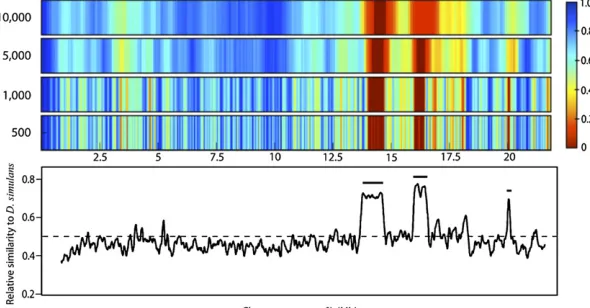
To confirm that our method was accurately enriching for regions affecting our complex trait, we used three approaches. First, we used an introgression model to give us expected sizes of introgression blocks given recombina-tion rate, number of backcross generarecombina-tions, and the level of replication (Figure 2). Second, we created a backcross sim-ulation to estimate the size and frequency of nonbackcross parental blocks remaining after 15 generations of backcross-ing without selection—that is, how often we would expect to see introgression blocks by chance alone. Finally, to en-sure thatD. simulansenrichment was not simply an artifact of bin size, we rebinned chromosomes at fewer (500) and greater (10,000) SNPs per bin (Figures 3 and 4).
Introgression modeling
To confirm that our method mapped regions of an appro-priate size, we created a forward simulation to estimate the mean and variance of donor introgression block sizes (Figure 2). Our model uses recombination rates from Dro-sophila(Trueet al.1996) within the recombination model of Foss et al. (1993), which incorporates crossover interfer-ence. We assumed a D. simulans genetic map of 460 cM and relatively simple interference (a noncrossover event must occur between adjacent crossovers, m= 1 from Foss
et al.1993). Over multiple backcross generations, an intro-gressed block size decreases asymptotically to 0 cM. With multiple independent introgressed replicates, the variance in block size also decreases asymptotically to 0. In our case, one replicate over 15 generations is expected to have a block size of565 cM. Our experimentally observed blocks were
0.5–1 cM, falling well within the expected block size. In
Drosophila, 1 cM is roughly equivalent to 0.5 Mb, depending on chromosomal position.
Backcross simulation
D. simulans-enriched regions could also remain due to drift alone. To reveal the variation of introgression size by chance (that is, without selection), we performed a simulation of introgression with backcrossing. We populated a virtual pool of chromosomes made up of two parental genotypes,AandB. Each generation, anAchromosome was recombined with aB
chromosome, experiencing one crossover event at a random position. Each event created two daughter chromosomes that received reciprocal products. To maintain a stable population size, one daughter from each crossover was picked at random to propagate the next generation. This daughter was then
In infinitely large populations, theory predicts that, on average, half of theAalleles will remain after each cycle of recombination and drift. In noninfinite populations, how-ever, drift will likely remove more than half ofAalleles. This is because once anAallele is lost, it is lost forever, and the probability of A alleles being lost due to drift is additive across generations. To get a sense of allele loss due to drift, consider an infinite population experiencing recombination and drift over 15 generations. This should produce a fre-quency of A alleles equal to (1/2)15, or 3.05 · 1025% of
the population allele frequency. In our simulation of 2000 independent backcross lineages we found only one surviving
Ablock within one chromosome for a population frequency of 3.8·1029%(152 bp in one 20-Mb chromosome).
Disregarding the low probability (1 in 2000) of introgres-sion by chance alone, we measured the variation in A fre-quency under a selection-free scenario. Simulations were repeated until 14 independentAblocks were found (20,600 replicates). Conditioning on anAblock persisting (N= 14), sizes ranged from 0.7 to 27% of one chromosome (avg = 6.1 6 7.4%). At a population level (N = 20,600), sizes ranged from 3.4·1027%to 1.3·1025%. In our pilot
exper-iment, we introgressed one lineage with selection and found at least 6 blocks ranging in size from 20 Kb to 1.5 Mb (0.1– 7.5% of a 20-Mb chromosome). Our simulation script is avail-able within the PSIseq manual (supporting information).
Figure 2 Mean size of candidate chromosomal region. Shown are results from a forward model estimating the size of introgressed blocks in a back-cross with selection scenario. The block,x, is the chromosomal region uniquely overlapped by all introgression lines,L. The size ofxwill depend on the number of generations of introgression and the number of in-dependent lines (Replicates). We simulated this process for 2–10 replicate lines and 5–20 generations. The averagexis blue; green and red dots represent 1 SD above and below the average, respectively.
Binning effect
In our effort to find regions of the 15th generation hybrid genome enriched forD. simulans, we binned chromosomes into overlapping 1000 SNP (100 kb) sections. This size was chosen primarily with consideration ofDrosophilagenic density. However, choice of bin size influences one’s ability to detect significant SNP enrichment. For example, picking a large bin size will mask enriched regions by including adjacent nonenriched regions. A bin size that is too small will force many comparisons and the correctedathreshold will be too low. Ultimately, bin size determines one’s ability to detect enrichment.
To illustrate the influence of binning on our analysis, we rebinned generation 15 chromosome arms2L and2R at dif-ferent sizes. Starting with a bin size of 500 SNPs (50 kb) we tracked clustering ofD. simulansSNPs, calculatedP-values, and then repeated this process, increasing bin size to a max-imum size of 10,000 SNPs/bin. All bins overlap by 10% of their bin size. Because bin size scales inversely with the num-ber of bins (hence the numnum-ber of significance tests), the threshold of significance according to a FDR changes.
Figure 3 and Figure 4 show data from chromosome arms
2L and2R, respectively, produced by four sample bin sizes. The two large regions on2L showing significantD. simulans
SNP enrichment maintained this significance under all bin sizes. As expected, regions are not identified as significant
for all bin sizes. As arm 2R (Figure 4) shows that, while regions harboring sharp peaks in D. simulans enrichment stand out, large regions with relatively shallow enrichment can still approach significance (e.g., centromeric region of
2R). One’s ability to detect significance at a given bin size is influenced by the physical size of the introgression block and the magnitude of SNP enrichment; thus it is difficult to pre-dict what is the“right”bin size. When choosing a bin size it is more important to consider the biological and experimen-tal conditions: recombination rate, generation number, gene density, influence of recombination hotspots, etc.
Independent confirmation of the effect of the X chromosomes
The X chromosome appeared not to harbor any genes affecting aversion behavior. An alternate explanation for this pattern is that our single introgression did not capture all regions affecting aversion. (As noted above, we captured only about three-quarters of theD. simulansphenotype with this single introgression line.) This will most likely occur within chromosomes where local recombination landscape can affect the efficacy of selection. We did not expect this problem within an independent linkage group.
Backcrossed D. simulans/D. sechellia flies with X-linked markers were subjected to an oviposition assay. When con-trolling for the influence of the X chromosome, we confirmed
Figure 3Ability to detect D. simulansenrichment with dynamic binning. Shown are sections from a heat plot of P-values on chromosome arm 2L from generation 15 hybrids, the same region shown in Figure 1. Four bin sizes were chosen to illustrate the binning effect described above: 500, 1000, 5000, and 10,000 SNPs/bin moving from middle to top. Heat plot colors correspond to cor-rectedP-values (normal approximation of binomial; signif-icance set by FDR); dark red regions have met the FDR threshold and are considered significantly enriched forD. simulans. The color gradient from light red to dark blue corresponds to scaledP-values, which are not significant. Bottom shows reproduction of Figure 1 for reference. Hor-izontal positions in the heat plots correspond to physical location on bottom.
the absence of its effect. Of the 169 flies withD. sechelliaX, 77% avoided the Morinda medium. Of the 202flies withD. simulansX, 73% avoided the Morinda medium. This pattern goes in the opposite direction predicted and is not statistically significant (x2 = 0.642, d.f. = 1,P= 0.4229).
Discussion
We have shown that PSIseq can efficiently map the genetic basis of a complex trait. This method can find multiple loci with small mapping populations that remain usable beyond mapping experiments. Other NGS methods rely on transient F2 mapping populations, which are irrevocably lost once
nucleic acids are extracted. On the other hand, introgression stocks can be tested in future assays to further resolve candi-date regions. Only low sequencing coverage is needed for rough mapping, and replicate populations can be created over time. We found at least six loci contributing to D. simulans
aversion of Morinda compounds, and we confirmed the
in-fluence on behavior of an odorant binding protein locus dis-covered previously (Obp56e; Dworkin and Jones 2009).
NGS mapping is typically composed of three main steps: (1) create a mapping population, (2) extract DNA and prepare libraries, and (3) assemble short reads and genotype. PSIseq improves thefirst and third steps. First, PSIseq uses introgres-sion lines propagated for more generations instead of an F2
backcross line because this allows mapping of smaller candi-date regions. Closely linked loci can be decoupled and mapped separately, especially if multiple replicate introgressions are made. For example, Bairdet al.(2008), Sarinet al.(2008), Blumenstielet al.(2009), Huanget al.(2009), Schneeberger
et al.(2009), Zurynet al.(2010), and Andolfattoet al.(2011) all used F2 backcross populations and successfully mapped
single loci from mutagenesis screens or dominant marker map-ping. PSIseq was able to isolate at least six distinct loci in our pilot study, three of which occurred within a 7-Mb region (See Figure 1).
PSIseq also improves the third step in NGS mapping: genotyping. Instead of using only common SNPs (à laGWAS), PSIseq uses all possible SNPs and avoids potential bias in map-ping to particular regions. A major issue with current short-read technology is the high per-base sequencing and mapping error rates. PSIseq overcomes this by using a window-based mapping approach, as described by Huang et al. (2009). A group of SNPs are collected into bins (“windows”), and statis-tical tests are performed on these bins. Thus, while a small percentage of SNPs may be inaccurate, these false SNPs are engulfed by surrounding populations of true SNPs. This method works particularly well when mapped regions are
fixed for one parent and contain few polymorphisms (e.g., RILs) and for rough mapping of hybrid genomes sequenced lightly. As an alternative to the window approach, Andolfatto
et al. (2011) developed a customized hidden-Markov model (HMM) to assign the probability of a SNP’s ancestry. The power of this method lies in its ability to map with high resolution the boundaries surrounding the recombination breakpoint itself.
We take a more simplistic approach in identifying ancestry by measuring SNP enrichment under a binomial expectation.
PSIseq has additional advantages. First, the experimental replication needed to increase mapping resolution can be spaced out over time, and population sizes within a replicate need only be large enough to maintain the introgression line—as small as one lineage per replicate. This approach allows us to increase introgression replicate sizes and the quality and number of phenotypic measurements. Second, like sequenced RILS (Huanget al.2009), these selected in-trogression lines are potentially shelf stable and can be used in future experiments. Third, complex traits can be mapped in organisms lacking a high-quality genome assembly. For example, with transcriptome sequence from parental and introgression lines one could identify gene transcripts enriched for alleles from the selected parent. Finally, in ad-dition to beingflexible and extensible, our approach needs only low sequence coverage (1·) for rough mapping, given enough SNPs (e.g.,100-kb resolution). To increase resolution of candidate regions one could replicate intro-gression crosses (see Figure 2) or take advantage of new targeted enrichment sequencing (Antsonet al.2000; Albert
et al.2007) to increase coverage for only interesting regions. This strategy would be particularly useful for regions with repetitive elements, duplications, pseudogenes, and other elements difficult to align at lower coverage.
Our study measured a divergent trait between two species, but our approach can be applied to two genetically diverged individuals. The parental line would be sequenced, unique SNPs identified, and then introgression and selection performed. Typically, these strains would have a lower SNP density. We provide a simple model for estimating the expected mapping resolution for a trait given sequence divergence rate and bin size (supporting information). For example, populations with relatively low sequence diver-gence (0.1%) and bins of 1000 SNPs each could be mapped to 2-Mb regions within one replicate introgression lineage, depending on recombination rates, strength of phenotypic selection during introgression, and mapping quality.
Acknowledgments
We thank Diana Hall for suggesting the Bionomial test, Sophia Shih and Piotr Mieczkowski for technical assistance, and Lauren McIntyre, J. Reinhardt, and A. Romanchuk for comments and suggestions. We also thank the anonymous reviewers for their comments. This work was supported the University of North Carolina University Cancer Research Fund, and National Science Foundation—Graduate Re-search Fellowship Program (E.J.E.).
Literature Cited
Albert, T. J., M. N. Molla, D. M. Muzny, L. Nazareth, D. Wheeler
Amlou, M., B. Moreteau, and J. R. David, 1998 Genetic analysis of
Drosophila sechelliaspecialization: oviposition behavior toward the major aliphatic acids of its host plant. Behav. Genet. 28: 455–464. Andolfatto, P., D. Davison, D. Erezyilmaz, T. T. Hu, J. Mastet al., 2011 Multiplexed shotgun genotyping for rapid and efficient genetic mapping. Genome Res. 21: 610–617.
Antson, D. O., A. Isaksson, U. Landegren, and M. Nilsson, 2000 PCR-generated padlock probes detect single nucleotide variation in genomic DNA. Nucleic Acids Res. 28: E58. Baird, N. A., P. D. Etter, T. S. Atwood, M. C. Currey, A. L. Shiver
et al., 2008 Rapid SNP discovery and genetic mapping using sequenced RAD markers. PLoS ONE 3: e3376.
Blumenstiel, J. P., A. C. Noll, J. A. Griffiths, A. G. Perera, K. N. Waltonet al., 2009 Identification of EMS-induced mutations inDrosophila melanogaster by whole-genome sequencing. Ge-netics 182: 25–32.
Desjardins, C. A., F. Perfectti, J. D. Bartos, L. S. Enders, and J. H. Werren, 2010 The genetic basis of interspecies host preference differences in the model parasitoidNasonia. Heredity 104: 270– 277.
Dworkin, I., and C. D. Jones, 2009 Genetic changes accompany-ing the evolution of host specialization in Drosophila sechellia. Genetics 181: 721–736.
Ehrenreich, I. M., N. Torabi, Y. Jia, J. Kent, S. Martis et al., 2010 Dissection of genetically complex traits with extremely large pools of yeast segregants. Nature 464: 1039–1042. Foss, E., R. Lande, F. W. Stahl, and C. M. Steinberg, 1993 Chiasma
interference as a function of genetic distance. Genetics 133: 681–691.
Huang, X., Q. Feng, Q. Qian, Q. Zhao, L. Wanget al., 2009 High-throughput genotyping by whole-genome resequencing. Ge-nome Res. 19: 1068–1076.
Huang, X., Q. Feng, Q. Qian, Q. Zhao, L. Wanget al., 2009 High-throughput genotyping by whole-genome resequencing. Ge-nome Res. 19: 1068–1076.
Jones, C. D., 1998 The genetic basis ofDrosophila sechellia’s re-sistance to a host plant toxin. Genetics 149: 1899–1908. Jones, C. D., 2005 The genetics of adaptation inDrosophila
sechel-lia. Genetica 123: 137–145.
Kliman, R. M., P. Andolfatto, J. A. Coyne, F. Depaulis, M. Kreitman
et al., 2000 The population genetics of the origin and diver-gence of theDrosophila simulanscomplex species. Genetics 156: 1913–1931.
Laitinen, R. A., K. Schneeberger, N. S. Jelly, S. Ossowski, and D. Weigel, 2010 Identification of a spontaneous frame shift mu-tation in a nonreferenceArabidopsisaccession using whole ge-nome sequencing. Plant Physiol. 153: 652–654.
Laurie, C. C., J. R. True, J. Liu, and J. M. Mercer, 1997 An in-trogression analysis of quantitative trait loci that contribute to a morphological difference betweenDrosophila simulansandD. mauritiana. Genetics 145: 339–348.
Li, H., and R. Durbin, 2009 Fast and accurate short read align-ment with Burrows-Wheeler transform. Bioinformatics 25: 1754–1760.
Mackay, T. F., E. A. Stone, and J. F. Ayroles, 2009 The genetics of quantitative traits: challenges and prospects. Nat. Rev. Genet. 10: 565–577.
Manolio, T. A., F. S. Collins, N. J. Cox, D. B. Goldstein, L. A. Hindorff
et al., 2009 Finding the missing heritability of complex diseases. Nature 461: 747–753.
Matsuo, T., S. Sugaya, J. Yasukawa, T. Aigaki, and Y. Fuyama, 2007 Odorant-binding proteins OBP57d and OBP57e affect taste perception and host-plant preference inDrosophila sechel-lia. PLoS Biol. 5: e118.
Michelmore, R. W., I. Paran, and R. V. Kesseli, 1991 Identification of markers linked to disease-resistance genes by bulked segre-gant analysis: a rapid method to detect markers in specific ge-nomic regions by using segregating populations. Proc. Natl. Acad. Sci. USA 88: 9828–9832.
R’Kha, S., P. Capy, and J. R. David, 1991 Host-plant specialization in theDrosophila melanogasterspecies complex: a physiological, behavioral, and genetical analysis. Proc. Natl. Acad. Sci. USA 88: 1835–1839.
Sarin, S., S. Prabhu, M. M. O’Meara, I. Pe’er, and O. Hobert, 2008 Caenorhabditis elegans mutant allele identification by whole-genome sequencing. Nat. Methods 5: 865–867. Sarin, S., V. Bertrand, H. Bigelow, A. Boyanov, M. Doitsidouet al.,
2010 Analysis of multiple ethyl methanesulfonate-mutagen-izedCaenorhabditis elegansstrains by whole-genome sequenc-ing. Genetics 185: 417–430.
Schneeberger, K., S. Ossowski, C. Lanz, T. Juul, A. H. Petersenet al., 2009 SHOREmap: simultaneous mapping and mutation iden-tification by deep sequencing. Nat. Methods 6: 550–551. True, J. R., J. M. Mercer, and C. C. Laurie, 1996 Differences in
crossover frequency and distribution among three sibling spe-cies of Drosophila. Genetics 142: 507–523.
Xia, Y., S. Won, X. Du, P. Lin, C. Rosset al., 2010 Bulk segregation mapping of mutations in closely related strains of mice. Genetics 186: 1139–1146.
Zuryn, S., S. Le Gras, K. Jamet, and S. Jarriault, 2010 A strategy for direct mapping and identification of mutations by whole-genome sequencing. Genetics 186: 427–430.
GENETICS
Supporting Information http://www.genetics.org/content/suppl/2011/09/21/genetics.111.129445.DC1
Next-Generation Mapping of Complex Traits
with Phenotype-Based Selection and Introgression
Eric J. Earley and Corbin D. Jones