INTEGRATED ASSESSMENT OF FLOODING HAZARDS AT U.S.
NUCLEAR POWER PLANTS
Michelle T. Bensi,1 Christopher B. Cook,2 and Nilesh Chokshi3
1Civil Engineer, Hydrology and Meteorology Branch, Division of Site Safety and Environmental
Analysis, United States Nuclear Regulatory Commission (NRC), Rockville, MD ([email protected])
2 Branch Chief, Hydrology and Meteorology Branch, Division of Site Safety and Environmental Analysis,
NRC, Rockville, MD
3 Deputy Director, Division of Site Safety and Environmental Analysis, NRC, Rockville, MD
ABSTRACT
In response to the events at the Fukushima Dai-ichi nuclear power plant following the March 11, 2011 earthquake and subsequent tsunami, the U.S. Nuclear Regulatory Commission (NRC) undertook a series of actions to reevaluate the capability of operating nuclear plants to withstand the effects of external flooding events. Amongst these activities, the NRC staff issued a letter to all power reactor licensees and holders of construction permits requesting reevaluation of potential flooding hazards using guidance and methodologies that reflect the current state of practice in hydrology and which are used in new reactor licensing. The integrated assessment for external flooding evaluates the total plant response of a nuclear power plant to this reevaluated flood hazard, considering both the protection and mitigation capabilities of the plant. The purpose of the integrated assessment is to: (1) evaluate the effectiveness of the current licensing basis (i.e., flood protection capability) under the reevaluated flood hazard, (2) identify plant-specific vulnerabilities due to external flood hazards, and (3) assess the effectiveness of existing or planned plant systems and procedures in protecting against flood conditions and mitigating consequences for the entire duration of a flooding event. In November 2012, the NRC staff issued interim staff guidance (ISG) that describes methods acceptable to NRC staff for performing the integrated assessment for external flooding. This paper describes the process outlined in the ISG for performing an integrated assessment.
BACKGROUND
Division VII
In response to the aforementioned Commission and Congressional direction, the NRC issued a request for information to all power reactor licensees and holders of construction permits under 10 CFR Part 50.54(f) on March 12, 2012 (Ref. (2)). Among other requests, the March 12, 2012, 10 CFR 50.54(f) letter requests that respondents: (1) perform plant walkdowns to verify the capability of the plants to respond to the flood events for which they were designed and licensed, and (2) reevaluate flooding hazards at their nuclear power plant sites using updated flooding hazard information and present-day regulatory guidance and methodologies consistent with those used for the review of applications for new nuclear reactors. The walkdowns have been completed by all licensees. The hazard reevaluation efforts are ongoing for all sites, though a subset of sites have already completed and submitted the results of their reevaluations. For the sites at which this reevaluated flood is not bounded by the current design basis (including flood height and associated effects for all flood-causing mechanisms), the March 12, 2012, letter requests that respondents perform an integrated assessment of the plant to identify vulnerabilities and actions to address them. In November, 2012, NRC staff issued interim staff guidance (ISG), JLD-ISG-2012-05, Guidance for Performing the Integrated Assessment for External Flooding
(Ref. (3)), to provide guidance on methods that NRC staff considers acceptable for performing the integrated assessment. The guidance was developed over the course of several months, including numerous public interactions with external stakeholders, which included representatives of industry through the Nuclear Energy Institute (NEI) Flooding Task Force. Summaries of public meetings (along with all documents discussed during the meetings) are available in NRC’s Agencywide Documents Access & Management System (ADAMS).
INTRODUCTION
The integrated assessment for external flooding evaluates the total plant response of operating nuclear power plant sites to a reevaluated flood hazard (developed based on the current state-of-the practice in hydrology), considering both the protection and mitigation capabilities of the plant. The intent of the integrated assessment is to identify site-specific vulnerabilities and to provide other important insights, including insights related to available physical margin,1 the balance between protection and
mitigation, defense-in-depth, and cliff-edge effects.2 To achieve this intent, the integrated assessment: (1)
evaluates the effectiveness of the current licensing basis (i.e., flood protection capability) under the reevaluated flood hazard, (2) identifies plant-specific vulnerabilities due to external flood hazards, and (3) assesses the effectiveness of existing or planned plant systems and procedures in protecting against flood conditions and mitigating consequences for the entire duration of a flooding event.
Integrated Assessment Concept
In developing the integrated assessment, it was recognized that there are significant differences from site-to-site with respect to potential flooding hazards, assumed margin, and the approaches and strategies used to protect against or mitigate the event. As a result, the integrated assessment is based on a graded approach to ensure the assessment is appropriate for the unique characteristics of a given site. Depending on site characteristics, the graded approach supports assessments that range from engineering evaluations of individual flood protection features to evaluations based on probabilistic risk assessment (PRA) techniques (e.g., system logic models and risk-insights).
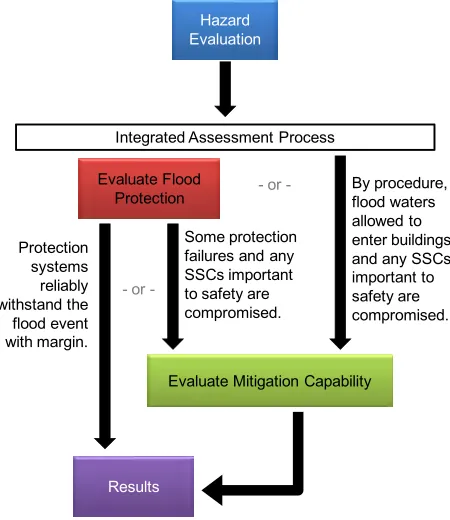
Figure 1 provides a conceptual illustration of the integrated assessment process. The outcomes of the flood hazard reevaluations performed in response to the March 12, 2012, letter provide input into the
1 The term available physical margin (APM) describes the flood margin available for applicable flood protection
features at a site. The APM for each applicable flood protection feature is the difference between licensing basis flood protection height and the flood height at which water could affect an structure, systems or component important to safety (Ref. (9)).
2 A cliff-edge elevation is an elevation at which safety consequences of a flood event may increase sharply with a
integrated assessment process. Upon entering the integrated assessment process, the analyst evaluates the capability of flood protection systems to meet their intended safety functions under the reevaluated hazard. If the licensee can demonstrate the site’s flood protection is reliable and has margin, the analyst proceeds to documentation and justification of results. If the licensee cannot demonstrate that the site’s flood protection is reliable and has margin, the analyst evaluates the plant’s ability to maintain key safety functions during the flood event. This step of the integrated assessment process is referred to as an evaluation of mitigation capability. After evaluating the mitigation capability of the plant, the process proceeds to documentation and justification of results. In lieu of flood protection, some sites may allow water to enter buildings (or other areas that house structures, systems, or components (SSCs) that are important to safety) by procedure or design. In these cases, the integrated assessment process proceeds directly to the evaluation of the mitigation capability of the plant as represented by the arrow on the rightmost side of Figure 1.
Figure 1: Conceptual illustration of integrated assessment process
Integrated assessment scope and key assumptions
The scope of the integrated assessment includes full-power operations and other plant configurations that could be susceptible to damage due to impairment of flood protection features. The integrated assessment evaluates the effectiveness of both the flood protection and mitigation capabilities of the plant for the mode(s) of operation that the plant will be in for the entire flood event duration. 3 The
integrated assessment also describes the expected total plant response under other modes of operation, including a discussion of controls (e.g., programmatic controls) that are in place in the event that a flood occurs during any of these modes (e.g., during refueling). Ultimately, the integrated assessment identifies
3 The flood event duration is the length of time in which the flood event affects the site, beginning with conditions
being met for entry into a flood procedure or notification of an impending flood event (e.g., a flood forecast or notification of dam failure), including preparation for the flood and period of site inundation, and ending when the water has receded from the site and the plant has reached a safe and stable plant state that can be maintained indefinitely.
Hazard Evaluation
Evaluate Flood Protection
Evaluate Mitigation Capability Integrated Assessment Process
Results
Some protection failures and any SSCs important to safety are compromised. Protection
systems reliably withstand the flood event with margin.
By procedure, flood waters allowed to enter buildings and any SSCs important to safety are compromised. or
-Division VII
whether specific vulnerabilities may arise during normal and full-power configurations and other modes of operation or configurations (e.g., conditions where flood protection features may be bypassed or defeated for maintenance or refueling activities).
There are several key assumptions that were integral to the development of the integrated assessment methodology and guidance, including:
1) The importance of facilitating of the use of all available resources: In assessing the protection and mitigation capability of a plant under the integrated assessment, credit can be taken for all available (onsite and offsite) resources as well as the use of systems, equipment, and personnel in nontraditional ways given appropriate justification. Temporary protection and mitigation measures, as well as nonsafety-related SSCs can be credited, provided there is a sufficient technical basis to justify the effectiveness (e.g., availability and reliability) of these resources. In crediting use of systems, equipment, and personnel in nontraditional ways, nonsafety-related SSCs, temporary mitigation and protection features, or similar resources, the integrated assessment requires that the assessment account for the potentially reduced reliability of such resources in relation to permanent, safety-related equipment. Moreover, if credit is taken for these resources, the integrated assessment should justify why the resources will be available and functional when they are required for the entire flood event duration.
2) The value and limitations of the current state of practice in probabilistic flood hazard assessment: The integrated assessment methodology acknowledges that, for most severe flood mechanisms, widely accepted and well-established methodologies are not available for assigning initiating event frequencies for the performance of a probabilistic flood hazard assessment. For this reason, the integrated assessment does not require the computation of initiating flood-hazard frequencies. Moreover, using initiating event frequencies to screen out flood events in lieu of evaluation of flood protection features at the site is not acceptable. However, it is also acknowledged that there is value in using probabilistic methods to assess risks from external flooding. Therefore, if desired and if given appropriate justification, the integrated assessment guidance does permit the use of the flood event frequency as part of a PRA to evaluate total plant response. Moreover, PRA concepts and tools (e.g., logic models) are utilized in the integrated assessment to provide a structured and transparent method to evaluate total plant response, even when risk is not quantitatively evaluated.
3) The importance of human performance: Human performance may take on added importance during flooding events compared to normal operations. For example, the establishment of flood protection features may rely heavily on manual actions such as constructing sandbag barriers, deploying and operating portable pumps, or relocating equipment. Significant manual actions may also be associated with mitigation actions, including actions that may leverage equipment, personnel, or other resources in nontraditional ways. In addition, failed or degraded instrumentation and controls in the main control room (MCR), as well as the unavailability of equipment and systems, may challenge the operating crew’s ability to monitor and control the plant to ensure that key safety functions are maintained. Access to and the functionality of local or remote control stations may also be compromised. The addition of responsibilities to oversee and manage flood response activities will increase the operators’ workload.
INTEGRATED ASSESSMENT PROCESS
Consistent with the objective of providing a flexible, adaptable, and graded approach to facilitate performance of the integrated assessment at diverse sites, the integrated assessment process consists of up to five possible steps, depending on the site flood response:
3. evaluation of flood protection systems (if applicable4) 4. evaluation of mitigation capability (if appropriate) 5. documentation of the results
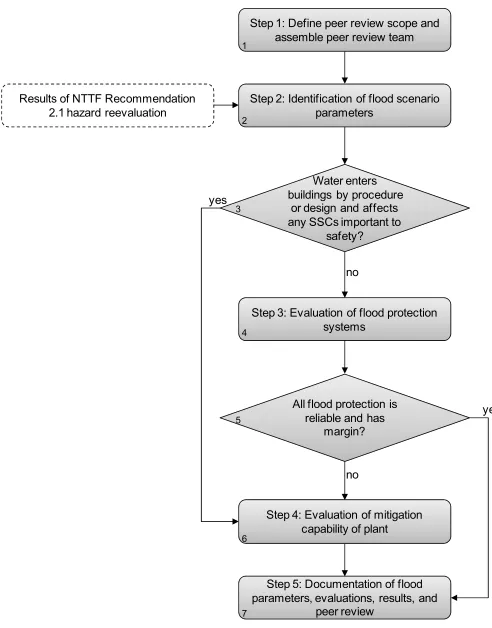
The flowchart in Figure 2 illustrates the integrated assessment process described below.
Figure 2: Integrated assessment process flowchart
Step 1: Peer Review
The first step of the integrated assessment process involves the assembly of an initial peer review team. This is specified as the first step because an in-process peer review is recommended (although a one-time peer review is also acceptable). Under an in-process peer review, the review is performed contemporaneously with the integrated assessment and observations made by the reviewers are transmitted to the teams performing the integrated assessment as soon as possible. As a result, the peer review team is established at the start of the integrated assessment with the scope of the peer review (and number of reviewers) expanded as necessary throughout the process. The integrated assessment guidance specifies that the peer review can leverage established licensee processes if they are compatible with the specific conditions and non-routine nature of the integrated assessment and the licensees can demonstrate that their existing processes and reviewers have the attributes outlined in the ISG.
An independent peer review is an important element for ensuring technical adequacy because of the significant amount of expert judgment that will need to be applied throughout the process. The technical adequacy of the integrated assessment is measured in terms of the appropriateness of the scope,
4 Some sites may have no flood protection. In these cases, a flood protection evaluation would not be applicable.
Step 2: Identification of flood scenario parameters
Step 3: Evaluation of flood protection systems
Step 4: Evaluation of mitigation capability of plant All flood protection is
reliable and has margin?
Step 5: Documentation of flood parameters, evaluations, results, and
peer review no
yes Step 1: Define peer review scope and
assemble peer review team
Water enters buildings by procedure
or design and affects any SSCs important to
safety?
no yes
1
2
3
4
6
7 5
Division VII
level of detail, methodologies employed, and plant representation, which should be consistent with the ISG and commensurate with the site-specific hazard and inherent flood protection reliability. Specifically, technical adequacy is determined by ensuring:
• the scope of effort is sufficient
• state of the art methodologies are correctly employed
• input parameters, including plant configurations, are justified
• the integrated assessment is performed consistent with NRC guidance
Step 2: Identification of controlling flood parameters
The second step in the integrated assessment process involves the determination of the flood scenario parameters that the assessment should consider based on the results produced as part of the flood hazard reevaluation (this step is represented by Box 2 in Figure 2). This step is intended to facilitate the collection and distillation of information contained in the hazard reevaluation report for use in the integrated assessment. Hazard mechanisms that are not bounded by the current design basis for the site must be considered in the integrated assessment. In some cases, only one controlling flood hazard may exist for a site. In this case, licensees should define the flood scenario parameters based on this controlling flood hazard.
While some sites are subject to a single dominant mechanism, many sites have a diversity of flood hazards to which the site may be exposed. In performing the integrated assessment, multiple sets of flood scenario parameters must be defined to capture the different plant effects from the diverse flood parameters associated with applicable hazards. In addition, these sites may use different flood protection systems to protect against or mitigate different flood hazards. In such instances, the integrated assessment should define multiple sets of flood scenario parameters. If appropriate, it is acceptable to develop an enveloping scenario (e.g., the maximum water surface elevation and inundation duration with the minimum warning time generated from different hazard scenarios) instead of considering multiple sets of flood scenario parameters as part of the integrated assessment. For simplicity, these flood parameters may be combined to generate a single bounding set of flood scenario parameters for use in the integrated assessment.
Flood parameters and conditions that should be defined to perform the integrated assessment include:
flood height and associated effects (i.e., wind waves and run-up effects; hydrodynamic loading, including debris; effects caused by sediment deposition and erosion; concurrent site conditions, including adverse weather conditions; groundwater ingress; and other pertinent factors)
flood event duration, including warning time and intermediate water surface elevations that trigger actions by plant personnel
plant mode(s) of operation during the flood event duration
other relevant plant-specific factors
Step 3: Evaluation of flood protection
Box 3 in Figure 2 represents a decision point. If a site has flood protection to prevent the entry of water into buildings or other areas containing SSCs important to safety, the process proceeds to step 3, which involves an evaluation of the effectiveness of the flood protection system(s) at the site for the reevaluated hazard from step 2. Conversely, if a site allows water to enter buildings or other areas with SSCs that are important to safety (by procedure or design) with potential effects on those SSCs, the integrated assessment process skips step 3 and proceeds directly to step 4. Step 4 involves the evaluation of the capability of the plant to maintain key safety functions5 during a flood event.
5 Key safety functions are the minimum set of safety functions that must be maintained to prevent core damage and
Site flood protection may include incorporated, exterior, and temporary features with passive and active functions that are credited to protect against the effects of external floods. In addition to physical barriers, flood protection at nuclear power plants may involve a variety of manual actions performed by personnel. These manual actions may be associated with installation of features (e.g., floodgates, portable panels, and the placement of portable pumps in service), the construction of barriers (e.g., sandbag barriers), and other actions. As part of the integrated assessment, flood protection is evaluated at both the feature- and system-levels.
Evaluation of whether flood-specific manual actions are feasible and reliable is performed using a relatively novel approach developed specifically for the integrated assessment to evaluate the manual actions required to protect against or mitigate the consequences of a large flood event. The method is described in an appendix of the ISG. The content of that appendix was adapted from and expanded on experience and guidance related to evaluation of manual actions associated with response to fire, specifically guidance contained in Refs. (4) and (5). In addition, more general documents related to evaluation of manual actions were also leveraged.
For each flood protection system on site, an evaluation is performed to demonstrate the system can reliability accommodate each set of flood scenario parameters (defined in step 2) with margin. This can be achieved using performance criteria contained within the ISG or through quantification of flood protection reliability. In addition to justifying conclusions regarding the effectiveness of flood protection, licensees are requested to identify the limiting margin associated with the flood protection system as well as the margin associated with individual flood protection features. Margin is characterized with respect to physical barrier dimensions, structural or other performance capacity, and time and staffing associated with the performance of manual actions to establish flood protection systems.
Conversely, if the flood protection system is not able to reliably accommodate the flood scenario parameters with margin, the credible failure modes and vulnerabilities, along with the direct consequences (e.g., inundation of a room) of each failure mode and vulnerability, are documented. In addition, if a flood protection feature or system cannot accommodate the flood scenario parameters, the flood protection evaluation determines at what flood height, and under what associated effects, the flood protection feature or system is able to reliably accommodate a flood. If the licensee proposes modifications to address vulnerabilities, improve margin, or otherwise improve the effectiveness of site flood protection, the integrated assessment should justify that the modified flood protection is reliable and has margin through comparison to established performance criteria or quantification of reliability (as appropriate).
Another decision point occurs after the conduct of the flood protection evaluation, as shown by Box 5 in Figure 2. If the evaluation demonstrates that on-site flood protection is reliable and has margin, the integrated assessment process proceeds directly to step 5 (documentation of the results). However, if the evaluation does not demonstrate that on-site flood protection is reliable and has margin, the process proceeds to step 4 to evaluate the plant’s capability to mitigate a loss of one or more flood protection systems by maintaining key safety functions (represented by Box 6 in Figure 2).
Step 4: Evaluation of mitigation capability
Mitigation capability refers to the capability of the plant to maintain key safety functions in the event that a flood protection system(s) fails or a site does not have flood protection under the flood scenario parameters defined in step 2. An evaluation of mitigation capability is required for sites that have not demonstrated that the flood protection systems are reliable and have margin. Mitigation capability should be evaluated for credible flood protection failure modes (identified under the flood protection evaluation), including concurrent failures. For each scenario involving the compromise of flood protection under the flood scenario parameters, the mitigation capability of the plant should be evaluated
Division VII
for the entire flood event duration considering available resources. In addition, sites that allow water to enter buildings or other areas with SSCs important to safety by procedure or design (and resulting in the potential compromise of those SSCs) should evaluate mitigation capability.
The licensee may demonstrate the mitigation capability of a plant using one of three potential methods, depending on site characteristics and information needed for decisions:
scenario-based evaluation
margins-type evaluation
full PRA
The scenario-based approach is intended to be a systematic, rigorous, and conservative, (although primarily qualitative), evaluation used to demonstrate that there is high confidence that key safety functions can be maintained. A margins-type evaluation is quantitative and uses conditional core damage probability (CCDP) and conditional large early release probability (CLERP) as figures of merit. The margins-type assessment will be more realistic than a scenario-based evaluation, but more conservative than a PRA. Moreover, a margins-type evaluation will typically use logic models that are more complex than a scenario-based evaluation but simpler than models used as part of a full PRA. The full PRA evaluation uses a conventional PRA-based approach to evaluate the mitigation capability of the plant.
A margins-type evaluation and a full PRA are acceptable for evaluating mitigation capability at all sites. However, licensees may opt to perform a scenario-based evaluation, or to use a scenario-based evaluation as a starting point, before proceeding to a margins-type evaluation or full PRA. When using a scenario-based evaluation to assess mitigation capability, the licensee is responsible for justifying that the scenario-based evaluation provides sufficient detail and supporting information (e.g., captures dependencies, interactions, and total flood effect) to demonstrate that there is high confidence that key safety functions can be maintained. For example, if the logic structure developed under a scenario-based evaluation becomes too complex, it would become apparent that a scenario-based evaluation is not capable of reaching a justifiable conclusion and a margins-type evaluation or full PRA would be necessary. As another example, if the use of conservative, deterministic engineering evaluations, logic structures, and conservative performance criteria using a scenario-based approach do not demonstrate that there is high confidence that key safety functions can be maintained, the licensee may choose to make modifications (e.g., to the plant or procedures) or proceed to an evaluation of mitigation capability using a margins-type evaluation. The margins-type evaluation can account for more complicated interactions and dependencies. In addition, the margins-type evaluation quantitatively evaluates the reliability of manual actions and active components and may (with certain conditions) credit the reliability of flood protection. If a more refined evaluation is needed than is possible in a margins-type evaluation, an external flood PRA is appropriate, which can consider the reliability of flood protection.
Scenario-based evaluation
The scenario-based evaluation is used to demonstrate that there is high confidence that key safety functions can be maintained using qualitative and quantitative information and insights. Although the scenario-based evaluation does not require the computation of risk-based metrics (e.g., CCDP and CLERP), it uses a systematic, rigorous, and conservative approach to demonstrate that key safety functions can be maintained with high confidence under the flood scenario parameters. The scenario-based evaluation was developed to yield many of the qualitative insights gained from use of PRA-tools even if quantification is not desirable or practical. For example, a scenario-based evaluation must include the following key elements:
a detailed description of the scenario and its key components
a description of the approach(es) used for mitigation
a timeline showing necessary manual actions, including cues, indications, and notifications
an evaluation of manual actions using the previously mentioned method for assessing whether actions are feasible and reliable, which was developed specifically for the purposes of the integrated assessment
the development of logic structures (i.e., event and fault trees) that include each SSC that must change state and each manual action, to capture dependencies between SSCs as well as manual actions. The logic structures should show necessary support systems for each SSC that changes state (e.g., AC or DC power, cooling water, fuel, equipment required for activation)
a conclusion of the overall reliability of the approach(es) used for mitigation
If the scenario-based evaluation can demonstrate that there is high confidence that key safety functions can be maintained, the results must be documented and justified. If the evaluation cannot demonstrate with high confidence that key safety functions can be maintained, then either: (1) a scenario-based evaluation is not sufficient and a margins-type evaluation or PRA is necessary, or (2) modifications should be made to the plant to improve flood protection or mitigation capability such that there is high confidence that key safety functions can be maintained.
Margins-type evaluation
The margins-type assessment evaluates mitigation capability given set(s) of flood scenario parameters and credible flood protection failures(s). This approach to evaluating mitigation capability is referred to as a “margins-type” evaluation because it was developed in the “general spirit” of the seismic margins assessment concept, although without the substantial body of research and development that has been performed over many years to support the generic definitions and guidance leveraged under seismic margins methods.
A margins-type approach to evaluating mitigation capability under the integrated assessment is quantitative and uses CCDP and CLERP as figures of merit. The licensee should perform a margins-type assessment for flood protection features, or flood protection feature combinations, that are not judged to be reliable or have margin, including credible concurrent failures given the flood scenario parameters defined in step 2. Once the evaluation has specified the plant conditions along with equipment affected by the flood protection failure, plant system models are updated, enhanced, or developed to reflect the current plant state and available equipment. The internal events PRA model, with appropriate modifications, can be used to model plant systems. Basic failure events are added to the internal events PRA model for evaluating the mitigation capability of the plant during a flood event. Alternatively, it is acceptable to develop a system model(s) specifically intended to compute CCDP and CLERP under the flood scenario parameters and flood protection failure mode(s) being analyzed rather than adapting the existing internal events PRA model. If such a model is developed, it should be consistent with the internal events systems model with respect to plant response.
Using plant system models, CCDP and CLERP are calculated. The evaluation of mitigation capability should be repeated until all flood protection failure modes and sets of flood scenario parameters have been evaluated.
PRA-based evaluation
Division VII
Step 5: Documentation
The ISG describes the documentation of the integrated assessment. In addition, NRC staff have interacted with industry during public meetings to discuss and provide feedback on industry-developed examples of integrated assessments, which are intended to demonstrate the scope, level of detail, and content of licensees’ integrated assessment submittals.
CONCLUSIONS
Guidance for performance of the integrated assessment is contained in the ISG developed by NRC staff over several months with significant interaction with external stakeholders. The guidance supports a systematic and rigorous evaluation of the capability of an operating nuclear power plants to protect against and mitigate the effects of external flood events.
ACKNOWLEDGEMENTS
The authors acknowledge the members of the NRC “NTTF R2.1-Flood Team,” who contributed to the development of the integrated assessment ISG. In particular, the authors acknowledge the support from: Marie Pohida, Jeff Mitman, Fernando Ferrante, and Malcolm Patterson, who shared their PRA-experience; Val Barnes, George Lapinsky, and Dave Desaulniers, who supported the development of methods for evaluation of manual actions; Jake Philip, who shared his expertise in evaluation of flood protection; and Ed Miller and Jenise Thompson, who kept us on track and provided support and guidance throughout the entire effort to develop the ISG for the integrated assessment. The authors also acknowledge the contributions from the NEI Flooding Task Force, which was lead by Jim Riley.
DISCLAIMER
Any opinions, findings and conclusions expressed in this paper are those of the authors and do not necessarily reflect the views of the United States Nuclear Regulatory Commission.
REFERENCES
1. U.S. Nuclear Regulatory Commission. "Recommendations for Enhancing Reactor Safety in the 21st Century, The Near-Term Task Force Review of Insights from the Fukushima Dai-ichi Accident," Enclosure to SECY-11-0093. July 12, 2011. Agencywide Documents Access and Management System (ADAMS) Accession No.
ML111861807.
2. U.S. Nuclear Regulatory Commission. Request for Information Pursuant to Title 10 of the Code of Federal Regulations 50.54(f) Regarding Recommendations 2.1, 2.3, and 9.3 of the Near-Term Task Force Review of Insights from the Fukushima Dai-ichi Accident. March 12, 2012. ADAMS Accession No. ML12053A340. 3. U.S. Nuclear Regulatory Commission. JLD-ISG-2012-05, “Guidance for Performing the Integrated Assessment
for External Flooding.” November 2012. ADAMS Accession No. ML12311A214.
4. U.S. Nuclear Regulatory Commission. "Demonstrating the Feasibility and Reliability of Operator Manual Actions in Response to Fire," NUREG-1852. October 2007.
5. U.S. Nuclear Regulatory Commission. "EPRI/NRC-RES Fire Human Reliability Analysis Guidelines," NUREG-1921. July 2012. ADAMS Accession No. ML12216A104.
6. American Society of Mechanical Engineers. “Addenda to ASME/ANS RA-S–2008, Standard for Level 1/Large Early Release Frequency Probabilistic Risk Assessment for Nuclear Power Plant Applications.” 2009.
ASME/ANS RA-Sa-2009.
7. U.S. Nuclear Regulatory Commission. "An Approach for Determining the Technical Adequacy of Probabilistic Risk Assessment Results for Risk-Informed Activities," Regulatory Guide 1.200, Revision 2. March 2009. ADAMS Accession No. ML090410014.