Available Online atwww.ijcsmc.com
International Journal of Computer Science and Mobile Computing
A Monthly Journal of Computer Science and Information Technology
ISSN 2320–088X
IJCSMC, Vol. 4, Issue. 4, April 2015, pg.650 – 656
RESEARCH ARTICLE
SIMULATION OF CANCER CELLS GROWTH BY
RECOGNIZING TEXTURE CHARACTERISTICS USING
OPPONENT COLOR LOCAL BINARY PATTERN
M.Pavithra
1, G.Ilanchezhiapandian
21Computer Science and Engineering, Ganadhipathy Tulsi‟s jain Engineering College, Vellore, Tamilnadu, India
2
Faculty of Computer Science Engg, Ganadhipathy Tulsi‟s Jain Engineering College, Vellore, Tamilnadu, India
Abstract- The objective of the paper is to address the most important and challenging problems in oncology (lung cancer). Nowadays Lung cancer remains the leading cause of cancer related deaths. Developing an effective computer aided diagnosis (CAD) systems for lung cancer is of great clinical importance and can increase the patient’s chance of survival. An opponent color local binary pattern (OCLBP) algorithm is used to test the relation between pixel and its neighbours by encoding this relation into a binary word and recognizing texture categories. The proposed work uses the OCLBP texture feature for segmentation. Texture is one of the important as well as useful tasks in image processing applications. Later using texture based segmentation this methodology adapted best results with efficient detection of cancer and severity levels as well.
Keywords: Texture Analysis, Computer Aided Diagnosis, Opponent color local binary pattern (OCLBP), Texture Categorization, Texture based segmentation.
I. INTRODUCTION
Lung cancer remains the leading reason for cancer connected deaths in U.S. In 2012;there have been approximately 229,47 new cases of respiratory organ cancer connected deaths. Early identification will improve the effective would like of treatment and increase the patient‟s probability of survival. Texture is key characteristic of a picture , that has tested quite difficult to this point, several strategies have been planned to describe it in a quantitative manner. Numerous so that the entire set has been recently named as a „galaxy of texture features‟. So texture is that the regular duplication of issue.
The pre-processing steps of lung recognition system consist including segmentation. Texture based segmentation technique and normalization done respectively. The main goal of the lung segmentation is to derive texture patterns using inter color channel combinations (OCLBP) to determine cancer detection and severity analysis. This is insensitive to noise, rotation invariant.
II. RELATED WORK
A. Texture description through histograms of equivalent patterns
Antonio Fernandez, Marcos X.Alvarez, Francesco Bianconi [1] described a general framework for texture analysis which we refer to as HEP (Histograms of Equivalent Patterns). The HEP, of which we give a clear and unambiguous mathematical definition, is based on partitioning the feature space associated to image patches of predefined shape and size. This task is approached by defining, a priori, suitable local or global functions of the pixels' intensities. The common trait of the methods belonging to the HEP is that each texture descriptor determines a partition of the grey-scale pattern space into equivalence classes. Such a partition is established a priori in the HEP, and is based on the definition of a local or global function (kernel function) of the pixel values. This approach is therefore alternative to those based on a posteriori space partitioning, which is typical of methods based on codebooks learnt from data. Diverse texture descriptors can be seen all to be examples of HEP. We have indeed revisited an example set of apparently diverse methods and showed that they can be represented in a very neat manner within the HEP.
B. Local Binary Patterns and Its Application to Facial Image Analysis: A Survey
Di Huang, Caifeng Shan, Mohsen Ardabilian, Yunhong Wang, presents a comprehensive survey of LBP methodology, including several more recent variations. LBP is one of the most powerful descriptors to represent local structures. During the development of LBP methodology, a large number of variations are designed to expand the scope of application, which offer better performance as well as improve the robustness in one or more aspects of the original LBP. ILBP, Hamming LBP, and ELBP enhance the discriminative ability of LBP; LTP and SLBP focus on improving the robustness of LBP on noisy images; MB-LBP, elongated LBP, TPLBP, and FPLBP, change the scale of LBP to provide other categories of local information; Gabor-wavelet-based LBP, CS-LBP, and LBP-HF combine other methods with LBP to bring in new merits. From this research work, we obtain the following points: 1) local- or component-oriented LBP representations are effective representations for facial image analysis, as they encode the information of facial configuration while providing local structure patterns; and 2) using the local- or component-oriented LBP facial representations, feature selection is particularly important for various tasks in facial image analysis, since this facial description scheme greatly increases the feature length. Meanwhile, similar to most of the texture-based techniques, LBP is sensitive to severe lighting changes, and to blurred and noisy images. The former case can be regarded as non-monotonic lighting variations, which normally occur in facial images due to 3-D facial volume structures, thereby leading to non-monotonic transformations, e.g., shadows and bright spots can typically occur and change their positions depending on lighting directions.
C. Early Diagnosis of Lung Cancer with ANN, FCM and FMNN
Vinod Kumar, Kanwal Garg, Vijay Kher presents a diagnosis of lung cancer. In spite of enormous diversity in their demographic information, there are number of similar parameters causing to cancer. Oral cancer and lung cancer in males are noted as a few numbers, depending on its registry. Uncontrolled cell progress in lung tissues causes lung cancer disease. It is the most frequent incurable malignancy in both men and women. Lung cancer can completely recover by early detection and treatment survived patient. Artificial Neural Network (ANN), Fuzzy C-Mean (FCM) and Fuzzy Min-Max Neural network (FMNN) are very effective and helpful in cancer diagnosis for its several advantages. The motive behind that the fault tolerance, flexibility, non linearity are the factors of artificial neural network. In case of FCM, it provides finest findings for overlapped data set; data point may be connected with more than one cluster centre. Non-linear separability, soft and hard decision, less training time, online adaptation is the advantages of FMNN.
D. A Novel Approach of Cancerous Cells Detection from Lungs CT Scan Images
III. EXISTING SYSTEM
LOCAL BINARY PATTERN
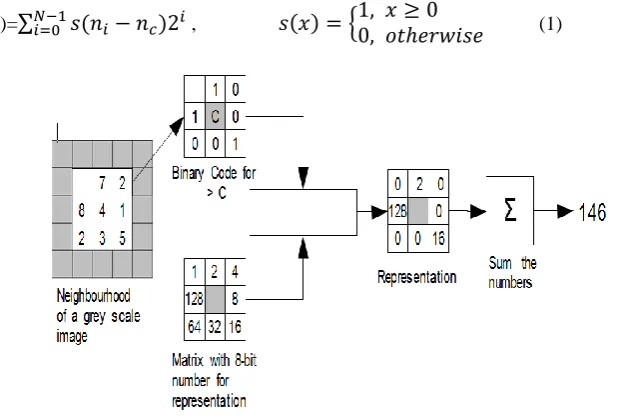
Local features have performed very well in many computer vision applications, such as image retrival, wide baseline matching, object reorganization; texture recognization. Local binary pattern (LBP) operator transforms an image into an array or image of integer labels describing micro-pattern, i.e. Pattern formed by a pixel and its immediate neighbours.
More specifically, LBP encodes the signs of the pixel element variations between a pixel and its neighbouring pixels to a binary code. The bar chart of such codes in an image block is commonly used for any analysis.
LBPR,N (X,Y)=
∑
,
{
(1)
Fig 1: Local Binary Pattern Features for a Neighbourhood of 8 Pixels.
If gray level of the neighbouring pixel is higher or equal, the value is set to one, otherwise zero. The descriptor describes the result over the neighbourhood as a binary number.Although LBP has gained much popularity of its simplicity and robustness to illuminations variations, its sensitivity to noise, the operator produces long histograms limits the performance. Another variation binary rotation invariant and noise tolerant (BRINT) overcome the difficulties of LBP. The construction of the local BRINT descriptor is analogous to the sampling scheme within the original LBP approach whereas computing this descriptor, we tend to sample pixels constituents around a central pixel xc, but on any circle of radius r, we tend to prohibit the quantity of points sampled to be a multiple of eight, so p = 8q for positive integer q. So the neighbours of xc sampled on radius r are xr,8q =[xr,8q,0, . . . , xr,8q,8q−1]T .
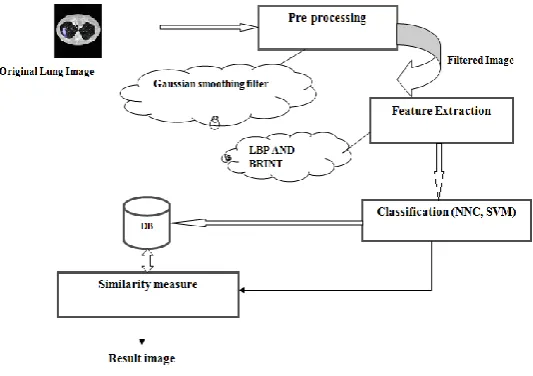
Fig 2: Existing System Architecture
IV. PROPOSED SYSTEM
To describe color and texture jointly OCLBP (Opponent Color Local Binary Pattern) was defined. In OCLBP the operator is employed on every color channel severally, and so for pairs of color channels in order that the center pixel is taken from one channel and the neighboring pixels from the opposite. Opposing pairs like R-G and G-R are extremely redundant, therefore either of them will be used for analysis. Thus LBP operator is applied on each color channel separately and in addition each pair of color channels for collecting opponent color patterns. By using primary colors, the following combinations are
Number of inter-channel LBP histograms=3
Number of intra-channel LBP histograms=6
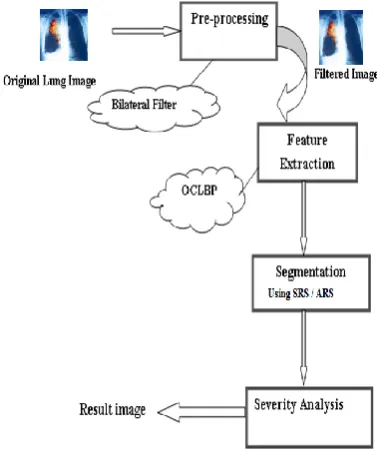
Fig 3: Proposed System Architecture
V. METHODOLOGY
A. Preprocessing
In this module, the amount of carcinoma pictures is collected from any of the health care organization. The carcinoma pictures could also be taken by CT or imaging scan device. Imaging knowledge consists of multiple channels of freelance however geometrically registered medically important knowledge, it analogous to multispectral remote sensing knowledge. A noise reduction procedure is required to enhance the standard of carcinoma pictures, as a result of there are lots of artifacts (e.g. attenuations, speckles, shadow and signal dropout) in carcinoma pictures. Bilateral filter that has been well-tried to be AN economical and effective technique for noise reduction.
B. Feature Extraction Using OCLBP
In this module, the input image was taken. After that, Opponent Color Local Binary Pattern operator accustomed extract the options within the carcinoma image. In OCLBP the operator is employed on every color channel severally, so for pairs of color channels in order that the middle picture element is taken from one channel and also the neighboring pixels from the opposite. Opposing pairs like R-G and G-R are extremely redundant, therefore either of them will be used for analysis therefore LBP operator is applied on every color channel severally and additionally every combine of color channels for assembling opponent color patterns. Based on the comparison OCLBP provides the cancer level of the carcinoma image
.
C. Texture based segmentation
Using the patterns and contrast measure generated using opponent color local binary pattern each texture feature is segmented. This can be then validated using simultaneous registration segmentation (SRS) and Artificial registration segmentation (ARS). Looking on the image domain, we have a tendency to use a special segmentation potential. For CT scan images we have a tendency to use threshold primarily based potential.
Thus SRS is more accurate and less dependent on the registration in comparison to an repititive optimization
D. Severity analysis
VI. RESULTS AND DISCUSSIONS
MATLAB 7.0.1 Software is extensively used for the study of lungs cancer detection from CT scan images. Concerned images obtained in the result are shown in Figure 1.
Fig 4: Original Lungs with Cancer
Fig 4 represent the input image with cancer .Here the image is preprocessed to improve the image Quality.
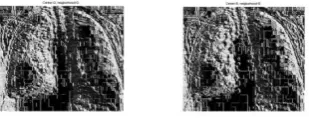
Fig 5: OCLBP texture extractions
Fig 5 extract the texture features using opponent color local binary pattern with 6 combinations of primary colors (R,G,B).
Fig 6: Texture based segmentation
Fig 6 based on patterns extracted textures are mapped to segment the lung
Based on this feature extraction the image is segmented using texture based segmentation methods. These are done based on the Simultaneous registration segmentation (SRS) and Artificial registration segmentation (ARS). This approach improves the efficiency of severity analysis. In severity analysis, whether the cancer level is mild, moderate or severe, is should be identified. This shows the exact level of lung cancer.
REFERENCES
[1] A. Fernández, M. Álvarez, and F. Bianconi, “Texture description through histrograms of equivalent patterns,” J. Math. Imag. Vis., vol. 45, no. 1, pp. 76–102, Jan. 2013.
[2] M. Raja and V. Sadavisam, “Optimized local ternary patterns: A new texture model with set of optimal patterns for texture analysis,” J. Comput.Sci., vol. 9, no. 1, pp. 1–14, 2013.
[3] Jisy Raju, C. Anand Deva Durai, Texture Classification in Iris Using Dominant Neighborhood Structure, International Journal of Advanced Research in Electronics and Communication Engineering (IJARECE) Volume 2, Issue 3, March 2013.
[4] D. Huang, C. Shan, M. Ardabilian, Y. Wang, and L. Chen, “Local binary patterns and its application to facial image analysis: A survey,” IEEETrans. Syst., Man, Cybern. C, Appl. Rev., vol. 41, no. 6, pp. 765– 781, Nov. 2011.
[5] Vinod Kumar, Kanwal Garg, Vijay Kher “Early Diagnosis of Lung Cancer with ANN, FCM and FMNN” International Journal of Advanced Research in Computer Science and Software Engineering 3(12), December - 2013, pp. 378-383.
[6] Nikita Pandey, Sayani Nandy,“ANovel Approach of Cancerous Cells Detection from Lungs CT Scan Images” International Journal of Advanced Research in Computer Science and Software Engineering 2 (8), August- 2012, pp. 316-320.
[7] M. Crosier and L. D. Griffin, “Using basic image features for texture classification”, Int. J. Comput. Vis., vol. 88, no. 3, pp. 447–460, 2010.
[8] B. S. Manjunathi and W. Y. Ma, “Texture features for browsing and retrieval of image data,” IEEETrans. Pattern Anal. Mach. Intell., vol. 18,no. 8, pp. 837–842, Aug. 1996.