Resilient S-boxes
ABSTRACT
Masking schemes represent a well-researched and successful option
to follow when considering side-channel countermeasures. Still,
such measures increase the implementation cost in term of power
consumption, clock cycles, and random numbers generation. In fact,
the higher the order of protection against side-channel adversaries,
the higher the implementation cost of countermeasures. S-boxes
represent the most vulnerable part in an implementation when
con-sidering side-channel adversary. In this paper, we investigate how
to generate S-boxes that have improved resilience against varying
orders of side-channel attacks while minimising the
implementa-tion costs. We examine whether S-boxes generated against a certain
order of attack also represent a good solution when considering
different order of attacks. We demonstrate that we successfully
generated S-boxes resilient against a certain physical attack order
but the improvements are small. As a result, S-boxes that are
re-silient against first order attacks stay rere-silient against higher-order
attacks, which saves computational power during the design of
higher-order side-channel attacks resilient S-boxes.
KEYWORDS
S-box construction, Genetic algorithms, Higher-order side-channel
analysis, Correlation power analysis.
. . Higher Order Side-Channel Attacks Resilient S-boxes. InProceedings of , , ,6 pages. DOI:
1
INTRODUCTION
For decades, designers estimated the security level of a
crypto-graphic algorithm independently of its implementation in a
cryp-tographic device. Since the first publication on implementation
attacks in 1996, the physical attacks have become an active research
area [11]. A side-channel attack (SCA) represents a process that
exploits physical leakages (measured on cryptographic devices) in
order to extract sensitive information (e.g., the key used in a
sym-metric encryption algorithm). The ability to secure devices against
side-channel attacks represents a critical requirement for the
in-dustry due to several publications on real-world physical attacks
against (certified and uncertified) industrial products.
The Internet of Things (IoT) represents an attractive target for
physical attacks (see e.g., Ronen et al. [21]) since the target device
is in the vicinity of the adversary (which facilitates the analysis of
physical properties). The widespread adoption of IoT, its extreme
constraints (in term of area and power consumption) as well as the
hostile environments in which the IoT is manipulated raise the need
,
©. . DOI:
of lightweight countermeasures against side-channel attacks.
Fol-lowing several works on this subject (see for example [4, 8, 10, 20]),
this paper analyses the protection of the nonlinear part (called
S-boxes) of ciphers, which is often targeted by implementation attacks.
More precisely, this paper focuses on lightweight countermeasures
in which the S-boxes (also called(n,m)functions) are intrinsically more resilient against side-channel attacks.
In 2014, Picek et al. generated S-boxes of various sizes providing
improved resistance to physical attacks [16]. They used genetic
programming and genetic algorithms to evolve S-boxes minimising
the transparency order metric that relates to the side-channel
resis-tance of the S-boxes [19]. The main advantage of these approaches
(compared to the exhaustive search) lies in the execution time of the
research: exhaustive search generates 2m·2
n
differentn×nS-boxes ((2n)! if we only consider permutations) while genetic algorithms optimise this search in an automatic way. At the same year, Picek et
al. obtained two S-boxes of sizes 4×4 and 8×8 by exploiting genetic
algorithms optimising the confusion coefficient property, which
represents another metric related to the side-channel resistance of
the S-boxes [18]. One year later, Picek et al. built a 4×4 S-box using
genetic algorithms optimising the improved transparency order
metric [6, 17]. Recently, Lerman et al. provided new S-boxes
min-imising the success probability of actual physical attacks [13]. They
provided 4×4 and 5×5 S-boxes that possess increased resistance
against various real-world attacks exploiting actual leakages.
In this paper, we focus on 4×4 S-boxes since we deem this size
to have the most impact in the future design of lightweight ciphers.
We aim to give an answer to the following question: “Should we
take into account the key-enumeration during the design of S-boxes?”. This approach is of high importance since (as reported in this paper)
the designers of S-boxes can concentrate only on the first order
success probability of side-channel adversaries. Eventually, this
paper highlights that the best S-box (which minimises the success
probability of physical attacks) depends on the physical noise level
in the leakages. This result demonstrates the requirement to select
S-boxes as a function of the cryptographic device executing these
S-boxes, and it confirms the assumption of Lerman et al. [13].
2
BACKGROUND
Letn,mbe positive integers –n,m∈ N+. We denote byFn
2 the
n-dimensional vector space overF2and byF2n the finite field with
2n elements. The set of alln-tuples of elements in the fieldF2is
denoted byFn
2, whereF2is the Galois field with two elements. For
any setS, we denoteS\{0}byS∗. The usual inner product ofaand
bequalsa·b=Lni
=1aibi inF
n
2.
The Hamming weightwH(a)of a vectora, wherea∈Fn
2, is the
number of non-zero positions in the vector. An(n,m)-function is any mappingFfromFn
2toF
m
2. An(n,m)-functionFis defined as a
vectorF =(f1,· · ·,fm), where the Boolean functionsfi :Fn2 →F2
The component functions of an (n,m)-functionF are all the linear combinations of the coordinate functions with non all-zero
coefficients. Since for everyn, there exists a fieldF2n of order 2n,
we can endow the vector spaceFn
2 with the structure of that field.
The addition of elements of the finite fieldF2nis denoted with “+”, as usual in mathematics. Since we often identifyFn
2 withF2n and
when there is no ambiguity, the addition of vectors ofFn
2,n>1 is
denoted with “+” as well.
2.1
S-box Properties and Bounds
An(n,m)-functionFis balanced if it takes every value ofFm
2 the
same number 2n−mof times.
The Walsh-Hadamard transform of an(n,m)-functionFis (see e.g., [2]):
WF(a,v)= X x∈Fm2
(−1)v·F(x)+a·x,a,v∈Fm
2. (1)
ThenonlinearityNFof an(n,m)-functionFequals the minimum nonlinearity of all its component functionsv·F, wherev∈Fm∗
2
[15]:
NF =2n−1− 1
2 max
a∈Fn2 v∈Fm∗2
|WF(a,v)|. (2)
LetF be a function fromFn
2
intoFm
2
witha∈Fn
2
andb ∈Fm
2
.
We denote:
DF(a,b)=(x ∈Fn2 :F(x)+F(x+a)=b )
. (3)
The entry at the position(a,b)corresponds to the cardinality of the difference tableDF(a,b)and is denoted asδ(a,b). Thedifferential uniformityδF is then defined as [14]:
δF =max
a,0,b
δ(a,b). (4)
The nonlinearity of any(n,m)functionFis bounded above by the so-calledcovering radius bound:
NF ≤2n−1−2
n
2−1. (5) There exists a better bound whenm=n– the Sidelnikov-Chabaud-Vaudenay bound [5]:
NF ≤2n−1−2
n−1
2 . (6)
Eq. (6) is an equality if and only ifFis an Almost Bent (AB) function. Functions that have differential uniformity equal to 2 are called
the Almost Perfect Nonlinear (APN) functions. Every AB function is
also APN, but the converse does not hold in general. AB functions
exist only in an odd number of variables, while APN functions
also exist for an even number of variables. When discussing the
differential uniformity for permutations, the best possible (and
known) value is 2 for any oddnand also forn =6. Forneven and larger than 6, this is an open question. To conclude, for 4×4
S-boxes, the best nonlinearity and differential uniformity equals 4.
2.2
Side-Channel Attacks
We assume that the adversary wants to retrieve the secret key used
when the cryptographic device (that executes a known
encryp-tion algorithm) encrypts known plaintexts and provides known
ciphertexts. In order to find the key, the adversary targets a set of
key-related information (called thetarget intermediate values) with
adivide-and-conquer approach. The divide-and-conquer strategy
extracts information on separate parts of the key (e.g., the adversary
extracts each byte of the key independently) and then combines the
results in order to get the full secret key. In the rest of the paper, we
systematically use the term key to denote the target of our attacks,
though in fact, we address one part of the key at a time.
During the execution of the encryption algorithm, the
crypto-graphic device processes a functionF(e.g., the S-box of the block
cipher AES):
F:P × K → Y (7)
y=Fk(p),
that outputs the target intermediate valueyand wherek∈ K is a key-related information (e.g., one byte of the secret key), andp∈ P represents information known by the adversary (e.g., one byte of
the plaintext).
2.2.1 Physical Characteristics.LetjTybe thej-th leakage (also known as trace) measured when the device manipulates the target
valuey. In the following, we represent each leakage with one real value measured when the analysed cryptographic device
manipu-lates the target valuey, i.e.:
jTy =L(y)+jϵy, (8)
=L(Fk(p))+jϵy, (9)
wherejϵy ∈Ris the noise of the tracejTyfollowing for example the Gaussian distribution with zero mean, andLis the
(determinis-tic) leakage function. The functionLcan belinear(e.g., the weighted
sum of each bit of the input value) ornonlinear(e.g., the weighted
sum of products of bits of the input value). Evaluators often model
linear leakage functions as the Hamming weight of the manipulated
valueyfor software implementations.
Aside-channel attackis a process during which an attacker
anal-yses leakages measured on a target device in order to extract
infor-mation on the secret value. Several side-channel attacks exist but
we focus on classical attacks exploiting correlation power analysis
(presented by Coron et al. [7]) since 1) they represent the most
effi-cient attacks when the leakage model fit to the leakage function in
univariate settings [1], and 2) we assume no assumption error and
no estimation error (of the estimation of the leakage function)
lead-ing to the evaluation of the S-boxes with the worst-case (univariate)
side-channel adversaries.
2.2.2 Correlation Power Analysis.Correlation power analysis (CPA) recover the secret key from a cryptographic device by
se-lecting the key that maximises the dependence between the actual
leakage and the estimated leakage based on the assumed secret key.
More precisely, CPA selects the secret keyDksuch that:
D
k∈arg max
k∈K
ρ
D T(k),T
, (10)
wherekxkdenotes the Euclidean norm ofx,ρ(X,Y)represents the Pearson’s correlation between two vectorsXandY, and:
• T =f1T, ...,NaTg
represents a vector ofNaattack traces measured when the target device manipulates the S-box
Resilient S-boxes , ,
• TD(k)= f
DL(F(k⊕p[1]), . . . ,DL(F(k⊕p[Na])
g
refers to a
vec-tor of estimated leakages (with a leakage modelDL) parametrised
with the output of the S-box combining (with the
exclusive-or operation denoted⊕) an estimated keykand known plaintextp[i]associated toiT.
2.2.3 i-th order Success Rate.The designers of cryptographic devices measure the resistance of an implementation against a
physical attack by using (among others) the first order Success
Rate (1oSR) [22]. The first order success rate (also known as the
first order success probability) represents the probability that the
physical attack ranks the actual key in the first position of the list of
keys sorted by the physical attack in decreasing order of likelihood.
Similarly, thei-th order success rate denotes the probability that the physical attack ranks the actual key among theifirst positions of the list of keys. This metric relates to a side-channel adversary applying
key enumeration algorithms (in which the adversary outputs a set
of keys from the most probable one to the least probable one).
3
RESILIENT S-BOXES AGAINST
KEY-ENUMERATION
This section extends the analysis of S-boxes (generated by genetic
algorithms and reported in [13, 16, 17]) by considering side-channel
adversaries exploiting a CPA with a key-enumeration. More
pre-cisely, we aim to verify whether the generated S-boxes, that
min-imise the first order success rate, minmin-imise also a higher order
success rate. We also provide results of newly generated S-boxes
taking into account the key enumeration during their design as
well as the multiplicative complexity of such S-boxes.
3.1
Scenarios under Consideration
3.1.1 Leakages generation. We generated synthetic leakages having 1 points related to the Hamming weight of the S-Box:
jTy=L(y)+jϵy=HW(SBox(p⊕k))+jϵy. (11)
This leakage function models the measurements collected during
the execution of (serial) software implementations (which represent
a realistic scenario in IoT). We assume no estimation/assumption
error, which leads the adversary to consider the Hamming weight
model during the attack:DL(·)=L(·)=HW(·). We estimated the success rate by generating 100 000 sets of attack leakages.
3.1.2 Target functions. We focus on seven 4×4 S-boxes used by Joltik, Klein, Minalpher, Prince, Prøst, Present, and Rectangle.
In the sequel, we refer to these (4×4) S-boxes asunoptimisedS-boxes
since the designers did not optimise these S-boxes with respect to
minimising the success rate of physical attacks.
TheoptimisedS-boxes represent nonlinear functions designed
to minimise the first order success rate of physical attacks and
already published in the side-channel literature. These optimised
4×4 S-boxes are the following: EvolvedCC [18], EvolvedT O[17],
EvolvedSR1, and EvolvedSR2[13]. Table 1 reports all these
(unopti-mised and opti(unopti-mised) S-boxes with their cryptographic properties.
Thenew optimisedS-boxes are nonlinear functions generated with
genetic algorithm by taking into account the key enumeration and
the noise level during the S-box generation. Table 2 provides the
new optimised 4×4.
3.1.3 Search strategy.As a search technique used to generate S-boxes, we use genetic algorithms (GAs) since it represents a method
that is easy to implement while being very efficient as reported
in related work. Genetic algorithms are generic population-based
metaheuristic optimization technique inspired by biological
evolu-tion and phenomena like mutaevolu-tion, recombinaevolu-tion, and selecevolu-tion [9].
Candidate solutions to the optimization problem play the role of
individuals in a population, and the fitness function determines the
quality of the solutions. Evolution of the population takes place
after the repeated application of the above operators. In our
algo-rithm, we encode solutions as lists of values between 0 and 2n−1
wherenis the size of the S-box. Next, we use 3-tournament selec-tion where three soluselec-tions are randomly selected and the worst one
is discarded. The remaining two solutions are used by the crossover
operator (order crossover) to create a new offspring. The order
crossover works by first randomly selecting two crossover points
and copying everything between those two points from the first
parent to the offspring. Then, starting from the second crossover
point in the second parent, the unused numbers are copied in the
order they appear in that parent [9]. Finally, we use the toggle
mutation where we randomly select two values and swap them.
The initial population is created uniformly at random and the
pop-ulation size equals 200 individuals. As a stopping criterion, we use
the number of evaluations without improvement, which we set to
150 generations. In order to obtain S-boxes with as high as possible
nonlinearity and as low as possible differential uniformity, we use
the following expression:
f itnesst=NF +(2n−δF)). (12)
Then, only those solutions that have good enough values of
cryp-tographic properties are further evolved (while retaining those
cryptographic properties) so they have low SCA success
probabil-ity, which gives us the fitness function used in our experiments:
f itness=f itnesst+(1−SR). (13)
We note that for 4×4 S-box size, we consider only S-boxes that
are optimal: bijective, with nonlinearity and differential uniformity
equal to 4 [12].
3.1.4 Multiplicative complexity of S-boxes.Introduced in the context of side-channel attacks by Carletet al., the multiplicative
Complexity (MC) of an S-box is important for its secure
implemen-tation [3]. Here we will refer to the MC of an S-box as the minimum
number ofANDgates (or instructions in case of a software
imple-mentation) that one would need to implement the S-box. MC is
important because the amount of randomness that one needs for
masked implementation grows fast with the number ofAND
opera-tions required for the implementation (i.e., it is easier to mask an
XORoperation compared toAND). We estimate the MC of each S-box
using equivalence classes presented in the work by Turan et al. [23],
where their work gives a way to compute the MC for 4-bit Boolean
functions. The results show that the multiplicative complexity for
our new S-boxes is similar to the previously obtained ones, which
points us that optimising S-boxes for different orders of attack does
not bring a negative impact with respect to the MC.
Finally, in Table 3 we list the equivalence classes where all the
investigated 4×4 S-boxes belong. In total, there are 16 optimal
Size Type Name NF δF MC S-box
4×4
U
Joltik 4 4 6 E,4,B,2,3,8,0,9,1,A,7,F,6,C,5,D
Klein 4 4 8 7,4,A,9,1,F,B,0,C,3,2,6,8,E,D,5
Minalpher 4 4 8 B,3,4,1,2,8,C,F,5,D,E,0,6,9,A,7
Prince 4 4 8 B,F,3,2,A,C,9,1,6,7,8,0,E,5,D,4
Prøst 4 4 6 0,4,8,F,1,5,E,9,2,7,A,C,B,D,6,3
Present 4 4 7 C,5,6,B,9,0,A,D,3,E,F,8,4,7,1,2
Rectangle 4 4 6 6,5,C,A,1,E,7,9,B,0,3,D,8,F,4,2
O
EvolvedCC 4 4 7 6,4,7,8,0,5,2,A,E,3,D,1,C,F,9,B EvolvedT O 4 4 6 2,0,C,6,A,E,F,7,3,1,8,4,9,D,B,5
EvolvedSR1 4 4 8 2,4,8,0,F,B,7,D,6,5,E,3,1,9,C,A
EvolvedSR2 4 4 7 F,E,0,A,1,8,9,B,7,6,4,C,5,2,3,D
Table 1: Properties of S-boxes when considering correlation power analysis. Values of S-boxes are given in hexadecimal for-mat. NotationsOandUrepresent optimised and unoptimised S-boxes with respect to side-channel analysis. The notationNF represents nonlinearity,δF differential uniformity, and MC multiplicative complexity.
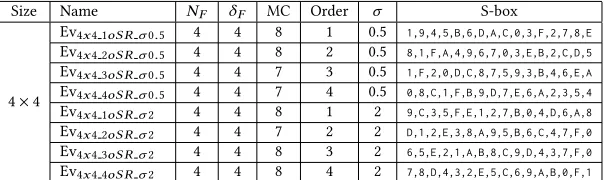
Size Name NF δF MC Order σ S-box
4×4
Ev4x4 1oS R σ0.5 4 4 8 1 0.5 1,9,4,5,B,6,D,A,C,0,3,F,2,7,8,E Ev4x4 2oS R σ0.5 4 4 8 2 0.5 8,1,F,A,4,9,6,7,0,3,E,B,2,C,D,5 Ev4x4 3oS R σ0.5 4 4 7 3 0.5 1,F,2,0,D,C,8,7,5,9,3,B,4,6,E,A Ev4x4 4oS R σ0.5 4 4 7 4 0.5 0,8,C,1,F,B,9,D,7,E,6,A,2,3,5,4 Ev4x4 1oS R σ2 4 4 8 1 2 9,C,3,5,F,E,1,2,7,B,0,4,D,6,A,8 Ev4x4 2oS R σ2 4 4 7 2 2 D,1,2,E,3,8,A,9,5,B,6,C,4,7,F,0 Ev4x4 3oS R σ2 4 4 8 3 2 6,5,E,2,1,A,B,8,C,9,D,4,3,7,F,0 Ev4x4 4oS R σ2 4 4 8 4 2 7,8,D,4,3,2,E,5,C,6,9,A,B,0,F,1
Table 2: Properties of new optimised S-boxes when considering correlation power analysis. The genetic algorithms optimise each S-box as a function of its size, its nonlinearity (NF), differential uniformity (δF), the order of the success rate as well as the standard deviation of the noise in the leakages.
it can be seen that S-boxes optimized in previous works favours
classesG0andG1while our new S-boxes are in classesG13,G14, and
G15. This could indicate that those classes have better side-channel
resilience when considering various orders of attack.
3.2
Impact of the Noise in the Generation of
S-boxes
The first experiment analyses the impact of the noise during the
generation of S-boxes by genetic algorithms. We focus on the first
order success rate of CPA against 4×4 S-boxes. Figure 1 shows the
success probability of CPA as a function of the number of attack
traces in which the standard deviation of the noise equals 0.5, 1,
and 2 (which leads to a signal-to-noise ratio of 4.27, 1.07, and 0.27).
Interestingly, the generated S-boxes optimised by genetic algorithm
for a noise levelxminimise the success rate when the standard deviation of the physical noise in the leakages equalsx. In other words, the noise level in the leakages impacts the selection of the
best boxes, which stresses the usefulness of the selection of
S-boxes as a function of the device executing the S-box operation (as
reported by Lerman et al. [13]).
3.3
New Optimised vs. Optimised vs.
Unoptimised S-boxes
This section compares the unoptimised 4×4 S-boxes with respect to
optimised S-boxes. We focus on the first, second, third, and fourth
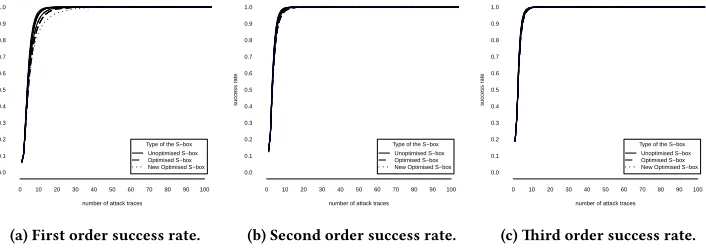
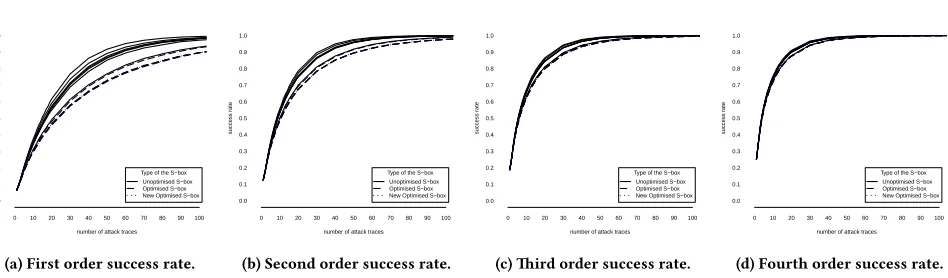
order success rates. Figures 2 and 3 report the results by considering
a standard deviation of the noise equal to 0.5 and 2 (which leads to
a signal-to-noise ratio of 4.27 and 0.27). Interestingly, as already
reported for the masking countermeasures, Figure 2 highlights that
all the (optimised and unoptimised) 4×4 S-boxes provide similar
success rate when the leakages contain a low noise. Figure 3 exhibits
that the generated S-boxes, that minimise the first order success
rate, minimise also a higher order success rate. We can see that
the higher the order of the success rate, the lower the difference
between the optimised and the unoptimised S-boxes.
4
CONCLUSION
Providing side-channel countermeasures represents a complex task
when considering the IoT. The rationale is that the IoT has
ex-treme constraints in terms of area and power consumption. In
this paper, we investigate lightweight side-channel
countermea-sures minimising the implementation costs. More precisely, we
investigate whether the key-enumeration should be considered
when designing side-channel attacks resilient S-boxes. Genetic
Resilient S-boxes , ,
Name Class
EvolvedS R1 G0
Present, Rectangle, EvolvedCC, EvolvedT O, EvolvedS R2 G1
Klein, Minalpher G4
Prøst, Joltik G8
Prince, Ev4x4 1oS R σ2, Ev4x4 3oS R σ2 G13 Ev4x4 1oS R σ0.5, Ev4x4 2oS R σ0.5, Ev4x4 2oS R σ2, Ev4x4 4oS R σ2 G14 Ev4x4 3oS R σ0.5, Ev4x4 4oS R σ0.5 G15
Table 3: Optimal4×4S-boxes and their equivalence classes (classes use the same order as presented by Turan et al. [23]).
0 10 20 30 40 50 60 70 80 90 100 0.0
0.1 0.2 0.3 0.4 0.5 0.6 0.7 0.8 0.9 1.0
number of attack traces
success r
ate
Type of the S−box Optimised for noise 0.5 Optimised for noise 1 Optimised for noise 2
(a)σ=0.5
0 10 20 30 40 50 60 70 80 90 100 0.0
0.1 0.2 0.3 0.4 0.5 0.6 0.7 0.8 0.9 1.0
number of attack traces
success r
ate
Type of the S−box Optimised for noise 0.5 Optimised for noise 1 Optimised for noise 2
(b)σ=1
0 10 20 30 40 50 60 70 80 90 100 0.0
0.1 0.2 0.3 0.4 0.5 0.6 0.7 0.8 0.9 1.0
number of attack traces
success r
ate
Type of the S−box Optimised for noise 0.5 Optimised for noise 1 Optimised for noise 2
(c)σ=2
Figure 1: Success rate of correlation power analysis on4×4S-boxes as a function of the number of attack traces. The standard deviation of the noise equalsσ=1. The S-boxes have nonlinearity equal toNF =4and differential uniformity equal toδF =4. Each S-box was generated by genetic algorithms minimising the first order success rate given a fixed noise level.
0 10 20 30 40 50 60 70 80 90 100 0.0
0.1 0.2 0.3 0.4 0.5 0.6 0.7 0.8 0.9 1.0
number of attack traces
success r
ate
Type of the S−box Unoptimised S−box Optimised S−box New Optimised S−box
(a) First order success rate.
0 10 20 30 40 50 60 70 80 90 100 0.0
0.1 0.2 0.3 0.4 0.5 0.6 0.7 0.8 0.9 1.0
number of attack traces
success r
ate
Type of the S−box Unoptimised S−box Optimised S−box New Optimised S−box
(b) Second order success rate.
0 10 20 30 40 50 60 70 80 90 100 0.0
0.1 0.2 0.3 0.4 0.5 0.6 0.7 0.8 0.9 1.0
number of attack traces
success r
ate
Type of the S−box Unoptimised S−box Optimised S−box New Optimised S−box
(c) Third order success rate.
Figure 2: Success rates (different orders) of correlation power analysis on4×4S-boxes as a function of the number of attack traces. The standard deviation of the noise equalsσ =0.5. The S-boxes have nonlinearity equal toNF = 4and differential uniformity equal toδF =4.
side-channel adversaries while keeping the same power
consump-tion, clock cycles and multiplicative complexity as an unprotected
S-box. The results exhibit that there is no advantage to take into
account the key-enumeration in order to build higher order resilient
S-boxes. In other words, S-boxes minimising the first order
suc-cess rate, minimise also a higher order sucsuc-cess rate. Consequently,
the designers of S-boxes can save computational power by only
focusing on the first order success probability of physical attacks.
Finally, since we recognise several classes for 4×4 size that seem to
be favoured by our search strategy, we plan to conduct additional
experiments where we concentrate only on the S-boxes belonging
to those classes.
REFERENCES
[1] Lejla Batina, Benedikt Gierlichs, Emmanuel Prouff, Matthieu Rivain, Franc ¸ois-Xavier Standaert, and Nicolas Veyrat-Charvillon. 2011. Mutual Information Analysis: a Comprehensive Study. J. Cryptology24, 2 (2011), 269–291. DOI:
http://dx.doi.org/10.1007/s00145- 010- 9084- 8
[2] Claude Carlet. 2010. Vectorial Boolean Functions for Cryptography. InBoolean
0 10 20 30 40 50 60 70 80 90 100 0.0
0.1 0.2 0.3 0.4 0.5 0.6 0.7 0.8 0.9 1.0
number of attack traces
success r
ate
Type of the S−box Unoptimised S−box Optimised S−box New Optimised S−box
(a) First order success rate.
0 10 20 30 40 50 60 70 80 90 100 0.0
0.1 0.2 0.3 0.4 0.5 0.6 0.7 0.8 0.9 1.0
number of attack traces
success r
ate
Type of the S−box Unoptimised S−box Optimised S−box New Optimised S−box
(b) Second order success rate.
0 10 20 30 40 50 60 70 80 90 100 0.0
0.1 0.2 0.3 0.4 0.5 0.6 0.7 0.8 0.9 1.0
number of attack traces
success r
ate
Type of the S−box Unoptimised S−box Optimised S−box New Optimised S−box
(c) Third order success rate.
0 10 20 30 40 50 60 70 80 90 100 0.0
0.1 0.2 0.3 0.4 0.5 0.6 0.7 0.8 0.9 1.0
number of attack traces
success r
ate
Type of the S−box Unoptimised S−box Optimised S−box New Optimised S−box
(d) Fourth order success rate.
Figure 3: Success rate of correlation power analysis on4×4S-boxes as a function of the number of attack traces. The standard deviation of the noise equalsσ=2. The S-boxes have nonlinearity equal toNF =4and differential uniformity equal toδF =4.
[3] Claude Carlet, Louis Goubin, Emmanuel Prouff,Micha¨el Quisquater,and Matthieu Rivain. 2012. Higher-Order Masking Schemes for S-Boxes. InFast
Software Encryption - 19th International Workshop, FSE 2012, Washington, DC, USA, March 19-21, 2012. Revised Selected Papers (Lecture Notes in Computer Sci-ence), Anne Canteaut (Ed.), Vol. 7549. Springer, 366–384.DOI:http://dx.doi.org/ 10.1007/978- 3- 642- 34047- 5 21
[4] Claude Carlet, Emmanuel Prouff, Matthieu Rivain, and Thomas Roche. 2015. Algebraic Decomposition for Probing Security. InAdvances in Cryptology
-CRYPTO 2015 - 35th Annual Cryptology Conference, Santa Barbara, CA, USA, August 16-20, 2015, Proceedings, Part I (Lecture Notes in Computer Science), Rosario Gennaro and Matthew Robshaw (Eds.), Vol. 9215. Springer, 742–763. DOI:
http://dx.doi.org/10.1007/978- 3- 662- 47989- 6 36
[5] Florent Chabaud and Serge Vaudenay. 1995. Links between differential and linear cryptanalysis. InAdvances in Cryptology — EUROCRYPT’94: Workshop on
the Theory and Application of Cryptographic Techniques Perugia, Italy, May 9–12, 1994 Proceedings, Alfredo De Santis (Ed.). Springer Berlin Heidelberg, Berlin, Heidelberg, 356–365.
[6] Kaushik Chakraborty, Sumanta Sarkar, Subhamoy Maitra, Bodhisatwa Mazum-dar, Debdeep Mukhopadhyay, and Emmanuel Prouff. 2017. Redefining the transparency order. Des. Codes Cryptography82, 1-2 (2017), 95–115. DOI:
http://dx.doi.org/10.1007/s10623- 016- 0250- 3
[7] Jean-S ´ebastien Coron, Paul C. Kocher, and David Naccache. 2000. Statistics and Secret Leakage. InFinancial Cryptography, 4th International Conference,
FC 2000 Anguilla, British West Indies, February 20-24, 2000, Proceedings (Lecture Notes in Computer Science), Yair Frankel (Ed.), Vol. 1962. Springer, 157–173.DOI:
http://dx.doi.org/10.1007/3- 540- 45472- 1 12
[8] Jean-S ´ebastien Coron,Arnab Roy,and Srinivas Vivek. 2015. Fast evalua-tion of polynomials over binary finite fields and applicaevalua-tion to side-channel countermeasures. J. Cryptographic Engineering5,2 (2015), 73–83. DOI:
http://dx.doi.org/10.1007/s13389- 015- 0099- 9
[9] A. E. Eiben and J. E. Smith. 2003.Introduction to Evolutionary Computing. Springer-Verlag, Berlin Heidelberg New York, USA.
[10] Vincent Grosso, Emmanuel Prouff, and Franc¸ois-Xavier Standaert. 2014. Effi-cient Masked S-Boxes Processing - A Step Forward -. InProgress in Cryptology
-AFRICACRYPT 2014 - 7th International Conference on Cryptology in Africa, Mar-rakesh, Morocco, May 28-30, 2014. Proceedings (Lecture Notes in Computer Science), David Pointcheval and Damien Vergnaud (Eds.), Vol. 8469. Springer, 251–266.
DOI:http://dx.doi.org/10.1007/978- 3- 319- 06734- 6 16
[11] Paul C. Kocher. 1996. Timing Attacks on Implementations of Diffie-Hellman, RSA, DSS, and Other Systems. InAdvances in Cryptology - CRYPTO ’96, 16th Annual
International Cryptology Conference, Santa Barbara, California, USA, August 18-22, 1996, Proceedings (Lecture Notes in Computer Science), Neal Koblitz (Ed.), Vol. 1109. Springer, 104–113. DOI:http://dx.doi.org/10.1007/3- 540- 68697- 5 9
[12] G. Leander and A. Poschmann. 2007. On the Classification of 4 Bit S-Boxes. In
Arithmetic of Finite Fields, Claude Carlet and Berk Sunar (Eds.). Lecture Notes in Computer Science, Vol. 4547. Springer Berlin Heidelberg, 159–176.
[13] Liran Lerman, Nikita Veshchikov, Stjepan Picek, and Olivier Markowitch. 2017. On the Construction of Side-Channel Attack Resilient S-boxes. InConstructive
Side-Channel Analysis and Secure Design - 8th International Workshop, COSADE 2017, Paris, France, April 13-14, 2017, Revised Selected Papers (Lecture Notes in Computer Science), Sylvain Guilley (Ed.), Vol. 10348. Springer, 102–119. DOI:
http://dx.doi.org/10.1007/978- 3- 319- 64647- 3 7
[14] Kaisa Nyberg. 1991. Perfect Nonlinear S-Boxes. InAdvances in Cryptology -
EURO-CRYPT ’91, Workshop on the Theory and Application of of Cryptographic Techniques, Brighton, UK, April 8-11, 1991, Proceedings (Lecture Notes in Computer Science), Vol. 547. Springer, 378–386.DOI:http://dx.doi.org/10.1007/3- 540- 46416- 6 32 [15] Kaisa Nyberg. 1993. On the construction of highly nonlinear permutations. In
Advances in Cryptology - EUROCRYPT’ 92, RainerA. Rueppel (Ed.). Lecture Notes in Computer Science, Vol. 658. Springer Berlin Heidelberg, 92–98.
[16] Stjepan Picek, Lejla Batina, and Domagoj Jakobovic. 2014. Evolving DPA-Resistant Boolean Functions. InParallel Problem Solving from Nature - PPSN
XIII - 13th International Conference, Ljubljana, Slovenia, September 13-17, 2014. Proceedings (Lecture Notes in Computer Science), Thomas Bartz-Beielstein, J ¨urgen Branke, Bogdan Filipic, and Jim Smith (Eds.), Vol. 8672. Springer, 812–821.DOI:
http://dx.doi.org/10.1007/978- 3- 319- 10762- 2 80
[17] Stjepan Picek, Bodhisatwa Mazumdar, Debdeep Mukhopadhyay, and Lejla Batina. 2015. Modified Transparency Order Property: Solution or Just Another Attempt. InSecurity, Privacy, and Applied Cryptography Engineering - 5th International
Conference, SPACE 2015, Jaipur, India, 2015, Proceedings (Lecture Notes in Computer Science), Rajat Subhra Chakraborty, Peter Schwabe, and Jon A. Solworth (Eds.), Vol. 9354. Springer, 210–227. DOI:http://dx.doi.org/10.1007/978- 3- 319- 24126- 5 13
[18] Stjepan Picek, Kostas Papagiannopoulos, Baris Ege, Lejla Batina, and Domagoj Jakobovic. 2014. Confused by Confusion: Systematic Evaluation of DPA Resis-tance of Various S-boxes. InProgress in Cryptology - INDOCRYPT 2014 - 15th
International Conference on Cryptology in India, New Delhi, India, December 14-17, 2014, Proceedings (Lecture Notes in Computer Science), Willi Meier and Debdeep Mukhopadhyay (Eds.), Vol. 8885. Springer, 374–390.
[19] Emmanuel Prouff. 2005. DPA Attacks and S-Boxes. InFast Software Encryption:
12th International Workshop, FSE 2005, Paris, France, February 21-23, 2005, Revised Selected Papers (Lecture Notes in Computer Science), Henri Gilbert and Helena Handschuh (Eds.), Vol. 3557. Springer, 424–441.DOI:http://dx.doi.org/10.1007/ 11502760 29
[20] J ¨urgen Pulkus and Srinivas Vivek. 2016. Reducing the Number of Non-linear Multiplications in Masking Schemes. InCryptographic Hardware and Embedded
Systems - CHES 2016 - 18th International Conference, Santa Barbara, CA, USA, August 17-19, 2016, Proceedings (Lecture Notes in Computer Science), Benedikt Gierlichs and Axel Y. Poschmann (Eds.), Vol. 9813. Springer, 479–497. DOI:
http://dx.doi.org/10.1007/978- 3- 662- 53140- 2 23
[21] Eyal Ronen, Adi Shamir, Achi-Or Weingarten, and Colin O’Flynn. 2017. IoT Goes Nuclear: Creating a ZigBee Chain Reaction. In2017 IEEE Symposium on Security
and Privacy, SP 2017, San Jose, CA, USA, May 22-26, 2017. IEEE Computer Society, 195–212. DOI:http://dx.doi.org/10.1109/SP.2017.14
[22] Franc¸ois-Xavier Standaert, Tal Malkin, and Moti Yung. 2009. A Unified Frame-work for the Analysis of Side-Channel Key Recovery Attacks. InAdvances in
Cryptology - EUROCRYPT 2009, 28th Annual International Conference on the Theory and Applications of Cryptographic Techniques, Cologne, Germany, April 26-30, 2009. Proceedings (Lecture Notes in Computer Science), Antoine Joux (Ed.), Vol. 5479. Springer, 443–461.DOI:http://dx.doi.org/10.1007/978- 3- 642- 01001- 9 26 [23] Meltem S ¨onmez Turan and Ren ´e Peralta. 2014. The Multiplicative Complexity
of Boolean Functions on Four and Five Variables. InLightweight Cryptography
for Security and Privacy - Third International Workshop, LightSec 2014, Istanbul, Turkey, September 1-2, 2014, Revised Selected Papers (Lecture Notes in Computer Science), Thomas Eisenbarth and Erdinc¸ ¨Ozt ¨urk (Eds.), Vol. 8898. Springer, 21–33.