Non-adaptive Group-Testing Aggregate MAC
Scheme
Shoichi Hirose1 and Junji Shikata2 1
University of Fukui, Japan 2
Yokohama National University, Japan
Abstract. This paper applies non-adaptive group testing to aggregate message authentication code (MAC) and introduces non-adaptive group-testing aggregate MAC. After formalization of its syntax and security requirements, simple and generic construction is presented, which can be applied to any aggregate MAC scheme formalized by Katz and Lin-dell in 2008. Then, two instantioations of the construction is presented. One is based on the aggregate MAC scheme by Katz and Lindell and uses addition for tag aggregate. The other uses cryptographic hashing for tag aggregate. Provable security of the generic construction and two instantiations are also discussed.
Keywords: Message authentication·Aggregate·Group testing· Prov-able security
1
Introduction
Background. A message authentication code (MAC) is a tag attached to a mes-sage to detect tampering of the mesmes-sage. The tag is computed with a crypto-graphic symmetric key primitive called a MAC function such as HMAC [1, 5] and CMAC [8, 13].
An aggregate MAC scheme allows one to aggregate multiple tags to multiple messages into a shorter tag. It is possible to verify the validity of the multiple messages only with the single tag. It is impossible in general, however, to identify invalid messages once the multiple messages are judged invalid with respect to the single tag.
It is expected that the problem above can be solved with group testing [3]. Group testing is a method to be able to verify if each sample is negative or positive with a smaller number of tests than a naive method to test each sample infividually on the assumption that the number of positive samples is at most a constant. In group testing, each test involves a subset of the given samples. The result of a test is negative if and only if all the involved samples are negative. The group testing is called adaptive if one can choose samples to be tested after one sees the result of the previous test and is called non-adaptive otherwise.
First, GTA MAC and its security requirements are formalized. The security requirements are unforgeability and identifiability. Unforgeability means that a message is judged invalid by the group testing if the tag to the message is not generated by a legitimate user. Identifiability is composed of completeness and soundness. Completeness captures the notion that a group-testing for pairs of a message and a tag should judge a pair valid if it is valid. Soundness captures the notion that a group-testing should judge a pair invalid if it is invalid. Then, simple and generic construction of a GTA MAC scheme is presented. It can be applied to any aggregate MAC scheme formalized by Katz and Lindell [9]. The generic construction produces a GTA MAC scheme satisfying unforgeability and completeness from any unforgeable aggregate MAC scheme. Finally, two instan-tiations are presented: One is from the Katz-Lindell aggregate MAC scheme [9] and the other is from an aggregate MAC scheme using hashing for aggregate. The former does not satisfy soundness. The latter is shown to satisfy soundness if the underlying hash function is a random oracle.
Related Work. Aggregate MAC and its security requirement were first formalized by Katz and Lindell [9]. They also proposed an aggregate MAC scheme and proved its security on the assumption that the underlying MAC function is unforgeable. Their scheme aggregates tags by their addition. The formalization of GTA MAC in the paper is based on that of aggregate MAC by Katz and Lindell.
Sequential aggregate MAC and its security requirement were formalized by Eikemeier et al. [4]. They also presented a provably secure sequential aggregate MAC scheme. Forward-secure sequential aggregate MAC was introduced by Ma and Tsudik [10]. It was also discussed by Ma and Tsudik [11] and Hirose and Kuwakado [7]. A typical application of the forward-secure sequential aggregate MAC is secure audit log.
The group testing was already applied to MAC schemes by Goodrich et al. [6] and Minematsu [12]. The major difference between their approach and ours is that their schemes do not, precisely speaking, aggregate tags for messages. Their schemes compute a tag of a subset of messages for each test in group testing. Minematsu [12] proposed a scheme based on PMAC [2, 14] aiming at reduction of amount of computation required to compute tags for group testing.
2
Preliminaries
2.1 Notations
Selecting an elementsuniformly at random from a set S is denoted bysS. For{0,1}-sequencesxandy,xky represents their concatenation.
Letv= (v1, v2, . . . , vn) andw = (w1, w2, . . . , wn) be vectors such that vi ∈
{0,1} and wi ∈ {0,1}l for 1≤i ≤n. Letx = (x1, x2, . . . , xn)∈Xn for some setX.hv,wirepresents inner product ofv andw, that is, hv,wi=Lni=1viwi. Lethhv,wii=wi1kwi2k · · · kwid, and v x= (xi1, xi2, . . . , xid), where 1≤i1<
i2<· · ·< id ≤n, andvi= 1 ifi∈ {i1, i2, . . . , id} andvi= 0 otherwise.
For vectorsv = (v1, v2, . . . , vn) andv0 = (v01, v20, . . . , vn0) in{0,1}n,vv0 if
vi ≤v0ifor 1≤i≤n.
2.2 MAC Functions
A MAC function is defined to be a keyed functionf :K × M → T, whereK is its key space, M is its messsage space, and T is its tag space.f(K,·) is often denoted byfK(·). The security requirement for a MAC function is unforgeability. LetAbe an adversary againstf.Ais given access to the tagging oraclefK and the corresponding verification oracleVK, whereKK. The tagging oraclefK returnsfK(M) in reply to a queryM ∈ M. The verification oracleVK, in reply to a query (M, T) ∈ M × T, returns >if fK(M) = T and ⊥ otherwise. It is assumed thatAdoes not make a query on (M, T)∈ M × T once it getsT from
fK as a reply to its query M. LetForge(A) represent an event thatAsucceeds in making a query to whichVK returns>. The mac-advantage ofAagainstf is defined as
Advmacf (A),Pr [Forge(A)] .
2.3 Non-adaptive Group Testing
A non-adaptive group-testing algorithm withnsamples andutests can be rep-resented by a u×n {0,1}-matrix, which is called a group-testing matrix. For 1 ≤i ≤uand 1 ≤j ≤n, the i-th test involves the j-th sample if and only if the (i, j)-th element of the corresponding group-testing matrix equals 1. Each sample is either positive or negative. It is assumed that the result of a test is neg-ative if all the samples involved in the test are negneg-ative and positive otherwise. All of the positive samples can be detected by the following simple procedure:
1. J← {1,2, . . . , n}, where j∈ {1,2, . . . , n} represents thej-th sample. 2. For 1 ≤ i ≤ u, if the result of the i-th test is negative, then J ← J \
{ji,1, ji,2, . . . , ji,wi}, where{ji,1, ji,2, . . . , ji,wi}are all of the samples involved
in thei-th test. 3. Output J.
Definition 1 (d-disjunct).A{0,1}-matrixGis said to bed-disjunct if, anyd
columns ofGdo not cover any other column ofG. Here,dcolumnsgc j1,g
c j2, . . . ,g
c jd
are said to cover a column gc if gc gc j1 ∨g
c
j2 ∨ · · · ∨g
c
jd, where ∨ is the
component-wise disjunction.
d-disjunct matrices are useful for group testing. If the group testing matrix isd-disjunct and at mostdof nsamples are positive, then the setJ computed by the procedure above does not contain any negative samples.
3
Aggregate MAC
3.1 Syntax
An aggregate MAC scheme is composed of the following algorithms:
Key generation k←KG(1p).
This algorithm takes as input a security parameterpand produces a secret keyk.
Tagging t←Tag(kid,id, m).
This algorithm takes as input a pair of an ID and a message (id,m) and a secret keykid corresponding toid, and produces as output a tagt.
Aggregate T ←Agg((id1, m1, t1), . . . ,(idn, mn, tn)).
This algorithm takes tuples of an ID, a message, and a tag (idi, mi, ti)’s as input and produces an aggregate tagT as output. Notice that it is not given secret keys used by the tagging algorithmTag.
Verification d←Ver((k1, . . . , kn),((id1, m1), . . . ,(idn, mn)),T).
This algorithm takes pairs of an ID and a message (idi, mi)’s and an ag-gregate tag T as input and checks their validity with respect to the keys corresponding to the given IDs. Here, ki is a key corresponding to idi for 1 ≤ i ≤ n. The decision d is either > or ⊥. If d = >, the pair ((id1, m1), . . . ,(idn, mn)) andT are judged as valid with respect to (k1, . . . ,
kn). Othewise, they are judged invalid.
For (id1, m1), . . . ,(idn, mn) andT, iftj=Tag(kj,idj, mj) for 1≤j≤nand
T = Agg((id1, m1, t1), . . . ,(idn, mn, tn)), then Ver((k1, . . . , kn),((id1, m1), . . . , (idn, mn)),T) =>.
3.2 Security Requirement
The security requirement of an aggregate MAC schemeAM,(KG,Tag,Agg,Ver) is unforgeability. An adversary against AM is given access to the oracles listed below:
Tagging The tagging oracleT G receives a pair of ID and a message (id,m) as a query and returns a tagt, wheret ←Tag(kid,id, m).
Verification The verification oracleVRreceives (((id1, m1), . . . ,(idn, mn)),T) as a query and returnsd, where
d←Ver((k1, . . . , kn),((id1, m1), . . . ,(idn, mn)), T) .
Definition 2 (Unforgeability). Let A be an adversary against an aggregate MAC scheme AM. A is given access to T G,KD,VR, and is allowed to make multiple queries adaptively to each of them. Let Forge(A) be an event that A succeeds in asking VR a query(((id1, m1), . . . ,(idn, mn)), T) satisfying the
fol-lowing conditions:
– Ver((k1, . . . , kn),((id1, m1), . . . ,(idn, mn)), T) =>
– Before asking (((id1, m1), . . . ,(idn, mn)), T), for some 1 ≤ j ≤ n, A asks
neither(idj, mj) toT G nor idj toKD.
Then, the advantage of A againstAMwith respect to unforgeability is defined as
AdvufAM(A),Pr[Forge(A)] .
An aggregate MAC schemeAMis informally said to satisfy unforgeability if AdvufAM(A) is negligibly small for any adversaryAwith realistic computational resources.
3.3 Katz-Lindell Aggregate MAC Scheme
An aggregate MAC scheme proposed by Katz and Lindell [9] is described in this section. Here, their scheme is calledKL-AM.
Scheme. LetF :K × M → T be a MAC function.
– The key generation algorithm just picks up a secret key uniformly at random fromKfor each user.
– For an input (id,m), the tagging algorithm returnst,F(kid,m).
– For an input ((id1,m1,t1), . . . ,(idn,mn,tn)), the aggregate algorithm re-turnsT =t1⊕t2⊕ · · · ⊕tn.
– For an input (((id1,m1), . . . ,(idn,mn)),T), the verification algorithm re-turnsdsuch that
d= (
> ifT =F(k1, m1)⊕ · · · ⊕F(kn, mn),
⊥ otherwise.
Theorem 1 (Unforgeability). For the Katz-Lindell aggregate MAC scheme
KL-AM, let ` be the number of the users. For any adversary A against KL-AM
running in time at most s, making at mostqt queries to its tagging oracle, and
making at mostqv queries to its verification oracle, there exists some adversary
B againstF such that
AdvufKL-AM(A)≤`·Adv mac F (B) ,
where B runs in time at most s+SF(qt+`qv), making at most qt queries to
its tagging oracle, and making at most qv queries to its verification oracle. SF
is time required to compute F.
Proof. The adversary B attacks F by making use of an adversary A against
KL-AM.B has oracle access to the tagging oracleFK and the verification oracle
VK, where KK.
Bfirst picks up a useridruniformly at random among`users.Balso selects a secret key uniformly at random from K for each of the other (`−1) users. Then,B runs A.
For a tagging query on the user idr made by A, B transfers it to FK and returns the reply from FK to A. For a tagging query on a user other than idr made by A, B computes the tag using the corresponding secret key chosen by itself and returns it to A. If A makes a key-disclosure query on a user other thanidr, thenB simply returns the corresponding secret key to A. If Amakes a key-disclosure query onidr, thenB aborts.
Suppose thatAsucceeds in forgery. Then,Amakes a verification query such that the verification oracle returns > in reply to it and, for some (id0, m0)
in-cluded in it, A asks neither (id0, m0) to the tagging oracle nor id0 to the key-disclosure oracle prior to it. Let Hit be the event such that id0 = idr. The conditional probability that Hit occurs when A succeeds in forgery is at least 1/`.
Suppose that A succeeds in forgery and that Hit occurs. For a verification query fromAnot related toidr,B verifies it by itself and returns the result. For a verification query fromAincluding (idr,mr),Bcomputes a tagtrfor (idr,mr) from the query and the secret keys of the other users and asks (mr,tr) to its verification query. Then, B makes at most qv queries to its verification oracle, which returns >for at least one of them. Thus,
Pr[Forge(B)] = Pr[Forge(A)∩Hit]
= Pr[Hit|Forge(A)] Pr[Forge(A)]
≥1
`Pr[Forge(A)]
4
Group-Testing Aggregate MAC
4.1 Syntax
A group-testing aggregate MAC (GTA MAC) scheme consists of the following algorithms:
Key generation k←KG(1p).
This algorithm takes as input a security parameterpand produces a secret keyk.
Tagging t←Tag(kid,id, m).
This algorithm takes as input a pair of an ID and a message (id,m) and a secret keykid corresponding toid, and produces as output a tagt.
Group-testing aggregate This algorithmGTA takes tuples of an ID, a mes-sage, and a tag (idj, mj, tj)’s as input and produces a tuple of aggregate tags
T1, . . . ,Tu as output:
(T1, . . . , Tu)←GTA((id1, m1, t1), . . . ,(idn, mn, tn)) . Notice that it is not given secret keys used by the tagging algorithm. Group-testing verification This algorithm GTV takes pairs of an ID and a
message (idj, mj)’s and a tuple of aggregate tagsTi’s as input and tries to identify invalid pairs of an ID and a message using the corresponding keys:
J ←GTV((k1, . . . , kn),((id1, m1), . . . ,(idn, mn)),(T1, . . . , Tu)) . The output J of this algorithm is a set of (idj0, mj0)’s which are judged
invalid.
For ((id1, m1), . . . ,(idn, mn)) and (T1, . . . ,Tu), if tj = Tag(kj,idj, mj) for 1 ≤ j ≤ n and (T1, . . . , Tu) = GTA((id1, m1, t1), . . . ,(idn, mn, tn)), then
GTV((k1, . . . , kn),((id1, m1), . . . ,(idn, mn)),(T1, . . . , Tu)) =∅.
4.2 Security Requirement
The security requirements of a GTA MAC schemeGTAM,(KG,Tag,GTA,GTV) are unforgeability and identifiability. An adversary againstGTAMis given access to the oracles listed below:
Tagging This oracleT Greceives a pair of ID and a message (id,m) as a query and returns a tagt←Tag(kid,id, m), wherekid is the secret key of the user
id.
Key disclosure This oracleKD receives an ID id as a query and returns the corresponding secret keykid.
Group-testing verification Given ((id1,m1), . . . ,(idn,mn)),(T1, . . . ,Tu)) as a query, this oracleGT V returns
Unforgeability. Let A be an adversary against a GTA MAC scheme GTAM. A
is given access to the oracles T G, KD, GT V, and is allowed to make multiple queries adaptively to each of them. LetGTForge(A) be an event thatAsucceeds in asking GT V a query (((id1,m1), . . . ,(idn,mn)),(T1, . . . ,Tu)) satisfying the following conditions: There exists some 1≤j≤nsuch that
– (idj,mj)6∈GTV((k1, . . . , kn),((id1,m1), . . . ,(idn,mn)),(T1, . . . ,Tu)), – Before asking (((id1,m1), . . . ,(idn,mn)),(T1, . . . ,Tu)),Aasks neither (idj,
mj) toT G noridj to KD.
Then, the advantage ofAagainstGTAMwith respect to unforgeability is defined as
AdvufGTAM(A),Pr[GTForge(A)] .
GTAMis informally said to satisfy unforgeability if AdvufGTAM(A) is negligibly small for any adversaryAwith realistic computational resources.
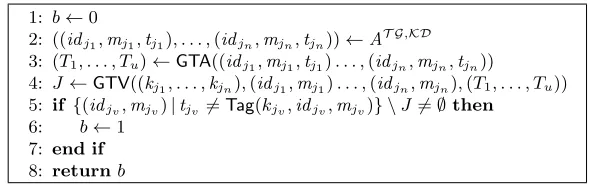
Identifiability. For identifiability, completeness and soundness are introduced. Let A be an adversary for identifiability. Let us consider the experiments pre-sented in Fig. 1 and in Fig. 2 for completeness and soundness, respectively. Steps from 1 to 4 are identical in both of the experiments. The adversary Ais given access to the tagging oracleT Gand the key-disclosure oracleKD. Then,A out-puts tuples ((idj1,mj1,tj1), . . . ,(idjn,mjn,tjn)), and the group testing is applied
to them. Completeness requires that any valid tuple (idjv,mjv,tjv) is judged
valid by the group testing. On the other hand, soundness requires that any in-valid tuple is judged inin-valid. The advantage ofAagainstGTAMwith respect to completeness and soundness is defined as
Advid-cGTAM(A),Pr
Expid-cGTAM(A) = 1
,
and
Advid-sGTAM(A),Pr
Expid-sGTAM(A) = 1
,
respectively.
1: b←0
2: ((idj1,mj1,tj1), . . . ,(idjn,mjn,tjn))←A
T G,KD
3: (T1, . . . , Tu)←GTA((idj1,mj1,tj1). . . ,(idjn,mjn,tjn))
4: J←GTV((kj1, . . . ,kjn),(idj1,mj1). . . ,(idjn,mjn),(T1, . . . , Tu))
5: if J∩ {(idjv,mjv)|tjv =Tag(kjv,idjv,mjv)} 6=∅then
6: b←1 7: end if 8: returnb
1: b←0
2: ((idj1,mj1,tj1), . . . ,(idjn,mjn,tjn))←A
T G,KD
3: (T1, . . . , Tu)←GTA((idj1,mj1,tj1). . . ,(idjn,mjn,tjn))
4: J←GTV((kj1, . . . ,kjn),(idj1,mj1). . . ,(idjn,mjn),(T1, . . . , Tu)) 5: if {(idjv,mjv)|tjv 6=Tag(kjv,idjv,mjv)} \J6=∅then
6: b←1 7: end if 8: returnb
Fig. 2: ExperimentExpid-sGTAM(A)
5
Generic Construction of GTA MAC Scheme
This section first presents generic construction of a GTA MAC scheme from an aggregate MAC scheme and a group-testing matrix. Then, it discusses the security of the GTA MAC scheme.
5.1 Generic Construction
LetAM= (KG,Tag,Agg,Ver) be an aggregate MAC scheme. Let Gbe a u×n
group-testing matrix, where G = (gi,j) for 1 ≤ i ≤ u and 1 ≤ j ≤ n and gi = (gi,1, . . . , gi,n)∈ {0,1}n is the i-th row of Gfor 1≤i≤u. A GTA MAC scheme GTAMg = (KGg,Tagg,GTAg,GTVg) is constructed from AM and G as follows:
– KGg,KG. – Tagg,Tag.
– (T1, . . . , Tu)←GTAg((id1, m1, t1), . . . ,(idn, mn, tn)). where, for 1≤i≤u,
Ti←Agg(gi ((id1, m1, t1), . . . ,(idn, mn, tn))).
– J←GTVg((k1, . . . , kn),((id1, m1), . . . ,(idn, mn)),(T1, . . . , Tu)), where 1. J ← {(id1,m1), . . . ,(idn,mn)}.
2. For 1≤i≤u, if
Ver(gi (k1, . . . , kn),gi ((id1, m1, t1), . . . ,(idn, mn, tn)),Ti) => , then
J ←J\ {(idj,mj)|1≤j≤n∧gi,j = 1} .
5.2 Unforgeability
The following theorem says that generic construction produces an unforgeable GTA MAC scheme from any unforgeable aggregate MAC scheme.
Theorem 2. For the GTA MAC scheme GTAMg, let ` be the number of the
at most qt queries to its tagging oracle, making at most qk queries to its
key-disclosure oracle, and making at mostqv queries to its group-testing verification
oracle, there exists some adversary B against AMwith `users such that
AdvufGTAM
g(A)≤Adv
uf AM(B) ,
where B runs in time at mosts, making at mostqtqueries to its tagging oracle,
making at mostqk queries to its key-disclosure oracle, and making at most u qv
queries to its verification oracle.
Proof. The adversaryB againstAMtries forgery by making use of the adversary
AagainstGTAMg.B has oracle access to the tagging oracle, the key-disclosure oracle, and the verification oracle.
Bsimply runsA. For a tagging query made byA,Btransfers it to its tagging oracle and returns the reply toA. For a key-disclosure query made byA,B also transfers it to its key-disclosure oracle and returns the reply toA. For a group-testing verification query made by A, B executes GTVg using its verification oracleutimes.
Suppose thatA succeeds in forgery and (((id1,m1), . . . ,(idn,mn)),(T1, . . . ,
Tu)) is a successful forgery. Then, there exists some 1≤j≤nsuch that
– (idj,mj)6∈GTVg((k1, . . . , kn),((id1,m1), . . . ,(idn,mn)),(T1, . . . ,Tu)), and – Before asking ((id1,m1), . . . ,(idn,mn)),(T1, . . . ,Tu)), A asks neither (idj,
mj) to its tagging oracle noridj to its key-disclosure oracle.
It implies that there exists some 1 ≤ i ≤ u such that the i-th test involves (idj,mj) and passes the verification. Thus, the i-th test is a successful query
made byB to its verification oracle. ut
5.3 Identifiability
An adversaryAis said to bed-dishonest ifAoutputs ((id1,m1,t1), . . . ,(idn,mn,
tn)) such that|{(idj,mj)|tj6=Tagg(kj,idj,mj)}| ≤dinExpid-cGTAMg orExp
id-s GTAMg.
Completeness. The theorem below says that the GTA MAC schemeGTAMg sat-isfies completeness against anyd-dishonest adversary if the group-testing matrix isd-disjunct.
Theorem 3 (Completeness). For the GTA MAC scheme GTAMg, suppose
that the group-testing matrixG is d-disjunct. Then, for any d-dishonest adver-sary A,
Advid-cGTAMg(A) = 0 .
Proof. LetAbe anyd-dishonest adversary. Suppose thatAoutputs ((id1,m1,t1),
. . . ,(idn,mn,tn)) inExpid-cGTAMg(A) and letV ={(idj,mj)|tj =Tagg(kj,idj,mj)}.
Since the group-testing matrix G is d-disjuct and A is d-dishonest, for any (id,m)∈V, there exists some test inGinvolving (id,m) and no invalid pairs. Thus,V ∩J =∅, whereJ is the set computed inExpid-cGTAM
Soundness. The GTA MAC scheme GTAMg may not satisfy soundness. It de-pends on how to aggregate tags.
Let us consider the following adversary ˜Ain Expid-sGTAM
g. ˜Afirst obtains valid
(idj,mj,tj) such thattj=Tagg(kj,idj,mj) using its tagging oracle for 1≤j≤
n. Let Ti =Agg(gi ((id1, m1, t1), . . . ,(idn, mn, tn))) for 1 ≤i ≤ u. Suppose that ˜Asucceeds in finding ((id1, m1,˜t1), . . . ,(idn, mn,˜tn))) such that, for some
i∗,gi∗ ((id1, m1,t˜1), . . . ,(idn, mn,t˜n))6=gi∗ ((id1, m1, t1), . . . ,(idn, mn, tn))
andTi∗ =Agg(gi∗ ((id1, m1,t˜1), . . . ,(idn, mn,˜tn))). Then, the result of thei∗
-th test gi∗ is valid, and there exists some j∗ such that ˜tj∗ 6=Tag(kj∗,idj∗,mj∗)
and (idj∗,mj∗)6∈J.
6
GTA MAC Scheme Based on Katz-Lindell Aggregate
MAC
From the generic construction, it is straightforward to obtain a GTA MAC sheme based on the Katz-Lindell aggregate MAC scheme. Let us call itGTAMX.
GTAMX is unforgeable if the underlying MAC function is unforgeable. For identifiability,GTAMXsatisfies completeness, while it does not satisfy soundness.
6.1 Scheme
LetF :K × M → {0,1}τ be a MAC function. The key generation and tagging algorithms of GTAMX are identical to those of the Katz-Lindell scheme. It is assumed that the group-testing aggregate algorithm of GTAMX is based on a pre-specified u×n group-testing matrix G. Let G = (gi,j) for 1 ≤i ≤u and 1≤j≤nandgi= (gi,1, . . . , gi,n)∈ {0,1}n be thei-th row ofGfor 1≤i≤u.
– The key generation algorithm just picks up a secret key uniformly at random fromKfor each user.
– For an input (id,m), the tagging algorithm returnst,F(kid,m).
– For an input ((id1,m1,t1), . . . ,(idn,mn,tn)), the group-testing aggregate al-gorithm returns (T1, . . . ,Tu), whereTi ,hgi,(t1,t2, . . . ,tn)ifor 1≤i≤u. – For an input (((id1,m1), . . . ,(idn,mn)),(T1, . . . ,Tu)), the verification
algo-rithm returnsJ computed in the following way: 1. J ← {(id1,m1), . . . ,(idn,mn)}.
2. For 1≤i≤u, ifTi=hgi,(F(k1,m1), . . . , F(kn,mn))i, then
J ←J\ {(idj,mj)|1≤j≤n∧gi,j = 1} .
6.2 Unforgeability
Theorem 4 (Unforgeability). ForGTAMX, let`be the number of the users.
For any adversary A againstGTAMXrunning in time at mosts, making at most
qt queries to its tagging oracle, making at most qk queries to its key-disclosure
oracle, and making at most qv queries to its group-testing verification oracle,
there exists some adversary B againstF such that
AdvufGTAM
X(A)≤`·Adv
mac F (B) ,
where B runs in time at most s+SF(qt+unqv), making at most qt queries to
its tagging oracle, and making at most u qv queries to its verification oracle.SF
is time required to compute F.
6.3 Identifiability
Completeness. Theorem 3 applies toGTAMX, and it satisfies completeness against anyd-dishonest adversary ifG isd-disjunct.
Soundness. GTAMXdoes not satisfy soundness. Let us consider an adversary ˜A behaving inExpid-sGTAM
g( ˜A) in the following way. ˜Aobtains valid (id1,m1,t1), . . . ,
(idn,mn,tn) using its tagging oracle, that is,tj =F(kj,mj) for 1≤j≤n. Then, ˜
Acan easily compute (˜t1, . . . ,˜tn) such thathgi∗,(˜t1, . . . ,˜tn)i=hgi∗,(t1, . . . , tn)i
andgi∗ (˜t1, . . . ,˜tn)6=gi∗ (t1, . . . , tn) for somei∗. Then, there exists somej∗
such that ˜tj∗6=F(kj∗,mj∗) and (idj∗,mj∗)6∈J.
7
GTA MAC Scheme Using Hashing for Aggregate
7.1 Scheme
Let F :K × M → {0,1}τ be a MAC function. Let H : {0,1}∗ → {0,1}τ be a cryptographic hash function. The proposed GTA MAC schemeGTAMHuses the hash function H for aggregate. The key generation and tagging algorithms of
GTAMHare identical to those ofGTAMX. The group-testing aggregate algorithm of GTAMH is also assumed to be based on a pre-specifiedu×n group-testing matrixG= (gi,j).
– The key generation algorithm just picks up a secret key uniformly at random fromKfor each user.
– For an input (id,m), the tagging algorithm returnst,F(kid,m).
– For an input ((id1,m1,t1), . . . ,(idn,mn,tn)), the group-testing aggregate al-gorithm returns (T1, . . . ,Tu), whereTi,H(hhgi,(t1,t2,· · ·,tn)ii). To make each aggregate tag unique, it is assumed that ((id1,m1,t1), . . . ,(idn,mn,tn)) is ordered in a lexicographic order.
– For an input (((id1,m1), . . . ,(idn,mn)),(T1, . . . ,Tu)), the verification algo-rithm returnsJ computed in the following way:
1. J ← {(id1,m1), . . . ,(idn,mn)}.
2. For 1≤i≤u, ifTi=H(hhgi,(F(k1,m1), . . . , F(kn,mn))ii), then
7.2 Unforgeability
The following theorem says thatGTAMH is unforgeable if the underlying MAC functionF is unforgeable and the underlying hash functionHis a random oracle.
Theorem 5 (Unforgeability). For the GTA MAC scheme GTAMH, let` be
the number of the users. For any adversary A againstGTAMHrunning in time at
mosts, making at mostqhqueries toH, making at mostqtqueries to its tagging
oracle, making at mostqkqueries to its key-disclosure oracle, and making at most
qv queries to its group-testing verification oracle, there exists some adversary B
against F such that
AdvufGTAMH(A)≤`·AdvmacF (B) +uqv 2τ +
(qh+uqv)2 2τ+1 ,
where B runs in time at mosts+SF(qt+unqv), making at mostqh+uqvqueries
to H, making at most qt queries to its tagging oracle, and making at most qv
queries to its verification oracle.SF is time required to computeF.
Proof. LetColl(H) be the event that a collision is found for H. Then,
AdvufGTAM
H(A) = Pr[GTForge(A)]
≤Pr[GTForge(A)∩Coll(H)] + Pr[Coll(H)]
≤Pr[GTForge(A)∩Coll(H)] + (qh+uqv)2/2τ+1 .
Let GTF(A) ⊆GTForge(A)∩Coll(H) be the event that there exists some suc-cessful group-testing verification query without a query of correct tags to H. Then,
Pr[GTF(A)]≤uqv/2τ ,
Similarly to the proof of Theorem 1, it can be shown that there exists some adversaryB againstF such that
Prh GTForge(A)∩Coll(H)
∩GTF(A)i≤`·AdvmacF (B) .
u t
7.3 Identifiability
Completeness. Theorem 3 also applies toGTAMH, and it satisfies completeness against anyd-dishonest adversary ifGisd-disjunct.
Soundness. The following theorem says thatGTAMHsatisfies soundness for any
Theorem 6 (Soundness). For the GTA MAC scheme GTAMH, suppose that
the hash function H is a random oracle and that the group-testing matrixG is
d-disjunct. Then, for anyd-dishonest adversary A making at most qh queries to
H,
Advid-sGTAMH(A)≤(qh+ 2u)
2 2τ+1 .
Proof. ForExpid-sGTAM
H(A), let ((id1,m1,
˜
t1), . . . ,(idn,mn,˜tn)) be the output ofA and tj = Fkj(mj) for 1 ≤j ≤ n. Exp
id-s
GTAMH(A) = 1 only if there exists some
i∗ such that gi∗ (˜t1, . . . ,˜tn) 6= gi∗ (t1, . . . ,tn) and H(hhg,(˜t1, . . . ,˜tn)ii) =
H(hhg,(t1, . . . , tn)ii), which implies a collision forH.H is called (qh+ 2u) times
in total. ut
8
Conclusion
The paper has formalized the syntax and security requirements of GTA MAC schemes and presented their generic construction. Then, it has also presented two instantiations with distinct aggregate methods. One is based on the Katz-Lindell aggregate MAC scheme and aggregates tags with addition for group testing. The other aggregates tags with hashing. The paper has analyzed the provable security of the proposed schemes. Future work includes design of an efficient algorithm to verify whether a given group-testing matrix is d-disjunct or not.
References
1. Bellare, M., Canetti, R., Krawczyk, H.: Keying hash functions for message authen-tication. In: Koblitz, N. (ed.) CRYPTO. Lecture Notes in Computer Science, vol. 1109, pp. 1–15. Springer (1996)
2. Black, J., Rogaway, P.: A block-cipher mode of operation for parallelizable message authentication. In: Knudsen, L.R. (ed.) Advances in Cryptology - EUROCRYPT 2002, International Conference on the Theory and Applications of Cryptographic Techniques, Amsterdam, The Netherlands, April 28 - May 2, 2002, Proceedings. Lecture Notes in Computer Science, vol. 2332, pp. 384–397. Springer (2002),http: //dx.doi.org/10.1007/3-540-46035-7_25
3. Du, D.Z., Hwang, F.K.: Combinatorial Group Testing and Its Applications. Series on Applied Mathematics: Volume 12, World Scientific, 2nd edn. (2000)
4. Eikemeier, O., Fischlin, M., G¨otzmann, J.F., Lehmann, A., Schr¨oder, D., Schr¨oder, P., Wagner, D.: History-free aggregate message authentication codes. In: Garay, J.A., Prisco, R.D. (eds.) SCN. Lecture Notes in Computer Science, vol. 6280, pp. 309–328. Springer (2010)
5. FIPS PUB 198-1: The keyed-hash message authentication code (HMAC) (2008) 6. Goodrich, M.T., Atallah, M.J., Tamassia, R.: Indexing information for data
7. Hirose, S., Kuwakado, H.: Forward-secure sequential aggregate message authenti-cation revisited. In: Chow, S.S.M., Liu, J.K., Hui, L.C.K., Yiu, S. (eds.) Provable Security - 8th International Conference, ProvSec 2014, Hong Kong, China, Octo-ber 9-10, 2014. Proceedings. Lecture Notes in Computer Science, vol. 8782, pp. 87–102. Springer (2014),http://dx.doi.org/10.1007/978-3-319-12475-9_7 8. Iwata, T., Kurosawa, K.: OMAC: One-key CBC MAC. In: Johansson, T. (ed.)
FSE. Lecture Notes in Computer Science, vol. 2887, pp. 129–153. Springer (2003), an updated version is “Cryptology ePrint Archive: Report 2002/180” at http: //eprint.iacr.org/
9. Katz, J., Lindell, A.Y.: Aggregate message authentication codes. In: Malkin, T. (ed.) CT-RSA. Lecture Notes in Computer Science, vol. 4964, pp. 155–169. Springer (2008)
10. Ma, D., Tsudik, G.: Extended abstract: Forward-secure sequential aggregate au-thentication. In: IEEE Symposium on Security and Privacy. pp. 86–91. IEEE Com-puter Society (2007), also published as IACR Cryptology ePrint Archive: Report 2007/052 athttp://eprint.iacr.org/
11. Ma, D., Tsudik, G.: A new approach to secure logging. ACM Transactions on Storage 5(1), 2:1–2:21 (2009)
12. Minematsu, K.: Efficient message authentication codes with combinatorial group testing. In: Pernul, G., Ryan, P.Y.A., Weippl, E.R. (eds.) Computer Security -ESORICS 2015 - 20th European Symposium on Research in Computer Security, Vienna, Austria, September 21-25, 2015, Proceedings, Part I. Lecture Notes in Computer Science, vol. 9326, pp. 185–202. Springer (2015),https://doi.org/10. 1007/978-3-319-24174-6_10
13. NIST Special Publication 800-38B: Recommendation for block cipher modes of operation: The CMAC mode for authentication (2005)