Before Execution
Gorka Irazoqui, Thomas Eisenbarth, and Berk Sunar Worcester Polytechnic Institute, Worcester, MA, USA
{girazoki,teisenbarth,sunar}@wpi.edu
Abstract. Microarchitectural attacks have gained popularity in recent years since they use only standard resources, e.g. memory and cache ac-cess timing. Such privileges are available to applications at the lowest privilege levels. Further, microarchitectural attacks have proven success-ful on shared cloud instances across VMs, on smartphones with sandbox-ing, and on numerous embedded platforms. Given the rise of malicious code in app stores and in online repositories it becomes essential to scan applications for such stealthy attacks. We present a static code analysis tool,MASCAT, capable of scanning for ever evolving microarchitectural attacks. Our proposed toolMASCAT can be used by app store service providers to perform large scale fully automated analysis of applications. The initialMASCATsuite is built to include attack vectors to cover pop-ular cache/DRAM access attacks and Rowhammer. Further, our tool is easily extensible to cover newer attack vectors as they emerge.
Keywords: Microarchitectural attacks, cache attacks, static code analysis.
1
Introduction
In recent years the security community has witnessed the rise of microachitec-tural side channel attacks. While only 3 years ago the feasibility of microarchitec-tural attacks was restricted to core private resources, today they are applicable across CPU cores and even across CPU sockets. Furthermore, new sophisti-cated methodologies are discovered frequently, e.g. memory bus locking attacks or rowhammer attacks, raising concerns among software and hardware security developers.
isolation techniques [7, 37]. What makes microarchitectural attacks so powerful, is not only the capability they provide, but also wide range of situations they apply. Contrary to early popular belief, microarchitectural attacks have proven to work in commercial clouds (e.g. Amazon EC2) [15], in browsers as Javascript extensions [27], in trusted execution environments or even on mobile devices, e.g. as smartphone applications [25]. In short, microarchitectural attacks are ap-plicable and even practical in numerous security-critical scenarios how we use technology every day.
Because of the threat posed it is important that applications distributed by official digital application stores, e.g., Microsoft store or Android Google Play, ensure the sanity of the binaries they release. In fact applications being released by these distributors have the full trust of the customers. However, unlike other kind of malware, microarchitectural attacks are harder to detect as their repre-sentation does not look harmful. A common solution is to utilize an anti-virus software to detect malicious code inside binaries. Nevertheless, as it will be presented later in this document, these mis-detect the entire range of microar-chitectural attacks, as they are based on (apparently) innocent instructions.
Other solutions have been proposed to protect against microarchitectural attacks, which may be divided into preventive and reactive (online detection) categories. Preventive countermeasures can be adopted at three layers: applica-tion layer, OS/hypervisor design layer or at the hardware design layer. However, none of these mechanisms help official application distributors to avoid the re-lease of microarchitectural attack binaries. The implementation of preventive methodologies (e.g., page coloring or Intel Cache Allocation Technology [26]) is not in control of distributors, and indeed are rarely found in common devices. The reactive approaches, such as the monitoring of performance counter events by the OS [42] or the execution of the potentially malicious code inside a secure environment, also fail on the detection of microarchitectural attack code. The first again depends on the behavior of an OS not in control of the application dis-tributor, while the latter can be bypassed by designing code that executes benign code until one date, and malicious after. Thus, official application distributors lack of a solution to prevent the release of malicious microarchitectural attack code, but yet they are the ones to blame if one of those malicious applications succeeds.
Our Contribution
MASCATalready covers. The execution of our approach is fully automated and in comparison to other solutions, the outcome is easily understandable as it not only colors the location where the threat was found in the binary but also adds an explanation on the characteristics that generated the threat.
Due to its similarity to antivirus tools,MASCAT can be adopted by digital application distributors (like Androids GooglePlay, Microsoft Store or Apple app store) to ensure the applications being offered do not contain microarchitectural attacks. In fact they can useMASCATto detect the presence of microarchitec-tural attack characteristics, and decide whether the application is dropped (never placed in the store) or modified (if the source code is available). More than that, if such an attack is found, the submitter can be banned from submitting any other application. Further,MASCATcan be easily adopted by other users that are already used to manage antivirus software, and that would find technically challenging to adopt any of the other existing countermeasures.
In summary, this work
– shows for the first time that app store and end users can stop microar-chitectural attacks prior to their execution without the collaboration of OS/software designers;
– introduces a novel a static binary analysis approach looking for attributes implicit to microarchitectural attacks in apparently innocent binaries; – implements a configurable threat score based approach that is not only easily
changeable but also expandable;
– presents a full analysis of 25 attack codes designed by different research groups together with an analysis on 100 benchmarking tools. Our results show a maximum of 6% false positives and a minimum of 0% false negatives; After reviewing additional related work in Section 2 we discuss existing cache-based side-channel attacks in 3 and their implicit characteristics in Section 4. The proposed tool is introduced in Section 5. The experimental setup and results are presented in Section 6 and 7. We present the conclusions in Section 8.
2
Related Work
In 2009, Ristenpart et al. [32] demonstrated that microarchitectural attacks are applicable in commerical clouds by recovering key strokes from core co-resident VMs. Shortly later, Zhang et al. [45] performed the first fine grain attack across VMs by recovering an El Gamal decryption key from a core co-resident VM. At the same time, Gullasch et al. [13] showed that an AES key can be obtained with very few microarchitectural attack traces if an attacker gains control over the Control Fair Scheduler.
It was in 2013 when Yarom et al. [40] presented the Flush and Reload attack, capable of recovering a RSA key across VMs located in different cores. Shortly later Irazoqui et al. [20] showed that the same technique can be applied to recover AES keys. The Flush and Reload attack was demonstrated to succeed in many other scenarion, like PaaS clouds [44], as a method to perform cache template attacks [12], recover TLS messages [21], work across CPU sockets [19] or even work across smartphone applications [25].
One of the main downsides of the Flush and Reload attack is that it requires memory deduplication to succeed. In 2015, concurrent works from Liu et al. [9] and Irazoqui et al. [18] demonstrated to bypass this requirement by implementing the Prime and Probe attack on the LLC. Later, Oren et al. [27] showed that this attack can be further executed from a javascript inside a local browser, Inci et al. [16] demonstrated its feasibility in commerical clouds and Gruss et al. presented its applicability across cores and in mobile devices [29, 25]. Pessl et al. used similar techniques to perform a cross-core DRAM access based attack [30]. In contrast, rowhammer attacks have been exploited for as little as two years. In 2014, Kim et al. [23] discovered that by constantly accessing a DRAM loca-tion bit flips can be induced in adjacent DRAM rows, and called this effect the rowhammer attack. Shortly later, Gruss et al. [11] demonstrated that one can implement rowhammer attacks from javascript, while Bhattacharya et al. [7] showed that faults in cryptographic implementations can be induced with the same technique. Recently, Xiao et al. [37] demonstrated that intelligent execution of rowhammer attacks from a VM to break the memory isolation provided by vir-tualization, while Van der veen et al. [34] showed the applicability of rowhammer in mobile platforms.
Memory bus locking attacks were presented by Varadarajan et al. [35] and Xu et al. [38] as a mechanism to detect performance degradations and infer co-residency. Shortly later Zhang et al. [43] and Inci et al. [17] demonstrated that the technique can be used to cause Quality of Service degradation in co-resident processes.
attacks. Similarly Zhou et al. [46] propose new page access based countermea-sures against cache side channel attacks and Basser et al. [8] propose two software based mechanisms to prevent rowhammer attacks. Finally, countermeasures also can be adopted at the hardware level, e.g. by proposing new microarchitectural isolation techniques to avoid exloitations [36].
3
Microarchitectural Attacks
Microarchitectural attacks take advantage of shared hardware contention to infer information from a co-resident victim. The choice of the hardware piece to target usually becomes a trade-off between feasibility and threat exposure. In the last years several practical microarchitectural attacks with severe privacy/availability violation implications have been proposed, most of which we include in our static analysis approach. This section gives a brief description on the functionality of each of them.
3.1 Cache Attacks
Cache attacks take advantage of cache collisions occurring in some shared cache in the cache hierarchy. These collisions are detected by measuring access times, i.e., by distinguishing accesses between two levels in the same cache hierarchy or between accesses to the cache hierarchy and accesses to the DRAM. Although several attack designs have been proposed, two (and their combinations) stand out over the rest: the Flush and Reloadand thePrime and Probeattacks.
Fig. 1.Flush and Reload code snippet from [40]
step, the attacker removes a shared memory block from the cache hierarchy (e.g., with the clflush instruction. In the second step, the attacker lets the victim interact with the shared memory block by waiting a specified number of cycles. In the last step, the attacker re-accesses the removed memory block. If the memory block comes from the cache (i.e. a fast access time observed) she derives that the victim utilized the memory block during the waiting period. On the contrary, if the memory block comes from the DRAM (i.e. a slow access observed) the attacker assumes the victim did not access the memory block during the waiting period. Flush and Reload attacks have been exploited in [40, 20, 12]
Prime and Probe: ThePrime and Probe attack does not make any special assumption between victim and attacker (rather than sharing the underlying hardware) and is also performed in three major steps. In the first step, the attacker fills a portion of the cache (usually a set) with his own data. Then the attacker waits again hoping to observe activity from the victim. In the third step, he re-accesses the data he used to fill part of the cache. If all his data comes from the cache (i.e. low access times) the attacker assumes the victim did not use the portion of the cache she filled (otherwise one of her data lines would have been evicted). On the contrary, if she observes that at least one of her data lines (i.e. high access times) comes from the DRAM, the she assumes the victims utilized that portion of the cache. Prime and Probe attacks were exploited in [18, 9]
Combinations of both techniques have also shown to be successful at execut-ing attacks. For instance, a Prime and Reload approach would be successful in those systems in which users do not have access to aclflushlike instruction.
3.2 DRAM Access Attacks
The DRAM is usually divided in channels (physical links between DRAM and memory controller), Dual Inline Memory Modules (DIMMS, physical memory modules attached to each channel), ranks (bank and front of DIMMS), banks ( analogous to cache sets) and rows (analogous to cache lines). If two addresses are physical adjacent they share the same channel, DIMM, rank and bank. Ad-ditionally each bank contains a row buffer array that holds the most recently accessed row.
3.3 Rowhammer Attacks
Rowhammer attacks take advantage of disturbance errors that occur in adja-cent DRAM rows within the same DRAM bank. It has been demonstrated that continuous accesses to a DRAM row can indeed influence the charge of adjacent row cells, making them leak at a higher rate. If these cells loose charge faster the charge refreshing interval, accesses to a DRAM row induce bit flips in adjacent rows in the same bank. Note that bit flips can have catastrophic consequences, e.g., cryptographic fault injections.
In order to execute a rowhammer attack, an attacker performs three essential steps. The attacker first opens a row that resides in the same bank as the row in which bit flips want to be induced. Then the attacker performs accesses to the DRAM row, trying to influence the charge leak rate of adjacent rows. In the third step, the attacker removes the accessed DRAM row from the cache hierarchy to ensure the next subsequent accesses will access the DRAM (e.g. with the clflush instruction). Note that steps 2 and three are continuously executed in a loop to try to induce bit flips in the victims DRAM row. Examples of studies in rowhammer attacks are [23, 11, 7].
Fig. 2.Rowhammer code snippet from [23]
3.4 Memory Bus Locking Covert Channels
Memory Bus Locking attacks take advantage of pipeline flushes that occur when atomic operations are performed on data that occupies more than one cache line. However, if the atomic operation is performed on data that fits within a single cache line the system locks the cache line for the atomic operation to happen. The pipeline flushing operations cause pipeline flushes that incur in performance overheads. Memory bus locking mechanisms have been used as a method to establish covert channels and derive co-residency in IaaS clouds and as a mechanism to perform Quality of Service degradation (QoS) [35, 17].
4
Implicit Characteristics of Microarchitectural Attacks
4.1 Cache Attacks
As already explained in the background section, cache attacks are implemented by creating cache contentions in any of the caches in the cache hierarchy. This effect, depending on the attack structure, can be accomplished in several ways. However, all cache attacks have three main characteristics in common:
– High resolution timersCache attacks rely on the ability of distinguishing different access patterns (e.g. L1 accesses from LLC accesses or even mem-ory accesses). As these accesses differ at most by a few hundred cycles, the attacker needs to have access to a timer accurate enough to carry out an at-tack. These timers can be accessed in many different ways (e.g., the common rdtscfunction or an incremental thread).
– Memory BarriersAnother common factor of cache attacks is the utiliza-tion of memory barriers to ensure serializautiliza-tion before the targeted reads are executed (i.e. making sure any load and stores have finished before the tar-get access). This memory barriers sometimes can sometimes be embedded in timer instructions (like the popularrdtscp instruction) or can come in the form of different instructions.
– Cache evictionsThe last factor that all cache attacks have in common is the implementation of an eviction routine that removes a target cache line from the cache hierarchy. This can be implemented with the popular flush instruction (in the case of shared memory) or with the creation of eviction sets.
4.2 DRAM Access Attacks
Similar to cache attacks, DRAM access attacks base their functionality on the capacity of colliding with an attacker in the same row buffer of the same bank, rank, Dual Inline Memory Module (DIMM) and channel. In order to achieve that purpose, DRAM attacks share common characteristics with cache attacks. – Cache evictionsDRAM access attacks exploit collisions in the DRAM row buffer, and as such, attackers need the victim to access the DRAM (instead of caches) for memory fetches. Since every time the victim makes an access the memory location would be brought to the cache, the attacker continuously needs to evict memory location from the cache hierarchy. As with cache attacks, this can be achieved by utilizing specific instructions (i.e. the flush instruction) or with carefully designed eviction set mechanisms.
– Fine grain timersIn order to retrieve meaningful information, attackers need to distinguish between DRAM row buffer hits and misses. This implic-itly requires accesses to fine grain timers.
4.3 Rowhammer Attacks
Perhaps the microarchitectural attack with the most dangerous implications that has been discovered in the last decade, due to the ability of flipping bits from memory locations belonging to a victim. In contrast to cache or memory bus locking attacks, rowhammer attacks only have one clear distinguishable charac-teristic distinguishable from bening code:
– Cache evictionsIn fact, rowhammer attacks rely on continuous access to a DRAM location that shares the DRAM bank with the victims memory location. Thus, attacker need to continuously bypass the cache, otherwise the CPU will bring the accessed DRAM portion to the cache for faster access. There are several methodologies to avoid the cache accesses, some of which are similar to those utilized in cache attacks (e.g. flush instructions or eviction sets).
4.4 Memory Bus Locking Covert Channels
Another popular attack in the last years is the ability to stall the memory bus to establish a covert channel between two co-resident processes. As with cache attacks, memory bus locking covert channels also have their own characteristics that need to be accomplished in their design:
– High resolution timersAs with cache attacks, memory bus locking mech-anisms require of a fine grain timer that measure the transmission of a 1 or 0 bit depending on the time to execute atomic operations. Further, fine grain timers might also be utilized by attackers willing to ensure the effects of the memory bus lockdown prior to its execution.
– Lock InstructionsIn addition to the fine grain timer, these attacks also require of specific atomic instructions capable of locking the memory bus. In x86 systems this instructions include, among others, the ADC, ADD, AND, BTC, BTR, BTS, CMPXCHG, DEC, FADDL, INC, NEG, NOT, OR, SBB, SUB, XADD, XOR instructions with the lock prefix. Further, the XCHG instruction executes atomically when operating on a memory location, regardless of the LOCK use.
5
Our Approach:
MASCAT
a Static Analysis Tool for
Microarchitectural Attacks
– Cache attacks can be embedded into a binary to be executed only after some specific time/date. Thus, the system should be monitoring the microarchi-tectural patterns of the binary every time it is executed and not only once. This can create significant overhead in the system.
– The knowledge on how to install such a mechanism might not be trivial for every end-user. Thus, although such an approach might well be adoptable by large scale systems (like IaaS clouds), a regular user might not have the capabilities to perform such an action.
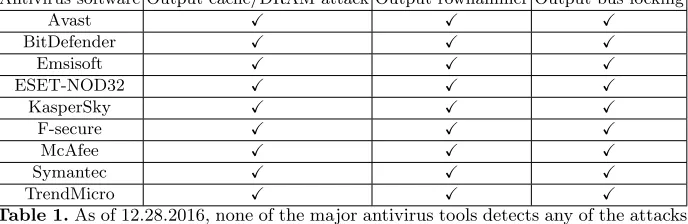
Our approach tries to solve both issues. Imagine a regular user that receives a binary from a trustworthy (or not) person, or an official application distributor aiming at providing malware free applications. How do they know whether the binary contains malicious code, and particularly microarchitectural exploitation code? The most common approach is to utilize an antivirus software to deter-mine whether the binary is safe to execute. Although antivirus tools might work well with certain kind of malware [33], their success when detecting microarchi-tectural attacks is still an open question. Table 1 shows the outcome of such an analysis in list of well known antivirus software (the best in 2016, as stated in [24]). Indeed, we utilized several examples of both cache, DRAM, rowhammer and memory bus locking attacks. None of the antivirus softwares was able to detect that the binaries were malicious.
Antivirus software Output cache/DRAM attack Output rowhammer Output bus locking
Avast X X X
BitDefender X X X
Emsisoft X X X
ESET-NOD32 X X X
KasperSky X X X
F-secure X X X
McAfee X X X
Symantec X X X
TrendMicro X X X
Table 1.As of 12.28.2016, none of the major antivirus tools detects any of the attacks we analyzed.
5.1 Attributes Analyzed by MASCAT
This section summarizes the attributes that MASCAT tries to identify within the binary code. Note that the goal of our design is not to detect all possible mi-croarchitectural attack designs (indeed, if an expert attacker knows the approach taken by our tool, he can always find a way to bypass it) but rather to give a good framework on the detection of existing attacks. More attributes can be added to cover more sophisticated and intelligent designs of microarchitectural attacks.
– clflush instruction:Theclflushinstructions is a common factor to both cache attacks, DRAM access and rowhammer attacks. Since these attacks require several accesses to succeed, our tool identifies thoseclflush instruc-tions that are being used inside a loop.
– monvnti & movntdq instructions:Themonvntiandmovntdqallow at-tacker to bypass the cache to directly access the DRAM in rowhammer attacks. Our tool further tries to find these instructions being utilized in a loop.
– Thread counters, performance counters, rdtscp & rdtsc instruc-tions:Therdtscpandrdtscinstructions are fine grain timers provided in x86 64 processors. In contrast tordtsc,rdtscpfurther implements memory barrier instructions before reading the clock cycle counter. Similarly, the per-formance counters can give us the number of clock cycles elapsed/evictions. Lastly, if none of these is accesible, a timer can be created by using a thread continuously incrementing a counter. Our tool identifies all these approaches being utilized in loops.
– lfence & mfence & cpuid instructions:Instructions that execute mem-ory barrier operations to ensure all loads (lfence) and all loads and stores (mfence, cpuid) have been issued. This instructions are necessary to prevent out of order execution and to obtain accurate timings from the fine grain timers.
– lock instructions: Atomic instructions that can be issued to implement memory bus locking attacks. Our tool monitors for all the instruction with the lock prefix plus the XCHG instruction.
– jump opcodes: L1 instruction cache attacks are commonly designed uti-lizing jump opcodes to jump to set concurrent addresses. Our tool again analyzes whether any of the functions inside a binary assigns jump opcodes in a loop.
– selfmap translation & slice mappings Although non-available from userspace since linux kernel 4.0.0, prior kernels are still vulnerable from hav-ing an attacker lookhav-ing at the phsyical address of his memory to facilitate eviction set creations. Aiming at avoiding these attacks, our tool also identi-fies accesses to this particular mapping. Further, our tool also finds whether theknown slice selection algorithms are utilized in the binary code to guess the slice location of the memory addresses.
– affinity assignmentSome of the above mentioned attacks (like the L1 cache attacks or LLC attacks) only succeed when core co-residency or CPU clus-ter co-residency are achieved. Further, the timers (and specially the thread counter) exhibit better performance when scheduled in a single core. Thus, our tool also tries to identify whether there is any affinity assignment inside the inspected binary code.
5.2 Measuring the Threat Score
One of the most important challenges of the design of our tool is to determine, based on the attributes observed, whether a threat exists or not. Although we could use machine learning algorithms to design such a methodology, we believe there are several facts that have to be smartly taken into account (e.g. location of the attributes, location of the nested functions calling the functions where the attributes were found, etc.) that can make machine learning algorithms to per-form poorly. In contrast, we designMASCATto be intelligent enough to retrieve those facts, such that we do not have a necessity for utilizing an automated data analysis tool. We decide to implement a score system based on the combination of attributes observed. For instance, we know memory barrier instructions are not a threat if they are not issued together with timers, lock or eviction instruc-tions. In this sense, we designed the following score based threat classification:
Maximum Threat Attributes: Attributes from this category are immedi-ately considered a threat when found by our algorithm. clflush, monvnti, movntdq and selfmap translation attributes fall into this category. The first 3 because they can directly imply a rowhammer attack, the latter one because having access to the physical address space can become a threat for both cache, DRAM access rowhammer attacks. The location where these attributes (and the functions calling them) are found will be marked in red.
not change the score. For instance,rdtscpandlockinstructions together would be considered a threat, while lock instructions with pointer chasing functions are not (see Section).
Low Threat Attributes: Attributes from this category are not immediately considered threats but rather small warnings. Only if these attributes are ob-served within the same location of the necessary of necessary medium or low threat attributes the code portion is considered a threat. Examples of these kind of attributes are memory barriers, timers (excluding rdtscp) and affinity as-signment. Only if two low threat attributes are observed with a medium threat attribute the code location is classified as a threat.
5.3 Tool Framework
In order to implement the specified design we utilize the popular IDA PRO static binary analyzer. We chose IDA because it offers us a high level programming language and several built in functions that facilitate our attribute finding design. Note that developing our tool with another open source static library analyzer (like hooper) should also be feasible with an extra amount of work.
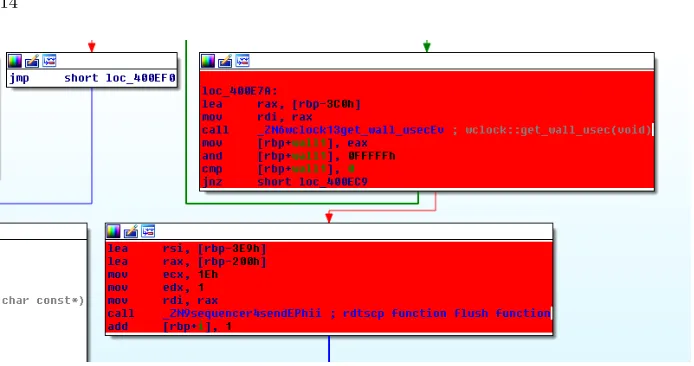
In summaryMASCATworks by analyzing binary elf fileswithout the need for the source code. The tool tries to find the attributes described above, coloring those locations where microarchitectural attack related features are found. Our tool colors threats in read, warnings in orange and small warnings in magenta. Note that, as MASCAT finds new attributes in already colored locations, the colors of those locations might change. Once the analysis is finished, MASCAT outputs a summary of the locations in which threats and warnings were found and their root of cause (e.g.,rdtscinstruction,lockinstructions, etc.). Figure 3 shows a visual example of an analysis made to one of our microarchitectural attacks. The binary is considered a threat for utilizing flush and fine grain timer instructions.
6
Experiment Setup
Fig. 3.Visual example output of MASCAT
As the benign binary set that was included for our test framework, we chose 100 binaries from the phoronix-test-suite. This choice was not random, but was intended to possibly maximize the number of false positives that our tool can output. In fact, a large number of the tests in the phoronix-test-suite are per-formance benchmarks that might need to utilize some of the attributes that our tool looks for. Since we do not expect to observe such a behavior in regular non-performance measurement related binaries, the binaries from the phoronix-test-suite should give a good upper false positive threshold.
Our analysis only focused in x86 64 binaries and utilized binaries compiled under Linux Operating Systems (as they are the most utilized OS to carry out microarchitectural attacks). However, this does not mean that other binaries (e.g., smartphone applications) can not be similarly analyzed. In order to perform such an analysis, only the semantics related to each architecture/OS should change (e.g., in ARM there is not a clflush instruction but the clean cache system call). For that reason, we believe the same analysis can be easily carried out for other architectures and scenarios.
7
Results
The results obtained for both the malicious and benign code in terms of false positives and negatives indeed depends on the conditions (i.e., strength factor) imposed for the attributes found. We start by taking the approach described in Section, i.e., imposing the conditions to detect all the microarchitectural attacks described in Section. The effects on the success rate that different conditions have will discussed in the subsequent paragraphs.
eviction instructions, while cache attacks are usually a combination of timers and eviction policies). In any case, we obtained a 100% success rate in the 25 malicious binaries analyzed. Note that our tool looks for the attributes in a generic manner, i.e., our analysis scripts are not modified accordingly to flag each malicious binary as a threat.
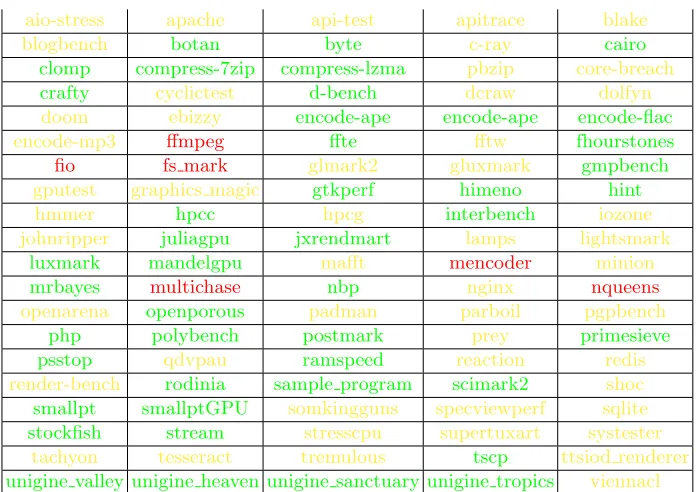
As for the benign binaries, the results are presented in Table 7, in which binaries categorized as threats are displayed with red font, binaries with warnings are displayed with yellow font and non-warning binaries are displayed with green font. We observed that out of the 100 binaries, only 6 flagged as potential threats. The rest either contained insufficient attributes to be considered as threats (i.e. warnings) or did not contain any of the attributes we were looking for. Thus, we obtained a 6% of false positives and a 0% of false negatives in our test binaries. Note that, due to the nature of the phoronix-test-suite benchmarks, the 6% rate of false positives is a good upper threshold indicator, but we expect a lower false positive rate with regular non-benchmarking binaries.
Table 7 shows the reason why those 6 binaries flagged as threats. Nqueens, multichase, mencoder and fs mark benchmarks flagged due to the usage of non-temporal load and stores instructions that could be an indicator of rowhammer attacks. Fio and ffmpeg benchmarks flagged because of the usage of timers, memory barriers and pointer chasing/set congruent jump instructions within the same location, which could be indicators of cache and DRAM access attacks. Lastly fs mark and again ffmpeg flagged because of the usage of timers and atomic instructions, indicating a potential memory bus locking covert channel exploitation.
aio-stress apache api-test apitrace blake blogbench botan byte c-ray cairo
clomp compress-7zip compress-lzma pbzip core-breach crafty cyclictest d-bench dcraw dolfyn doom ebizzy encode-ape encode-ape encode-flac encode-mp3 ffmpeg ffte fftw fhourstones
fio fs mark glmark2 gluxmark gmpbench gputest graphics magic gtkperf himeno hint hmmer hpcc hpcg interbench iozone johnripper juliagpu jxrendmart lamps lightsmark
luxmark mandelgpu mafft mencoder minion mrbayes multichase nbp nginx nqueens
openarena openporous padman parboil pgpbench php polybench postmark prey primesieve psstop qdvpau ramspeed reaction redis render-bench rodinia sample program scimark2 shoc smallpt smallptGPU somkingguns specviewperf sqlite stockfish stream stresscpu supertuxart systester
tachyon tesseract tremulous tscp ttsiod renderer unigine valley unigine heaven unigine sanctuary unigine tropics viennacl
Table 2.Output of the microarchitectural static analyzer on 100 benign phoronix-test-suite binaries. Green indicates no warnings, yellow indicates the presence of warnings and red indicates presence of threats
Binary flagged Reason
ffmpeg timers, memory barriers, pointer chasing and lock functions fio timers, memory barriers and pointer chasing functions fs mark timers, lock and non-temporal load/store functions mencoder non-temporal load/store functions
multichase non-temporal load/store functions nqueens non-temporal load/store functions
Table 3.Explanation for benign binaries classified as threats
Attack targeted FN rowhammer FN cache/DRAM FN bus locking FP bening
rowhammer 0% 100% 0% 4%
cache/DRAM attacks 50% 100% 0% 2%
bus locking 100% 0% 100% 2%
intended to obtain an estimate of the upper false positive threshold that our tool can output.
8
Conclusion
For the first time we presented a static code analysis tool, MASCAT capable of scanning for common microarchitectural attacks. Microarchitechtural attacks are particularly damaging as they are hard to detect since they use standard resources, e.g. memory access, made available to applications at the lowest priv-ilege level. Given the rise of malicious code in app stores and online repositories it becomes essential to scan applications for such stealthy attacks. The proposed tool, MASCAT is ideally suited to fill this need. MASCATcan be used by app store service providers to perform large scale fully automated analysis of ap-plications. The initial MASCATsuite is built to include attack vectors to cover popular cache/DRAM access attacks, rowhammer and memory bus covert chan-nels. Nevertheless, our tool is easily configurable to include newer attack vectors as they arise.
References
1. Aciic¸mez, O., Brumley, B. B., and Grabher, P. New results on instruction cache attacks. In Cryptographic Hardware and Embedded Systems, CHES 2010, 12th International Workshop, Santa Barbara, CA, USA, August 17-20, 2010. Pro-ceedings (2010), S. Mangard and F.-X. Standaert, Eds., vol. 6225 ofLecture Notes in Computer Science, Springer, pp. 110–124.
2. Acıic¸mez, O. Yet Another MicroArchitectural Attack: Exploiting I-Cache. In Proceedings of the 2007 ACM Workshop on Computer Security Architecture. 3. Acıic¸mez, O., K. Koc¸, c., and Seifert, J.-P.Predicting secret keys via branch
prediction. InTopics in Cryptology CT-RSA 2007, vol. 4377. pp. 225–242. 4. Almeida, J. B., Barbosa, M., Barthe, G., Dupressoir, F., and Emmi, M.
Verifying constant-time implementations. In 25th USENIX Security Symposium (USENIX Security 16)(Austin, TX, Aug. 2016), USENIX Association, pp. 53–70. 5. Benger, N., van de Pol, J., Smart, N. P., and Yarom, Y. “Ooh Aah... Just a Little Bit”: A Small Amount of Side Channel Can Go a Long Way. In CHES (2014), pp. 75–92.
6. Bernstein, D. J. Cache-timing attacks on AES, 2004. URL: http://cr.yp.to/papers.html#cachetiming.
7. Bhattacharya, S., and Mukhopadhyay, D. Curious Case of Rowhammer: Flipping Secret Exponent Bits Using Timing Analysis.
8. Brasser, F. F., Davi, L., Gens, D., Liebchen, C., and Sadeghi, A. Can’t touch this: Practical and generic software-only defenses against rowhammer at-tacks. CoRR abs/1611.08396 (2016).
9. Fangfei Liu and Yuval Yarom and Qian Ge and Gernot Heiser and Ruby B. Lee. Last level cache side channel attacks are practical. InS&P 2015. 10. Gruss, D., Maurice, C., Fogh, A., Lipp, M., and Mangard, S.Prefetch
11. Gruss, D., Maurice, C., and Mangard, S.Rowhammer.js: A remote software-induced fault attack in javascript. In Proceedings of the 13th International Conference on Detection of Intrusions and Malware, and Vulnerability Assessment -Volume 9721 (New York, NY, USA, 2016), DIMVA 2016, Springer-Verlag New York, Inc., pp. 300–321.
12. Gruss, D., Spreitzer, R., and Mangard, S.Cache template attacks: Automat-ing attacks on inclusive last-level caches. In 24th USENIX Security Symposium (2015), USENIX Association, pp. 897–912.
13. Gullasch, D., Bangerter, E., and Krenn, S.Cache Games – Bringing Access-Based Cache Attacks on AES to Practice. SP ’11, pp. 490–505.
14. ˙Inc˙I, M. S., G¨ulmezoglu, B., Eisenbarth, T., and Sunar, B. Co-location detection on the cloud. InCOSADE (2016).
15. ˙Inci, M. S., Gulmezoglu, B., Irazoqui, G., Eisenbarth, T., and Sunar, B. Cache Attacks Enable Bulk Key Recovery on the Cloud. 2016.
16. ˙Inc˙I, M. S., Gulmezoglu, B., Irazoqui, G., Eisenbarth, T., and Sunar, B. Cache attacks enable bulk key recovery on the cloud. InCryptographic Hard-ware and Embedded Systems–CHES 2016: 18th International Conference, Santa Barbara, CA, USA, August 17-19, 2016, Proceedings (2016), vol. 9813, Springer, p. 368.
17. Inci, M. S., Irazoqui, G., Eisenbarth, T., and Sunar, B.Efficient adversarial network discovery using logical channels on microsoft azure. InAnnual Computer Security Applications Conference (Los Angeles, CA, US, dec 2016).
18. Irazoqui, G., Eisenbarth, T., and Sunar, B. S$A: A Shared Cache Attack that Works Across Cores and Defies VM Sandboxing and its Application to AES. In36th IEEE Symposium on Security and Privacy (S&P 2015).
19. Irazoqui, G., Eisenbarth, T., and Sunar, B. Cross processor cache attacks. InProceedings of the 11th ACM Symposium on Information, Computer and Com-munications Security (2016), ASIA CCS ’16, ACM.
20. Irazoqui, G., ˙Inc˙I, M. S., Eisenbarth, T., and Sunar, B. Wait a Minute! A fast, Cross-VM Attack on AES. InRAID (2014), pp. 299–319.
21. Irazoqui, G., ˙Inc˙I, M. S., Eisenbarth, T., and Sunar, B. Lucky 13 strikes back. InProceedings of the 10th ACM Symposium on Information, Computer and Communications Security (2015), ASIA CCS ’15, pp. 85–96.
22. Kim, T., Peinado, M., and Mainar-Ruiz, G.Stealthmem: System-level protec-tion against cache-based side channel attacks in the cloud. In Presented as part of the 21st USENIX Security Symposium (USENIX Security 12) (Bellevue, WA, 2012), USENIX, pp. 189–204.
23. Kim, Y., Daly, R., Kim, J., Fallin, C., Lee, J. H., Lee, D., Wilkerson, C., Lai, K., and Mutlu, O. Flipping bits in memory without accessing them: An experimental study of dram disturbance errors. InProceeding of the 41st An-nual International Symposium on Computer Architecuture(Piscataway, NJ, USA, 2014), ISCA ’14, IEEE Press, pp. 361–372.
24. Best 2016 antivirus.
27. Oren, Y., Kemerlis, V. P., Sethumadhavan, S., and Keromytis, A. D. The spy in the sandbox: Practical cache attacks in javascript and their implications. In Proceedings of the 22Nd ACM SIGSAC Conference on Computer and Communi-cations Security (New York, NY, USA, 2015), CCS ’15, ACM, pp. 1406–1418. 28. Osvik, D. A., Shamir, A., and Tromer, E. Cache Attacks and
Countermea-sures: The Case of AES. InProceedings of the 2006 The Cryptographers’ Track at the RSA Conference on Topics in Cryptology, CT-RSA’06.
29. Pessl, P., Gruss, D., Maurice, C., Schwarz, M., and Mangard, S. Drama: Exploiting dram addressing for cross-cpu attacks. In25th USENIX Security Sym-posium (USENIX Security 16) (Austin, TX, Aug. 2016), USENIX Association, pp. 565–581.
30. Pessl, P., Gruss, D., Maurice, C., Schwarz, M., and Mangard, S.DRAMA: exploiting DRAM addressing for cross-cpu attacks. In 25th USENIX Security Symposium, USENIX Security 16, Austin, TX, USA, August 10-12, 2016.(2016), pp. 565–581.
31. Qiao, R., and Seaborn, M.A new approach for rowhammer attacks.2016 IEEE International Symposium on Hardware Oriented Security and Trust (HOST) 00, undefined (2016), 161–166.
32. Ristenpart, T., Tromer, E., Shacham, H., and Savage, S. Hey, you, get off of my cloud: Exploring information leakage in third-party compute clouds. In Proceedings of the 16th ACM Conference on Computer and Communications Security, CCS ’09, pp. 199–212.
33. Sukwong, O., Kim, H. S., and Hoe, J. C. Commercial antivirus software effec-tiveness: an empirical study. Computer 44, 3 (2011), 0063–70.
34. van der Veen, V., Fratantonio, Y., Lindorfer, M., Gruss, D., Maurice, C., Vigna, G., Bos, H., Razavi, K., and Giuffrida, C.Drammer: Deterministic rowhammer attacks on mobile platforms. InProceedings of the 2016 ACM SIGSAC Conference on Computer and Communications Security (New York, NY, USA, 2016), CCS ’16, ACM, pp. 1675–1689.
35. Varadarajan, V., Zhang, Y., Ristenpart, T., and Swift, M. A placement vulnerability study in multi-tenant public clouds. In24th USENIX Security Sympo-sium (USENIX Security 15)(Washington, D.C., Aug. 2015), USENIX Association, pp. 913–928.
36. Wang, Z., and Lee, R. B. New Cache Designs for Thwarting Software Cache-based Side Channel Attacks. In Proceedings of the 34th Annual International Symposium on Computer Architecture(2007).
37. Xiao, Y., Zhang, X., Zhang, Y., and Teodorescu, R. One bit flips, one cloud flops: Cross-vm row hammer attacks and privilege escalation. In 25th USENIX Security Symposium (USENIX Security 16) (Austin, TX, Aug. 2016), USENIX Association, pp. 19–35.
38. Xu, Z., Wang, H., and Wu, Z. A measurement study on co-residence threat inside the cloud. In 24th USENIX Security Symposium (USENIX Security 15) (Washington, D.C., Aug. 2015), USENIX Association, pp. 929–944.
39. Yarom, Y. Mastik: A micro-architectural side-channel toolkit, 2016.
40. Yarom, Y., and Falkner, K.FLUSH+RELOAD: A High Resolution, Low Noise, L3 Cache Side-Channel Attack. In 23rd USENIX Security Symposium (USENIX Security 14), pp. 719–732.
41. Zankl, A., Miller, K., Heyszl, J., and Sigl, G. Towards efficient evaluation of a time-driven cache attack on modern processors. InESORICS 2016.
43. Zhang, T., Zhang, Y., and Lee, R. B. Memory dos attacks in multi-tenant clouds: Severity and mitigation. CoRR abs/1603.03404 (2016).
44. Zhang, Y., Juels, A., Reiter, M. K., and Ristenpart, T. Cross-tenant side-channel attacks in paas clouds. InProceedings of the 2014 ACM SIGSAC Confer-ence on Computer and Communications Security.
45. Zhang, Y., Juels, A., Reiter, M. K., and Ristenpart, T. Cross-VM Side Channels and Their Use to Extract Private Keys. InProceedings of the 2012 ACM Conference on Computer and Communications Security.
![Fig. 1. Flush and Reload code snippet from [40]](https://thumb-us.123doks.com/thumbv2/123dok_us/7949666.1319344/5.612.216.401.436.590/fig-flush-and-reload-code-snippet-from.webp)