A mechanical approach to derive identity-based protocols from
Diffie–Hellman-based protocols
IKim-Kwang Raymond Chooa, Junghyun Namb,∗, Dongho Wonc
aInformation Assurance Research Group, Advanced Computing Research Centre, University of South
Australia, Mawson Lakes, SA 5095, Australia
bDepartment of Computer Engineering, Konkuk University, 322 Danwol-dong, Chungju-si,
Chungcheongbuk-do 380-701, Korea
cDepartment of Computer Engineering, Sungkyunkwan University, 300 Cheoncheon-dong, Suwon-si,
Gyeonggi-do 440-746, Korea
Abstract
We describe a mechanical approach to derive identity-based (ID-based) protocols from existing Diffie–Hellman-based ones. As case studies, we present the ID-based versions of the Unified Model protocol, UMP-ID, Blake-Wilson, Johnson & Menezes (1997)’s protocol, BJM-ID, and Krawczyk (2005)’s HMQV protocol, HMQV-ID. We describe the calculations required to be modified in existing proofs. We conclude with a compar-ative security and efficiency of the three proposed ID-based protocols (relcompar-ative to other similar published protocols) and demonstrate that our proposed ID-based protocols are computationally efficient.
Keywords: Key establishment protocols, Identity-based (ID-based) protocols, Diffie–Hellman-based protocols
1. Introduction
Key distribution is one of the most fundamental problems in cryptography, and was revolutionized by the introduction of the key exchange protocol by Diffie and Hellman in 1976 [20]. The Diffie–Hellman (DH) protocol illustrated that:
arbitrary two parties even with no prior acquaintance and no secure phys-ical/electronic channels can establish a shared secret key (called a session key) simply by exchanging their public keys over an insecure public network
IThis is the authors’ post-print version of the paper accepted by Information Sciences, and citation
to this paper should be as follows: Choo K-K R, Nam J and Won D. A mechanical approach to derive identity-based protocols from Diffie-Hellman-based protocols. Information Sciences [In press; Also available fromhttp://eprint.iacr.org/2014/358.pdf].
as long as integrity of public keys is guaranteed and the underlying compu-tational problem (known as the computational Diffie-Hellman problem) is hard.
We note that the public keys exchanged in the DH protocol are usually ephemeral (short-term) rather than static (long-term) keys, although this (i.e. Whether the keys are ephemeral or static?) was not in the original protocol specification. Perhaps, this was not an issue at that time. While public key cryptography facilitates key distribution over an insecure communication channel, the integrity of public keys is crucial for security against an active adversary – it is well known that the basic (unauthenticated) DH protocol is susceptible to active man-in-the-middle attacks.
Many of the popular key establishment protocols are based on the DH key exchange and are implicitly authenticated via public key certificates1 [25, 41]. Examples include
the MTI protocol [35], the Unified Model protocol (UMP) [2, 8], the MQV protocol [37, 34], and the HMQV protocol [31]. Throughout the paper, we will use the term “DH-based protocols” to refer to these implicitly authenticated DH-based protocols. A key goal of DH-based protocols is to achieve the same level of efficiency as the basic DH protocol, both in terms of communication and computation, when the possible transmission and verification of public key certificates are excluded from consideration. The design and security of DH-based protocols have been extensively studied over the last decades and are now fairly well-understood. For example, some recent DH-based protocols were proven secure in the extended Canetti-Krawczyk (eCK) model [33, 47, 30].
While public key certificates have been widely used to bind public keys to identities, their management has turned out to be more challenging than was initially anticipated. The quest for a solution to this problem has led to the invention of identity-based (ID-based) cryptography [42]. At the price of key escrow, ID-based cryptography eliminates the need for certificates by allowing parties to use their identity as their public key. Typically, we would already know the identity of our communication peer and, thus, do not need a signed certificate for it. This is of great benefit in simplifying the management of public keys [40]. From an ID-based scheme user’s perspective, an obvious benefit is an absence of certificate transmission and verification.
In the past decade, we have witnessed a surge of interest in ID-based cryptography, particularly the use of elliptic curve pairings to realize cryptographic structures that seemed impossible before. To illustrate how elliptic curve pairings can be used to build novel cryptographic schemes with interesting properties, we refer the reader to the work of Al-Riyami [1]. Published schemes include a number of ID-based key establish-ment protocols using pairing, which we will refer to simply as “ID-based protocols”. Examples include the protocols of Smart [45], Shim [43], Chen and Kudla [14], Choie,
1A public key certificate is an electronic document signed by a trusted third party (called a
Jeong and Lee [16], Xie [51], McCullagh and Barreto [36], Wang, Cao and Cao [50], and Wang [49].
The security properties required for key establishment protocols are well studied, and an excellent overview is presented by Blake-Wilson and Menezes [9]. The most basic property is that a passive adversary eavesdropping on the protocol should be unable to obtain the session key. Other desirable properties include:
Known key security. It is often reasonable to assume that the adversary will be able to obtain session keys from any session different from the one under attack. A protocol has known key security if it is secure under this assumption. This is generally regarded as a standard requirement for key establishment protocols.
Unknown key-share security. Sometimes the adversary may be unable to obtain any useful information about a session key, but can deceive the protocol principals about the identity of the peer entity. Such an attack was first described by Diffie, van Oorschot and Wiener [21], and can result in principals giving away information to the wrong party or accepting data as coming from the wrong party.
As discussed by Boyd and Mathuria [12, Chapter 5.1.2], a malicious adversaryA need not obtain the session key to profit from this attack. Consider the scenario whereby Alice will deliver some information of value (such as e-cash) to Bob. Since Bob believes the session key is shared with A, A can claim this credit deposit as his. Also, A can exploit such an attack in a number of ways if the established session key is subsequently used to provide encryption or integrity [29]. Consequently, security against unknown key-share attacks is regarded as a standard requirement.
Forward secrecy. When the static key of an entity is compromised, the adversary will be able to masquerade as that entity in any future protocol runs. However, the situation will be even worse if the adversary can also use the compromised static key to obtain session keys that were established before the compromise. Protocols that prevent this are said to provide forward secrecy. Since there is usually a computational cost in providing forward secrecy, it is sometimes sacrificed in the interest of efficiency.
Key compromise impersonation resistance. Another problem that may occur when the static key of an entityAis compromised is that the adversary may be able to masquerade not onlyas A but also toA as another party B. Such a protocol is said to allow key compromise impersonation. Resistance to such attacks is often seen as desirable.
A survey by Boyd and Choo [11] shows that many existing ID-based protocols have been published without a careful security analysis or a systematic comparison with alternatives, highlighting the need for more rigorously tested ID-based protocols. In addition, their survey suggests some interesting similarities between ID-based protocols and various DH-based protocols. They then conjectured that these similarities may well extend to the security properties of these protocols, and the key mapping technique described in Table 1 of Section 3.2 was designed by Choo in 2005. In 2009, Wang [48] independently proposed a similar technique, referred to as the key substitution rules. Although the motivations behind both techniques were similar, the actual rules of mapping are different and the security of the resultant ID-based protocols was not discussed [48].
In this paper, our main contribution is to present a systematic approach to me-chanically derive provably-secure ID-based protocols from their DH-based versions. In our approach, we
1. first propose ID-based versions of DH-based protocols based on some rules for parameters conversion,
2. describe the computational assumptions required to be modified due to the pa-rameters conversion, and
3. describe the calculations required to be modified in comparison to the original proof.
To demonstrate that our approach is independent of the underlying security model (i.e. our approach can be applied to protocols proven secure in different security mod-els), we use three popular protocols — the UMP protocol [2, 8], the BJM protocol [8, protocol 4], and the HMQV protocol [31] — as case studies. UMP was proven secure in a restricted model where the adversary is not allowed to reveal session keys [8]. We provide a proof of security for the ID-based version of UMP, which we de-note by UMP-ID0, in the same restricted model. We also show that a slight variant
of UMP-ID0, denoted as UMP-ID, can be proven secure in the model of Bellare and
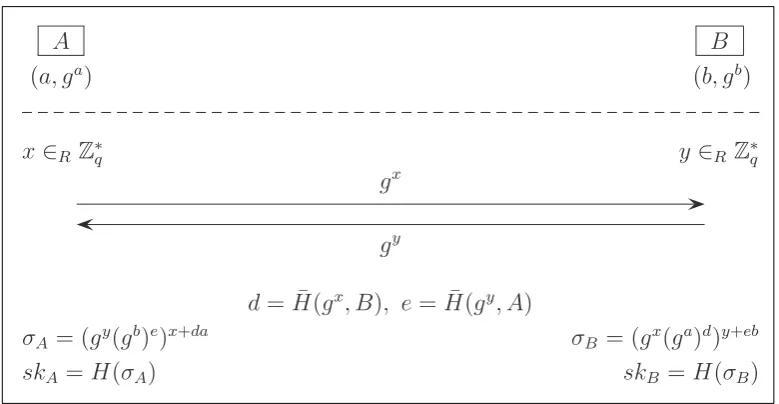
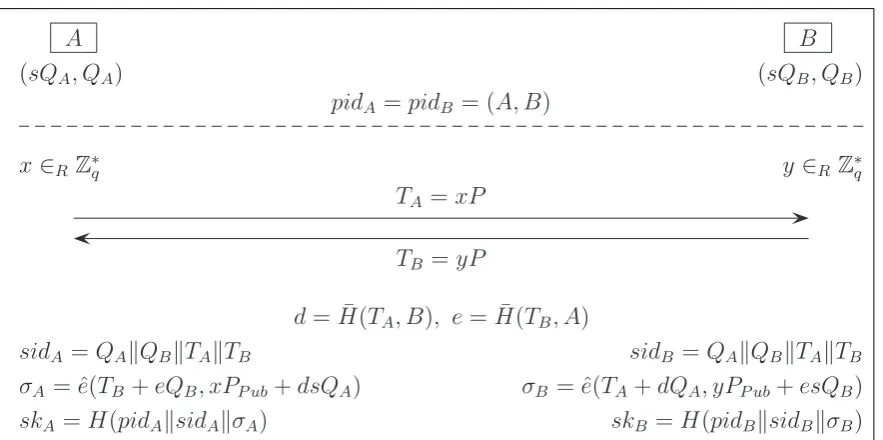
Hitchcock [18], protocols proven secure in the BR model are not necessarily secure in the CK model but the converse is true; for example, the adversary is allowed to obtain the ephemeral private keys of parties only in the CK model. For the ID-based version of HMQV (HMQV-ID), we provide a proof of forward security in the eCK model [33], which is an extesion of the (original) CK model.
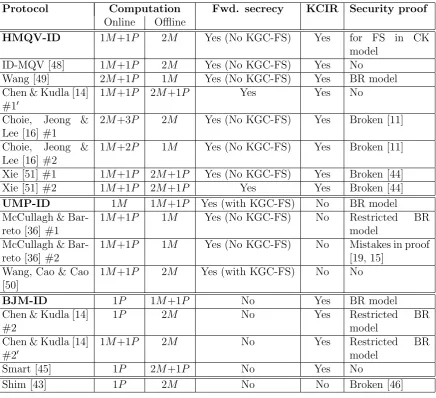
The next section presents the mathematical preliminaries and an overview of both the BR and eCK models. In Section 3, we present the mechanics of mapping the protocol parameters and the computational assumptions from DH-based to ID-based protocols. In Sections 4 to 6, we present the ID-based versions of UMP, BJM and HMQV, followed by the calculations required to be modified in their existing proofs. We conclude with a comparative security and efficiency of the derived ID-based protocols (relative to other similar published protocols) in Section 7.
2. Preliminaries
In cryptographic algorithms, the value ofk is important since negligibility of func-tions and complexity of algorithms are often parameterized by k (e.g., the size of cryptographic groups and key lengths within those algorithms). The larger the value of k is, the more computation is required to run an algorithm. The value k relates to the bounds on an adversary’s success probability (i.e.,k is often known as the security parameter). All cryptographic algorithms in this paper receive the security parameter
k as input and their security is measured ink. We recall the definition of a negligible function.
Definition 1 (A negligible function [6]). A function f :N→Ris callednegligible if it approaches zero faster than the reciprocal of any polynomial. That is, for every
c∈N there is an integer kc such that f(k)≤k−c for all k≥kc.
In general, a cryptographic algorithm is considered secure if for any adversary against the algorithm, its success probability is a negligible function of the security parameter
k.
2.1. Bilinear maps from elliptic curve pairings
Using the notation of Boneh and Franklin [10], we let G1 be an additive group of prime orderqwith|q|=k, wherekis the security parameter, andG2be a multiplicative group of the same order q. We assume the existence of a map ˆe from G1×G1 to G2. Typically,G1 will be a subgroup of the group of points on an elliptic curve over a finite field,G2 will be a subgroup of the multiplicative group of a related finite field and the map ˆe will be derived from either the Weil or Tate pairing on the elliptic curve2. The
mapping ˆe must be efficiently computable and has the following properties.
Bilinearity. ForQ, W, Z ∈G1, both ˆ
e(Q, W +Z) = ˆe(Q, W)·ˆe(Q, Z) and eˆ(Q+W, Z) = ˆe(Q, Z)·eˆ(W, Z).
Non-degeneracy. For some elements P, Q∈G1, we have ˆe(P, Q)̸= 1G2.
Computability. For some elements P, Q ∈ G1, we have an efficient algorithm to compute ˆe(P, Q).
A bilinear map, ˆe, is said to be an admissible bilinear map if it satisfies all three properties. Since ˆe is bilinear, the map ˆe is also symmetric.
2.2. Computational problems and assumptions
In the provable security paradigm, the underlying computational assumptions em-ployed form the basis of security for the protocol. In the definition of such assumptions, protocol designers have various degrees of freedom related to the concrete mathematical formulation of the assumption (e.g., what kind of attackers are considered or over what values the probability spaces are defined). In the case of DH-based protocols and ID-based protocols, security is usually proved by finding a reduction to the Computational Diffie–Hellman (CDH) problem [20] or its variants and the Bilinear Diffie–Hellman (BDH) problem [10] or its variants respectively, whose intractability is assumed. In other words, we assume that there exists no probabilistic polynomial-time (ppt)
algo-rithm whose advantage in solving the problem is non-negligible. In the following we briefly describe the CDH and BDH problems and their variants. Assume that DH-based protocols work in a finite cyclic group G of prime order q (with |q| = k) while ID-based protocols operate on⟨G1,G2,eˆ⟩ which are defined as above. Letg and P be generators of G and G1, respectively.
Computational Diffie–Hellman (CDH) problem. Given an instance of (ga,gb)∈
G2 (or (aP, bP) ∈ G2
1), where a, b ∈R Z∗q, output gab ∈ G (or abP ∈ G1
respec-tively).
An algorithm, ACDH, running in time t has advantage ϵ in solving the CDH problem in G (or G1) if Pr[ACDH(ga, gb) = gab] ≥ ϵ (or Pr[ACDH(aP, bP) =
abP] ≥ ϵ), where the probability is over the random choice of a, b ∈ Z∗q, the random choice ofg ∈G∗ (or P ∈G∗1 respectively), and the random bits ofACDH.
Decisional Diffie–Hellman (DDH) problem. Distinguish between two distribu-tions (ga, gb, gab) and (ga, gb, gc), where a, b, c∈RZ∗q.
An algorithm, ADDH, running in time t has advantage ϵ in solving the DDH problem in G if |Pr[ADDH(ga, gb, gab) = 1]−Pr[ADDH(ga, gb, gc) = 1]| ≥ϵ, where the probability is over the random choice of a, b, c ∈ Z∗q, the random choice of
Gap Diffie–Hellman (GDH) problem. Given an instance of (ga,gb)∈G2, as well as an oracle ODDH(·,·,·) that solves the DDH problem in G, output gab ∈ G.
Here, the oracleODDH(·,·,·) outputs 1 if the given problem instance is a decisional Diffie–Hellman tuple, and 0 otherwise.
An algorithm, AGDH, running in time t has advantage ϵ in solving the GDH problem in G if Pr[AGDH(ga, gb,ODDH(·,·,·)) = gab] ≥ ϵ, where the probability
is over the random choice of a, b ∈ Z∗q, the random choice of g ∈ G∗, and the random bits ofAGDH.
Bilinear Diffie–Hellman (BDH) problem. Given an instance of (aP, bP, cP) ∈
G3
1, wherea, b, c∈RZ∗q, output ˆe(P, P)abc∈G2.
An algorithm,ABDH, running in timethas advantageϵin solving the BDH prob-lem on⟨G1,G2,eˆ⟩if Pr[ABDH(aP, bP, cP) = ˆe(P, P)abc]≥ϵ, where the probability
is over the random choice of a, b, c ∈ Z∗q, the random choice of P ∈ G∗1, and the random bits ofABDH.
Decisional bilinear Diffie–Hellman (DBDH) problem. Distinguish between two distributions (aP, bP, cP,ˆe(P, P)abc) and (aP, bP, cP,eˆ(P, P)d), wherea, b, c, d∈
R
Z∗
q.
An algorithm, ADBDH, running in time t has advantage ϵ in solving the DBDH problem on⟨G1,G2,ˆe⟩if |Pr[ADBDH(aP, bP, cP,eˆ(P, P)abc) = 1]−Pr[ADBDH(aP,
bP, cP,eˆ(P, P)d) = 1]| ≥ ϵ, where the probability is over the random choice of
a, b, c, d∈Z∗q, the random choice ofP ∈G∗1, and the random bits of ADBDH.
Gap bilinear Diffie–Hellman (GBDH) problem. Given (aP, bP, cP) ∈ G3 1, as
well as an oracle ODBDH(·,·,·,·) that solves the DBDH problem on ⟨G1,G2,eˆ⟩, output ˆe(P, P)abc ∈ G2. Here, the oracle ODBDH(·,·,·,·) outputs 1 if the given
problem instance is a bilinear Diffie–Hellman tuple, and 0 otherwise.
An algorithm, AGBDH, running in time t has advantage ϵ in solving the GBDH problem on⟨G1,G2,ˆe⟩if Pr[AGBDH(aP, bP, cP,ODBDH(·,·,·,·)) = ˆe(P, P)abc]≥ϵ, where the probability is over the random choice ofa, b, c∈Z∗q, the random choice of P ∈G∗1, and the random bits of AGBDH.
2.3. Communication model
Participants. Let U be a nonempty set of participants (also called users). We assume each user U ∈ U is identified by a string, and we interchangeably use U and IDU
to refer to this identifier string. For a key exchange protocol P, each user is able to execute P multiple times with different participants, and we model this by allowing unlimited number of instances of each user. We use Πi
U to denote instance i of user
U, and use ΠiU,U′ to denote instance i of user U attempting to establish a session key
with (an instance of) user U′ ∈ U. An instance Πi
U is said to accept when it computes
a session key ski
Partnering. We say, informally, that two instances arepartnered if they participate in a protocol execution and establish a (shared) session key. Formally, partnering between instances is defined in terms of the notions of session and partner identifiers (See the work of Choo [17] on the role and the possible construct of session and partner identifiers as a form of partnering mechanism that enables the right session key to be identified in concurrent protocol executions). Session identifier (sid) is a unique identifier of a protocol session and is usually defined as a function of the messages transmitted in the session (although this may not be possible in a multi-party protocol where not all participants have the same view). sidi
U denotes the sid of instance ΠiU. A partner
identifier (pid) is a sequence of identities of participants of a specific protocol session. Instances are given as input a pid before they can run the protocol. pidi
U denotes the
pidgiven to instance Πi
U. Then, either pidiU = (U, U′) or pidiU = (U′, U) must be true,
whereU′ is another user with whom ΠiU believes it runs the protocol. We say that two instances, Πi
U and Π j
U′, are partnered if all the following hold: (1) both Π i
U and Π j U′
have accepted, (2) sidi
U =sid j
U′, and (3) pidiU =pid j U′.
Adversary capabilities. Apptadversary A has complete control over the environment
(mainly the network), and its capabilities are modeled via a pre-defined set of oracle queries described below.
• Send(U, i, M) causes message M to be sent to instance ΠiU. The instance com-putes what the protocol says to and any outgoing messages are given to A. If this query causes Πi
U to accept, this will also be shown to A. If M = (U, U′) (or
M = (U′, U)), then the query will prompt instance ΠiU to initiate the protocol with pidi
U = (U, U′) (or pidiU = (U′, U) respectively).
• Reveal(U, i) causes the output of the session key ski
U held by ΠiU.
• Corrupt(U) returns any static secret key(s) that U holds. U could be KGC in the ID-based setting and in this case, the master secret of KGC is returned in response to the query.
• Test(U, i) causes the oracle to choose a bit b uniformly at random. If b = 1, the session keyski
U is output; otherwise, a string is drawn uniformly from the space
of session keys and output. A Test query may be asked at any time during the execution ofP, but may only be asked once.
Session key (SK) security. We now proceed to define the basic security, called the SK security, of protocol P. The notion of freshness is a key element in defining the SK security. Intuitively, a fresh instance is one that holds a session key which should not be known to the adversaryA, and an unfresh instance is one whose session key can be known by trivial means. A formal definition of freshness follows:
Definition 2 (Freshness). An instance Πi
U,U′ is fresh unless one of the following
oc-curs: (1) the adversary queries Reveal(U, i) or Reveal(U′, j), where ΠjU′ is an instance
partnered with ΠiU; or (2) the adversary queriesCorrupt(U) or Corrupt(U′).
The SK security of protocol P is defined in the context of the following two-stage experiment:
Stage 1. A makes any oracle queries at will as many times as it wishes as long as (1) the Test query is not asked against an unfresh instance and (2) the test instance remains fresh until the end of the stage.
Stage 2. Once A decides that Stage 1 is over, it outputs a bit b′ as a guess on the hidden bit b chosen by the Test oracle. A is said to succeed if b=b′.
Let Succ be the event that A succeeds in this experiment. Then, the advantage of A in attacking protocol P is defined asAdvP(A) = 2·Pr[Succ]−1.
Definition 3 (SK security). A key exchange protocol P is SK-secure if AdvP(A) is
negligible for any pptadversary A.
3. Mechanics of protocol derivation
3.1. System setup
Assume a DH-based protocol, DHP, for which the system parameters are defined as (G, q, g) and the static private/public keys of eachU ∈ U are set to (u∈R Z∗q, gu ∈G).
Given the protocol DHP, we define the following system parameters for IDP, an ID-based version of DHP:
• An additive group G1 with a generator P of order q, a multiplicative group G2 of the same order q, and a bilinear map ˆe from G1×G1 to G2.
• A cryptographic hash function G:{0,1}∗ →G1, which is modelled as a random oracle in our proofs of security.
Depending on the instantiation of DHP, the system parameters for IDP may include additional hash functions to be used for session-key derivation and other purposes.
We set the master private/public keys of KGC to s ∈R Z∗q and PP ub = sP ∈ G1,
and the static private/public keys of each U ∈ U to sQU and QU = G(IDU), where
3.2. Keys mapping
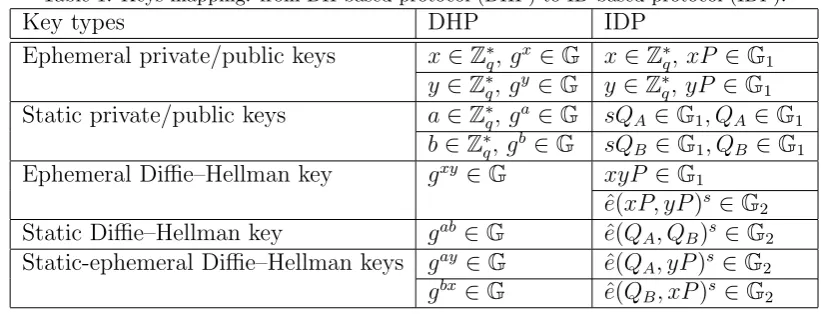
Assume two protocol participantsAandB of DHP whose static private/public keys are (a, ga) and (b, gb), respectively, as defined above. Let (x, gy) and (y, gy) denote the
ephemeral private/public keys to be generated by A and B, respectively, during the execution of DHP. Table 1 describes the mapping of various protocol keys between DHP and IDP.
Table 1: Keys mapping: from DH-based protocol (DHP) to ID-based protocol (IDP).
Key types DHP IDP
Ephemeral private/public keys x∈Z∗q,gx ∈G x∈Z∗q, xP ∈G1 y∈Z∗q, gy ∈G y∈Z∗q, yP ∈G1
Static private/public keys a∈Z∗q, ga∈G sQ
A∈G1, QA∈G1
b∈Z∗q, gb ∈G sQ
B ∈G1, QB ∈G1
Ephemeral Diffie–Hellman key gxy ∈G xyP ∈G1
ˆ
e(xP, yP)s ∈G2
Static Diffie–Hellman key gab ∈G eˆ(QA, QB)s∈G2
Static-ephemeral Diffie–Hellman keys gay ∈G eˆ(Q
A, yP)s∈G2
gbx∈G eˆ(QB, xP)s ∈G2
The Diffie–Hellman keys gxy, gab, gay and gbx are mapped to xyP (or ˆe(xP, yP)s), ˆ
e(QA,QB)s, ˆe(QA,yP)s and ˆe(QB, xP)s, respectively, so that no one can compute any
of these keys without knowing the right private key. The ephemeral Diffie–Hellman key
gxy is mapped to eitherxyP or ˆe(xP, yP)s, depending on how the key is used in DHP. If gxy is used in a mathematically-combined form with any types of static or
static-ephemeral keys, we replace it with ˆe(xP, yP)sin IDP (see, for example, the HMQV-ID
protocol in Section 6.1). Otherwise, we replace it with xyP (see the UMP-ID proto-col in Section 4.1). In practice, the static-ephemeral Diffie–Hellman key ˆe(QA, yP)s
(resp. ˆe(QB, xP)s) can be obtained by computing ˆe(sQA, yP) or ˆe(yQA, PP ub) (resp.
ˆ
e(sQB, xP) or ˆe(xQB, PP ub)) (see the BJM-ID protocol in Section 5.1).
3.3. Assumptions mapping
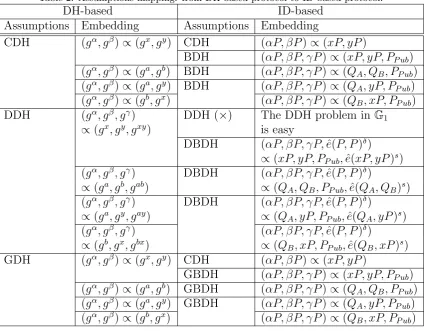
We now describe the mapping of computational assumptions between DH-based protocols and ID-based protocols. We focus on considering the CDH, DDH and GDH assumptions under which most DH-based protocols are proven secure.
CDH. Suppose that a security property ϕ of DHP was proven under the CDH as-sumption inG, which we denote as CDH≤ϕ DHP.
• If the CDH-problem instance (gα, gβ)∈G2was used in place of the ephemeral public keys (gx, gy) in the proof simulation for DHP (denoted as (gα, gβ)∝
in the keys-mapping stage (denoted as gxy ⇒ xyP), then we can prove the security property ϕ of IDP under the CDH assumption in G1. Let (αP, βP) ∈ G2
1 be the given instance of the CDH problem. Then, the
simulator in the proof for IDP will embed the problem instance into the simulation by using it in place of the ephemeral public keys (xP, yP) (see, for example, the proof given in Section 4.4).
• Otherwise, one of the following is true:
– (gα, gβ)∝(gx, gy) and gxy ⇒ˆe(xP, yP)s
– (gα, gβ)∝(ga, gb) andgab ⇒eˆ(QA, QB)s
– (gα, gβ) ∝ (ga, gy) and gay ⇒ ˆe(Q
A, yP)s, or (gα, gβ) ∝ (gb, gx) and
gbx⇒eˆ(QB, xP)s
In all of these three cases, we can prove the security propertyϕof IDP under the BDH assumption on ⟨G1,G2,ˆe⟩. Let (αP, βP, γP) ∈ G31 be the given instance of the BDH problem. Then, the simulator in the proof for IDP will embed the problem instance into the simulation by using it in place of (xP, yP, PP ub), (QA, QB, PP ub), or (QA, yP, PP ub) (or (QB, xP, PP ub)), in
each of the three cases, respectively. (See, for example, the proofs in Sections 4.2 and 6.2.)
DDH. Suppose that a security propertyϕ of DHP is proven under the DDH assump-tion in G (i.e., DDH ≤ϕ DHP). Let (gα, gβ, gγ) ∈ G3 be the DDH-problem
instance given to the simulator in the proof for DHP.
• Consider, first, the case that (gα, gβ, gγ) ∝(gx, gy, gxy) and gxy ⇒xyP. In
this case, we cannot rely on the DDH assumption to prove the security prop-ertyϕ of IDP since the DDH problem inG1 is easy [28]. To see this, observe that, given (αP, βP, γP)∈G1, one can easily decide whetherγ =αβ modq
by testing if ˆe(P, γP) = ˆe(αP, βP). One possible solution to overcome this problem is to replace the ephemeral Diffie–Hellman key gxy with ˆe(xP, yP)s in the keys-mapping stage and then prove the security property ϕ of IDP under the DBDH assumption on ⟨G1,G2,eˆ⟩ (see below for details). But, this solution comes at the price of reduced efficiency of IDP since pairing is typically much more expensive than scalar-point multiplication [5].
• Consider next the other cases:
– (gα, gβ, gγ)∝(gx, gy, gxy) andgxy ⇒eˆ(xP, yP)s
– (gα, gβ, gγ)∝(ga, gb, gab) and gab ⇒eˆ(Q
A, QB)s
– (gα, gβ, gγ) ∝ (ga, gy, gay) and gay ⇒ ˆe(QA, yP)s, or (gα, gβ, gγ) ∝
(gb, gx, gbx) and gbx⇒eˆ(Q
B, xP)s
In these cases, we can prove the security propertyϕof IDP under the DBDH assumption on⟨G1,G2,eˆ⟩. Let (αP, βP, γP,eˆ(P, P)δ)∈G3
instance of the DBDH problem. Then, the simulator in the proof for IDP will embed the problem instance into the simulation by using it in place of
– (xP, yP, PP ub,eˆ(xP, yP)s),
– (QA, QB, PP ub,eˆ(QA, QB)s), or
– (QA, yP, PP ub,eˆ(QA, yP)s) (or (QB, xP, PP ub,eˆ(QB, xP)s)),
in each of the three cases, respectively.
GDH. Suppose that a security property ϕ of DHP is proven under the GDH assump-tion inG (i.e., GDH≤ϕ DHP). Let (gα, gβ)∈G2 be the GDH-problem instance
given to the simulator in the proof for DHP. In the case that (gα, gβ) ∝(gx, gy)
and gxy ⇒ xyP, we can prove the security property ϕ of IDP under the CDH
assumption in G1. Note that a DDH oracle for G1 is not needed for the proof since the DDH problem in G1 is easy; each DDH-oracle access can be replaced by two evaluations of the bilinear map ˆe. Given the CDH-problem instance (αP, βP)∈G21, the simulator in the proof for IDP will embed it into the simula-tion by using αP and βP in place of xP and yP. In the other three cases where we considered above to replace the CDH assumption with the BDH assumption, we can prove the security property ϕ of IDP under the GBDH assumption on
⟨G1,G2,eˆ⟩. Problem instances between GBDH and BDH are identical and thus, can be embedded in the same way. (See, for example, the proofs in Sections 4.3 and 5.2.)
Table 2 summarizes the mapping of computational assumptions we have described. According to the mapping in the table, the simulator in the proof for IDP sets the master public keyPP ubto beγP when embedding the BDH- or GBDH-problem instance
(αP, βP, γP) or the DBDH-problem instance (αP, βP, γP, ˆe(P, P)δ). As a result of
setting PP ub = γP, the simulator is unable to compute the master private key s =γ.
This explains why the HMQV-ID protocol whose forward secrecy is proven under the BDH assumption cannot be proven to provide KGC forward secrecy (see Section 6.2); unlike HMQV-ID, UMP-ID can be proven to provide KGC forward secrecy since the master keys can be honestly generated when a proof is based on the CDH assumption in G1 (see Section 4.4). However, even when the master private key is unavailable, the simulator can still generate the static private keys of users and thus can correctly answer Corrupt queries of the adversary. Suppose a user U ∈ U whose static public key was not set to a value contained in the problem instance. For each such user
U, the simulator simply chooses a random rU ∈ Z∗q and sets the private/public keys
of U as (sQU = ruγP, QU = ruP). In order for this strategy to work, we require
that the adversary never query the random oracleG which is used in generating static public keys of users. This restriction3 is implicit in all our proofs except for the proof
3We note that Chen and Kudla [14] also made the same restriction in the security proof for their
Table 2: Assumptions mapping: from DH-based protocol to ID-based protocol.
DH-based ID-based
Assumptions Embedding Assumptions Embedding
CDH (gα, gβ)∝(gx, gy) CDH (αP, βP)∝(xP, yP)
BDH (αP, βP, γP)∝(xP, yP, PP ub)
(gα, gβ)∝(ga, gb) BDH (αP, βP, γP)∝(Q
A, QB, PP ub)
(gα, gβ)∝(ga, gy) BDH (αP, βP, γP)∝(QA, yP, PP ub)
(gα, gβ)∝(gb, gx) (αP, βP, γP)∝(Q
B, xP, PP ub)
DDH (gα, gβ, gγ) DDH (×) The DDH problem inG1
∝(gx, gy, gxy) is easy
DBDH (αP, βP, γP,ˆe(P, P)δ)
∝(xP, yP, PP ub,eˆ(xP, yP)s)
(gα, gβ, gγ) DBDH (αP, βP, γP,ˆe(P, P)δ)
∝(ga, gb, gab) ∝(Q
A, QB, PP ub,ˆe(QA, QB)s)
(gα, gβ, gγ) DBDH (αP, βP, γP,ˆe(P, P)δ)
∝(ga, gy, gay) ∝(Q
A, yP, PP ub,ˆe(QA, yP)s)
(gα, gβ, gγ) (αP, βP, γP,ˆe(P, P)δ)
∝(gb, gx, gbx) ∝(QB, xP, PP ub,eˆ(QB, xP)s)
GDH (gα, gβ)∝(gx, gy) CDH (αP, βP)∝(xP, yP)
GBDH (αP, βP, γP)∝(xP, yP, PP ub)
(gα, gβ)∝(ga, gb) GBDH (αP, βP, γP)∝(Q
A, QB, PP ub)
(gα, gβ)∝(ga, gy) GBDH (αP, βP, γP)∝(Q
A, yP, PP ub)
(gα, gβ)∝(gb, gx) (αP, βP, γP)∝(QB, xP, PP ub)
in Section 4.4 whereby UMP-ID is shown to provide KGC forward secrecy under the CDH assumption.
4. UMP and its ID-Based versions
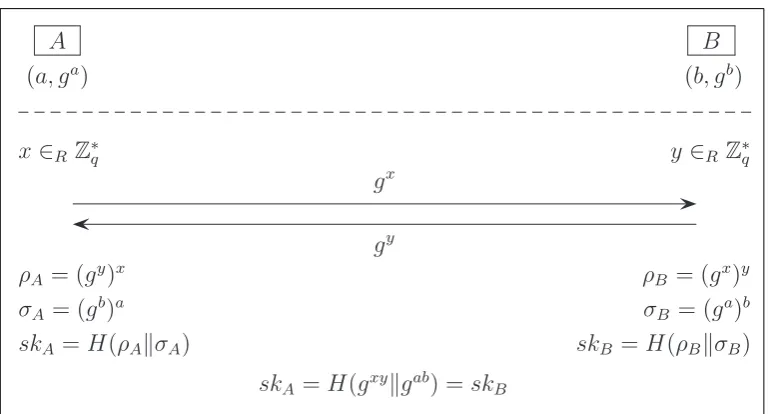
The ‘unified model’ protocol (UMP) is an implicitly-authenticated Diffie–Hellman protocol that has been standardized in IEEE P1363 [24], ANSI X9.63 [4] and ANSI X9.42 [3]. Let A and B be two users who wish to agree on a session key. We assume that A and B have pre-established their static private/public keys (a, ga) and (b, gb),
respectively. UMP runs as shown in Fig. 1 where (1)g is a generator of a cyclic group
A B
(a, ga) (b, gb)
x∈R Z∗q y∈RZ∗q
ρA = (gy)x ρB = (gx)y σA= (gb)a σB = (ga)b skA=H(ρAkσA) skB=H(ρBkσB)
skA=H(gxykgab) = skB gx
gy
Figure 1: UMP: The unified model protocol.
proposed a variant of UMP, where the session key is defined asH(A∥B∥gx∥gy∥gxy∥gab),
and proved its forward secrecy4 under the CDH assumption.
4.1. ID-based versions of UMP
We now derive an ID-based version of UMP by conducting the system setup and then mapping the protocol keys, as described in Sections 3.1 and 3.2. Specifically, we define the system parameters (G1, G2, ˆe, P, G, H), the master private/public keys (s, PP ub = sP) of KGC, and the static private/public keys (sQU, QU = G(IDU)) of
each userU ∈ U. The two groupsG1 andG2 have the orderq and we assume thatq is implicit inG1andG2. The hash functionH has been added into the system parameters since UMP uses it as the key derivation function. We then apply the mapping of Table 1 to all kinds of keys used in UMP, replacing the ephemeral private/public keys (x, gx)
and (y, gy) with (x, xP) and (y, yP), the static private/public keys (a, ga) and (b, gb) with (sQA, QA) and (sQB, QB), the ephemeral Diffie–Hellman key gxy with xyP, and
the static Diffie–Hellman key gab with ˆe(Q
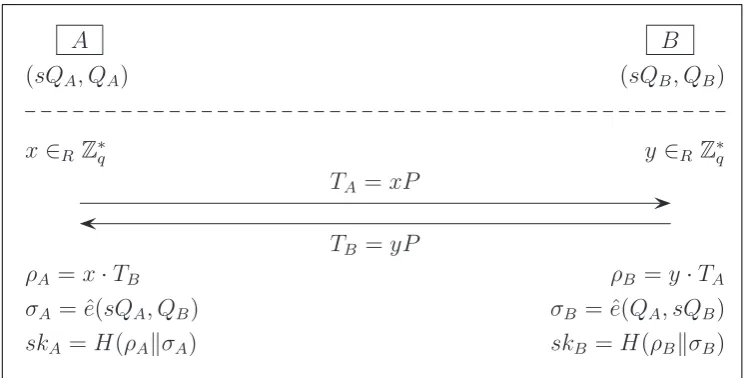
A, QB)s. The resulting protocol, UMP-ID0,
is outlined in Fig. 2. Since ρA =xyP =ρB and σA = ˆe(QA, QB)s =σB, A and B will
compute the same session key
sk =H(xyP∥ˆe(QA, QB)s)
in the presence of a passive adversary.
4In the UMP variant of Jeong, Katz and Lee [26], forward secrecy holds only for session keys
A B
(sQA, QA) (sQB, QB)
x∈RZ∗q y∈R Z∗q
ρA=x·TB ρB =y·TA
σA= ˆe(sQA, QB) σB = ˆe(QA, sQB)
skA =H(ρAkσA) skB =H(ρBkσB)
TA=xP
TB =yP
Figure 2: UMP-ID0: An ID-based version of UMP.
As mentioned above, UMP was proven SK-secure in a restricted adversary model [8]. Since CDH ≤SK UMP, (gα, gβ) ∝ (ga, gb)5 and gab ⇒ eˆ(QA, QB)s, we can prove
the SK security of UMP-ID0 under the BDH assumption on ⟨G1,G2,eˆ⟩ in the same
restricted model. Our proof is provided in the next subsection and, as shown in Table 2, the simulator in the proof will embed the BDH-problem instance (αP, βP, γP)∈G31 into the simulation by using it in place of (QA, QB, PP ub).
Similar to UMP, UMP-ID0 is not secure if the adversary is allowed to ask a Reveal
query. However, this weakness can be easily removed by modifying the session-key computation to
sk =H(pid∥sid∥xyP∥eˆ(QA, QB)s)
where pid = (A, B) and sid =QA∥QB∥TA||TB. This modification ensures (with high
probability) that two user instances must hold the same sets of pid and sid to com-pute the same session key, and thus prevents key-replication attacks such as the one presented by Blake-Wilson, Johnson and Menezes [8] against UMP. We denote this variant of UMP-ID0 by UMP-ID. As claimed by Theorem 2 in Section 4.3, UMP-ID
is SK-secure in the random oracle model under the GBDH assumption. Our proof of Theorem 2 is based on the result of Kudla and Paterson [32] which shows how “ pro-tocols that are proven secure in a restricted model whereby the adversary is restricted from asking Reveal queries can be proven secure without imposing the restriction to the adversary by using a GAP assumption [39] in the random oracle model”.
UMP-ID also provides KGC forward secrecy (see Theorem 3 in Section 4.4). We will derive the proof of this claim from the proof of forward secrecy for the UMP
5As described in Section 3.3, this notation means that in the proof for UMP, the simulator
variant of Jeong, Katz and Lee [26], which is named T S2. Since CDH ≤FS T S2, (gα, gβ) ∝ (gx, gy) and gxy ⇒ xyP, we can prove KGC forward secrecy of UMP-ID
under the CDH assumption inG1. As described in Table 2, the simulator in the proof will embed the CDH-problem instance (αP, βP) ∈ G21 into the simulation by using it in place of (xP, yP).
4.2. Proof of SK security for UMP-ID0
Theorem 1. In the random oracle model and under the BDH assumption, UMP-ID0 is a SK-secure key exchange protocol as long as the adversary makes noReveal queries.
Proof. Assume an adversary A who makes no Reveal queries and can gain a
non-negligible advantage in distinguishing the test session key from random. Then we prove the theorem by constructing from A an algorithm ABDH that solves the BDH problem on ⟨G1,G2,ˆe⟩ with a non-negligible advantage. The objective of ABDH is to compute and output the value ˆe(P, P)αβγ ∈ G2 when given a BDH-problem instance
(αP, βP, γP)∈G31 whereα, β, γ ∈R Z∗q. Let Π∗U,U′ denote ΠiU,U′ for any i.
ABDH runs A while simulating the oracles on its own. ABDH embeds the BDH-problem instance (αP, βP, γP) into the simulation by settingQA =αP, QB =βP and
PP ub=γP. Here,Aand B are two users chosen at random from the set of all users, in
the hope thatAwill ask itsTest query against Π∗A,B or Π∗B,A. For eachU ∈ U \{A, B},
ABDH chooses a random ru ∈ Z∗q and sets their private/public keys to be (ruγP, ruP).
(Recall that, as mentioned in Section 3.3,A will never get direct access to the random oracle G.) ABDH outputs a random k-bit string in response to each distinct H query while storing the input-output pairs of H into a list, which we denote as HList. If A corruptsA orB, thenABDH aborts. When Aasks theTest query, ABDH responds with a random k-bit string. For all other queries of A, ABDH handles them exactly in the same way as the oracles would do. At some point in time,Awill terminate and output its guessb′. When this happens, ABDH selects an entry of the form (ρ∥σ, h) at random from HList, terminates and outputsσ.
Let Ask be the event that A makes the query H(ρt
U∥σUt) when ΠtU is the test
instance. Let qH be the number of H queries made by A. Then, the following is
immediate from the simulation:
• SinceRevealqueries are not allowed (meaning that key-replication attacks are not possible), ABDH outputs the desired result ˆe(P, P)αβγ with probability at least
1/qH if Ask occurs and if the test instance is Π∗A,B or Π∗B,A.
• The probability that the test instance is Π∗A,B or Π∗B,A is 1/(|U|2) = |U|(|U|−2 1). (We stress that this probability is independent of the number of instances but depends only on the number of users.)
Combining these observations yields that: ABDH outputs the desired result ˆe(P, P)αβγ with probability at least
Pr[Ask] 1
qH
2
which is non-negligible as long as Pr[Ask] is non-negligible.
Now, to prove the theorem, it suffices to prove that Pr[Ask] is non-negligible. Since
H is a random oracle and the Reveal oracle is not available, A gains no advantage in distinguishing the test session key from a random key if the event Askdoes not occur, as indicated by the following equation:
AdvUMP-ID0(A) = 2·Pr[Succ]−1 ≤2(Pr[Ask] + 1
2(1−Pr[Ask]))−1 = Pr[Ask].
Therefore, if the advantage of A is non-negligible, Pr[Ask] is non-negligible and so is the probability that ABDH succeeds in solving the BDH problem. This completes the
proof of Theorem 1.
4.3. Proof of SK security for UMP-ID
Theorem 2. In the random oracle model and under the GBDH assumption, UMP-ID is a SK-secure key exchange protocol.
Proof. Assume that there exists an adversary A who can gain a non-negligible
ad-vantage in distinguishing the test session key from random. Then we can construct an algorithm AGBDH that has a non-negligible advantage in solving the GBDH prob-lem on ⟨G1,G2,eˆ⟩. The goal of AGBDH is to output the value ˆe(P, P)αβγ ∈ G2 when given a triple of elements αP, βP, γP ∈ G1, where α, β, γ ∈R Z∗q, as well as an oracle
ODBDH(·,·,·,·) that solves the DBDH problem on ⟨G1,G2,ˆe⟩. Let Π∗U,U′ be ΠiU,U′ for
any i. In UMP-ID, the session key is computed by applying the random oracle H to some string which we call a key derivation string (kds). Let kdsi
U denote the kds of
instance ΠiU. Then,kdsiU =pidiU∥sidiU∥ρiU∥σiU.
AGBDH begins by choosing two usersA and B at random from U and setting QA=
αP, QB = βP and PP ub = γP. For each U ∈ U \ {A, B}, AGBDH chooses a random
ru ∈ Z∗q and sets their private/public keys to be (ruγP, ruP). AGBDH then invokes A
as a subroutine and handles the queries of A as follows:
• Send: AGBDH answers each Send query as per the protocol specification, except that it aborts if the following eventRepeat occurs.
Repeat: The event that an ephemeral private key used by any user in re-sponse to a Send query is used again by that user (in response to a Send
query).
A straightforward calculation shows:
Pr[Repeat]≤ qsend(qsend−1) 2|Z∗q| ,
whereqsend is the number of Sendqueries made by A. Note that no two
• Corrupt: If A corrupts A or B, then AGBDH aborts. Otherwise, AGBDH returns the static private key of the queried user.
• H: AGBDH uses a list, HList, to maintain input-output pairs of H. For each H
query on a string m, AGBDH first checks if HList contains an entry of the form (m, h). If it does, AGBDH returns h. Otherwise, AGBDH checks thatODBDH(αP,
βP, γP, mG2) = 1, where mG2 is a |G2|-bit string that is a suffix of m. If this is true, mG2 = ˆe(P, P)αβγ and therefore, AGBDH will terminate and output m
G2. Otherwise, AGBDH returns a random k-bit string str to A and adds (m, str) to HList.
• Reveal: Given a Reveal query on any instance ΠiU, AGBDH proceeds as follows: 1. If Πi
U ̸= Π∗A,B and ΠiU = Π̸ ∗B,A, AGBDH computes kdsiU and checks if HList
contains an entry of the form (kdsiU, h). If it does, AGBDH returns h to A. Otherwise, AGBDH selects a random k-bit string str, returns str to A, and adds (kdsi
U, str) into HList.
2. If Πi
U = Π∗A,B or ΠiU = Π∗B,A, AGBDH cannot compute kdsiU as it cannot
compute σi
U = ˆe(P, P)αβγ. In this case, AGBDH computes ρiU and checks
if an entry of the form (pidiU∥sidiU∥ρiU, sk) is in a list called RList which
AGBDH maintains to store the revealed session keys of Π∗A,B and Π∗B,A. If it is,AGBDH returnssk toA. Otherwise,AGBDH selects a random k-bit string
str, returns strto A, and adds (pidiU∥sidiU∥ρiU, str) into the RList.
When A asks its Test query, AGBDH responds with a random k-bit string. Let
Ask be the event that A makes the query H(pidt
U∥sidtU∥ρUt∥σUt) when ΠtU is the test
instance. WhenAterminates and outputs its guessb′ (meaning thatAskdid not occur or AGBDH’s guess on the test instance was wrong), AGBDH terminates and outputs a random|G2|-bit string.
From the simulation above, the following can be easily observed:
• IfAskoccurs and if the test instance is Π∗A,B or Π∗B,A, AGBDH outputs the desired result ˆe(P, P)αβγ with probability 1 (see the simulation ofH above) unlessRepeat
occurs.
• The probability that A makes its Test query against Π∗A,B or Π∗B,A is |U|(|U|−2 1).
• The probability that Repeat does not occur is at least 1− qsend(qsend−1)
2|Z∗q| , which is
non-negligible.
These observations together mean thatAGBDHcan output the desired result ˆe(P, P)αβγ
with probability at least
Pr[Ask] 2
|U|(|U| −1)(1−
qsend(qsend−1)
which is non-negligible if Pr[Ask] is non-negligible.
We are now left to prove that Pr[Ask] is non-negligible. Since H is a random oracle and Pr[Repeat] is negligible,Acannot gain a non-negligible advantage in distinguishing the test session key from a random key if Pr[Ask] is negligible, as shown by the following equation:
AdvUMP-ID(A) = 2·Pr[Succ]−1
≤2(Pr[Repeat] + Pr[Ask] + 1
2(1−Pr[Ask]))−1 = 2·Pr[Repeat] + Pr[Ask].
(1)
But since the advantage ofA is non-negligible (by assumption), we obtain that Pr[Ask] is non-negligible and so is the probability of AGBDH solving the GBDH problem. This
completes the proof of Theorem 2.
4.4. Proof of KGC-FS for UMP-ID
Definition 4. For a Send(U, i, M) query, we say that the Send query was passively-generated if the message M was output by a previous Sendquery.
Definition 5 (FS-freshness). We say that an instance is FS-fresh if (1) the Send
queries directed to the instance are passively-generated ones and (2) the adversary has not issued a Reveal query against the instance and its partner instance.
Definition 6 (KGC forward secrecy). A key exchange protocol providesKGC for-ward secrecy (KGC-FS)if, for any FS-fresh instance and for anypptadversaryAwith access to the master private key of KGC, the advantage of A in distinguishing the session key from random is negligible.
Theorem 3. In the random oracle model and under the CDH assumption, UMP-ID provides KGC-FS.
Proof. Assume an adversary A who breaks, with a non-negligible advantage, the
KGC-FS property of UMP-ID. Given the adversary A, we prove the theorem by con-structing an algorithm ACDH that solves, with a non-negligible advantage, the CDH problem inG1. The goal ofACDH is to compute and output the value αβP ∈G1 when given a CDH-problem instance (αP, βP)∈G2
1.
aborts if Repeat occurs, where Repeat is as defined in the proof of Theorem 2. ACDH outputs a random k-bit string in response to each distinct H query while storing the input-output pairs of H into a list called HList. When A asks its Test query, ACDH simply outputs a random k-bit string. For all other queries of A, ACDH handles them in the straightforward way. When A terminates and outputs its guessb′,ACDH selects an entry of the form (pid∥sid∥ρ∥σ, h) at random from HList, terminates and outputs
ρ.
Letkdst
U be the key derivation string of the test instance (see the proof of Theorem
2 for the definition of a key derivation string), andAskbe the event that A makes the query H(kdstU). The statement of the theorem easily follows if we make the following observations:
• If Ask occurs and if ACDH’s guess on the test instance is correct, ACDH outputs the desired resultαβP with probability at least 1/qH unlessRepeatoccurs. Here,
qH denotes the number of H queries made by A.
• The probability that ACDH’s guess on the test instance turns out to be correct (i.e., the probability that the session key of the test instance is computed using bothαP and βP) is n(n2−1)(= 1/(n2)).
• The probability thatRepeatdoes not occur is at least 1−qsend(qsend−1)
2|Z∗q| , whereqsend
is the number ofSend queries made by A.
Therefore, the probability thatACDH outputs αβP is at least Pr[Ask] 1
qH
2
n(n−1)(1−
qsend(qsend−1)
2|Z∗q| ) which is non-negligible as long as Pr[Ask] is non-negligible.
It is not hard to see that Pr[Ask] is non-negligible. SinceH is a random oracle and Pr[Repeat] is negligible,A cannot gain a non-negligible advantage in distinguishing the test session key from a random key if Pr[Ask] is negligible (see Eq. (1) in the proof of Theorem 2). Therefore, Pr[Ask] is non-negligible and so is the probability of ACDH solving the CDH problem. This completes the proof of Theorem 3.
As the static private keys of all users can be computed from the master private key of KGC, Theorem 3 implies that: UMP-ID provides forward secrecy.
5. BJM protocol and its ID-based version
The BJM protocol was presented in 1997 by Blake-Wilson, Johnson and Menezes [8, protocol 4], and runs as shown in Fig. 3 where (1)g is a generator of a cyclic group
Gof prime orderq, (2) (a, ga) and (b, gb) are pairs of static private/public keys ofAand
A B
(a, ga) (b, gb)
x∈R Z∗q y∈R Z∗q
ρA= (gy)a ρB = (ga)y σA = (gb)x σB = (gx)b skA=H(ρAkσA) skB =H(ρBkσB)
skA =H(gaykgbx) =skB gx
gy
Figure 3: BJM: Protocol 4 of Blake-Wilson, Johnson and Menezes [8].
k-bit session keys. BJM is similar to earlier protocols, like MTI/A0 [35], Goss [23] and KEA [38], in the sense that the session key is defined as a function of two shared keysgay
andgbx established through the protocol execution. Kudla and Paterson [32] proposed
a variant of the BJM protocol, where the session key is defined asH(gbx∥gay∥sid) with
sid=ga∥gb∥gx∥gy, and proved its security under the GDH assumption in a model that
captures the notion of key compromise impersonation resistance.
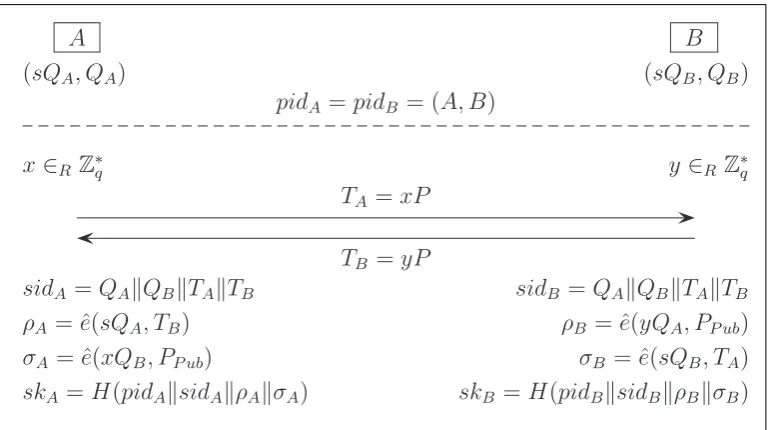
5.1. ID-based version of BJM
We now construct an ID-based protocol from BJM. We first conduct the system setup as described in Section 3.1 to define the system parameters (G1,G2, ˆe,P,G,H), the master private/public keys (s, PP ub =sP) of KGC, and the static private/public
keys (sQU, QU = G(IDU)) of each U ∈ U. The two groups G1 and G2 have order
q, and the hash function H is as defined in BJM. We then apply the mapping of Table 1 to the protocol keys of BJM. The shared secrets gay and gbx are keys of type
“Static-ephemeral Diffie–Hellman keys”, and thus are replaced with ˆe(QA, yP)s and
ˆ
e(QB, xP)s, respectively. Similar to the BJM variant of Kudla and Paterson [32] and
A B
(sQA, QA) (sQB, QB)
x∈R Z∗q y∈RZ∗q
sidA=QAkQBkTAkTB sidB =QAkQBkTAkTB
ρA = ˆe(sQA, TB) ρB = ˆe(yQA, PP ub)
σA = ˆe(xQB, PP ub) σB = ˆe(sQB, TA)
skA=H(pidAksidAkρAkσA) skB =H(pidBksidBkρBkσB)
pidA=pidB= (A, B)
TA=xP
TB =yP
Figure 4: BJM-ID: An ID-based version of protocol BJM.
easily verified from:
ρA = ˆe(sQA, TB)
= ˆe(sQA, yP)
= ˆe(QA, P)ys
= ˆe(yQA, sP)
= ˆe(yQA, PP ub) =ρB,
σA = ˆe(xQB, PP ub)
= ˆe(xQB, sP)
= ˆe(QB, P)xs
= ˆe(sQB, xP)
= ˆe(sQB, TA) = σB.
BJM-ID is a SK-secure protocol that provides key compromise impersonation resistance (KCIR). We will derive the proof for BJM-ID from the proof that the BJM variant of Kudla and Paterson [32], KP-BJM, is a SK-secure protocol providing KCIR. Since GDH ≤SK,KCIR KP-BJM, (gα, gβ) ∝ (gb, gx) and gbx ⇒ eˆ(QB, xP)s, we can prove the
security of BJM-ID under the GBDH assumption on⟨G1,G2,ˆe⟩. As described in Table 2, the simulator in the proof for BJM-ID will embed the GBDH-problem instance (αP, βP, γP)∈G3
1 into the simulation by using it in place of (QB, xP, PP ub).
5.2. Proof of SK security with KCIR for BJM-ID Definition 7 (KCIR-freshness). An instance Πi
U,U′ is KCIR-fresh if none of the
1. The adversary queries Reveal(U, i) or Reveal(U′, j), where ΠjU′ is partnered with
Πi U.
2. The adversary queries Corrupt(U′).
This definition considers an instance Πi
U,U′ as fresh even after the adversary obtained
the static private key of U, and thus captures the notion of KCIR as well as the SK-security notion.
Definition 8 (SK security with KCIR). A key exchange protocol isSK-secure with KCIR if, for any KCIR-fresh instance and for any ppt adversaryA, the advantage of
A in distinguishing the session key from random is negligible.
Theorem 4. In the random oracle model and under the GBDH assumption, BJM-ID is SK-secure with KCIR.
Proof. Assuming an adversary A who can distinguish the test session key from
ran-dom with a non-negligible advantage, we build an algorithm AGBDH that solves the GBDH problem on⟨G1,G2,eˆ⟩with a non-negligible advantage. Let (αP, βP, γP)∈G3 1
be an instance of the GBDH problem given to AGBDH. Then, the goal of AGBDH is to compute and output the value ˆe(P, P)αβγ ∈ G2 when given access to an oracle
ODBDH(·,·,·,·) that solves the DBDH problem on ⟨G1,G2,ˆe⟩.
AGBDH first sets the master public key of KGC to beγP (i.e.,PP ub=γP). AGBDH
then chooses a random user B ∈ U and sets its public key to be αP. For each other user,AGBDH selects a randomr∈Z∗q and sets the private/public keys to be (rγP, rP). Let n be the maximum number of instances that A may activate. AGBDH chooses an instance ΠtA, where A ̸= B, at random from all the n instances, in the hope that A will choose Πt
A,B as the test instance.
Now, AGBDH invokes A as a subroutine and answers the oracle queries on its own.
AGBDH answers all theSend queries ofA as per the protocol specification, except that
AGBDH uses βP as the ephemeral public key of Πt
A and aborts if the event Repeat
occurs (see the proof of Theorem 2 for details on the event Repeat). When A asks a
Corrupt(U) query, AGBDH aborts ifU =B and otherwise, returns the static private key of U.
As defined in the proof of Theorem 2, we let kds be a key derivation string from which a session key is computed by applying the random oracle H, and kdsiU =
pidi
U∥sidiU∥ρiU∥σiU denote the kds of instance ΠiU. As is clear from the above
simu-lation,AGBDH cannot compute kdss
B for anys if the ephemeral public key received by
ΠsB has been generated by A. But, given a string m, AGBDH can determine whether
m=kdss
Deciding m=? kdss B
Letx′P be the ephemeral public key received by ΠsB. Given a stringm,AGBDH first checks if the (bit) length of m is equal to the length of key derivation strings. If it is, then AGBDH checks that (1) pids
B∥sidsB∥ρsB is a prefix of m
and (2)ODBDH(αP, x′P, γP, mG2) = 1 where mG2 is a|G2|-bit string that is a suffix ofm. If both are true, then m =kdss
B.
By using this deciding operation,AGBDH can maintain consistency between answers to
H queries and Reveal queries. AGBDH simulates the random oracle H and the Reveal
oracle as follows:
• H: AGBDH uses a list, HList, to maintain input-output pairs of H. For each
H query on a string m, AGBDH first checks if an entry of the form (m, h) is in HList. If it is, then AGBDH returns h to A. Otherwise, AGBDH checks that
ODBDH(αP, βP, γP, mG2) = 1, where mG2 is a|G2|-bit string that is a suffix of m. If this is true,mG2 = ˆe(P, P)
αβγ and therefore, AGBDH will terminate and output
mG2. Otherwise, AGBDH checks if m = kdss
B for some s. Given the string m,
this check can be done by performing the above deciding operation for each tuple (pidsB∥sidsB∥ρsB, sk) in the RList which is maintained by AGBDH to store revealed session keys of instances ofB. If such a tuple (pids
B∥sidsB∥ρsB, sk) exists in RList,
AGBDH returns sk toA and adds (m, sk) into HList. Otherwise, AGBDH returns a random k-bit string str to A and adds (m, str) into HList.
• Reveal: Given a Reveal query on any instance Πi
U, AGBDH proceeds as follows:
1. If ΠiU = ΠtA or ΠiU = ΠUj′, where ΠjU′ is partnered with ΠtA, AGBDH aborts.
2. If ΠiU = ΠsB for anys,AGBDH computes ρsB and checks if a tuple of the form (pids
B∥sidsB∥ρsB, sk) is in the RList. If it is, AGBDH returns sk in response
to the query. Otherwise, AGBDH checks if HList contains an entry (m, h) such that m = kdssB. Given pidBs∥sidsB∥ρsB, this check can be done by performing the deciding operation for all entries in HList. If such entry (m, h) exists in HList, AGBDH returns h to A and adds (pids
B∥sidsB∥ρsB, h)
into RList. Otherwise, AGBDH returns a random k-bit string str to A, and adds (pids
B∥sidsB∥ρsB, str) into RList.
3. Otherwise,AGBDHcomputeskdsi
U and checks if an entry of the form (kdsiU, h)
is in HList. If it is, AGBDH returns h to A. Otherwise, AGBDH returns a random k-bit string str to A, and adds (kdsi
U, str) into HList.
When A asks its Test query, AGBDH responds with a random k-bit string. LetAsk
![Figure 3: BJM: Protocol 4 of Blake-Wilson, Johnson and Menezes [8].](https://thumb-us.123doks.com/thumbv2/123dok_us/7916338.1314448/21.595.110.497.83.288/figure-bjm-protocol-blake-wilson-johnson-menezes.webp)