collaborative fraud detection
Alex Sangers1, Maran van Heesch1, Thomas Attema1,5, Thijs Veugen1,5, Mark Wiggerman2, Jan Veldsink3, Oscar Bloemen4, and Dani¨el Worm1 1 Netherlands Organisation for Applied Scientific Research (TNO), The Netherlands
2
ABN AMRO, The Netherlands
3 Rabobank, The Netherlands 4
ING, The Netherlands
5 CWI, The Netherlands
Abstract Collaboration between financial institutions helps to improve detection of fraud. However, exchange of relevant data between these in-stitutions is often not possible due to privacy constraints and data confi-dentiality. An important example of relevant data for fraud detection is given by a transaction graph, where the nodes represent bank accounts and the links consist of the transactions between these accounts. Previous works show that features derived from such graphs, like PageRank, can be used to improve fraud detection. However, each institution can only see a part of the whole transaction graph, corresponding to the accounts of its own customers. In this research a new method is described, mak-ing use of secure multiparty computation (MPC) techniques, allowmak-ing multiple parties to jointly compute the PageRank values of their com-bined transaction graphs securely, while guaranteeing that each party only learns the PageRank values of its own accounts and nothing about the other transaction graphs. In our experiments this method is applied to graphs containing up to tens of thousands of nodes. The execution time scales linearly with the number of nodes, and the method is highly parallelizable. Secure multiparty PageRank is feasible in a realistic set-ting with millions of nodes per party by extrapolaset-ting the results from our experiments.
Keywords: Multiparty computation, PageRank, fraud detection, col-laborative computation
1
Introduction
and events between different organizations would be beneficial as well. However, sharing benign data between organizations has always been strongly limited due to competition and privacy regulations, especially if it concerns personal data of customers and employees. The risks of sharing data for companies as well as public services are loss of trust in services, integrity, financial losses, societal damage and damaged reputation.
1.1 The financial sector
The financial sector continuously fights the misuse of the financial infrastructure for criminal activities like fraud and money laundering. An example of such a criminal activity is the following.
Example 1 (‘Carousel’) Loan applications are based on income of the client that requests the loan. A criminal may try to feign income by creating repeated transactions to his account, or node, coming from another node pretending to be a company - just as legitimate salary payments. To keep the needed funds for a criminal low, the money is often drained from the account and placed back on the node of the fake company where the process is repeated.
By looking at the whole network, we may quickly realize that while the feigned salary payments look similar to other salary payments, the node pretending to be a company lacks the structure we see of nodes known to be companies.
Protected by privacy regulations such as the recent GDPR, these bank-transcending fraud and money laundering cases can be challenging to detect. In fact, even malign transaction sequences moving through different departments or channels within a bank may be troublesome to detect, due to the confidentiality of the involved data.
Financial crime detection is an example of a situation in which different parties share a common interest, but confidentiality and privacy regulations pre-vent collaboration. In a payment transaction a financial institution typically only knows one of the parties involved in the payment. Financial institutions would greatly benefit from accessing information from other organizations.
1.2 Secure multiparty computation
Already in the 1980s it was shown that any computable function can be evaluated securely, i.e. in an MPC fashion [24,25,12,3,8]. However, early MPC protocols came at a cost as they introduced a significant computation and/or communication overhead. Over the years progress has been made and research interests have shifted towards practical applicability making MPC ready for deployment [17,4,15,19,11].
MPC has been applied to various use cases ranging from sugar-beet auc-tions [5] to key-management systems [22]. Moreover, applicaauc-tions in the financial domain include confidential benchmarking [9] and off-exchange trading [21]. All these use cases fall under the MPC paradigm in which multiple parties aim to collaboratively evaluate some function without revealing its private input values. Secure graph algorithmics has been another particular area of interest. Short-est path and max-flow algorithms, for example, find their applicability in many situations and a natural question to ask is whether these algorithms can be eval-uated in a privacy-preserving manner. In [7], a secure shortest path algorithm is constructed for the 2-party setting. In [1], the shortest path and max-flow algo-rithm are considered in the general multi-party setting. However, the complexity of these algorithms renders them only applicable to small graphs. To the best of our knowledge, this work is the first to consider the secure application of the PageRank algorithm to large-scale transaction graphs.
MPC delivers the mechanisms needed to collaborate and safeguard data se-curity and privacy without the need for a trusted third party, which would be highly beneficial for the financial industry.
The rest of this paper is structured as follows. The PageRank algorithm is explained in Section 2. Secure multiparty PageRank is described in Section 3. In Section 4 the performance results are presented and the conclusions are presented in Section 5.
2
PageRank for fraud detection
In a transaction graph, nodes represent bank accounts, and edges consist of the unique transactions between accounts. Several graph-based features can be used in machine-learning algorithms to improve existing fraud detection algo-rithms, by reducing the false positives of existing techniques [18]. Namely, after the graph-based features are computed, new transactions that are classified as fraudulent by an existing fraud-detection technique can be re-evaluated by an algorithm that uses these features.
2.1 Requirements for PageRank application for fraud detection
Financial institutions could compute the PageRank values of bank accounts with their observation of the transaction graph. However, in that case they would use only a part of the whole transaction graph. The PageRank values would be much more accurate if the PageRank algorithm were securely applied on transaction data of multiple financial institutions.
In order to apply secure multiparty PageRank in the fraud detection of a bank, the PageRank values need to be available as a feature for machine learning models that use PageRank as input feature. They need to be calculated based on the transaction graph for a predefined period, which is typically one or two months, and need to be updated regularly, e.g. on a monthly basis.
This requires the PageRank and the reverse PageRank computations to take place within ∼ 15 days each. For practical application, however, it would be preferable to compute the PageRank values within∼1 day. This process spans from the starting point where all participants have their graph for the given period ready, to the moment when the PageRank values for all nodes of the participants have been computed and can be used. Furthermore, a reasonable bandwidth for each participant is required, e.g., 100 Mbit/s.
In terms of information, it is not allowed for any participant to learn anything about the graph of another participant, other than what can be learned from the final private PageRank values.
2.2 PageRank and the power method
The original goal of the PageRank algorithm is to compute a scalable centrality measure for websites using the hyperlink structure of the web. Intuitively, imag-ine an Internet user that randomly follows hyperlinks on websites, goes to the next website, etc. As soon as it encounters a website without hyperlinks (a so-calleddangling website), a new website is chosen at random. In addition to this behavior of following hyperlinks, the Internet user will ‘teleport’ to any random website with a known probability 1−p. The resulting probability distribution of visiting frequencies of the Internet user on the websites represents the PageRank value of each website.
Inspired by [18], this idea can easily be translated to transaction graphs. Similarly as with the websites, as soon as a dangling node is encountered, a new node is chosen at random, and there is a teleport probability 1−p. The PageRank values of the transaction graph is the probability distribution based on the visiting frequency of an imaginary coin on the bank accounts.
of node j at the k-th iteration is denoted as xjk. Equation (1) describes the initialization and iterations of the power method variant of [16] to compute the PageRank values of the non-dangling nodes.
xj0= 1
n, ∀j ∈U.
xjk+1= 1−p
n +p·
X
i∈S(j)
xi k
ci +p
n(1−
X
i∈U
xik), ∀j ∈U,
= 1
n+p·
X
i∈S(j)
xi k ci − p n X
i∈U
xik, ∀j∈U,
(1)
where pis a fixed probability, n the total number of nodes, ci the out-degree of nodei, S(j) is the set of incoming edges of nodej intersected withU. Note that ci ≥1 for ∀i ∈S(j). Equation (2) describes how the PageRank values of the dangling nodes can be computed after convergence of the power method iterations in Equation (1).
xj = 1
n+p·
X
i∈S(j)
xi
ci
−p n
X
i∈U
xi, ∀j∈D. (2)
Under mild conditions that are satisfied by transaction graphs, the convergence rate of the power method equalsp[13] (and is thus independent of the size of the graph). For the commonly used p= 0.85, the power method converges within 50 to 100 iterations.
3
A secure multiparty PageRank algorithm
Several factors make securely implementing an algorithm a non-trivial task. The overhead introduced by MPC is significant, requiring a careful analysis of the PageRank algorithm in order to select the optimal MPC protocol. Moreover, most cryptographic protocols work over finite groups, rings or fields and not over the real or complex numbers. This requires a specific representation of the PageRank algorithm, which is originally defined over the real numbers.
3.1 Additively homomorphic encryption
An approach to utilize these linear properties is additively homomorphic encryption. A homomorphic encryption scheme allows the evaluation of certain functions on encrypted input values while remaining oblivious to the actual input values.
Any of the parties could play the evaluator role and perform the compu-tations, as long as the other parties deliver their encrypted input values. The computations can also be distributed amongst the parties so that they share the computational effort. By distributing the computations in such a way that the division by the private valueci is executed by the party that knows this value, all computations become linear, i.e. ciphertexts do not have to be multiplied by other ciphertexts. Because of this linearity the encryption scheme only has to be additively homomorphic and there is no need to use the more sophisticated but far less efficient fully homomorphic encryption (FHE) schemes. For this reason, the additively homomorphic Damg˚ard-Jurik encryption scheme [10], which is a generalization of the Paillier encryption scheme [20], has been adapted.
Damg˚ard-Jurik is a public-key encryption scheme that takes plaintexts from
ZNs and maps them to ciphertexts inZ∗Ns+1, for somes∈Z>0, Encpk:ZNs →Z∗Ns+1,
where N is an RSA-modulus and pk is the public key with the associated pri-vate keysk. The Damg˚ard-Jurik encryption function is probabilistic; it takes as additional input a random argumentr∈RZNs+1\{0}for each invocation, which
we omit in our notation. The additive homomorphic property means that for all
a, b∈ZN,
Decsk(Encpk(a)·Encpk(b)) = Decsk(Encpk(a+b)) =a+b modNs, and, as a consequence, for allc∈Z,
Decsk(Encpk(a) c
) = Decsk(Encpk(c·a)) =c·a modNs.
The parametersinfluences the size of the plaintexts, the size of the ciphertexts and the ratio of the former two. In section 3.6 we will see that, in our case,s= 1 results in a sufficiently large plaintext space. For this reason we will fix s= 1 from now on.
It must also be noted that this approach of distributing the computations does introduce a communication overhead in contrast to using, for example, a fully homomorphic encryption scheme. This trade-off between computation and communication complexity is typical for applying MPC. As we will see later in Section 4, the communication overhead of our solution is acceptable.
3.2 PageRank algorithm over ZN
outcome (approximately) coincides with the outcome of the original PageRank algorithm.
An integer representativey of the real numberxcan be found by applying a scaling factorfx∈Z+,
y=bfx·xe ∈Z.
The fixed scaling factorfxdetermines the precision of the computations, in fact, the real numberxcan be approximated by fxy and
x− y fx ≤ 1
2fx
.
The scaling factorfc is applied to find an integer representation of the fraction p
ci. Multiplying both sides of Equation (1) with the factor (fc) k+1f
xthen results in the following recurrence relation:
(fc)k+1fxx j k+1=
(fc)k+1fx
n +
X
i∈S(j)
pfc
ci
(fc)kfxxik−
pfc
n
X
i∈U
(fc)kfxxik.
Defining ˜yjk :=j(fc)kfxx j k
m
, φk :=
j(f
c)k+1fx n
m
,ρi :=
jpf
c ci
m
and ψ:=jpfc n
m
for all nodesiand iterationskyields the following approximation:
˜
yk+1j ≈φk+
X
i∈S(j)
ρiy˜ik−ψ
X
i∈U ˜
yik.
From this the recurrence relation of Equation (3) is deduced, which is defined over the integers and can be used to approximate the PageRank values of the non-dangling nodes.
yk+1j =φk+
X
i∈S(j)
ρiyik−ψ
X
i∈U
yik with y0j=jfxxj0
m
, ∀j∈V. (3)
The same scaling approach is applied to Equation (2) in which the PageRank values for the dangling nodes are computed. The PageRank values xi
k can be approximated byyi
k/((fc)kfx) with a precision that can be modified by changing the scaling factorsfxand fc.
3.3 PageRank algorithm in the encrypted domain
The encryption function Encpk maps Equation (3) to the following recursive relation overZ∗N2,
zjk+1=Φk·
Y
i∈S(j)
zkiρi
· Y
i∈U
zki
!−ψ
modN2 ∀k,
z0j= Encpk
y0j ∀j∈V.
Here ρi, ψ ∈Zare as in Section 3.2, Φk := Encpk(φk)∈Z∗N2 andz
j
k ∈Z∗N2 for
all j, k. Since the encryption scheme is additively homomorphic it follows that Decsk
zkj=yjk for allj, k.
Note that the value ρi is derived from the out-degree of node i ∈ V, and therefore contains private information. For this reason, the terms zi
k
ρi
should be computed by the party owning nodei. Similarly, the setsS(j) andU contain private information, hence summing over these sets can only be done collabo-ratively. More precisely, the productQ
i∈S(j) z i k
ρi
should be computed by the party owning nodej, and the productQ
i∈Uz i
k should be computed as the pro-duct of all privately computed propro-ducts Q
i∈UPzki, for all partiesP ∈ P. Here
UP is the set of non-dangling nodes belonging to partyP andP is the set of all parties.
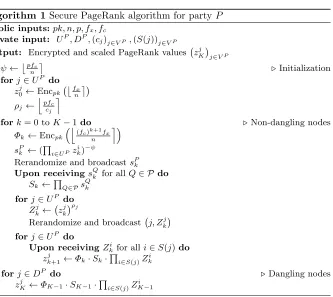
Algorithm 1 describes the computations that have to be performed by partyP, assuming that the encryption key has already been generated. Except for the initialization phase all computations take place in Z∗N2, hence modular
reduc-tions are implicit. Each party executes this algorithm and it is evident that it can only be performed collaboratively.
All values that are broadcast are ciphertexts, hence they do not leak private information. However, together multiple ciphertexts might leak information. In particular, we see that ρj could be derived from the two ciphertexts Z
j k and
zkj. For this reason, every ciphertext is rerandomized before it is broadcast. By rerandomization we obtain another unlinkable ciphertext that decrypts to the same value. We therefore maintain the required functionality without leaking private information. Rerandomization is a standard technique and, in our case, comes down to multiplying the ciphertext with a fresh encryption of 0.
Furthermore, the broadcasting introduces unnecessary communication and even leaks some private information, namely the set UP. Both can be avoided by only sending the ciphertexts to the parties that require them.
3.4 Key generation and decryption
Algorithm 1Secure PageRank algorithm for partyP
Public inputs:pk, n, p, fx, fc
Private input: UP, DP,(c
j)j∈VP,(S(j))j∈VP Output: Encrypted and scaled PageRank values zKj
j∈VP
1: ψ←pfc
n
.Initialization 2: forj∈UP do
3: zj0←Encpk
fx
n
4: ρj←
j
pfc
cj m
5: fork= 0 toK−1do .Non-dangling nodes
6: Φk←Encpk
j
(fc)k+1fx
n
m
7: sPk ←(
Q
i∈UPzki) −ψ
8: Rerandomize and broadcastsPk
9: Upon receivingsQk for allQ∈ Pdo
10: Sk←QQ∈Ps Q k
11: forj∈UP do
12: Zkj← zjkρj
13: Rerandomize and broadcast j, Zkj
14: forj∈UP do
15: Upon receivingZki for alli∈S(j)do
16: zkj+1←Φk·Sk·Qi∈S(j)Z
i k
17: forj∈DP do .Dangling nodes
18: zjK←ΦK−1·SK−1·Qi∈S(j)Z
i K−1
solution requires a distributed implementation of the key generation and decryp-tion algorithm, ensuring that ciphertexts can only be decrypted collaboratively, while individually no information can be deduced. Solutions for distributed key-generation and decryption, allowing up to|P|−1 passive corruptions, are readily available for some cryptosystems [10,14], including, in particular, the DJ scheme of our choice.
3.5 Security model
The implementation achieves computational security in the semi-honest model (passive security), i.e. assuming that all parties follow the prescribed protocol. The number of passive corruptions that can be tolerated is|P| −1.
It is assumed that the number of nodes n in the entire graph is publicly known. This can be achieved by each partyP sharing their number of nodesnP, or by again applying an MPC solution to avoid leaking nP, and only revealing
n. In our solution the values arenP are made public.
3.6 Parameters
As discussed in Section 2, the parameterpand the number of iterationsK
are set to 0.85 and 50 respectively. The size of the RSA-modulusNis set to 2048 bit, as is recommended for 112-bit computational security [2], henceN >22047. Moreover, the scaling parametersfxandfc are both chosen to be equal to 27n, where n is the total number of nodes in the graph. In Section 4 we will show that these scaling factors achieve a desirable level of precision.
Each PageRank valuexi
k is upper bounded by 1, and the total scaling fac-tor after 50 iterations equals (fc)50fx = 2357n51; the following condition will therefore guarantee that we do not encounter overflows:
n <233 =⇒ 2357n51< N.
In other words, the chosen parameter set returns approximated PageRank values for all graphs with less than 233 nodes and there is no need to initialize the Damg˚ard-Jurik cryptosystem with parameters >1.
For larger graphs a larger RSA-modulusN can be chosen or the Damg˚ ard-Jurik cryptosystem can be initialized with a larger exponents. Another approach is the implementation of a secure division protocol, see for example [23], by which the size of the accumulated scaling factor, (fc)kfx, can be reduced after some iterations.
4
Results
In this section, our secure multiparty PageRank solution is evaluated, both in terms of accuracy and in terms of computational and communication complex-ity. Firstly, the securely-computed PageRank values are compared to the stan-dard PageRank values. Secondly, the running time of the algorithm is evaluated for various randomly-generated transaction graphs. Thirdly, the communication complexity of the protocol is analyzed, and finally, the results of the experiment are extrapolated to large-scale transaction graphs.
Our solution has been implemented in Python 3.5 using the General Multi-Precision librarygmpy2 and the Partially Homomorphic Encryption libraryphe. All experiments were run in a single virtual machine with 48 CPU cores (2.4 GHz Intel Xeon E5-2680v4) and 16 GB RAM. The multiparty setting is emulated by assigning every core to exactly one party. The parties communicate by reading and writing data in a given folder on the virtual machine, which means the communication between the parties is performed instantly in this experimental set-up.
4.1 Accuracy of the secure multiparty PageRank algorithm
of our solution is quantified by the maximum relative error:
max i∈V
|s(i)−x(i)| |s(i)| .
To evaluate the accuracy of our algorithm, we randomly sampled directed graphs
G, withnnodes and average out-degreed. To be more precise, for distinct nodes
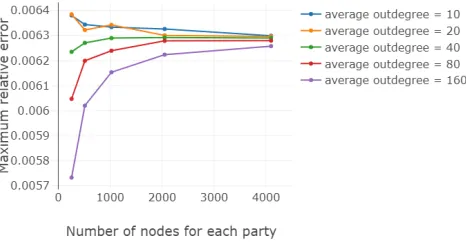
i, j ∈V we draw an edge from i to j with probability d/n. The nodes of this graph are distributed equally amongst 3 parties to represent the multiparty setting. Figure 1 displays the maximum relative error for randomly generated graphs withnranging from 3×256 to 3×4096 anddranging from 10 to 160.
The values x(i) are computed by our implementation of the secure multi-party PageRank algorithm and the valuess(i) are computed with the PageRank functionality of the Python3 package NetworkX. These results show that the maximum relative error is between 0.0057 and 0.0064, meaning that our imple-mentation indeed gives an accurate approximation of the standard PageRank values.
The accuracy of our algorithm is actually independent of the number of parties. To further increase it, the number of iterations K and/or the scaling factorsfx andfc could be increased.
Figure 1.Maximum relative error with increasing number of nodes and edges.
4.2 Performance of the secure multiparty PageRank algorithm
To benchmark the computational complexity of our algorithm, we again consider randomly generated graphs with a total number of nodesnranging from|P|×256 to |P| ×4096 and an average out-degreed ranging from 10 to 160. Recall that
to 3 and consider the computation time for various graph sizes. In our second experiment, we fix the average out-degree to 80 and vary the number of parties. Note that the final step of our protocol, the decryption, is executed collabo-ratively, and therefore the computation times for each party are approximately equal. For this reason, only the computation time for party 1 is considered.
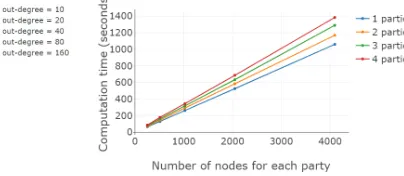
Graph size. Figure 2 shows the results of our first experiment, in which the number of parties is fixed at 3 and each party runs their part of the protocol on a single core of the virtual machine. The computation time of the algorithm scales linearly in the number of nodes and in the average out-degree.
Figure 2.Computation time for
increas-ing numbers of nodes and edges. Figure 3.Computation time for increas-ing numbers of parties.
Number of parties. Figure 3 shows the results of our second experiment, in which the average out-degree is fixed to 80 and the number of parties is varied between 1 and 4. In the setting of our instantiations, each party is assigned the same number of nodes. Hence, the size of the total graph increases with the number of parties. The results show that increasing the number of parties only has a minor effect on the computational complexity of the protocol.
4.3 Parallelization.
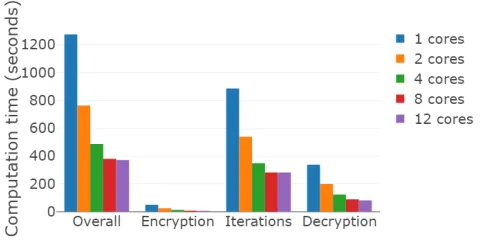
Figure 4.Computation time for increasing numbers of cores.
4.4 Communication
The experiments of the above section were all run on a single machine, and the communication between the parties thus amounted to reading and writing data in a given folder. In real-life scenarios, the parties would be physically separated, and this data has to be communicated over some network. It is therefore impor-tant to measure the communication complexity of the protocol, both in terms of communication rounds and in terms of communicated data.
The number of communication rounds of our secure multiparty PageRank algorithm, excluding the key generation phase, equals K+ 1, where K is the number of PageRank iterations. Table 1 displays the number of ciphertexts that have to be communicated in our protocol, under the assumption that the graph is randomly generated with average out-degree d |P|. Recall that |P|is the number of parties,nis the total number of nodes andnP is the number of nodes of partyP.
Table 1.The number of cipher texts that each partyP uploads and downloads during the secure multiparty PageRank algorithm.
Phase Number of uploaded Number of downloaded cipher texts cipher texts PageRank computation K(nP + 1) K(|P|+n−nP−1)
Decryption n n−2nP+nP|P|)
4.5 Realistic transaction graphs
The performance of our solution was evaluated on relatively small graphs, while in practice, transaction graphs contain millions of nodes. The first column of Table 2 shows the expected computation time for a 3-party setting in which each party has 10 million bank accounts with 80 transaction per bank account on average. Moreover, we assume a very conservative performance gain of a factor 3.4 by distributing the computation over 12 cores instead of using a single core per party; in practice, this gain will likely be much closer to a factor 12 for large graphs.
A significant improvement can be expected by judiciously implementing the algorithm in C++. In particular, 2048-bit modular multiplications have been reported to take only 3.012 ms on a Xeon X64 processor [6]. Modular multipli-cations take up a significant part of the computation time and can be accelerated up to a factor 17 compared to our Python implementation. The estimates in the second column of Table 2 show such an implementation would enable a running time of less than 1 day for a large-scale graph as described above.
Table 2.The estimated runtime for the application of the secure multiparty PageRank algorithm to a graph with 30 million nodes and average out-degree 80 in the 3-party setting.
Python C++
implementation implementation Computation time (days) 10.62 ∼0.62
Communication time (days) 0.35 0.35
Total time (days) 10.97 ∼0.97
5
Conclusions and future research
Existing techniques for fraud detection would highly benefit from collaboration between financial institutes. However, the exchange of relevant information is often limited, or not even possible, due to privacy restrictions or commercial confidentiality. This paper illustrated that secure multiparty computation can help tackle this challenge.
values of its own bank accounts that are derived from the joint network. To achieve the desired security properties an additively homomorphic encryption scheme has been used.
The feasibility of this secure multiparty PageRank algorithm has been shown by implementing it in Python and applying it successfully on randomly gener-ated test networks while simulating up to four different parties. Furthermore, the results show that the secure multiparty PageRank algorithm is scalable and can handle transaction graphs of realistic size in reasonable time, while remain-ing sufficiently accurate. In particular, this allows financial institutes to update PageRank scores at reasonable intervals, e.g. over a month, and use these as features for their own fraud detection methods.
Planned future work includes developing, in contrast to the current passively secure protocol, an actively secure solution. In addition, other homomorphic en-cryption schemes, in particular ones that can withstand the attack of a quantum computer, will be considered.
Further important future work is testing the algorithm on actual combined transaction graphs and analyzing its effectiveness in improving fraud detection. Moreover, PageRank is only one of many graph-based features that may be extracted from transaction graphs as input for fraud detection methods; other application domains in the financial sector that could benefit from the secure analysis of transaction graphs are, for example, commercial banking and anti-money laundering.
In conclusion, the feasibility of securely analyzing features of a large-scale network that is distributed over multiple parties has been demonstrated, thus paving the way for several collaboration initiatives that were previously not possible.
6
Acknowledgments
A
Parameters
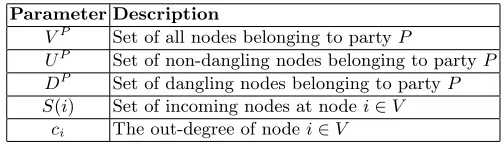
The following public and private parameters are considered in the secure PageRank algorithm, Algorithm 1.
Table 3.Public parameters of the secure multiparty PageRank algorithm
Parameter Description
P Set of parties n Number of nodes
N RSA modulus
K Number of PageRank iterations p PageRank probability
fc Scaling factor for all cp
i
fx Scaling factor for allxik
φk Integer PageRank constant of iterationk Φk Encrypted PageRank constant of iterationk
ψ Integer PageRank constant
pk Public Damg˚ard-Jurik encryption key zki Encrypted and scaled PageRank value
of nodeiat iterationk
Table 4.Private parameters of the secure multiparty PageRank algorithm
Parameter Description
VP Set of all nodes belonging to partyP
UP Set of non-dangling nodes belonging to partyP DP Set of dangling nodes belonging to partyP S(i) Set of incoming nodes at nodei∈V
References
1. Aly, A., Cuvelier, E., Mawet, S., Pereira, O., Vyve, M.V.: Securely solving sim-ple combinatorial graph problems. In: Sadeghi, A. (ed.) Financial Cryptography and Data Security - 17th International Conference, FC 2013, Okinawa, Japan, April 1-5, 2013, Revised Selected Papers. Lecture Notes in Computer Science, vol. 7859, pp. 239–257. Springer (2013). https://doi.org/10.1007/978-3-642-39884-1 2https://doi.org/10.1007/978-3-642-39884-1, https://doi.org/https://doi.org/10.1007/978-3-642-39884-10.https://doi.org/10.1007/978-3-642-39884-1007/978-3-642-39884-https://doi.org/10.1007/978-3-642-39884-1 2https://doi.org/10.1007/978-3-642-39884-1
2. Barker, E., Barker, W., Burr, W., Polk, W., Smid, M., Zieglar, L.: Recommendation for key management - part 1: General (revision 4). National Institute of Standards and Technology - Special Publication800(57), 1–156 (2015)
3. Ben-Or, M., Goldwasser, S., Wigderson, A.: Completeness theorems for non-cryptographic fault-tolerant distributed computation (extended abstract). In: Si-mon, J. (ed.) Proceedings of the 20th Annual ACM Symposium on Theory of Computing, May 2-4, 1988, Chicago, Illinois, USA. pp. 1–10. ACM (1988). https://doi.org/10.1145/62212.62213, http://doi.acm.org/10.1145/62212.62213 4. Bogdanov, D., Laur, S., Willemson, J.: Sharemind: A framework for fast
privacy-preserving computations. In: Jajodia, S., L´opez, J. (eds.) Computer Security -ESORICS 2008, 13th European Symposium on Research in Computer Security, M´alaga, Spain, October 6-8, 2008. Proceedings. Lecture Notes in Computer Sci-ence, vol. 5283, pp. 192–206. Springer (2008). https://doi.org/10.1007/978-3-540-88313-5 13, https://doi.org/10.1007/978-3-540-https://doi.org/10.1007/978-3-540-88313-5 13
5. Bogetoft, P., Christensen, D.L., Damg˚ard, I., Geisler, M., Jakobsen, T.P., Krøigaard, M., Nielsen, J.D., Nielsen, J.B., Nielsen, K., Pagter, J., Schwartzbach, M.I., Toft, T.: Secure multiparty computation goes live. In: Dingledine, R., Golle, P. (eds.) Financial Cryptography and Data Security, 13th Interna-tional Conference, FC 2009, Accra Beach, Barbados, February 23-26, 2009. Revised Selected Papers. Lecture Notes in Computer Science, vol. 5628, pp. 325–343. Springer (2009). https://doi.org/10.1007/978-3-642-03549-4 20, https://doi.org/10.1007/978-3-642-03549-4 20
6. Bos, J.W., Montgomery, P.L., Shumow, D., Zaverucha, G.M.: Montgomery multi-plication using vector instructions. IACR Cryptology ePrint Archive2013, 519 (2013), http://eprint.iacr.org/2013/519
7. Brickell, J., Shmatikov, V.: Privacy-preserving graph algorithms in the semi-honest model. In: Roy, B.K. (ed.) Advances in Cryptology - ASIACRYPT 2005, 11th International Conference on the Theory and Application of Cryptology and Information Security, Chennai, India, December 4-8, 2005, Proceedings. Lecture Notes in Computer Science, vol. 3788, pp. 236–252. Springer (2005). https://doi.org/10.1007/11593447 13, https://doi.org/10.1007/11593447 13 8. Chaum, D., Cr´epeau, C., Damg˚ard, I.: Multiparty unconditionally secure
pro-tocols (extended abstract). In: Simon, J. (ed.) Proceedings of the 20th An-nual ACM Symposium on Theory of Computing, May 2-4, 1988, Chicago, Illinois, USA. pp. 11–19. ACM (1988). https://doi.org/10.1145/62212.62214, http://doi.acm.org/10.1145/62212.62214
10. Damg˚ard, I., Jurik, M.: A generalisation, a simplification and some applications of paillier’s probabilistic public-key system. In: Kim, K. (ed.) Public Key Cryp-tography, 4th International Workshop on Practice and Theory in Public Key Cryptography, PKC 2001, Cheju Island, Korea, February 13-15, 2001, Proceed-ings. Lecture Notes in Computer Science, vol. 1992, pp. 119–136. Springer (2001). https://doi.org/10.1007/3540445862 9, https://doi.org/10.1007/3540445862 -9
11. Damg˚ard, I., Pastro, V., Smart, N.P., Zakarias, S.: Multiparty computation from somewhat homomorphic encryption. In: Advances in Cryptology - CRYPTO 2012 - 32nd Annual Cryptology Conference, Santa Barbara, CA, USA, August 19-23, 2012. Proceedings. pp. 643–662 (2012). https://doi.org/10.1007/978-3-642-32009-5 38, https://doi.org/10.1007/978-3-642-32009-https://doi.org/10.1007/978-3-642-32009-5 38
12. Goldreich, O., Micali, S., Wigderson, A.: How to play any mental game or A completeness theorem for protocols with honest majority. In: Proceedings of the 19th Annual ACM Symposium on Theory of Computing, 1987, New York, New York, USA. pp. 218–229 (1987). https://doi.org/10.1145/28395.28420, http://doi.acm.org/10.1145/28395.28420
13. Haveliwala, T., Kamvar, S.: The second eigenvalue of the google matrix. Technical Report 2003-20, Stanford InfoLab (2003), http://ilpubs.stanford.edu:8090/582/ 14. Hazay, C., Mikkelsen, G.L., Rabin, T., Toft, T.: Efficient RSA key
gen-eration and threshold paillier in the two-party setting. In: Dunkelman, O. (ed.) Topics in Cryptology - CT-RSA 2012 - The Cryptographers’ Track at the RSA Conference 2012, San Francisco, CA, USA, February 27 -March 2, 2012. Proceedings. Lecture Notes in Computer Science, vol. 7178, pp. 313–331. Springer (2012). https://doi.org/10.1007/978-3-642-27954-6 20, https://doi.org/10.1007/978-3-642-27954-6 20
15. Henecka, W., K¨ogl, S., Sadeghi, A., Schneider, T., Wehrenberg, I.: TASTY: tool for automating secure two-party computations. In: Al-Shaer, E., Keromytis, A.D., Shmatikov, V. (eds.) Proceedings of the 17th ACM Conference on Com-puter and Communications Security, CCS 2010, Chicago, Illinois, USA, October 4-8, 2010. pp. 451–462. ACM (2010). https://doi.org/10.1145/1866307.1866358, http://doi.acm.org/10.1145/1866307.1866358
16. Ipsen, I.C.F., Selee, T.M.: Pagerank computation, with special attention to dan-gling nodes. SIAM J. Matrix Analysis Applications 29(4), 1281–1296 (2007). https://doi.org/10.1137/060664331, https://doi.org/10.1137/060664331
17. Malkhi, D., Nisan, N., Pinkas, B., Sella, Y.: Fairplay - secure two-party computa-tion system. In: Blaze, M. (ed.) Proceedings of the 13th USENIX Security Sym-posium, August 9-13, 2004, San Diego, CA, USA. pp. 287–302. USENIX (2004), http://www.usenix.org/publications/library/proceedings/sec04/tech/malkhi.html 18. Molloy, I., Chari, S., Finkler, U., Wiggerman, M., Jonker, C., Habeck, T., Park, Y., Jordens, F., van Schaik, R.: Graph analytics for real-time scoring of cross-channel transactional fraud. In: Grossklags, J., Preneel, B. (eds.) Financial Cryptography and Data Security - 20th International Conference, FC 2016, Christ Church, Bar-bados, February 22-26, 2016, Revised Selected Papers. Lecture Notes in Computer Science, vol. 9603, pp. 22–40. Springer (2016). https://doi.org/10.1007/978-3-662-54970-4 2, https://doi.org/10.1007/978-3-662-https://doi.org/10.1007/978-3-662-54970-4 2
Science, vol. 7417, pp. 681–700. Springer (2012). https://doi.org/10.1007/978-3-642-32009-5 40, https://doi.org/10.1007/978-3-https://doi.org/10.1007/978-3-642-32009-5 40
20. Paillier, P.: Public-key cryptosystems based on composite degree residuosity classes. In: Stern, J. (ed.) Advances in Cryptology - EUROCRYPT ’99, Inter-national Conference on the Theory and Application of Cryptographic Techniques, Prague, Czech Republic, May 2-6, 1999, Proceeding. Lecture Notes in Computer Science, vol. 1592, pp. 223–238. Springer (1999). https://doi.org/10.1007/3-540-48910-X 16, https://doi.org/10.1007/3-540-https://doi.org/10.1007/3-540-48910-X 16
21. Partisia: Secure order matching. https://partisia.com/order-matching/ (2018), ac-cessed: 2018-07-31
22. Unbound: Hybrid cloud key management for any key, any cloud. https://www.unboundtech.com/usecase/hybrid-it-key-management-any-key-any-cloud/ (2018), accessed: 2018-07-31
23. Veugen, T.: Encrypted integer division and secure comparison. IJACT
3(2), 166–180 (2014). https://doi.org/10.1504/IJACT.2014.062738, https://doi.org/10.1504/IJACT.2014.062738
24. Yao, A.C.: Protocols for secure computations (extended abstract). In: 23rd Annual Symposium on Foundations of Computer Science, Chicago, Illinois, USA, 3-5 November 1982. pp. 160–164. IEEE Computer Society (1982). https://doi.org/10.1109/SFCS.1982.38, https://doi.org/10.1109/SFCS.1982.38 25. Yao, A.C.: How to generate and exchange secrets (extended abstract). In: