Tasks in the Quantum World
Serge Fehr1, Jonathan Katz2?,
Fang Song3, Hong-Sheng Zhou2??, and Vassilis Zikas4? ? ? 1 Centrum Wiskunde & Informatica (CWI),
2
University of Maryland,{jkatz, hszhou}@cs.umd.edu
3 Pennsylvania State University,[email protected] 4
UCLA,[email protected]
Abstract. It is known that cryptographic feasibility results can change by moving from the classical to the quantum world. With this in mind, we study the feasibility of realizing functionalities in the framework of uni-versal composability, with respect to both computational and information-theoretic security. With respect to computational security, we show that existing feasibility resultscarry over unchanged from the classical to the quantum world; a functionality is “trivial” (i.e., can be realized without setup) in the quantum world if and only if it is trivial in the classical world. The same holds with regard to functionalities that arecomplete
(i.e., can be used to realize arbitrary other functionalities).
In the information-theoretic setting, the quantum and classical worlds differ. In the quantum world, functionalities in the class we consider are either complete, trivial, or belong to a family of simultaneous-exchange functionalities (e.g., XOR). However, other results in the information-theoretic setting remain roughly unchanged.
1
Introduction
In a classicalsetting of cryptography, participants in a protocol (both the hon-est parties and the adversary), are modeled as being able to perform classical computation only. In thequantum setting, however, parties are able to send and receive quantum states and process quantum information. It is well known that cryptographic feasibility results in these two settings differ; for example, key exchange with information-theoretic security is possible in the quantum world, but not in the classical world. In this paper we focus on protocols for univer-sally composable two-party computation, and study the relationships between feasibility/impossibility results in the classical and quantum settings.
?
This work was supported by NSF awards #1111599 and #1223623.
?? Supported by an NSF CI postdoctoral fellowship. ? ? ?
1.1 Universally Composable Computation in the Classical World
Our focus in on secure computation within the framework of universal compos-ability [8], which provides strong composition guarantees when arbitrary proto-cols are executed concurrently. Soon after the introduction of this framework, Canetti and Fischlin [9] showed that, without honest majority, UC commitment is impossible to achieve. This was later extended to rule out protocols for securely achieving most other “interesting” tasks [10, 32].
On the positive side, it is known that (under suitable cryptographic assump-tions) any functionality can be securely computed, without honest majority, if we are willing to assume some form of trusted setup such as a common ref-erence string [9, 11]. Subsequent work has identified other complete setup as-sumptions [1, 19, 18, 12]. Completeness results in the information-theoretic (or statistical) setting, where the adversary is computationally unbounded, have also been shown [21, 18].
Maji et al. [28] proved azero/one law: every two-party deterministic function with polynomial-size input domain is either trivial1 (i.e, can be realized in the UC framework with no setup assumptions), orcomplete(i.e., sufficient for com-puting arbitrary other functions, under appropriate complexity assumptions). This characterization was extended by Katz et al. [20], who showed complete-ness for deterministic functions with exponential-size input domains, and by Rosulek [33], who showed completeness for randomized, reactive functions as well. In the setting of information-theoretic security, Kraschewski et al. [22] give a characterization of completeness for two-party deterministic functionalities, and show that a zero/one laws does not hold. In fact, Maji et al. [27] show there is an infinite hierarchy of function complexity in the statistical setting.
1.2 The Shift to a Quantum World
How do the results described in the previous section change when we move to the quantum world? The answer,a priori, is unclear. Feasibility results in the classical setting may not hold in the quantum setting since quantum adversaries are more powerful than classical ones. This is true even if “quantum-resistant” cryptographic assumptions are used, since techniques such as rewinding that are used to prove security against classical adversaries may not apply in the quantum setting. Even in the case of statistical security, feasibility results may not translate from the classical world to the quantum world [14].
In the other direction, impossibility results in the classical setting might po-tentially be circumvented in the quantum setting since honest parties can rely on quantum mechanics, too. As a notable example of this, statistically secure key exchange is possible in the quantum world [3] but not in the classical one. While several impossibility results for statistically secure two-party computation in the quantum setting are known [29, 24, 23, 34, 6], these results say nothing about the computational setting. They also say nothing about what might be possi-ble given trusted setup. An example here, that also demonstrates the power of
1
quantum protocols, arises in the context of building oblivious transfer (OT) from commitment. Classically, this is impossible [27]. However, there is a construction of OT from commitment in the quantum world [4, 15, 36, 5]; as a consequence, commitment is complete for UC computation in that setting [36].
Given the above, the situation regarding triviality and completeness of func-tionalities within thequantum UC framework (see Section 2) is unclear, though partial answers are known. In the statistical setting, Unruh [36] gives a generic “lifting” theorem asserting that classically secure protocols remain (statistically) secure in the quantum world. So any functionalities that are classically trivial (in a statistical sense) are also trivial in a quantum setting. Moreover, any functional-ity that is classicallycompletein a statistical sense (and so in particular OT [36]) is complete with respect to the quantum UC framework as well. The situation is less clear with regard to computational security. A recent work by Hallgren et al. [17] “salvages” a few classically complete functionalities, showing that, for example, coin-flipping and zero-knowledge are still complete in the quantum world. But this does not rule out the possibility that some classically complete functionalities are no longer complete in the quantum setting.
1.3 Our Results
We study feasibility and completeness of an interesting class of two-party, deter-ministic functionalities on polynomial-size domains. We prove generic, quantum-lifting theorems and use them to show that feasibility in the quantum world is equivalent to classical feasibility, in both the computational and statistical settings. An important ingredient here is a quantum analogue of the Canetti-Fischlin result [9], showing that there is no quantum protocol realizing UC com-mitment against computationally bounded quantum adversaries in the plain model.2 This result extends the known impossibility results mentioned earlier for statistically secure protocols in the quantum setting.
At the core of our quantum-lifting theorems is a quantum construction of sta-tistically secure OT from the “2-bit cut-and-choose” functionality F2CC. (Note
that F2CC is not complete in the classical setting.) Our construction is a
modi-fication of the BBCS protocol [4], but existing techniques do not seem to apply for arguing its security. Instead, we introduce and analyze anadaptive version of the sampling technique from [5], and use this to prove the security of our OT protocol. The adaptive-sampling analysis may be of independent interest.
Our lifting theorems for the case of computational security, together with Unruh’s lifting theorem for the statistical case [36], imply that any classically complete functionality remains complete in the quantum setting. On the other hand, we identify tasks that are statistically complete using quantum protocols but are incomplete classically. Our results show, roughly, that every functionality in our class is either trivial or complete in the quantum computational setting; thus, the situation here is analogous to the classical case [28]. In the quantum
2
statistical setting, however, functionalities fall into one of three different classes; this is in contrast with the (more complicated) classical picture [27, 22].
1.4 Additional Related Work
Proving security of quantum protocols has been challenging and nontrivial. In-deed, it was only several years after the invention of quantum key-exchange protocols that rigorous proofs of security were given [30, 25, 35]. With regard to secure computation, the first broad feasibility results were in the setting of multi-party protocols with information-theoretic security, assuming honest ma-jority [13, 2]. Positive results for computational security in the quantum world, without honest majority, have only recently been shown [37, 26, 17, 16].
1.5 Outline of the Paper
In Section 2, we describe the classical and the quantum UC models as well as our terminology. We prove our lifting theorems for completeness in Section 3, and for feasibility in Section 4. In Section 5, we apply our lifting theorems to classify the cryptographic complexity of functionalities in the class we consider.
2
The Model
In this section we describe the model and our terminology. We consider two types of security statements, namely classical and quantum. The classical statements are done in Canetti’s (classical) UC framework [8]. For quantum statements we use the recently developed quantum-UC framework [36]. In this work, we assume static, i.e., non-adaptive corruption. Namely an adversary chooses the set of parties to corrupt before execution of the protocol.
Universal composability and the hybrid model.The most important fea-ture of the simulation-based security definition is that it allows to argue about security of protocols in a composable way. In particular, letπbe a protocol which securely realizes a functionality F. If we can prove that a protocol π0 securely realizes a functionalityF0 using invocations of F as in the ideal world, then it follows automatically that if we replace inπ0 the invocations ofFby invocations ofπ, the resulting protocol also securely realizesF0. Therefore we only need to prove the security of π0 in the so-calledF-hybridmodel, where the players run π0 and are allowed to make invocations toF.
Reductions and cryptographic complexity.For two ideal functionalitiesF and F0, we say that F computationally (classical) UC reduces to F0, denoted as F vccompF0, if there exists aF0-hybrid protocolπF0 which computationally
securely realizes F. If the protocolπF0 statistically securely realizesF, then we say thatFstatistically (classical) UC reduces toF0, denoted asF vcstatF0. As
syntactic sugar, we say that F andF0 are computationally (resp. statistically) UC equivalent, denoted as F ccomp≡ F0 (resp. F cstat≡ F0), if F vccomp F0 and
F0vccompF (resp.F vcstatF0 and F0vcstatF).
The reduction-relationvis “transitive” in the sense that ifF0v F, then any task which is implementable in theF0-hybrid world is also implementable in the F-hybrid world. This implies a notion of cryptographic complexity for functions, whereF0v F implies thatF is at least as high in the hierarchy asF0.
Feasibility and completeness.LetFSECdenote the secure channels
function-ality.We say that a functionality F is computationally (resp. statistically) UC feasibleif F vccomp F
SEC (resp. F vcstat FSEC). Furthermore, we say that F is
computationally (resp. statistically) UC completeif for any well-formed function-alityF0:F0vccompF (resp.F0vcstatF).
The Quantum UC framework [36].The quantum-UC framework generalizes the classical UC model, in which the players (including the adversaries and the environment) are quantum machines. A quantum universal composition theo-rem was proved in [36]. We point out that in this work we only consider ideal functionalities with classical inputs and outputs. For two ideal functionalities F and F0, we say thatF computationally quantum-UC reduces toF0, denoted as F vqcompF0, if there exists aF0-hybrid protocolπF0 which computationally
securely realizes F. If the protocolπF0 statistically securely realizesF, then we say that Fstatistically quantum-UC reduces toF0, denoted asF vqstatF0. We
say that a functionality F is computationally (resp. statistically) quantum-UC feasibleifFcan be computationally (resp. statistically) quantum-UC realized in the plain quantum-UC model, i.e., without assuming any hybrids.3Furthermore, we say thatFiscomputationally (resp. statistically) quantum-UC completeif for any well-formed (classical) functionality F0 : F0 vqcomp F (resp.F0 vqstatF).
3 We point out that quantum secure channel is implied by authentication channel
The definitions of computation and statistical quantum-UC equivalence is also analogous to the classical setting.
In [36] the so-called(statistical) quantum lifting theoremwas proved which, roughly speaking shows that if a classical protocol is statistically UC secure then it is also statistically quantum-UC secure.
Fact 1 ([36, Theorem 15] – The Quantum Lifting Theorem) If a proto-colπstatistically UC realizes a functionalityF, thenπstatistically quantum-UC realizes the functionalityF.
Remark 1 (Polynomial Simulation).In all the security definitions considered in this work we explicitly require that the simulator’s running time is polynomial to the running time of the adversary. We call this propertypolynomial simulation. The property ensures that when a protocol statistically realizes a functionality, then it also computationally realizes it [7, 8]. We point out that the definition of statistical quantum-UC security in [36] explicitly requirespolynomial simulation.
Ideal functionalities and the classU−.Ideally, we would like our statements
to cover the whole classU of finite, deterministic, two-party functionalities, which is the central class studied in [27, 28]. However, we were unable to prove or disprove (quantum-UC) neither completeness nor feasibility of the 1-bit cut-and-choose functionalityF1CC∈ U (also denoted asFCC). We were able to prove
statistical quantum-UC completeness of its “closest sibling;” namely, the 2-bit cut-and-choose functionality F2CC.4 Therefore, our results are for the slightly
smaller class U− which isU excluding the small fraction of functionalities that
are sufficient for (statistically classically) realizingF1CCbut not for realizingF2CC.
Formally:
U−={F |(F ∈ U)∧((F2CCvcstatF)∨(F1CC6vcstatF))}.
Note that, as demonstrated in [28], the missing fraction, i.e.,U \ U−, is indeed
very small as, roughly, it corresponds to the lowest primitive of an infinitestrict hierarchy of (statistically classically) incomplete “cut-and-choose” primitives.5 Nevertheless, it remains an open problem to prove quantum-UC feasibility or completeness of F1CC (which would complete the characterization of U) as it
does not follow from any known classical or quantum results.
For completeness, we list a few two-party ideal functionalities that are used as setups in this work.Consistently with existing literature we use the names Alice and Bob for the parties:
•1-out-of-2 Oblivious TransferFOT: Alice (the sender) inputs 2 bits (s0, s1) and Bob (the receiver) inputs a selection bitc∈ {0,1}. Bob receivessc fromFOT. We
4 Our conjecture is thatF
1CC is also statistically quantum-UC complete. Recall that
classically neitherFCCnorF2CCis statistically UC complete [28].
5 These are variations of F
2CC parameterized by the size of Bob’s input, i.e., FmCC
behaves as FCC where Bob’s input is a string of length m. (F1CC is the lowest and
also consider the more general string OT, where (s0, s1) are`-bit strings. Our OT protocol in Sect. 3.1 realizes string OT.
•CommitmentFCOM: Alice (the committer) inputs a bitband Bob (the receiver)
receives from FCOM a notification that a bit was received. At a later point, Alice
can input the commandopentoFCOM in which case Bob receivesb.
•XORFXOR: Alice and Bob input bitsbAandbB, respectively. They both receive
the outputy=bA⊕bB.
• 2-bit Cut-and-Choose F2CC: Bob inputs a 2-bit string b = (b0, b1), an Alice inputs a selection bit sA; informally, sA indicates whether or not Alice wishes to learn b. Bob receives output sA and Alice receives output b if sA = 1, and receives⊥ifsA= 0.
•Coin TossingFCOIN: Alice and Bob input a request toFCOIN, andFCOINrandomly
chooses a fair coinr ∈ {0,1}and it then sends delayed output r to both Alice and Bob.
Note that the functionalitiesFOT,FXOR, F2CC, andFCOMare in the set U−.
Notational conventions. Throughout the paper we use small π to denote a classical protocol in classical UC model, while we use capital Π to denote a classical or quantum protocol in quantum UC model.
3
Quantum Lifting for Completeness
In this section we prove that statements about completeness of functionalities in the classical setting are preserved in the quantum setting. More precisely, we prove the following theorem:
Theorem 1. For anyF ∈ U− the following statements hold:
1. (Statistical Setting) IfF is statistically classical-UC complete thenF is sta-tistically quantum-UC complete.
2. (Computational Setting) IfFis computationally classical-UC complete under the semi-honest OT assumption shOT then F is computationally quantum-UC complete under the assumptions of existence of a quantum-secure pseu-dorandom generator and a dense encryption that is quantum IND-CPA.
The statistical statement follows easily from Unruh’s quantum lifting theorem (Fact 1) and the definition of completeness. In the remaining of this section we prove the computational statement. To this direction we follow a structure similar to that of [28]: First, in Section 3.1 we show that for any F ∈ U−,
either F is computationally quantum-UC feasible or for a functionality F0 ∈ {FXOR,FOT,F2CC,FCOM}, there exists a statistically quantum-UC secure protocol
which reducesF0 toF. Second, in Section 3.2, we show thatFXOR,FOT,F2CC, and FCOM are computationally quantum-UC complete. Statement 2 of the theorem
3.1 Non-Feasibility Implies FXOR,FOT, F2CC, or FCOM
To show that every infeasibleF ∈ U−, there is someF0 ∈ {F
XOR,FOT,F2CC,FCOM}
such that F0 vqcompF, we use the following result that is proved in [28,
Theo-rems 1,4]: ifF ∈ U is not UC feasible, then forF0vcstatF. Using this result on
U− we obtain the following:
Fact 2 ([28]) Let F ∈ U−. IfF is not compuationally (UC) feasible, then for someF0∈ {FXOR,FOT,F2CC,FCOM} the following holds:F0vcstatF.
Because the reductions in Fact 2 are information-theoretic (with polynomial-simulation), the statement can be translated to the quantum-UC setting by Fact 1. This proves the following lemma:
Lemma 1. LetF ∈ U−. IfFis not statistically quantum-UC feasible , then for
someF0∈ {FXOR,FOT,F2CC,FCOM} the following holds:F0vqstatF.
Proof. First observe thatFis not statistically classical-UC feasible, because oth-erwise the lifting lemma (Fact 1) will impy thatFis also statistically quantum-UC feasible, contradicting the assumption. Then by our lifting theorem for fea-sibility in later section (Sect. 4, Theorem 2), statistical UC infeafea-sibility of F implies thatFisnot computationally UC feasible. Then Fact 2 tells us that for some F0 ∈ {FXOR,FOT,F2CC,FCOM} : F0 vcstat F , which, in turns implies that
F0vqstatF by Fact 1.
3.2 Quantum-UC Completeness of FXOR,FOT, F2CC, and FCOM
We next prove that each of the functionalitiesFXOR,FOT,F2CCandFCOMis
compu-tationally quantum-UC complete6. The quantum-UC completeness ofF
OT and
FCOMwas proved in [36]:
Lemma 2. FOT andFCOMare statistically quantum-UC complete.
This immediately gives us the desired computational quantum-UC complete-ness ofFOT andFCOM. Next, we show completeness for the XORfunctionality. To
this direction we use the following idea: first we use the straight-forward classical FXOR-hybrid coin-tossing protocol (each party chooses a random bit and sends
it to FXOR; the output of every party is the value they receive from FXOR) to constructFCOIN; subsequently, we apply the results of [17] who proved
computa-tionally quantum-UC completeness ofFCOIN under proper assumptions.
Lemma 3. Assuming existence of a quantum-secure pseudorandom generator and a dense encryption that is quantum IND-CPA, thenFXORis computationally
quantum-UC complete.
6
The most involved completeness proof is the one concerning the cut-and-choose functionalityF2CC. In [28], they constructed a classical protocol realizing
FCOMfromF1CC. However, their security proof involves rewinding, and it is unclear
how to make it go through against quantum adversaries.7
Instead, we demonstrate completeness of F2CC by constructing a quantum
protocol that statistically quantum-UC realizes FOT in F2CC-hybrid world (and
then applying Lemma 2). The idea is motivated by the quantum OT construction in theFCOMhybrid world by Bennett et al [4]. In this protocol, roughly speaking,
FCOM is used in a checking subroutine to ensure that malicious Bob measures
his qubits upon arrival (and does not store them until Alice informs him about the bases used). More specifically, Alice sends several qubits encoded in random bases, and Bob measures all of them and commits, for each qubit, to the pair (˜xBi ,θ˜iB), where ˜xBi is the outcome of the measurement of theithqubit and ˜θiB is the corresponding basis Bob used. Alice then asks Bob to open a randomly chosen subset of the committed pairs, and she checks consistency with how she had prepared the qubits. Intuitively, this indeed ensures that Bob has measures most of the qubits, as otherwise he would not know what to commit to. Formally proving this intuition turned out to be non-trivial, with the first rigorous proofs given in [15, 36, 5].
Our protocol uses, instead of commitments, invocations toF2CCto implement
the checking step (see the protocolΠQOT below). Intuitively, this should enforce
Bob to measure all the qubits as in the original protocol based on commitments. Unfortunately, the formal proof does not carry over. The problem arises from the fact that in the original protocol, Bob has to commit to all the ˜θB
i and ˜xBi beforehe gets to see the random subset that Alice chooses for testing consistency, whereas in our protocol based onF2CC, Bob can make his input (˜θBi ,x˜
B
i ) toF2CC
adaptively, and dependent on which prior positions Alice has tested. Current proofs, like [15, 5], cannot deal with that.
In order to deal with this issue, we introduce an adaptive version of the sampling framework of [5]. We then show, analogous to the static setting as in [5], that the security of the OT scheme reduces to the analysis of a quantum sampling problem in our adaptive sampling framework. Analyzing the quantum sampling problem can further be reduced to a classical probabilistic analysis, which can be handled by standard techniques (e.g., Azuma’s inequality).
In the following, we describe theF2CC-hybrid OT protocolΠQOTand state its
security in Lemma 4. The formal proof can be found in the full version. Lemma 4. There exists anF2CC-hybrid protocol which statistically quantum-UC
realizesFOT.
The following corollary follows from Lemma 4 and the completeness ofFOT
(Lemma 2), by applying the quantum-UC composition theorem. 7
ProtocolΠQOT
Parameters:A familyF=
f:{0,1}n→ {
0,1}`
of universal hash functions. Parties:The sender Alice and the recipient Bob.
Inputs:Alice gets two`-bit stringss0 ands1, Bob gets a bitc.
1. (Initialization)
1.1 Alice chooses ˜xA = (˜xA1, . . . ,x˜An) ∈R {0,1}n and ˜θA = (˜θ1A, . . . ,θ˜An) ∈R
{+,×}n uniformly at random and sends |x˜Ai
˜
θA to Bob who denotes the
received state by|ψi.
2.2 Bob chooses ˜θB = (˜θB1, . . . ,θ˜
B
n) ∈R {+,×}n uniformly at random and
measures the qubits of |ψi in the bases ˜θB; denote the result by ˜xB := (˜xB1, . . . ,x˜Bn).
2. (Checking)
2.1 Fori= 1, . . . nthe following steps are executed sequentially: (a) Alice chooses a bitbi∈R{0,1}uniformly at random.
(b) Alice and Bob invokeF2CCwith inputsbi and (˜xBi,θ˜Bi ), respectively.
2.2 If in some iterationiof Step 2.1 Alice receives ˜θB
i = ˜θAi but ˜xBi 6= ˜xAi, then
Alice aborts. If in Step 2.1 Bob receives (as output of F2CC) the bitbi = 1
more than 3n/5 times then Bob aborts.
2.3 Let ˆxA be the string resulting from removing in ˜xA the bits at positionsi
withbi= 1. Define ˆθA, ˆxB, ˆθB analogously.
3. (Partition Index Set) Alice sends ˆθA to Bob. Bob setsI
c :={i: ˆθAi = ˆθiB}
andI1−c:={i: ˆθAi = ˆ6 θiB}. Then Bob sends (I0, I1) to Alice. 4. (Secret Transferring)
4.1 Alice picks a functionf∈RF; fori= 0,1 : Alice computesmi:=si⊕f(x0i),
where x0i is the n-bit string that consists of ˆx A|
Ii padded with zeros, and
sends (f, m0, m1) to Bob.
4.2 Bob outputss:=mc⊕f(x0B), wherex
0
B is then-bit string that consists of
ˆ xB|
Ic padded with zeros.
Corollary 1. F2CC is statistically quantum-UC complete.
The proof of Theorem 3 follows easily from Lemmas 1, 2, 3, and Corollary 1, by applying the quantum-UC composition theorem.
4
Quantum Lifting for Feasibility
In this section we show a bi-directional lifting theorem for feasibility statements. Informally, we show that if a functionality F ∈ U− is feasible in the classical
UC setting, then F is also feasible in the quantum-UC setting and vise versa. In fact, we can even show a stronger statement, namely that the set of feasible functionalities inU− is the same setirrespectiveof whether we are considering
classical setting, and under the assumptions of existence of a quantum-secure pseudorandom generator and a dense encryption that is quantum IND-CPA, for the quantum setting.
Theorem 2. Let F ∈ U−. The following statements are equivalent
1. Fis computationally (classical) UC feasible.
2. Fis statistically (classical) UC feasible.
3. Fis statistically quantum-UC feasible.
4. Fis computationally quantum-UC feasible.
Proof. (1⇒2) is already implicit in [28]. ForF ∈ U−, if F is computationally
feasible, then such F is splittable and we can construct a trivial protocol [32]. Then we can show the same trivial protocol can realizeFinformation theoreti-cally, which meansFis statistically feasible.
(2⇒3) is immediate from Unruh’s quantum lifting lemma. (3⇒4) follows because we require poly-time simulation in statistical UC model, and hence statistical UC security in particular implies computational UC security. We are left to show (4⇒1).
Assume for contradiction that F is computationally quantum-UC feasible but classically not computationally classical-UC feasible. Invoke Fact 2 again, we have that for someF0 ∈ {FOT,F2CC,FCOM,FXOR}:F0vcstat F, which by
Theo-rem 1, implies thatFis computationally quantum-UC complete. This, combined with the assumption that F is computationally quantum-UC feasible, implies that every F ∈ U− is computationally quantum-UC feasible. This is a
contra-diction because one can prove that FCOM is not computationally quantum-UC
feasible, i.e., there exists no (quantum) protocol that realizes FCOM with
compu-tational quantum-UC security. The argument is similar the classical impossibility proof of UC commitments [9], and the details can be found in the full version.
5
Putting it Together
In this section we bring the pieces together and describe the cryptographic-complexity landscape forU−in the quantum world. In the case of computational
quantum-UC security, we can derive a zero/one law in the flavor of [28]. For statistical quantum-UC security we show that, roughly speaking, everyF ∈ U−
is either statistically quantum-UC feasible, or F is statistically quantum-UC complete, orFXOR statistically quantum-UC reduces toF.
5.1 Computational Security: A Zero/One Law
Our quantum lifting theorems for feasibility and completeness imply that all computational UC complete (resp. UC feasible) functionalities in U− are also
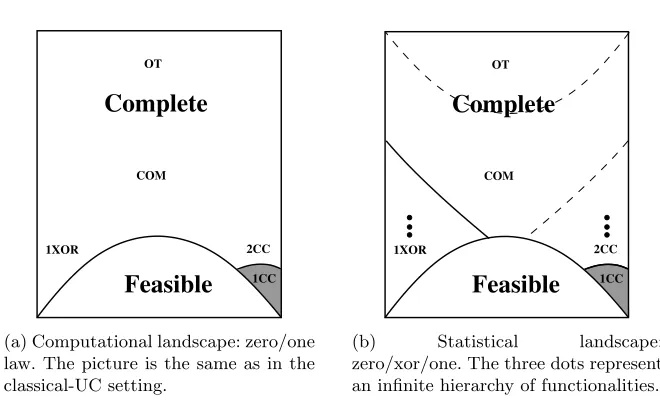
computational quantum-UC setting in a straight-forward manner (under the assumptions of existence of a quantum-secure pseudorandom generator and a dense encryption that is quantum IND-CPA). This proves the following theorem (see Figure 1a):
Theorem 3 (A Computational Zero/One Law). Every functionalityF ∈ U− is either computationally UC feasible or computationally
quantum-UC complete.
As a straightforward corollary of the above theorem we can conclude that the quantum lifting theorem for completeness can be made bi-directional in the computational setting. Theorem 1 already states that computational complete-ness of someF ∈ U−in the classical setting implies computational completeness
ofFin the quantum setting. In the other direction, ifF is quantumly-UC com-plete, then Theorem 3 implies that it is not quantum-UC feasible, which implies (by Theorem 2) that it is not (classically) UC feasible; hence, the computational (classical) zero/one law implies thatFis computationally (classically) UC com-plete. This proves the following:
Corollary 2. LetF ∈ U−be a functionality.Fis computationally UC complete
under the semi-honest OT assumption shOTif and only if F is computationally quantum-UC complete under the assumptions of existence of a quantum-secure pseudorandom generator and a dense encryption that is quantum IND-CPA.
5.2 Statistical Security: Three Classes
We next turn to the setting of statistical security. In the classical setting, the cryptographic-complexity landscape is complicated, as, apart from the com-plete/feasible functionalities, there is a partition of the set U− in clusters for
which the exact relation is not known. In contrast we can show a “[zero/xor/one]-law” in the statistical quantum-UC setting. In other words we can divide the classU− into functionalities that are either complete, or feasible, or we can
re-duce FXOR to them. This considerably simplifies the landscape of the classical
statistical setting, as the hierarchy of functionalities that we can reduceF2CC to
collapses at the second level (i.e, to F2CC) which as it follows from Lemma 4 is
in fact complete in the quantum setting. This illustrates, as [36] mentioned also, that the inverse of the Unruh’s quantum lifting lemma is in general not true. Namely,there exist classical well-formed infeasible functionalitiesFandF0 such that there exist an F-hybrid quantum protocol which statistically quantum-UC securely realizes F0, but there exists no F-hybrid classical protocol which statis-tically classical-UC realizes F0.
The following theorem states the aforementioned zero/xor/one-law:
Theorem 4 (A [zero/xor/one]-law for the information-theoretic set-ting). Let F ∈ U−. Then exactly one of the following statements holds: (1)F
quantum-UC complete nor quantum-UC feasible and FXOR vqstat F.
Further-more, for each of the three statements, there exists at least one F ∈ U− which
satisfies it.
Proof (Sketch). By Lemma 2 and because statistically, F2CC, FCOM and FOT are
quantum-UC complete and FXOR is not quantum-UC feasible (since otherwise
FXORis also classical-UC feasible, contradicting the classical impossibility result in [27]), we can see that that for anyF ∈ U−, eitherFis quantum-UC feasible,
or at least one of the following two statements holds: (1) F is quantum-UC complete and (2)FXORvqstatF.
We then show thatFXORis not quantum-UC complete by proving that there
isnoquantum protocol that UC realizesFCOMin theFXOR-hybrid world. Proof of
this statement is reminiscence of Lo and Chau’s proof that quantum protocols are impossible to implement commitment [24]. The essence there is a so called “purification” attack where a dishonest sender can purify the protocol in the commit phase which allows him to apply a transformation on his local system, by which he can open to a value other than what he committed to. In our case, the only difference is that a quantum protocol can useFXOR as an extra setup.
However, FXOR is nothing but a classical fair-exchange channel. In particular,
the classical information in the protocol is symmetric to both parties, and we can argue that a dishonest committer can make the overall quantum state pure conditioned on shared classical information at the end of commit phase, so that the purification attack still applies. We defer a formal proof to the full version.
Finally, [27] showed that classically the class of functionalities that FXOR
reduces to and are not complete, denoted E, are exactly those of the form FEXCH(`1,`2): simultaneous exchange channels that trasmit`
1(resp.`2) bits from one party to the other. The above argument thatFXORis not quantum-UC
com-plete extends straightforwardly to all such FEXCH, thus we conclude that any functionality in theFXORfamilyEare neither statistically quantum-UC complete
nor statistically quantum-UC feasible. Thus we can derive the quantum-UC sta-tistical landscape forU− as in Figure 1b.
References
1. B. Barak, R. Canetti, J. B. Nielsen, and R. Pass. Universally composable protocols with relaxed set-up assumptions. In 45th Annual Symposium on Foundations of Computer Science (FOCS), pages 186–195. IEEE, Oct. 2004.
2. M. Ben-Or, C. Cr´epeau, D. Gottesman, A. Hassidim, and A. Smith. Secure multi-party quantum computation with (only) a strict honest majority. In47th Annual Symposium on Foundations of Computer Science (FOCS), pages 249–260. IEEE, Oct. 2006.
3. C. Bennett and G. Brassard. Quantum cryptography: Public key distribution and coin tossing. InProceedings of IEEE International Conference on Computers Systems and Signal Processing, Bangalore India, pages 175–179, December 1984. 4. C. H. Bennett, G. Brassard, C. Cr´epeau, and M.-H. Skubiszewska. Practical
1CC 2CC 1XOR
Feasible
Complete
OT
COM
(a) Computational landscape: zero/one law. The picture is the same as in the classical-UC setting.
1CC 2CC 1XOR
Feasible
Complete
OT
COM
(b) Statistical landscape: zero/xor/one. The three dots represent an infinite hierarchy of functionalities.
Fig. 1: Cryptographic complexity in the quantum-UC framework: the box de-notes the class of deterministic finite two-party functionalities. The setU−
cor-responds to the white area. The solid lines represent separations between non-equivalent primitives. The dotted lines represent separations that exist only in the classical-UC setting.
5. N. J. Bouman and S. Fehr. Sampling in a quantum population, and applications. InAdvances in Cryptology — Crypto 2010, volume 6223 ofLNCS, pages 724–741. Springer, 2010.
6. H. Buhrman, M. Christandl, and C. Schaffner. Complete insecurity of quantum protocols for classical two-party computation. Phys. Rev. Lett., 109:160501, Oct 2012.
7. R. Canetti. Security and composition of multiparty cryptographic protocols. Jour-nal of Cryptology, 13(1):143–202, 2000.
8. R. Canetti. Universally composable security: A new paradigm for cryptographic protocols. In 42nd Annual Symposium on Foundations of Computer Science (FOCS), pages 136–145. IEEE, Oct. 2001.
9. R. Canetti and M. Fischlin. Universally composable commitments. In J. Kilian, editor,Advances in Cryptology — Crypto 2001, volume 2139 ofLNCS, pages 19–40. Springer, 2001.
10. R. Canetti, E. Kushilevitz, and Y. Lindell. On the limitations of universally com-posable two-party computation without set-up assumptions.Journal of Cryptology, 19(2):135–167, Apr. 2006.
11. R. Canetti, Y. Lindell, R. Ostrovsky, and A. Sahai. Universally composable two-party and multi-two-party secure computation. In 34th Annual ACM Symposium on Theory of Computing (STOC), pages 494–503. ACM Press, May 2002.
13. C. Cr´epeau, D. Gottesman, and A. Smith. Secure multi-party quantum computa-tion. In34th Annual ACM Symposium on Theory of Computing (STOC), pages 643–652. ACM Press, May 2002.
14. C. Cr´epeau, L. Salvail, J.-R. Simard, and A. Tapp. Two provers in isolation. LNCS, pages 407–430. Springer, 2011.
15. I. Damg˚ard, S. Fehr, C. Lunemann, L. Salvail, and C. Schaffner. Improving the security of quantum protocols via commit-and-open. In S. Halevi, editor,Advances in Cryptology — Crypto 2009, volume 5677 of LNCS, pages 408–427. Springer, 2009.
16. F. Dupuis, J. B. Nielsen, and L. Salvail. Actively secure two-party evaluation of any quantum operation. InAdvances in Cryptology - Crypto 2012, volume 7417 of
LNCS, pages 794–811. Springer, 2012.
17. S. Hallgren, A. Smith, and F. Song. Classical cryptographic protocols in a quantum world. InAdvances in Cryptology — Crypto 2011, volume 6841 ofLNCS, pages 411–428. Springer, 2011.
18. Y. Ishai, M. Prabhakaran, and A. Sahai. Founding cryptography on oblivious transfer - efficiently. In D. Wagner, editor,Advances in Cryptology — Crypto 2008, volume 5157 ofLNCS, pages 572–591. Springer, 2008.
19. J. Katz. Universally composable multi-party computation using tamper-proof hardware. In M. Naor, editor, Advances in Cryptology — Eurocrypt 2007, vol-ume 4515 ofLNCS, pages 115–128. Springer, 2007.
20. J. Katz, A. Kiayias, R. Kumaresan, A. Shelat, and H.-S. Zhou. From impossibility to completeness for deterministic two-party SFE, 2011. Manuscript.
21. J. Kilian. Founding cryptography on oblivious transfer. In STOC, pages 20–31. ACM, 1988.
22. D. Kraschewski and J. M¨uller-Quade. Completeness theorems with constructive proofs for finite deterministic 2-party functions. In 8th Theory of Cryptography Conference — TCC 2011, volume 6597 ofLNCS, pages 364–381. Springer, 2011. 23. H.-K. Lo. Insecurity of quantum secure computations. Physical Review A,
56(2):1154–1162, 1997.
24. H. K. Lo and H. F. Chau. Is quantum bit commitment really possible? Physical Review Letters, 78:3410–3413, 1997.
25. H.-K. Lo and H. F. Chau. Unconditional security of quantum key distribution over arbitrarily long distances. Science, 283(5410):2050–2056, 1999.
26. C. Lunemann and J. B. Nielsen. Fully simulatable quantum-secure coin-flipping and applications. LNCS, pages 21–40, 2011.
27. H. K. Maji, M. Prabhakaran, and M. Rosulek. Complexity of multi-party compu-tation problems: The case of 2-party symmetric secure function evaluation. In6th Theory of Cryptography Conference — TCC 2009, volume 5444 of LNCS, pages 256–273. Springer, 2009.
28. H. K. Maji, M. Prabhakaran, and M. Rosulek. A zero-one law for cryptographic complexity with respect to computational UC security. InAdvances in Cryptology — Crypto 2010, volume 6223 ofLNCS, pages 595–612. Springer, 2010.
29. D. Mayers. Unconditionally secure quantum bit commitment is impossible. Phys-ical Review Letters, 78:3414–3417, 1997.
30. D. Mayers. Unconditional security in quantum cryptography.J. ACM, 48(3):351– 406, 2001.
32. M. Prabhakaran and M. Rosulek. Cryptographic complexity of multi-party compu-tation problems: Classifications and separations. In D. Wagner, editor,Advances in Cryptology — Crypto 2008, volume 5157 of LNCS, pages 262–279. Springer, 2008.
33. M. Rosulek. Universal composability from essentially any trusted setup. In
Advances in Cryptology - Crypto 2012, volume 7417 of LNCS, pages 406–423. Springer, 2012.
34. L. Salvail, C. Schaffner, and M. Sot´akov´a. On the power of two-party quantum cryptography. InAdvances in Cryptology — Asiacrypt 2009, volume 5912 ofLNCS, pages 70–87. Springer, Dec. 2009.
35. P. W. Shor and J. Preskill. Simple proof of security of the BB84 quantum key distribution protocol. Phys. Rev. Lett., 85(2):441–444, Jul 2000.
36. D. Unruh. Universally composable quantum multi-party computation. InAdvances in Cryptology — Eurocrypt 2010, volume 6110 ofLNCS, pages 486–505. Springer, 2010.