© 2014, IJCSMC All Rights Reserved
569
Available Online atwww.ijcsmc.comInternational Journal of Computer Science and Mobile Computing
A Monthly Journal of Computer Science and Information Technology
ISSN 2320–088X
IJCSMC, Vol. 3, Issue. 3, March 2014, pg.569 – 575
RESEARCH ARTICLE
Congestion Detection & Minimization in
Wireless Sensor Network By Using Multipath
Rate Organization Technique
Prof. Sachin Patel Prof. Rakesh Pandit Mr.Abhijeet Rathod
M.Tech(IT),Ph.D Pursuing M.Tech(IT),M.Phil(Comp.Sc.) M.Tech (Final Year, I T)HOD(Information Technology) Assistant Professor PCST, Indore PCST, Indore PCST, Indore RGPV University
Abstract
In wireless sensor network to achieve higher consistency and load balancing the various multipath routing protocols
have been proposed. Moreover, wireless sensor network typically incorporates heterogeneous applications within the
same network. A sensor node may have multiple sensors i.e. light, temperature, motion etc. with different
transmission characteristics. An important function of the transport layer in WMSNs is congestion control [1]. When
an event occurs the sensor node becomes active in transmitting information because of this data traffic increases and
might lead to congestion that results in packet drops and decrease network performance. In this paper, we present a
new technique on node based Congestion Control with Priority Support distributing the load on node as an
indication of congestion degree [6]. The rate assignment to each traffic source is based on its priority index as well as
its current congestion degree.
Keywords: - Congestion control, network performance, Rate organization
I.
INTRODUCTION
© 2014, IJCSMC All Rights Reserved
570
information to base stations. Under normal load condition the data traffic in the network is light. When an event occurs, the load becomes heavy and the data traffic also increases. This might lead to congestion.
There are mainly two causes for congestion in WSNs. The first case is node level congestion which occurs when the packet-arrival rate exceeds the packet-service rate. This is more likely to occur at sensor nodes close to the sink, as they usually carry more combined upstream traffic [7]. The second case is link level congestion which occurs due to contention, interference, and bit-error rate. Congestion control mechanism has three phases: congestion detection, congestion notification and congestion improvement through rate control. Sensor nodes may have multiple sensors like light, temperature etc, with different transmission characteristics. In a multi path routing a child node could have multiple parents and packets from the child node will be forwarded to all parents according to certain policy which depends on the specific multi-path routing protocol [1]. Thus in multipath routing, the packets of a flow may pass through multiple paths before they arrive at the sink and only a fraction of a flow passes through a particular node or link.
Contributions
In this paper, we propose a new protocol on multiple rate organization technique for node & priority congestion control for heterogeneous multi path wireless sensor network which achieves priority based weighted fairness to different nodes as well as to different applications simultaneously running in the sensor nodes. Each parent node divides the bandwidth among its child nodes considering the source traffic priority and transit traffic priority according to multi path routing criterion. The nodes have multiple simultaneous applications running with different priority.
The remainder of the paper is organized as follows.
Section II presents the related work. Section III describes the proposed system. Section IV presents the conclusion and the future work.
II.
RELATED WORK
In recent years, lots of work is going on in congestion control for wireless sensor network. Most of the works deal with the rate control for homogeneous applications. Congestion Detection and Avoidance (CODA) [5] uses buffer occupancy and channel load for measuring congestion level. It handles both transient and persistent congestion. For transient congestion, the node sends explicit back pressure messages to its neighbors whereas for persistent congestion, it needs explicit ACK from sink.
It uses mechanisms likes Receiver based congestion detection, open loop hop-by hop backpressure, closed loop multi source regulation. Congestion Control and Fairness (CCF)[6] is a congestion control protocol to ensure fairness. It uses two schemes: probabilistic selection and epoch based proportional selection. It ensures absolute fairness among every node. Siphon detects congestion using queue length. It uses traffic redirection to mitigate congestion. It doesn’t use any rate adjustment technique.
Enhanced Congestion Detection and Avoidance (ECODA) is an energy efficient congestion control scheme for sensor networks. It uses three mechanisms:
I. Uses dual buffer thresholds and weighted buffer difference for congestion detection. II. Flexible queue scheduler for packets scheduling.
III. A bottleneck node based source sending rate control scheme.
Priority Based Congestion Control Protocol (PCCP) is a node priority based congestion control protocol. It detects both node level and link level congestion. However, it defines priority from node’s point of view instead of the traffic flow’s point of view. So, it can’t differentiate flows from multiple applications from a particular sensor node. Fusion detects congestion by measuring the queue length. It uses three mechanisms: hop-by-hop flow control, rate limiting and prioritized MAC to alleviate congestion. With these combinations, it achieves higher throughput and better fairness.
Queue Based Congestion Control Protocol (QCCP-PS) with Priority Support [7] uses the queue length as an indication of congestion degree. The rate assignment to each traffic source is based on its priority index as well as its current congestion degree. It supports only single path routing. The authors proposed a protocol for multipath Environment but the parent node divides the bandwidth equally among its child nodes. Rate to different child nodes are not allocated based on the priority.
III. PROPOSED WORK
© 2014, IJCSMC All Rights Reserved
571
Data service rate
Congestion Occurs
To all child node
Figure 1. System Architecture
When the value of packet service ratio is less than 1, it indicates congestion. With the help of Rate Adjustment Unit (RAU), each parent node allocates the bandwidth to the child nodes according to the source traffic priority and transit traffic priority. The Congestion Notification Unit (CNU) uses an implicit congestion notification by piggybacking the rate information in its packet header. All the child nodes of a parent node overhear the congestion notification information.
Scheduler model
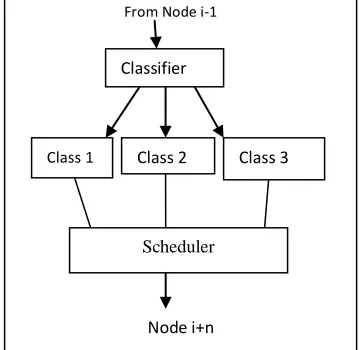
Fig. 2 shows the Scheduler model of each sensor node. To differentiate different types of traffic in the heterogeneous network a source sensor node adds a traffic class identifier to identify the traffic class. For each traffic class a separate queue is maintained in the sensor nodes. The classifier classifies the packets based on the traffic class and sends them to the appropriate schedule.
The following are the descriptions of the scheduler model.
Originating Rate of Scheduler :- It is the rate at which a sensor node originates data
Scheduling rate :- It is defined as the rate at which the scheduler schedules the packets from the queues. The scheduler of node i, forwards the packet from node i-1 to the next node i+1.
Average packet service rate :- It is the average rate at which packets are forwarded from the MAC layer.
Queuing Model
Fig 2:- Scheduler Model Congestion
Recognition Unit
Total Priority
Rate adjustment Unit Congestion
Notification Unit
Source Priority Unit
From Node i-1
Node i+n Classifier
Class 1 Class 2 Class 3
© 2014, IJCSMC All Rights Reserved
572
Each queue is assigned with a priority. The scheduler schedules the packets from queues according to the queue priority. The packets from higher priority queue will be serviced more than the packets from the lower priority queue. The packets in a particular queue are processed based on if it is source traffic and transit traffic. Transit traffic is given more priority than source traffic, since the transit traffic data have already been traversed several paths, and dropping them would cause more wastage of network resources. The classifier differentiates the transit traffic from source traffic by examining the source address in the packet header.
Congestion detection
The packet service ratio γ ( ) is used to measure the congestion level at each node . Packet service ratio is calculated as
γ ()= /
Where,
- Packet service rate of node
-packet scheduling rates of node
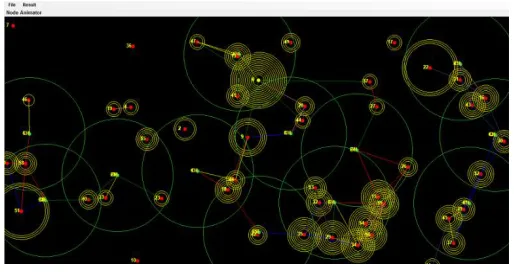
Fig 3: - Network Scenario
Here, the packet service rate is the inverse of packet service time . The packet service time is the time interval when a packet arrives at the MAC layer and successfully transmitted towards the next hop.
The packet service ratio reflects the congestion level at each sensor node. When this ratio is equal to 1, the scheduling rate is equal to the service rate. When this ratio is greater than 1, the scheduling rate is less than the packet service rate. In both these cases, there is no congestion. When the packet service ratio is less than 1, the scheduling rate is more than service rate and it causes the queuing up of packets. It indicates congestion.
Implicit congestion notification
Each node piggybacks the scheduling rate of its children in the congestion notification information. All the child nodes of node overhear the congestion notification information and they control their rate according to it.
Rate adjustment
Rate adjustment is done hop–by-hop. It ensures that the heterogeneous data from different stations will reach the base station at the desired rates. When each node receives the congestion notification information, it adjusts its rate accordingly.
The following describes the rate adjustment algorithm:
© 2014, IJCSMC All Rights Reserved
573
= (1- ) (Where denotes the service time of the current packet in sink node. is a constant between 0< <1
The average packet service rate is calculated as the inverse of the average service time. =1/
Each node has different application running in sensor node. Let denotes the traffic source priority of application j in sensor node i. For each node i the total source priority is calculated as the sum of traffic source priority of all the applications running in it.
=∑
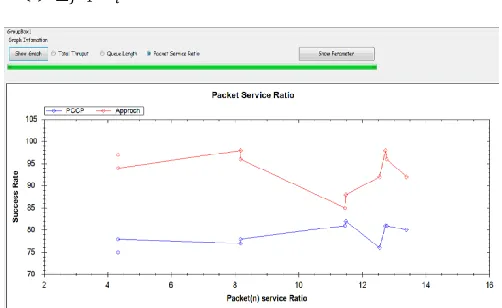
Fig 4: -Packet Service Ratio Vs Success Rate
Where n denotes the number of applications running in sensor node I Under multipath routing, the packets of a flow may pass through multiple paths before they arrive at the sink and only a fraction of a flow passes through a particular node or link. The traffic of a particular flow forwarded in one path is defined as a sub flow. Transit traffic priority at sensor node is used to represent the relative priority of transit traffic from other nodes routed through node.
Let be the traffic rate of flow from application a in sensor node 1. represents the traffic rate of the sub flow j from application a of sensor node l that passes through node . So, the transit priority of node is calculated as follows,
TP(i)=
×GP(ɩ)
The global priority refers to the relative importance of the total traffic at each node . It is calculated as:
GP ( )=SP(i)+TP()
Where
SP () is the total source traffic priority of node . TP () is the transit traffic priority of node .
© 2014, IJCSMC All Rights Reserved
574
packet service rate is equal to the scheduling rate. To increase the scheduling rate, the value of α is chosen smaller than but close to 1.The value of α is set as 0.75.
If R(i)< μ then
= ×
Else If r(i)>1, then
=( Else
=
Where,
is the packet service rate of the parent node j.
GP(j) is global priority of all the child nodes of the parent node j. Node i now calculates its total scheduling rate as Follows
=∑
Where p represents the number of parents for node I Just after calculating the scheduling rate, each node allocates the rate for different applications running in it according to the source traffic priority as follows.
= ×
Fig 5 :- Packet Drop Ratio
Fig. 3 shows the multi path multi hop heterogeneous network model considered in the work. In case of multipath routing, each node divides its total traffic into multiple traffic flows and those flows pass through multiple downstream nodes. For simplicity, we assume that each node divides its rate equally among all its parents.
© 2014, IJCSMC All Rights Reserved
575
CONCLUSION AND FUTURE WORK
We have proposed a priority based congestion control mechanism for heterogeneous data for multipath environment. We have calculated source traffic priority of sensor nodes as the sum of source traffic priorities of all the applications simultaneously running in the sensor nodes. Instead of dividing the bandwidth equally among the child nodes, in the proposed method the parent node divides the bandwidth according to the global priorities of the child nodes. Our future work is to evaluate the performance of the proposed system through packet drop ratio, delay and normalized throughput.
REFERENCES
[1]. Guohua Li Jianzhong Li Bo Yu. , Lower Bound of Weighted Fairness Guaranteed Congestion Control Protocol for WSNs
[2]. Tan Ming-hao, Yu Ren-lai, Li Shu-jiang, Wang Xiang-dong. Multipath Routing Protocol with Load Balancing in WSN Considering Interference, 2011 6th IEEE Conference on Industrial Electronics and Application.
[3]. Mary Cherian, T. R. Gopalakrishnan Nair, Multipath Routing With Novel Packet Scheduling Approach In Wireless Sensor Networks, International Journal of Computer Theory and Engineering, Vol. 3, No. 5, October 2011.
[4]. P. Y amunadevi, T.Vairam, Dr.C.Kalaiarasan, G.Yidya. Efficient Comparison of Multipath Routing Protocols in WSN, 2012 International Conference on Computing, Electronics and Electrical Technologies [ICCEET]. .
[5]. Mingwei Li, Yuanwei Jing. Feedback Congestion Control Protocol for Wireless Sensor Networks, 978-1-4577-2074- 1/12/2012 IEEE
[6]. Muhammad Mostafa Monowar, Md. Obaidur Rahman and Choong Seon Hong. , Multipath Congestion Control for Heterogeneous Traffic in Wireless Sensor Network, Feb. 17-20, 2008 ICACT 2008