Date of publication xxxx 00, 0000, date of current version xxxx 00, 0000.
Digital Object Identifier 10.1109/ACCESS.2017.Doi Number
Efficient Multi-key FHE with short extended
ciphertexts and less public parameters
Tanping Zhou1, Ningbo Li1, XiaoYuan YANG1, YiLiang HAN1, WenChao LIU1
1Key Laboratory of Network & Information Security under the People's Armed Police, College of Cryptography Engineering, Engineering University of People's Armed Police,
Xi’an, 710086, China
Corresponding author: NingBo LI (e-mail:[email protected]),TanPing ZHOU (e-mail:[email protected]).
This work was supported by National Key R&D Program of China under Grants No. 2017YFB0802000, National Natural Science Foundation of China (Grant Nos. U1636114,61772550,61572521,61872384), State Key Laboratory of Information Security (2017-MS-18).
ABSTRACT
Multi-Key Full Homomorphic Encryption (MKFHE) can perform arbitrary operations on encrypted data under different public keys (users), and the final ciphertext can be jointly decrypted by all involved users. Therefore, MKFHE has natural advantages and application value in security multi-party computation (MPC). The MKFHE scheme based on Brakerski-Gentry-Vaikuntanathan (BGV) inherits the advantages of BGV FHE scheme in aspects of encrypting a ring element, the ciphertext/plaintext ratio, and supporting the Chinese Remainder Theorem (CRT)-based ciphertexts packing technique. However some weaknesses also exist such as large ciphertexts and keys, and complicated process of generating evaluation keys. In this paper, we present an efficient BGV-type MKFHE scheme. Firstly, we construct a nested ciphertext extension for BGV and separable ciphertext extension for Gentry-Sahai-Waters (GSW), which can reduce the size of the extended ciphertexts about a half. Secondly, we apply the hybrid homomorphic multiplication between RBGV ciphertext and RGSW ciphertext to the generation process of evaluation keys, which can significantly reduce the amount of input/output ciphertexts and improve the efficiency. Finally, we construct a directed decryption protocol which allows the evaluated ciphertext to be decrypted by any target user, thereby enhancing the ability of data owner to control their own plaintext, and abolish the limitation in current MKFHE schemes that the evaluated ciphertext can only be decrypted by users involved in homomorphic evaluation.INDEX TERMS Multi-key Full Homomorphic Encryption, ciphertext extension, evaluation key, hybrid homomorphic
multiplication, directed decryption
I. INTRODUCTION
Full-homomorphic encryption (FHE), which can perform arbitrary operations on encrypted data without knowing the secret key, has the exchangeable property for encryption and computation. It has high research value in the current cloud computing environment, and can be widely used in ciphertext retrieval [1], secure multi-party computing (MPC) [2-4], cloud data analysis, etc.
Since the first ideal-based FHE scheme Gen09 was proposed in 2009 [5], many FHE schemes [6-21] was proposed following Gentry’s blueprint. Multi-key FHE (MKFHE) [22-31] allows computations on ciphertexts under different secret keys, which is an extension of FHE in secure MPC. L´opez-Alt et al. [22] first proposed a MKFHE scheme LTV12 based on the NTRU cryptosystem [32]. However, its security is based on a somewhat non-standard assumption on polynomial rings.
Clear and McGoldrick [23] proposed the first GSW-type MKFHE scheme CM15 based on the learning with error (LWE) problem whose security can be reduced to the
worst-case hardness of problems on ideal lattices. Mukherjee and Wichs [24] simplified CM15 and gave a construction of MKFHE scheme MW16 based on LWE. MW16 can be used to construct a simple 1-round threshold decryption protocol and a two-round MPC protocol.
Both CM15 and MW16 need to determine the parties involved in homomorphic computation in advance and any new party cannot be allowed to join in during the homomorphic computation. This type of MKFHE is called single-hop in [25], comparing to multi-hop MKFHE whose result ciphertext can be employed to further evaluation with new parties, i.e. any new party can dynamically join the homomorphic evaluation at any time. Another similar concept named fully dynamic MKFHE was proposed in [26], which means that the bound of number of users does not need to be input during the setup procedure.
technique, and simplifies the ciphertext extension process in MKFHE. What’s more, CZW17 admits a threshold decryption protocol and two-round MPC protocol.
Our Contributions. At present, the BGV-type MKFHE scheme supporting batched multi-hop operations is represented by CZW17. This type of MKFHE scheme has the weaknesses of large ciphertexts and public parameters, and complicated process for the generation of evaluation keys. In this paper, we make the following improvements to these weaknesses:
(1) We construct a nested ciphertext extension for BGV and separable ciphertext extension for GSW, which can reduce the size of the extended ciphertexts about a half.
(2) We optimize the generation process of evaluation keys. The hybrid homomorphic multiplication between RBGV ciphertexts and RGSW ciphertexts are adopted in our scheme instead of homomorphic multiplication between two RBGV ciphertexts, thus reduce the size of public parameters.
(3) We construct a directed decryption protocol in which the users involved in homomorphic evaluation can appoint the target user who can get the final decrypting result, thereby enhancing the ability of data owner to control their own plaintext.
These improvements can efficiently reduce the size of ciphertexts and public parameters during homomorphic evaluation, and further reduce the computational complexity of homomorphic operations.
II. PRELIMINARIES
Throughout this paper, we let denote the security parameter and negl( denote a negligible function of . We use bold lowercase symbol to denote vectors and bold uppercase symbol to denote matrixes. The i-th component of vector a is represented as [ ]ai , and the element located in the i-th row and the j-th column of matrix A is represented as A[ , ]i j . In general, vectors can be regarded as a row matrix.
Let Φ Xm( ) denote the m-th cyclotomic polynomial with the degree n( )m , where ( ) is the Euler’s function. We work over rings R [X] /Φm and Rq R/qR for a prime integer qq( ). Addition and multiplication in these rings is done component-wise in their coefficients, and
[ ]
x
qdenotes that the coefficients of
x
are reduced in [q/ 2, / 2)q (except for q2). Let ( ) be a B-bound error distribution over R whose coefficients are in the range [B B, ]. For a probability distribution D, xD denotes thatx
is sampled from D, and x$D denotes thatx
is sampled uniformly from D.For aR, we use amax0 i n1 ai to denote the
standard l -norm and use 1
1 0
n j i
a
a to denote thestandard l1-norm.
A. THE GENERAL LEARNING WITH ERRORS (GLWE) PROBLEM
The learning with errors (LWE) problem and the ring learning with errors (RLWE) problem are syntactically identical, aside from different rings, and these two problems are summarized as GLWE problem in [BGV12].
Definition 1 (GLWE problem). Let be a security
parameter. For the polynomial ring [ ] / d 1
X x
R and
/
q q
R R R, and an error distribution ( ) over R, the GLWE problem is to distinguish the following two distributions: In the first distribution, one samples
1
( , ) n
i bi q
a R uniformly from Rqn1 . For the second distribution, one first draws aiRqn uniformly, and
samples ( , ) n1
i bi Rq
a by choosing sRqn and ei
uniformly, and set bi a si, ei. The GLWE assumption is that the GLWE problem is infeasible.
LWE problem. The LWE problem is simply GLWE
problem instantiated with d1.
RLWE problem. The RLWE problem is GLWE problem
instantiated with n1.
B. LEVELED MULTI-KEY FHE
We now introduce the cryptographic definition of a leveled multi-key FHE, which is similar to the one defined in CZW17 with some modifications from LTV12.
Definition 2 (Multi-key FHE). Let be a class of
circuits. A leveled multi-key FHE scheme
(Setup, KeyGen, Enc, Eval, Dec) is described as follows:
.Setup(1 ,1 ,1 )K L :Given the security parameter ,
the circuit depth L, and the number of distinct users K that can be tolerated in an evaluation, outputs the public parameters pp.
. Key Gen(pp):Given the public parameters pp, derives and outputs a public key pki, a secret key ski, and the evaluation keys evki of party i(i1,...,K). . Enc(pk mi, ):Given a public key pki and message
,outputs a ciphertext cti.
1 2
. Dec((ski,ski ,...,skik),ctS):Given a ciphertext ctS
corresponding to a set of users S{ , ,..., }i i1 2 ik [ ]K , and their secret keys
1 2
{ , ,..., k}
S i i i
sk sk sk sk , outputs
the message 。
1 1 1
. Eval( , (ctS,pkS,evkS ),..., (ctSt,pkSt,evkSt)) : On
input a Boolean circuit along with t tuples
1,...,
( , )
i i i
S S S i t
ct pk ,evk ,each tuple comprises of a
ciphertext i
S
ct corresponding to a user set Si, a set of public keys pkSi {pkj, j Si} , and the evaluation
keys
i S
evk , outputs a ciphertext ctS corresponding to a
set of secret keys indexed by 1 [ ]
t i i
S S K 。
Definition 3 (Correctness of MKFHE). On input any
circuit of depth at most L and a set of tuples{(ctSi,pkSi)}i{1,..., }t , let i Dec(skSi,ctSi) , where
{ , }
i
S j i
sk sk j S , a leveled MKFHE scheme is correct if it holds that
[ ] 1
Pr[Dec( , ( , ( , , ) )) ( ,..., )]
( )
i i i
S S S S i t t
sk Eval ct pk evk
negl
Definition 4 (Compactness of MKFHE). A leveled MKFHE scheme is compact if there exists a polynomial
( , , )
poly such that ct poly( ,K L, ) , which means that the length of ct is independent of the circuit , but depend on the security parameter , the number of users K and the circuit depth L.
C. TWO SUBROUTINES
Here we introduce two subroutines ( BitDecomp( ) and Powersof 2( ) ) which are widely used in FHE schemes. Let
n q
x R be a polynomial of dimension n over Rq, and let
logq 1
.
BitDecomp( n, )
q q
x R : On input ( ,...,1 ) n
n q
x x
x R and
the modulus q ,outputs (x1,0,...,x1,1,...,xn,0,...,xn,1) {0,1}n where
,
i j
x is the j-th bit in xi ’s binary representation (ordered from least significant to most
significant), namely 1 1, 1 ,
0 0
( 2j ,..., 2j )
j n j
j x j x
x .
Powersof 2(yRqn, )q : On input y(y1,...,yn)Rqn and
the modulus q , outputs 1
1 1 1
(y, 2y,..., 2 y,...,yn, 2yn,..., 1
2 yn)Rqn.
It’s straightforward to verify that for arbitrary ,x yRqn, it holds that
BitDecomp( , ), Powersof 2( , )xq yq x y, modq
D. TWO TECHNIQUES
In this section, we introduced two powerful techniques (key-switching and modulus-(key-switching) from [BGV12], which are applied to control the dimension and noise of ciphertext during homomorphic evaluation.
Key-switching : The key switching technique can be used
to reduce the dimension of an expanded ciphertext to a normal level, but more generally can be used to transform a
ciphertext 1
1
n q
c R (under the secret key s1 ) to another
ciphertext 2
2
n q
c R (under the secret key s2 ) with the corresponding message unchanged. For a FHE scheme , let logq1, the key switching process mainly consists of two procedures:
1 2
1 2
.SwitchKeyGen( n, n )
q q
s R s R : Compute s
1
1
Powersof 2( )s Rqn, and output
2 1 2: { Enc ( [ ])2 } 1,...,1
n
i i q i n
s s s s R
1 2 1
.SwitchKey( ss , , )c q : Compute c1
1
1
BitDecomp( ) n
q
c R , and output
1 2
2 1 1[ ]
n n
i q
i i
c c R
Lemma 1 (BGV12). Let c1 be a ciphertext under the key
1
s for modulus q such that e1 [ c s1, 1]q has length at
most B and m[ ]e1 2 ( p2 ). Let
1 2
2 .SwitchKey( , , )1
c ss c q , and let e2 [ c s2, 2 ]q.
Then e2 (the new noise) has length at most
2 R log
B B q n, and (assuming this noise length is less than / 2q ) we have m[ ]e2 2.
Modulus-switching : Since the noise involved in the
ciphertext grows with homomorphic operations, modulus switching which can change the inner modulus ql1 of
ciphertext c1 to a smaller number ql is used to reduce the noise term roughly by the ratio ql1/ql, while preserving the correctness of decryption under the same secret key.
. ModulusSwitch( ,c1 ql1,ql): On input 1 l11 n q
c R and
another smaller modulus ql, output 1
2 l
n q
c R which is the closest element to (ql/ql1)c1.
Lemma 2 (BGV12). Let c1 be a ciphertext under the key
1
s for modulus ql1 such that el1 [ c s1, 1]ql1 has
length at most B and m[ ]e1 2 . Let
2 . ModulusSwitch( ,1 l 1, l)
c c q q , and let
2, 1
[ ]
l
l q
e c s . Then el (the new noise) has length at most (ql/ql1) B nRB , and (assuming this noise length is less than ql/ 2) we have m[ ]el 2.
We just give a brief introduction of the two techniques above, and more details can be seen in BGV12.
III. EFFICIENT COMPONENTS IN OUR MKFHE
In this section, we present the details of some efficient techniques for homomorphic operations in our scheme, including: two optimized algorithms for ciphertext extension (nested ciphertext extension for BGV and separable ciphertext extension for GSW), generation of evaluation keys, and directed decryption process.
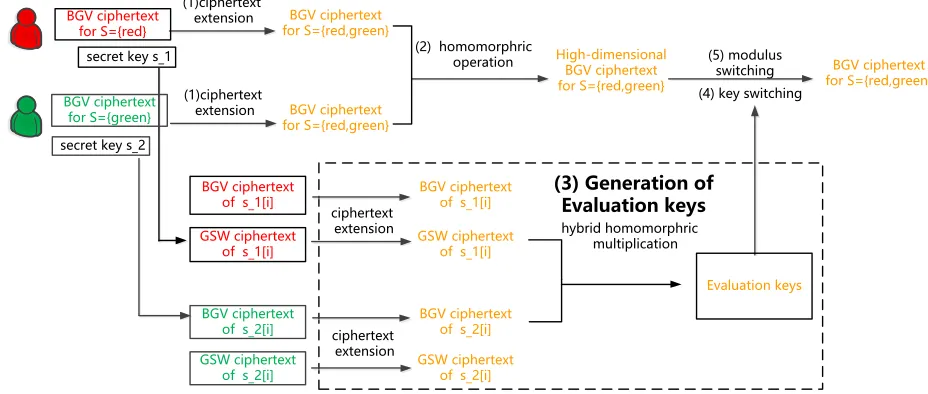
The aim of the system is to perform homomorphic operations on ciphertexts of different users in the cloud. In the initialization phase, the users upload the RBGV ciphertexts corresponding to their messages to the cloud, along with some materials used in the generation process of evaluation keys.
Step 1 (Ciphertext extension): The users respectively
extend their RBGV ciphertexts to ones corresponding to the user set S before homomorphic evaluation.
Step 2 (Homomorphic evaluation): Do homomorphic
computations on the user’s extended ciphertexts and get a high-dimensional RBGV ciphertext.
Step 3 (Evaluation keys): Do ciphertext extension on
materials in the initialization phase and perform hybrid homomorphic multiplication on RBGV and RGSW ciphertexts to obtain the evaluation keys.
Step 4 (Key switching): Perform key-switching operation
on the high-dimensional RBGV ciphertext in step2 using the evaluation keys.
Step 5 (Modulus switching): Perform modulus-switching
operation on the result ciphertext of step 4 and output the final ciphertext.
(1)ciphertext extension
(2) homomorphric operation
(4) key switching
BGV ciphertext
for S={red} for S={red,green}BGV ciphertext
BGV ciphertext for S={green}
secret key s_1
secret key s_2
BGV ciphertext for S={red,green}
(1)ciphertext extension
High-dimensional BGV ciphertext for S={red,green}
BGV ciphertext of s_1[i]
BGV ciphertext of s_2[i]
hybrid homomorphric multiplication
Evaluation keys
BGV ciphertext for S={red,green}
GSW ciphertext of s_1[i]
GSW ciphertext of s_2[i]
(3) Generation of Evaluation keys
(5) modulus switching
ciphertext extension
ciphertext extension
BGV ciphertext of s_1[i]
BGV ciphertext of s_2[i] GSW ciphertext
of s_1[i]
GSW ciphertext of s_2[i]
FIGURE 1. The process of homomorphic operation in MKFHE scheme
A. CIPHERTEXT EXTENSION
1) NESTED CIPHERTEXT EXTENSION FOR BGV
Here we present the basic ring-LWE based BGV scheme with some modifications to the original scheme in [BGV12].
RBGV.Setup(1 ,1 ) L : For the security parameter , given
a bound K on the number of keys, a bound L on the
circuit depth with L decreasing modulus
1 0
L L
q q q for each level and a small integer p coprime with all ql, let l logql1. We work over
rings R [X] /Φm and Rql R/qlR defined above. Let ( )
be a B-bound error distribution over R whose coefficients are in the range [B B, ].
RBGV.KeyGen(1 ,1 )n L : Generate keys of circuit depth l for the j-th party (l0,...,L).
1. Sample zl j, R3 and set secret key 2
, , : (1, , ) 3
l j l j l j
sk s z R
2. Generate al j, $Rq and el j, $ randomly, and compute the public key for the j-th user
2
, , : ( , , , mod , , ) ( , , , ) l
l j l j l j l j l j l l j l j l j q
pk p a z pe q a b a R
RBGV.Enc(pkl j, , ) : On input a message Rp and
the public key pkL j, , sample random elements r,e,e , compute level-L ciphertext
(0) (1) 2
, ,
( , ) ( , )
L
L j L j q
c c rb pe ra pe
c R
Let S be an ordered set containing all indexes of users that the ciphertext corresponding to, and we assume that the indexes are arranged from small to large and S has no duplicate elements, thus we can describe a ciphertext as a tuple ct{ , , }c S l . Here we set S{ }j , lL, and output
{ ,{ }, } ct c j L .
RBGV. Dec(skS,ct( , , ))c S l : On input a level-l ciphertext ct( , , )cS l where S{ ,...,j1 jk} ,and its corresponding secret keys
1
2
, , 3
{ ,..., }
k k j l j l
s s R . Let
1
1 , (1, ,,..., k,) 3
k S l zj l zj l
s R , output the message
,
, S l modqlmodp
c s
RBGV.CTExt( ,cl S) :On input a ciphertext tuple
1 1
{ , { ,..., }, }
l k
q k
ct c R S i i l corresponding to k parties and another user set S { ,...,j1 jk} for SS, output an
extended tuple 1
1
{ , { ,..., }, }
l k
q k
ct cR S j j l . The extending algorithm is as follows:
(a) Divide the ciphertext c into k1 sequential
sub-vectors indexed by S{ ,..., }i1 ik (except for the first sub-vector), i.e.,
1
(0) (1) (1) 1
( )
l k S
k q
i i
c c c
c R
where the corresponding secret key is
1
,=(1, ,,..., k,)
S l zi l zi l
s
.
(b) The extended ciphertext c consists of k 1 sequential sub-vectors, which can be indexed by
1 { ,..., k} S j j , i.e.,
1
(0) (1) (1) 1
( )
l k
S j j
k q
c c c
c R
Set (0) (0)
S S
c c . If index j in S is also included in S, we set (1) (1)
j j
c c ,otherwise we set (1)=0
j
c . The corresponding secret key for decryption is
1
1 ,=(1, , ,..., ,k) 3
k S l zl j zl j
s R .
It’s easy to verify that c s, S l, c s, S l, modql.
2) NESTED CIPHERTEXT EXTENSION FOR GSW
In this section, we describe a variant of Ring-LWE based GSW scheme.
RGSW.Setup(1 ):For the security parameter , given a
bound K on the number of keys, a bound L on the
circuit depth with L decreasing modulus
1 0
L L
q q q for each level and a small integer p coprime with all ql, let l logql1. We work over rings R [X] /Φm and Rql R/qlR defined above. Let
( )
be a B-bound error distribution over R whose coefficients are in the range [B B, ].
RGSW.KeyGen(1 )n :Sample
3
zR , choose a random vector 2
l l q
a R and e 2l uniformly,output
the secret key 2
3 (1, z)T
s R and public key
2 2
[ , ] [ , ] l
l q
z p
P a e a b a R .
RGSW.EncRand( , )r P :This procedure is to generate the encryption of randomness which is used in the ciphertext extension. On input
l q
i
r (i1,...,l) and two vectors e e1 , 2 l
randomly, output the encryption of the randomness: 2 1 2
RGSW . EncRand ( ) [ , ]
l l q
r
s F f f R
where 1[ ] [ ] 1[ ] Powersof 2( )[ ]
l q i
i i r p i r i
f b e R
2[ ]i [ ]i rip 2[ ]i ql
f a e R .
Notice that [ Powersof 2( )] l
l q
p r
Fs e R for some
small ee[ ]i rie1[ ]i e2[ ]i z.
RGSW . Enc( , ) P :Given a message Rq and the
public key 2 2
[ , ] l
q
P b a R ,sample a random element
r and an error matrix 2 2
1 2
[ , ] l
E e e ,output
the ciphertext
1 2
RGSW. Enc( , )
[ , ]
[ , ]
[ ( ), ]
r p
r p
r z p p
r z p r r p
P C P E G
b a E G
a e a E G
a e e a e G
where 1 2 2
2 2 2
( , 2 ,..., 2 l )T l q
G I I I R and I2 is a 2 2
identity matrix. Notice that 2 l
q
p
C s e G s R .
RGSW.CTExt(C Fi, i,{ ,Pj j1,..., })k : On input the i-th
user’s ciphertext 2 2
,0 ,1
[ , ] l
i i i q
C C C R ,an encryption
i
F of randomness
l i q
rR , and the public keys of all involved users Pj [b aj, j] , j1,...,i1,i1,...k . Output the extended ciphertext:
1,0 ,0 ,1 1,1
2,0 ,0
2 ( 1) ,1
1,0 ,0
,0 ,0 ,1 ,1
0 0 0 0 0 l i i i k k
i i q
k i
k i k i
X C C X
X C
C C
X C
X C X C
R
where [ ,0, ,1] [BitDecomp( [ ]) ] 2 l 2
j j j j u i q
X X X b F R ,
[ ] [ ] [ ]
j u j u i u
b b b , u1,..., 2l , and the
corresponding secret key s(1,z1, zk)R3k1.
Correctness of Ciphertext Extension:In order to
ensure the correctness of the extending algorithm of GSW
ciphertext, it is necessary to verify that the j-th row in
C
isatisfies:
2
,0 ,0 ,1 ,1
( ) l
j i i zj j zi i j j i p i j q
X C C X C s X s e Gs R
where eR2l is a small noise vector. The analysis
process is as follows:
[ ]
[ ]
( )
i j i i i j j i j
i i i j j j i j i j
i j i j j i j
j i j i j i j
r z p z p
r z p z p p r p
r p r p
p r p r
C s a e a Es Gs
a e a e Es Gs e
b Gs Es e
Es e Gs b
BitDecomp( )
BitDecomp( )[ Powersof 2( )]
BitDecomp( )
j i j i i
j i
j i j
p r
p r
X s b F s
b e
b e b
Then we have:
2
BitDecomp( ) ( )
i j j i i j j j i j
i j q
p p r p
p
C s X s Gs b e Es e
Gs e R
Finally we can get =
i j j i j p i
C s X s C s e G s
where ( 2 , 2 2 ,..., 2 1 2 ) 2 2
l k k T
k k k q
G I I I R
.
B. GENERATION OF EVALUATION KEY
In this paper, we optimize the generation of evaluation keys during the key-switching process in [CZW17]. We apply the hybrid homomorphic multiplication in [19] between RBGV ciphertexts and RGSW ciphertexts instead of homomorphic multiplication between two RBGV ciphertexts, thus decrease the noise involved in the evaluation keys. What’s more, we limit the coefficient of user’s secret key to { 1, 0,1} so that BitDecomp( ) and Powersof 2( ) techniques are no longer required in key-switching, thus reduce the number of ciphertexts during key-switching process. For convenience, we use RGSW . Enc ( )s (or RBGV . Enc ( )s ) to denote a GSW/BGV ciphertext that can be decrypted to with the secret key s.
MKFHE .EVKGen(em pkS, S):Given a level-l extended
secret key ( 1)2
3
ˆ = k
l l l
s s s R for
1
, ,
=(1, ,..., )
k l zl j zl j
s ,
and corresponding public keys
1
1, 1, { ,..., }
[ , ]
k l j l j jj j
b a for
the user set S{ ,...,j1 jk} . For j{1,..., }k , {0,..., l 1}
m , compute
1,
, RGSW . Encl j( , )
l j zl j
s, RGSW . EncRand( , , 1, )
l j rl j pkl j
F
1,
, , RBGV. Encl j(2 , )
m
l j m zl j
s Output the evaluation keys { , 2}
l
m q
evk R ,
2 {1,..., (k 1) }
, and the process is shown in
Algorithm1.
Algorithm1:the generation of evk{ m,} Input: l j, ,Fl j, ,l j m, ,
1. for {0,..., }k
1
1 , , ,
RGSW. Enc (1) 0 [ ]
RGSW.CTExt ( , , ) else
l
l l
l l j l j s
s F P
2. for {0,..., }k
for m{0,...,l1}
1 1
,
, ,
RBGV. Enc (2 ) 0
[ ]
RBGV.CTExt ( , ) else
l
l m l m
lm S s s
3. for [0,..., ]k
for [0,..., ]k
for m[0,...,l1]
( 1)
, , [ ] , , [ ]
m k l j l jm
4. output , 2
{0,..., 1}; {1,...,( 1) }
{ }
l
m m k
evk
where “ ” denotes the hybrid homomorphic
Definition 5 (Hybrid homomorphic multiplication). We define the product as
: RGSW RBGV RBGV
C c2, 1
C2 c1BD( )c1 C2The definition of hybrid homomorphic multiplication based on RLWE is a variant of the external product based on TLWE in [19], and it can be used in evaluating process to reduce the amount of ciphertexts and noise, thereby improving the efficiency of homomorphic evaluation.
Corollary 1. Let C2 be a valid RGSW sample of message
2
and let c1 be a valid RBGV sample of message 1.Then
2 1
C c is a RBGV sample of message 2 1 and
2 1 2 2 1
( ) (2 ) 2 || ( )|| || ( )||
Err C c n Err C Err c ,
2 1 1
( ( )) 2 (2 1) ( ) ( )
Var Err C c p n Var e pnVar e , where n
is the degree of the cyclotomic polynomial, p is an integer,
is the bound of the noise coefficients,
is the standard deviation of the error distribution , pe1 is the noise of1
c ,e is the noise involved in C2.
C. DIRECTED DECRYPTION PROTOCOL
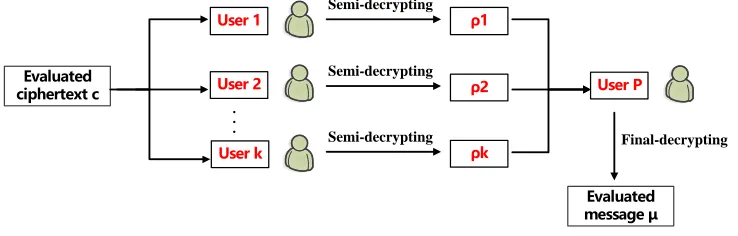
MKFHE can be applied to realize secure computation among multi-parties, and the evaluated ciphertext can be jointly decrypted by all involved users. However, sometimes we do not prefer the final decrypting result to be known by all involved users, and only want the designated and recognized legitimate user(s) to get the decrypting result, even the user(s) does not participate in the computing process. For this scenario in Figure 2, a directed decryption protocol is essential to enhance the ability of data owner to control their own plaintext.
Evaluated ciphertext c
User 1
User 2
User k
..
.
ρ1 Semi-decrypting
ρ2 Semi-decrypting
ρk Semi-decrypting
User P
Final-decrypting
Evaluated message μ
FIGURE 2. The process of directed decryption in our MKFHE scheme
In this paper, we construct a directed decryption protocol in which the users involved in homomorphic evaluation can appoint the target user who can get the final decrypting result, thereby enhancing the ability of data owner to control their own plaintext. The directed decryption protocol is realized by adding the encryption of 0 (under the public key of target user) to the intermediate decryption result of the users involved in homomorphic evaluation, and the process is as follows:
Assume that the level-l ciphertext needs to be finally decrypted is denoted by
1 2
1
, , ,
( , , ,..., )
k l k l l j l j l j q
b a a a
c R , the
corresponding user set S( ,...,j1 jk) and the plaintext 1
( ,..., k)
where is the Boolean circuit. Assume that the target user who needs to get the ultimate decrypted result is i, and he can get the ciphertext c, the process of our directed decryption protocol is implemented as follows:
1. Semi-decrypting: The users in S respectively do
decrypting operations on ciphertext c with their special extended keys. For user j1 with secret key
1 1
, (1, , )
l j zl j
s ,
get the semi-decrypting result
1 ( 1, 0)
j j
c
c by the extended
key
1 1
, (1, , , 0,..., 0)
l j zl j
s :
1 1 1
1 ( j, 0) ( , l j, , 0) ( l l j,1 l j, , 0)
j b a z
c c s
c
Other users in S do similar operations as user j1.
2. Adding target user’s encryption of 0: The users in S
respectively compute the encryption of 0 using the public key of user i :
1 1
2
, , ,
RBGV . Enc( , 0) ( , )
l i pkl i bl i al i q
c R
For user j1 , compute the sum of ci and the semi-decrypting result
1 j
c :
1 ( ,1 ,1 ,1, ,1) j bl al j zl j bl i al i
c
Following the same method, other users can get
1 2
{ , ,..., }
k
j j j
c c c and send them to user i.
3. Final decryption: When user i receives
1 2
{ , ,..., }
k
j j j
c c c ,
he compute
1 2 ... k sum j j j
c c c c , and compute the final
decrypting result as
1
1 1
, ,
, , , , ,
1 1
, , , , ,
1 1
1
1
( ( 1) ) ( ... ( 1) ) (1, )
( 1) ( )
( )
( ,..., ) ... ...
( ,...
k
m m m m
m m m m
k k
sum l l i j j l l i
k k
l l j l j l l i l i l i
m m
k k
l l j l j l i l i l i
m m
k j j i i
k b k b z
kb a z k b b a z
b a z b a z
e e e e
c s c c
Lemma 3: Let
B
denotes the bound of noise in a fresh RBGV ciphertext, andB
l denotes the bound of noise in a level-l RBGV ciphertext, then the directed decryption process is correct if1 1 1
| ... ... | | ... |+ + < / 4
k k k
j j i i j j l
e e e e e e kBkB kB q
Note that in current MKFHE schemes, the result of homomorphic evaluations can only be finally decrypted by users involved in the evaluation process, and the directed decryption protocol designed in this paper allow the result ciphertext to be decrypted by any legitimate user. Moreover, as no homomorphic multiplication is involved in our protocol, there is no need of some techniques to control the noise.
IV. NEW CONSTRUCTION OF BGV-TYPE MKFHE
SCHEME
In this section, we present the details of our BGV-type MKFHE scheme. For convenience, in the following we use RGSW . Enc ( )s (presented in Section 3.1) to denote a GSW ciphertext (or RBGV . Enc ( )s ) that can be decrypted to with the secret key s. Also we adopt the techniques of key-switching and modulus-switching introduced in section 2.4.
A. BASIC SCHEME MKFHE.Setup(1 ,1 ,1 ) K L
: For the security parameter , given a bound K on the number of keys, a bound L on the circuit depth with L decreasing modulus
1 0
L L
q q q for each level and a small integer p coprime with all ql. We work over rings R [X] /Φm
and /
l q ql
R R R defined above. Let ( ) be a B -bound error distribution over
R
whose coefficients are in the range [B B, ]. Let l logql1, B logB1,and choose L1 random public vectors 2 l l
l q
a R for
{0, , }
l L . All the following algorithms implicitly take the public parameter pp( , , ,{ , }R B ql al l{0, , }L, )p as input.
Let S be an ordered set containing all indexes of users that the ciphertext corresponding to, and we assume that the indexes are arranged from small to large and S has no duplicate elements, thus we can describe a ciphertext as a tuple ct{ , , }c S l .
MKFHE.KeyGen(pp): Given the public parameters pp, generate keys of circuit depth l for the j-th party (l0,...,L).
1. Sample zl j, and set secret key 2
, , : (1, , ) 3
l j l j l j
sk s z R .
2. Choose , $ 2 l
l j
e randomly, and compute the
public key for the j-th user
2 2
, , : [ , , , , , ] [ , , , ]
l
l j l j l j l j l j l j l j l j q
pk p a z pe a b a R
3. Compute the materials used in the generation of evaluation keys:
2 2 2
2
, , , , { ,...,0}
{( B), ( l , l )}
l l l
j l j m q l j q l j q l L
em R R F R
where
1,
, , ,
2
, , 1, , , , , , , , ,
RBGV. Enc (2 )
{ [1] 2 2 , [1] 2 }
l j
l m
l j m l j
m
l j m l j l j m l j l j m l j l j m q
r e r
z z e s
b a R
1
, ,
2 2
, 1 1 , ,
RGSW. Enc ( )
{ [ , ] }
l
l l
l j l j
l j l l l j l j q
z
r p z R
s
b a E G
2 , RGSW . EncRand( , , 1, )
l l
l j rl j pkl j q
F R
MKFHE. Enc(pkL j, ,j): On input a message jRp and the public key pkL j, , sample random elements r, e,
e , compute level-L ciphertext
,
2
,0, ,1) ( [1] , [1] )
(
L
L j
j j r pe j r L p q
c c e
c b a R
and output the tuple ct{ ,{ }, }c j L
.
MKFHE. Dec(skS,ct( , , ))c S l : On input a level-l ciphertext ct( , , )cS l where S{ ,...,j1 jk} ,and its corresponding secret keys
1
2
, , 3
{ ,..., }
k k j l j l
s s R . Let
1
1 , (1, ,,..., k,) 3
k S l zj l zj l
s R , output the message
,
, S l modqlmodp
c s
1
, , 1
MKFHE. (( , , ), , , ( , ))
k
l j l j S t
Eval pk pk em ct ct :
Assume that the sequence of ciphertexts
{1, , } { , , }
i i i i t
ct c S l are at the same level-l (If needed, use key-switching and modulus-switching to make it so). Let
1 ( ,1 , )
t
i i k
S S j j . Then the outline of evaluation on Boolean circuit is as follows.
1. For i{1, , }t , compute RBGV.CTExt( , )ci S to get an extended ciphertext ci under extended secret key
1
, ,
: (1, , )
k l zl j zl j
s .
2.Generate the evaluation keys by compute
1
ˆl l =MKFHE.EVKGen( , , )
S S l S
evk em pk
s s
3. Evaluate the circuit by using the two basic homomorphic operations
1 2
MKFHE.EvalAdd(evkS,c ci, i ) and
1 2
MKFHE.EvalMult(evkS,c ci, i ).
B. HOMOMORPHIC OPERATIONS
In the following subsections, we will detail how to perform the two basic homomorphic operations MKFHE.EvalAdd( ) and MKFHE.EvalMult( ) on two (extended) ciphertext
1
c , 1
2 l
k q
c R corresponding to the user set S{ ,...,j1 jk}. The evaluation key is defined as :
2 1
ˆl l { , } 1,..., l, 1,...,( 1)
S m m k
evk ss
where ˆsl sl sl ,
1
1
, , 3
=(1, ,..., )
k k l zl j zl j
s R , sl1=(1,
1
1 1, ,..., 1,k) 3
k l j l j
z z
R
,, and it holds that
1
1 1
, , 1 , 2 ˆ[ ] 1, ,..., 1,k) 3
m k
m l pem l
zl j zl j
s s R
where the canonical form of
e
m, is small. MKFHE.EvalAdd(evkS, ,c c1 2): On input two (extended) ciphertext c1, 1
2 l
k q
c R at the same level-l under the same
secret key 1
3
k l
s R (If needed, use key-switching and modulus-switching to make it so) .
1. Compute c3 c1c2modql under the secret key 1 3 k l
2. Compute
1
ˆ 3 SwitchKey(slsl , 3)
c c under the secret
keysl1R3k1.
3. Compute c3 ModulusSwitch( ,c3 ql1).
MKFHE.EvalMult(evkS,c c1, 2): On input two (extended) ciphertext c1, 1
2 l
k q
c R at the same level-l under the same secret key slR3k1 (If needed, use key-switching and modulus-switching to make it so).
1. Compute c3 c1c2modql under the secret key
2
( 1) 3
ˆ = k
l l l s s s R .
2. Compute
1
ˆ 3 SwitchKey(slsl , 3)
c c under the secret
keysl1R3k1.
3. Compute c3 ModulusSwitch( ,c3 ql1).
C. ANALYSIS
1) SECURITY ANALYSIS
The basic BGV and GSW encryption scheme in our scheme are same as CZW17, and the main differences between us lies in: (1) we construct the nested ciphertext extension for BGV and separable ciphertext extension for GSW (2) we apply the hybrid homomorphic multiplication between RBGV ciphertext and RGSW ciphertext. The input and output of these three functions are ciphertext, and the homomorphic operations are all performed on ciphertext, so the security of our scheme is same as CZW17.
2) EFFICIENCY ANALYSIS
TABLE 1. Comparison of storage overhead between our
scheme and CZW17
CZW17 Our scheme
Ciphertext size
( k users) 2kln (k1)ln
Materials size 3
024
L l l n
0(4 4 )L
B l l
l n
Evaluation keysize
2 2
4k ln ( 1)2
B l
k n
As the range of secret key is limited to {-1,0,1} , the
ciphertext size of the secret key is reduced to B and the efficiency of our scheme is improved, which can make up for the increase of computational complexity caused by the increase of polynomial dimension n.
V. CONCLUSION
In this paper, we propose an efficient multi-key FHE scheme by constructing some efficient techniques such as nested ciphertext extension for BGV and separable ciphertext extension for GSW, and we apply the hybrid homomorphic multiplication between RBGV ciphertext and RGSW ciphertext, which can reduce the size of public parameters and evaluation keys, thus improve the efficiency of BGV-type MKFHE scheme. We also construct a directed decryption protocol which allows the evaluated ciphertext to be decrypted by any target user, thereby enhancing the ability of data owner to control their own plaintext.
REFERENCES
[1] Hamlin A., Shelat A., Weiss M., Wichs D, “Multi-Key Searchable Encryption, Revisited,” in IACR International Workshop on Public Key Cryptography – PKC 2018, Berlin, Germany: Springer, vol. 10769, pp. 95-124, Mar.2018.
[2] O. Goldreich, S. Micali, and A. Wigderson, “How to play any mental game or a completeness theorem for protocols with honest majority,” in STOC, pp. 218-229, 1987.
[3] M. Ben-Or, S. Goldwasser, and A. Wigderson, “Completeness theorems for non-cryptographic fault-tolerant distributed computation (extended abstract),” in STOC, pp. 1-10, 1988.
[4] Chaum D., Crépeau C., Damgård I., “Multiparty Unconditionally Secure Protocols (Abstract),” in Advances in Cryptology—CRYPTO ’87, Berlin, Germany: Springer, vol. 293, pp. 462-462, 1987. [5] Craig Gentry, “Fully homomorphic encryption using
ideal lattices,” in STOC, vol. 9, pp. 169-178, 2009. [6] Dijk M V, Gentry C, Halevi S, et al., “Fully
homomorphic encryption over the integers,” in International Conference on Theory and Applications of Cryptographic Techniques. Berlin, Germany: Springer, pp. 24-43, 2010.
[7] Zvika Brakerski and Vinod Vaikuntanathan, “Efficient fully homomorphic encryption from (standard) LWE,” in IEEE 52nd Annual Symposium on Foundations of Computer Science, vol.2, pp. 97-106, 2011.
[8] Zvika Brakerski and Vinod Vaikuntanathan, “Fully homomorphic encryption from ring-lwe and security for key dependent messages,” in Advances in Cryptology-CRYPTO 2011, Berlin, Germany: Springer, pp. 505-524, 2011.
[9] Zvika Brakerski, Craig Gentry, and Vinod Vaikuntanathan, “(leveled) fully homomorphic encryption without bootstrapping,” in Proceedings of the 3rd Innovations in Theoretical Computer Science Conference, ACM, pp. 309-325, 2012.
[10] Ivan Damg˚ard, Valerio Pastro, Nigel Smart, and Sarah Zakarias, “Multiparty computation from somewhat homomorphic encryption,” in Advances in Cryptology-CRYPTO 2012, Springer, pp. 643-662, 2012.
[11] Craig Gentry, Shai Halevi, and Nigel P Smart, “Fully homomorphic encryption with polylog overhead,” in Advances in Cryptology-EUROCRYPT 2012, Springer, pp. 465-482, 2012.
[12] Craig Gentry, Shai Halevi, and Nigel P Smart, “Homomorphic evaluation ofthe AES circuit,” In Advances in Cryptology-CRYPTO 2012, Springer, pp. 850-867, 2012.
“Lattice-based FHE as secure as PKE,” in: Proceedings of the 5th Conference on Innovations in Theoretical Computer Science, ACM, pp. 1-12, 2014.
[15] Jacob Alperin-Sheriff and Chris Peikert, “Faster bootstrapping with polynomial error,” in Advances in Cryptology-CRYPTO 2014, Berlin, Germany: Springer, pp, 297-314. 2014.
[16] Shai Halevi and Victor Shoup, “Algorithms in HElib,” in Advances in Cryptology-CRYPTO 2014, Proceedings, Part I, pp. 554-571, 2014.
[17] L´eo Ducas and Daniele Micciancio, “Fhew: Bootstrapping homomorphic encryption in less than a second, in Advances in Cryptology-EUROCRYPT 2015, Springer, pp. 617-640, 2015.
[18] Shai Halevi and Victor Shoup, “Bootstrapping for HElib,” in Advances in Cryptology-EUROCRYPT 2015, Springer, pp. 641-670, 2015.
[19] Chillotti I, Gama N, Georgieva M, et al., “Faster Fully Homomorphic Encryption: Bootstrapping in Less Than 0.1 Seconds,” in International Conference on the Theory and Application of Cryptology and Information Security—ASIACRYPT 2016, Berlin, Heidelberg, Springer, pp.3-33, 2016.
[20] Chillotti I, Gama N, Georgieva M, et al., “Faster Packed Homomorphic Operations and Efficient Circuit Bootstrapping for TFHE,” in International Conference on the Theory and Application of Cryptology and Information Security—ASIACRYPT 2017. Cham, Springer, pp. 377-408, 2017.
[21] T. Zhou, X. Yang, L. Liu, W. Zhang and N. Li, "Faster Bootstrapping With Multiple Addends," in IEEE Access, vol. 6, pp. 49868-49876, 2018.
[22] Adriana L ´ opez-Alt, Eran Tromer, and Vinod Vaikuntanathan, “On-the-fly multiparty computation on the cloud via multikey fully homomorphic encryption,” in Proceedings of the forty-fourth annual ACM symposium on Theory of computing, ACM, pp. 1219-1234, 2012.
[23] Michael Clear and Ciaran McGoldrick, “Multi-identity and multi-key leveled FHE from learning with errors,” in Advances in Cryptology - CRYPTO 2015, Proceedings, Part II, pp. 630-656, 2015.
[24] Pratyay Mukherjee and Daniel Wichs, “Two round multiparty computation via multi-key FHE,” in Advances in Cryptology - EUROCRYPT 2016 , Proceedings, Part II, pp. 735-763, 2016.
[25] Chris Peikert and Sina Shiehian, “Multi-key FHE from lwe, revisited,” in Theory of Cryptography - 14th International Conference, TCC, pp. 217-238, 2016. [26] BRAKERSKI Z, PERLMAN R,“Lattice-based fully
dynamic multi-key FHE with short ciphertexts,”in: Advances in Cryptology—CRYPTO 2016. Heidelberg, Germany: Springer, pp. 190-213, 2016.
[27] Doröz, Y., Hu, Y, and Sunar, B, “Homomorphic AES evaluation using the modified LTV scheme,” Designs, Codes and Cryptography, vol.80, pp. 333-358, 2016. [28] Chen L, Zhang Z, Wang X, “Batched Multi-hop
Multi-key FHE from Ring-LWE with Compact Ciphertext Extension,” in Theory of Cryptography Conference, TCC. Springer, pp. 597-627, 2017. [29] Chongchitmate W., Ostrovsky R, “Circuit-Private
Multi-key FHE,” in Public-Key Cryptography–PKC 2017, Heidelberg, Berlin, Springer, vol. 10175, pp.241-270, 2017.
[30] Rishab Goyal, “Quantum Multi-Key Homomorphic Encryption for Polynomial-Sized Circuits,” https://eprint.iacr.org/2018/443.pdf.
[31] Hamlin A., Shelat A., et al., “Multi-Key Searchable Encryption, Revisited,” in Public-Key Cryptography – PKC 2018, Springer, vol. 10769, pp. 95-124, 2018. [32] Jeffrey Hoffstein, Jill Pipher, and Joseph H. Silverman,
NINGBO LIwas born in Sanmenxia, China in 1992. He received the B.S. and M.S. degrees in Engineering University of People's Armed Police. Now he is a Ph.D. candidate in Engineering University of People's Armed Police. His main research interests include fully homomorphic encryption, encryption scheme based on lattice.
TANPING ZHOU was born in Yingtan, China in 1989. He received Ph.D degrees in Engineering University of People's Armed Police. His main research interests include fully homomorphic encryption, encryption
scheme based on lattice.
XIAOYUAN YANG was born in Xi’an, China in 1959. He is a PhD supervisor in Engineerin g University of People's Armed Police. His ma in research interests include information securi ty and cryptology.
YILIANG HAN was born in 1978. PhD and PhD supervisor. His main research interests include information security and cryptology.
WENCHAO LIUwas born in Wuwei, China i n 1994. He received the B.S. degrees in Sun ya t-sen university. Now he is a master in Enginee ring University of People's Armed Police. His main research interests include fully homomor phic encryption, encryption scheme based on l attice.