ADAPTIVE BEHAVIOR SATISFACTION INDEX ANALYSIS FRAMEWORK FOR ENERGY EFFICIENT BUILDING ASSESSMENT
ALI KEYVANFAR
A thesis submitted in fulfilment of the requirements for the award of the degree of
Doctor of Philosophy (Civil Engineering)
Faculty of Civil Engineering Universiti Teknologi Malaysia
ACKNOWLEDGEMENT
With the saying thanks to ―ALLAH‖ for getting me the opportunity to conduct this work, I would like to give my sincere appreciation to my project supervisor Prof. Dr. Muhd Zaimi Abd. Majid for being patience with me, and his friendly guidance, critic advices, motivation and last not least the valuable encouragement.
I cannot forget my lovely mother and father for all which I have. I am also very thankful to my wife Dr. Arezou Shafaghat, and my friends Dr. Izran Sarrazin Mohammad and Dr. Tassaduq Abbas Malik for their willingness to share their valuable knowledge, expertise and technical knowns-how which assist me a lot in preparing this project. Without their continued support and interest, this project would not have been the same as presented here.
ABSTRACT
ABSTRAK
TABLE OF CONTENTS
CHAPTER TITLE PAGE
DECLARATION ii
DEDICATION iii
ACKNOWLEDGEMENT iv
ABSTRACT v
ABSTRAK vi
TABLE OF CONTENTS vii
LIST OF TABLE xi
LIST OF FIGURE xiv
LIST OF ABBREVIATIONS xvi
LIST OF APPENDICES xviii
1 INTRODUCTION 1
1.1 Introduction 1
1.2 Research discipline 1
1.3.Background of building assessment tools 3
1.4.Problems associated with building assessment tools 5
1.5.Aim and Objectives 9
1.6.Scope of Study 10
1.7.Research Methodology 14
1.8.Significance of Study 19
1.9.Thesis Outline 20
2 LITERATURE REVIEW 23
2.1.Introduction 23
2.2.Sustainable Building Design 23
2.3.Definition of Energy Efficient Building 25
2.3.2.Definition of Energy Efficiency in Building 27
2.3.3.Definition of Energy Efficient Building in
Current Study 28
2.4.Taxonomy of Research in Energy Efficient Building
Design Studies 29
2.5.Effect of User‘s Satisfaction from Adaptive Behavior
in Energy Consumption of Building 31
2.5.1.Definition of User‘s Adaptive Behavior in
Energy Efficient Building Studies 31
2.5.2.User‘s Satisfaction from Adaptive Behavior
in Energy Consumption of Building 33
2.5.3.Summary of Review on Effect of User‘s
Satisfaction from Adaptive Behavior in
Energy Consumption of Building 36
2.6.Building User‘s Adaptive Behavior in Energy
Efficient Indoor Environment 37
2.6.1.Adaptive Behaviors in Response to Indoor
Environmental Conditions Provided by
Cooling Systems 38
2.6.2.Adaptive Behavior in Response to Indoor
Environmental Conditions Provided by
Lighting Systems 47
2.7.Characteristics of Building Assessment Framework 56
2.8.User-satisfaction Index AnalysisFrameworks 60
2.8.1.Performance-based Building
User-satisfaction Measurement 61
2.8.2.Perception-based Building User-satisfaction
Measurement 68
2.8.2.1.Kano User Satisfaction Measurement
Model 70
2.9.Summary of Chapter 73
3 RESEARCH METHODOLOGY 74
3.1 Introduction 74
3.2 Research Design 74
3.3.1.Techniques and Methods on Data Collection 102
3.3.1.1.Systematic Literature Review 103
3.3.1.2.Group Decision Making Methods 104
3.3.1.3.Synectics Close Group Discussion 106
3.3.1.4.Respondent Sampling in Group
Decision Making 107
3.3.2.Techniques and Methods on Data Analysis 108
3.3.2.1.Grounded Group Decision Making
(GGDM) 108
3.3.2.2.Weighted Sum Method (WSM) 111
3.3.2.3.Descriptive statistics 112
3.3.2.4.Kano Questionnaires Design, Data
Analysis and Reliability 114
3.4.Summary of Chapter 116
4 DATA ANALYSIS 117
4.1.Introduction 117
4.2.Data Analysis of First Research Phase 117
4.2.1.Data Analysis of Hypothesis Testing Survey 118
4.2.2 Data Analysis on Expert Input
Corresponding to the First Objective 125
4.3 Data Analysis of Third Research Phase 129
4.3.1.Data Analysis of Expert Input Corresponding
to the Second objective 129
4.3.2.Data Analysis of Expert Input Corresponding
to the Third Objective 135
4.3.3.Data Analysis of Expert Input Corresponding
to the Fourth Objective 138
4.4.Summary of Chapter 141
5 FRAMEWORK DEVELOPMENT 142
5.1.Introduction 142
5.2 Framework Development 142
5.3 User input 146
6 CASE STUDY 149
6.1.Introduction 149
6.2 Case Study Site Selection 149
6.2.1.Data analysis and result of expert input in
case selection criteria 150
6.2.2.Data analysis and result of expert input in
case study selection 151
6.3.Case study and framework user input 153
6.4.Summary of chapter 159
7 FINDINGS AND DISCUSSION 160
7.1.Introduction 160
7.2 Discussion on the findings of the first objective 160
7.3 Discussion on the findings of the second objectives 163
7.4 Discussion on the findings of the third objective 167
7.5 Discussion on the findings of the fourth objectives 170
7.6 Discussion on the findings of the fifth objectives 173
7.7 Discussion on the findings of the sixth objectives 176
7.8 Summary of chapter 178
8 CONCLUSION 179
8.1 Introduction 179
8.2 Conclusion of study 179
8.3 Recommendations 181
8.4 Limitations of Study 182
8.5 Further Research 182
REFERENCES 184
LIST OF TABLES
TABLE NO. TITLE PAGE
2.1 Summery of review on users‘ adaptive behaviors in
response to indoor conditions provided by energy
efficient cooling system 42
2.2 Summery of review on user‘s adaptive behavior in
response to indoor conditions provided by energy
efficient lighting system 50
2.3 Characteristic-based classification of building
assessment framework 59
3.1 Description of different possible observations used in
interview questionnaire 81
3.2 Matrix used to record the observations in interview
questionnaires sheet 82
4.1 Summary of data collected in section C of survey
interview questionnaire 119
4.2 Summary of Variable Values for section C of survey
interview questionnaire 119
4.3 Correlation analysis corresponding to hypothesis testing
in cooling system 120
4.4 Coefficient of equation modeled corresponding to
hypothesis testing in cooling system 121
4.5 Correlation analysis corresponding to hypothesis testing
in lighting system 121
4.6 Coefficients of equation modeled corresponding to
hypothesis testing in lighting system 122
4.7 Correlation analysis corresponding to hypothesis testing
in building facilities 123
in working equipment 124
4.9 GGDM analysis process in the validation of case study
for hypotheis testing 127
4.10 WSM analysis process in the validation of case study
for hypotheis testing 128
4.11 GGDM analysis process on validation of definition of
adaptive behavior and selection of Energy Efficient
builing Indoor environment as scope of framework 130
4.12 WSM analysis process on validation of definition of
adaptive behavior and selection of Energy Efficient
builing Indoor environment as scope of framework 131
4.13 The result of brainstorming on building users‘
adaptive behavior in response to indoor conditions
provided by energy efficient cooling system 133
4.14 The result of brainstorming on building users‘
adaptive behavior in response to indoor conditions
provided by energy efficient lighting system 134
4.15 GGDM analysis process in the perception of expert on
the selected framework charecteristics 136
4.16 WSM analysis process in the perception of expert on
the selected framework charecteristics 137
4.17 GGDM analysis process in the validation of each
user-satsifaction index analysis frameworks to be used in this
study 139
4.18 WSM analysis process in the validation of each
user-satsifaction index analysis framwork to be used in this
study 140
5.1 The result of brainstorming on the stagesofframework
developement 144
5.2 WSM analysis process in the preliminary validation in
the overal feasibility of the framework 147
6.1 The result of brainstorming on the factors to be
considered in case selectionofframeworkvalidation 151
6.2 WSM analysis process in the case study selection of
framework validation 152
1st stage of the framework by framework useres 155
6.4 WSM analysis process in the feasibility validation of
2nd stage of the framework by framework useres 156
7.1 Building user‘s adaptive behaviors in response to
LIST OF FIGURES
FIGURE NO. TITLE PAGE
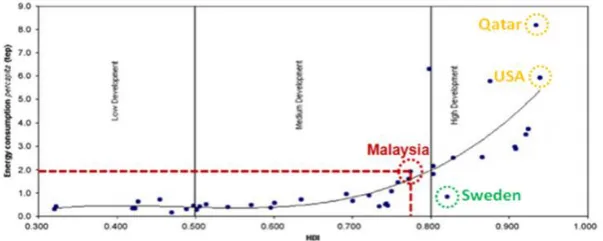
1.1 HDI versus Energy consumption within various
countries (Adopted from Dias et al., 2006) 11
1.2 Research flow diagram 15
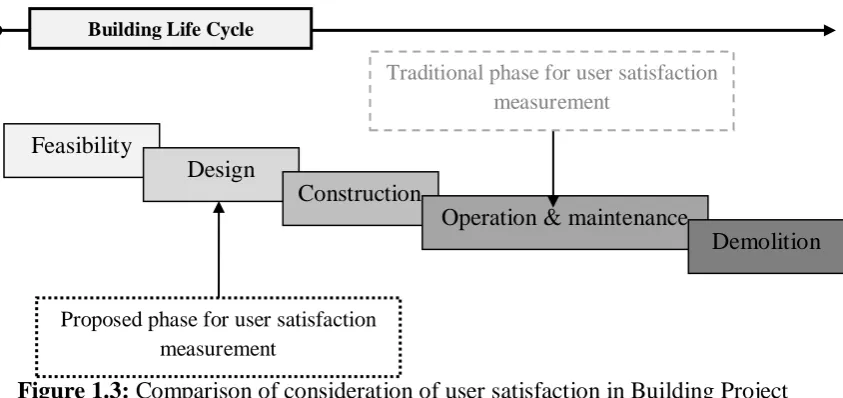
1.3 Comparison of consideration of user satisfaction in
Building Project Life Cycle, traditional approach
verses proposed approach 20
2.1 An overview on Literature Review 23
2.2 Relationships of environmental, social, and economic
principles in sustainable design, and benefits related to
each principle (Adopted from US EPA, 2010). 24
2.3 Taxonomies of researches in user satisfaction index
analysisframeworks 61
2.4 Kano model on user-satisfaction measurement in three
categories of Needs (i.e. Must Be there), Satisfier (i.e.
One-dimensional), and Happiness (i.e. attractive)
criteria (Adopted from Kano et al., 1984; Cohen, 1995) 71
3.1 Flow of systematic review to address 1st Step 76
3.2 Variables selected in survey instrumental design 78
3.3 Human thermal satisfaction assessment cycle 80
3.4 Flow of systematic review to address 4th step 87
3.5 Flow of systematic review to address the 5th step 88
3.6 Flow of systematic review to address the 6th step 89
3.7 Research flow diagram 101
3.8 Techniques and Methods used to conduct the Research 102
3.9 Flow of systematic review used in this study 104
3.10 Grounded Group Desicion Making (GGDM) Model
3.11 Sampling distribution to reject the null hypothesis 113
5.1 Initial framework proposed by researcher in ‗Intro.‘
section of brainstorming 143
5.2 Framework resulted from ‗Round 1‘ of brainstorming 143
5.3 Framework resulted from ‗Round 2‘ of brainstorming 145
6.1 The LEO building 153
6.2 Illustration of changing coding of the questionnaires
sheet from (a) to (b) to minimize the transferring error 157
6.3 Sample of results presented in report sheet of the
developed framework based on the LEO building case
LIST OF ABBREVIATIONS
ABSI Adaptive Behavior Satisfaction Index
ACEM Association of Consulting Engineers Malaysia AEUI Annual Area Energy Use Index
AHP Analytic Hierarchy Process ANN Artificial-Neural-Network
ANSI American National Standards Institute
ASHRAE American Society of Heating, Refrigeration, and Air-Conditioning Engineers
ASMI Athena Sustainable Material Institute BEMS Building Energy Management System
BREEAM Building Research Establishment Environmental Assessment Method
BUS Building Use Studies
BRE Building Research Establishment
CAD Computer Aided Design
CBE Center for the Built Environment CGD Close Group Discussion
COPE Cost-effective Open-Plan Environments
CRISP Construction Related Sustainability Indicators Project
EI Energy Intensity
EN European Standards
EPI Energy Performance Indicators EUI Energy Use Intensities
GBC Green Building Challenges GBI Green Building Index
GEO Green Energy Office
HK-BEAM Hong Kong Building Environmental Assessment Method
HDI Human Development Index
HTM Human Thermal Model
HVAC Heating, Ventilation, & Air Conditioning
iiSBE international initiative for Sustainable Built Environment IEQ Indoor Environmental Quality
ISO International Organization for Standardization IUCN International Union for the Conservation of Nature LEED Leadership in Energy & Environmental Design-
LEO Low Energy Office
MEWC Ministry of Energy, Water and Communication
MS Malaysian Standard
NEMA National Electrical Manufacturing Association NGOs Non-Governmental Organizations
NRCC National Research Council of Canada PAM Pertubuhan Akitek Malaysia
PLEA Passive and Low Energy Architecture POE Post Occupancy Evaluation
PTM Persatuan Tenaga Malaysia SBtool Sustainable Building tool
SIRIM Standards & Industrial Research Institute of Malaysia TNB Tenaga Nasional Berhad
UNCHE United Nations Conference on the Human Environment UNWCED UN World Commission an Environment and Development UNWCED Nation World Commission on Environment and Development UNMDG United Nations Millennium Development Goals
UNEP-SBCI United Nations Environmental Programme for Sustainable Buildings and Construction Initiatives
USGBC US Green Building Council
US EPA United States Environmental Protection Agency
WSM Weighed Sum Method
LIST OF APPENDICES
APPENDIX TITLE PAGE
A Questionnaire Survey for the First Objective 206
B Expert Input Questionnaire for the First Objective 210
C Expert Input Questionnaire for the Second Objective 214
D Expert Input Questionnaire for the Third Objective 225
E Expert Input Questionnaire for the Fourth Objective 230
F Brainstorming Form for the Fifth Objective 235
G User Input Questionnaire for the Fifth Objective 239
H Introduction on Case Study 244
I Expert Input Questionnaire for the Sixth Objective 263
J Adaptive Behavior Satisfaction Index Excel File Used In
Case Study 269
K User Input Questionnaire for the Sixth Objective 284
CHAPTER 1
INTRODUCTION
1.1Introduction
This chapter is an introductory explanation of the study accomplished in this research. The chapter includes following sections; Research Discipline, Background of building assessment tools, Problems associated with building assessment tools, Aim and Objectives, Scope of Study, Research Methodology, Significance of Study, and Thesis Outline.
1.2 Research discipline
Study is to introduce the Macro, Meso, and Micro research disciplines in this section, including; Sustainability, Managing Sustainability, and Sustainability managerial technique in building construction practice.
Commission on Environment and Development conference (UNWCED, 1987). The ‗Brundtland Report‘ also defined sustainability as ‗Our Common Future‘ state ―…to ensure that it meets the needs of the present without compromising the ability of future generations to meet their own needs‖ (UNWCED, 1987). Hence, there is dramatic development of sustainability issues in all research fields all over the world.
Managing Sustainability: Expressed by Daub (2007), and Roca and
Searcy (2012), there is lack of proper management effort in the diverse sustainability research field. Hence, there is a recent research trend called ‗Managing Sustainability‘. There is no established definition on the terminology ‗Managing Sustainability‘. This study defined the term ‗Managing Sustainability‘ based on the fundamental definition of the word ‗Managing‘ (as a verb); having control and supervising over the ‗Sustainability‘ (as a noun). Defining sustainability, there are three main sustainability aspects to be considered; that is, social sustainability, economic sustainability, and environmental sustainability. These ―three aspects are independent, inter-connected, and shall be considered as equal‖ (Poveda and Lipsett, 2011). Thus, this study defines ‗Managing Sustainability‘ as ‗to control and supervise implementation of the different aspects of sustainability; including, social, economic, and environmental. The ‗Managing Sustainability‘ aims to enhance effectiveness of sustainability techniques towards a sustainable ‗sustainability‘ practice. There are a variety of international co-operations, international journals and conferences, and research institutes established under the subject of ‗Managing Sustainability‘. Managing efficient energy or efficient energy management is one of the main categories in the Managing Sustainability which has been emphasized intensively by engineering researchers.
Sustainability managerial technique in building construction
construction practice‘ is a traditional concern for building owners and consultants. Indeed, one of the evidences to this argument is the ‗Hammurabi code‘. The ‗Hammurabi code‘ is the first building code dating more than 3000 years (Taylor, 2011). Focusing on more recent history, all industries related to building industry are influenced by ‘Earth summit‘ conference organized in Rio de Janeiro. In 1992, it was the first United Nation conference where the attending countries came up with five agreements. Among the five agreements, ‗agenda 21‘ considered the reevaluation of sustainability included more than hundred (100) diverse industries including the building industry. More recently, in 2000, the global momentum and initiatives towards sustainability in the building practices was established as the United Nations Millennium Development Goals ‗7‘ - MDG 7 (UNMDG, 2000). It was agreed by the number of countries to enhance sustainable building practices globally. Furthermore, the United Nations Environmental Programme for Sustainable Buildings and Construction Initiatives (UNEP-SBCI) is the other current international research efforts to enhance sustainable building practices.
Based on presented overview on the general research discipline, Sustainability understood as ‗macro‘ discipline. Managing Sustainability understood as ‗meso‘ discipline, and ‗Sustainability managerial technique in building construction practice‘ as ‗micro‘ discipline. From the introduced micro discipline study is narrowed to enhance ‗building assessment tools‘. This is presented in ‗Background of building assessment tools‘ and ‗Problems associated with building assessment tools‘.
1.3 Background of Building Assessment Tools
building codes, (c) private and professional associations or Non-Governmental Organizations (NGOs), and (d) marketing strategies (Taylor, 2011). Amongst, the largest contributor to enhance sustainability in building practices is the private and professional associations, NGOs (Taylor, 2011). Within which, mainly, NGOs have resulted with multi-perspective ‗Sustainable building assessment tools‘ to enhance sustainability of building practices in specific regional areas. Even though these assessments tools were not originally designed to serve as design guidelines, it seems they are increasingly being used as such (Cole, 1998; Crawley and Aho, 1999).
In the building construction industry, sustainable assessment tools are specifically used to benchmark enhancement of sustainability in building practices (Christensen, 2011). Application of these assessment tools is a contribution of ‗Managing Sustainability‘ to the building construction industry. These tools traditionally called ‗Environmental building assessment tools‘, ‗Green building assessment tools‘ and recently called ‗Sustainable building assessment tools‘. Building assessment tools are categorized into physical assessment tools, monetary assessment tools, models, scenario analysis, multi-criteria analysis, sustainability-environmental appraisal tools, participatory tools, and transition management (Rorarius, 2007).
managers, building owners, consultants, authority, contractor, and/or academic researchers. The academic researchers indirectly use the sustainable building assessment tools as decision support tools in order to fulfill the requirement of building sustainability accreditation (Abdalla et al., 2011).
Furthermore, these tools are categorized based on assessment methods, as qualitative tools incorporating rating and/or labeling criteria, and as quantitative tools incorporating quantitative life cycle assessment of materials, energy, water, and etc. (Reijnders and Roekel, 1999).
There are some efforts being undertaken by International Organization for Standardization (ISO) to establish standardized requirements for building assessment tools (ISO/TS21929- 1:2006, ISO/TS21931-1:2006). The need for a comprehensive and global assessment tool still remains a challenging proposition to be undertaken.
1.4 Problems associated with building assessment tools
‗….specifically for the Malaysian-tropical climate, environmental and developmental context, cultural and social needs‘ (PAM, 2009).
With regards to problems with sustainable building assessment tools, there are some shortcomings addressed by researchers in the available literature. Gibson (2001) states that established tools do not work effectively towards sustainability. Poveda and Lipsett (2011) state there is no agreement amongst stakeholders to have a specific framework to evaluate the method of building assessment. Furthermore, Abdalla et al. (2011) mentioned two main shortcomings; Sustainable building assessment tools are not accurate in estimation project output in terms of energy consumption and other sustainability measures, more so, building assessment tools do not consider end-user sustainable program. Furthermore, Pemsel et al. (2010) express that lack of ‗guidance and narrow focus‘ restricts the ability of tools in the assessment process. Moreover, there is lack of global standardized assessment tools (Christensen, 2011). According to literature, the current phenomenon of majority of building assessment tools is lack of focus on energy, environment, and/or economic aspects in the design phase of building life cycle.
Lützkendorf and Lorenze (2008) state ―… due to the complexity involved, only a few tools (i.e. LEGEP in Germany and OGIP in Switzerland) exist that allow for a combined determination and assessment of cost, environment and to some extent occupational health and other social issues in the planning phase‖.
Christensen (2011) states ‗user satisfaction‘, ‗access to public transport‘, and ‗development impact on community‘ as social sustainability criteria need to be considered in sustainable building assessment tools.
For the further development of building assessment frameworks, Lützkendorf and Lorenz (2006) proposed an integration of instruments and measures of the design, construction and management phase, that is ‗integrated building performance‘. It is argued that the application of integrated design and assessment tools can greatly assist in consolidating and improving property professionals‘ knowledge and active services provided over the life of buildings (Lützkendorf and Lorenz, 2006).
Lützkendorf and Lorenz (2006) state assessing a building‘s contribution to sustainable development requires an integrated building performance approach. This allows one to describe and assess buildings with respect to all dimensions of sustainable development including aspects of functionality and serviceability as well as the quality of planning, construction and management process. Lützkendorf and Lorenz (2006) state to enable assessment tools to influence the design of buildings, further development of tool is required. This will allow architects and engineers to use them to compare different solutions or optimizing sketches and designs during the whole design process, including the very early phases of conception or pre-design.
Lützkendorf and Lorenz (2008) express that in contrast to conventional assessment tool, integrated design and assessment tools can contribute to the simplification of the assessment process, and will reduce time and costs. Integrated design and assessment tools may be applied to the whole planning and design stage, and are capable of providing a concluding assessment of the finished design concept or of new/existing buildings, respectively. In addition, these tools take into account economic, environmental, and social aspects simultaneously.
According to Chen et al. (2009), another problem of current building assessment tools is that their evaluation processes are not convincing enough to provide a reasonable assessment result.
Environmental Quality (IEQ) through following standards of energy efficient building (for example; MS1525:2007). Indeed, building assessment tools cover the user satisfaction in considering Post Occupancy Evaluation (POE) criteria. SBtool is the first building assessment tool launched to consider the ‗user satisfaction‘ as an independent criterion of building assessment index among other criteria. Considering the user satisfaction criterion in a building assessment development is completely compatible with fundamental definition of sustainability which indicates that ―three aspects are independent‖.
The user satisfaction in the SBtool seeks to analyze its ‗inter-connectivity‘ with other sustainability criteria. The user satisfaction has been studied across diverse disciplines; for instance, building architectural design, building value management (Achterkamp and Vos, 2008), building asset management (Lorenz and Lutzkendorf, 2008), real estate management (Lorenze and Lutzkendorf, 2008), and construction management. Reviewing mentioned disciplines indicate that the user satisfaction has been analyzed independent from environmental and economic aspects of sustainable building practices (Zimmerman and Matin, 2001).
Hwang et al. 2009, Liu et al. 2012). Other types of ‗behavior and activities‘ are more relevant to job specifications or user psychology. This confirms the need to enhance sustainable building assessment tools in consideration with the user satisfaction from ‗adaptive behavior‘ as a missing criterion.
Furthermore, tools actually pay less attention to functional variation in different types of buildings, which influence not only the emotional and physical well-being of human beings, but also the design and the management of buildings (Chen et al., 2009).
In conclusion, it has been proven that user satisfaction was not considered as an inter-connected criterion in compliance with other assessment criteria like energy efficiency in sustainable building assessment tools. Furthermore, this section concludes that among diverse aspects of user satisfaction, ‗user satisfaction from adaptive behavior‘ is the focal criterion in inter-connection with other sources affecting energy consumption in building. Based on these conclusions, this study emerges with the idea to develop Adaptive behavior satisfaction index analysis framework for energy efficient building assessment. To sum up, the study is to address the following research question;
‘How to calculate adaptive behavior satisfaction index for energy efficient building assessment?’
1.4 Aim and Objectives
This study aims to develop adaptive behavior satisfaction index analysis framework for assessment of energy efficient buildings. To address the aim of study, six objectives have been designed as following;
Objective 1: To investigate the effect of users‘ satisfaction from adaptive behavior on energy consumption of building.
Objective 3: To identify and establish energy efficient building assessment characteristics.
Objective 4: To identify and establish suitable user-satisfaction index analysis framework.
Objective 5: To develop Adaptive Behavior Satisfaction Index (ABSI) analysis framework for energy efficient building assessment.
Objective 6: To validate Adaptive Behavior Satisfaction Index (ABSI) analysis framework.
1.5 Scope of Study
This section addresses the scopes identified by the researcher in this study. The followings sections explain and justify ‗Scope of study on applicable classification of the building assessment framework‘, ‗Scope of study on energy efficient building‘, ‗Scope of study on applicable building functionality‘, Scope of study on applicable building energy consumption aspects‘, ‗Scope of study on applicable users of the framework‘ and ‗Scope of study on building life cycle‘
Scope of study on applicable classification of the building assessment
framework: This section elaborates scope of study in terms of various classifications on building assessment frameworks. According to Haapio and Viitaniemi (2008) there are two main kinds of environmental assessment classification; Athena Sustainable Material Institute (ASMI) classification system, and, IEA Annex 31 classification systems.
Environment-iiSBE (2001) introduced IEA Annex 31 classification system. According to IEA Annex 31, there are five classes of building assessment tools. First class; energy modeling software; second class, environmental life cycle analysis tools; third class, environmental rating system; fourth class, environmental design guideline or design checklist, and fifth class, environmental labeling and certification.
Based on introduced aim and objective, the scope of the current study is to develop the framework under second level of ASMI classification which is ‗Building design and decision support tool‘. According to IEA Annex 31, this research‘s final tool is classified under class three that is ‗environmental rating system‘.
Scope of study on energy efficient building: This section elaborates
importance of scope of study on energy efficient building. This selected based on local needs on energy efficiency. It is a common issue among all countries to improve Human Development Index (HDI) as a measure of human Quality of Life. The increase in HDI will affect higher energy consumption. Figure 1.1 shows the correlation between HDI and energy consumption within countries and specifically highlights the critical position of Malaysia in this trend. The figure confirms that Malaysia has to foresee the future energy consumption and optimize its energy consumption in sustainable building design towards improving HDI.
This momentum is recognized by the government of Malaysia. The key Ministry and agencies involved are; the Ministry of Energy, Green Technology and Water, Section of Economic Planning Unit, the Energy Commission of Malaysia, and Persatuan Tenaga Malaysia (PTM). In this regard, agendas have been set for the relevant Ministry and agencies by formulating Five-Year Plans. The government of Malaysia is seriously considering energy efficiency programs in the Ninth Malaysia Plan (2006-2010), and to a greater concern, in the Tenth Malaysia Plan (2011-2015). However, sustaining the quality of life for the needs of the population and at the same time managing Malaysia‘s resources has not been considered in parallel with energy efficiency issue.
Scope of study on applicable building functionality: In construction industry, buildings are classified as; residential, office, commercial, industrial and so on. In current research, ‗office building‘ is selected as the applicable building functionality; because the ‗office buildings‘ are highest energy consumer buildings in Malaysia (MS 1525:2007). Another justification to this scope selection is availability of energy consumption data in office buildings. Furthermore, the momentum of the Malaysian government towards energy efficient buildings which is parallel to this scope selection.
Scope of study on applicable building energy consumption aspects:
According to MS 1525:2007 minimum requirement of Building Energy Management System is the availability of the data on energy consumption. The dataset on energy consumption in office buildings was provided for four aspects; including, air conditioners, lighting, building facilities (lifts and pumps), and work equipment.
To measure the user satisfaction from adaptive behavior, the research selected air conditioners and lighting among diverse building energy consumption aspects. The ‗Phase I‘ of research methodology resulted in the effect of between user satisfaction and building facilities (e. g. lifts and pumps) and work equipment is considerably very low.
selection of air conditioners, lighting matches with highest energy using equipment in office buildings.
Scope of study on building life cycle: Building life cycle may include; feasibility, design, construction, operation and maintenance, and demolition. This study‘s scope is the ‗design‘ phase of building life cycle. This complements the scope of study on classification of the framework. The selection of ‗design‘ phase is significant in comparison with the traditional approach to evaluate user satisfaction in operational phase of the project life cycle.
Scope of study on applicable users of framework: According to Haapio
and Viitaniemi (2008), scope on users of the building assessment framework may include; design professionals, contractors, building owner, consultants, building users, facility managers, researchers, and authorities. This research has determined ‗Architect practicing Energy Efficiency‘ as the scope on user of framework. The framework user can use it as building design decision support framework. This is adapted to the scope on building life cycle.
1.6 Research Methodology
.
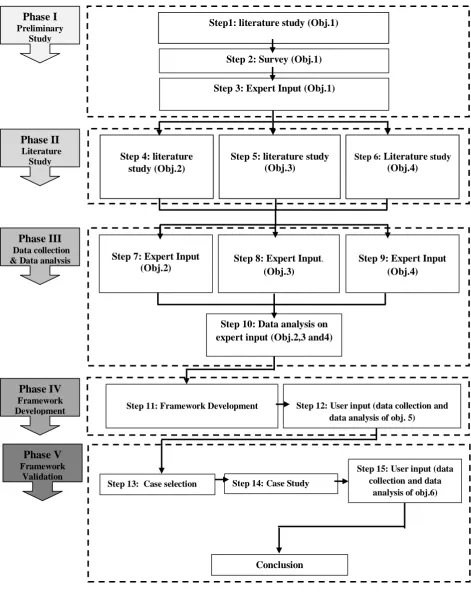
Figure 1.2: Research flow diagram Step 2: Survey (Obj.1)
Step 3: Expert Input (Obj.1) Step1: literature study (Obj.1)
Phase I Preliminary
Study
Step 10: Data analysis on expert input (Obj.2,3 and4)
Conclusion Step 4: literature
study (Obj.2)
Step 5: literature study (Obj.3)
Step 6: Literature study
(Obj.4)
Step 8: Expert Input.
(Obj.3) Step 7: Expert Input
(Obj.2)
Step 9: Expert Input (Obj.4)
Step 12: User input (data collection and data analysis of obj. 5)
Step 11:Framework Development Phase II
Literature Study
Phase III Data collection & Data analysis
Phase IV Framework Development
Step 13: Case selection Step 14: Case Study
Step 15: User input (data collection and data
analysis of obj.6) Phase V
Phase I: Preliminary study (to fulfill requirement of first objective)
Step 1: Literature Study: In this step a Systematic Literature Review Analysis was conducted to investigate effect of user satisfaction from adaptive behavior on building energy consumption. This step concluded with a hypothesis. Based on the result of this step, the study carried out a survey and included expert input.
Step2: Survey (data collection and data analysis): In this step a survey
was conducted to test the ‗hypothesis‘ established based on literature review. Data gathering involved structured interviews with ten staff representing different office units in a green certified office building. Data analysis was conducted by means of correlation analysis.
Step3: Expert Input (data collection and data analysis): In this step an
expert validation was conducted on the survey findings. Data collection included field expert Delphi structured close group discussion. It was carried out in four sessions of close group discussion with the involvement of seven participants. The participants were experts who had expertise in building energy efficiency assessment framework development and implementation. Data analysis was conducted using Grounded Group Decision Making (GGDM) method. Since GGDM is a relatively new method of data analysis, the Weighed Sum Method (WSM) was applied as a control data analysis method.
Phase II: Literature Study
Step 4: Literature Study (to fulfill requirement of second objective):
This step was to conduct Systematic Review Analysis on adaptive behavior in energy efficient building.
Step 5: Literature Study (to fulfill requirement of third objective):
Step 6: Literature Study (to fulfill requirement of fourth objective):
This step was to identify several satisfaction Index analysis frameworks based on Systematic Review Analysis.
Phase III: Data Collection and Data Analysis
Step 7: Expert Input (to fulfill requirement of second objective):
This step was to validate the literature findings on adaptive behavior in energy efficient indoor environment. It included field expert Delphi structured close group discussion. It was carried out in three sessions of close group discussion with a total of seven participants. Two were field-experts who had experience in building energy management and five were field-experts who had experience in building facility management.
Step 8: Expert Input (to fulfill requirement of third objective): This
step was to validate literature findings on building energy efficient assessment framework characteristics. It included field expert Delphi structured close group discussion. It was carried out in five sessions of close group discussion with a total of nine participants. All had expertise in building energy efficiency assessment framework development and implementation.
Step 9: Expert Input (to fulfill requirement of fourth objective):
This section was to select suitable satisfaction index analysis framework to be implemented. It included field expert Delphi structured close group discussion. It was carried out in two sessions of close group discussion. This included fifteen structured interviews with experts who have experience in satisfaction measurement field of research.
Step 10: Data analysis on expert input: In this study data analysis was
Phase IV: framework development
Step 11: Framework Development: This step was to develop ABSI framework. It included Synectics Session involving five experts who had experience in building environmental design assessment framework development and implementation.
Step 12: User input (data collection and data analysis): This step was
to get preliminary validation of the developed framework. The preliminary validation was done by expected users of the framework. It included a Delphi structured close-group discussion with five building architectural consultants who are practicing energy efficient building design consultancy.
Phase V: Framework Validation
Step 13: Case selection: This step was to select the appropriate building as case study. It included a Delphi structured close-group discussion with five building architectural consultants who are practicing energy efficient building design.
Step 14: Case Study: This step was to address unforeseen biases of the
developed framework through a case study. The case study was conducted engaging three graduate students (Masters in Architecture) as users of framework within selected case study building.
Step 15: User validation (data collection and data analysis): This step
1.7 Significance of Study
This section explains the significance of the current research. Indeed, this issue is grounded problem statement. The following is to address the significance of the study to the construction industry.
Figure 1.3: Comparison of consideration of user satisfaction in Building Project Life Cycle, traditional approach verses proposed approach
Furthermore, it is obvious that ‗study on user satisfaction requirement‘ will enhance sustainability of building in diverse dimensions; such as, functionality, serviceability, adoptability, human comfort requirement, well-being, and risk reduction of investment and negative impact on the nature (Lutzkendorf and Lorenz, 2008).
1.8 Thesis Outline
This research basically follows the afore-mentioned six objectives to address the aim. To do so, the report of the research is presented in eight chapters corresponding to university thesis manual. This includes; Chapter ‗1‘: Introduction, Chapter ‗2‘: Literature Review, Chapter ‗3‘: Research Methodology, Chapter ‗4‘: Data Analysis, Chapter ‗5‘: Framework Development, Chapter ‗6‘: Case study, Chapter ‗7‘: Finding and Discussion, Chapter ‗8‘: Conclusion.
Chapter ‗1‘: Introduction,
First chapter presents introduction to the research. In this chapter rational to the research, identified aim and objectives and brief research methodology is presented.
Feasibility
Design
Construction
Operation & maintenance
Demolition Traditional phase for user satisfaction
measurement
Proposed phase for user satisfaction measurement
Chapter ‗2‘: Literature Review,
Chapter ‗2‘ presents critical reviews on the related literatures to each objective. Validated finding of literature review is implemented in the final model. This chapter mainly presents Phase II of the research methodology flow.
Chapter ‗3‘: Research Methodology,
Chapter ‗3‘ addresses the grounded research methodology of the study in detail. In this chapter methods and techniques undertaken to conduct the data collection are explained. This chapter mainly presents rational of research methodology flow carried out in this study.
Chapter ‗4‘: Data analysis,
Chapter ‗4‘ presents results of survey and validation done on literature by means of ‗expert input‘. In chapter ‗4‘ data analysis corresponds to ‗Phase I & III‘ of the research methodology.
Chapter ‗5‘: Framework Development,
Chapter ‗5‘ presents the development of the framework and user input as preliminary validation of developed framework. This chapter corresponds to ‗Phase IV‘ of research methodology.
Chapter ‗6‘: Case study,
Chapter ‗6‘ addresses case selection, the case study done to validate developed framework and the final user validation. This chapter presents ‗Phase V‘ of the research methodology.
Chapter ‗7‘: Discussion,
Chapter ‗7‘ discusses on strength and weakness of each objective finding including the final developed framework.
REFERENCES
Abbaszadeh, S., Zagreus, Leah, Lehrer, D., and Huizenga, C. (2006). Occupant satisfaction with indoor environmental quality in green buildings. UC Berkeley: Center for the Built Environment. Available from: http://www.escholarship.org/uc/item/9rf7p4bs access at Dec. 2010.
Ganjbakhsh, H. (2010). POE for Low Energy Office Building. Master thesis, University technology Malaysia.
Abdalla, G., Maas, G., Huyghe, J., and Oostra, M. (2011). Criticism on Environmental Assessment Tools. 2nd International Conference on Environmental Science and Technology, IPCBEE, 6, Singapore.
Achterkamp, M.C., and Vos, J.F.J. (2008). Investigating the use of the stakeholder notion in project management literature, a meta-analysis. International Journal of Project Management, 26:749-757.
Akbas, R., Clevenger, C., and Haymaker, J. (2007). Temporal Visualization of Building Occupancy Phase. ASCE Proceeding of International Workshop on Computing in Civil Engineering, Pittsburgh, Pennsylvania.
Allsop, D.T., Bassett, B.R., Hoskins, J.A. (2007). Word of mouth research: principles and applications. Journal of Advertising Research 47(4):398-411
American Society of Heating Refrigeration and Air conditioning Engineers-ASHRAE (1992). Standard 55 Thermal Environmental Conditions for Human Occupancy. ASHRAE, Atlanta.
American Society of Heating, Refrigerating and Air-Conditioning Engineers-ASHRAE (2004b). ASHRAE Standard 62.12004. Ventilation for acceptable indoor air quality. Atlanta: American Society of Heating, Air-conditioning, and Refrigerating Engineers, Inc.
American Society of Heating, Refrigerating and Air-Conditioning Engineers-ASHRAE (2004). ANSI/ASHRAE Standard 55. 2004.Thermal Environment Conditions for Human Occupancy, American Society of Heating, Ventilating and Air-Conditioning Engineers, Inc.
American Society of Heating, Refrigerating and Air-Conditioning Engineers-ASHRAE (2006). ASHRAE GreenGuide: The design, construction, and operation of sustainable buildings. Atlanta, GA: American Society of Heating, Refrigerating and Air-Conditioning Engineers.
American Society of Heating, Refrigerating and Air-Conditioning Engineers-ASHRAE (2010). ANSI/ASHRAE Standard 55-2010: The design of sustainable buildings for occupant comfort. GA: American Society of Heating, Refrigerating and Air-Conditioning Engineers.
Aries M.B.C., Veitch J.A., and Newsham G.R. (2010). Windows, view, and office characteristics predict physical and psychological discomfort. Journal of Environmental Psychology 30:533–541.
Azar, E.; and Menassa, C.C., (2012). Agent-Based Modeling of Occupants and Their Impact on Energy Use in Commercial Buildings. Journal of Computing in Civil Engineering, 26(4), 506–518.
Baker, N., and Standeven, M. (1996). comfort for free-running buildings. Energy and Buildings, 23:175-182
Benton, C.C., and Brager. G.S. (1994). Unset Building: Final Report -- A Study of Occupant Thermal Comfort in Support of PG&E’s Advanced Customer Technology Test (ACT2) for Maximum Energy Efficiency. Center for Environmental Design Research, University of California, Berkeley, CA
Beynon, M.J. (2005). A method of aggregation in DS/AHP for group decision-making with the non-equivalent importance of individuals in the group. Computers & Operations Research, 32:1881–1896.
Borgeson, S., and Brager G. (2011). Comfort standards and variations in exceedance for mixed-mode buildings. Building Research & Information,39(2):118-133 Bourgeois, D. Reinhart, and C. Macdonald, I. (2006). Adding advanced behavioural
models in whole building energy simulation: a study on the total energy impact of manual and automated lighting control. Energy and Buildings, 38:814– 823. Boyce, P.R. (2003). Human factors in lighting. Taylor & Francis; 2003.
Brager, G., Paliaga, G., and de Dear, R. (2004). Operable Windows, personal control and occupant comfort. ASHRAE Transactions;110 (Part 2).
Brager, G.S., and de Dear, R.J. (1998). Thermal adaptation in the built environment: a literature review. Energy and Buildings, 27:83-96.
Brager, G., and Baker, L. (2009). Occupant satisfaction in mixed-mode buildings. Building Research and Information, 37(4):369-380.
Brandt, D.R. (1988). How service marketers can identify value-enhancing service elements. Journal of Services Marketing, 2 (3): 35–41.
Brandt, D.R., and Scharioth, J. (1998). Attribute life cycle analysis. Alternatives to the Kano method. Proceeding of 51th ESOMAR-Congress, 413-429.
Building and Construction Authority-BCA (2002). BCA contractor’s registry. Singapore, Available from http://www.dir.bca.gov.sg/bca/index.asp, access at December , 2011.
Building and Construction Authority-BCA (2005). Singapore Green Mark Scheme. Available from http://www.bca.gov.sg/greenmark/green_mark_buildings.html access at December 2011
Building Research Establishment (1992). BREEAM: BRE Environmental Assessment Method. Available from http://www.breeam.org/, access at Dec., 2010.
Building Science Corporation -BSC (2008). Towards sustainability: Green building, sustainability objectives, and building America whole house systems research (Research Report 0801). Available from Building Science Corporation website:
http://www.buildingscience.com/documents/reports/rr-0801-towards- sustainability-green-building-sustainability-objectives-and-building-america-whole-house-systems-research, access at Dec. , 2010.
Bulut, E., kan, D., Tuba, K., and Shigeru, Y. (2012). Use of consistency index, expert prioritization and direct numerical inputs for generic fuzzy-AHP modeling: A process model for shipping asset management. Expert Systems with Applications, 39:1911–1923.
Campbell, A., Conserve, P.E., and Rodgers, W.L. (1975). The Quality of American Life, Russell Sage.
Cândido, Ch., Lamberts, R., de Dear, R., Bittencourt, L., and de Vecchi, R. (2011). Towards a Brazilian standard for naturally ventilated buildings: guidelines for thermal and air movement acceptability. Building Research & Information, 39(2):145-153.
Cena, K., and de Dear R. (2001). Thermal comfort and behavioral strategies in office buildings located in a hot-arid climate. Journal of Thermal Biology, 26(4-5):409–414.
Chen, Z., Clements-Croome, D., Hong, J., Li, H., and Xu, Q. (2009). A multicriteria lifespan energy efficiency approach to intelligent building assessment. Energy and Buildings, 38:393–409
Chiang, H.C., Su, C.C, Pan, C.S., and Tsau, F.H. (2002). Study of an innovative partition-type personal modulation air-conditioning system, Indoor Air, Monterey, CA, USA, 2002:289–294.
Cho, Y., and Cho, K. (2008). A loss function approach to group preference aggregation in the AHP. Computers & Operations Research, 35:884 – 892. Choi, S.M. (2011). The Relationships Among Indoor Environmental Quality,
Occupant Satisfaction, Work Performance, and Sustainability Ethic In Sustainable Buildings. A Dissertation on Doctor Of Philosophy, Faculty Of The Graduate School Of The University Of Minnesota.
Choong; K. N., Abbas, M.; Said, O.M.; Lee; C.S., and Mohamed, R.R. (2009).The setup of national IP Multimedia Subsystem (IMS) testbed - approach and challenges. Proceeding of International Conference on Information Networking- ICOIN 2009 :1-5.
Chowdhury, A.A., Rasul, M.G., and Khan, M.M.K. (2008). Thermal-comfort analysis and simulation for various low-energy cooling-technologies applied to an office building in a subtropical climate. Applied Energy, 85:449–462
http://eres.scix.net/data/works/att/eres2011_336.content.pdf, acess at November 2011.
Chung, W. (2011). Review of building energy-use performance benchmarking methodologies. Applied Energy 88:1470–1479.
Chung, W., Hui, Y.V., and Miu Lam, Y. (2006). Benchmarking the energy efficiency of commercial buildings. Applied Energy, 83:1–14.
Chwolka, A., and Raith, M.G. (2001). Group preference aggregation with the AHP-implications for multiple-issue agendas. European Journal of Operational research, 132:176-186.
Clark, K. (1985). The interaction of design hierarchies and market concepts in technological evolution. Research Policy, 14:235-251.
Clément Roca, L., and Searcy, C. (2012). An analysis of indicators disclosed in corporate sustainability reports. Journal of Cleaner Production, 20:103-118. Cohen, L. (1995). Quality Function Deployment: How to Make QFD Work for You.
(1 edition), Prentice Hall.
Cole, R.J. (1998). Emerging trends in building environmental assessment methods. Building Research & Information, 26(1): 3-16.
Cole, R. J., Brown, Z., and McKay, S. (2010). Building human agency: a timely manifesto. Building Research & Information, 38(3):339-350.
Collins, KJ. (1979). Hypothermia and thermal responsiveness in the elderly. Proceeding of First Internal Indoor Climate Symposium, 819–34.
Cook, D.J., Mulrow, C.D., and Haynes, R.B. (1997). Systematic Reviews: Synthesis of Best Evidence for Clinical Decisions. Annals of Internal Medicine, 126 :364-371.
Cook, D.J., Greengold, N.L., Ellrodt, A.G., and Weingarten, S.R. (1997). The Relation Between Systematic Reviews and Practice Guidelines, Annals of Internal Medicine, 127(3):210–216.
Cozby, P.C. (2004). Methods in Behavioral Research. London: McGraw Hill.
Crawley, D., and Aho, I. (1999). Building environmental assessment methods: applications and development trends. Building Research & Information, 27 :300-308.
Cuttle, C. (1983). People and windows in workplaces. Proceedings of the People and Physical Environment Research Conference, Wellington, New Zealand, 203– 212.
Danny, H.W. Li, Cheung, K.L., Wong, S.L., Lam, T.N.T. (2010). An analysis of energy-efficient light fittings and lighting controls, Applied Energy, 87 (2):558-567.
Darby, S. (2000). Making it Obvious: Designing Feedback into Energy Consumption. Proceedings of the 2nd Annual International Conference on Energy Efficiency in Household Appliances and Lighting. Italian Association of Energy Economists, Naples.
Daub, C.H. (2007). Assessing the quality of sustainability reporting: an alternative methodological approach. Journal of Cleaner Production, 15:75-85.
De Dear R.J, and Brager G.S. (2001). The adaptive model of thermal comfort and energy conservation in the built environment. International Journal of Biometeorology, 45(2):100-108.
De Dear, R. J. (2007). Adaptive comfort applications in Australia and impacts on building energy consumption. Proceedings of the Sixth International Conference on Indoor Air Quality, Ventilation and Energy Conservation in Buildings: Sustainable Built Environment, Sendai, Japan.
De Dear, R.J., and Brager, G.S. (1997). Developing an adaptive model of thermal comfort and preference. ASHRAE Transactions, 104(1a):145-167.
Degelman, L.O, and Soebarto, V.I. (1995). Software description for ENER-WIN, A visual interface model for hourly energy simulation in buildings, Proceeding of Building Simulation, 2005:692-696.
Dias, R.A., Mattos, C.R., and Balestieri, J.A.P. (2006). The limits of human development and the use of energy and natural resources. Energy Policy, 34(9):1026-1031.
Dibra, A., Mahdavi, A, and Koranteng C., (2011). An analysis of user behaviour and indoor climate in an office building in Kosovo. Advances in Applied Science Research, 2(5):48-63.
Duin, H., Baalsrud Hauge, J., and Thoben, K. (2009). An ideation game conception based on the Synectics method. On the Horizon, 17(4):286-295.
Eang, L.S. (2001). Energy Efficiency of Office Buildings in Singapore. Available at http://www.bdg.nus.edu.sg/buildingenergy/publication/papers/paper4.html, access at Nov. 2011.
Edwards, B. (2006). Benefits of green offices in the UK: analysis from examples built in the 1990s. Sustainable Development, 14:190–204.
Emery, A.F., and Kippenhan, C.J., (2006). A long-term study of residential home heating consumption and the effect of occupant behavior on homes in the Pacific Northwest constructed according to improved thermal standards. Energy, 31 (5):677–693.
European Committee for Standardization-CEN (2007). EN 15251:2007-Criteria for the Indoor Environment Including Thermal, Indoor Air Quality, Light and Noise, European Committee for Standardization, Brussels, Belgium.
Erickson, V. L., Lin, Y., Kamthe A., Brahme, R., Surana, A., Cerpa, A.E., Sohn, M.D., and Narayanan, S. (2009). Energy Efficient Building Environment Control Strategies Using Real-time Occupancy Measurements, Available from <http://andes.ucmerced.edu/papers/Erickson09a.pdf, access at June 2010.
Estes, J.M, Schreppler,S., and Newsom, T. (2004). Daylighting prediction software: comparative analysis and application. Proceedings of Fourteenth Symposium on Improving Building Systems in Hot and Humid Climates, Texas, 259-267.
Fanger, P. O, (1973). Thermal Comfort. Danish Technical Press, (Republished by McGraw-Hill, New York, 1973).
Fanger, P.O, and Toftum, J. (2002). Extension of the PMW model to non-air-conditioner building in warm climates. Energy and Buildings, 34:533-536. Fishburn, P.C. (1967). Additive Utilities with Incomplete Product Set: Applications
to Priorities and Assignments, Operations Research Society of America (ORSA) Publication, Baltimore, MD.
Fisher, S. (1990). Environmental change, control and vulnerability. Chishester: Wiley.
Fountain, M. Brager, G., and de Dear, R. (1996). Expectations of indoor climate control. Energy and Buildings, 24:179-182.
Froehlich, J. (2009), Promoting Energy Efficient Behaviors in the Home through Feedback: The Role of Human-Computer Interaction. Proceeding of HCIC 2009 Workshop Volum 9.
Gass, S.I., and Rapcs´ak, T. (1988). A note on synthesizing group decisions, Decision Support Systems, 22:59–63.
Geller, E. S., Winett, R. A., and Everett, P. B. (1982). Preserving the Environment: New Strategies for Behavior Change. Pergamon Press Inc.
Georgiadou, M. C, Hacking, T., and Guthrie, P. (2012). A conceptual framework for future-proofing the energy performance of buildings. Energy Policy, 47:145– 155.
Gibson, C., Head, L., Gill, N. and Waitt, G. (2011). Climate change and household dynamics: beyond consumption, unbounding sustainability. Transactions of the Institute of British Geographers, 36:3–8.
Goldsmith, R. (1974). Acclimatization to cold in man—Fact or fiction? Heat loss from animals and an: assessment and control. Proceedings of the 20th Easter School in Agricultural Science, Univ. of Nottingham. J.L. Monteith, and L.E. Mount, eds. London: Butterworths.
González, A.B.R., José, J., Díaz, V., Caamaño, A.J., Wilby, M.R. (2011). Towards a universal energy efficiency index for buildings. Energy and Buildings, 43(4):980-987.
Gordon, W.J.J. (1961). Synectics, The Development of Creative Capacity. Harper, New York, NY.
Goto, T., Mitamura, T. , Yoshino, H. , and Tamura A. (2007). Long-term field survey on thermal adaptation in office buildings in Japan Inomata. Building and Environment, 42:3944–395.
Gouda, G. G., Danaher, S., and Underwood. C. P. (2006). Quasi-adaptive fuzzy heating control of solar buildings. Building and Environment, 4:1881-1891. Grace, M. (2000). BREEAM — a practical method for assessing the sustainability
of buildings for the new millennium. Proceedings of the Sustainable Building Conference 2000, Maastricht, the Netherlands.
Gratia, E., and De Herde, A., (2004). Natural cooling strategies efficiency in an office building with a double-skin façade. Energy and Buildings 36 (11):1139-1152.
Green Building Challenges-GBC (1996). Green Building tool. Available from http://www.iisbe.org/ access at December 2011.
Green Building Challenges-GBC (2001). IEA Annex 31 classification system. Available from http://www.iisbe.org/ access at December 2011.
Green, S.D., and Moss, G.W. (1998). Value management and post-occupancy evaluation: closing the loop. Facilities, 16(1):34-39.
Haapio, A., and Viitaniemi, P. (2008). A critical review of building environmental assessment tools. Environmental Impact Assessment Review. 28:469–482.
Haas, R. (1997). Energy efficiency indicators in the residential sector: What do we know and what has to be ensured? Energy Policy, 25:789–802.
Hadjri, K. and Crozier, C. (2009). Post-occupancy evaluation: purpose, benefits and barriers. Facilities, 27(1-2):21 – 33
Heidari, S., and Sharples, S. (2002). A comparative analysis of short-term and long-term thermal comfort surveys in Iran. Energy and Buildings, 34(6):607-614. Halawa, E., and van Hoof, J., (2012). The adaptive approach to thermal comfort: A
critical overview. Energy and Buildings, 51:101–110.
Haldi F, and Robinson D. (2010). Adaptive actions on shading devices in response to local visual stimuli. Journal of Building Performance Simulation, 3(2):135-153. Haldi F, and Robinson D. (2008). On the behaviour and adaptation of office
occupants. Building Environment, 43(12):2163-77.
Haldi, F., and Robinson, D. (2009). Interactions with window openings by office occupants. Building and Environment, 44:2378–2395.
Han S., Ishida T., Iguchi M., and Iwai W. (2006).Visual impression of lighting from a window and a ceiling: a comparison between the compound lighting and the uniform lighting. Journal of Light and Visual Environment, 30(2):87–93.
Han S., Ishida T., and Iwai W. (2005). Visual impression of lighting from window and a ceiling: the effect of their compound ratio. Journal of Light and Visual Environment, 29(1):25–33.
Reinhart, C.F., Herkel, S. (2000). The simulation of annual daylight illuminance distributions — a state-of-the-art comparison of six RADIANCE-based methods. Energy and Buildings, 32(2):167-187.
Herkel, S., Knapp, U., and Pfafferott, J. (2005). A preliminary model of user behaviour regarding the manual control of windows in office buildings. Proceeding of Ninth international IBPSA conference on building simulation, Montreal, Canada.
Herkel, S., Knapp, U., and Pfafferott, J. (2008). Towards a model of user behaviour regarding the manual control of windows in office buildings. Building and Environment, 43:588–600.
Herring, H. (2006). Energy efficiency-a critical view, Energy, 31:10–20.
Hoes, P., Hensen, J.L.M., Loomans, M.G.L.C., de Vries, B. , and Bourgeois, D. (2009). User behavior in whole building simulation. Energy and Buildings, 41(3):295–302.
Holopainen, R. (2012). Utilizing a human thermal model for securing the thermal comfort of buildings. Doctoral Dissertation for the degree of Doctor of Science in Technology to be presented with due permission of the Aalto University School of Engineering, 2012.
Hong Kong: Business Environment Council (1996). Hong Kong Building Environmental Assessment Method-HK-BEAM. Available from http://www.bec.org.hk/eng/index.aspx access at December 2011
Huat, N. B., and bin Akasah, Z. A. (2011). Building performance analysis model using Post Occupancy Evaluation for energy-efficient building in Malaysia: A review. Proceeding of National Postgraduate Conference-NPC, 2011:1-7. Huizenga, C., Abbaszadeh, S., Zagreus, L. , and Arens, E. (2006) .Air quality and
thermal comfort in office buildings: results of a large indoor environmental quality survey. Proceedings of Healthy Buildings, Lisbon, Portugal, (3):393-397. Humphreys, M.A., and Nicol, F.J. (1998). Understanding the adaptive approach to
thermal comfort. ASHRAE Transactions, 98(1):991-1004.
Hwang, T., and Tai Kim, J. (2011). Effects of Indoor Lighting on Occupants‘ Visual Comfort and Eye Health in a Green Building. Indoor and Built Environment, 20(1):75-90.
IEA Annex 31, (2001). Energy related environmental impact of buildings. Available from http://www.annex31.com/, Accessed at Sep 2011.
Illuminating Engineering Society of North America-IESNA (2000). The Lighting Handbook, (ninth ed.). Illuminating Engineering Society of North America. Indraganti, M., and Daryani Rao, K. (2010). Effect of age, gender, economic group
and tenure on thermal comfort: A field study in residential buildings in hot and dry climate with seasonal variations. Energy and Buildings, 42:273–281.
Inkarojrit, V. (2005). Balancing comfort: occupant’ control of window blinds in private offices. Doctoral dissertation, University of California, Berkeley, USA. International Initiative for a Sustainable Built Environment (2001). Report. Available
from www.iisbe.org/, accessed at November 2012.
International Organization for Standardization (2011). ISO/TS21929- 1:2011 Sustainability in building construction -- Sustainability indicators. ISO, Sweden. International Organization for Standardization (2011). ISO/TS21931-1:2006 Sustainability in building construction -- Framework for methods of assessment for environmental performance of construction works International Standards Organisation, Geneva.
International Standards Organisation (2001). International Standard 7730. International Standards Organisation, Geneva.
International Standards Organisation (2005). International Standard 7730. International Standards Organisation, Geneva.
International Union for Conservation of Nature- IUCN (1980). World Conservation Strategy. Available from http://www.iucn.org/ accessed at November 2010. Jackson, T. (2005). Motivating Sustainable Consumption: a review of evidence on
consumer behaviour and behavioural change. Technical Report, Centre for Environmental Strategy, University of Surrey, Surrey, United Kingdom.
Jensen, W., Fischer, B., Wentz, T. and Camara, G. (2008). A proposed LEED standard for indoor acoustical quality. Journal of Green Building, 3(1): 93-101. Kano, N., Nobuhiku, S., Takahashi, F., and Tsuji, Sh. (1984). Attractive quality and