A Survey on Semantic Link Network Based
Big Data Analytics Framework for Image
Recognition in Social Network
Saranya R, Jitha P.B
P.G Scholar, Department of Computer Science and Engineering, Cochin College of Engineering, Kerala, India
P.G Scholar, Department of Computer Science and Engineering, Cochin College of Engineering, Kerala, India
ABSTRACT: In this paper, the semantic link network model is used for analyzing multimedia big data and performs image recognition in social networks through collaborative filtering. A whole model for generating the association relation between multimedia resources using semantic link network model is proposed. The definitions, modules, and methods of the semantic link network are used in the proposed method. The tags and the adjoining texts of multimedia resources are used to measure their semantic association. The modules of semantic link network model are implemented to quantify association relations. A real data set including 100 thousand images with social tags from Flickr is used in our experiments. Two evaluation methods, including clustering and retrieval, are performed, which shows the proposed method can measure the semantic relatedness between Flickr images correctly and robustly. Face recognition (FR) has been at the crux of more than a few novel breakthroughs over the past two decades and has progressively proffered several cross-domain applications that range from mainstream commercial software to critical law enforcement applications. Recent innovative developments in Big Data analysis, Cloud Computing, Social Networks and Machine learning have immensely transformed the conventional view of how several dreadful problems in Computer Vision can be tackled. Hence in this paper, we will provide a thorough survey of the concepts of Cloud Computing, Big Data, Social networks and Machine Learning from a recent outlook of FR, and proffer a framework for a novel FR approach based on the Extreme Learning Machines technique to perform the task of Face Tagging for Social Networks operating on Big Data.
KEYWORDS: Big data, multimedia resources, semantic link network, Big data application, cluster, collaborative filtering, FR.
I. INTRODUCTION
Recently, Big data is an emerging paradigm applied to datasets whose size is beyond the ability of commonly used software tools to capture, manage, and process the data within a acceptable elapsed time 3. Various technologies are being discussed to support the management of big data such as massively parallel processing databases 4, scalable storage systems 5, cloud computing platforms 6, and MapReduce 7.
Understanding the semantics of multimedia has been a vital component in many multimedia based applications. Manual annotation and tagging has been considered as a reliable source of multimedia semantics. Unfortunately, manual annotation is time-consuming and expensive when dealing with huge scale of multimedia data. Advances in Semantic Web 8 have made ontology an additional functional source for describing multimedia semantics.
manual metadata generation named ``social tagging'', which requires all the users in the social network label the multimedia resources with their own keywords and share with others. The characteristics of social tags are as follows.
(1) Ontology free. The ontology based labeling defines ontology and then let users label the multimedia resources using the semantic markups in the ontology. Social tagging requires all the users in the social network label the multimedia resources with their own keywords and share with others. Different from ontology based annotation. There is no pre-defined ontology or taxonomy in social tagging. Thus the tagging task is more convenient for users.
(2) User oriented. The users can annotate images with their favorite tags. The tags of multimedia resources are determined by users' cognitive ability. To the multimedia resources, users may give different tags. Each multimedia resource may be with one tag at least, and each tag may appear in many different multimedia resources.
(3) Semantic loss. Irrelevant social tags frequently appear, and users typically will not tag all semantic objects in the image, which is called semantic loss. Polysemy, synonyms, and ambiguity are some drawbacks of social tagging.
Human interaction is primarily reliant on the recognition of a variety of assorted patterns. These patterns consist of facets such as the familiarity of kind, the voice of a familiar person, the appearance of potentially harmful objects/individuals and so on 11.The accuracy of the recognition of the aforesaid patterns dictates our daily survival and has been a stimulating factor in the evolution of the social complexity of human beings and thus enabled our existence as a progressively advanced species. The inherent ability of the human brain to recognize patterns in a
swift and accurate manner has aggravated scientists to attempt to emulate this behavior using several sophisticated techniques and algorithms 12. Face Recognition (FR) 10 is one such preeminent cognitive ability that researchers have been strenuously striving to emulate by using a myriad of intricate algorithms and distinctly perceptive methodologies.FR has advanced at an incredible scale over the past two decades and has proffered a substantial number of practical applications that have served immensely in a wide array of commercial and law-enforcement settings.
The following sections intricate upon the notion of Big Data Analysis (BDA), Social Networks(SN), Machine
Learning (ML) and Cloud Computing(CC) from a contemporary perspective of FR technology. We confine our
discussion to the correlation of FR with these topics and do not delve into the particulars of their operation(a thorough elaboration on the working of BDA, SN, ML and CC can be found in 13). We will also provide the framework for a novel FR technique based on the Extreme Learning Machines 20 technique to perform the task of Face Tagging for Social Networks operating on Big Data.
The major contributions of this paper are summarized as follow.
(1) A whole model for generating the association relation between multimedia resources using Semantic Link Network model is proposed. The definitions, modules, and mechanisms of the Semantic Link Network are used in the proposed method. The integration between the Semantic Link Network and multimedia resources provides a new prospect for organizing them with their semantics.
(2) The tags and the surrounding texts of multimedia resources are used to measure their semantic association. The hierarchical semantic of multimedia resources are defined by their annotated tags and surrounding texts. The semantics of tags and surrounding texts are different in the proposed framework. The modules of Semantic Link Network model are implemented to measure association relations.
(3) A real data set including 100 thousand images with social tags from Flickr is used in our experiments. Two evaluation methods including clustering and retrieval are performed, which shows the proposed method can measure the semantic relatedness between Flickr images accurately and robustly.
(4) The relatedness measures between concepts are extended to the level of multimedia. Since the association relation is the basic mechanism of brain. The proposed Semantic Link Network based model can help the multimedia related applications such as searching and recommendation.
II. RELATED WORK
ontology builds a formal and explicit representation of semantic hierarchies for the concepts and their relationships in video events, and allows reasoning to derive implicit knowledge. In this section, the related work of the proposed model is given. The Semantic Web 8 is an evolving development of the World WideWeb, in which the meanings of information on the web is defined; therefore, it is possible for machines to process it.
Web, each fragment of the description is a triple, based on Description Logic. Thus, the unspoken connections and semantics within the description fragments can be reasoned using Description Logic theory and ontological definitions. Earlier research work on the Semantic Web focused on defining domain specific ontologies and reasoning technologies. Therefore, data are only meaningful in certain domains and are not connected to each other from the World Wide Web point of view, which certainly limits the contributions of SemanticWeb for sharing and retrieving contents within a distributed environment.
The Semantic Link Network (SLN)1 was proposed as a semantic data model for organizing various Web resources by extending the Web's hyperlink to a semantic link. SLN is a directed network consisting of semantic nodes and semantic links. A semantic node can be a concept, an instance of concept, a schema of data set, a URL, any form of resources, or even an SLN. A semantic link rejects a kind of relational knowledge represented as a pointer with a tag describing such semantic relations as cause Effect, implication, subtype, similar, instance, sequence, reference, and equal. The semantics of tags are usually common sense and can be regulated by its category, appropriate reasoning rules, and use cases. A set of general semantic relation reasoning rules was suggested in 14 and 15. If a semantic link exists between nodes, a link of reverse relation may exist. A relation could have a reverse relation. Relations and their corresponding reverse relations are knowledge for supporting semantic relation reasoning.
The principal advantage of Big Data analysis (BDA)is the significant accuracy boost and improvement in performance that it can tender due its capability of proffering massive number of images for the task at hand. This upsurge in accuracy is due to the fact that BDA relies on N=all sample size13 i.e. all the facial characteristics for comparison (as opposed to about five or six points in conventional mechanisms).
The popular BDA technologies include: Apache Hive, Apache Giraph and the already prominent Horton works, Hadoop and so on. Yahoo developed Apache Giraph in 2010, on the basis of a prominent Pregel paper published by Google 21. Apache Giraph technology is based on the strategies of distributed computing and iterative graph processing system and is decisively reliant on the there three critical components of parallel computation and processing: Concurrent computation, communication and barrier synchronization 13. These properties make Apache Giraph it an ideal candidate to aid in proffering efficient FR systems. Facebook also continues to widen its presence in the sphere of BDA by opting for the Apache Giraph methodology in order to proffer a novel social graph search that can effectively scale up to a trillion edges 21.
SEMANTIC LINK NETWORK BASED MODEL
The tags and surrounding texts of multimedia resources are used to represent the semantic content. The relatedness between tags and surrounding texts are implemented in the Semantic Link Network model. In this section, the details of the proposed model are given. The basic definitions, representations, heuristics are introduced.
SLN can be formalized into a loosely coupled semantic model for managing various resources. As a data model, the proposed model consists of the following parts, as shown in Figure. 1 .
1) Resources Representation Mechanism: Element FuzzyCognitive Map (E-FCM) 19 is used to
represent multimedia resources with social tags since it does not only reserve resources' keywords but also the relations among them.
2) Resources Storage Mechanism: Database/XML is used to store E-FCM since it is easy to define
the mark-up elements. 3) SLN Generation Mechanism: Based on E-FCM and the association rules, ALN can be generated by machine automatically.
4) Application Mechanism: SLN can be used for Web intelligence activities, Web knowledge
discovery and publishing, etc. For example, when a user browses multimedia, other resources with semantic links to it can be recommended to the user.
3.1 Generating The Semantic Link:
In this section, the working out model for generating the semantic link between multimedia resources is proposed. The social tags provided by users are used in our computation model. Overall, the proposed computation model is divided into three steps.
(1) Tag relatedness computation. In this step, all of the tag pairs between two multimedia resources are computed.
(2) Semantic relatedness integration. In this step, the semantic relatedness between multimedia resources is computed.
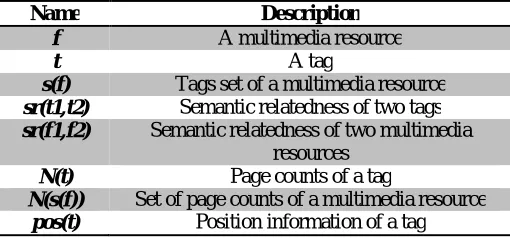
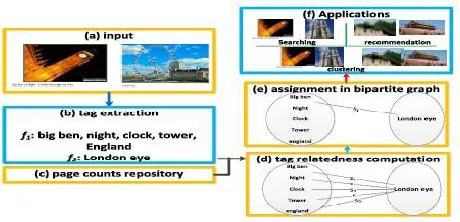
(3) Tag order revision. In this step, the multimedia resources relatedness on step 2 is revised. Table 1 shows the variables and parameters used in the following discussion. Fig. 2 illustrates an overview of the proposed computation model.
Name Description
f A multimedia resource
t A tag
s(f) Tags set of a multimedia resource
sr(t1,t2) Semantic relatedness of two tags
sr(f1,f2) Semantic relatedness of two multimedia
resources
N(t) Page counts of a tag
N(s(f)) Set of page counts of a multimedia resource
pos(t) Position information of a tag
Table 1: The variables and parameters used in the proposed computation model
3.2 Tag Relatedness Computation:
Figure 2: The illustration of the semantic link generation
3.3 . Semantic Relatedness Integration:
We compute the tag pair relatedness of two multimedia resources. Obviously, the tag pair relatedness of two multimedia resources f1 and f2 can be treated as a bipartite graph, which is denoted as
G = (V,E)
V = { f1,f2}
E = < ti, tj, sr(ti,tj) >; ti € s( f1) ^ tj € s( f2)
A matching is defined as M E so that no two edges in M share a common end vertex. An assignment in a bipartite graph is a matching M so that each node of the graph has an incident edge in M. Suppose that the set of vertices are partitioned in two sets f1 and f2, and that the edges of the graph have an associated weight given by a function f : ( f1, f2) -> 0..1. The function maxRel: (f, f1, f2) -> 0..1 returns the maximum weighted assignment, i.e., an assignment so that the average of the weights of the edges is highest.
Using the assignment in bipartite graphs problem to our context, the variables f1 and f2 represent the two multimedia resources to compute the semantic relatedness. For example, that f1 and f2 are composed of the tags s(f1) and s(f2). s(f1)j >s(f2)j means that the number of tags in s(f2) is lower than that of s(f1). We divide the result of the maximization by the lower cardinality of s(f1) or s(f2). In this way, the influence of the number of tags is reduced, and the semantic relatedness of two multimedia resources is symmetric
Algorithm maxRel
Input: The tags set of two images f1 and f2, which is s(f1) and s(f2) Output: The semantic relatedness of two images f1 and f2
for each ti s(f1)
N(s(f1)) N(ti);
pos(s(f1)) pos(ti);
for each tj s(f1)
N(s(f2)) N(tj);
pos(s(f2)) pos(tj);
for eachti s(f1)
for eachti s(f1)
if(ti=tj) sr(ti,tj) =0; /* pruning*/
else sr(ti,tj)= f(N(ti),N(tj)); /* relatedness */
FACE RECOGNITION IN CLOUD
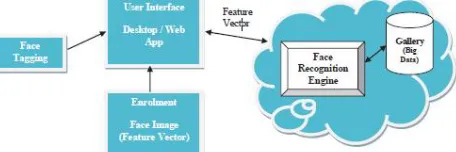
This section intricates on a novel FR methodology that is cloud-based i.e. both its FR engine and FR database reside on the cloud (non-local) and operates on a large-scale database of images (Big Data)2. The working of the proposed system applied for the task of Face Tagging in the context of social networks in illustrated in Figure. The new faces are enrolled through the user interface, which can either be a desktop or web application. In order to carry out the task of Face Tagging, the user interface communicates with the cloud-based web API (which typically runs on REST 17) that contains the FR engine and a massive database of faces (the Big Data repository of Facebook for instance would consist of trillions of faces).
Figure 3: Framework of image recognition in cloud
The application (user interface) enrolls new faces and proceeds to encoded the face image, which is then sent to the cloud-based API which processes the image through the FR engine, which runs a pre-defined FR algorithm which will consist of several stages (face detection, extraction, matching and so on).The query face (the input face from the user interface) is then evaluated by the FR engine against a gallery of images (Big Data set of Facebook with tagged images in this instance) and once a conclusive match is determined, the query face classified as belonging to a particular individual. Subsequently, the face can be tagged accordingly and the result is sent back to the local or web application. Although the framework described above centers on Face Tagging, it can also be employed for Face Authentication/Access Control tasks.
The FR mechanism utilized by Facebook relies on the Deepfaces technique, which is known to produce an accuracy of 97.5%and is primarily employed by Facebook to perform tagging and other recognition tasks. DeepFace requires to be trained extensively on a massive pool of faces in order to be efficient and is capable of identifying about 4000 identities from a database of over 4 million separate images 19. Hence the computational complexity of DeepFace is considerably high. In order to provide an alternative, less expensive approach to DeepFace, we employ a distinctly optimized 24 novel technique called Extreme Learning Machines (ELM) 20 to conduct facial extraction in our approach, as it has been established to be highly robust for FR tasks212223.
Figure 4:Architecture of extreme learning machine classifier
The input weights and the hidden layer biases are randomly selected in order to transform the training of the Single Layer Fuzzy Neural Network (SLFNN) into a linear system 1819.Subsequently, the output weights that link the* hidden and output layer are determined by carrying out a generalized inverse operation of the hidden layer output matrices 19. In case of ELM the random assignment of input weights and hidden layer biases enabled by an infinitely differentiable activation function.
The conventional neural networks operate by determining ᵟ by opting for the gradient descent optimization and iteratively tune wi, γi and bi (input layer weight, hidden layer weight, bias parameters) by utilizing for the learning rate p 19. In this case, small values of p are preferred 2125, as they lead to slow convergence of the learning algorithm (higher value tend to cause instability and lead to divergence to a local minima). Hence, in order to refrain from causing such instability and divergence, ELM uses a minimum norm least-square solution. Furthermore, in case of ELM, rather than tuning the all the network parameters, the input weights(wi) ) and bias Parameters bi) are allocated in a random manner and the problem is reduced to a least-square solution ᵟγ=τ19.
III.CONCLUSION
number of multimedia resources has brought an urgent need to develop intelligent methods to organize and process them. In this paper, We have proffered a comprehensive view of the recent advances in Big Data, Social Networking
and Machine Learning and the various ways in which they converge with FR.
The Semantic Link Network model is used for organizing multimedia resources. Semantic Link Network (SLN) is designed to establish associated relations among various resources (e.g., Web pages or documents in digital library) aiming at extending the loosely connected network of no semantics (e.g., the Web) to an association-rich network. The tags and surrounding texts of multimedia resources are used to represent the semantic content. The relatedness between tags and surrounding texts are implemented in the semantic Link Network model. The data sets including about 100 thousand images with social tags from Flickr are used to assess the proposed method. Two data mining tasks such clustering and searching are performed by the proposed framework, which shows the efficacy and robustness of the proposed framework. The FR framework was demonstrated for the task of Face Tagging in social networking systems operating on Big Data by employing the highly potent Extreme Learning Machines technique. The proposed system can also be engaged for a plethora of other FR tasks such as Face Authentication/Access Control with relative ease.
REFERENCES
1 Chuanping Hu, Zheng Xu, Yunhuai Liu1, Lin Mei1lan Chen, And Xiangfeng Luo,``Semantic Link Network-Based Model for Organizing Multimedia Big Data,'' IEEE Trans., Volume 2, No. 3, September 2014
2 Vinay Aa,Vinay S Shekhara, Rituparna Jb, Tushar Aggrawalb, K N Balasubramanya Murthya, S Natarajanb, ``Cloud Based Big Data Analytics Framework for Face Recognition in Social Networks using Machine Learning,'' Elsevier, 2nd International Symposium on Big Data and Cloud Computing.
3 M. R. Wigan and R. Clarke, ``Big data's big unintended consequences,'' Computer, vol. 46, no. 6, pp. 46_53, 2013.
4 D. Yuan et al., ``A highly practical approach toward achieving minimum data sets storage cost in the cloud,'' IEEE Trans. Parallel Distrib. Syst., vol. 24, no. 6, pp. 1234_1244, Jun. 2013.
5 X. Zhang, C. Liu, S. Nepal, S. Pandev, and J. Chen, ``A privacy leakage upper bound constraint-based approach for cost-effective privacy preserving of intermediate data sets in cloud,'' IEEE Trans. Parallel Distrib. Syst., vol. 24, no. 6, pp. 1192_1202, Jun. 2013.
6 X. Liu, Y. Yang, D. Yuan, and J. Chen, ``Do we need to handle every temporal violation in scientific workflow systems?'' ACM Trans. Softw. Eng. Methodol., vol. 23, no. 1, p. 5, Feb. 2014.
7 X. Zhang, T. Yang, C. Liu, and J. Chen, ``A scalable two-phase top- down specialization approach for data anonymization using MapReduce on cloud,'' IEEE Trans. Parallel Distrib. Syst., vol. 25, no. 2, pp. 363_373, Feb. 2014.
8 T. Berners-Lee, J. Hendler, and O. Lassila, ``The semantic web,'' Sci. Amer., vol. 284, no. 5, pp. 28_37, 2001.
9 L. Wu, X. Hua, N. Yu, W. Ma, and S. Li, ``Flickr distance: A relationship measure for visual concepts,'' IEEE Trans. Pattern Anal. Mach.
Intell., vol. 34, no. 5, pp. 863_875, May 2012. no. 6, pp. 785_799, Jun. 2009.
10 Ramanathan, Narayanan, Rama Chellappa, and A. K. Roy Chowdhury. "Facial similarity across age, disguise, illumination and pose." 11 L. Wang, D. Chen, Y. Hu, Y. Ma, and J. Wang, ``Towards enabling cyber infrastructure as a service in clouds,'' Comput. Electr. Eng., vol. 39,
no. 1, pp. 3_14, 2013.
12 Bhumika G. Bhatt, Zankhana H. Shah “Face Feature Extraction Techniques: A Survey”, National Conference on Recent Trends in Engineering & Technology, 13-14 May 2011