Abstract
GUNAL, UGUR. The Effectiveness of Global Difference Value Prediction And Memory Bus Priority Schemes for Speculative Prefetch.
(Under the direction of Dr. Thomas M. Conte.)
Processor clock speeds have drastically increased in the recent years. However, the cycle
time improvement in the DRAM semiconductor technology used for memories has been
comparatively slow. The expanding processor – memory gap encourages developers to
find aggressive techniques to reduce the latency of memory accesses.
Value prediction is a powerful approach to break true data dependencies. Prefetching is
another technique, which aims to reduce the processor stall time by bringing data into the
cache before it is accessed by the processor. Recovery-free value prediction [26] scheme
combines these two techniques and uses value prediction only for prefetching so that the
need for validation of predictions and a recovery mechanism for mispredictions are
eliminated.
In this thesis, the effectiveness of using global difference value prediction for
recovery-free speculative execution is studied. A bus model is added for modeling the buses in the
memory system. Three bus priority schemes, First Come First Served (FCFS), Real
Access First Served (RAFS) and Prefetch Access First Served (PAFS), are proposed and
their performance potentials are evaluated when a stride and a hybrid global difference
predictor (hgDiff) is used. The results show that the recovery-free speculative execution
using value prediction is a promising technique that increases the performance
significantly (up to 10%), and this increase depends on the bus priority scheme and the
THE EFFECTIVENESS OF GLOBAL DIFFERENCE VALUE PREDICTION AND MEMORY BUS PRIORITY SCHEMES FOR SPECULATIVE PREFETCH
by
UGUR GUNAL
A thesis submitted to the Graduate Faculty of North Carolina State University in partial fulfillment of the requirements for
the Degree of Master of Science
COMPUTER ENGINEERING
Raleigh
2003
APPROVED BY:
_________________________________ ________________________________ Dr. Mehmet C. Ozturk Dr. Eric Rotenberg
_______________________________________ Dr. Thomas M. Conte
Biography
Ugur Gunal was born on April 29, 1980 in Ankara, Turkey. Ugur is the only child of Ipek
and Ibrahim Gunal. Ugur spent 21 years of his life in the Middle East Technical
University campus, where he finished the kindergarten, the primary school, the middle
school and the high school. Ugur spent the majority of these years playing volleyball for
the school team as a captain, going to national and international scout camps and having
soccer games with his friends every week. The international scout camps gave him the
opportunity to see many countries, meet new people and practice his English. After long
and hard years of training, Ugur became a successful scoutmaster. Ugur graduated from
his high school as the first valedictorian in the school’s history. Following his parents’
footsteps, Ugur wanted to continue his education in the Middle East Technical University
and succeeded in his goal. In his senior year, Ugur started working part-time in the VLSI
Design Group of Information Technology & Electronics Research Institute. After being
listed in the High Honor List for 8 semesters and receiving the Highest Departmental
GPA Award for 4 semesters, Ugur graduated with a B.S. degree in Electrical and
Electronics Engineering in June of 2001. Ugur stepped into a new life by leaving his
home and moving to the USA to study at the North Carolina State University to receive
his M.S. degree in Computer Engineering. Ugur worked as a Teaching Assistant for one
year and then joined the TINKER microprocessor design group in May of 2002. Ugur is
currently continuing his research under the supervision of Dr. Tom Conte in the areas of
Acknowledgements
I would like to dedicate this thesis to my parents; Ipek and Ibrahim, for always supporting
me and making me believe I could succeed in all of my goals. They were always there for
me whenever I needed them, with their endless love and support. They mean much more
than just being my parents; they are also my friends with whom I can share almost
anything. I would like to thank them for being so caring, understanding and wonderful.
I would like to thank my amazing girlfriend Sezen, who filled my life with love, joy and
passion. Together we proved that a long-distance relationship could last, when the love
binding it is strong. From ten thousand miles away, she was still able to charm me with
her unexceptional love and fabulous eyes.
I would also like to thank my grandmother Latife for her loving heart, my uncle Erdo for
being an idol in my life, my aunt Meral for convincing me to make my own decisions and
my grandparents Servin and Osman for all the things they taught me. All of you have
made great contributions to my personality.
In addition, I would like to thank all of my good friends in Turkey, who made my life a
blast. They are very special because they did not let the distance between us ruin our
friendship and I know I can trust all of them in my bad times. In no specific order, I
would like to thank the Sakarya Group (Uygar, Berk, Berkay, and Can), Baris, Cagil,
Meltem, Kerem, Pinar, Doruk, Omer and Yagiz. I could not have asked for better friends.
Thanks also to my scout leaders, Cem and Nihal, and former scouts, Pinar in particular.
I would like especially to thank my committee chair, Dr. Tom Conte, who gave me the
opportunity to work in the TINKER research group. His guidance has helped me to
become a better researcher. I would also like to thank Dr. Eric Rotenberg and Dr.
Mehmet Ozturk for accepting to be my committee members. Thanks also to Nikhil and
members of the TINKER group, Mark and Huiyang. Finally I thank Besiktas, for
Contents
List of Tables ... v
List of Figures ... vi
1. Introduction and Background ... 1
1.1 Overview ... 1
1.2 Previous Work... 2
1.2.1 Prefetching... 2
1.2.2 Pre-execution/Pre-computation ... 6
1.3 Organization of the Thesis ... 8
2. Architectural Models ... 9
2.1 Value Predictors ... 9
2.1.1 Stride Predictor ... 9
2.1.2 Hybrid gDiff Predictor (hgDiff) ... 10
2.2 Cache and Bus Models... 11
3. Experimental Results ... 19
3.1 Simulation Methodology... 19
3.2 Simulation Results ... 21
4. Conclusions and Future Work... 37
4.1 Conclusions ... 37
4.2 Future Work ... 38
List of Tables
Table 1. Priorities of bus accesses in different priority schemes... 13
Table 2. Cache timings for the block ready and block being loaded cases. ... 16
Table 3. Miss latencies for the memory models. ... 18
Table 4. Base processor configuration. ... 20
List of Figures
Figure 1. Stride prediction table ... 9
Figure 2. The gDiff predictor... 10
Figure 3. Data cache hit rate... 22
Figure 4. Data cache misses for load instructions... 23
Figure 5. L2 cache hit rate... 24
Figure 6. L2 cache misses for load instructions... 24
Figure 7. Queuing delay for the data cache – L2 cache bus. ... 26
Figure 8. Queuing delay for the L2 cache – memory bus. ... 26
Figure 9. Queuing delay for the instruction cache - L2 cache bus. ... 27
Figure 10. Prediction accuracy and coverage for load instructions. ... 29
Figure 11. Prediction accuracy and coverage for load instructions on the actual path. .... 29
Figure 12. Prediction accuracy and coverage for all value producing instructions. ... 30
Figure 13. Prediction accuracy and coverage for all value producing instructions on the actual path. ... 31
Figure 14. Prediction power of stride and hgDiff predictors... 32
Figure 15. Effect of GVQ Size on Prediction Accuracy and Coverage for the bzip2 Benchmark. ... 33
Figure 16. Effect of GVQ Size on Prediction Accuracy and Coverage for the bzip2 Benchmark. ... 34
Chapter 1.
Introduction and Background
1.1 Overview
Recent advances in microprocessor fabrication technology have drastically increased
processor clock speeds. The cycle time improvement in the DRAM semiconductor
technology used for memories, however, has been slow. As a result, processor – memory
gap continues to grow. This expanding gap encourages developers to find aggressive
techniques to reduce the latency of memory accesses.
The use of a cache is an effective way of hiding memory latency since caches reduce the
number of main memory accesses. However, additional techniques are required to further
reduce the high memory latencies. These include compile-time techniques such as
instruction scheduling, run-time techniques such as non-blocking loads, out-of-order
issue and pre-execution/pre-computation and hardware-based techniques such as write
buffers, victim caches and multi-level caches. Prefetching is one of these techniques,
which aims to reduce the processor stall time by bringing data into the cache or dedicated
prefetch buffers before it is accessed by the processor. An ideal prefetching scheme
would bring the data into the cache just in time for the processor to access it. Accurate
prefetch prediction and sufficient prefetch time are required to improve the overall
system performance.
Data prefetchers can be classified into three categories. Software prefetchers insert
prefetch instructions into the code several cycles before their corresponding memory
instructions so that the requested data can be brought into the cache while the processor
continues computing. They can often take the advantage of compile-time information to
schedule prefetches more accurately than the hardware techniques. However, execution
of the prefetch instructions introduces extra cycles to the processor’s total execution time.
Hardware prefetchers predict future memory-access patterns using the past access and/or
more memory contention between demand and prefetch requests. Thread-based
prefetchers execute code in another thread context and bring the requested data into the
shared cache before it is accessed by the main thread. They take the advantage of using
the actual code instead of speculating it, which allows them to accurately pre-compute
load addresses. However, the cache misses can prevent the speculative thread from
making faster progress than the main thread and pre-computing the addresses. In this
thesis, a prefetching technique based on speculative pre-execution using value prediction
is studied.
1.2 Previous Work
Several hardware approaches have been proposed for the pre-execution/pre-computation
and prefetching concepts to hide the memory latency.
1.2.1 Prefetching
An early example of prefetching aiming to take advantage of spatial locality is one block
look-ahead (OBL) approach by Smith [24]. In this approach, when block i is referenced,
block i+1 could be prefetched. Depending on when the prefetch is initiated, OBL
implementations differ. In the prefetch-on-miss algorithm, prefetch for block i+1 is
initiated whenever an access for block i misses the cache. In the tagged prefetch
algorithm, each cache block has a tag bit which is set to zero when the block is
prefetched. When the block is fetched and the bit is zero, a prefetch for the next
sequential block is initiated and the bit is set to one.
Chen and Baer [6] introduced a mechanism to predict future data addresses by keeping
track of past data access patterns in a Reference Prediction Table (RPT). RPT is
organized as an instruction cache and each entry in the RPT holds the last address
referenced by that load instruction, the stride (i.e., difference between the last two
matches an entry in the RPT and the difference between the current address of the load
and the last address stored in the RPT equals the stride, a prefetch for the block at one
offset ahead the current address is initiated. They also proposed a look-ahead scheme by
using a Look-Ahead Program Counter (LA-PC) and a Branch Prediction Table (BPT).
Since LA-PC runs ahead of the normal instruction fetch engine and generates prefetch
requests, they were able to initiate prefetches farther in advance than using the normal
PC.
Reinman et al. [20] examined applying Chen and Baer’s [6] approach to instruction
prefetching. Their architecture uses a single decoupled branch predictor, which can run
ahead of the instruction fetch, instead of two as in Chen and Baer [6]. The branch
predictor produces fetch blocks into a Fetch Target Queue (FTQ), where they are
eventually consumed by the instruction cache. They used the fetch addresses in the FTQ
to perform prefetching for the instruction cache.
Jouppi [15] introduced stream buffers to improve direct mapped cache performance.
Stream buffers are FIFO queues that prefetch successive lines starting at the miss target,
independent of the program context. In order to avoid polluting the cache, lines
prefetched are placed in the buffer and not in the cache. On subsequent misses, the
address of the first item in the stream buffer is compared against the miss address. In case
of a match, cache can be reloaded in a single cycle from the stream buffer.
Palacharla and Kessler [18] enhanced the stream buffers using two techniques: allocation
filters and a non-unit stride detection mechanism. The allocation filter avoids unnecessary
prefetching by allowing a stream buffer to be allocated only after two consecutive misses
for the same stream. For the non-unit stride detection, they dynamically partitioned the
physical address space and detected strided references within each partition. In order to
achieve this they used a history buffer to store currently active partitions and a finite state
machine to detect the stride for references that fall within the same partition. They also
distance (or delta) between the address of the load and the entries in the history buffer is
found. The delta is then used as a stride for the stream.
Farkas et al. [11] further enhanced stream buffers by using a per-load stride predictor. A
stride is determined for a load instruction by considering only the previous miss
addresses generated by the same load instruction. This differs from the minimum-delta
scheme since the minimum-delta scheme uses global history to calculate the stride for a
given load. They further improved stream buffers by providing them with an associative
lookup capability and a mechanism to avoid the allocation of stream buffers to duplicate
streams.
Sherwood et al. [23] extended the Farkas et al.’s idea [11] for the stream buffers to follow
the correct stream for non-stride based load patterns. They proposed a Predictor-directed
Stream Buffer (PSB) architecture, which uses a predictor to generate an address stream
for prefetching. The predictor is shared among stream buffers and each stream buffer
contains a per-stream history. They used a Stride-Filtered Markov (SFM) predictor.
Correlation-based prefetching is a technique in which a prefetch address is paired with a
current address. A prefetch for an address is initiated when the corresponding block is
referenced or when there is a cache miss to the corresponding block. Pomerene et al. [19]
were the first to apply correlation-based prefetching to data prefetching. They used a
hardware cache to hold the prefetch – current address pair information. Charney and
Reeves [5] extended this mechanism and applied it to the L1 miss reference stream
instead of applying it directly to the load/store stream. They showed that stride based
prefetching could be combined with correlation-based prefetching to give better prefetch
coverage. Joseph and Grunwald [14] used Markov prefetching, which is an evolution of
correlation-based prefetching. They used the miss address stream as their prediction
source and a Markov prediction table to store the addresses that follow a cache miss
address. Each prefetch request has an associated priority and not all prefetch requests
result in a transfer from the L2 cache. They also examined accuracy based adaptivity to
Shadow Directory Prefetching (SDP), another correlation-based prefetching technique. In
their approach, each L2 cache block contains a second address, i.e. a shadow address.
The shadow address identifies a following address to the corresponding cache block.
When there is a hit in the L2 cache, a prefetch for the shadow address for the
corresponding block is initiated. Alexander and Kedem [1] proposed a mechanism similar
to correlation-based prefetching but used a prediction table distributed over the DRAM
modules. This table is used to prefetch blocks from the large but slow DRAM array into a
small but fast SRAM cache.
Recent prefetching techniques include Content-Directed Data Prefetching by Cooksey et
al. [9], Pointer Cache Assisted Prefetching by Collins et al. [7] and a tag based
prefetching by Hu et al. [13]. Cooksey et al. [9] presented a prefetching scheme without
any history for pointer-intensive applications. In their approach, each address-sized word
of the data is examined for a potential prefetch address. Candidate addresses are
translated and then issued as prefetch requests. As prefetch requests return data from
memory, their contents are also examined for potential prefetch addresses. Collins et al.
[7] introduced a pointer cache, which holds mappings between heap pointers and the
address of the heap object they point to. They examined using the values out of the
pointer cache for value prediction and also initiating prefetching of the first two blocks of
the object pointed-to when a load hits the pointer cache. They further extended the use of
the pointer cache and added it to speculative pre-computation. Hu et al. [13] introduced a
tag-based prefetcher named as Tag Correlating Prefetcher (TCP), which keeps track of
tag sequences per cache-set and the tag correlation patterns. They showed that a small
TCP could outperform a larger address based prefetcher by using the facts that tag
sequences are highly repetitive and easy to predict and a single tag sequence covers
1.2.2 Pre-execution/Pre-computation
Roth and Sohi [21] proposed speculative data-driven multithreading (DDMT), in which
critical computations are executed in speculative threads called data-driven threads
(DDTs). The DDT fetches and executes only the critical computation and does not
change the architectural state of the machine. They showed that performance can be
improved when computations of loads that are likely to miss in the cache and the
branches that are likely to be mispredicted are executed in DDTs. Collins et al. [8]
extended Roth and Sohi’s idea [21] and explored speculative pre-computation. They
showed that using a basic trigger (i.e., allowing a thread to be spawned only from the
main thread) has two problems. First, if the main thread is stalled, no additional threads
could be spawned. Second, pre-computing the speculative threads many loop iterations
ahead of the main thread is not very effective by this method. In order to overcome these
problems, they proposed chaining triggers, in which a speculative thread can explicitly
spawn another. Zilles and Sohi [28] proposed using speculative slices that execute as
helper threads to avoid cache misses and branch mispredictions for critical instructions.
Their idea is similar to Roth and Sohi’s [21]. However, their control-based scheme
enables the main thread to avoid the latency of re-executing pre-executed instructions by
resolving the mispredicted pre-executed branches at the fetch stage.
Zhou and Conte [26] proposed a recovery-free speculative execution scheme using value
prediction. This is the technique studied in this thesis. Unlike most traditional value
prediction approaches, they focused on using value prediction only for prefetching. A
stride predictor [12, 17, 22] is used to value predict the instructions. At the issue stage, an
instruction is issued un-speculatively if its source operands are ready. However, if they
are not ready and the prediction made in the dispatch stage is confident, then the
instruction is issued speculatively provided that there are enough resources. A
speculatively issued instruction does not leave the issue queue until it is issued
un-speculatively. It writes its result to the physical register file so that its dependent
instructions can be executed speculatively. The speculative result in the register file is
result is ready and every instruction is executed un-speculatively before it is committed.
Hence, the speculative results do not change the architectural state of the machine.
Therefore, the need for validation of predictions and a recovery mechanism for
mispredictions are eliminated. This is the main difference between their approach and
earlier value prediction schemes.
Pointer chasing, a missing load’s address being dependent on the previous missing load’s
value, is a well-known phenomenon that degrades the performance of a system. In such a
case, if the source operands of the first load instruction are not ready, then both loads will
be stalled in the issue queue if there is no value speculation. The first load will be issued
after its source operands become ready. It will access the cache and will be stalled due to
a cache miss. The second load will be issued only after the first load executes and
produces a value and it will also cause a cache miss. Using the value speculation, the first
load is speculatively issued and causes a cache miss. Prefetching, the process of bringing
the required block into the cache before it is needed, is initiated. This might convert a
cache miss to a cache hit or at least decrease the stall time for the un-speculative
execution of the same load. If the value prediction for the first load instruction is
confident, then the second load instruction uses this value to speculatively execute. The
second load accesses the cache in addition to the first load and starts a prefetch without
waiting for the first load, overlapping the cache misses. In the case of a value
misprediction, the load instruction will miss the cache, just as it would without any
speculation. The disadvantages of value misprediction are cache pollution and increased
memory contention.
The same approach is also used for memory disambiguation. In an un-speculative
machine, load instructions are stalled if there are prior store instructions with unresolved
addresses. Using the technique described above, the loads are issued speculatively for
prefetching as if they were value predicted. They are un-speculatively executed when
The proposed recovery-free value prediction scheme is similar to the pre-execution
approaches described above. In Zhou and Conte’s approach [26], each confident value
prediction triggers speculative execution of dependent instructions. They execute as a
speculative helper thread to avoid cache misses, even though there is no multi-threading
support. The speculative helper thread is terminated when the un-speculative execution
catches it.
In this thesis, the effect of using a hybrid global difference (hgDiff) value predictor with
Zhou and Conte’s approach [26] is studied. Moreover, to make the memory system more
realistic, a bus model is introduced. The effects of using different priorities for the bus
accesses are also examined.
1.3 Organization of the Thesis
The remainder of the thesis is organized as follows. Chapter 2 explains the stride and
hgDiff predictors used to value speculate instructions. The cache and bus models along
with the bus priority schemes are also discussed in Chapter 2. Chapter 3 explains the
simulation methodology used and presents the results. Chapter 4 concludes the thesis and
Chapter 2.
Architectural Models
2.1 Value Predictors
Value prediction is a powerful technique to break true data dependencies. It can be
performed in two ways, local value prediction and global value prediction. In local value
prediction, the value to be produced by an instruction is predicted by using the values that
are produced by the prior executions of the same instruction. On the other hand, in global
value prediction, the prediction is based on the values produced by all the dynamic
instructions in completion order. Value prediction can also be classified as computational
and context-based. Computational predictors compute some function of the prior values
to make a prediction. The context-based predictors detect a value pattern and predict the
value based on the next value produced when the same pattern repeats.
2.1.1 Stride Predictor
Zhou and Conte [26] used a stride predictor [12, 17, 22] for their recovery-free value
prediction scheme. A stride predictor exploits computational value locality in the local
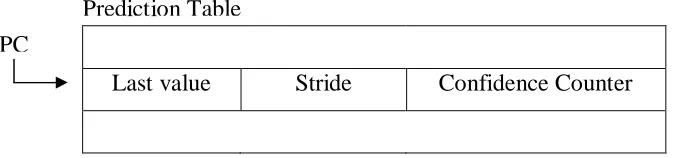
value history. As shown in Figure 1, it has a PC-indexed table that stores the last value
produced by an instruction and a stride - the difference between the last value and one
before that. Each entry in the table also has a 3-bit confidence counter, which is increased
by 2 when a correct prediction is made and decreased by 1 for a misprediction [25]. The
stride predictor predicts the next value of an instruction by adding the stride to the last
value stored in the prediction table. The prediction is confident if the confidence counter
is greater than 3. The stride predictor is updated speculatively as in [16].
Last value Stride Confidence Counter PC
2.1.2 Hybrid gDiff Predictor (hgDiff)
In this thesis, the effect of using a hybrid global difference predictor (hgDiff) is studied.
Bodine [2] and Zhou et al. [27] proposed the hgDiff predictor for computational global
value prediction. It is a hybrid of a stride and a gDiff predictor and has the advantage of
exploiting both local and global value localities. A structure called the global value queue
(GVQ) holds the values produced by the selected instructions. These values in the GVQ
are then used to value predict future instructions.
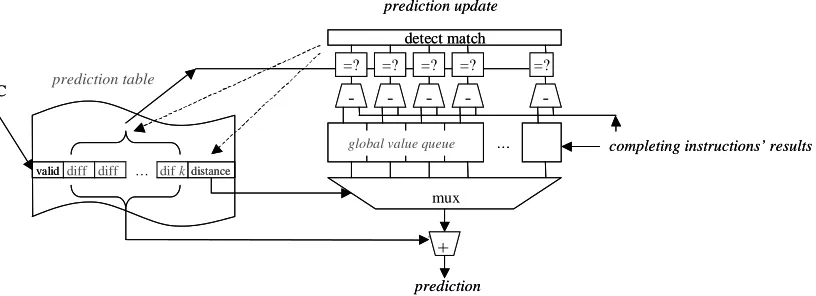
The gDiff predictor has a PC-indexed prediction table that stores the differences between
the value produced by an instruction and the n prior values in the GVQ, as shown in
Figure 2. Each entry in the table also has a selected distance and a 3-bit confidence
counter, which is increased by 2 for a correct prediction and decreased by 1 for a
misprediction [25]. Like the stride predictor, the prediction is confident if the confidence
counter is greater than 3. If the current instruction’s index in the GVQ is x and the
selected distance is y, then the gDiff predictor makes a prediction by adding the value at
entry z in the GVQ to the stored difference diffy, where z=x-y. When a value-producing
instruction completes, the differences between its result and the values stored in the GVQ
are calculated. If any of these differences match the differences stored in the prediction
table for this instruction, then the selected distance is set to the distance for the matching
difference. If there is no match, however, the selected distance is not set and the
differences for this entry are updated with the calculated ones.
Figure 2. The gDiff predictor
valid distance
PC
… completing instructions’ results
prediction
=? =? =? =?
detect match
global value queue prediction update
diff1diff2 … diffk
- - - -
-=?
+
valid distance
PC
… completing instructions’ results
mux
prediction
=? =? =? =?
detect match
global value queue
prediction update
diff diff … dif k
- - - -
-=?
The stride predictor inserts its predictions into the GVQ at dispatch stage so that they can
be used by the gDiff predictor. Building the GVQ at dispatch time eliminates the pipeline
execution variations due to cache misses and keeps the GVQ ordered. At dispatch stage,
an instruction is value predicted by both stride and gDiff predictors. The gDiff predictor
has a higher priority so if both predictions are confident, the gDiff predictor’s prediction
is used to value speculate the instruction. When a value-producing instruction completes,
it updates both predictors and their confidence counters. The result of the instruction also
updates the GVQ by overwriting the stride prediction for this instruction.
2.2 Cache and Bus Models
The CPU and the memory in a real computer system communicate commonly via a bus.
Contentions on the bus may increase the memory access time and degrade the
performance of the overall system. Since CPU speeds keep increasing at a fast rate and
the performance of many applications is dependent on the observed memory latency, the
buses are playing a greater role in today’s architectures.
Zhou and Conte [26] used a memory hierarchy consisting of an instruction cache, a data
cache and a unified level-2 (L2) cache. In this thesis, a bus model, based on the
Sim-alpha bus model [10], is used to model the buses between the instruction cache and the
L2 cache, the data cache and the L2 cache, and the L2 cache and the memory. The aim is
to use a more realistic memory model and designing these buses to improve the memory
access latency is beyond the scope of this thesis.
There are five different types of accesses to a bus:
A Read Request carries the address of the cache line for which a cache miss occurred. The instruction causing the cache miss must be an un-speculatively
executing load instruction or a store instruction, which is always un-speculatively
A Read Response is the reply to a Read Request. The requested cache block is sent to the cache, which requested it.
A Prefetch Request is equivalent to a Read Request except the fact that the instruction causing the cache miss must be a speculatively executing load
instruction.
A Prefetch Response is the reply sent to a Prefetch Request, and it is similar to a
Read Response.
A Write Request is sent to the next level in the memory hierarchy when a cache block, that is to be evicted from the cache, is dirty. It carries only the sub-blocks
that are marked dirty, for the corresponding cache block.
There is a separate queue for each bus which holds the accesses that are waiting to be
sent on that bus. These queues are called Bus Queues (BQs). Each access is assigned a
priority according to its type and the bus priority scheme being used. This priority and the
access’ arrival time to a BQ are stored in the corresponding BQ entry. When a bus is idle,
a bus controller selects the next access to be sent on the bus from the candidates in the
corresponding BQ using the stored priorities and the arrival times. The bus controller
selects the candidate with the highest priority. If there is more than one BQ entry with the
highest priority, then the one having an earlier arrival time is selected.
Three bus priority schemes are studied in this thesis. These are First Come First Served
(FCFS), Real Access First Served (RAFS) and Prefetch Access First Served (PAFS).
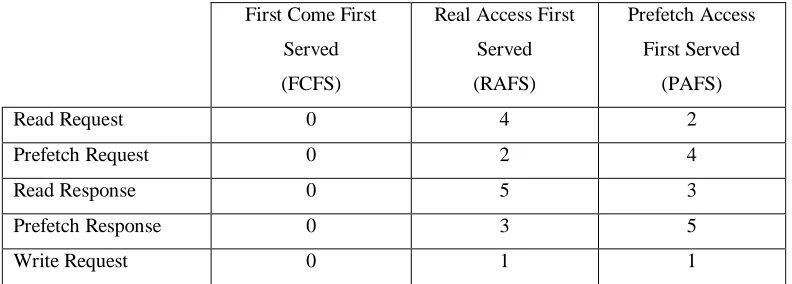
Table 1 shows the priorities assigned to each type of bus access using these priority
First Come First
Served
(FCFS)
Real Access First
Served
(RAFS)
Prefetch Access
First Served
(PAFS)
Read Request 0 4 2
Prefetch Request 0 2 4
Read Response 0 5 3
Prefetch Response 0 3 5
Write Request 0 1 1
Table 1. Priorities of bus accesses in different priority schemes.
In FCFS, all of the bus access types have the same priority and the arrival time of a BQ
entry is the only criterion used in the selection of the next bus access. In RAFS, any real
access has a higher priority than a prefetch access, regardless of whether these accesses
are requests or responses. PAFS favors the prefetch accesses over the real accesses, just
as RAFS favors the real accesses over the prefetch accesses. Note that in both schemes, a
Read Response has a higher priority than a Read Request and a Prefetch Response has a
higher priority than a Prefetch Request. This is because the cache miss waiting for a
response occurs earlier than a cache miss producing a request. However, there still exist
certain cases in which a request is more critical than a response for a better performance.
Also, a Write Request has the lowest priority because it does not affect the memory
access time of a load or store instruction. In all of the three bus priority schemes, the
priorities of accesses are constant and do not change with time unless a prefetch access
changes into a real access. How a prefetch access is converted to a real access is
discussed further in this section.
In addition to the buses, sub-blocking and critical word first technique are also added to
the memory model of Zhou and Conte [26]. Bringing a block into a cache by a Read
Response takes several cycles. However, the instruction that caused the cache miss does
not need the whole cache block. Therefore, the cache blocks are divided into sub-blocks.
The instruction can continue execution if the corresponding sub-block is ready even
instruction can continue executing as the rest of the block is being transferred.
Sub-blocking is also useful in decreasing the size of Write Requests. When sub-Sub-blocking is
used, a write to a sub-block marks it as dirty and when a cache block is evicted from the
cache only the dirty sub-blocks are sent to the next level in the memory hierarchy. When
sub-blocking is not used, however, the whole block has to be sent, which usually wastes
bus bandwidth.
The operation of the caches and the buses can be summarized as follows. The CPU sends
the address of a load/store instruction to the cache. The required block and sub-block are
determined using this address. The cache is checked to see if the corresponding block is
present in the cache.
If the required block is present and ready in the cache, then it is a cache hit and the access time is the hit latency of that cache. The dirty bit of the corresponding
sub-block is set in the case of a store instruction or a writeback.
If the required block is being loaded by a Read/Prefetch Response, then it is checked if the required sub-block has been loaded. If that sub-block is ready, then
it is a cache hit. If not, then the access time is equal to the hit latency of the cache
plus the time it will take for that sub-block to be loaded. If the instruction
accessing the cache is a store, or this is a writeback from the previous level cache,
then the sub-block is marked as dirty.
If the required block is not ready and it is not being loaded, then this is a cache
miss. There are special registers used for cache misses. These are called Miss
Handling Status Registers (MHSRs) and collapse requests for the same cache line.
In addition to storing the address requested from the next level in the memory
hierarchy, each MHSR has an isStore flag which is set to “true” when a store
instruction or a writeback from the previous level requests that address. In order
to distinguish the prefetch accesses from the real ones for accessing the bus, a
BQ_seqnum is used to locate the bus queue entry holding the bus access for a
miss. isRequired flag is set to “true” if a store or an un-speculatively executing
load is requesting the cache block.
o If the requested address does not match with any of the used MHSR’s address, then it is a non-covered (i.e., new) cache miss and a new MHSR
is allocated. The MHSR’s isRequired flag is set to “true” if this is the data
or instruction cache and the instruction requesting this address is not a
speculatively executing load, or if this is the L2 cache, the access is not a
writeback and the isRequired flag of the corresponding MHSR in the
previous level cache is set. After checking these conditions, if the new
MHSR’s isRequired flag is set to “true”, then a Read Request for the
required block is entered to the bus queue. If it is “false”, then a Prefetch
Request is entered. The bus queue entry number is stored in the MHSR’s
BQ_seqnum field.
o If there is a match between the requested address and an MHSR address, then there is no need to request the same block again. Since the required
cache block has already been requested, the misses are overlapped. This is
called a partially covered miss. If the matching MHSR’s isRequired flag
is not set, then this block has been requested as a prefetch. Just like the
previous case, if this is the data or instruction cache and the instruction
requesting this address is not a speculatively executing load, or if this is
the L2 cache, the access is not a writeback and the isRequired flag of the
corresponding MHSR in the previous level cache is set, then the
isRequired flag of this MHSR must also be set. If the MHSR’s isRequired
flag is changed from “false” to “true”, then the bus queue is checked to see
if there is a corresponding bus queue entry by using the BQ_seqnum field
of the MHSR. There may be a Prefetch Request or a Prefetch Response for
Response since this block is not only required for a prefetch but also
required for a normal access now. It should be noted that converting a
Prefetch Response to a Read Response is not a realistic approach.
However, this conversion is unlikely to have a great impact on the results.
When a Read/Prefetch Request hits the memory or the L2 cache, or when a block that has
been requested by the data or instruction cache is brought to the L2 cache from the
memory, a Read/Prefetch Response is scheduled. The isRequired flag of the MHSR
waiting for that response determines whether the response is a Read Response or a
Prefetch Response. As explained above, a Prefetch Response can be converted to a Real
Response later while waiting in the bus queue if a non-prefetch access requests the same
block.
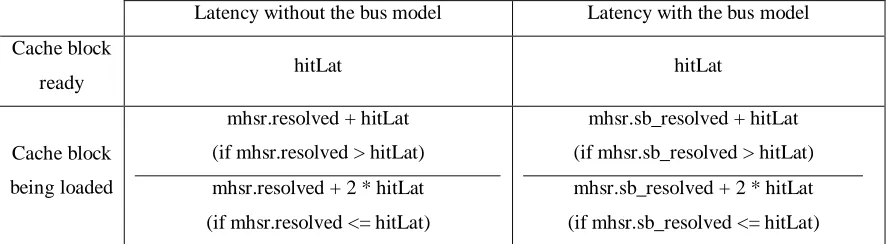
Table 2 shows the timings for the memory model used by Zhou and Conte [26] and the
memory model used in this thesis when the required block is ready in the cache, and
when it is being loaded from the next level in the memory hierarchy. The time it will take
for the required block to be loaded is denoted by mhsr.resolved. Similarly,
mhsr.sb_resolved indicates the time it will take for the required sub-block to be loaded.
The hit latency of the cache is denoted by hitLat.
Latency without the bus model Latency with the bus model
Cache block
ready hitLat hitLat
Cache block
being loaded
mhsr.resolved + hitLat
(if mhsr.resolved > hitLat)
mhsr.resolved + 2 * hitLat
(if mhsr.resolved <= hitLat)
mhsr.sb_resolved + hitLat
(if mhsr.sb_resolved > hitLat)
mhsr.sb_resolved + 2 * hitLat
(if mhsr.sb_resolved <= hitLat)
Table 2. Cache timings for the block ready and block being loaded cases.
The bus model introduces extra cycles to Zhou and Conte’s cache timings [26] for the
cache misses. The cache timings for possible cache miss scenarios are presented below.
hitLat(L1), hitLat(L2), and hitLat(mem) respectively. The L2 cache access time when the
required block is present or being loaded is denoted by accessLat(L2). Note that,
accessLat(L2) represents one of the timings listed in Table 1. For the memory model with
the buses, the data cache – L2 cache bus queuing delay is denoted by qdelay(L1-L2), the
L2 cache – memory bus queuing delay is denoted by qdelay(L2-mem), the latency of
sending a Read/Prefetch Request on a bus is denoted by reqLat, the latency of sending a
Read/Prefetch Response on the data cache – L2 bus is denoted by resLat(L1), the latency
of sending a Read/Prefetch Response on the L2 cache – memory bus is denoted by
resLat(L2), and the time to process returned data and forward it to another bus is denoted
by processLat. The reqLat is a constant since the Read/Prefetch Request size is fixed.
The resLat depends on the cache block size and the bus width. It is calculated using the
formula: resLat = clock differential * (1 + cache block size / bus width), where clock
differential is the ratio of the processor frequency to the bus frequency. The processLat is
1 cycle. While calculating the miss latencies, the latencies and delays are added in the
order of occurrence.
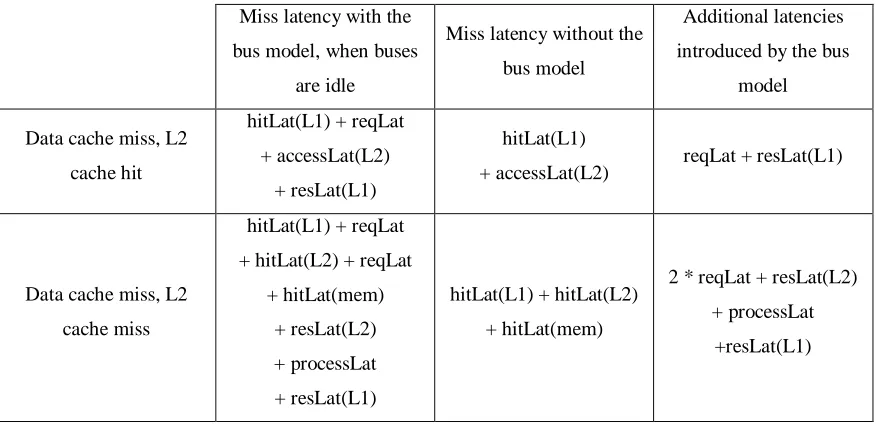
Data cache miss, L2 cache hit:
o Memory model without the buses:
miss latency = hitLat(L1) + accessLat(L2).
o Memory model with the buses:
miss latency = hitLat(L1) + qdelay(L1-L2) + reqLat + accessLat(L2) +
qdelay(L1-L2) + resLat(L1).
Data cache miss, L2 cache miss:
o Memory model without the buses:
o Memory model with the buses:
miss latency = hitLat(L1) + qdelay(L1-L2) + reqLat + hitLat(L2) +
qdelay(L2-mem) + reqLat + hitLat(mem) +
qdelay(L2-mem) + resLat(L2) + processLat +
qdelay(L1-L2) + resLat(L1).
The bus queuing delays depend on the bus traffic and can vary significantly. Even if all
the buses are idle (i.e., there are no bus queuing delays) when handling a cache miss, the
miss latency for the memory model with the buses is greater than the memory model
without the buses due to the latencies for bus accesses, as shown in Table 3.
Miss latency with the
bus model, when buses
are idle
Miss latency without the
bus model
Additional latencies
introduced by the bus
model
Data cache miss, L2
cache hit
hitLat(L1) + reqLat
+ accessLat(L2)
+ resLat(L1)
hitLat(L1)
+ accessLat(L2) reqLat + resLat(L1)
Data cache miss, L2
cache miss
hitLat(L1) + reqLat
+ hitLat(L2) + reqLat
+ hitLat(mem)
+ resLat(L2)
+ processLat
+ resLat(L1)
hitLat(L1) + hitLat(L2)
+ hitLat(mem)
2 * reqLat + resLat(L2)
+ processLat
+resLat(L1)
Table 3. Miss latencies for the memory models.
Chapter 3.
Experimental Results
In this chapter, the stride and hgDiff predictors are compared and the performance
potential of using different bus priority schemes with these predictors is evaluated.
3.1 Simulation Methodology
The proposed technique is implemented in a cycle-level simulator built using the
SimpleScalar [3] toolset. The underlying processor organization is based on the MIPS
R1000 processor. The base processor configuration is shown in Table 4. The benchmarks
are selected from the SPEC2000 integer benchmark suite. Benchmarks bzip2, gap, gcc
and perl are computation-intensive and benchmarks parser and twolf are
memory-intensive since they have higher data cache miss rates. The reference input data are used
for these benchmarks. The first 800M instructions are fast-forwarded and the next 200M
instructions are simulated. Both predictors have unlimited table sizes, so that they could
be compared without the table size being a limiting factor. The GVQ has 32 entries for
Instruction Cache Size = 64kB; Associativity = 4-way; Replacement =
LRU; Line Size = 16 instructions (64 bytes); Hit
latency = 1 cycle.
Data Cache Size = 32kB; Associativity = 2-way; Replacement =
LRU; Line Size = 64 bytes; Hit latency = 2 cycles;
32 MHSRs.
Unified Level-2 Cache Size = 512kB; Associativity = 8-way; Replacement
= LRU; Line Size = 128 bytes; Hit latency = 10
cycles; 64 MHSRs.
Memory Hit latency = 80 cycles.
Branch Predictor 64K entry G-share; 32K entry BTB.
Superscalar Core Reorder buffer: 64 entries; Dispatch/issue/retire
bandwidth: 4-way superscalar; 4 fully symmetric
functional units.
Execution Latencies Address generation: 1 cycle; Memory access: 2
cycles (data cache hit); Integer ALU ops: 1 cycle;
Complex ops: MIPS R1000 latencies.
Memory Disambiguation Load stalls when there is a pending store with an
unresolved address.
Value Speculation No value speculation.
Instruction Cache – L2 Cache Bus Bus width = 16 bytes; Clock differential (processor
frequency / bus frequency) = 1.
Data Cache – L2 Cache Bus Bus width = 16 bytes; Clock differential (processor
frequency / bus frequency) = 1.
L2 Cache – Memory Bus Bus width = 16 bytes; Clock differential (processor
frequency / bus frequency) = 1.
Read/Prefetch Request Latency 1 cycle.
Bus Priority Scheme FCFS.
3.2 Simulation Results
The results using the base processor model are shown in Table 5. In order to evaluate the
effectiveness of the predictors and the bus priority schemes, six different processor
configurations are simulated along with the base model. In the figures, the base model is
labeled as ‘base’ and other configurations are labeled by using the predictor and the bus
priority scheme they use, i.e. the processor using hgDiff predictor for value speculation
and PAFS bus priority scheme is labeled as ‘hgDiff PAFS ’.
Table 5. Baseline results of the benchmarks.
Value speculation is used to break data dependencies so that load instructions that would
otherwise be stalled can be executed speculatively for prefetching the required data for
their un-speculative execution. Hence, this technique should increase the hit rates for the
data cache and the L2 cache. The cache accesses for the prefetches are not counted while
calculating the cache hit rates. The data cache hit rates are shown in Figure 3 and the
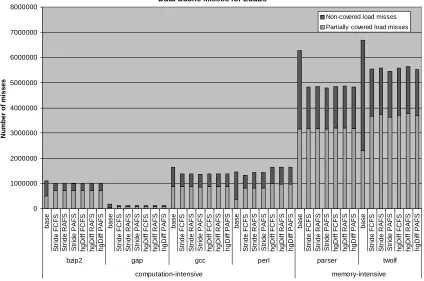
number of data cache misses for load instructions is shown in Figure 4. These cache
misses are divided into non-covered misses and partially covered misses (i.e., the
required block has already been requested from the L2 cache or the memory).
Non-covered cache misses have longer latencies and a greater impact on the overall
performance than the partially covered ones. Figure 3 shows that the proposed technique
increases the data cache hit rate by 1.5% for the memory-intensive benchmarks. For the
computation-intensive benchmarks bzip2, gap and perl the change in the hit rate is
Computation - Intensive Memory- Intensive
bzip2 gap gcc perl parser twolf
IPC 2.02 1.22 1.87 1.28 0.81 0.70
D-Cache Partially covered load misses 494804 38240 873249 375323 3157874 2297266
D-Cache Non-covered load misses 605561 131086 778026 1082292 3124750 4377583
D-Cache Hit Rate (%) 98.22 97.01 94.39 97.98 91.69 89.38
D-Cache - L2 Cache bus queue delay 539105 3897963 10249993 1435030 2974201 16613429
L2 Cache Partially covered load misses 6891 75674 28112 13652 236614 218
L2 Cache Non-covered load misses 98825 87898 85912 112067 1109456 1205872
L2 Cache Hit Rate (%) 84.20 73.09 93.17 93.37 61.64 82.86
configurations. Figure 4 shows that the proposed technique is effective in reducing the
number of load misses and also increasing the ratio of partially covered misses to overall
misses. This ratio increases because prefetching converts many non-covered load misses
into partially covered ones. The increase in the ratio is around 30% for the bzip2 (27%),
gap (36%), perl (37%) and twolf (33%) benchmarks. The benchmark gcc has the smallest
increase (11%) in the ratio of partially covered loads. Figures 3 and 4 also show that the
data cache hit rate and the ratio of partially covered loads do not depend much on the
predictor or the bus priority scheme being used. The effect of the predictor on the data
cache hit rate is the maximum for the benchmark perl. When the bus priority scheme is
FCFS and a stride predictor is used instead of an hgDiff predictor, the data cache hit rate
increases by 0.6%.
Data Cache Hit Rate
84% 86% 88% 90% 92% 94% 96% 98% 100%
bzip2 gap gcc perl parser twolf
computation-intensive memory-intensive H-Mean
base Stride FCFS Stride RAFS Stride PAFS hgDiff FCFS hgDiff RAFS hgDiff PAFS
Data Cache Misses for Loads 0 1000000 2000000 3000000 4000000 5000000 6000000 7000000 8000000 bas e S tr id e FC FS S tr ide R A F S Str id e PAF S h g D if f FC FS hgD iff R A F S hgD iff P A F S bas e S tr id e FC FS S tr ide R A F S Str id e PAF S h g D if f FC FS hgD iff R A F S hgD iff P A F S bas e S tr id e FC FS S tr ide R A F S Str id e PAF S h g D if f FC FS hgD iff R A F S hgD iff P A F S bas e S tr id e FC FS S tr ide R A F S Str id e PAF S h g D if f FC FS hgD iff R A F S hgD iff P A F S bas e S tr id e FC FS S tr ide R A F S Str id e PAF S h g D if f FC FS hgD iff R A F S hgD iff P A F S bas e S tr id e FC FS S tr ide R A F S Str id e PAF S h g D if f FC FS hgD iff R A F S hgD iff P A F S
bzip2 gap gcc perl parser twolf
computation-intensive memory-intensive N u m b er o f m isses
Non-covered load misses Partially covered load misses
Figure 4. Data cache misses for load instructions.
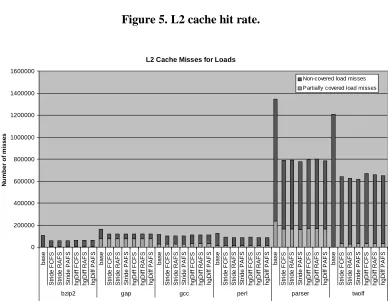
Figures 5 and 6 show L2 cache hit rates and the number of L2 cache misses for load
instructions. It can be seen that the proposed technique does not decrease the L2 cache hit
rate for most benchmarks. Bzip2 and gcc are the two benchmarks for which the L2 cache
hit rate decreases for all used configurations. This greatest decrease is for the bzip2
benchmark (by 2.1%). The increase in the L2 cache hit rate is the maximum for the twolf
benchmark (by 3.3%). Figure 6 shows that the number of load misses is decreased for all
benchmarks and the ratio of partially covered misses is increased for most benchmarks.
The increase in the ratio is the maximum for the gap benchmark (16%). For the
benchmarks gcc, perl, parser and twolf the increase is less than 5% and for the
benchmark bzip2 there is a decrease of 2%. Similar to the data cache, L2 cache hit rate
does not vary much with the predictor type or the bus priority scheme. However, for the
benchmark perl, when the stride predictor is used and the bus priority scheme is changed
priority scheme is FCFS and an hgDiff predictor is used instead of a stride predictor, the
data cache hit rate increases by 1%.
L2 Cache Hit Rate
0% 10% 20% 30% 40% 50% 60% 70% 80% 90% 100%
bzip2 gap gcc perl parser twolf
computation-intensive memory-intensive H-Mean base Stride FCFS Stride RAFS Stride PAFS hgDiff FCFS hgDiff RAFS hgDiff PAFS
Figure 5. L2 cache hit rate.
L2 Cache Misses for Loads
0 200000 400000 600000 800000 1000000 1200000 1400000 1600000 bas e S tr id e FC FS S tr ide R A F S Str id e PAF S h g D if f FC FS hgD iff R A F S hgD iff P A F S bas e S tr id e FC FS S tr ide R A F S Str id e PAF S h g D if f FC FS hgD iff R A F S hgD iff P A F S bas e S tr id e FC FS S tr ide R A F S Str id e PAF S h g D if f FC FS hgD iff R A F S hgD iff P A F S bas e S tr id e FC FS S tr ide R A F S Str id e PAF S h g D if f FC FS hgD iff R A F S hgD iff P A F S bas e S tr id e FC FS S tr ide R A F S Str id e PAF S h g D if f FC FS hgD iff R A F S hgD iff P A F S bas e S tr id e FC FS S tr ide R A F S Str id e PAF S h g D if f FC FS hgD iff R A F S hgD iff P A F S
bzip2 gap gcc perl parser twolf
computation-intensive memory-intensive N u m b er o f m isses
Non-covered load misses Partially covered load misses
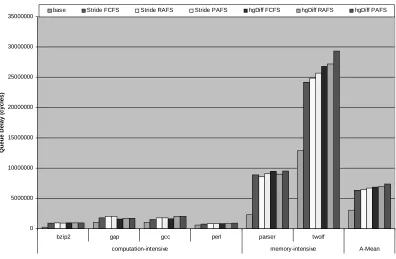
Figures 7 and 8 show the queuing delays on the data cache – L2 cache and the L2 cache –
memory buses. For both buses, using value speculation for prefetching increases the
queuing delay significantly since it increases the number of cache accesses. The increase
in the queuing delay ranges from 6% (Stride FCFS configuration for the benchmark gcc)
to 272% (Stride PAFS configuration for the benchmark gcc) for the data cache – L2
cache bus and from 20% (Stride FCFS configuration for the benchmark perl) to 320%
(hgDiff PAFS configuration for the benchmark parser) for the L2 cache – memory bus.
For the data cache – L2 cache bus, the queuing delay does not vary much with the
predictor type. The average queuing delay for the hgDiff predictor is at most 3% greater
than that of the stride predictor for a selected priority scheme. However, the perl
benchmark is an exception. For this benchmark, the hgDiff predictor has a queuing delay
that is 68% greater than the queuing delay of the stride predictor for the PAFS priority
scheme. Figure 7 also shows that for most benchmarks, the queuing delay is the same for
PAFS and RAFS priority schemes. When compared to the FCFS, the RAFS or PAFS
priority scheme has a greater queuing delay (50% on average) for most benchmarks. The
FCFS has a greater queuing delay than that of the PAFS or RAFS only when a stride
predictor is used for the benchmark perl.
Figure 8 shows that for most benchmarks, the configurations with the hgDiff predictor
have greater queuing delays for the L2 cache – memory bus. Gap is the only benchmark
for which, a configuration with a stride predictor has a greater queuing delay. For the
computation-intensive benchmarks, the queuing delay for RAFS and PAFS priority
schemes are similar and greater than the queuing delay for the FCFS priority scheme (by
21% for the benchmark gcc). For the memory-intensive benchmarks, the PAFS priority
scheme has the longest queuing delay. When an hgDiff predictor is used, the average
queuing delay for the PAFS priority scheme is 8% greater than the average queuing delay
for the FCFS priority scheme. This increase in the average queuing delay is 6% when a
Data Cache - L2 Cache Bus Queue Delay
0 5000000 10000000 15000000 20000000 25000000 30000000 35000000 40000000 45000000
bzip2 gap gcc perl parser twolf
computation-intensive memory-intensive A-Mean
Q
u
eu
e Del
a
y (
cycl
es)
base Stride FCFS Stride RAFS Stride PAFS hgDiff FCFS hgDiff RAFS hgDiff PAFS
Figure 7. Queuing delay for the data cache – L2 cache bus.
L2 Cache - Memory Bus Queue Delay
0 5000000 10000000 15000000 20000000 25000000 30000000 35000000
bzip2 gap gcc perl parser twolf
computation-intensive memory-intensive A-Mean
Q
u
eu
e Del
ay (
cycl
es)
base Stride FCFS Stride RAFS Stride PAFS hgDiff FCFS hgDiff RAFS hgDiff PAFS
For the benchmark gap, the BQ for the data cache – L2 cache bus holds a maximum of 9
accesses for all used configurations. The BQ for the L2 cache – memory bus holds a
maximum of 8 accesses for the base configuration. This number increases up to 19 for the
stride configurations and up to 18 for the hgDiff RAFS configuration.
Figure 9 shows the queuing delay on the instruction cache – L2 cache bus. It can be seen
that for the benchmarks bzip2, gap, parser and twolf, the instruction cache – L2 cache bus
queuing delay is negligible. For the gcc and perl benchmarks, the queuing delays for
RAFS and PAFS are similar and greater than the queuing delay for the FCFS. When a
stride predictor is used, the queuing delay for the RAFS or PAFS is 1.5 times greater than
the queuing delay for FCFS. The instruction cache – L2 cache bus queuing delay
becomes a limiting factor for the perl benchmark.
Instruction Cache - L2 Cache Bus Queuing Delay
0 100000 200000 300000 400000 500000 600000 700000
bzip2 gap gcc perl parser twolf
computation-intensive memory-intensive A-Mean
Q
u
eu
e
D
e
la
y
(c
ycl
e
s
)
base Stride FCFS Stride RAFS Stride PAFS hgDiff FCFS hgDiff RAFS hgDiff PAFS
Figures 10 through 13 compare the accuracies and the coverages of the stride and the
hgDiff predictors for various cases while using the FCFS bus priority scheme. The effect
of the bus priority scheme on the accuracy and coverage of a predictor was observed to
be negligible. This is the reason why the two predictors are compared using only one bus
priority scheme.
Figures 10 and 11 show the accuracies and coverages of the both predictors only for load
instructions. Figure 10 is for all load instructions, whereas Figure 11 is for load
instructions that are on the actual path, i.e. the load instructions that will actually commit
their results. Both figures show that the stride predictor has a better accuracy for most
benchmarks, whereas the hgDiff predictor has a better coverage for all benchmarks. The
difference in the prediction accuracy is the highest for the benchmark gap, for which the
stride predictor has a 6% higher accuracy for all load instructions and a 7% higher
accuracy for load instructions on the actual path. For this benchmark, the hgDiff
predictor’s coverage is around 3.5% greater than that of the stride predictor for both
cases. The difference in the prediction coverage is the highest for the benchmark gcc, for
which the hgDiff predictor has a 6% higher coverage for all load instructions and a 7%
higher coverage for load instructions on the actual path. The stride predictor’s accuracy
for this benchmark is around 3% greater than that of the hgDiff predictor. As an average,
the hgDiff has a 4% higher coverage for all load instructions and the load instructions on
the actual path, whereas the stride predictor has a 2% higher accuracy for all load
Prediction Accuracy and Coverage for Load Instructions 0% 10% 20% 30% 40% 50% 60% 70% 80% Accu ra cy Cov e rage Accu ra cy Cov e rage Accu ra cy Cov e rage Accu ra cy Cov e rage Accu ra cy Cov e rage Accu ra cy Cov e rage Accu ra cy Cov e rage
bzip2 gap gcc perl parser twolf
computation-intensive memory-intensive A_mean
Stride FCFS hgDiff FCFS
Figure 10. Prediction accuracy and coverage for load instructions. Prediction Accuracy and Coverage for Load Instructions on the Actual Path
0% 10% 20% 30% 40% 50% 60% 70% 80% 90% 100% Accu ra cy Cov e rage Accu ra cy Cov e rage Accu ra cy Cov e rage Accu ra cy Cov e rage Accu ra cy Cov e rage Accu ra cy Cov e rage Accu ra cy Cov e rage
bzip2 gap gcc perl parser twolf
computation-intensive memory-intensive A_mean
Stride FCFS hgDiff FCFS
Figures 12 and 13 show the accuracies and coverages of the both predictors for value
producing instructions. Figure 12 is for all value producing instructions, whereas Figure
13 is for those instructions that are on the actual path. The results for all value producing
instructions are similar to the results for the load instructions. The hgDiff predictor has
better coverage for all benchmarks, whereas the stride predictor has better accuracy for
all benchmarks except the twolf benchmark. For this benchmark, the hgDiff predictor
accuracy is 2% greater than the stride predictor accuracy and the hgDiff predictor
coverage is more than 3% greater than the stride predictor coverage regardless of whether
the value producing instructions are on the actual path or not. The coverage of the hgDiff
predictor is 5% greater than that of the stride predictor for the benchmark gcc and the
accuracy of the stride predictor is more than 2% greater than that of the hgDiff predictor
for the benchmarks gcc and perl.
Prediction Accuracy and Coverage for All Instructions
0% 10% 20% 30% 40% 50% 60% 70% 80% 90% Accu ra cy Cov e rage Accu ra cy Cov e rage Accu ra cy Cov e rage Accu ra cy Cov e rage Accu ra cy Cov e rage Accu ra cy Cov e rage Accu ra cy Cov e rage
bzip2 gap gcc perl parser twolf
computation-intensive memory-intensive A_mean
Stride FCFS hgDiff FCFS
Prediction Accuracy and Coverage of All Instructions on the Actual Path 0% 10% 20% 30% 40% 50% 60% 70% 80% 90% 100% Accu ra cy Cov e rage Accu ra cy Cov e rage Accu ra cy Cov e rage Accu ra cy Cov e rage Accu ra cy Cov e rage Accu ra cy Cov e rage Accu ra cy Cov e rage
bzip2 gap gcc perl parser twolf
computation-intensive memory-intensive A_mean
Stride FCFS hgDiff FCFS
Figure 13. Prediction accuracy and coverage for all value producing instructions on the actual path.
Bodine [2] used the prediction power to compare predictors with varying strengths in
accuracy and coverage. The prediction power is defined as the product of the accuracy
and coverage of the predictor. Figure 14 shows the prediction powers of the stride and
hgDiff predictors. Each predictor’s prediction power is calculated for load instructions
and for all value producing instructions. The hgDiff predictor has a prediction power,
which is 0.5% (for the benchmark perl) to 2.2% (for the benchmark bzip2) greater than
the stride predictor for load instructions. The hgDiff predictor is superior to the stride
predictor also for all value producing instructions, except for the bzip2 benchmark. As an
average, the hgDiff prediction power is greater than the stride prediction power by 1.3%
Prediction Power
0% 5% 10% 15% 20% 25% 30% 35% 40% 45% 50%
Loads All Loads All Loads All Loads All Loads All Loads All Loads All
bzip2 gap gcc perl parser twolf
computation-intensive memory-intensive A-Mean
Stride FCFS hgDiff FCFS
Figure 14. Prediction power of stride and hgDiff predictors.
Previous studies [2, 27] show that the hgDiff predictor has greater prediction coverage
than the stride predictor. They also show that the prediction accuracy of the hgDiff
predictor is greater than that of the stride predictor on average. However, this contradicts
with the results presented in this thesis. The reason for this discrepancy is the speculative
update used for the stride predictor. The speculative update increases the performance of
the stride predictor significantly. Since the correct stride predictions entered into the
GVQ increase the accuracy of the gDiff predictor, speculative update also increases the
performance of the gDiff predictor. However, this increase is not as significant as the
increase in the stride predictor’s performance because the GVQ size starts to become a
bottleneck for the gDiff predictor. If an instruction has a stride pattern and the execution
of the instruction is completed before it is dispatched again, then the speculative update is
not used and both predictors can predict this instruction correctly. Then, if the same
instruction is dispatched multiple times before the current execution of that instruction is
the GVQ size is small, the result from the prior execution of the same instruction gets
overwritten by another instruction’s result and when the current execution of this
instruction is completed, the correct difference cannot be calculated. Therefore, the gDiff
predictor starts making incorrect predictions, whereas the stride predictor keeps correctly
predicting the instruction since it does not depend on the GVQ size.
The effects of the GVQ size on the hgDiff prediction accuracy and coverage can be seen
in Figures 15 and 16. Figure 15 shows that for the bzip2 benchmark, the hgDiff
prediction coverage increases as the GVQ size increases. The accuracy is not affected
significantly; however, it decreases when the GVQ size is increased beyond 64. Figure 16
shows that for the benchmark gap, changing the GVQ size from 16 to 32 increases the
hgDiff prediction accuracy and coverage significantly. When the GVQ size is increased
to 64, the hgDiff prediction accuracy becomes greater than the stride prediction accuracy.
Further increasing the GVQ size does not provide much benefit for the gap benchmark.
Effect of GVQ Size on Prediction Accuracy and Coverage for the bzip2 Benchmark
50% 55% 60% 65% 70% 75% 80% 85%
GVQ size = 16 GVQ size = 32 GVQ size = 64 GVQ size = 128 GVQ size = 256
Stride hgDiff hgDiff hgDiff hgDiff hgDiff
Accuracy (All) Coverage (All)
Effect of GVQ Size on Prediction Accuracy and Coverage for the gap Benchmark
25% 35% 45% 55% 65% 75% 85%
GVQ size = 16 GVQ size = 32 GVQ size = 64 GVQ size = 128 GVQ size = 256
Stride hgDiff hgDiff hgDiff hgDiff hgDiff
Accuracy (All) Coverage (All)
Figure 16. Effect of GVQ Size on Prediction Accuracy and Coverage for the bzip2 Benchmark.
Figure 17 shows the speedups of the proposed speculative execution technique using six
different configurations. Although the hgDiff predictor has a better prediction power, the
speedups of the configurations with the hgDiff predictor are smaller than the speedups of
the configurations with the stride predictor for all benchmarks except the gap benchmark.
For this benchmark, both predictors have the same prediction accuracy, but the hgDiff
predictor has a better coverage. Also, the L2 cache – memory bus queuing delay is less
for the configurations with the hgDiff predictor. For the benchmarks bzip2 and perl, the
speedups of the configurations with hgDiff predictor are negative. For the benchmark
bzip2, using an hgDiff predictor results in a decreased L2 cache hit rate and an increased
L2 cache – memory bus queuing delay. For the benchmark perl, the queuing delays for
both data cache – L2 cache and L2 cache – memory buses increase when an hgDiff
For a given benchmark, the effect of the bus priority scheme is usually the same for both
predictors. When using the hgDiff predictor, the RAFS priority scheme provides the
greatest speedups for all benchmarks except the twolf benchmark, for which the PAFS
priority scheme outperforms the other priority schemes. When using the stride predictor,
the RAFS priority scheme provides the greatest speedups for the bzip2, gap, gcc and
parser benchmarks. The PAFS priority scheme provides the smallest speedups for the
bzip2, gap, perl and parser benchmarks. However, it outperforms the other priority
schemes for the twolf benchmark. The greatest impact of the bus priority scheme on the
speedups is observed for the perl benchmark when using a stride predictor. For this case,
the FCFS priority scheme provides a speedup that is almost 4 times greater than the
speedup provided by the other two priority schemes. The FCFS priority scheme provides
greater speedup than the RAFS and PAFS priority schemes because the instruction cache
– L2 cache queuing delays for these two schemes are much greater than the queuing
delay for the FCFS priority scheme.
Speedups
-2% 0% 2% 4% 6% 8% 10% 12%
bzip2 gap gcc perl parser twolf
computation-intensive memory-intensive H-Mean
Stride FCFS Stride RAFS Stride PAFS hgDiff FCFS hgDiff RAFS hgDiff PAFS
The results show that using the recovery-free speculative execution, the performance is
increased significantly, especially for the memory-intensive benchmarks. Using the stride
predictor provides more benefit over the hgDiff predictor for most benchmarks. The bus
priority schemes affect the overall performance. The RAFS priority scheme provides
better speedups for most benchmarks for both predictors. When compared to Zhou and
Conte’s results [26], the proposed recovery-free speculative execution technique with a
more realistic memory model provides greater speedups especially for the perl and the
memory-intensive benchmarks. The main reason for this is that the base model presented
in this thesis usually has a lower IPC than the base model used by Zhou and Conte [26]
for a given benchmark due to the contentions on the buses. Another reason could be the
unlimited table size of the stride predictor used in this thesis, as opposed to the 4K entry