Uniform Deployment of Sensor and Density
Based Cluster Head Selection Protocol for
WSN
Charat Singh
1
, Simranjit Kaur
2
, Sourabh Mahajan
3
M. Tech Scholar, Department of ECE, S.S.C.E.T, Badhani, Pathankot, India1
Assistant Professor, Department of ECE, S.S.C.E.T, Badhani, Pathankot, India2
Assistant Professor, Department of ECE, S.S.C.E.T, Badhani, Pathankot, India3
ABSTRACT: Progress and progress in the wireless communication made it possible to wireless sensor networks (WSN) to develop the data processing as an important platform in the new few years appeared. In WSN is battery is the only source for the supply of energy to the sensor nodes; which in the different environmental work. WSN consumes a lot of energy for the detection, processing, storage and communicate the data with the bathtub. In such methods groups head (CH) sends data directly to sump or via relay node. It guarantees a uniform distribution of CHs and fixed number of groups, all nodes. The proposed method is used to select the following hops to specific properties is based. Since only CH rotated, there is no energy consumption for the group update. Because sensor nodes sensitive data and works in the hostile unattended environment it must be protected against attacks. But security in the sensor networks, the major challenges for the data processing and resource constraints. This also included position of paper-based intrusion detection method to the sensor nodes from the non-authorized attack and node compromise to protect. Simulation result shows that our uniform deployment and density based energy efficient clustering head protocol (UDDEECH) is Energy-saving and secure communication can make available.
KEYWORDS: WSN, energy consumption, grid-based approach, cluster-based method, intrusion detection system
I.INTRODUCTION
Different protocols and methodologies are developed up to now to mitigate the energy consumption of the traditional decentralised system is different. The different group that is based protocol [2] for hierarchical network, are proposed by many researchers and scholars. Here sensor nodes to the various groups submit your requested data to a node belong to your group grouped, the group header (CH) was called and then collects the received data and forward it to the data sink. The group-based approach has the ability to network durability and stability by improvement in energy efficiency and energy consumption among the nodes in the network life time balances. You will be in relation to the techniques classified for the prefixes of group heads and the transfer of the accumulated data for the bath or on the BS [3] will be accepted.
ISSN(Online): 2320-9801
ISSN (Print): 2320-9798
I
nternational
J
ournal of
I
nnovative
R
esearch in
C
omputer
and
C
ommunication
E
ngineering
(An ISO 3297: 2007 Certified Organization)
Website: www.ijircce.com
Vol. 5, Issue 3, March 2017
Another important feature is that there is no group update there; only CHs, turned at the end of each round. This can energy consumption for the group update will be saved. Since communication success is only achieved if the data is safe and in the right form are we a position-based approach in order to identify the nodes and unauthorized access to the network may be compromised. Consequently bonds of this paper to the watchful eye toward energy efficiency with security.
This paper is organised as follows: Section II describes related work to this work and motivated. Section III describes suggested that energy-saving method and section IV Algorithm of UDDEECH. In Section V, we evaluate our proposed method and the simulation results shown. Section VI closes the paper with future improvements.
II.RELATED WORK
Some of the group-based hierarchical protocols are researched and taught over to the power of WSN have been proposed to improve. W. Heinzelman et al.; proposed liquor [4] One of the earliest protocols hierarchical grouping together was developed to increase the life of the network to increase. Here are CHs to BS in connection and the not group head node uses CHs as between nodes, to BS.
LEACH with a factor of mobility called LEACH-M [11] introduced by D.S. Kim, et al; consider mobility of nodes during the communication with the liquor exceeds. It caused many packet losses during CH-motion, before you create a new CH for the next round of primaries. HPAR [12] proposed by Q. Li, et al.; is conscious way dialing protocol of the energy that the clustered zones formatted and then decides how to releases on other zones hierarchically for the maximisation of net life time laid.
SEECH, Mehdi Tarhani et al. [17] introduced selects CHs and relay separately. This method differs from most of the protocols in which high-level energy nodes as a group header can be selected and you rotation in round each changed. Although CH and relay separately is preselected, energy limitation exists yet, since the number of following hops from each CH to decrease maximum two and is therefore not in the large networks is applicable.
For the performance of the existing route selection mechanism to improve and to overcome, we propose a new method for selecting the various parameters of the CHs, and data transmission path in order to decrease. In order to make it fit in the long-distance communication, appropriate numbers of hops based on energy of the submitter, energy of CH-receiver distance from the CHi to CHj and distance from CH to BS preselected. Also we will add an additional functionality, the intruders determined the unauthorized access on the network. It uses a simple methodology that only a small amount of memory and computer capacity requires.
III.ENERGY-EFFICIENT ROUTING IN UDDEECH
Wireless sensor nodes for the detection and the collection of information is battery operated, are used in the areas in which there is very little leeway there to manually change batteries or the load. It seems very difficult to frequently change batteries or recharge while it, uninterrupted human effort, time and cost. Sensor nodes that the data of the used environment collect, follow in the direction of the pan for the further processing and analysis. There is a very large area of research if you matching route selection/communication mechanism in WSN introduces because their function according to the nature of the network structure and the nature of the application depends on. For improving the performance, the functionality and the lifetime of WSN, we need the life time of each sensor node increase by we look at its energy consumption.
Fig.1. Transmission model in UDDEECH
IV. PROPOSED ALGORITHM
For the operation of UDDEECH is shown in Fig.1. This is repeated each round different phases have regularly, as follows:
Network is virtually in 4 zones separately. Each node generates a random probability (P) on the product to calculate the introduction of order and the threshold value T (N). New node control the energy of all nodes. The node, the maximum energy in the previous round, select as marginal (Relay node) and check the minimum distance from the BS. After that the energy of the new node in the previous round is not relay node is equal and minimum distance of BS off, select as CZH (Group zone head) after the completion of the zone selection procedure, each member sends its data and residual energy to CZH. The CZH retains residual energy information of all Member node and send it to marg. The Relay node sends BS maximum residual energy value of the node to its our group belonging, if the last frame of round completes. BS find the maximum residual energy of the network and send this value to all Cnodes in the network. Further ZH-node will send the maximum value to all network ZH-nodes. Exclusive ZH-node defense of the value of the maximum residual energy for the following competition of T (N) and the current round is completed.
V. SIMULATION AND RESULTS
ISSN(Online): 2320-9801
ISSN (Print): 2320-9798
I
nternational
J
ournal of
I
nnovative
R
esearch in
C
omputer
and
C
ommunication
E
ngineering
(An ISO 3297: 2007 Certified Organization)
Website: www.ijircce.com
Vol. 5, Issue 3, March 2017
Case I: Node – 100 , Area -100 x 100
In this case we deploy 100 nodes are non-uniformly in SEECH and then they are deploy uniformly inthe 100 m X 100 m area. As shown in Figure 2
Fig.2 Non Uniform deployment 100 Nodes, Area (100,100)
In Fig.3 uniform deployment it is studied that the nodes are at equal distance and nodes are at equal coverage of the nodes and hence here is less loose of energy due equal transmission from nodes to Base station is less than non-uniform deployment .here also the density of nodes area also non-uniform .
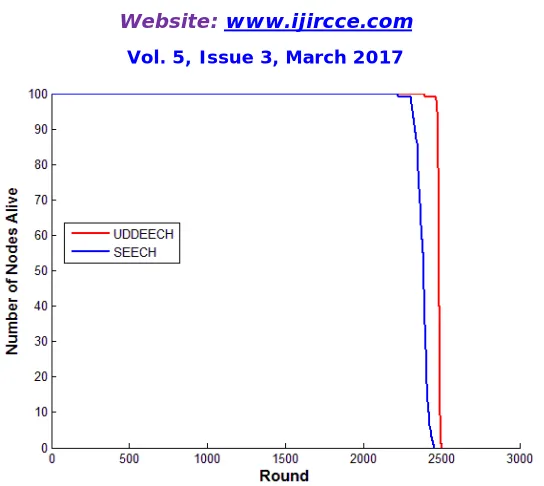
Fig.4 Nodes 100 Number of nodes Alive per Round in SEECH vs. UDDEECH
In Fig.4and Fig.5 graph it is observe that all the of nodes dead around 2491 but in case of its more then 2506 .so from their is it studied that it is also from simulation clear that the death of nodes occur not in long period but in very small periods so UDDEECH have more life time then SEECH .
Fig. 5Nodes 100 Energy Consumed per round in SEECH vs. UDDEECH
Table.1. Parameters
Parameters Values
Number of nodes 100
Channel Type Channel/Wireless
Channel
Initial Energy 50
ISSN(Online): 2320-9801
ISSN (Print): 2320-9798
I
nternational
J
ournal of
I
nnovative
R
esearch in
C
omputer
and
C
ommunication
E
ngineering
(An ISO 3297: 2007 Certified Organization)
Website: www.ijircce.com
Vol. 5, Issue 3, March 2017
VI CONCLUSION ANDFUTUREWORK
This paper is mainly focused on how to improve the energy efficiency of WSN to increase the life of the network to increase. The proposed method uses mesh-based approach with group-based strategy. To achieve the objective by CH prefixes, is based on two parameters: Energy and distance. You also considers energy of the CH-transmitter and receiver, the distance between the CH and the hops, distance between CH and sump to the selected path in the BS. In order to make them more energy-efficient, we just to be rotated before CH and no change in the grid as soon as it is formed. The paper also specifies position-based method to match incoming nodes and attacker to identify. Simulation results in successful implementation of the shows our proposed method and performance evaluation says that our method of energy efficiency with lower energy consumption can achieve.
As future work more attacking scenario (sip hole attack, worm infestation, etc.) other than CH-attack. Here we considered only CH-attack no attacks in other sensor nodes assuming. We can also improve this method by methods included, in order to treat node failure by way we support and provide alternate
REFERENCES
1. Zheng, Jamali pour, "Wireless Sensor Networks a networking perspective", IEEE-book, John Wiley & Sons, 2009
2. Shankar, Dr. Raja Shree; "Overview on energy-saving safe route selection in the wireless sensor networks"; International Journal of Engineering Informatics Research, p. 7-11, July 2013
3. O. Boyinbode, H. Le, A. Mbogho, Takizawa and Poliah, "an overview on grouping algorithms for wireless sensor networks," in Proc. 13. Int. Conf. Netw.-based Inf. System. p. 358-364, September 2010,
4. Heinzelman, A. Chandra Kazan, Bala Krishnan, "Energy-saving transmission protocol for wireless micro sensor networks," in international conference Proc.33rd Hawaii on System Sciences, HI, USA, Vol. 8, p. 110,2000.
5. Wu, P. Wang, performance comparison of alkalis and leach-Cprotokollen by NS2," in the procedures of the 9. International symposium on distributed computing and applications on business, technology and science. Hong Kong, China, P. 254-258, 2010
6. Lindsey, C.Raghavendra, "PEGASIS: power-efficient assembly in the sensor information systems," in Proc. Ieee aviation conference, USA, Montana, Vol. 3, p. 1125, 1130, 2002.
7. Jung, p.; Han, Y. "The concentric grouping design for powerful energy consumption in PEGASIS"; in the procedures of the 9. International conference on AdvancedCommunications-Technologie, Gangwon-do Kore; P. 260-265, 2005.
8. Loscri, V.; Morabito, G.; Marano, P.; "a two-level hierarchy for low-energy adaptive grouping hierarchy"; in the procedures of the 2. IEEE Fahrzeug-Technologysemi-annual conference, Dallas, TX, USA; p. 1809 1813; September 2005.
9. Manjeshwar, D. Agrawal, "juvenile: A route selection protocol for increased performance in the wireless sensor networks," in Proc. 15. Workshops internationally in parallel and distributed computing Symposium-(IPDPS-"01), USA, California, p. 2009-2015,2001.
10. Manjeshwar. ; Agrawal, D.P. "APTEEN: A Hybrid Protocol for Efficient Routing and Comprehensive Information Retrieval inthe Radio SetSensor Networks." In the proceedings of the second international workshop on similarity and of distributed computing questions in the wireless networks and mobile computing, Lauderdale, FL, USA, p. 195-202,15-19 April 2002.
11. Kim and Y.J. Chung, "Self-Organization Route Selection Protocol, the Mobile Node For Wireless Sensor Network," in international multi-Symposiums Proc.First on computers and computer sciences, Hangzhou, China, 2006.
12. Q. Li, J. Aslam, D. Rus, "hierarchical power-conscious way choice in the sensor networks," in Proc. DIMACS seminar on penetrating networking, California, p. 25-27, 2001.
13. Wu, P. Fahmy, N. Shroff, "Power saving sleep/track scheduling for multihop sensor networks: Not convexity and proximity value algorithm," in Proc. 26. Annual IEEE conference on computer communications, Anchorage, Alaska p. 1568-1576, 2007.
14. YE, M.; Li, C.; Chen, G.; Wu, J. "An Energy-Saving Gruppi Render Design in the Wireless Sensor Networks". Ad hoc Sens. Wirel. Netw,p.3, 99 – 119, 2006.
15. Younis, O.; Fahmy, P.-"ATTENTION: A Crossing, Energy-Efficient, Distributed Grouping Approach for Ad Hoc Sensor Networks". IEEE trans. Mobile computer and telecommunication,p.3, 366-379,2004.
16. S.d.Murugunathan; MA, D.C.F.; Bhasin; Fapajuwo, A.O. "A Centralized Energy-Saving Route Selection Protocol for Wireless Sensor Networks". IEEE radio Communication p. 43, S8-S13.2005.
17. Tarhani, Yousef P. Kavian and SamanSiavoshi. "Ersteigbares SEECH: Energy-Saving Break End Hierarchy Protocol in the Wireless Sensor Networks". IEEE-Sensor magazine, vol. 14, no. 11,p. 3944 3954, November 2014.