Performance Optimization in Spray and
Wait Routing Protocol of Delay Tolerant
Network
Nilam Chaudhary1, Prof. Shakti Patel2
M.E Student, Dept. of C.E, SPCE, Visnagar, Gujrat, India1 Assistant Professor, Dept. of C.E, SPCE, Visnagar, Gujrat, India2
ABSTRACT : Delay tolerant network refers to a network where connectivity is opportunistic. Due to such intermittent connectivity traditional routing protocol fails. In order to efficiently route the information in such an environment researcher have proposed various classes of routing protocols: forwarding, replication, control replication etc. This technique uses local information available with node: Neighbourhood index, past contacts, contact duration, node mobility etc. to determine next hop or destination. When considering routing protocols of DTNs, a forwarding decision and the buffer management scheme are important to improve the opportunity of successful message delivery. The work proposed in this paper presents related work of routing in delay tolerant networks. Furthermore, The work proposed in this paper presents a combine strategy of Replication and Forwarding during routing in delay tolerant networks. We proposed an improved version of Spray and wait routing algorithm in which during replication phase, Spray and wait is utilized with the calculated value of L. In the forwarding phase, we have utilized the improved version of PROPHET algorithm along with Buffer management at each relay node.Buffer management policy is introduced to drop the queued messages with the most replicate copies in the network to reduce irrelevant overhead to the node.
KEYWORDS : Delay tolerant networks, DTN, Routing protocols.
I. INTRODUCTION
Inwireless Mobile Ad Hoc network there is not always continuous path between source to destination. In TCP concept the link is disconnected or not perfect then data or information are losses. At that time DTN networks were introduced. [1] DTN is normally works with the opportunistic-connectivity networks that may tolerate the disruption or disconnection. The networks which has high delay and which may undergo with disruption or disconnection are comes under Delay Tolerant Network. [1]
DTN refer to a wide range of challenged networks, where 1) End-to-End connection cannot be assumed to exist. 2) Network partitioning is frequent. 3) Delay/ Disruption/Disconnection can be tolerated. Inter-Planet satellite communication network, Military battlefield network, Wildlife tracking sensor network and underwater wireless sensor networks are the DTN examples.
The challenging areas in DTN are that how it should possible to communicate the end-to-end connectivity in heterogeneous environment.
Because of the DTN characteristics, it should make it to different approach from the other Internet architecture. Following are the characteristics of DTN:
A. Intermittent connectivity [2]
Fig. 1 Intermittent connectivity [3]
B. Store and Carry approach [2]
In this approach an intermediate node becomes carrier and takes custody of the data in its buffer until the perfect path will be available and then forward the data to next node and continue the process. Due to the Disruption, retransmission , delays, and flow control etc in the Network are using this technique in DTN.
Fig 2 Store and Carry approach [3]
C. Bundle layer [2]
The store and forward mechanism in DTN architecture is implemented by new protocol layer called “Bundle layer”. Bundle layer stores the messages or bundles in its buffer and forward them between nodes. It is below of the Application layer and above of the Transport layer.
Fig. 3 Bundle layer [3]
The rest of this paper is in following Manner: Section 2 presents Routing Protocol in DTN, Section 3 represent the Releted Work, Proposed Work is presented in Section 4.
II. ROUTING PROTOCOL IN DTN
Because of the Opportunistic connectivity and lack of continuous path in DTN, it uses the routing protocols. DTN suffer from the lack of continuous path, at that time messages are store in buffer until the perfect path establish between nodes. Whenever node gets the opportunities to forward the messages then it spray the messages. Hence, DTN routing has several methodologies that which is the best technique to successfully deliver the messages. Following are the basic DTN Routing Protocols:
1) Replication based (flooding) protocols
Fig 4: Routing in DTN Classification [4]
1) Epidemic routing [2]
In this schema the sender node flooding the bundles until the all nodes has the copy of the bundle. This process continues till the sender node has at least one copy. This scheme is useful when the network is partitioning and message size is small. Epidemic routing is simple routing strategy therefore it is used when not any better method is available. But the problem is that the node replicates the message even the message is successfully delivered to the destination.
2) Spray and Wait [5]
Spray and Wait routing have two phases, Spray phase and Wait phase. In the spray phase, a sender node forwards the copy of message to its neighbour node until the destination encounter. The every node has at least one copy of message. If during this process destination is not encounter, this scheme switches to the wait phase. In this Wait phase, node keeps the copy of the message till the destination is encounter. Once the destination encounter then node directly delivered the copy of the message.
Binary Spray and Wait is the improve version of the conventional Spray and Wait. In this scheme a node forward the half of the copy of message to the entire node until destination encounter. If the destination does not encounter during this process then it switches to wait phase. In the Wait phase node keeps the copy of message till the destination encounter.
3) MaxProp [5]
In MaxProp, this scheme related best suited example is city buses. In that the nodes are city buses which have maximum possibilities to meet often. For exchanging the messages this scheme use this concept of city buses. It measure the total cost to select the path to the destination. This scheme divides into two phases. In the First phase order stored messages based on hop count information of each message from low to high. Second phase is to order messages by cost from high to low.
4) Geographical Routing [6]
In the wireless routing the node’s coordinate is change in network topology then it changes the topology. So the topology changes in the network is often which cause a large overhead in routing schemes. So that the position of the nodes is based on the routing. Thus, the routing strategy which is based on the information about the geographical position is called geographical routing.
5) Randomized routing
In this scheme, the node found the destination node to sending the bundle in random way. First, thenode send the data to its nearest contact nodes, then the data reach at the destination node in few minutes and then after this sending process is stop. The data reach at destination in only one jump this is called one hop distance. But if it accesses the every node in network this arrives in worst case.
6) Location Service
It is a one kind of service or mechanism, in which it provide the destination’s current location for data. Hence it is called Location service. It has dividing this mechanism into two parts:
Dream location service
Simple location service
A node position is share with its nearest neighbour node. Thus location tables are exchanging between its neighbours, and also the Communication information is local while permitting the location data to globally be distributed in the system.
III. RELATED WORK
A. ProPHET
Probabilistic Routing Protocol using History of Encounters and Transitivity (PROPHET) initiate a metric for probability is called Delivery Probability. P (a, b) € [0,1] Where probability of node a and b is always in between 0 and 1.
The Delivery Probability has been calculated in three parts: At First, the node first time face then, it is calculated by using Eq.1.
P(a,b)new = P(a,b)old + ( 1 - P(a,b)old ) *P init ...(1)
Where Pinit is an initialization Constant.
At in Second, two node face each other again then it update the delivery probability by using aging constant, P(a,b)new = P(a,b)old × γ k ...(2)
Where, γ € (0, 1) is the aging constant k is the total time units that
have passed as the last time the metric was meet. At the Third, If the node A habitually faces the node B, and node B habitually face the node C. Thus the node C is possibly a better node to send the message for node A. It is the transitive rule. Eq.3 shows this rule:
P(a,c)new = P(a,c)old + (1- P(a,c)old ×P(a,b)×P(b,c) ×β)...(3)
where β is a scaling constant
B. Spray And Wait
Spray and Wait routing have two phases, Spray phase and Wait phase. In the spray phase, a sender node forwards the copy of message to its neighbour node until the destination encounter. The every node has at least one copy of message. If during this process destination is not encounter, this scheme switches to the wait phase. In this Wait phase, node keeps the copy of the message till the destination is encounter. Once the destination encounter then node directly delivered the copy of the message.
Binary Spray and Wait is the improve version of the conventional Spray and Wait. In this scheme a node forward the half of the copy of message to the entire node until destination encounter. If the destination does not encounter during this process then it switches to wait phase. In the Wait phase node keeps the copy of message till the destination encounter.
C. First Contact
In this routing, node sends a message to any available contact randomly.
If there is no any of the path is available then the message waits for that particular path until become available and is assigned to first available contact. In this schema node only forward the single copy of message. The node who have same message transfer to each other for long period of time that two nodes are detect. The accepted node only obtain a message which is not suffers from it before.
IV. PROPOSED WORK
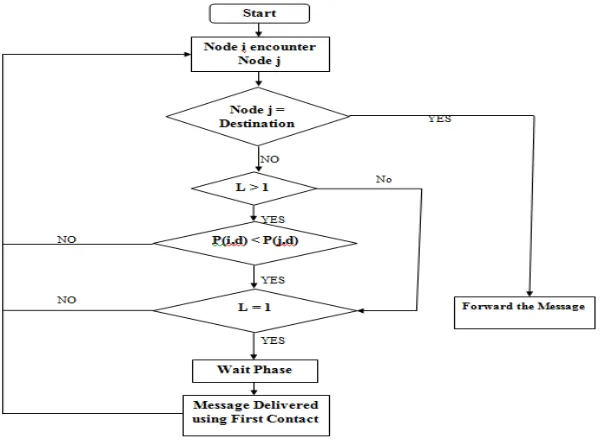
to its buffer until the destination meets. The destination node encounter then it sprays the copy of message. Therefore, many number of copies of messages are spray, it can occur meaningless duplication. Due to the limited size of buffer the important messages are losses when buffer overflow. Thus the result is that increase the communication overhead and wastage of buffer.
Therefore, We propose a method in Spray and Wait routing protocol, We improve in the Spray phase we use the improve ProPHET routing protocol and in Wait phase we use First contact routing protocol.
Furthermore, We use ProPHET routing for spraying a copies of messages in that the node which have highest delivery probability.
We have also utilized the improved version of Prophet by doing following modifications to the existing protocol. Steps to Improve PROPHET:
Remove delivered and (acknowledge) message Copy from all intermediate nodes of communication path.
Furthermore, We have utilized First Contact routing protocol in Wait phase to deliver message to the destination node.
Fig 5 Example of the operation of probability-based spray and wait routing protocol.[7]
V. CONCLUSION
The challenging problem with DTN is the capability of easily and attractively route the data in opportunistic connected network. Most of the routing protocols use the flooding based routing strategy for getting high message delivery ratios. Unluckily, protocols which have low network resource utilization are not capable for getting better delivery ratios.
Hence, proposed routing protocol integrates both forwarding and replication strategies and attempts to achieve high delivery ratio with less amount of overhead. To avoid the useless spray in the conventional Spray and Wait routing protocol, the ProPHET routing protocol is used because of delivery probability. Thus As a result, efficient message delivery is obtained by only spraying message copies to the nodes with a higher probability of message Delivery. By integrating the advantages of conventional methods, proposed method has shown to be more adaptive to the different environments and represents better performance than the other conventional routing methods.
REFERENCES
1. Boudguig, Mohammad, and Abdelmounaïm Abdali."NewDTNrouting lgorithm." International Journal of Computer Science 10, no. 3:pp 82-87, 2013.
2. Puri, Paritosh, and Mrigendra Pratap Singh. "A survey paper on routing in delay-tolerant networks." International Conference on, In Information Systems and Computer Networks (ISCON), 2013, pp. 215-220. IEEE, 2013.
3. F. Warthman, “Delay Tolerant Networks (DTN),” prius.ist.osaka-u.ac.jp, no. March, 2003.
4. Salman Ali, Junaid Qadir, Adeel Baig, ”Routing ProtocolsIn Delay Tolerant Networks :A Survey”, page- 70-75, IEEE-2010.
5. R. S. Mangrulkar, Dr. Mohammad Atique.” Routing protocol for Delay Tolerant Network: A SurveyandComparison” , page-201-215, IEEE-2010.
6. Yue Cao, Zhili Sun, Naveed Ahmad, Haitham Cruickshank“A Mobility Vector Based Routing AlgorithmforDelayTolerant Networks Using HistoryGeographicInformation”, Page-2757-2762, IEEE-2012.
![Fig. 3 Bundle layer [3]](https://thumb-us.123doks.com/thumbv2/123dok_us/1448461.1177460/2.595.241.371.458.602/fig-bundle-layer.webp)
![Fig 4: Routing in DTN Classification [4]](https://thumb-us.123doks.com/thumbv2/123dok_us/1448461.1177460/3.595.178.432.188.308/fig-routing-dtn-classification.webp)