ISSN(Online): 2320-9801 ISSN (Print): 2320-9798
I
nternational
J
ournal of
I
nnovative
R
esearch in
C
omputer
and
C
ommunication
E
ngineering
(An ISO 3297: 2007 Certified Organization)
Website:www.ijircce.com
Vol. 5, Issue 1, January 2017
Implement & Analysis of RSS Threshold
based Vertical handoff Decision Algorithm for
LTE & WLAN
Zarna M. Gohil1, Mr. D. N. Khandhar2, Mr. K. M. Pattani3
P. G. Student, Dept. of E.C.,C. U. Shah University, Wadhwan, India1
H.O.D, Dept. of E.C.,C. U. Shah University, Wadhwan, India2
Assistant Professor, Dept. of E.C.,C. U. Shah University, Wadhwan, India3
ABSTRACT: Communication services anywhere and anytime is driving an accelerated technological development towards the integration of various wireless access technologies such as WLAN, 3G and etc. MTs (Mobile Terminal) must be able to seamlessly transfer to the “best” access link among all available candidates with no perceivable interruption to an ongoing data, voice or video conversation. Such ability to handover between heterogeneous networks is referred to as vertical handovers. VHD (Vertical Handoff Decision) algorithm can be classified in to different four category 1) RSS (Received Signal Strength) based 2) Freq. based 3) cost based 4) combination. These algorithms need to be designed to provide the required Quality of Service (QoS) and different parameter to a wide range of applications while allowing seamless roaming among a multitude of access network technologies. In this paper, design analgorithm in which the handoff decision can be taken on the basis of the value of current RSS and threshold RSS andresults are plotted using the Matlab code. The current location and velocity of users and the requirement of users and availability of network among them the best algorithm is chosen by the mobile station.
KEYWORDS: Vertical handoff, RSS, Handoff delay, Handoff failure probability, Heterogeneous wireless networks.
I. INTRODUCTION
Mobile wireless communications is one of the most advanced form of human communications ever. The intense research has led to rapid development in the mobile communication sector. One of the important objectives in the development of the new generation is the quality improvement of cellular service, with handovers nearly invisible to the mobile station subscriber. Generally, a handoff takes place, when the link quality between the base station and the mobile terminal is degraded on movement. In next-generation wireless systems, it is important for Radio Resource Management (RRM) functionality to ensure that the system is not overloaded and guaranteeing the needed requirements. If the system is not properly planned, it leads to low capacity than required and the QOS degraded. The system became overloaded and unstable.
ISSN(Online): 2320-9801 ISSN (Print): 2320-9798
I
nternational
J
ournal of
I
nnovative
R
esearch in
C
omputer
and
C
ommunication
E
ngineering
(An ISO 3297: 2007 Certified Organization)
Website:www.ijircce.com
Vol. 5, Issue 1, January 2017
current RSS and threshold RSS and results are plotted using the Matlab code. The current location and velocity of users and the requirement of users and availability of network among them the best algorithm is chosen by the mobile station.
II. RELATEDWORK
In [1] authors discuss the different types of handoff in the next-generation wireless systems and the recent trend of link-layer-assisted handoff management protocol design. Then, they analyse the performance of handoff management protocols that use a fixed value of RSS threshold to initiate the handoff process. Through their analysis, they observe that, when a fixed value of hysteresis used, handoff failure probability increases when either speed or handoff signalling delay increases. This information to calculate a dynamic value of RSS threshold for handoff initiation. Their analysis and simulation results show that CHMP significantly enhances the performance of both intra and intersystem handoffs. In [2] this paper, they presented a handover-based algorithm that adapts according to the load status of cells. A proper thresholdvalue to control the handover initiation time according to the load status of cells, mobile’s speed and handover types is used.This algorithm is developed to efficiently manage overloaded traffic in the cells and roll out the most precise or ideal time forhandoff initiation. Also, a comparison of probability of handofffailure in case of fixed RSS and Adaptive RSS algorithm havebeen shown. Results prove that a better QOS is achieved in Adaptive RSS than fixed RSS scheme. In [3] they present two vertical handoff decision algorithms for a mobile node either staying in the UMTS or WLAN/WiMAX networks are proposed. Initially, the PRSS conditions are different for real-time and nonreal-time services. The proposed vertical handoff and network selection reduces packet delay and increases the throughput of WLAN/WiMAX networks. In [4] this paper, authors present the design and simulation of distributed distance-based scheme for vertical handoff in heterogeneous wireless networks and provide performance measurements using the MATLAB.It is to enhance and provides higher overall system performance in terms of minimizing service disconnection probability during vertical handoff as compared with the SINR based vertical handoff scheme. In [5] this paper, they have proposed a new handover triggering mechanism (DR-HTM) based on IEEE 802.21 MIH in order toimprove capacity of not only LTE but also overall networks.In addition, they adopt Time-to-Trigger (TTT)
mechanism invertical handover between WLAN and cellular networks forefficient handover triggering. In [6]this
paper, authors have determined the appropriate timing instants for initiation of vertical handover for the mobileterminals that enter the WiFi hotspots, stay there for some time and then leave the area. They have ensured that transitionbetween cellular and WiFi networks should be with minimum disruption while utilizing WiFi signals for as long as possible.
III. RSSTHRESHOLDBASEDALGORITHM
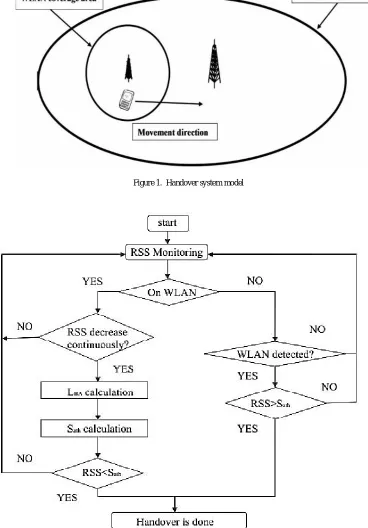
A. HANDOVER SCENARIO:
ISSN(Online): 2320-9801 ISSN (Print): 2320-9798
I
nternational
J
ournal of
I
nnovative
R
esearch in
C
omputer
and
C
ommunication
E
ngineering
(An ISO 3297: 2007 Certified Organization)
Website:www.ijircce.com
Vol. 5, Issue 1, January 2017
Figure 1. Handover system model
ISSN(Online): 2320-9801 ISSN (Print): 2320-9798
I
nternational
J
ournal of
I
nnovative
R
esearch in
C
omputer
and
C
ommunication
E
ngineering
(An ISO 3297: 2007 Certified Organization)
Website:www.ijircce.com
Vol. 5, Issue 1, January 2017
B. RELATED EQUATIONS:
Received signal strength (RSS)of both thenetworkscalculated using below equation:
RSS(dBm)= Pt (dBm) + K (dB) – 10 n log10 [d/d0] eq (1)
K (dB) = 20 log10 [lammda/4 *pi* d0] [12]eq (2)
False handoff initiation probability calculated using below equation:
Pa = 1-[(1/pi)*(atan(a/2d))] eq (3)
False handoff failure probability calculated using below equation:
Pf = acos[d/(v*handoff delay)] /asin [a/(2*d)] eq (4)
Here, Pt = Transmitted power of system
d= Distance between MS and BT of system
d0= Reference distance from BT
n= Path loss exponent v= velocity of MS
a= coverage area radius of system
C. PARAMETERS SETTING:
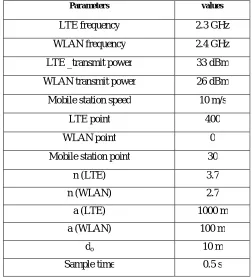
Table 1. Parameters related to systems
Parameters values
LTE frequency 2.3 GHz
WLAN frequency 2.4 GHz
LTE _transmit power 33 dBm
WLAN transmit power 26 dBm
Mobile station speed 10 m/s
LTE point 400
WLAN point 0
Mobile station point 30
n (LTE) 3.7
n (WLAN) 2.7
a (LTE) 1000 m
a (WLAN) 100 m
do 10 m
ISSN(Online): 2320-9801 ISSN (Print): 2320-9798
I
nternational
J
ournal of
I
nnovative
R
esearch in
C
omputer
and
C
ommunication
E
ngineering
(An ISO 3297: 2007 Certified Organization)
Website:www.ijircce.com
Vol. 5, Issue 1, January 2017
IV. SIMULATIONRESULTS
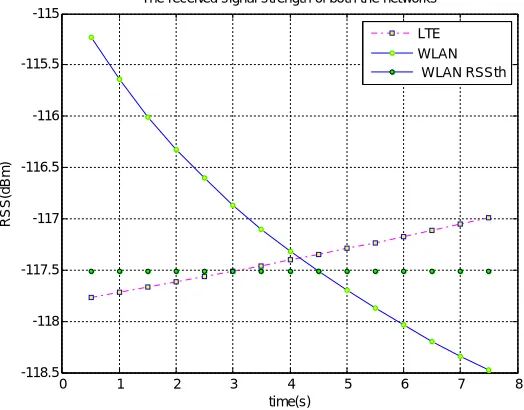
Fig.3 shows the RSS value of the both network. From that the current RSS value ofboth network and the threshold RSS value are calculated as from the algorithm the decision can be taken and is shown in the fig.4 the state of MS in network As shown in figure 4 the MS initially in the WLAN network shows the network of mark at zero. After the handoff the MS handed over to LTE and that time the mark of the network is one.
Figure 3. Current RSS value of both the network
Figure 4. State of mobile station
0 1 2 3 4 5 6 7 8
-118.5 -118 -117.5 -117 -116.5 -116 -115.5 -115
time(s)
R
S
S
(d
B
m
)
The received signal strength of both the networks
LTE WLAN WLAN RSSth
0 1 2 3 4 5 6 7 8
0 0.1 0.2 0.3 0.4 0.5 0.6 0.7 0.8 0.9 1
time(s)
m
a
rk
o
f
n
e
tw
o
rk
WLAN
LTE
ISSN(Online): 2320-9801 ISSN (Print): 2320-9798
I
nternational
J
ournal of
I
nnovative
R
esearch in
C
omputer
and
C
ommunication
E
ngineering
(An ISO 3297: 2007 Certified Organization)
Website:www.ijircce.com
Vol. 5, Issue 1, January 2017
Figure 5. Relationship between false handoff initiation probability and d
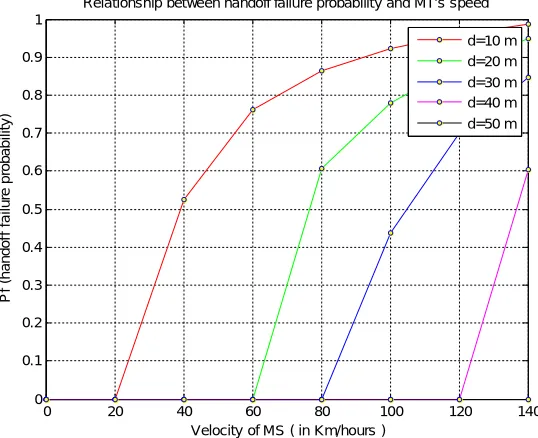
Figure 6 . Relationship between handoff failure probability and speed
It is clear from figure 5 that, if an unnecessarily large value for d (hence, the corresponding value of Sth is used for
handoff initiation, the probability of false handoff initiation increases. This results in the wastage of limited wireless system resources. Moreover, this increases the load on the network that arises because of the handoff initiation. The relationship between probability of false handoff initiation and d is shown in Fig. 5 for different cell sizes, a. Fig.5
shows that, for a particular value of a, the probability of false handoff Sth initiation increases as d increases. It also
10 20 30 40 50 60 70 80 90 100
0.5 0.55 0.6 0.65 0.7 0.75 0.8 0.85 0.9 0.95
Distance ( in m )
P a ( fa ls e h a n d o ff i n it ia ti o n p ro b a b il it y )
Relationship between false handoff initiation probability and d
a=100 a=200 a=500 a=1000
0 20 40 60 80 100 120 140
0 0.1 0.2 0.3 0.4 0.5 0.6 0.7 0.8 0.9 1
Velocity of MS ( in Km/hours )
P f (h a n d o ff f a il u re p ro b a b il it y )
Relationship between handoff failure probability and MT’s speed
ISSN(Online): 2320-9801 ISSN (Print): 2320-9798
I
nternational
J
ournal of
I
nnovative
R
esearch in
C
omputer
and
C
ommunication
E
ngineering
(An ISO 3297: 2007 Certified Organization)
Website:www.ijircce.com
Vol. 5, Issue 1, January 2017
shows that the problem of false handoff initiation becomes more and more severe when the cell size decreases. The cell size of wireless systems is decreasing so that the capacity and data rate may increase.
Eq 5 shows that, if a fixed value of Sth(hence, a fixed valueof corresponding d) is used, the handoff failure
probabilitydepends on the speed of the MT. The probability ofhandoff failure Pf, increases when MT’s speed
increases.The relationship between Pfand MT’s speed is shown in Fig.6 for intersystem handoff. This figure show the
numerical value of Pf for different values of d (corresponding to different values of Sth). We considered a cell size of
100 m for this simulation. The latency of intersystem handoff is significantly larger than that of intrasystem handoff because, during an intersystem handoff before registration, authentication and billing procedures are carried out, adding extra delay to the handoff process. Moreover, the intersystem signalling messages are handled by MT’s home agent (HA) instead of gateway foreign agent (GFA), adding extra delay to the signal propagation as the distance of MT from HA is typically larger than that of MT from the BT. We considered handoff latency 3 sec for intersystem handoff procedures. Fig.6 show that, for a particular value of d, as speed increases, the handoff failure probability increases for both intersystem handoff. This is because, as speed increases, on average, the MT requires less time to cross the
coverage region of OBS. These figure also show that, when a particular value of Sththis used, Pfbecomes higher for
intersystem handoff compared to intrasystem handoff for a different speed. To summarize, this analysis shows that the
value of d and, therefore, the value of Sth, should be adaptive to the speed of the MT and to the type of handoff to
guarantee a desired handoff failure probability.
V. CONCLUSION
In this work, we first discusswhat is handoff in the next-generation wireless systems? Then, we analyse the performance of handoff algorithm that use a fixed value of RSS threshold (Sth)to initiate the handoff process. Through our analysis, we observe that, at starting when MS is in WLAN and stats journey from WLAN BS and moving towards LTE network at this condition current RSS is continuously decreases. When current RSS below the threshold RSS and same time RSS of LTE network is higher than the RSS threshold at that time connection transfer to the LTE.It is clear
from result that, if an unnecessarily large value for d (hence, the corresponding value of Sth is used for handoff
initiation, the probability of false handoff initiation increases. This results in the wastage of limited wireless system resources. Moreover, this increases the load on the network that arises because of the handoff initiation. The handoff
failure probabilitydepends on the speed of the MT. The probability ofhandoff failure Pf, increases when MT’s speed
increases.Result show that, for a particular value of d, as speed increases, the handoff failure probability increases for both intersystem handoff. This is because, as speed increases, on average, the MT requires less time to cross the coverage region of OBS.
REFERENCES
1. Shantidev Mohanty and Ian F. Akyildiz,’A Cross-Layer (Layer 2 + 3) Handoff Management Protocol for Next-Generation Wireless Systems’, IEEE, vol. 5, no. 10, october 2006.
2. Prof. S. Nandakumar, SanjeetSingh,Rahul Singh,’ Traffic Driven & Received Signal Strength Adaptive Handoff Scheme’,International Journal of Computer Applications, ISSN:0975 – 8887, Volume 21– No.6, May 2011.
3. SunisaKunarak and RaungrongSulessathira and ErykDutkiewicz,’ Vertical Handoff with Predictive RSS and DwellTime’,IEEE,2013.
4. Wail Mardini and Musab Q. Al-Ghadi and Ismail M. Ababneh,’ Distance-Based Scheme for Vertical Handoff in Heterogeneous Wireless Networks’, journal of emerging technologies in web intelligence, vol. 4, no. 1, february 2012.
5. Sueng Jae Bae and Min Young Chung and Jungmin So,’ Handover Triggering Mechanism Based on IEEE 802.21 in Heterogeneous Networks with LTE and WLAN’IEEE,2011.
6. A Haider, I Gondal, J Kamruzzaman,’ Dynamic Dwell Timer for Hybrid Vertical Handover in 4G Coupled Networks’, IEEE,2011.
7. Xiaohuan Yan, Y. AhmetS_ekerciogSathya Narayanan,’ A survey of vertical handover decision algorithms in Fourth Generation heterogeneous wireless networks’,Elsevier, ISSN: 1848–1863,2010.
8. Bhaumik S. Khakhi, K.M.Pattani,’Implement and analysis of different vertical hadoff algorithms for WLAN and 3G’,IJEA,volume 2, issue 7,ISSN:2320-0804,2013.
9. AbhijitBijwe, AbhijitBijwe,’ RSS based Vertical Handoff algorithms for Heterogeneous wireless networks - A Review’,(IJACSA) International Journal of Advanced Computer Science and Applications,ISSN:2156-5570;2011.
10. Sandra Brigit Johnson , SaranyaNath P and T.Velmurugan,’ An Optimized Algorithm for Vertical Handoff inHeterogeneous Wireless Networks’, IEEE,2013. 11. Safdar Rizvi, Asif Aziz and N.M Saad,’ Optimizations in Vertical Handoff Decision Algorithms for Real Time Services’,IEEE,2010.