Resolution with Non-Anaphor
Identification Capability
Xiaofeng Yang1,2, Jian Su1, and Chew Lim Tan2
1
Institute for Infocomm Research, 21, Heng Mui Keng Terrace, Singapore, 119613
{xiaofengy, sujian}@i2r.a-star.edu.sg
2 Department of Computer Science,
National University of Singapore, Singapore, 117543 {yangxiao, tancl}@comp.nus.edu.sg
Abstract. Although effective for antecedent determination, the tradi-tional twin-candidate model can not prevent the invalid resolution of non-anaphors without additional measures. In this paper we propose a modified learning framework for the twin-candidate model. In the new framework, we make use of non-anaphors to create a special class of training instances, which leads to a classifier capable of identifying the cases of non-anaphors during resolution. In this way, the twin-candidate model itself could avoid the resolution of non-anaphors, and thus could be directly deployed to coreference resolution. The evaluation done on newswire domain shows that the twin-candidate based system with our modified framework achieves better and more reliable performance than those with other solutions.
1
Introduction
In recent years supervised learning approaches have been widely used in corefer-ence resolution task and achieved considerable success [1,2,3,4,5]. Most of these approaches adopt the single-candidate learning model, in which coreference rela-tion is determined between a possible anaphor and one individual candidate at a time [1,3,4]. However, it has been claimed that the reference between an anaphor and its candidate is often subject to the other competing candidates [5]. Such information is nevertheless difficult to be captured in the single-candidate model. As an alternative, several researchers proposed a twin-candidate model [2,5,6]. Instead of directly determining coreference relations, this model would judge the preference between candidates and then select the most preferred one as the an-tecedent. The previous work has reported that such a model can effectively help antecedent determination for anaphors [5,6].
However, one problem exits with the twin-candidate model. For every encoun-tered NP during resolution, the model would always pick out a “best” candidate as the antecedent, even if the current NP is not an anaphor. The twin-candidate
R. Dale et al. (Eds.): IJCNLP 2005, LNAI 3651, pp. 719–730, 2005. c
model itself could not identify and block such invalid resolution of non-anaphors. Therefore, to apply such a model to coreference resolution, some additional ef-forts have to be required, e.g., using an anaphoricity determination module to eliminate non-anaphors in advance [5], or using threshold to prevent the selection of a candidate if the confidence it wins other competitors is low [6].
In this paper, we explore how to effectively apply the twin-candidate model to the coreference resolution task. We propose a modified learning framework with the capability of processing non-anaphors. In the framework, we make use of non-anaphors to create training instances. This special class of instances would enable the learned classifier to identify the test instances formed by non-anaphors during resolution. Thus, the resulting model could avoid resolving a non-anaphor to a non-existent antecedent by itself, without specifying a threshold or using an additional anaphoricity determination module. Our experiments on MUC data set systematically evaluated effectiveness of our modified learning framework. We found that with this new framework, the twin-candidate based system could not only outperform the single-candidate based one, but also achieve better and more reliable results than those twin-candidate based systems using the two mentioned solutions.
The rest of the paper is organized as follows. Section 2 describes the original framework of the twin-candidate model. Section 3 presents in details the modified framework, including the training and resolution procedures. Section 4 reports and discusses the experimental results and finally Section 6 gives the conclusions.
2
The Original Framework of the Twin-Candidate Model
The basic idea of the twin-candidate model is to learn a binary classifier which could judge the preference between candidates of an anaphor. In this section we will describe a general framework of such a model.
2.1 Instance Representation
In the twin-candidate model, an instance takes a form likei{C1,C2,M}, where
M is a possible anaphor and C1 and C2 are two of its antecedent candidates. We stipulate thatC2 should be closer toM thanC1 in distance. An instance is labelled as “10” ifC1is preferred toC2to be the antecedent, or “01” if otherwise. A feature vector would be specified for an instance. The features may describe the lexical, syntactic, semantic and positional relationships betweenM and each one of the candidates, C1 or C2. In addition, inter-candidate features could be used to represent the relationships between the pair of candidates, e.g. the distance betweenC1andC2 in position.
2.2 Training Procedure
A set of “10” instances,i{Cante, Cp,Mana}, is generated by pairingMana and Cante, as well as each of the interning candidatesCp. Also a set of “01” instances,
i{Ca,Cante,Mana}, is created by pairingCanteand each non-antecedental can-didateCa beforeCante.
Table 1.An example text
[1 Globalstar] still needs to raise [2 $600 million], and [3
Schwartz] said [4 that company] would try to raise [5 the money]
in [6 the debt market] .
Consider the example in Table 1. In the text segment, [4that company] and [5 the money] are two anaphors with [1 Globalstar] and [2 $600 million] being their antecedents respectively. Thus the training instances to be created for this text would be:
i{[1 Globalstar], [2 $600 million], [4 that company]} : 10
i{[1 Globalstar], [3 Schwartz], [4 that company]} : 10
i{[1 Globalstar], [2 $600 million], [5 the money]} : 01
i{[2 $600 million], [3 Schwartz], [5 the money]} : 10
i{[2 $600 million], [4 that company], [5 the money]} : 10
Based on the training instances, a classifier is trained using a certain machine learning algorithm. Given the feature vector of a test instance, the classifier would return “10” or “01” indicating which one of the two candidates under consideration is preferred.
2.3 Resolution
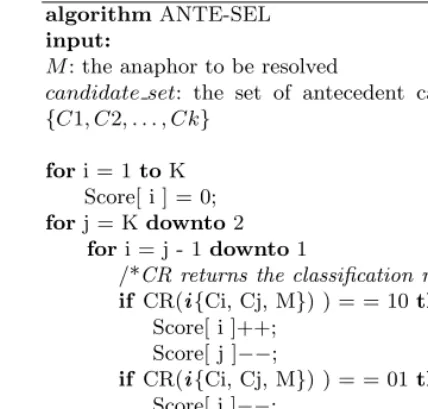
After the classifier is ready, it could be employed to select the antecedent for an encountered anaphor. The resolution algorithm is shown in Figure 1. In the algorithm, a round-robin model is employed, in which each candidate is compared with every other candidate and the final winner is determined by the won-lost records. The round-robin model would be fair for each competitor and the result is reliable to represent the rank of the candidates.
algorithmANTE-SEL
input:
M: the anaphor to be resolved
candidate set: the set of antecedent candidates of M, {C1, C2, . . . , Ck}
fori = 1toK Score[ i ] = 0;
forj = Kdownto 2
fori = j - 1downto1
/*CR returns the classification result*/
if CR(i{Ci, Cj, M}) ) = = 10then
Score[ i ]++; Score[ j ]−−;
if CR(i{Ci, Cj, M}) ) = = 01then
Score[ i ]−−; Score[ j ]++; SelectedIdx= arg
i
max
Ci∈candidate setScore[i];
returnCSelectedIdx
Fig. 1.The original antecedent selection algorithm
3
Modified Framework for Coreference Resolution Task
3.1 Non-anaphor Processing
In the task of coreference resolution, it is often that an encountered NP is non-anaphoric, that is, no antecedent exists among its possible candidates. However, the resolution algorithm described in the previous section would always try to pick out a “best” candidate as the antecedent for each given NP, and thus could not be applied for coreference resolution directly.
One natural solution to this is to use an anaphoricity determination (AD) module to identify the non-anaphoric NPs in advance (e.g. [5]). If an NP is judged as anaphoric, then we deploy the resolution algorithm to find its antecedent. Otherwise we just leave the NP unresolved. This solution, however, would heavily rely on the performance of the AD module. Unfortunately, the accuracy that most state-of-the-art AD systems could provide is still not high enough (around 80% as reported in [7]) for our coreference resolution task.
Another possible solution is to set a threshold to avoid selecting a candidate that wins with low confidence (e.g. [6]). Specifically, for two candidates in a match, we update their match records only if the confidence returned from the classifier is above the specified threshold. If no candidate has a positive record in the end, we deem the NP in question as non-anaphoric and leave it unresolved. In other words, a NP would be resolved to a candidate only if the candidate won at least one competitor with confidence above the threshold.
there exist other cases for which the classifier would also assign low confidence values, for example, when the two candidates of an anaphoric NP both have strong or weak preference. The solution of using threshold could not discrimi-nate these different cases and thus may not be reliable for coreference resolution. In fact, the above problem could be addressed if we could teach the classi-fier to explicitly identify the cases of non-anaphors, instead of using threshold implicitly. To do this, we need to provide a special set of instances formed by the anaphors to train the classifier. Given a test instance formed by a non-anaphor, the newly learned classifier is supposed to give a class label different from the instances formed by anaphors. This special label would indicate that the current NP is a non-anaphor, and no preference relationship is held be-tween the two candidates under consideration. In this way, the twin-candidate model could do the anaphoricity determination by itself, without any additional pre-possessing module. We will describe the modified training and resolution procedures in the subsequent subsections.
3.2 Training
In the modified learning framework, an instance also takes a form like i{C1,
C2, M}. During training, for an encountered anaphor, we create “01” or “10” training instances in the same way as in the original learning framework, while for a non-anaphorMnon ana, we
– From the candidate set, randomly select a candidate Crand as the anchor candidate.
– Create an instance by pairingMnon ana,Crand, and each of the candidates other thanCrand.
The above instances formed by non-anaphors would be labelled as “00”. Note that an instance may have a form likei{Ca,Crand,Mnon ana}if candidateCa is pre-cedingCrand, or likei{Crand,Cp,Mnon ana}if candidateCpis followingCrand.
Consider the text in Table 1 again. For the non-anaphors [3 Schwartz] and [6 the debt market], supposing the selected anchor candidates are [1Globalstar] and [2$600 million], respectively. The “00” instances generated for the text are:
i{[1 Globalstar], [2 $600 million], [3 Schwartz]} : 00
i{[1 Globalstar], [2 $600 million], [6 the debt market]} : 00
i{[2 $600 million], [3 Schwartz], [6 the debt market]} : 00
i{[2 $600 million], [4 that company], [6 the debt market]} : 00
i{[2 $600 million], [5 the money], [6 the debt market]} : 00
3.3 Resolution
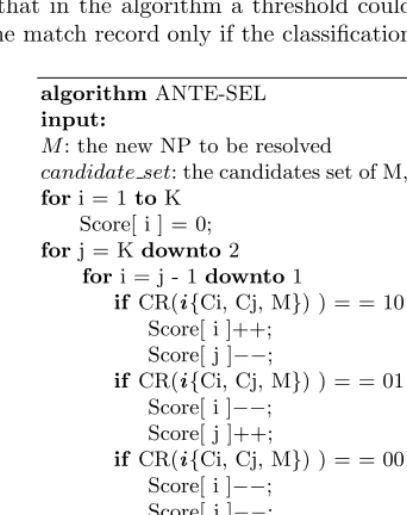
difference is that, if two candidates are judged as “00” in a match, both candi-dates would receive a penalty of −1 in their respective record; If no candidate has a positive final score, then the NP would be deemed as non-anaphoric and left unresolved. Otherwise, it would be resolved to the candidate with highest score as usual. In the case when an NP has only one antecedent candidate, a pseudo-instance is created by paring the candidate with itself. The NP would be resolved to the candidate if the return label is not “00”.
Note that in the algorithm a threshold could still be used, for example, to update the match record only if the classification confidence is high enough.
algorithmANTE-SEL
input:
M: the new NP to be resolved
candidate set: the candidates set of M,{C1, C2, . . . , Ck}
fori = 1toK Score[ i ] = 0;
forj = Kdownto 2
fori = j - 1downto1
if CR(i{Ci, Cj, M}) ) = = 10then
Score[ i ]++; Score[ j ]−−;
if CR(i{Ci, Cj, M}) ) = = 01then
Score[ i ]−−; Score[ j ]++;
if CR(i{Ci, Cj, M}) ) = = 00then
Score[ i ]−−; Score[ j ]−−;
SelectedIdx= arg i
max
Ci∈candidate setScore[i];
if (Score[SelectedIdx]<= 0)
return nil;
returnCSelectedIdx;
Fig. 2.The new antecedent selection algorithm
4
Evaluation and Discussion
4.1 Experiment Setup
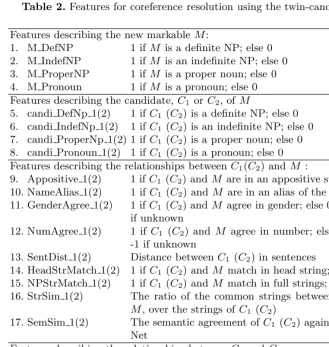
Table 2.Features for coreference resolution using the twin-candidate model
Features describing the new markableM:
1. M DefNP 1 ifM is a definite NP; else 0 2. M IndefNP 1 ifM is an indefinite NP; else 0 3. M ProperNP 1 ifM is a proper noun; else 0 4. M Pronoun 1 ifM is a pronoun; else 0 Features describing the candidate,C1orC2, ofM
5. candi DefNp 1(2) 1 ifC1 (C2) is a definite NP; else 0
6. candi IndefNp 1(2) 1 ifC1 (C2) is an indefinite NP; else 0
7. candi ProperNp 1(2) 1 ifC1 (C2) is a proper noun; else 0
8. candi Pronoun 1(2) 1 ifC1 (C2) is a pronoun; else 0
Features describing the relationships betweenC1(C2) andM :
9. Appositive 1(2) 1 ifC1(C2) andM are in an appositive structure; else 0
10. NameAlias 1(2) 1 ifC1 (C2) andM are in an alias of the other; else 0
11. GenderAgree 1(2) 1 ifC1 (C2) andM agree in gender; else 0 if disagree; -1
if unknown
12. NumAgree 1(2) 1 if C1 (C2) andM agree in number; else 0 if disagree;
-1 if unknown
13. SentDist 1(2) Distance betweenC1 (C2) in sentences
14. HeadStrMatch 1(2) 1 ifC1 (C2) andM match in head string; else 0
15. NPStrMatch 1(2) 1 ifC1 (C2) andM match in full strings; else 0
16. StrSim 1(2) The ratio of the common strings between C1 (C2) and
M, over the strings ofC1 (C2)
17. SemSim 1(2) The semantic agreement ofC1(C2) againstM in
Word-Net
Features describing the relationships betweenC1 andC2
18. inter SentDist Distance betweenC1 andC2 in sentences
19. inter StrSim 0, 1, 2 ifStrSim1(C1, M) is equal to, larger or less than
StrSim1(C2, M)
20. inter SemSim 0, 1, 2 ifSemSim1(C1, M) is equal to, larger or less than
SemSim1(C2, M)
The candidates of a markable to be resolved were selected as follows. During training, for each encountered markable, the preceding markables in the current and previous four sentences were taken as the candidates. During resolution, for a non-pronoun, all the preceding markables were included into the candidate set, while for a pronoun, only the markables in the previous four sentences were used, as the antecedent of a pronoun usually occurs in a short distance.
For MUC-6 and MUC-7, our modified framework generated 207k training training instances, three times larger than the single-candidate based system by Soon et al [3]. Among them, the ratio of ‘00”,“01” and “10” instances was around 8:2:1. The distribution of the class labels was more balanced than in Soon et al.’s system, where only 5% training instances were positive while others were all negative.
the properties of a new markable and its two candidates, as well as their relation-ships. Most of these features could be found in previous systems on coreference resolution (e.g. [3], [4]). In addition, three inter-candidate features, f18-f20, mark the relationship between the two candidates. The first one,inter SentDist, records the distance between the two candidates in sentences, while the latter two, inter StrSim and inter SemSim compare the similarity scores of the two candidates, in string-matching and semantics respectively.
To provide necessary information of feature computation, an input raw text was preprocessed automatically by a pipeline of NLP components. Among them, the chunking component was trained and tested for the shared task for CoNLL-2000 and achieved 92% F-score. The HMM based NE recognition component was capable of recognizing the MUC-style NEs with F-scores of 96.9% (MUC-6) and 94.3% (MUC-7).
4.2 Results and Discussion
In the experiment we compared four systems:
SC. The system based on the single-candidate model. It was a duplicate of the system by Soon et al. [3]. The feature set used in the baseline system was similar to those listed in Table 2, except that no inter-candidate feature would be used and only one set of features related to the single candidate was required.
TC AD. The system based on the twin-candidate mode with the original learn-ing framework, in which non-anaphors were eliminated by an anaphoricity determination module in advance. We built a supervised learning based AD module similar to the system proposed by Ng and Cardie [7]. We trained the AD classifier on the additional 100 MUC-6 documents. By adjusting the misclassification cost parameter of C5, we obtained a set of classifiers capable of identifying “positive” anaphors with variant recall and precision rates.
TC THRESH. The system based on the twin-candidate mode with the origi-nal learning framework, using threshold to discard the low-confidenced com-parison results between candidates.
TC NEW. The system based on the twin-candidate mode, with our modified learning framework.
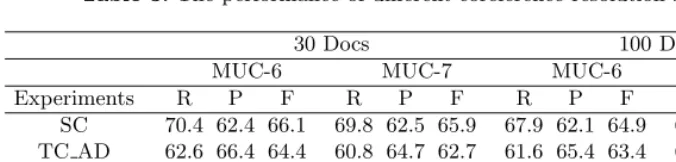
The results of the four systems on MUC-6 and MUC-7 are summarized in Table 3. In these experiments, five-fold cross-evaluation was performed on the training data to select the resolution parameters, for example, the threshold for systems TC THRESH and TC NEW, and final AD classifier for TC AD.
As shown in the table, the baseline system SC achieves 66.1% and 65.9% F-measure for MUC-6 and MUC-7 data sets. This performance is better than that reported by Soon et al. [3], and is comparable to that of the state-of-the-art systems on the same data sets.
Table 3.The performance of different coreference resolution systems
30 Docs 100 Docs
MUC-6 MUC-7 MUC-6 MUC-7
Experiments R P F R P F R P F R P F
SC 70.4 62.4 66.1 69.8 62.5 65.9 67.9 62.1 64.9 69.8 62.5 65.9 TC AD 62.6 66.4 64.4 60.8 64.7 62.7 61.6 65.4 63.4 60.8 64.6 62.7 TC THRESH 70.7 59.1 64.4 70.0 61.7 65.6 71.0 60.7 65.4 70.6 60.9 65.4 TC NEW 64.8 70.1 67.3 66.0 68.6 67.2 67.0 70.2 68.5 67.0 69.2 68.1
of the AD classifier reveals that it successfully identifies 79.3% anaphors (79.48% precision) for MUC-6, and 70.9% anaphors (76.3% precision) for MUC-6. That means, although the pre-processing AD module could partly avoid the wrong res-olution of a non-anaphor, it eliminates many anaphors at the same, which leads to the low recall for coreference resolution. Although in resolution different AD clas-sifiers could be applied, we only observe the tradeoff between recall and precision, with no effective resolution improvement in F-measure.
In contrast to TC AD, system TC THRESH yields large gains in recall. The recall, up to above 70%, is higher than all the other three systems. However, the precision at the same time is unfortunately the lowest. Such a pattern of high recall and low precision indicates that using threshold could reduce, to some degree, the risk of eliminating true anaphors, but it would be too lenient to effectively block the resolution of non-anaphors.
Compared with TC AD and TC THRESH, TC NEW produces large gains in the precision rates, which rank the highest among all the four systems. Although the recall also drops at the same time, the increase in the precision could compen-sate it well; we observe a F-measure of 67.3% for MUC-6 and 67.2% for MUC-7, significantly better (p ≤ 0.05, by a sign test) than the other twin-candidate based systems. These results suggest that with our modified framework, the twcandidate model could effectively identify non-anaphors and block their in-valid resolution, without affecting the accuracy of the antecedent determination for anaphors.
In our experiment we were interested to evaluate the resolution performance of TC NEW under different sizes of training data. For this purpose, we used the additional 100 annotated documents for training, and plotted the learning curve in Figure 3. The curve indicates that the system could perform well with a small number of training data, while the performance would get further improved with more training data (the best performance is obtained on 90 documents).
0 10 20 30 40 50 60 70 80 90 100 60
61 62 63 64 65 66 67 68 69 70
Number of Documents Trained On
F−measure
Fig. 3.Learning curve of system TC NEW on MUC-7
40 50 60 70 80 90 100
30 35 40 45 50 55 60 65 70 75 80
Recall
Precision
TC_THRESH TC_AD TC_NEW
Fig. 4.Recall and precision results for the twin-candidate based systems
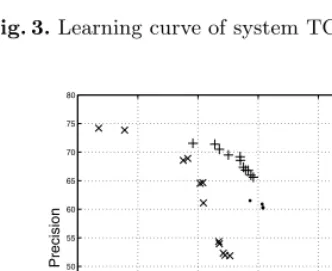
In Figure 4, we plotted the variant recall and precision scores that the three twin-candidate based systems were capable of producing when trained on 100 documents. (Here we only showed the results for MUC-7. Similar results could be obtained for MUC-6). In line with the results in Table 3, system TC AD tends to obtain a high precision but low recall, while system TC THRESH tends to obtain a high recall but low precision. Comparatively, system TC NEW produces even recall and precision. For the range of recall within which the three systems coincide, TC NEW yields higher precision than the other two systems. This figure further proves the effectiveness of our modified learning framework.
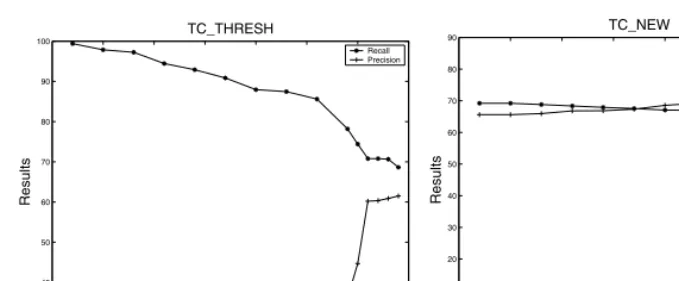
As mentioned, in systems TC THRESH and TC NEW the threshold pa-rameter could be adjusted. It would be interesting to evaluate the influence of different thresholds on the resolution performance. In Figure 5 we compared the recall and precision of two systems, with thresholds ranging from 65 to 100.
65 70 75 80 85 90 95 100
Fig. 5.Performance of TC THRESH and TC NEW under different thresholds
non-anaphors, will be resolved. As a consequence, all the occurring markables in a document tends to be linked together. In fact, the effective range of the threshold that leads to an acceptable performance is quite short. The threshold would only work when it is considerably high (above 95). Before that, the precision remains very low (less than 40%) while the recall keeps going down with the increase of the threshold.
By contrast, in TC NEW, both the recall and precision vary little unless the threshold is extremely high. That means, the threshold would not impose much influence on the resolution performance of TC NEW. This should be because in the modified framework, the cases of non-anaphors are determined by the special class label “00”, instead of the threshold as in TC THRESH. The purpose of using threshold in TC NEW is not to identify the non-anaphors, but to improve the accuracy of class labelling. Indeed, we could obtain a good result without using any threshold in TC NEW. These further confirm our claims that the modified learning framework could perform more reliably than the solution of using threshold.
5
Conclusions
In this paper we aimed to find an effective way to apply the twin-candidate model into coreference resolution task. We proposed a modified learning framework in which non-anaphors were utilized to create a special class of training instances. With such instances, the resulting classifier could avoid the invalid resolution of non-anaphors, which enables the twin-candidate model to be directly deployed to coreference resolution, without using an additional anaphoricity determination module or using a pre-defined threshold.
based systems using other solutions. Especially, the analysis of the results indi-cates that our modified framework could lead to more reliable performance than the solution of using threshold. All these suggest that the twin-candidate model with the new framework is effective for coreference resolution.
References
1. McCarthy, J., Lehnert, Q.: Using decision trees for coreference resolution. In: Proceedings of the 14th International Conference on Artificial Intelligences. (1995) 1050–1055
2. Connolly, D., Burger, J., Day, D. New Methods in Language Processing. In: A machine learning approach to anaphoric reference. (1997) 133–144
3. Soon, W., Ng, H., Lim, D.: A machine learning approach to coreference resolution of noun phrases. Computational Linguistics27(2001) 521–544
4. Ng, V., Cardie, C.: Improving machine learning approaches to coreference resolu-tion. In: Proceedings of the 40th Annual Meeting of the Association for Compu-tational Linguistics, Philadelphia (2002) 104–111
5. Yang, X., Zhou, G., Su, J., Tan, C.: Coreference resolution using competition learning approach. In: Proceedings of the 41st Annual Meeting of the Association for Computational Linguistics, Japan (2003)
6. Iida, R., Inui, K., Takamura, H., Matsumoto, Y.: Incorporating contextual cues in trainable models for coreference resolution. In: Proceedings of the 10th Conference of EACL, Workshop “The Computational Treatment of Anaphora”. (2003) 7. Ng, V., Cardie, C.: Identifying anaphoric and non-anaphoric noun phrases to
im-prove coreference resolution. In: Proceedings of the 19th International Conference on Computational Linguistics (COLING02). (2002)
8. MUC-6: Proceedings of the Sixth Message Understanding Conference. Morgan Kaufmann Publishers, San Francisco, CA (1995)
9. MUC-7: Proceedings of the Seventh Message Understanding Conference. Morgan Kaufmann Publishers, San Francisco, CA (1998)
10. Quinlan, J.R.: C4.5: Programs for machine learning. Morgan Kaufmann Publishers, San Francisco, CA (1993)