Sentiment Aggregation using ConceptNet Ontology
Subhabrata Mukherjee and Sachindra Joshi
IBM India Research Lab
{subhabmu, jsachind}@in.ibm.com
Abstract
Sentiment analysis of reviews traditionally ig-nored the association between the features of the given product domain. The hierarchical re-lationship between the features of a product and their associated sentiment that influence the polarity of a review is not dealt with very well. In this work, we analyze the influence of the hierarchical relationship between the prod-uct attributes and their sentiments on the over-all review polarity. ConceptNet is used to automatically create a product specific ontol-ogy that depicts the hierarchical relationship between the product attributes. The ontology tree is annotated with feature-specific polari-ties which are aggregated bottom-up, exploit-ing the ontological information, to find the overall review polarity. We propose a weakly supervised system that achieves a reasonable performance improvement over the baseline without requiring any tagged training data.
1 Introduction
In recent years there has been a huge surge of activity in the social networking sites, blogs and review sites. The voluminous amount of data generated is a goldmine of information for the re- tail brands to find out the customer needs, con-cerns and potential market segments. Sentiment analysis aims to mine this information to find out the popular sentiment about any product and its associated features.
Traditionally sentiment analysis has been posed as a text classification task on features de-rived from the given text. In the product review domain, the initial works in sentiment analysis focused on classifying the entire review as posi-tive or negaposi-tive using various word-based and phrase-based features (Turney et al., 2003; Tur-ney 2002; Kamps et al., 2002; Hatzivassiloglou et al., 2000; Hatzivassiloglou et al., 2002). The more recent works focused on product feature
extraction from a review and performing feature-specific sentiment analysis (Hu et al., 2004; Mukherjee et al., 2012). For example, the re-view, The audio quality of my new phone is ab-solutely awesome but the picture taken by the camera is a bit grainy, is positive with respect to the audio quality and negative with respect to the camera. However, once the feature-specific po-larities are obtained, the works do not describe any systematic approach to aggregate the feature-specific polarities to obtain the overall review polarity. A naïve count-based feature-specific polarity aggregation will not work well for re-views having different features with diverse opinions. A bag-of-words based model will pick up awesome and grainy as the sentiment features and mark the overall review as neutral. One may argue that the audio quality is more important to a cell phone than the camera and hence the over-all review polarity should be positive. While the feature-specific model associates sentiment to features, it cannot do a polarity aggregation in absence of feature association information to find the overall review polarity.
Let us consider the following review taken from Amazon.com which more clearly depicts the necessity of learning the hierarchical product- attribute relationship and associated sentiments.
I bought a Canon EOS 7D (DSLR). It's very small, sturdy, and constructed well. The handling is quite nice with a powder-coated metal frame. It powers on quickly and the menus are fairly easy to navigate. The video modes are nice, too. It works great with my 8GB Eye-Fi SD card. A new camera isn't worth it if it doesn't exceed the picture quality of my old 5Mpixel SD400 and this one doesn't. The auto white balance is poor. I'd need to properly balance every picture taken so far with the ELPH 300. With 12 Mpixels, you'd expect pretty good images, but the problem is that the ELPH 300 compression is turned up so high that the sensor's acuity gets lost (softened) in compression.
The above example depicts the complexity involved in analyzing product reviews. The re-view has a mix of good and bad comments about various features of the product. A flat classifica-tion model which considers all features to be equally important will fail to capture the proper polarity of the review. The reviewer seems happy with the camera size, structure, easy use, video modes, SDHC support etc. However, the auto-white balance and high compression leading to sensor acuity seem to disappoint him. Now, the primary function of a camera is to take good pic-tures and videos. Thus picture, video quality, resolution, color balance etc. are of primary im-portance whereas size, video mode, easy use etc., are secondary in nature. The overall review po-larity should be negative as the reviewer shows concerns about the most important features of the camera.
In this paper, we propose a weakly super-vised approach to aggregate the sentiment about various features of a product to give the overall polarity of the review, without requiring expen-sive labeled training data. The approach is weakly supervised due to the requirement of ConceptNet (created by crowd-sourcing), a de-pendency parser and a sentiment lexicon.
The objectives of the paper can be summa-rized as:
1. Automatically learning the product-attribute hierarchy from a knowledge resource, where we leverage ConceptNet (Hugo et al., 2004) to learn the product attributes, synonyms, essential components, functionalities etc. and create a domain specific ontology tree
2. Discovering the various features of a product in the review and extracting feature-specific sentiment
3. Mapping the product features with their associated sentiments to the ontology tree and aggregating the feature-specific sentiments to determine the overall review polarity
2 Related Works
The initial works in sentiment analysis used bag-of-words features like unigrams, bigrams, adjec-tives etc. which gave way to the usage of phrase-based features like part-of-speech sequences (Ex: adjectives followed by nouns) (Turney et al., 2003; Turney 2002; Kamps et al., 2002; Hat-zivassiloglou et al., 2000; HatHat-zivassiloglou et al., 2002). These works did not consider the attrib-utes or features of the underlying product domain in the review. A review may contain multiple
features with a different opinion about each fea-ture. This makes it difficult to come up with an overall polarity of the review. The latter works addressed this issue by focusing on feature-specific sentiment analysis.
Feature-specific sentiment analysis attempts to find the polarity of a review with respect to a given feature. Approaches like dependency pars-ing (Wu et al., 2009; Chen et al., 2010; Muk-herjee et al., 2012), joint sentiment topic model using LDA (Lin et al., 2009) have been used to extract feature-specific expressions of opinion. Although these works extract the feature-specific polarities, they do not give any systematic ap-proach to aggregate the polarities to obtain the overall review polarity.
Wei et al. (2010) propose a hierarchical learning method to label a product’s attributes and their associated sentiments in product re-views using a Sentiment Ontology Tree (HL SOT). Although our work stems from a similar idea, it differs in a number of ways. The HL-SOT approach is completely supervised, requir-ing the reviews to be annotated with product-attribute relations, as well as feature-specific opinion expressions. The approach requires a lot of labeling information which needs to be pro-vided for every domain. Also, the authors do not describe any elegant approach to aggregate the feature-specific polarities of the children nodes to obtain the overall review polarity.
In this work, we use ConceptNet (Hugo et al., 2004) as a knowledge resource to automatically construct a domain-specific ontology tree for product reviews, without requiring any labeled training data. ConceptNet relations have an in-herent structure which helps in the construction of an ontology tree from the resource. Concept-Net has been used in information retrieval tasks in other domains (Guadarrama et al., 2008; Ko-tov et al., 2012). But there has been a very few works (Sureka et al., 2010) in sentiment analysis using ConceptNet. Unlike the previous works, we present an approach to deal with noisy and one-to-many relations in ConceptNet as well as the myriad of relations and the ensuing topic drift. We also present a novel sentiment aggrega-tion approach to combine the feature-specific polarities with ontological information to find the overall polarity of the review.
3 Ontology Creation from ConceptNet
rela-tions and individuals (Estival et al., 2004). The hierarchical relationship between the product attributes can be best captured by an Ontology Tree. Wei et al. (2010) use a tree-like ontology structure that represents the relationships be-tween a product’s attributes or features. They define a Sentiment Ontology Tree (SOT) where each of the non-leaf nodes of the SOT represents an attribute of a camera and all leaf nodes of the SOT represent sentiment (positive/negative) nodes respectively associated with their parent nodes.
We adopt a similar idea and consider an On-tology Tree for a product domain (say, camera) where the feature nodes (attributes like body, lens, flash etc.) are annotated with feature-specific polarities of the review.
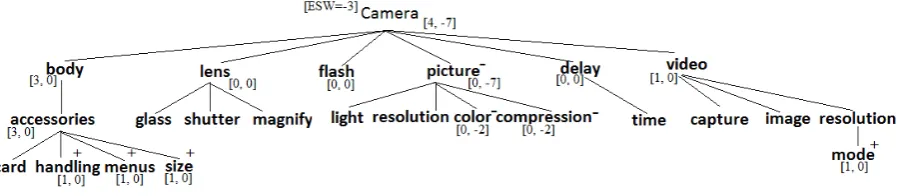
Figure 1. Snapshot of Camera Ontology Tree
The feature nodes in our ontology tree depict features of interest or attributes (Ex: lens, flash, picture etc.) of the given product (Ex: camera). The edges in the ontology tree depict the relation type connecting a feature with its parent. For ex-ample, a lens is a partof a camera, a camera is usedfor taking_pictures, time_delay is derived-from time etc. The feature nodes are annotated with polarities (+ and – denoting positive and negative sentiment, respectively) of the feature with respect to the review.
Figure 1 shows a snapshot of the ontology tree of a camera for the given example review in Sec-tion 1. The figure shows more positive feature- polarities than negative feature-polarities, but the review is still negative. This is because the fea-ture polarities in the higher level of the ontology tree dominate those at a lower level, i.e. the im-portance of a feature dilutes with the increase in the ontology depth.
3.1 Domain Ontology Tree Creation
In this work, we leverage ConceptNet (Hugo et al., 2004) to construct a domain-specific ontol-ogy tree for product reviews. ConceptNet is a very large semantic network of common sense knowledge which can be used to make various inferences from text. It is the largest, machine-usable common sense resource consisting of more than 250,000 propositions. Mining
infor-mation from ConceptNet can be difficult as one-to-many relations, noisy data and redundancy undermine its performance for applications re-quiring higher accuracy (Smith et al., 2004). However, we use ConceptNet for the following reasons:
1. The relational predicates in ConceptNet have an inherent structure suitable for building ontol-ogy. For example, relations like partof, hasa, madeof can be readily conceptualized as hierar-chical relations.
2. ConceptNet has a closed class of well-defined relations. The relations can be suitably weighted and used for various purposes.
3. The continual expansion of the knowledge resource through crowd-sourcing incorporates new data and enriches the ontology.
4. Ontology creation using ConceptNet does not require any labeling of product reviews.
3.1.1 ConceptNet Relations
ConceptNet1 has a closed class of 24 primary relations, expressing connections between vari-ous concepts.
camera UsedFor take_picture camera IsA tool_for_take_picture camera AtLocation store
tripod UsedFor keep_camera_steady camera CapableOf record_image camera IsA device
flash PartOf camera lens AtLocation camera tripod AtLocation camera_shop camera IsA photo_device
cannon ConceptuallyRelatedTo camera photograph ConceptuallyRelatedTo camera picture ConceptuallyRelatedTo camera
Table 1. ConceptNet Relation Examples
We categorize the ConceptNet relations into 3 primary categories – hierarchical relations, syn-onymous relations and functional relations. Hier-archical relations represent parent-child relations and can be used to construct the tree top-down, as the relations are transitive. Synonymous rela-tions help to identify related concepts. Thus simi-lar nodes can be merged during tree construction. Functional relations help to identify the purpose or property of interest of the concept. The tion categorization helps to weigh various rela-tions differently. Consider the case where the functional relation “a camera is usedfor tak-ing_picture” may be of more interest to an indi-vidual than the hierarchical relation “a camera
1http://csc.media.mit.edu/docs/conceptnet/conceptnet4
hasa tripod”. Thus a product which takes good pictures but lacks a tripod will have a high posi-tive polarity. This is, of course, subjecposi-tive and can be used to personalize the ontology tree. The other advantage of relation categorization is to deal with one-to-many relations, as will be dis-cussed in the next section.
Hierarchical : LocatedNear, HasA, PartOf, MadeOf, IsA, InheritsFrom
Synonymous : Synonym, ConceptuallyRelatedTo Functional : UsedFor, CapableOf, HasProperty, DefinedAs
Table 2. ConceptNet Relation Type Categorization
3.1.2 Algorithm for Ontology Construction
Ontology construction from ConceptNet is hin-dered by the following obstacles:
1. One-to-many relations exist between the con-cepts. For example, the concepts camera and picture can be associated by relations like - cam-era UsedFor take_picture, camcam-era HasA picture, picture ConceptuallyRelatedTo camera, picture AtLocation camera etc.
2. There is a high degree of topic drift during relation extraction. For example, the predicates camera HasA lens, lens IsA glass and glass HasA water places water at a high level in the ontology tree, although it is not at all related to camera. The hierarchical relations in ConceptNet are much more definitive, have much less topic drift and can be used to ground the ontology tree. Hence, they are preferred over other relations during a relational conflict. In the above exam-ple, where picture is ConceptuallyRelatedTo camera, putting camera and picture at the same level will generate an incorrect ontology tree. The issue can be averted by preferring the hierar-chical relation between camera and picture over the synonymous relation. The relational conflict is averted by ordering the predicate relations where hierarchical relations > synonymous rela-tions > functional relarela-tions. In order to avoid topic drift, the ontology feature nodes extracted from ConceptNet are constrained to belong to a list of frequently found concepts in the domain, which is obtained from an unlabeled corpus.
In the first step of ontology construction, all the unlabeled reviews in the corpus are Part-of-Speech tagged and all Nouns are retrieved. The frequently occurring concepts are then added to the feature set. In the second step, the Concept-Net relations are partitioned into three disjoint sets hierarchical, synonymous and functional. The domain name is taken as the root of the On-tology Tree.
Input: Raw unlabeled corpus of product reviews and Con-ceptNet Knowledge Network
1. Part-of-speech tag the reviews and retrieve all Nouns. Let Nbe the set of all potential features.
2. A feature ni∈N is considered relevant and added
to the feature set N if tf −idf(fi)>ϑ , where
ϑ
is the corpus threshold3. Let Rbe the set of all ConceptNet relations which is partitioned into the relation sets H (hierarchical),
S(synonymous) and F (functional).
4. Every relation tuple rij(fi,fj)∈Ris assigned to
one of the sets S ,For Hwith ties being broken as F
S H > >
5. Construct the ontology tree T(V,E) top-down. The root of the tree is taken as the domain name. Initially
} { }, _
{ = φ
= domain name E
V .
6. Add a vertex vj to V and an edge eij(vi,vj)to
E, r v v H
j i
ij ∈
∀ ( , ) s.t. vi∈Vand vj∈N
7. Merge vjwith vi ∀rij(vi,vj)∈S s.t vi∈V and
N vj∈
8. Add a vertex vj to V and an edge eij(vi,vj)to
E,∀rij(vi,vj)∈Fs.t. vi∈Vand vj∈N
Output : T(V,E)
Algorithm 1. Ontology Tree Construction from ConceptNet
The hierarchical relation set is taken first, and the tree is constructed recursively, such that the parent concept in any hierarchical relation is al-ready in the tree and the child concept belongs to the set of frequently occurring concepts in the domain. The synonymous relation set is taken next, and similar concepts are merged recur-sively, such that one of the concepts in any syn-onymous relation is already in the tree and the other concept belongs to the frequently occurring feature set. In the last step, the functional rela-tion set is taken and processed in the same way as the hierarchical relation set.
The constructed ontology tree depicts the product attributes in the domain and the different parent-child relations. The ontology creation does not require any labeled training data. Algo-rithm 1 shows the detailed steps for the ontology creation. Figure 1 shows a snapshot of the con-structed ontology.
3.2 Feature Specific Sentiment Extraction
fea-ture, it is essential to obtain the polarity of the sentence with respect to the feature. For example the sentence, “The movie had a nice plot but the acting was too shabby”, is positive with respect to plot but negative with respect to acting.
In this work, we use the feature-specific sen-timent extraction approach in Mukherjee et al. (2012), which do not need labeled review data for training. The authors use Dependency Pars-ing to capture the association between any spe-cific feature and the expressions of opinion that come together to describe that feature.
Given a sentence S, let W be the set of all words in the sentence. Let R be the list of signifi-cant dependency parsing relations (like nsubj, dobj, advmod, amod etc.), which are learnt from a corpus. A Graph G(W,E) is constructed such
We initialize ‘n’ clusters Ci, corresponding to
each feature fi∈Fs.t. fi is the clusterhead of Ci.
We assign each word wi∈Sto the cluster whose clusterhead is closest to it. The distance is meas-ured in terms of the number of edges in the shortest path, connecting any word and a cluster-head. Any two clusters are merged if the dis-tance between their clusterheads is less than some threshold. Finally, the set of words in the cluster Ct, corresponding to the target feature ft
gives the opinion about ft.
The words in the cluster Ct are classified with
the help of a lexicon (majority voting) to find the polarity pt∈{−1,0,1} about the target feature ft.
3.3 Sentiment Aggregation
Consider the camera review example in Section 1, and Figure 1 where the facets of the review are mapped to the camera ontology with their spe-cific polarities. It can be observed that the prod-uct attributes at a higher level of the tree domi-nate those at the lower level. If a reviewer says something positive or negative about a particular feature, which is at a higher level in the ontology tree (say picture), it weighs more than the infor-mation of all its children nodes (say light, resolu-tion, color and compression). This is because the parent feature abstracts the information of its children features. The feature importance is cap-tured by the height of a feature node in the
ontol-ogy tree. In case the parent feature polarity is neutral, its polarity is given by its children fea-ture polarities. Thus the information at a particu-lar node is given by its self information and the weighted information of all its children nodes. The information propagation is done bottom-up to determine the information content of the root node, which gives the polarity of the review.
Consider the ontology tree T(V,E) where V
Vi∈ is a product attribute set. The product
at-tribute set Vi is represented by the tuple
andhi is the height of the product attribute in the
ontology tree. eij∈E is an attribute relation type negative sentiment weight (NSW) of a vertex
V
iare defined as,
The review polarity is given by the expected sen-timent-weight (ESW) of the tree defined as,
) ( )
( )
(root PSW root NSW root
ESW = +
Figure 2. Snapshot of Camera Ontology Tree with Sentiment Weights
4 Experimental Evaluation
Analysis is performed in three domains corre-sponding to automobile, camera and software. 4.1 Dataset Preparation
Domain Positive Reviews
Negative Reviews
Total Reviews
Automobile 584 152 736
Camera 986 210 1196
Software 1000 915 1915
Table 3. Dataset Statistics
The camera reviews are collected from Ama-zon.com and manually tagged as positive or negative. The automobile and software reviews2 are taken from Blitzer et al. (2007). Table 3 shows the dataset statistics.
All the words are lemmatized in the reviews so that camera and cameras are reduced to the same root word camera.
Words like hvnt, dnt, cnt, shant etc. are re-placed with their proper form in both our model and the baseline to capture negation.
4.2 Baselines
In this work, we consider three unsupervised baselines to compare the proposed approach. 1. Lexical Baseline: Lexical classification (Taboada et al., 2011) is taken as the first base-line for our work. A sentiment lexicon is taken which contains a list of positive and negative terms. If the number of positive terms is greater than the number of negative terms, the review is considered to be positive and negative otherwise. The same approach is also used in our work while finding the polarity of the cluster repsenting the featuspecific opinion about a re-view. The lexical baseline considers all unigrams to be equally important, whereas we distinguish features by their position in the ontology hierar-chy. This baseline model does not incorporate feature-specificity.
2
http://www.cs.jhu.edu/~mdredze/datasets/sentiment/
We experimented with three publicly available lexicons to obtain unigram polarities:
1. SentiWordNet 3.0 (Baccianella et al., 2010)
2. General Inquirer (Stone et al., 1966) 3. Bing Liu Lexicon (Hu et al., 2004) 2. Corpus Feature-Specific Baseline: Tf-Idf measure is used to obtain the frequently occur-ring concepts in the domain from an unlabeled corpus. A feature-specific sentiment extraction model (Mukherjee et al., 2012) is used to find the review polarity regarding each feature. A lin-ear aggregation of the feature-specific polarities is done to obtain the overall review polarity. If the aggregation of the positive feature-specific polarities is greater than the aggregation of the negative feature-specific polarities, the review is considered to be positive and negative otherwise. This model resembles the approach of LARA (Wang et al., 2010) in a loose way, where the authors jointly learn the feature weights and feature-specific polarities.
3. ConceptNet and Corpus Feature-Specific Baseline: In this baseline, the features are ex-tracted using ConceptNet and an unlabeled cor-pus using Algorithm 1. The feature set
F S H
F = ∨ ∨ is considered and the same fea-ture-specific sentiment extraction model is used to aggregate all the feature-specific polarities in the set.
All the baselines lack sentiment aggregation (refer Section 3.3) using ontological information. A simple negation handling approach is used both in our work and the baselines. A window of size 5 (Hu et al., 2004) is taken and polarities of all the words appearing in the window starting from any of the negation operators not, neither, nor and no are reversed.
Models Lexical Corpus ConceptNet Sent. Aggr. Lexical
Baseline
Y
Corpus Fea-ture Specific Baseline
Y Y
Corpus and ConceptNet Feature Spe-cific Base-line
Y Y Y
Sent. Aggr. With Ontol-ogy Info.
Y Y Y Y
Table 4. Models and Baselines
4.3 Results
Stanford Pos-Tagger3 is used to part-of-speech tag the reviews to find the frequently occurring concepts (Nouns) in the domain. The ontology construction is done using ConceptNet 54. The depth of the ontology tree is taken till level 4. The ontology depth has been empirically fixed. Further increase in depth leads to topic drift and domain concept dilution. Table 5 shows the number of frequently occurring concepts in the corpus, and the total number of nodes, leaf nodes and edges in the ontology tree for each domain.
Table 5. Ontology Tree Statistics
Table 6 shows the accuracy of the three lexical baselines in different domains in the dataset.
Lexicons Auto-mobile
Camera Software
SentiWordNet 3.0 60.88 59.32 60.76
General Inquirer 65.70 68.15 66.14
Bing Liu Lexicon 64.43 63.65 69.38
Table 6. Lexical Baselines
Stanford Dependency Parser5 is used to parse the reviews for dependency extraction during fea-ture-specific sentiment analysis (refer Section
3 http://nlp.stanford.edu/software/tagger.shtml 4 http://conceptnet5.media.mit.edu/
5
http://nlp.stanford.edu/software/lex-parser.shtml
3.2). All the edge weights uij are taken to be 1.
Table 7 shows the overall accuracy comparison of the proposed approach with the baselines. Bing Liu sentiment lexicon is used in all the ap-proaches as it is found to deliver a better per-formance compared to the other lexicons in our model.
Models Automobile Camera Software
Lexical Baseline (Bing Liu)
64.43 63.65 69.38
Corpus 68.34 65.25 72.54
ConceptNet
+ Corpus
70.19 67.15 74.74
ConceptNet
+ Corpus + Sent. Aggr.
71.38 72.90 76.06
Table 7. Overall Accuracy of All Models
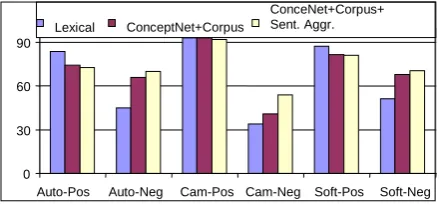
Figure 3 shows the accuracy of different models on the positive and negative dataset in each do-main.
Figure 3. Positive and Negative Accuracy of Models in Each Domain
5 Discussions
In this section, we discuss the observations from the experimental results of using sentiment ag-gregation approach with ConceptNet Ontology. 1. Ontology Construction: The first part of our work outlines an approach to leverage Con-ceptNet to construct a domain-specific ontology for product reviews. It is a difficult task to evaluate the purity of any ontology. In our work, we only perform a qualitative analysis where the constructed ontology is found to con-tain most of the relevant concepts in the given domain with appropriate hierarchy.
It is observed that 75.75% of the concepts in the automobile domain are mapped to some relevant concept in the corresponding product ontology; the corresponding figures for the camera and software domain being 43.49% and
Domains Corpus Frequent Features
Ontology Nodes
Ontology Edges
Leaf
Nodes
Automobile 268 203 202 76
Camera 768 334 333 148
Software 1020 764 763 208
0 30 60 90
Auto-Pos Auto-Neg Cam-Pos Cam-Neg Soft-Pos Soft-Neg Lexical ConceptNet+Corpus
74.90% respectively. In the camera domain, although the number of ontology feature nodes is much less than the frequently occurring con-cepts in the reviews, the proposed model per-forms much better than the baseline, which con-siders all features to be equally relevant. This shows that the ontology feature nodes capture concepts which are most relevant to the product and hence, makes a difference to the overall review polarity.
2. Lexical Baseline Performance: General In-quirer and Bing Liu sentiment lexicons outper-form SentiWordNet in our dataset. Bing Liu sentiment lexicon was subsequently found to work better in our model than General Inquirer. 3. Corpus Feature-Specific Baseline: A sig-nificant accuracy improvement is observed over the lexical baseline due to the consideration of feature-specific polarities of relevant features mined from the frequently occurring concepts in the domain corpus.
3. ConceptNet and Corpus Feature-Specific Baseline: Incorporating ConceptNet informa-tion during the feature extracinforma-tion process from the corpus improves the model performance. Only the features that frequently occur in the domain and form an important concept in the ontology hierarchy are retained.
4. Sentiment Aggregation: The model using sentiment aggregation approach by combining the feature-specific polarities with ontology in-formation achieved the best accuracy in all the three domains.
5. Negative Opinion Detection: Reviews have much more explicit positive expressions of opinion than negative ones (Kennedy et al., 2006; Voll et al., 2007; Mukherjee et al., 2012). This is because negative emotions are often very implicit and difficult to capture, as in sar-casm and thwarting. This is evident from Figure 3, where the lexical baseline attains a high accu-racy on positive reviews in all the domains, but fares very poorly on negative reviews. The other two models, on the other hand, perform much better on the negative reviews. This shows that the ontology based sentiment extrac-tion method is able to capture negative senti-ment much more strongly. The model also paves the way for analyzing reviews which con-tain more positive expressions of opinion than negative ones, but are still tagged as negative;
which cannot be captured by a feature-counting classifier.
6. Sentiment Ontology Tree Personalization: In this work, we have assumed all relations to be equally important, and thus considered the edge weights in the tree to be 1. However, the model allows the ontology tree to be personal-ized to suit the purpose of an individual and incorporate subjectivity in the reviews. If an individual prefers functional relations or use of certain features over its components, this infor-mation can be incorporated in the tree. This al-lows the general domain-specific ontology tree to be customized to an individual’s interest.
6 Conclusions and Future Work
In this work, we outline an approach to combine the feature-specific polarities of a review with ontology information to give better sentiment classification accuracy. The proposed approach leverages ConceptNet to automatically construct a domain specific ontology tree. We performed experiments in multiple domains to show the performance improvement induced by the senti-ment aggregation approach using ontology in-formation over simple aggregation of feature-specific polarities.
The work is mostly unsupervised, requiring no labeled training reviews. The performance of the classifier is subject to the coverage of the lexicon and the accuracy of the feature-specific classi-fier.
The work also addresses the idea of personal-izing a sentiment ontology tree to suit an indi-vidual’s interest over specific features and par-ent-feature relations. This is also the first work, to the best of our knowledge, to discuss an ap-proach to deal with reviews having majority positive (or negative) features but still tagged as negative (or positive). Reviews, of such kind, can be aptly handled using ontology information which captures the intrinsic specificities of prod-uct-feature relations in a given product domain.
References
A. Sureka, V. Goyal, D. Correa, and A. Mondal. 2010. Generating Domain-Specific Ontology from Common-Sense Semantic Network for Target-Specific Sentiment Analysis. In Fifth International Conference of the Global WordNet Association (GWC).
contextual valence shifters. Computational Intelli-gence, 22(2):110–125, 2006.
Chen Mosha. 2010. Combining Dependency Parsing with Shallow Semantic Analysis for Chinese Opin-ion-Element Relation Identification. IEEE, pp.299-305.
Dustin Smith and Stan Thomas. 2004. Investigating ConceptNet. Ph.D Thesis. December 2004
Estival, D. Nowak, C. and Zschorn, A. 2004. To-wards Ontology-Based Natural Language Process-ing. In Proceedings of 4th Workshop on NLP and XML.
Hu, Minqing and Liu, Bing. 2004. Mining and sum-marizing customer reviews, Proceedings of the ACM SIGKDD International Conference on Knowledge Discovery & Data Mining, Seattle, Washington, USA.
Hugo Liu and Push Singh. 2004. ConceptNet: A prac-tical commonsense reasoning toolkit. BT Technol-ogy Journal, 22(4):211–226, October.
Jaap Kamps, Maarten Marx, Robert J. Mokken, and-Marten de Rijke. 2002. Words with attitude. In Proceedings of the 1st International Conference on Global WordNet, Mysore, India
John Blitzer, Mark Dredze, Fernando Pereira. 2007. Biographies, Bollywood, Boom-boxes and Blend-ers: Domain Adaptation for Sentiment Classifica-tion. In Proceedings of Association of Computa-tional Linguistics (ACL).
Kimberly Voll and Maite Taboada. 2007. Not all words are created equal: Extracting semantic ori-entation as a function of adjective relevance. In Proceedings of the 20th Australian Joint Confer-ence on Artificial IntelligConfer-ence.
Kotov, Alexander and Zhai, ChengXiang. 2012. Tap-ping into knowledge base for concept feedback: leveraging conceptnet to improve search results for difficult queries. In Proceedings of the fifth ACM international conference on Web search and data mining.
Lin, Chenghua and He, Yulan. 2009. Joint senti-ment/topic model for sentiment analysis. In Pro-ceedings of the 18th ACM conference on Informa-tion and knowledge management (CIKM).
Minqing Hu and Bing Liu. 2004. Mining and summa-rizing customer reviews. In Proceedings of the tenth ACM SIGKDD international conference on Knowledge discovery and data mining.
P.D. Turney and M.L. Littman. 2003. Measuring praise and criticism: Inference of semantic orienta-tion from associaorienta-tion. ACM Transacorienta-tions on In-formation Systems (TOIS), 21(4):315–346.
P.D. Turney. 2002. Thumbs up or thumbs down? se-mantic orientation applied to unsupervised
classifi-cation of reviews. In Proceedings of the 40th An-nual Meeting of the Association for Computational Linguistics, Philadelphia
Sergio Guadarrama and Marta Garrido. 2008. Con-cept-Analyzer: A tool for analyzing fuzzy con-cepts. In Proceedings of IPMU.
Stefano Baccianella and Andrea Esuli and Fabrizio Sebastiani. 2010. SENTIWORDNET 3.0: An En-hanced Lexical Resource for Sentiment Analysis and Opinion Mining, LREC.
Stone, P.J., Dunphy, D.C., Smith, M.S., Ogilvie, D.M. and associates. 1966. The General Inquirer: A Computer Approach to Content Analysis. The MIT Press.
Subhabrata Mukherjee and Pushpak Bhattacharyya. 2012. Feature specific sentiment analysis for prod-uct reviews. Part 1, Lecture Notes in Computer Science, Springer 7181:475–487.
Subhabrata Mukherjee and Pushpak Bhattacharyya. 2012. WikiSent: Weakly Supervised Sentiment Analysis through Extractive Summarization with Wikipedia. In Procedings of Machine Learning and Knowledge Discovery in Databases - European Conference.
Taboada, Maite and Brooke, Julian and Tofiloski, Milan and Voll, Kimberly and Stede, Manfred. 2011. Lexicon-based methods for sentiment analy-sis. Computational Linguistics.
Tony Mullen and Nigel Collier. 2004. Sentiment analysis using support vector machines with di-verse information sources. In Proceedings of EMNLP 2004, pp.412-418.
V. Hatzivassiloglou and J. Wiebe. 2000. Effects of adjective orientation and gradability on sentence subjectivity.
V. Hatzivassiloglou and K.R. McKeown. 2002. Pre-dicting the semantic orientation of adjectives. In Proceedings of the 35th Annual Meeting of the As-sociation for Computational Linguistics and the 8th Conference of the European Chapter of the ACL.
Yuanbin Wu, Qi Zhang, Xuanjing Huang, Lide Wu. 2009. Phrase Dependency Parsing for Opinion Mining. In Proceedings of the 2009 Conference on Empirical Methods in Natural Language Process-ing (EMNLP).
Wang, Hongning and Lu, Yue and Zhai, ChengXiang. 2010. Latent aspect rating analysis without aspect keyword supervision. In Proceedings of the 17th ACM SIGKDD international conference on Knowledge discovery and data mining