Two Case Studies on Translating Pronouns in a Deep Syntax Framework
Michal Nov´ak, Zdenˇek ˇZabokrtsk´y and Anna Nedoluzhko Charles University in Prague, Faculty of Mathematics and Physics
Institute of Formal and Applied Linguistics Malostransk´e n´amˇest´ı 25, CZ-11800
{mnovak,zabokrtsky,nedoluzko}@ufal.mff.cuni.cz
Abstract
We focus on improving the translation of the English pronounitand English reflex-ive pronouns in an English-Czech syntax-based machine translation framework. Our evaluation both from intrinsic and ex-trinsic perspective shows that adding spe-cialized syntactic and coreference-related features leads to an improvement in trans-lation quality.
1 Introduction
Machine Translation (MT) is an extremely broad task and can be decomposed along various di-rections. One of them lies in using specialized translation models (TMs) for certain types of lan-guage expressions. For instance, different types of named entities often receive specialized treat-ment in real translation systems. This paper deals with introducing specialized TMs for two types of pronouns: the pronoun itand reflexive pronouns. The models are integrated into an English-Czech syntax-based MT framework.
Several works have previously focused on trans-lating pronouns. The linguistic study of Morin (2009) investigated the translation of pronouns, proper names and kinship terms from Indonesian into English. Onderkov´a (2010) has conducted a corpus-based research on possesive pronouns in Czech and English, focusing especially on their use with parts of the human body.
From the perspective of MT, translating per-sonal pronouns from English to morphologically richer languages, such as French (Le Nagard and Koehn, 2010), German (Hardmeier and Federico, 2010) and Czech (Guillou, 2012) has recently aroused higher interest. In these languages, one usually has to ensure agreement in gender and number between the pronoun and its direct an-tecedent, which requires a coreference resolver to be involved.
In this work, we make use of the English-to-Czech translation implemented within the Tec-toMT system ( ˇZabokrtsk´y et al., 2008). In contrast to the phrase-based approach (Koehn et al., 2003), TectoMT performs a tree-to-tree machine transla-tion. An input English sentence is first analyzed into its deep-syntactic representation, which is subsequently transferred into Czech. The pipeline ends with generating a surface form of the Czech translation from its deep representation.
The deep syntactic representation of a sentence in TectoMT follows the Prague tectogrammatics theory (Sgall, 1967; Sgall et al., 1986). It is a de-pendency tree whose nodes correspond to content words. Personal pronouns missing on the surface are reconstructed in special nodes. All nodes are assigned semantic roles and coreference relations are annotated.
Originally, translation of both it and reflexive pronouns was treated by rules in TectoMT. The English deep representation ofitwas translated as
to and a simple heuristics determined if it is be-ing expressed on the surface. Similarly, reflexives were always translated as se. This paper evalu-ates the translation quality reached using special-ized classifiers for these pronouns. Unlike the re-lated work on pronouns in MT, we focus on im-proving the lexical choice, not tuning other com-ponents that affect generating a particular surface form (e.g. coreference resolution).
2 Linguistic analysis
We started with an analysis of how the pronouns under investigation are translated1 in two Czech-English parallel treebanks – Prague Czech-Czech-English Dependency Treebank 2.0 (Hajiˇc et al., 2011, PCEDT) and CzEng 1.0 (Bojar et al., 2012).
1Note that besides the means mentioned below, there are
other ways of translating these pronouns. However, in most cases they can be replaced by one of the variants listed with no harm to the quality of the Czech output.
En
gl
is
h
C
ze
ch
emphasis on object object affected by
its own action reflexive pronoun se pronoun sám
both sám and se
adjective samotný
coreferential with VP
or a segment demonstrative pronoun to
coreferential with NP personal pronoun
[image:2.595.73.294.62.204.2]pleonastic nothing, structure changes [PersPron]
[To]
[Null]
[Samotny] [Sam]
[Se] [SamSe]
It
Reflexives
Figure 1: The mapping of the types of Englishit(top) and reflexive pronouns (bottom) to their Czech counterparts.
2.1 Translatingitfrom English to Czech
In English, three coarse-grained types ofitare tra-ditionally distinguished: referentialitpointing to a noun phrase in the preceding or following context, anaphoricitreferring to a verbal phrase or a larger discourse segment, and non-referential pleonastic
it, whose presence is imposed only by the syntac-tic rules of English.
There are three prevailing ways of translat-ing it into Czech, also three different ways pre-vail. Personal pronouns or zero forms2, whose gender and number are determined by their an-tecedent, are the most frequent variant (referred to as thePersPronclass in the following). Another way is using the Czech demonstrative pronounto, which is a neuter singular form of the pronounten
(Toclass). The third option results in fact no lex-ical counterpart in the Czech translation, the En-glish and Czech sentences thus having a different syntactic structure (Nullclass).
The mapping between English and Czech types is shown in Figure 1. The To class is particu-larly overloaded. Even if a given occurrence of
it corefers with a noun phrase, translating it toto
does not require identifying the antecedent since the gender and number oftoare always fixed (see Example 1).
(1) Some investors say Friday’s sell-off was a good thing. “Itwas a healthy cleansing,” says Michael Holland.
Nˇekteˇr´ı investoˇri ˇr´ıkaj´ı, ˇze p´ateˇcn´ı v´yprodej byla dobr´a vˇec. “Bylatozdrav´a oˇcista,” ˇr´ık´a Michael Holland.
2Czech is a pro-drop language.
2.2 Translating reflexive pronouns from English to Czech
According to theLongman Dictionary of Contem-porary English,3 reflexive pronouns are typically used in two scenarios: to show that the object is affected by its own action and to emphasize that the utterance relates to one particular thing, per-son etc. (see Example 2).
(2) The Gambia’s President himself partici-pated in the hunt last year.
The most usual Czech counterparts of English reflexives comprise the Czech reflexive pronoun
se (Se class), the adjective samotn´y (Samotny
class) and the pronouns´am(Samclass), all in var-ious morphological forms. Moreover, s´am often appears with se to emphasize that the action af-fecting the object is performed by the object itself (SamSeclass). Figure 1 illustrates the correspon-dence between English usages and Czech expres-sions.
3 Data
To train and intrinsically evaluate TMs forit and English reflexives, we have extracted data from the entire PCEDT and 11 sections of CzEng. Both treebanks follow the annotation style based on the Prague tectogrammatics theory (Sgall, 1967; Sgall et al., 1986). While PCEDT consists of 50,000 sentence pairs annotated mostly manually, the an-notation of CzEng with 15 million parallel sen-tences is entirely automatic. Both treebanks have been provided with a fully automatic alignment of Czech and English nodes (Mareˇcek et al., 2008), which is, however, prone to errors for it and its Czech counterparts. Since they are pronouns, they can replace a wide range of content words and their meaning is inferred mainly from the context. The situation is better for verbs as their usual par-ents in dependency trees: since they carry meaning in a greater extent, their automatic alignment is of a higher quality.
We took advantage of this property and the gold annotation of semantic roles in PCEDT, obtaining Czech translations as the argument of the Czech verb aligned with the English parent verb that fills the same semantic role as the givenit. Using this approach, we succeeded in reaching the Czech counterpart in more than 60% of instances. The rest had to be done manually.
3
It Train Test Reflexives Train Test PCEDT sections 00–19 20–21 CzEng sections 00–09 98
PersPron 576 322 Se 6,305 652
To 231 138 Sam 2,271 205
Null 133 83 SamSe 1,361 129
Samotny 804 89
[image:3.595.307.527.58.124.2]Total 940 543 Total 10,741 1,075 Table 1: Distribution of classes in the data sets.
Czech counterparts of English reflexive pro-nouns have been collected directly from the align-ment in CzEng, ignoring the cases where the aligned Czech word does not fall in one of the classes mentioned in Section 2.2.
The overall statistics of the train and the test set are shown in Table 1. The disproportion of train-ing instances forit results from the manual anno-tation of classes, which could not be completely finished due to time reasons. In order to maintain the overall distribution, we also had to limit the number of automatically annotated classes.
Given the observation (see Section 2), we de-signed features to differentiate between the ways
itand reflexives are translated.
3.1 Features forit
The translation mapping in Figure 1 suggests that identifying the English type ofit might be infor-mative. We thus constructed a binary coreference-related feature based on the output of the system NADA (Bergsma and Yarowsky, 2011) giving an estimate of whether an instance ofitis coreferen-tial.
Some verbs are more likely to bind with it
that refers to a longer utterance. Such it is rel-atively consistently translated as a demonstrative
to. However, PCEDT is too small to be a suffi-cient sample from a distribution over lexical prop-erties. Hence, we took advantage of CzEng and collected co-occurrence counts between a seman-tic role that the given it fills concatenated with a lemma of its verbal parent and a Czech counter-part having the same semantic role (denoted as
csit). We filtered out all occurrences wherecsit
was neither a personal pronoun nor to. For both possible values ofcsita feature is constructed by looking up frequencies for a concrete occurrence in the co-occurrence counts collected on CzEng and quantized into 4-5 bins following the formula:
bin(log( count(semrole:parent∧csit)
count(semrole:parent)count(csit))).
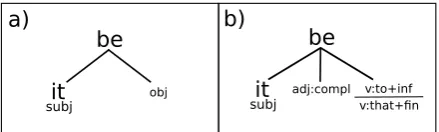
Linguistic analysis suggested including
syntax-be it
subj obj adj:compl v:to+infv:that+fin
be
it
subj
a) b)
Figure 2: Examples of syntactic features capturing typical constructions with a verbbe.
oriented patterns related to the verbto besuch as those shown in Figure 2. For instance, nominal predicates4 tend to be translated as to even if it is coreferential. On the other hand, an adjectival predicate followed by a subordinating clause in-troduced by the English connectivestoorthat usu-ally indicates a pleonastic usage ofittranslated as a null subject.
3.2 Features for reflexive pronouns
Here we focused on distinguishing between the two most frequent meanings (see Section 2.2). Ideally, the POS tag of the parent would be a sufficient feature because reflexives in the second meaning should depend on a noun. However, since we deal with automatically parsed trees we had to support the parent POS tag by the POS tag of the immediately preceding word. Moreover, another feature indicates if the preceding word is a noun and agrees with the pronoun in gender and num-ber.
Furthermore, we observed that s´am rarely ap-pears in other case than nominative. Although this feature exploits the target side, we can use it since the case of the governing Czech noun is already known at the point when reflexives are translated.
Last but not least, the morpho-syntactic pattern (including a possible preposition) in which the re-flexive pronoun appears is a valuable feature.
4 Experiments and Evaluation
To mitigate a possible error caused by a wrong classifier choice, we built several models based on various Machine Learning classification methods including Maximum Entropy inplemented in the AI::MaxEntropy Perl library,5 logistic regression with one-against-all strategy from Vowpal Wab-bit6as well as decision trees, k-NN and SVM from Scikit-learn library (Pedregosa et al., 2011).
4The verbto behas an object. 5
http://search.cpan.org/˜laye/AI-MaxEntropy-0.20 6
[image:3.595.75.292.59.125.2]It Reflexives
Train Test Train Test
Baseline 60.70 59.30 58.70 60.65
AI::MaxEntropy 85.99 76.61 76.37 77.77
VW (passes=20, l2=10e-5) 89.99 76.43 76.98 77.77
sklearn:decision-trees 93.36 73.66 81.78 76.37
sklearn:k-NN (k=10) 82.51 73.30 77.64 76.74
[image:4.595.329.507.58.114.2]sklearn:SVM (kernel=linear) 90.83 75.51 76.55 78.14
Table 2: Accuracy of both translation models on the training and test data.
We compare our results with a majority class baseline (PersPronandSeclasses) in Table 2. The results show a 17% gain when our approach is used.
The specialized models have been integrated in the TectoMT system and extrinsically evaluated on the English-Czech test set for the WMT 2011 Translation Task (Callison-Burch et al., 2011).7 This data set contains 3,003 English sentences with one Czech reference translation, out of which 430 contain at least one occurrence of it and 52 contain a reflexive pronoun.
The new approach was compared to the origi-nal TectoMT rule-based pronoun handling heuris-tics (see Section 1). The shift from the original settings to the new translation models results in 166 changed sentences withitand 17 changed sen-tences with English reflexives. In terms of BLEU score, we observe a marginal drop from 0.1404 to 0.1403 using the new approach. However, BLEU may be too coarse for this kind of experiment.
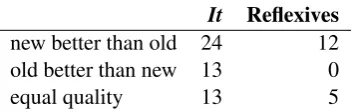
In order to give a more realistic view, we car-ried out a manual evaluation. All 17 modified sentences for reflexives and 50 randomly sampled changed sentences containingitwere presented to one annotator who assessed which of the two sys-tems gave a better translation. Table 3 shows that improved sentences dominate in both cases. Over-all, the improved sentences account for around 8.5% of all sentences with it and 23% sentences containing a reflexive pronoun.
5 Discussion
Looking into the types of improvements and er-rors in the manually evaluated sentences, we have found that the new model for it opted for a dif-ferent translation only in cases where the original system decided to express to on the surface. In 13 out of 24 improvements, the new model for it
succeeded in correctly resolving the Null class
7
http://www.statmt.org/wmt11/test.tgz
It Reflexives
new better than old 24 12 old better than new 13 0
equal quality 13 5
Table 3: The results of manual evaluation on sentences trans-lated by TectoMT in the original settings and using the new translation models
while in the remaining 11 cases, the corrected class was PersPron. It took advantage mostly of the syntax-based features in the former case and the coreference-related feature in the latter.
Regarding the reflexive pronouns the pronoun was used in its emphasizing meaning in all but two altered sentences. This accords with the design of features, which are mainly targeted at revealing this usage of reflexives. Moreover, the feature in-dicating if a Czech noun is in nominative case has proved to be particularly useful, correctly driving the lexical choice betweens´amandsamotn´y. The majority of errors stem from incorrect activation of syntactic features due to parsing and POS tag-ging errors.
6 Conclusions
In this work, we presented specialized translation models for two types of English pronouns: itand reflexives. Integrating them into an English-Czech syntax-based MT system TectoMT we succeeded in improving the concerned sentences measured by human evaluation.
Generally, it is intractable to design a specific feature set for every word. However, this work shows on two examples that the correct transla-tion of some words depends on many linguistic aspects, e.g. syntax and coreference and that is worth taking these aspects into account.
Acknowledgments
[image:4.595.74.291.59.143.2]References
Shane Bergsma and David Yarowsky. 2011. NADA: A Robust System for Non-Referential Pronoun
De-tection. InDAARC, pages 12–23, Faro, Portugal,
October.
Ondˇrej Bojar, Zdenˇek ˇZabokrtsk´y, Ondˇrej Duˇsek, Pe-tra Galuˇsˇc´akov´a, Martin Majliˇs, David Mareˇcek, Jiˇr´ı Marˇs´ık, Michal Nov´ak, Martin Popel, and Aleˇs Tam-chyna. 2012. The Joy of Parallelism with CzEng 1.0. InProceedings of LREC 2012, Istanbul, Turkey, May. ELRA, European Language Resources Associ-ation.
Chris Callison-Burch, Philipp Koehn, Christof Monz,
and Omar Zaidan. 2011. Findings of the 2011
Workshop on Statistical Machine Translation. In
Proceedings of the Sixth Workshop on Statisti-cal Machine Translation, pages 22–64, Edinburgh, Scotland, July. Association for Computational Lin-guistics.
Liane Guillou. 2012. Improving Pronoun Translation for Statistical Machine Translation. InProceedings of the Student Research Workshop at the 13th Con-ference of the EACL, pages 1–10, Stroudsburg, PA, USA. Association for Computational Linguistics.
Jan Hajiˇc, Eva Hajiˇcov´a, Jarmila Panevov´a, Petr Sgall, Silvie Cinkov´a, Eva Fuˇc´ıkov´a, Marie Mikulov´a, Petr Pajas, Jan Popelka, Jiˇr´ı Semeck´y, Jana ˇSindlerov´a, Jan ˇStˇep´anek, Josef Toman, Zdeˇnka Ureˇsov´a, and
Zdenˇek ˇZabokrtsk´y. 2011. Prague Czech-English
Dependency Treebank 2.0.
Christian Hardmeier and Marcello Federico. 2010.
Modelling Pronominal Anaphora in Statistical Ma-chine Translation. In Marcello Federico, Ian Lane, Michael Paul, and Franc¸ois Yvon, editors, Proceed-ings of the seventh International Workshop on Spo-ken Language Translation (IWSLT), pages 283–289.
Philipp Koehn, Franz Josef Och, and Daniel Marcu. 2003. Statistical Phrase-based Translation. In Pro-ceedings of the 2003 Conference of the NAACL HLT – Volume 1, pages 48–54, Stroudsburg, PA, USA. Association for Computational Linguistics.
Ronan Le Nagard and Philipp Koehn. 2010.
Aid-ing Pronoun Translation with Co-Reference Resolu-tion. InProceedings of the Joint Fifth Workshop on Statistical Machine Translation and MetricsMATR, pages 252–261, Uppsala, Sweden, July. Association for Computational Linguistics.
David Mareˇcek, Zdenˇek ˇZabokrtsk´y, and V´aclav
Nov´ak. 2008. Automatic Alignment of Czech and
English Deep Syntactic Dependency Trees. In
Pro-ceedings of the Twelfth EAMT Conference, pages 102–111.
Izak Morin. 2009. Translating Pronouns, Proper
Names and Kinship Terms from Indonesian into
En-glish and vice versa. TEFLIN Journal: A
publica-tion on the teaching and learning of English, 16(2).
Krist´yna Onderkov´a. 2010. Possessive Pronouns in English and Czech Works of Fiction, Their Use with Parts of Human Body and Translation. Master’s the-sis, Masaryk University, Faculty of Arts.
Fabian Pedregosa, Ga¨el Varoquaux, Alexandre Gram-fort, Vincent Michel, Bertrand Thirion, Olivier Grisel, Mathieu Blondel, Peter Prettenhofer, Ron Weiss, Vincent Dubourg, Jake Vanderplas, Alexan-dre Passos, David Cournapeau, Matthieu Brucher,
Matthieu Perrot, and ´Edouard Duchesnay. 2011.
Scikit-learn: Machine Learning in Python.
Jour-nal of Machine Learning Research, 12:2825–2830, November.
Petr Sgall, Eva Hajiˇcov´a, and Jarmila Panevov´a. 1986.
The Meaning of the Sentence in Its Semantic and Pragmatic Aspects. D. Reidel Publishing Company, Dordrecht.
Petr Sgall. 1967. Generativn´ı popis jazyka a ˇcesk´a
deklinace. Academia, Prague, Czech Republic.
Zdenˇek ˇZabokrtsk´y, Jan Pt´aˇcek, and Petr Pajas. 2008. TectoMT: Highly Modular MT System with
Tec-togrammatics Used as Transfer Layer. In