Recognizing Explicit and Implicit Hate Speech Using a Weakly
Supervised Two-path Bootstrapping Approach
Lei Gao
Texas A&M University [email protected]
Alexis Kuppersmith Stanford University [email protected]
Ruihong Huang Texas A&M University [email protected]
Abstract
In the wake of a polarizing election, social media is laden with hateful content. To address various limitations of supervised hate speech classification methods includ-ing corpus bias and huge cost of annota-tion, we propose a weakly supervised two-path bootstrapping approach for an online hate speech detection model leveraging large-scale unlabeled data. This system significantly outperforms hate speech de-tection systems that are trained in a super-vised manner using manually annotated data. Applying this model on a large quan-tity of tweets collected before, after, and on election day reveals motivations and patterns of inflammatory language.
1 Introduction
Following a turbulent election season, 2016’s dig-ital footprint is awash with hate speech. Apart from censorship, the goals of enabling computers to understand inflammatory language are many. Sensing increased proliferation of hate speech can elucidate public opinion surrounding polarizing events. Identifying hateful declarations can bolster security in revealing individuals harboring mali-cious intentions towards specific groups.
Recent studies on supervised methods for on-line hate speech detection (Waseem and Hovy, 2016;Nobata et al., 2016) have relied on manu-ally annotated data sets, which are not only costly to create but also likely to be insufficient to ob-tain wide-coverage hate speech detection systems. This is mainly because online hate speech is rela-tively infrequent (among large amounts of online
contents) and tends to transform rapidly following a new trigger event. Our pilot annotation experi-ment with 5,000 randomly selected tweets shows that around 0.6% (31 tweets) of tweets are hateful. The mass-scale (Yahoo!Finance online comments) hate speech annotation effort from Yahoo! ( No-bata et al., 2016) revealed that only 5.9% of on-line comments contained hate speech. Therefore, large amounts of online texts need to be annotated to adequately identify hate speech. In recent stud-ies (Waseem and Hovy, 2016; Kwok and Wang, 2013), the data selection methods and annotations are often biased towards a specific type of hate speech or hate speech generated in certain scenar-ios in order to increase the ratio of hate speech content in the annotated data sets, which how-ever made the resulting annotations too distorted to reflect the true distribution of hate speech. Fur-thermore, inflammatory language changes dramat-ically following new hate “trigger” events, which will significantly devalue annotated data.
To address the various limitations of super-vised hate speech detection methods, we present a weakly supervised two-path bootstrapping ap-proach for online hate speech detection that re-quires minimal human supervision and can be eas-ily retrained and adapted to capture new types of inflammatory language. Our two-path bootstrap-ping architecture consists of two learning compo-nents, an explicit slur term learner and a neural net classifier (LSTMs (Hochreiter and Schmidhuber, 1997)), that can capture both explicit and implicit phrasings of online hate speech.
Specifically, our bootstrapping system starts with automatically labeled online hateful content that are identified by matching a large collection of unlabeled online content with several hateful
slur terms. Then two learning components will be initiated simultaneously. A slur term learner will learn additional hateful slur terms from the auto-matically identified hateful content. Meanwhile, a neural net classifier will be trained using the au-tomatically labeled hateful content as positive in-stances and randomly sampled online content as negative instances. Next, both string matching with the newly learned slur terms and the trained neural net classifier will be used to recognize new hateful content from the large unlabeled collec-tion of online contents. Then the newly identi-fied hateful content by each of the two learning components will be used to augment the initially identified hateful content, which will be used to learn more slur terms and retrain the classifier. The whole process iterates.
The design of the two-path bootstrapping sys-tem is mainly motivated to capture both explicit and implicit inflammatory language. Explicit hate speech is easily identifiable by recognizing a clearly hateful word or phrase. For example: (1)Don’t talk to me from an anonymous account you faggot coward, whither up and die.
(2) And that’s the kind of people who support Trump! Subhumans!
In contrast, implicit hate speech employs circum-locution, metaphor, or stereotypes to convey ha-tred of a particular group, in which hatefulness can be captured by understanding its overall composi-tional meanings, For example:
(3) Hillary’s welfare army doesn’t really want jobs. They want more freebies.
(4) Affirmative action means we get affirmatively second rate doctors and other professionals.
Furthermore, our learning architecture has a fla-vor of co-training (Blum and Mitchell, 1998) in maintaining two learning components that concen-trate on different properties of inflammatory lan-guage. By modeling distinct aspects of online hate speech, such a learning system is better equipped to combat semantic drift, which often occurs in self-learning where the learned model drifts away from the esteemed track. Moreover, training two complementary models simultaneously and utiliz-ing both models to identify hate speech of different properties in each iteration of the learning process is important to maintain the learning momentum and to generate models with wide coverage. In-deed, our experimental results have shown that the
two-path bootstrapping system is able to jointly identify many more hate speech texts (214,997 v.s 52,958 v.s 112,535) with a significantly higher F-score (48.9% v.s 19.7% v.s 26.1%), when com-pared to the bootstrapping systems with only the slur term learner and only the neural net classi-fier. In addition, the evaluation shows that the two-path bootstrapping system identifies 4.4 times more hateful texts than hate speech detection sys-tems that are trained using manually annotated data in a supervised manner.
2 Related Work
Previous studies on hate speech recognition mostly used supervised approaches. Due to the sparsity of hate speech overall in reality, the data selection methods and annotations are often bi-ased towards a specific type of hate speech or hate speech generated in certain scenarios. For instance, Razavi et al. (2010) conducted their experiments on 1525 annotated sentences from a company’s log file and a certain newsgroup. Warner and Hirschberg (2012) labeled around
fo-cus on comments by users who were reported to have posted hateful comments. We instead aim to detect hate speech w.r.t. its real distribution, using a weakly supervised method that does not rely on large amounts of annotations.
The commonly used classification methods in previous studies are logistic regression and Naive Bayes classifiers. Djuric et al. (2015) and No-bata et al. (2016) applied neural network models for training word embeddings, which were further used as features in a logistic regression model for classification. We will instead train a neural net classifier (Kim,2014;Lai et al.,2015;Zhou et al., 2015) in a weakly supervised manner in order to capture implicit and compositional hate speech ex-pressions.
Xiang et al. (2012) is related to our research because they also used a bootstrapping method to discover offensive language from a large-scale Twitter corpus. However, their bootstrapping model is driven by mining hateful Twitter users, instead of content analysis of tweets as in our ap-proach. Furthermore, they recognize hateful Twit-ter users by detecting explicit hateful indicators (i.e., keywords) in their tweets while our boot-strapping system aim to detect both explicit and implicit expressions of online hate speech.
3 The Two-path Bootstrapping System for Online Hate Speech Detection
[image:3.595.75.285.468.631.2]3.1 Overview
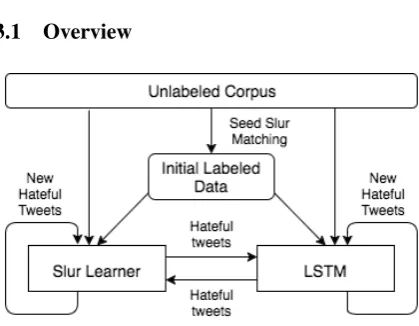
Figure 1: Diagram of co-training model
Figure 1illustrates that our weakly supervised hate speech detection system starts with a few pre-identified slur terms as seeds and a large collection of unlabeled data instances. Specifically, we ex-periment with identifying hate speech from tweets. Hateful tweets will be automatically identified by matching the large collection of unlabeled tweets
with slur term seeds. Tweets that contain one of the seed slur terms are labeled as hateful.
The two-path bootstrapping system consists of two learning components, an explicit slur term learner and a neural net classifier (LSTMs (Hochreiter and Schmidhuber, 1997)), that can capture both explicit and implicit descriptions of online hate speech. Using the initial seed slur term labeled hateful tweets, the two learning compo-nents will be initiated simultaneously. The slur term learner will continue to learn additional hate-ful slur terms. Meanwhile, the neural net classi-fier will be trained using the automatically labeled hateful tweets as positive instances and randomly sampled tweets as negative instances. Next, both the newly learned slur terms and the trained neu-ral net classifier will be used to identify new hate-ful content from the unlabeled large collection of tweets. The newly labeled hateful tweets by each of the two learning components will be used to augment the initial slur term seed identified hateful tweet collection, which will be used to learn more slur terms and retrain the classifier in the next iter-ation. The whole process then iterates.
After each iteration, we have to determine if a stopping criterion is met and we should termi-nate the bootstrapping process. In general, a tuned threshold score is applied or a small annotated dataset is used to evaluate the learned classifiers. We adopt the latter method. Specifically, the boot-strapping system stops when the precision of the LSTM classifier is lower than 0.6 when evalu-ated using an existing small annotevalu-ated tweet set (Waseem and Hovy,2016).
3.2 Automatic Data Labeling of Initial Data Seeing a hate slur term in a tweet strongly indi-cates that the tweet is hateful. Therefore, we use 20 manually selected slur terms to match with a large unlabeled tweet collection in order to quickly construct the initial small set of hateful tweets. Ta-ble1shows the20seed slurs we used.
bimbo chink commie coon cunt fag faggot feminazi honky islamist libtard muzzie negro nigger paki skank subhuman tranny twat wanker
Table 1: Seed slurs
[image:3.595.312.522.658.709.2]Hate-base1, the Racial Slurs Database2, and a page of LGBT slang terms3. We ranked the slur terms by their frequencies in tweets, eliminating ambiguous and outdated terms. The slur ”gypsy”, for exam-ple, refers to derogatorily to people of Roma de-scent, but currently in popular usage is an ideal-ization of a trendy bohemian lifestyle. The word ”bitch” is ambiguous, sometimes a sexist slur but other times innocuously self-referential or even friendly.
For these reasons, we only selected the top 20
terms we considered reliable (shown in Table 1). We use both the singular and the plural form for each of these seed slur terms.
3.3 Slur Term Learner
The slur term learning component extracts individ-ual words from a set of hateful tweets as new slurs. Intuitively, if a word occurs significantly more fre-quently in hateful tweets than in randomly selected tweets, this term is more likely to be a hateful slur term. Following this intuition, we assign a score to each unique unigram that appears 10 or more times in hateful tweets, and the score is calculated as the relative ratio of its frequency in the labeled hateful tweets over its frequency in the unlabeled set of tweets. Then the slur term learner recog-nizes a unigram with a score higher than a cer-tain threshold as a new slur. Specifically, we use the threshold score of100in identifying individual word slur terms.
The newly identified slur terms will be used to match with unlabeled tweets in order to identify additional hateful tweets. A tweet that contains one of the slur terms is deemed to be a hateful tweet.
While we were aware of other more sophisti-cated machine learning models, one purpose of this research is to detect and learn new slur terms from constantly generated user data. Therefore, the simple and clean string matching based slur learner is designed to attentively look for specific words that alone can indicate hate speech. In ad-dition, this is in contrast with the second learning component that uses a whole tweet and model its compositional meanings in order to recognize im-plicit hate speech. These two learners are comple-mentary in the two-path bootstrapping system.
1https://www.hatebase.org 2http://www.rsdb.org
3https://en.wikipedia.org/wiki/List of LGBT slang terms
3.4 The LSTM Classifier
We aim to recognize implicit hate speech expres-sions and capture composite meanings of tweets using a sequence neural net classifier. Specifically, our LSTM classifier has a single layer of LSTM units. The output dimension size of the LSTM layer is100. A sigmoid layer is built on the top of the LSTM layer to generate predictions. The input dropout rate and recurrent state dropout rate are both set to0.2. In each iteration of the bootstrap-ping process, the training of the LSTM classifier runs for10epochs.
The input to our LSTM classifier is a sequence of words. We pre-process and normalize tokens in tweets following the steps suggested in ( Pen-nington et al., 2014). In addition, we used the pre-processing of emoji and smiley described in a preprocess tool4. Then we retrieve word vector representations from the downloaded5 pre-trained word2vec embeddings (Mikolov et al.,2013).
The LSTM classifier is trained using the au-tomatically labeled hateful tweets as positive in-stances and randomly sampled tweets as negative instances, with the ratio of POS:NEG as 1:10. Then the classifier is used to identify additional hateful tweets from the large set of unlabeled tweets. The LSTM classifier will deem a tweet as hateful if the tweet receives a confidence score of0.9or higher. Both the low POS:NEG ratio and the high confidence score are applied to increase the precision of the classifier in labeling hateful tweets and control semantic drift in the bootstrap-ping learning process. To further combat semantic drift, we applied weighted binary cross-entropy as the loss function in LSTM.
3.5 One vs. Two Learning Paths
As shown in Figure1, if we remove one of the two learning components, the two-path learning tem will be reduced to a usual self-learning sys-tem with one single learning path. For instance, if we remove the LSTM classifier, the slur learner will learn new slur terms from initially seed la-beled hateful tweets and then identify new hateful tweets by matching newly learned slurs with unla-beled tweets. The newly identified hateful tweets will be used to augment the initial hateful tweet collection and additional slur terms can be learned from the enlarged hateful tweet set. The process
will iterates. However as shown later in the evalu-ation section, single-path variants of the proposed two-path learning system are unable to receive ad-ditional fresh hateful tweets identified by the other learning component and lose learning momentum quickly.
3.6 Tackling Semantic Drifts
Semantic drift is the most challenging problem in distant supervision and bootstrapping. First of all, we argue that the proposed two-path bootstrapping system with two significantly different learning components is designed to reduce semantic drift. According to the co-training theory (Blum and Mitchell, 1998), the more different the two com-ponents are, the better. In evaluation, we will show that such a system outperforms single-path boot-strapping systems. Furthermore, we have applied several strategies in controlling noise and imbal-ance of automatically labeled data, e.g., the high frequency and the high relative frequency thresh-olds enforced in selecting hate slur terms, as well as the low POS:NEG training sample ratio and the high confidence score of 0.9 used in selecting new data instances for the LSTM classifier.
4 Evaluations
4.1 Tweets Collection
We randomly sampled 10 million tweets from 67 million tweets collected from Oct. 1st to Oct. 24th using Twitter API. These 10 million tweets were used as the unlabeled tweet set in bootstrapping learning. Then we continued to collect 62 mil-lion tweets spanning from Oct.25th to Nov.15th, essentially two weeks before the US election day and one week after the election. The 62 million tweets will be used to evaluate the performance of the bootstrapped slur term learner and LSTM classifier. The timestamps of all these tweets are converted into EST. By using Twitter API, the col-lected tweets were randomly sampled to prevent a bias in the data set.
4.2 Supervised Baselines
We trained two supervised models using the 16 thousand annotated tweets that have been used in a recent study (Waseem and Hovy, 2016). The annotations distinguish two types of hateful tweets, sexism and racism, but we merge both categories and only distinguish hateful from non-hateful tweets.
First, we train a traditional feature-based classi-fication model using logistic regression (LR). We apply the same set of features as mentioned in (Waseem and Hovy,2016). The features include character-level bigrams, trigrams, and four-grams. In addition, for direct comparisons, we train a LSTM model using the 16 thousand annotated tweets, using exactly the same settings as we use for the LSTM classifier in our two-path bootstrap-ping system.
4.3 Evaluation Methods
We apply both supervised classifiers and our weakly supervised hate speech detection systems to the 62 million tweets in order to identify hate-ful tweets that were posted before and after the US election day. We evaluate both precision and recall for both types of systems. Ideally, we can easily measure precision as well as recall for each sys-tem if we have ground truth labels for each tweet. However, it is impossible to obtain annotations for such a large set of tweets. The actual distribution of hateful tweets in the 62 million tweets is un-known.
Instead, to evaluate each system, we randomly sampled 1,000 tweets from the whole set of hate-ful tweets thathad been tagged as hateful by the corresponding system. Then we annotate the sam-pled tweets and use them to estimate precision and recall of the system. In this case,
precision= 1000n
recall∝precision·N
Here, nrefers to the number of hateful tweets that human annotators identified in the 1,000 sam-pled tweets, andN refers to the total number of hateful tweets the system tagged in the 62 million tweets. We further calculated system recall by nor-malizing the product,precision·N, with an esti-mated total number of hateful tweets that exist in the 62 million tweets, which was obtained by mul-tiplying the estimated hateful tweet rate of 0.6%6 with the exact number of tweets in the test set. Fi-nally, we calculate F-score using the calculated re-call and precision.
LSTM models, only tweets that receive a con-fidence score over 0.9 were tagged as hateful tweets.
4.4 Human Annotations
When we annotate system predicted tweet sam-ples, we essentially adopt the same definition of hate speech as used in (Waseem and Hovy,2016), which considers tweets that explicitly or implicitly propagate stereotypes targeting a specific group whether it is the initial expression or a meta-expression discussing the hate speech itself (i.e. a paraphrase). In order to ensure our annota-tors have a complete understanding of online hate speech, we asked two annotators to first discuss over a very detailed annotation guideline of hate speech, then annotate separately. This went for several iterations.
Then we asked the two annotators to annotate the 1,000 tweets that were randomly sampled from all the tweets tagged as hateful by the supervised LSTM classifier. The two annotators reached an inter-agreement Kappa (Cohen, 1960) score of 85.5%. Because one of the annotators become un-available later in the project, the other annotator annotated the remaining sampled tweets.
4.5 Experimental Results Supervised Baselines
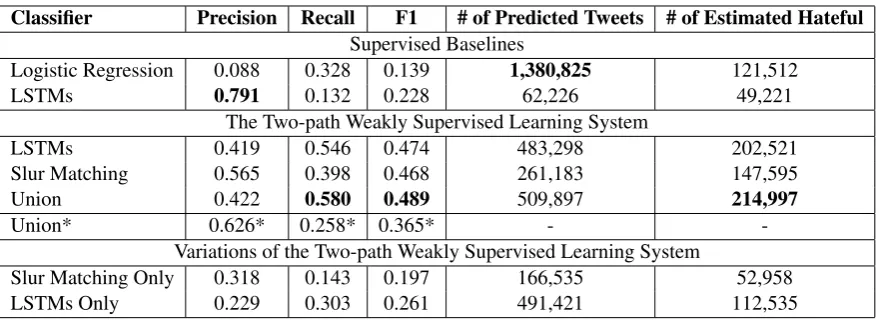
The first section of Table 2 shows the perfor-mance of the two supervised models when applied to 62 million tweets collected around election time. We can see that the logistic regression model suffers from an extremely low precision, which is less than 10%. While this classifier aggressively labeled a large number of tweets as hateful, only 121,512 tweets are estimated to be truly hateful. In contrast, the supervised LSTM classifier has a high precision of around 79%, however, this clas-sifier is too conservative and only labeled a small set of tweets as hateful.
The Two-path Bootstrapping System
Next, we evaluate our weakly supervised classi-fiers which were obtained using only20seed slur terms and a large set of unlabeled tweets. The two-path weakly supervised bootstrapping system ran for four iterations. The second section of Table2 shows the results for the two-path weakly super-vised system. The first two rows show the eval-uation results for each of the two learning com-ponents in the two-path system, the LSTM classi-fier and the slur learner, respectively. The third
row shows the results for the full system. We can see that the full systemUnionis significantly better than the supervised LSTM model in terms of recall and F-score. Furthermore, we can see that a significant portion of hateful tweets were identified by both components and the weakly su-pervised LSTM classifier is especially capable to identify a large number of hateful tweets. Then the slur matching component obtains an preci-sion of around 56.5% and can identify roughly 3 times of hateful tweets compared with the super-vised LSTM classifier. The last column of this section shows the performance of our model on a collection of human annotated tweets as intro-duced in the previous work (Waseem and Hovy, 2016). The recall is rather low because the data we used to train our model is quite different from this dataset which contains tweets related to a TV show (Waseem and Hovy,2016). The precision is only slightly lower than previous supervised mod-els that were trained using the same dataset.
Table3shows the number of hateful tweets our bootstrapping system identified in each iteration during training. Specifically, the columns Slur Match and LSTMs show the number of hateful tweets identified by the slur learning component and the weakly supervised LSTM classifier re-spectively. We can see that both learning compo-nents steadily label new hateful tweets in each it-eration and the LSTM classifier often labels more tweets as hateful compared to slur matching.
Classifier Precision Recall F1 # of Predicted Tweets # of Estimated Hateful
Supervised Baselines
Logistic Regression 0.088 0.328 0.139 1,380,825 121,512
LSTMs 0.791 0.132 0.228 62,226 49,221
The Two-path Weakly Supervised Learning System
LSTMs 0.419 0.546 0.474 483,298 202,521
Slur Matching 0.565 0.398 0.468 261,183 147,595
Union 0.422 0.580 0.489 509,897 214,997
Union* 0.626* 0.258* 0.365* -
-Variations of the Two-path Weakly Supervised Learning System
Slur Matching Only 0.318 0.143 0.197 166,535 52,958
[image:7.595.80.520.60.221.2]LSTMs Only 0.229 0.303 0.261 491,421 112,535
Table 2: Performance of Different Models
Its Prev Slur Match LSTMs
1 8,866 422 3,490
2 12,776 4,890 13,970
3 27,274 6,299 21,579
[image:7.595.91.272.261.332.2]4 50,721 9,895 22,768
Table 3: Number of Labeled Tweets in Each Itera-tion
Intersection LSTM Only Slur Only
234,584 248,714 26,599
Table 4: Number of Hateful Tweets in Each Seg-ment
In order to understand how necessary it is to maintain two learning paths for online hate speech detection, we also ran two experiments with one learning component removed from the loop each time. Therefore, the reduced bootstrapping sys-tems can only repeatedly learn explicit hate speech (with the slur learner) or implicit hateful expres-sions (with the LSTM classifier).
The third section of Table2 shows the evalua-tion results of the two single-path variants of the weakly supervised system. We can see that both the estimated precision, recall, F score and the estimated number of truly hateful tweets by the two systems are significantly lower than the com-plete two-path bootstrapping system, which sug-gests that our two-path learning system can effec-tively capture diverse descriptions of online hate speech, maintain learning momentums as well as effectively combat with noise in online texts.
5 Analysis
5.1 Analysis of the Learned Hate Indicators
berk chavs degenerates douches facist hag heretics jihadists lesbo pendejo paedo pinche retards satanist scum scumbag slutty tards unamerican wench
Table 5: New slurs learned by our model We have learned 306 unigram phrases using the slur term learning component. Among them, only 45 phrases were seen in existing hate slur databases while the other terms, 261 phrases in to-tal, were only identified in real-world tweets. Ta-ble5shows some of the newly discovered hate in-dicating phrases. Our analysis shows that 86 of the newly discovered hate indicators are strong hate slur terms and the remaining 175 indicators are re-lated to discussions of identity and politics such as ’supremacist’ and ’Zionism’.
5.2 Analysis of LSTM Identified Hateful Tweets
The LSTM labeled 483,298 tweets as hateful, and 172,137 of them do not contain any of the original seed slurs or our learned indicator phrases. The following are example hateful tweets that have no explicit hate indicator phrase:
(1) @janh2h The issue is that internationalists keep telling outsiders that they’re just as entitled to the privileges of the tribe as insiders.
[image:7.595.324.508.322.385.2]We can see that the hatefulness of these tweets is determined by their overall composi-tional meanings rather than a hate-indicating slur.
5.3 Error Analysis
The error of our model comes from semantic drift in bootstrapping learning, which partially results from the complexity and dynamics of language. Specifically, we found dynamic word sense of slurs and natural drifting of word semantic. Many slur terms are ambiguous and have multiple word senses. For instance, “Chink”, an anti-Asian epi-thet, can also refer to a patch of light from a small aperture. Similarly, “Negro” is a toponym in ad-dition to a racial slur. Further, certain communi-ties have reclaimed slur words. Though the word “dyke” is derogatory towards lesbians, for exam-ple, some use it self-referentially to destigmatize it, a phenomenon we sometimes encountered.
5.4 Temporal Distributions of Tagged Hateful Tweets
By applying our co-training model on the 62 mil-lion tweets corpus, we found around 510 thousand tweets labeled as hateful in total.
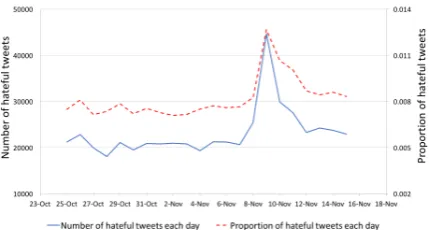
Figure 2: Temporal Distribution of Hateful Tweets
The figure 2displays the temporal distribution of hateful tweets. There is a spike in hateful tweets from Nov.7th to Nov.12th in terms of both number of hateful tweets and ratio of hateful tweets to total tweets.
5.5 Most Frequent Mentions and Hashtags of Tagged Hateful Tweets
Table6and7show the top 30 most frequent men-tions in hateful tweets. They are ranked by fre-quency from left to right and from top to bottom.
It is clear that the majority of mentions found in tweets tagged as hateful address polarizing political figures (i.e. @realDonaldTrump and
@HillaryClinton), indicating that hate speech is often fueled by partisan warfare. Other common mentions include news sources, such as Politico and MSNBC, which further support that ”trigger” events in the news can generate inflammatory re-sponses among Twitter users. Certain individual Twitter users also received a sizable number of mentions. @mitchellvii is a conservative activist whose tweets lend unyielding support to Donald Trump. Meanwhile, Twitter user @purplhaze42 is a self-proclaimed anti-racist and anti-Zionist. Both figured among the most popular recipients of inflammatory language.
Table7shows that the majority of hashtags also indicate the political impetus behind hate speech with hashtags such as #Trump and #MAGA (Make America Great Again, Trump’s campaign slogan) among the most frequent. The specific televised events also engender proportionally large amounts of hateful language as they can be commonly ex-perienced by all television-owning Americans and therefore a widely available target for hateful mes-sages.
@realDonaldTrump @HillaryClinton @megynkelly
@CNN @FoxNews @newtgingrich
@nytimes @YouTube @POTUS
@KellyannePolls @MSNBC @seanhannity @washingtonpost @narendramodi @CNNPolitics @PrisonPlanet @guardian @JoyAnnReid @BarackObama @thehill @BreitbartNews
@politico @ABC @AnnCoulter
@jaketapper @ArvindKejriwal @FBI @mitchellvii @purplhaze42 @SpeakerRyan
Table 6: List of Top 30 Mentions in Hateful Tweets During Election Days
#Trump #ElectionNight #Election2016
#MAGA #trndnl #photo
#nowplaying #Vocab #NotMyPresident #ElectionDay #trump #ImWithHer #halloween #cdnpoli #Latin #Hillary #WorldSeries #1 #Brexit #Spanish #auspol #notmypresident #C51 #NeverTrump #hiring #bbcqt #USElection2016 #tcot #TrumpProtest #XFactor
Table 7: List of Top 30 Hashtags in Hateful Tweets During Election Days
6 Conclusions
[image:8.595.312.528.385.496.2] [image:8.595.74.289.415.530.2]corpus. To address these issues, we proposed a weakly supervised two-path bootstrapping model to identify hateful language in randomly sampled tweets. Starting from 20 seed rules, we found 210 thousand hateful tweets from 62 million tweets collected during the election. Our analysis shows a strong correlation between temporal distributions of hateful tweets and the election time, as well as the partisan impetus behind large amounts of in-flammatory language. In the future, we will look into linguistic phenomena that often occur in hate speech, such as sarcasm and humor, to further im-prove hate speech detection performance.
References
Avrim Blum and Tom Mitchell. 1998. Combining la-beled and unlala-beled data with co-training. In Pro-ceedings of the eleventh annual conference on Com-putational learning theory. ACM, pages 92–100.
Peter Burnap and Matthew Leighton Williams. 2014. Hate speech, machine classification and statistical modelling of information flows on twitter: Interpre-tation and communication for policy decision mak-ing. In Proceedings of the Internet, Politics, and Policy conference.
Jacob Cohen. 1960. A coefficient of agreement for nominal scales. Educational and psychological measurement20(1):37–46.
Nemanja Djuric, Jing Zhou, Robin Morris, Mihajlo Gr-bovic, Vladan Radosavljevic, and Narayan Bhamidi-pati. 2015. Hate speech detection with comment embeddings. In Proceedings of the 24th Interna-tional Conference on World Wide Web. ACM, pages 29–30.
Sepp Hochreiter and J¨urgen Schmidhuber. 1997. Long short-term memory. Neural computation
9(8):1735–1780.
Yoon Kim. 2014. Convolutional neural net-works for sentence classification. arXiv preprint arXiv:1408.5882.
Irene Kwok and Yuzhou Wang. 2013. Locate the hate: Detecting tweets against blacks. InAAAI.
Siwei Lai, Liheng Xu, Kang Liu, and Jun Zhao. 2015. Recurrent convolutional neural networks for text classification. In AAAI. volume 333, pages 2267– 2273.
Tomas Mikolov, Ilya Sutskever, Kai Chen, Greg S Cor-rado, and Jeff Dean. 2013. Distributed representa-tions of words and phrases and their compositional-ity. InAdvances in neural information processing systems. pages 3111–3119.
Chikashi Nobata, Joel Tetreault, Achint Thomas, Yashar Mehdad, and Yi Chang. 2016. Abusive lan-guage detection in online user content. In Proceed-ings of the 25th International Conference on World Wide Web. International World Wide Web Confer-ences Steering Committee, pages 145–153.
Jeffrey Pennington, Richard Socher, and Christopher D Manning. 2014. Glove: Global vectors for word representation. InEMNLP. volume 14, pages 1532– 1543.
Amir H Razavi, Diana Inkpen, Sasha Uritsky, and Stan Matwin. 2010. Offensive language detection using multi-level classification. InCanadian Conference on Artificial Intelligence. Springer, pages 16–27. Sara Sood, Judd Antin, and Elizabeth Churchill. 2012.
Profanity use in online communities. In Proceed-ings of the SIGCHI Conference on Human Factors in Computing Systems. ACM, pages 1481–1490. William Warner and Julia Hirschberg. 2012. Detecting
hate speech on the world wide web. In Proceed-ings of the Second Workshop on Language in Social Media. Association for Computational Linguistics, pages 19–26.
Zeerak Waseem and Dirk Hovy. 2016. Hateful sym-bols or hateful people? predictive features for hate speech detection on twitter. In Proceedings of NAACL-HLT. pages 88–93.
Guang Xiang, Bin Fan, Ling Wang, Jason Hong, and Carolyn Rose. 2012. Detecting offensive tweets via topical feature discovery over a large scale twit-ter corpus. In Proceedings of the 21st ACM inter-national conference on Information and knowledge management. ACM, pages 1980–1984.