Evaluating N-gram based Evaluation Metrics for
Automatic Keyphrase Extraction
Su Nam Kim, Timothy Baldwin CSSE
University of Melbourne
[email protected], [email protected]
Min-Yen Kan School of Computing National University of Singapore
Abstract
This paper describes a feasibility study of n-gram-based evaluation metrics for automatic keyphrase extraction. To ac-count for near-misses currently ignored by standard evaluation metrics, we adapt various evaluation metrics developed for machine translation and summarization, and also theR-precisionevaluation metric from keyphrase evaluation. In evaluation, theR-precision metric is found to achieve the highest correlation with human anno-tations. We also provide evidence that the degree of semantic similarity varies with the location of the partially-matching component words.
1 Introduction
Keyphrases are noun phrases (NPs) that are repre-sentative of the main content of documents. Since they represent the key topics in documents, ex-tracting good keyphrases benefits various natu-ral language processing (NLP) applications such as summarization, information retrieval (IR) and question-answering (QA). Keyphrases can also be used in text summarization as semantic metadata (Barzilay and Elhadad, 1997; Lawrie et al., 2001; D’Avanzo and Magnini, 2005). In search engines, keyphrases supplement full-text indexing and as-sist users in creating good queries.
In the past, a large body of work on keyphrases has been carried out as an extraction task, uti-lizing three types of cohesion: (1) document cohesion, i.e. cohesion between documents and keyphrases (Frank et al., 1999; Witten et al., 1999;
Matsuo and Ishizuka, 2004; Medelyan and Wit-ten, 2006; Nguyen and Kan, 2007; Wan and Xiao, 2008); (2) keyphrase cohesion, i.e. cohe-sion among keyphrases (Turney, 2003); and (3) term cohesion, i.e. cohesion among terms in a keyphrase (Park et al., 2004).
and Barriere, 2004).
Our goal in this paper is to evaluate the relia-bility of automatic evaluation metrics that better account for near-misses. Prior research based on semantic similarity (Jarmasz and Barriere, 2004; Mihalcea and Tarau, 2004; Medelyan and Wit-ten, 2006) has taken the approach of using ex-ternal resources such as large corpora, Wikipedia or manually-curated index words. While we ac-knowledge that these methods can help address the near-miss problem, they are impractical due to the effort required to compile the requisite re-sources for each individual evaluation exercise, and furthermore, the resources tend to be domain-specific. In order to design a cheap, practical and stable keyphrase evaluation metric, our aim is to properly account for these near-misses without re-liance on costly external resources.
According to our analysis, the degree of se-mantic similarity of keyphrase candidates varies relative to the location of overlap. For exam-ple, the candidate grid computing algorithm has higher semantic similarity than computing algo-rithm with the gold-standard keyphrase effective grid computing algorithm. Also,computing algo-rithmis closer thaneffective gridto the same gold-standard keyphrase. From these observations, we infer that n-gram-based evaluation metrics can be applied to evaluating keyphrase extraction, but also that candidates with the same relativen-gram overlap are not necessarily equally good.
Our primary goal is to test the utility ofn-gram based evaluation metrics to the task of keyphrase extraction evaluation. We test the following eval-uation metrics: (1) evaleval-uation metrics from MT and multi-document summarization (BLEU, NIST,
METEORandROUGE); and (2)R-precision(Zesch and Gurevych, 2009), an n-gram-based evalua-tion metric developed specifically for keyphrase extraction evaluation which has yet to be evalu-ated against humans at the extraction task. Sec-ondarily, we attempt to shed light on the bigger question of whether it is feasible to expect that n-gram-based metrics without access to external resources should be able to capture subtle seman-tic differences in keyphrase candidates. To this end, we experimentally verify the impact of lex-ical overlap of different types on keyphrase
sim-ilarity, and use this as the basis for proposing a variant ofR-precision.
In the next section, we present a brief primer on keyphrases. We then describe the MT and sum-marization evaluation metrics trialled in this re-search, along withR-precision,modified R-precision
and a semantic similarity-based evaluation metric for keyphrase evaluation (Section 3). In Section 4, we discuss our gold-standard and candidate ex-traction method. We compare the evaluation met-rics with human assigned scores for suitability in Section 5, before concluding the paper.
2 A Primer on Keyphrases
Keyphrases can be either simplex words (e.g. query,discovery, orcontext-awareness)1or larger
N-bars/noun phrases (e.g. intrusion detection, mobile ad-hoc network, or quality of service). The majority of keyphrases are 1–4 words long (Paukkeri et al., 2008).
Keyphrases are normally composed of nouns and adjectives, but may occasionally contain ad-verbs (e.g.dynamically allocated task, orpartially observable Markov decision process) or other parts of speech. They may also contain hyphens (e.g.sensor-grouping ormulti-agent system) and apostrophes for possessives (e.g.Bayes’ theorem oragent’s goal).
Keyphrases can optionally incorporate PPs (e.g. service qualityvs.quality of service). A variety of prepositions can be used (e.g.incentive for coop-eration, inequality in welfare, agent security via approximate policy), although the genetive of is the most common.
Keyphrases can also be coordinated, either as simple nouns at the top level (e.g. performance and scalabilityorgroup and partition) or within more complex NPs or between N-bars (e.g. his-tory of past encounter and transitivityortask and resource allocation in agent system).
When candidate phrases get too long, abbre-viations also help to form valid keyphrases (e.g. computer support collaborative workvs.CSCW, orpartially observable Markov decision process vs.POMDP).
3 Evaluation Metrics
There have been various evaluation metrics de-veloped and validated for reliability in fields such as MT and summarization (Callison-Burch et al., 2009). While n-gram-based metrics don’t cap-ture systematic alternations in keyphrases, they do support partial match between keyphrase candi-dates and the reference keyphrases.
In this section, we first introduce a range of popular n-gram-based evaluation metrics from the MT and automatic summarization literature, which we naively apply to the task of keyphrase evaluation. We then present R-precision, an n -gram-based evaluation metric developed specif-ically for keyphrase evaluation, and propose a modified version of R-precisionwhich weightsn -grams according to their relative position in the keyphrase. Finally, we present a semantic similar-ity method.
3.1 Machine Translation and Summarization Evaluation Metrics
In this research, we experiment with four popu-lar n-gram-based metrics from the MT and au-tomatic summarization fields —BLEU, METEOR,
NISTandROUGE. The basic task performed by the
respective evaluation metrics is empirical determi-nation ofhow good an approximation is string1of string2?, which is not far removed from the re-quirements of keyphrase evaluation. We briefly outline each of the methods below.
One subtle property of keyphrase evaluation is that there is no a priori preference for shorter keyphrases over longer keyphrases, unlike MT where shorter strings tend to be preferred. Hence, we use the longer NP as reference and the shorter NP as a translation, to avoid the length penalty in most MT metrics.2
BLEU (Papineni et al., 2002) is an evaluation metric for measuring the relative similarity be-tween a candidate translation and a set of ref-erence translations, based on n-gram composi-tion. It calculates the number of overlapping n -grams between the candidate translation and the
2While we don’t present the numbers in this paper, the results were lower for the MT evaluation metrics without this reordering of the reference and candidate keyphrases.
set of reference translations. In order to avoid hav-ing very short translations receive artificially high scores,BLEUadds a brevity penalty to the scoring equation.
METEOR(Agarwal and Lavie, 2008) is similar toBLEU, in that it measures string-level similarity between the reference and candidate translations. The difference is that it allows for more match flexibility, including stem variation and WordNet synonymy. The basic metric is based on the num-ber of mapped unigrams found between the two strings, the total number of unigrams in the trans-lation, and the total number of unigrams in the ref-erence.
NIST (Martin and Przybocki, 1999) is once again similar to BLEU, but integrates a
propor-tional difference in the co-occurrences for all n -grams while weighting more heavilyn-grams that occur less frequently, according to their informa-tion value.
ROUGE (Lin and Hovy, 2003) — and its vari-ants includingROUGE-NandROUGE-L— is
simi-larly based on n-gram overlap between the can-didate and reference summaries. For example,
ROUGE-N is based on co-occurrence statistics,
using higher-order n-grams (n > 1) to esti-mate the fluency of summaries. ROUGE-L uses longest common subsequence (LCS)-based statis-tics, based on the assumption that the longer the substring overlap between the two strings, the greater the similar Saggion et al. (2002). ROUGE-W is a weighted LCS-based statistic that priori-tizes consecutive LCSes. In this research, we ex-periment exclusively with the basic ROUGE met-ric, and unigrams (i.e.ROUGE-1).
3.2 R-precision
In order to analyze near-misses in keyphrase ex-traction evaluation, Zesch and Gurevych (2009) proposed R-precision, an n-gram-based evalua-tion metric for keyphrase evaluaevalua-tion.3 R-precision
contrasts with the majority of previous work on keyphrase extraction evaluation, which has used semantic similarity based on external resources
3Zesch and Gurevych’sR-precisionhas nothing to do with the information retrieval evaluation metric of the same name, where P@Nis calculated forNequal to the number of
(Jarmasz and Barriere, 2004; Mihalcea and Tarau, 2004; Medelyan and Witten, 2006). As our inter-est is in fully automated evaluation metrics which don’t require external resources and are domain independent (for maximal reproducibility of re-sults), we experiment only withR-precisionin this paper.
R-precision is based on the number of
overlap-ping words between a keyphrase and a candi-date, as well as the length of each. The met-ric differentiates three types of near-misses: IN-CLUDE, PARTOF and MORPH. The first two types are based on an n-gram approach, while the third relies on lexical variation. As we use stemming, in line with the majority of previous work on keyphrase extraction evaluation, we fo-cus exclusively on the first two cases, namely IN-CLUDE, and PARTOF. The final score returned byR-precisionis:
number of overlapping word(s) length of keyphrase/candidate
where the denominator is the longer of the keyphrase and candidate.
Zesch and Gurevych (2009) evaluated R-precisionover three corpora (Inspec, DUC and SP) based on 566 non-exact matching candidates. In order to evaluate the human agreement, they hired 4 human annotators to rate the near-miss candi-dates, and reported agreements of 80% and 44% for the INCLUDE and PARTOF types, respec-tively. They did not, however, perform holistic evaluation with human scores to verify its relia-bility in full system evaluation. This is one of our contributions in this paper.
3.3 Modified R-precision
In this section, we describe a modification to
R-precision which assigns different weights for component words based on their position in the keyphrase (unlike R-precision which assigns the
same score for each matching component word). The head noun generally encodes the core seman-tics of the keyphrase, and as a very rough heuris-tic, the further a word is from the head noun, the less semantic import on the keyphrase it has. As such, modified R-precision assigns a score to each component word relative to its position as
CW = N−1i+1 where N is the number of com-ponent words in the keyphrase andiis the posi-tion of the component word in the keyphrase (1 = leftmost word).
For example, ABandBC fromABCwould be scored as 13+
1 2 1 3+
1 2+
1 1
= 115 and 12+ 1 1 1 3+
1 2+
1 1
= 119, re-spectively. Thus, with the keyphrase effective grid computing algorithm and candidates effec-tive grid, grid computing and computing algo-rithm,modified R-precisionassigns different scores for each candidate (computing algorithm > grid computing>effective grid). In contrast, the orig-inalR-precisionassigns the same score to all can-didates.
3.4 Semantic Similarity
In Jarmasz and Barriere (2004) and Mihalcea and Tarau (2004), the authors used a large data set to compute the semantic similarity of two NPs to assign partial credits for semantically similar candidate keyphrases. To simulate these meth-ods, we adopted the distributional semantic simi-larity using web documents. That is, we computed the similarity between a keyphrase and its sub-string by cosine measure over collected the snip-pets fromYahoo! BOSS.4We use the computed
similarity as our score for near-misses.
4 Data
4.1 Data Collection
We constructed a keyphrase extraction dataset us-ing papers across 4 different categories5 of the
ACM Digital Library.6 In addition to
author-assigned keyphrases provided as part of the ACM Digital Library, we generated reader-assigned keyphrases by assigning 250 students 5 papers each, a list of candidate keyphrases (see below for details), and standardized instructions on how to assign keyphrases. It took them an average of 15 minutes to annotate each paper. This is the same
4http://developer.yahoo.com/search/ boss/
5C2.4 (Distributed Systems), H3.3 (Information Search and Retrieval), I2.11 (Distributed Artificial Intelligence – Multiagent Systems) and J4 (Social and Behavioral Sciences – Economics).
Author Reader Total Total 1298/1305 3110/3221 3816/3962
NPs 937 2537 3027
Average 3.85/4.01 12.44/12.88 15.26/15.85
Found 769 2509 2864
Table 1: Details of the keyphrase dataset
(Rule1) NBAR =(NN*|JJ*)∗(NN*) e.g.complexity, effective algorithm,
distributed web-service discovery architecture (Rule2) NBARINNBAR
e.g.quality of service, sensitivity of VOIP traffic, simplified instantiation of zebroid
Table 2: Regular expressions for candidate selec-tion
document collection and set of keyphrase annota-tions as was used in the SemEval 2010 keyphrase extraction task (Kim et al., 2010).
Table 1 shows the details of the final dataset. The numbers after the slashes indicate the number of keyphrases after including alternate keyphrases based onof-PPs. Despite the reliability of author-assigned keyphrases discussed in Medelyan and Witten (2006), many author-assigned keyphrases and some reader-assigned keyphrases are not found verbatim in the source documents because: (1) many of them are substrings of the candidates or vice versa (about 75% of the total keyphrases are found in the documents); and (2) our candi-date selection method does not extract keyphrases in forms such as coordinated NPs or adverbial phrases.
4.2 Candidate Selection
During preprocessing, we first converted the PDF versions of the papers into text using
pdftotext. We then lemmatized and POS
tagged all words usingmorphaand theLingua
POS tagger. Next, we applied the regular expres-sions in Table 2 to extract candidates, based on Nguyen and Kan (2007). Finally, we selected can-didates in terms of their frequency: simplex words with frequency≥2and NPs with frequency≥1. We observed that for reader-assigned keyphrases, NPs were often selected regardless of their
fre-quency in the source document. In addition, we allowed variation in the possessive form, noun number and abbreviations.
Rule1detects simplex nouns or N-bars as candi-dates. Rule2extracts N-bars with post-modifying PPs. In Nguyen and Kan (2007), Rule2was not used to additionally extract N-bars inside modify-ing PPs. For example, our rules extract not only performance of grid computingas a candidate, but alsogrid computing. However, we did not extend the candidate selection rules to cover NPs includ-ing adverbs (e.g.partially-observable Markov de-cision process) or conjunctions (e.g. behavioral evolution and extrapolation), as they are rare.
4.3 Human Assigned Score
We hired four graduate students working in NLP to assign human scores to substrings in the gold-standard data. The scores are between 0 and 4 (0 means no semantic overlap between a NP and its substring, while 4 means semantically indistin-guishable).
We broke down the candidate–keyphrases pairs into subtypes, based on where the overlap oc-curs relative to the keyphrase (e.g. ABCD): (1) Head: the candidate contains the head noun of the keyphrase (e.g. CD); (2) First: the candi-date contains the first word of the keyphrase (e.g. AB); and (3)Middle: the candidate overlaps with the keyphrase, but contains neither its first word nor its head word (e.g. BC). The average human scores are 1.94 and 2.11 for First andHead, re-spectively, when the candidate is shorter, while they are 2.00, 1.89 and 2.15 forFirst,Middle, and Head, respectively when the candidate is longer. Note that we did not haveMiddle instances with candidates as the shorter string. The scores are slightly higher for the keyphrases as substrings than for the candidates as substrings.
5 Correlation
To check the feasibility of metrics for keyphrase evaluation, we checked the Spearman rank corre-lation between the machine-generated score and the human-assigned score for each keyphrase– candidate pairing.
ex-Human R-precision BLEU METEOR NIST ROUGE Semantic
Orig Mod Similarity
Average LAll≤4 .4506.4510 .4763 .2840 .3250.5264 .2806 .3242 .3246.3238 .3366.3369 .3246.3240 .2116.2050 L≤3 .4551 .4834 .2893 .3439 .3437 .3584 .3437 .1980
Majority
All .4603 .4763 .3438 .3407 .3403 .3514 .3404 .2224 L≤4 .4604 .5264 .3434 .3423 .3421 .3547 .3422 .2168 L≤3 .4638 .4838 .3547 .3679 .3675 .3820 .3676 .2123
Table 3: Rank correlation between humans and the different evaluation metrics, based on the human average (top half) and majority (bottom half)
Human R-precision BLEU METEOR NIST ROUGE
Orig Mod
LOCATION
First .5508 .5032 .5033 .3844 .3844 .4057 .3844 Middle .5329 .5741 .5988 .4669 .4669 .4055 .4669 Head .3783 .4838 .4838 .3865 .3860 .3780 .3864
COMPLEXITY
Simple .4452 .4715 .2790 .3653 .3445 .3527 .3445 PP .4771 .4814 .1484 .3367 .3122 .3443 .3123 CC .3645 .3810 .3140 .3748 .3446 .3384 .3748 POS AdjNNN .4616.4467 .4844.4586 .3507 .3147.2581 .3321 .3132.3321 .3115 .3133.3488 .3322
Table 4: Rank correlation between human average judgments andn-gram-based metrics
actly on 55%-70% of instances, 3 subjects agree exactly on 25%-35% of instances), we require a method for combining the annotations. We ex-periment with two combination methods: major-ity and average. The majormajor-ity is simply the label with the majority of annotations associated with it; in the case of a tie, we break the tie by select-ing that annotation which is closest to the median. The average is simply the average score across all annotators.
5.1 Overall Correlation with Human Scores Table 3 presents the correlations between the hu-man scores (acting as an upper bound for the task), as well as those between human scores with machine-generated scores. We first present the overall results, then results over the subset of keyphrases of length 4 words or less, and also 3 words or less. We present the results for the anno-tator average and majority in top and bottom half, respectively, of the table.
To compute the correlation between the hu-man annotators, we used leave-one-out
cross-validation, holding out one annotator, and com-paring them to the combination of the remaining annotators (using either the majority or average method to combine the remaining annotations). This was repeated across all annotators, and the Spearman’sρwas averaged across the annotators. Overall, we found thatR-precisionachieved the highest correlation with humans, above the inter-annotator correlation in all instances. That is, based on the evaluation methodology employed, it is performing slightly above the average level of a single annotator. The relatively low inter-annotator correlation is, no doubt, due to the dif-ficulty of the task, as all of our near-misses have 2 or more terms, and the annotators have to make very fine-grained, and ultimately subjective, deci-sions about the true quality of the candidate.
Comparing then-gram-based methods with the semantic similarity-based method, the n -gram-based metrics achieved higher correlations across the board, withBLEU,METEOR,NISTandROUGE
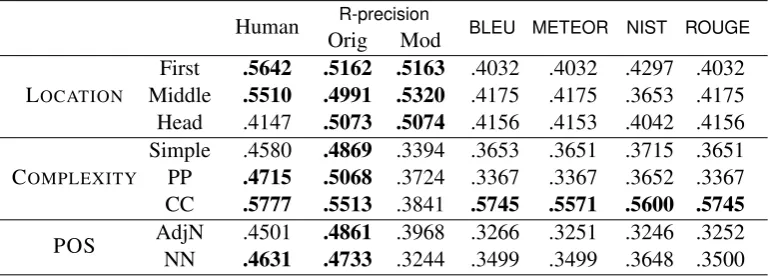
Human R-precision BLEU METEOR NIST ROUGE
Orig Mod
LOCATION
First .5642 .5162 .5163 .4032 .4032 .4297 .4032 Middle .5510 .4991 .5320 .4175 .4175 .3653 .4175 Head .4147 .5073 .5074 .4156 .4153 .4042 .4156
COMPLEXITY
[image:7.595.104.490.71.209.2]Simple .4580 .4869 .3394 .3653 .3651 .3715 .3651 PP .4715 .5068 .3724 .3367 .3367 .3652 .3367 CC .5777 .5513 .3841 .5745 .5571 .5600 .5745 POS AdjNNN .4501.4631 .4861.4733 .3968 .3266.3244 .3499 .3251.3499 .3246 .3252.3648 .3500
Table 5: Rank correlation between human majority andn-gram-based metrics
below the level ofR-precision. Due to the markedly lower performance of the semantic similarity-based method, we do not consider it for the re-mainder of our experiments. A general finding was that as the length of the keyphrase (L) got longer, the correlation tended to be higher across alln-gram-based metrics.
One disappointment at this stage is that the re-sults formodified R-precision are well below those of the original, especially over the average of the human annotators.
5.2 Correlation with Different NP Subtypes To get a clearer sense of how the different eval-uation metrics are performing, we broke down the keyphrases according to three syntactic sub-classifications: (1) the location of overlap (see Section 4.3); (2) the complexity of the NP (does the keyphrase contain a preposition [PP], a junction [CC] or neither a preposition nor a con-junction [Simple]?); and (3) the word class se-quence of the keyphrase (is the keyphrase an NN [NN] or an AdjN sequence [AdjN]?). We present the results in Tables 4 and Table 4 for the human average and majority, respectively, presenting re-sults inboldfacewhen the correlation for a given method is higher than for that same method in our holistic evaluation in Table 3 (i.e. .4506 and .4603, for the average and majority human scores, respectively).
All methods, including inter-annotator correla-tion, improve in raw numbers over the subsets of the data based on overlap location, indicating that the data was partitioned into more
internally-consistent subsets. Encouragingly, modified R-precisionequalled or bettered the performance of the original R-precision over each subset of the
data based on overlap location. Where modified R-precision appears to fall down most noticeably is over keyphrases including prepositions, as our assumption about the semantic import based on linear ordering clearly breaks down in the face of post-modifying PPs. It is also telling that it does worse over noun–noun sequences than adjective– noun sequences. In being agnostic to the effects of syntax, the originalR-precisionappears to
bene-fit overall. Another interesting effect is that the performance of BLEU, METEOR and ROUGE is notably better over candidates which match with non-initial and non-final words in the keyphrase.
We conclude from this analysis that keyphrase scoring should be sensitive to overlap location. Furthermore, our study also shows that n -gram-based MT and summarization metrics are sur-prisingly adept at capturing partial matches in keyphrases, despite them being much shorter than the strings they are standardly applied to. More compellingly, we found thatR-precisionis the best
6 Conclusion
In this work, we have shown that preexisting n -gram-based evaluation metrics from MT, summa-rization and keyphrase extraction evaluation are able to handle the effects of near-misses, and that
R-precisionperforms at or above the average level of a human annotator. We have also shown that a semantic similarity-based method which uses web data to model distributional similarity per-formed below the level of all of then-gram-based methods, despite them requiring no external re-sources (web or otherwise). We proposed a mod-ification to R-precision based on the location of match, but found that while it could achieve better performance over certain classes of keyphrases, its net effect was to drag the performance of R-precisiondown. Other methods were found to be
remarkably consistent across different subtypes of keyphrase.
Acknowledgements
Many thanks to the anonymous reviewers for their insightful comments. We wish to acknowledge the generous funding from National Research Foundation grant R 252-000-279-325 in support-ing Min-Yen Kan’s work.
References
Abhaya Agrwal and Alon Lavie. METEOR, M-BLEU and M-TER: Evaluation Metrics for High-Correlation with Human Rankings of Machine Translation Output. In Proceedings of ACL Work-shop on Statistical Machine Translation. 2008. Ken Barker and Nadia Corrnacchia. Using noun
phrase heads to extract document keyphrases. In Proceedings of BCCSCSI : Advances in Artificial Intelligence. 2000, pp.96–103.
Regina Barzilay and Michael Elhadad. Using lexi-cal chains for text summarization. InProceedings of ACL/EACL Workshop on Intelligent Scalable Text Summarization. 1997, pp. 10–17.
Chris Callison-Burch, Philipp Koehn, Christof Monz and Josh Schroeder. Proceedings of 4th Workshop on Statistical Machine Translation. 2009.
Ernesto D’Avanzo and Bernado Magnini. A Key-phrase-Based Approach to Summarization: the LAKE System at DUC-2005. In Proceedings of DUC. 2005.
Eibe Frank, Gordon W. Paynter, Ian H. Witten, Carl Gutwin and Craig G. Nevill-Manning. Domain Specific Keyphrase Extraction. In Proceedings of IJCAI. 1999, pp.668–673.
Mario Jarmasz and Caroline Barriere. Using semantic similarity over Tera-byte corpus, compute the per-formance of keyphrase extraction. InProceedings of CLINE. 2004.
Su Nam Kim, Olena Medelyan, Min-Yen Kan and Timothy Baldwin. SemEval-2010 Task 5: Auto-matic Keyphrase Extraction from Scientific Arti-cles. InProceedings of SemEval-2: Evaluation Ex-ercises on Semantic Evaluation. to appear.
Dawn Lawrie, W. Bruce Croft and Arnold Rosenberg. Finding Topic Words for Hierarchical Summariza-tion. InProceedings of SIGIR. 2001, pp. 349–357. Chin-Yew Lin and Edward H. Hovy. Automatic
Eval-uation of Summaries Using N-gram Co-occurrence Statistics. InIn Proceedings of HLT-NAACL. 2003.
Alvin Martin and Mark Przybocki. The 1999 NIST Speaker Recognition Evaluation, Using Summed Two-Channel Telephone Data for Speaker Detec-tion and Speaker Tracking. InProceedings of Eu-roSpeech. 1999.
Yutaka Matsuo and Mitsuru Ishizuka. Keyword Ex-traction from a Single Document using Word Co-occurrence Statistical Information. International Journal on Artificial Intelligence Tools. 2004, 13(1), pp. 157–169.
Olena Medelyan and Ian Witten. Thesaurus based automatic keyphrase indexing. In Proceedings of ACM/IEED-CS JCDL. 2006, pp. 296–297.
Rada Mihalcea and Paul Tarau. TextRank: Bringing Order into Texts. InProceedings of EMNLP 2004. 2004, pp. 404–411.
Guido Minnen, John Carroll and Darren Pearce. Ap-plied morphological processing of English. NLE. 2001, 7(3), pp. 207–223.
Thuy Dung Nguyen and Min-Yen Kan. Key phrase Extraction in Scientific Publications. InProceeding of ICADL. 2007, pp. 317–326.
Sebastian Pad´o, Michel Galley, Dan Jurafsky and Christopher D. Manning. Textual Entailment Fea-tures for Machine Translation Evaluation. In Pro-ceedings of ACL Workshop on Statistical Machine Translation. 2009, pp. 37–41.
Youngja Park, Roy J. Byrd and Branimir Boguraev. Automatic Glossary Extraction Beyond Terminol-ogy Identification. In Proceedings of COLING. 2004, pp. 48–55.
Mari-Sanna Paukkeri, Ilari T. Nieminen, Matti Polla and Timo Honkela. A Language-Independent Ap-proach to Keyphrase Extraction and Evaluation. In Proceedings of COLING. 2008, pp. 83–86.
Horacio Saggion, Dragomir Radev, Simon Teufel, Wai Lam and Stephanie Strassel. Meta-evaluation of Summaries in a Cross-lingual Environment us-ing Content-based Metrics. InProceedings of COL-ING. 2002, pp. 1–7.
Peter Turney. Coherent keyphrase extraction via Web mining. InProceedings of IJCAI. 2003, pp. 434– 439.
Xiaojun Wan and Jianguo Xiao. CollabRank: to-wards a collaborative approach to single-document keyphrase extraction. InProceedings of COLING. 2008, pp. 969–976.
Ian Witten, Gordon Paynter, Eibe Frank, Car Gutwin and Craig Nevill-Manning. KEA:Practical Auto-matic Key phrase Extraction. In Proceedings of ACM conference on Digital libraries. 1999, pp. 254–256.