Towards an implementable dependency grammar
T i m o J K r v i n e n and P a s i T a p a n a i n e n Research Unit for Multilingual Language Technology P.O. Box 4, FIN-00014 University of Helsinki, F i n l a n d
I
i
I
!
i
I
I
I
I
I
I
i
| !
i'
A b s t r a c t
Syntactic models should be descriptively ade- quate and parsable. A syntactic description is autonomous in the sense that it has certain ex- plicit formal properties. Such a description re- lates to the semantic interpretation of the sen- tences, and to the surface text. As the formal- ism is implemented in a broad-coverage syntac- tic parser, we concentrate on issues that must be resolved by any practical system that uses such models. The correspondence between the structure and linear order is discussed.
1 I n t r o d u c t i o n
The aim of this paper is to define a dependency grammar framework which is both linguistically motivated and computationally parsable.
A linguistically adequate grammar is the pri- mary target because if we fail to define a de- scriptive grammar, its application is less use- ful for any linguistically motivated purposes. In fact, our understanding of the potential bene- fits of the linguistic means can increase only if our practical solutions stand on an adequate de- scriptive basis.
Traditionally, grammatical models have been constructed by linguists without any consider- ation for computational application, and later, by computationally oriented scientists who have first taken a parsable mathematical model and then forced the linguistic description into the model which has usually been too weak to de- scribe what a linguist would desire.
Our approach is somewhere between these two extremes. While we define the grammar strictly in linguistic terms, we simultaneously test it in the parsing framework. What is excep- tional here is that the parsing framework is not restricted by an arbitrary mathematical model
such as a context-free phrase structure gram- mar. This leads us to a situation where the parsing problem is extremely hard in the gen- eral, theoretical case, but fortunately parsable in practise. Our result shows that, while in gen- eral we have an NP-hard parsing problem, there is a specific solution for the given g r a m m a r that can be run quickly. Currently, the speed of the parsing system I is several hundred words per second.
In short, the g r a m m a r should be empirically motivated. W e have all the reason to believe that if a linguistic analysis rests on a solid de- scriptive basis, analysis tools based on the the- ory would be more useful for practical purposes.
W e are studying the possibilities of using com-
putational implementation as a developing and testing environment for a grammatical formal- ism. W e refer to the computational implemen-
tation of a grammar as a parsing grammar.
1.1 A d e q u a c y
A primary requirement for a parsing grammar is that it is descriptively adequate. Extreme dis- tortion results if the mathematical properties
of the chosen model restrict the data. H o w - ever, this concern is not often voiced in the dis- cussion. For example, McCawley (1982, p. 92) notes that such a basic assumption concerning
linguistic structures that "strings are more basic than trees and that trees are available only as a side product of derivations that operate in terms of strings" was attributable to the historical ac- cident that early transformational grammarians knew some automata theory but no graph the-
Ory."
One reason for computationally oriented syn- tacticians to favour restricted formalisms is t h a t they are easier to implement. Those who began
I
i
I
I
I
!
i
I
I
I
I
!
i
I
I
I
I
to use dependency models in the 1960's largely ignored descriptive adequacy in order to develop models which were mathematically simple and, as a consequence, for which effective parsing al- gorithms could be presented. These inadequa- cies had to be remedied from the beginning, which resulted in ad hoc theories or engineering solutions 2 without any motivation in the theory. There have been some serious efforts to re- solve these problems. Hudson (1989), for exam- ple, has a t t e m p t e d to construct a parser that would reflecs the claims of the theory (Word Grammar) as closely as possible. However, it seems that even linguistically ambitious depen- dency theories, such as Hudson's Word Gram- mar, contain some assumptions which are at- tributable to certain mathematical properties of an established formalism rather than imposed by the linguistic d a t a 3. These kinds of unwar- ranted assumptions tend to focus the discus- sion on phenomena which are rather marginal, if a complete description of a language is con- cerned. No wonder that comprehensive descrip- tions, such as Quirk et al. (1985), have usually been non-formal.
1.2 T h e E u r o p e a n s t r u c t u r a l i s t t r a d i t i o n
We argue for a syntactic description that is based on dependency rather than constituency, and we fully agree with Haji~ovA (1993, p. 1) t h a t "making use of the presystemic insights of classical European linguistics, it is then possi- ble that constituents may be dispensed with as basic elements of (the characterization of) the sentence structure." However, we disagree with the notion of "presystemic" if it is used to imply that earlier work is obsolete. From a descriptive point of view, it is crucial to look at the d a t a t h a t was covered by earlier non-formal gram- marians.
• As far as syntactic theory is concerned, there is no need to reinvent the wheel. Our de- scription has its basis in the so-called "classi- cal model" based on the work of the French linguist Lucien Tesni~re. His structural model should be capable of describing any occurring
2See discussion of an earlier engineering art in apply- ing a dependency grammar in Kettunen (1994).
3For instance, the notion of adjacency was redefined in WG, but was still unsuitable for "free ~ word order languages.
2
natural language. His main work, (1959) ad- dresses a large amount of material from typo- logically different languages. It is indicative of Tesni~re's empirical orientation t h a t there are examples from some 60 languages, though his method was not empirical in the sense t h a t he would have used external d a t a inductively. As Heringer (1996) points out, Tesni~re used d a t a merely as an expository device. However, in order to achieve formal rigour he developed a
model of syntactic description, which obviously stems from the non-formal tradition developed since antiquity but without compromising the descriptive needs. We give a brief historical overview of the formal properties inherent in Tesni~re's theory in Section 5 before we proceed t o the implementational issues in Section 6.
1.3 T h e s u r f a c e s y n t a c t i c a p p r o a c h
We aim at a theoretical framework where we have a dependency theory t h a t is both descrip- tively adequate and formally explicit. The lat- ter is required by the broad-coverage parsing grammar for English that we have implemented. We maintain the parallelism between the syn- tactic structure and the semantic structure in our design of the syntactic description: when a choice between alternative syntactic construc- tions in a specific context should be made, the semantically motivated alternative is selected 4. Although semantics determines what kind of structure a certain sentence should have., from the practical point, of view, we have a completely different problem: how to resolve the syntactic structure in a given context. Sometimes, the latter problem leads us back to redefine the syn- tactic structure so that it can be detected in the sentence s . Note, however, that this redef- inition is now made on a linguistic basis. In order to achieve parsability, the surface descrip-
41n such sentence as "I asked John to go home", the
noun before the infinitive clause is analysed as the (se- mantic) subject of the infinitive rather than as a com- plement of the governing verb.
SFor instance, detecting the distinct roles of the to- infinitive clause in the functional roles of the purpose or reason is usually difficult (e.g. Quirk et al. (1985, p. 564): "Whg did he do itf; purpose: "To relieve his anger" and reason: "Because he was angry"). In such
sentence as UA m a n came to the p a r t y to have a good time", the interpretation of the infinitive clause depends
on the interaction of the contextual and lexical semantics
rather than a structural distinction.
I
i
I
I
I
I
I
1
I
!
i
I
i
ill
m !
tion should not contain elements which can not be selected by using contextual information. It is important that the redefinition should not be made because an arbitrary mathematical model denies e.g. crossing dependencies between the syntactic elements.
2 C o n s t i t u e n c y v s . d e p e n d e n c y
A central idea in American structuralism was to develop rigorous mechanical procedures, i.e. "discovery procedures", which were assumed to decrease the grammarians' own, subjective assessment in the induction of the grammars. This practice was culminated in Harris (1960, p. 5), who claimed that "the main research of descriptive linguistics, and the only rela- tion which will be accepted as relevant in the present survey, is the distribution or arrange-
ment within the flow of speech of some parts or features relative to others."
The crucial descriptive problem for a distri- butional grammar (i.e. phrase-structure gram- mar) is the existence of non-contiguous ele- ments. The descriptive praxis of some earlier IC theoricians allows discontiguous constituents. For example, already Wells (1947) discussed the problem at length and defined a restriction for discontiguous constituents 6. Wells' restriction implies that a discontiguous sequence can be a constituent only if it appears as a contigu- ous sequence in another context. This means that Wells' characterisation of a constituent de- fines an element which is broadly equivalent to the notion of bunch in Tesni~re's (1959} the- ory. Consequently, these two types of grammars are capable of describing the equivalent syntac- tic phenomena and share the assumption that a syntactic structure is compatible with its se- mantic interpretation. However, the extended constituent grammar thus no longer provides a rigorous distributional basis for a description, and its formal properties are unknown.
We can conclude our argument by stating that the reason to reject constitutional gram- mars is that the formal properties for descrip-
6Wells (1947): "A d i s c o n t i n u o u s sequence is a con-
s t i t u e n t i l in s o m e e n v i r o n m e n t the corresponding contin- uous sequence o c c u r s as a c o n s t i t u e n t in a c o n s t r u c t i o n
s e m a n t i c a l l y h a r m o n i o u s with t h e c o n s t r u c t i o n s in which
the given d i s c o n t i n u o u s sequence occurs." Further, Wells
notes that "The phrase s e m a n t i c a l l y h a r m o n i o u s is left
undefined, and will merely be elucidated by examples."
3
tively adequate constitutional grammars are not known. In the remaining sections, we show t h a t a descriptively adequate dependency model can be constructed so that it is formally explicit and parsable.
3 P a r a l l e l i s m b e t w e e n t h e s y n t a c t i c a n d s e m a n t i c s t r u c t u r e s
Obviously, distributional descriptions that do not contribute to their semantic analysis can be given to linguistic strings. Nevertheless, the minimal descriptive requirement should be that a syntactic description is compatible with the semantic structure. The question which arises is that if the correspondence between syntactic and semantic structures exists, why should these linguistic levels be separated. For example, Sgall (1992, p. 278) has questioned the necessity of the syntactic level altogether. His main argument for dispensing with the whole surface syntactic level is that there are no strictly synonymous syntactic constructions, and he therefore suggests that the surface word order belongs more properly to the level of mor- phemics. This issue is rather complicated. We agree that surface word order does not belong to syntactic structure, but for different reasons. In contradistinction to Sgall's claim, Mel'~uk (1987, p. 33) has provided some evidence where the morphological marker appears either• in the head or the dependent element in different lan- guages, as in the Russian "kniga professor+a" (professor's book) and its Hungarian equivalent '~professzor kSnyv÷e'. Consequently, Mel'~uk (1987, p. 108) distinguishes the morphological dependency as a distinct type of dependency. Thus morphology does not determine the syn- tactic dependency, as Tesni~re (1959, Ch. 15) also argues.
For Tesni~re (1959, Ch. 20:17) meaning (Fr. sens) and structure are, i n principle, inde- pendent. This is backed by the intuition that one recognises the existence of the linguistic structures which are semantically absurd, as il- lustrated by the structural similarity between the nonsensical sentence "Le silence vertebral indispose la voie licite" and the meaningful sen- tence "Le signal vert indique la voie libre".
I
I
I
I
I
I
i
I
I
I
I
I
I
I
l
I
I
the semantic structure, but not vice versa. This means that whenever there is a syntactic rela- tion, there is a semantic relation (e.g. comple- mentation or determination) going in the op- posite direction. In this view, the syntactic head requires semantic complementation from its dependents. Only because the syntactic and semantic structures belong to different levels is there no interdependency or mutual depen- dency, though the issue is sometimes raised in the literature.
There is no full correspondence between the syntactic and semantic structures because some semantic relations are not marked in the func- tional structure. In Tesni~re (1959, p. 85), for example, there are anaphoric relations, seman- tic relations without correspondent syntactic re- lations.
4 S u r f a c e r e p r e s e n t a t i o n a n d s y n t a c t i c s t r u c t u r e
4.1 T h e n u c l e u s a s a s y n t a c t i c p r i m i t i v e The dependency syntactic models are inher- ently more "word oriented" than constituent- structure models, which use abstract phrase cat- egories. The notion of word, understood as an orthographic unit in languages similar to En- glish, is not the correct choice as a syntactic primitive. However, many dependency theo- ries assume that the orthographic words directly correspond r to syntactic primitives (nodes in the trees). Although the correspondence could be very close in languages like English, there are languages where the word-like units are much longer (i.e. incorporating languages).
TesniSre observed that because the syntactic connexion implies a parallel semantic connex- ion, each node has to contain a syntactic and a semantic centre. The node element, or
nucleus,
is the genuine syntactic primitive. There is no one-to-one correspondence between nuclei and orthographic words, but the nucleus consists of one or more, possibly discontiguous, words or parts of words. The segmentation belongs to the linearisation, which obeys language-specific rules. Tesni~re (1959, Ch 23:17) argued that the notionword,
a linear unit in a speech-chain, does not belong to syntactic description at all.A word
is nothing but asegment
in the speech chain (1959, Ch 10:3).7See Kunze (1975, p. 491) and Hudson (1991).
The basic element in syntactic description is the nucleus. It corresponds to a node in a de- pendency tree. When the sentence is repre- sented as a dependency tree, the main node con- tains the whole verb chain.
There are at least two reasons why the con- cept of the nucleus is needed. In the first place, there are no cross-linguistically valid criteria to determine the head in, say, a prepositional phrase. One may decide, arbitrarily, that ei- ther the preposition or the noun is the head of the construction. Second, because the nucleus is also the basic semantic unit, it is the minimal unit in a lexicographical description.
4 . 2 L i n e a r i s a t i o n
Tesni~re makes a distinction between the
linear
order, which is a one-dimensional property of the physical manifestations of the language, and thestructural order,
which is two-dimensional. According to his conception, constructing the structural description is converting the linear order into the structural order. Restricting him- self to syntactic description, Tesni~re does not formalise this conversion though he gives two main principles: (1) usually dependents either immediately follow or precede their heads (pro- jectivity) and when they do not, (2) additional devices such as morphological agreement can in- dicate the connexion.Although Tesni~re:s distinction between the linear and structural order corresponds to some extent with the distinction between the linear precedence (LP) and the immediate dominance, there is a crucial difference in emphasis with re- spect to those modern syntactic theories, such as GPSG, that have distinct ID and LP compo- nents. Tesni~re excludes word order phenom- ena from his structural syntax and therefore does not formalise the LP component at all. Tesni~re's solution is adequate, considering that in many languages word order is considerably free. This kind of "free" word order means that the alternations in the word order do not neces- sarily change the meaning of the sentence, and therefore the structural description implies sev- eral linear sequences of the words. This does
n o t mean that there are no restrictions in the linear word order but these restrictions do not emerge in the structural analysis.
In fact, Tesni~re assumes that a restriction that is later formalised as an
adjacency princi-
!
!
!
!
'i
ple characterizes the neutral word order when he says t h a t there are no syntactic reasons for vio- lating adjacency in any language, but the prin- ciple can be violated, as he says, for stylistic
reasons or to save the metric structure in poet-
ics. If we replace the stylistic reasons with the more broader notion which comprises the dis- course functions, his analysis seems quite con- sistent with our view. Rather than seeing that there are syntactic restrictions concerning word order, one should think that some languages due to their rich morphology have more freedom in using word order to express different discourse functions. Thus, linearisation rules are not for- mal restrictions, but language-specific and func- tional.
There is no need for constituents. Tesni~re's theory has two mechanisms to refer to linearisa- tion. First, there are static functional categories with dynamic potential to change the initial cat- egory. Thus, it is plausible to separately define the combinatorial and linearisation properties of each category. Second, the categories are hierar- chical so that, for instance, a verb in a sentence governs a noun, an adverb or an adjective. The lexical properties, inherent to each lexical ele- ment, determine what the governing elements are and what elements are governed.
There are no simple rules or principles for linearisation. Consider, for example, the treat- ment of adjectives in English. The basic rule is that attributive adjectives precede their heads. However, there are notable exceptions, includ- ing the postmodified adjectives s, which follow their heads, and some lexical exceptions 9, which usually or always are postmodifying.
5 H i s t o r i c a l f o r m u l a t i o n s
In this section, the early formalisations of the dependency grammar and their relation to Tesni~re's theory are discussed. The depen- dency notion was a target of extensive formal studies already in the first half of the 1960's l°.
8Example: "It is a phenomenon consistent with ..."
9Example: "president el.ect"
l°A considerable number of the earlier studies were listed by Marcus (1967, p. 263), who also claimed that
"Tesni~re was one ol the first who used (dependency) graphs in syntax. His ideas n,ere repeated, developed and precised by Y. Lecer] ~ P. l"hm (1960), L. Hirschbe~ and L Lynch, particularly by studying syntactic projectivity and linguistic subtrees."
5 . 1 G a i f m a n ' s f o r m u l a t i o n
The classical studies of the formal properties of dependency grammar are Gaifman (1965) and Hays (1964) 11, which demonstrate t h a t de- pendency grammar of the given type is weakly equivalent to the class of context-free p h r a s e structure grammars. The formalisation of de- pendency grammars is given in Gaifman (1965, p. 305): For each category X , there will be a fi- nite number of rules of the t y p e X (YI, Y2"'" Y! * F i + t - . "Yn), which means that YI"" "Y~ can de- pend on X in this given order, where X is to occupy the position of , .
Hays, referring to Gaifman's formulation above, too strongly claims t h a t "[d]ependency theory is weakly omnipotent to I C theory. The proof is due to Gaifman, and is too lengthy to
present here. The consequence o f Gaifman's
theorem is that the class of sets of utterances [...] is Chomsky's class of context-free languages."
This claim was later taken as granted to ap- ply to any dependency grammar, and the first, often cited, attestation of this apparently false claim appeared in Robinson (1970). She pre- sented four axioms of the theory and claimed t h e y were advocated by Tesni~re and formalised by Hays and Gaifman.
Thus, the over-all result of the Gaifman- Hays proof was that there is a weak equiv- alence of dependency theory and context-free phrase-structure grammars. This weak equiva- lence means only that both grammars charac-
S lTesni~re is not mentioned in these papers. Gaif- man's paper describes the results "... obtained while the author was a consultant for the RAND Corporation in the summer of 1960. ~ Whereas phrase-structure sys- tems were defined by referring to Chomsky's Syntactic Structures, the corresponding definition for the depen- dency systems reads as follows: "By dependency system we mean a system, containing a finite number of rules, by which dependency analysis for certain language is done, as described in certain RAND publications (Hays: Febru- ary 1960; Hays and Ziehe, April 1960). ~ Speaking of the dependency theory, Hays (1960) refers to the Soviet work on machine translation using the dependency theory of Kulagina et al. In Hays (1964), the only linguistic refer- ence is to the 1961 edition of Hjelmslev's Prolegomena:
"Some of Hjelmslev's empirical principles are closely re- lated to the insight behind dependency theory, but em- pirical dependency in his sense cannot be identified with abstract dependency in the sense of the present paper,
since he explicitly differentiates dependencies 1ram other
kinds at relations, whereas the present theorlt intends to
I
I
I
I
I
!
I
I
I
I
I
I
I
I
I
terize the same sets of strings. Unfortunately, this formulation had little to do with TesniSre's dependency theory, but as this result met the re- quirements of a characterisation theory, interest in the formal properties of dependency grammar diminished considerably.
5.2 L i n g u i s t i c h y p o t h e s e s
Tesni~re's Hypothesis, as Marcus (1967) calls it, assumes t h a t each element has exactly one head. Marcus also formulates a stronger hypothesis, the Projectivity hypothesis, which connects the linear order of the elements of a sentence to the structural order of the sentence. The hypoth- esis is applied in the following formulation: let
X "- a l a 2 . . . a i . . . a n be a sentence, where ai and
aj are terms in the sentence. If the term ai is subordinate to the term aj, and there is an in- dex k which holds m i n ( i , j ) < k < max(i,j), then the term ak is subordinate to the term a j .
This is the formal definition of projectivity, also known as adjacency or planarity. The intu- itive content of adjacency is that modifiers are placed adjacent to their heads. The intuitive content behind this comes from Behaghel's First Law 12 (Siewierska, 1988, p. 143).
The adjacency principle is applicable only if the linear order of strings is concerned. How- ever, the target of Tesni~re's syntax is struc- tural description and, in fact, Tesnibre discusses linear order, a property attributable to strings, only to exclude linearisation from his concep- tion of syntax. This means that a formalisa- tion which characterises sets of strings can not even be a partial formalisation of Tesni~re's the- ory b e c a u s e his syntax is not concerned with strings, but structures. Recently, Neuhaus and BrSker (1997) have studied some formal prop- erties of dependency grammar, observing that Gaifman's conception is not compatible either with Tesnibre's original formulation or with the
"current" variants of DG.
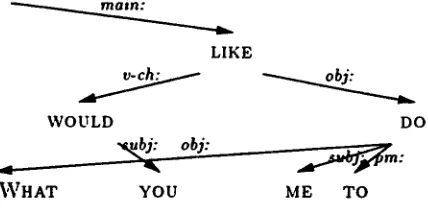
There are several equivalent formalisations for this intuition. In effect they say that in a syntactic tree, where words are printed in lin- ear order, the arcs between the words must not cross. For example, in our work, as the arc be- tween the node "what" and the node "do" in
l~ "The most important law is that what belongs to*
gether mentally (semantically) is placed close together
syntactically."
"---- main:
LIKE
WOULD DO
~VHAT YOU M E T O
Figure 1: Non-projective dependency tree
Figure I violates the principle, the construction is non-projective.
5.3 F o r m a l p r o p e r t i e s o f a
T e s n i ~ r e - t y p e D G
Our current work argues for a dependency grammar that is conformant with the original formulation in Tesni~re (1959) and contains the following axioms:
• The primitive element of syntactic descrip- tion is a nucleus.
• Syntactic structure consists of connexions between nuclei.
• Connexion (Tesnikre, 1959, Ch. 1:11) is a binary functional relation between a supe- rior term (regent.) and inferior term (depen- dent).
• Each nucleus is a node in the syntactic tree and it has exactly one regent (Tesnibre, 1959, Ch. 3:1).
• A regent, which has zero or more depen- dents, represents the whole subtree.
• The uppermost regent is the central node of the sentence.
These axioms define a structure graph which is acyclic and directed, i.e. the result is a tree. These strong empirical claims restrict the the- ory. For example, multiple dependencies and all kinds of cyclic dependencies, including mutual dependency, are excluded. In addition, there can be no isolated nodes.
However, it is not required that the structure be projective, a property usually required in many formalised dependency theories t h a t do
I
I
[image:6.612.333.547.49.154.2]!
'i
S
I i
i
i
| i
Ii
i
l
not take into account the empirical fact that non-projective constructions occur in natural languages.
6 T h e F u n c t i o n a l D e p e n d e n c y G r a m m a r
Our parsing system, called the Functional De- pendency G r a m m a r (FDG), contains the follow- ing parts:
• the lexicon,
• the CG-2 morphological disambiguation (Voutilainen, 1995; Tapanainen, 1996), and
• the Functional Dependency Grammar (Ta- panainen and J~rvinen, 1997; J~irvinen and Tapanainen, 1997).
6.1 O n t h e f o r m a l i s m a n d o u t p u t
It has been necessary to develop an expressive formalism to represent the linguistic rules that build up the dependency structure. The de- scriptive formalism developed by Tapanainen can be used to write effective recognition gram- mars and has been used to write a comprehen- sive parsing grammar of English.
When doing fully automatic parsing it is necessary to address word-order phenomena. Therefore, it is necessary that the grammar for- realism be capable of referring simultaneously both to syntactic order and linear order. Obvi- ously, this feature is an extension of Tesni~re's theory, which does not formalise linearisation. Our solution, to preserve the linear order while presenting the structural order requires that functional information is no longer coded to the canonical order of the dependents Is.
In the FDG output, the functional informa- tion is represented explicitly using arcs with la- bels of syntactic functions. Currently, some 30 syntactic functions are applied.
To obtain a closer correspondence with the semantic structure, the nucleus format corre- sponding to Tesni~re's stemmas is applied. It
lSCompare this solution with the Prague approach, which uses horizontal ordering as a formal device to e x - p r e s s the topic-focus articulation at their tectogrammat- ical level. The mapping from the tectogrammatical level
t o the linear order requires separate rules, called 8hallow rules (Petkevi~, 1987). Before such a description e x i s t s ,
one can not make predictions concerning the complexity of the grammar.
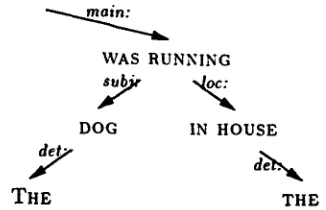
WAS RUNNING DOG IN HOUSE
T H E THE
Figure 2: "The dog was running in the house"
~ f f l l [ l i l l ."
DID RUN
DOG IN HOUSE
aep-
THE THE
Figure 3: "Did the dog run in the house"
is useful for many practical purposes. Con- sider, for example, collecting arguments for a given verb "RUN". Having the analysis such as those illustrated in Figure 2, it is easy to ex- cerpt all sentences where the governing node is verbal having a main element that has "run" as the base form, e.g. ran, "was running" (Fig- ure 2), "did run" {Figure 3). The contraction form "won't run" obtains the same analysis (the same tree although the word nuclei can contain extra information which makes the distinction) as a contraction of the words "will not run".
As the example shows, orthographic words were segmented whenever required by the syntactic analysis.
This solution did not exist prior the FDG and generally is not possible in a monostratal dependency description, which takes the (or- thographic) words as primitives. The problem is that the non-contiguous elements in a verb- chain are assigned into a single node while the subject in between belongs to its own node.
[image:7.612.353.516.60.165.2] [image:7.612.351.518.229.337.2]tains a lexico-functional level closely similar to the syntactic analysis of the earlier English Con- straint G r a m m a r ( E N G C G ) (Karlsson et al. , 1995) parsing system. The current F D G for- malism overcomes several shortcomings 14 of the earlier approaches: (1) the F D G does not rely on the detection of clause boundaries, (2) pars- ing is no longer sequential, (3) ambiguity is rep- resented at the clause level rather than word level, (4) due to explicit representation of de- pendency structure, there is no need to refer to phrase-like units. Because the F D G rule formal- ism is more expressive, linguistic generalisation can be formalised in a more transparent way, which makes the rules more readable.
7 D e s c r i p t i v e s o l u t i o n s
7.1 C o o r d i n a t i o n
W e now tackle the problem of how coordination
can be represented in the framework of depen- dency model. For example, Hudson (1991) has argued that coordination is a phenomenon that requires resorting to a phrase-structure model.
Coordination should not be seen as a directed functional relation, but instead as a special con- nexion between two functionally equal elements. The coordination connexions are called junc- tions in Tesnibre (1959, Chs. 134-150). Tesni~re considered junctions primarily as a mechanism to pack multiple sentences economically into one. Unfortunately, his solution, which repre- sents all coordinative connexions in stemmas, is not adequate, because due to cyclic arcs the result is no longer a tree.
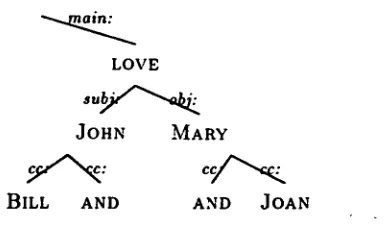
Our solution is to pay due respect to the for- mal properties of the dependency model, which requires that each element should have one and only one head} 5 This means that coordinated elements are chained (Figure 4) using a specific arc for coordination (labeled as
cc).
The coordi- nators are mostly redundant markers (Tesnibre, 1959, Ch. 39:5) 16, especially, they do not have~4Listed in Voutilainen (1994).
lSThe treatment of coordination and gapping in Ka- hane (1997) resembles ours in simple cases. However, this model maintains projectivity, and consequently, both multiple heads and extended nuclei, which are es- sentially phrase-level units, are used in complex cases, making the model broadly similar to Hudson (1991).
~The redundancy is shown in the existence of asyn- detic coordination. As syntactic markers, coordinators are not completely void of semantic content, which is
8
LOVE
JOHN MARY
BILL A N D A N D J O A N
Figure 4: Coordinated elements
any (governing) role in the syntactic structure as they do in many word-based forms of depen- dency theory (e.g, Kunze (1975) and Mel'/:uk (1987)).
Unlike the other arcs in the tree, the arc marking coordination does not imply a depen- dency relation but rather a functional equiva- lence. If we assume that the coordinated el- ements have exactly the same syntactic func- tions, the information available is similar to t h a t provided in Tesnibre:s representation. If needed, we can simply print all the possible combina- tions of the coordinated elements:
"Bill loves
Mary", "John loves Mary ~,
etc.7.2 G a p p i n g
It is claimed that gapping is even a more se- rious problem for dependency theories, a phe- nomenon which requires the presence of non- terminal nodes. The treatment of gapping, where the main verb of a clause is missing, fol- lows from the treatment of simple coordination.
In simple coordination, the coordinator has an auxiliary role without any specific function in the syntactic tree. In gapping, only the coor- dinator is present while the verb is missing. One can think that as the coordinator represents all missing elements in the clause, it inherits all properties of the missing (verbal) elements (Fig- ure 6). This solution is also computationally effective because we do not need to postulate empty nodes in the actual parsing system.
From a descriptive point of view there is no problem if we think that the coordinator ob- tains syntactic properties from the nucleus t h a t
demonstrated !)5' the existence of contrasting set of co- ordinators; 'and', 'or', 'but' etc.
[image:8.612.363.555.55.173.2]=!
I I
i I
<John>
"John" N SG @SUBJ subj:>2 <gave>
"give" V PAST ~,+FV # 2 main:>0 < t h e >
"the" DET ART SG/PL ~.'DN> det:>4 <lecture>
"lecture" N SG ~OBJ # 4 obj:>2 <on>
"on" P R E P @ADVL # 5 tmp:>2 <Tuesday>
"Tuesday" N SG ~ < P pcomp:>5 <and>
"and" CC ~ C C # 7 cc:>2 <Bill>
"Bill" N SG @SUBJ subj:>7 <on>
"on" P R E P ~ADVL # 9 tmp:>7 <Wednesday>
"Wednesday" N SG ~ < P pcomp:>9 < . >
Figure 5: Text-based representation
it is connected to. Thus, in a sentence with ver-
bal ellipsis, e.g. in the sentence "Jack painted
the kitchen white and the living room blue", the coordinator obtains the subcategorisation prop- erties of a verb. A corresponding graph is seen in Figure 6.
Due to 'flatness' of dependency model, there is no problem to describe gapping where a sub- ject rather than complements are involved, as the Figure 5 shows. Note that gapping provides clear evidence that the syntactic element is a
nucleus rather than a word. For example, in
the sentence "Jack has been lazy and Jill an-
gry', the elliptic element is the verbal nucleus
has been.
8 C o n c l u s i o n
This paper argues for a descriptively adequate syntactic theory that is based on dependency
rather than constituency. Tesni~re's theory
seems to provide a useful descriptive framework for syntactic phenomena occurring in various natural languages. We apply the theory and develop the representation to meet the require- ments of computerised parsing description. Si-
9
multaneously, we explicate the formal proper- ties of Tesni~re;s theory that are used in con- structing a practical parsing system.
A solution to the main obstacle to the utilisa- tion of the theory, the linearisation of the syn- tactic structure, is presented. As a case study, we reformulate the theory for the description of coordination and gapping, which are difficult problems for any comprehensive syntactic the- ory.
Acknowledgments
We thank Fred Karlsson, Atro Voutilainen and three Coling-ACL '98 workshop referees for useful comments on earlier draft of this paper.
R e f e r e n c e s
Haim Gaifman. 1965. Dependency systems and
phrase-structure systems. Information and
Control, 8:304-337.
Eva Haji~:ov~i. 1993. Issues of Sentence Struc-
tune and Discourse Patterns, volume 2 of
Theoretical and Computational Linguistics.
Institute of Theoretical and Computational Linguistics, Charles University, Prague.
Zellig S. Harris. 1960. Structural Linguistics.
Phoenix Books. The University of Chicago Press, Chicago & London, first Phoenix edi- tion. Formerly entitled: Methods in Struc- tural Linguistics, 1951.
David G. Hays. 1960. Grouping and depen- dency theories. Technical Report RM-2646, The RAND Corporation, September.
David G. Hays. 1964. Dependency theory: A
formalism and some observations. Language,
40:511-525.
Hans Jiirgen Heringer. 1996. Empiric und Intu- ition bei Tesni~re. In Gertrud Greciano and
Helmut Schumacher, editors, Lucien Tesni~ne
- Syntaze structurale et operations mentales,
volume 330 of Linguistische Arbeiten, pages
15-31. Niemeyer.
Richard Hudson. 1989. Towards a computer-
testable word grammar of English. UCL
working papers in Linguistics, 1:321-338.
Richard Hudson. 1991. English Ilion/ Gram-
mar. Basil Blackwell, Cambridge, MA. Timo J~rvinen and Pasi Tapanainen. 1997. A
PAINTED
7
J A C K KITCHEN WHITE AND
THE LIVING_ROOM BLUE
THE
Figure 6: Jack painted the kitchen white and the living room blue.
tactic representations. In Becker and Krieger,
editors, Proceedings 5th Meeting of Mathe-
matics of language, Saarbriicken, DFKI. Fred Karlsson, Atro Voutilainen, Juha Heikkil~i,
and Arto Anttila, editors. 1995. Constraint
Grammar: a language-independent system for parsing unrestricted text, volume 4 of
Natural Language Processing. _Mouton de Gruyter, Berlin and New York.
Kimmo Kettunen. 1994. Evaluating FUNDPL, a dependency parsing formalism for Finnish. In Research in Humanities Computing, vol- ume 2, pages 47-63. Clarendon Press, Oxford.
Jiirgen Kunze. 1975. Abh6ngigkeitsgrammatik.
Akadenaie-Verlag, Berlin.
Solomon Marcus. 1967. Introduction
mathdmatique h la linguistique structurale.
Dunod, Paris.
James D. McCawley. 1982. Parentheticals and
discontinuous constituent structure. Linguis-
tic Inquiry, 13(1):91-106.
Igor A. Mel'~.uk. 1987. Dependency Syntax:
Theory and Practice. State University of New York Press, Albany.
Peter Neuhaus and Norbert BrSker. 1997. The complexity of recognition of linguistically
adequate dependency grammars. In ACL-
EACL'97 Proceedings, pages pp. 337-343, Madrid, Spain, July. Association for Compu- tational Linguistics.
Vladimir Petkevi~:. 1987. A new dependency
based specification. Theoretical Linguistics,
14:143-172.
Randolph Quirk, Sidney Greenbaum, Geoffrey
10
Leech, and Jan Sx~rtvik. 1985. A Compre-
hensive Grammar of the English Language.
Longman, Harcourt.
Jane J. Robinson. 1970. Dependency struc-
tures and transformational rules. Language,
46:259-285.
Petr Sgall. 1992. Underlying structure of sen-
tences and its relations to semantics. Wiener
Slawistischer Almanach, Sonderband 30:349- 368.
Anna Siewierska. 1988. Word Order Rules.
Croom Hehn, London.
Pasi Tapanainen and Timo J~irvinen. 1997. A
non-projective dependency parser. In Pro-
ceedings of the 5th Conference on Applied Natural Language Processing, Washington, D.C, pages 64-71, Washington, D.C.,April. Association for Computational Linguistics. Pasi Tapanainen. 1996. The constraint gram-
mar parser CG-2. Publications 27, Depart- ment of General Linguistics, University of Helsinki, Finland.
Lucien Tesni~re. 1959. Elgments de syntaxe
structurale. Editions Klincksieck, Paris.
Atro Voutilainen. 1994. Designing a Parsing
Grammar. Publications of Department of General Linguistics, University of Helsinki, No. 22, Helsinki.
Atro Voutilainen. 1995. Morphological disam- biguation. In Karlsson et al. (1995), chap- ter 6, pages 165-284.
Rulon S. Wells. 1947. Immediate constituents.
Language. Reprinted in Martin Joos: Read- ings In Linguistics I, 1957, pp. 186-207.
I-
i
[image:10.612.120.544.50.189.2]