CHE KU SUFIAH BT CHE KU ABDULLAH
A project report submitted in partial fulfillment of the requirements for the award of the degree of Master Science (Construction Management)
Faculty of Civil Engineering
ACKNOWLEDGEMENT
First and foremost, I would like to thank to Allah S.W.T. for giving me the strength and blessing to complete this project. It is really a great pleasure after working on this study completely. Alhamdulilhah.
I would also like to address my sincere appreciation to my thesis supervisor, Prof. Dr. Aminah bt. Md Yusof for her guidance, advice and invaluable assistance to successfully complete this project.
I would also like to take this opportunity to extend my gratitude to the staff of PWD and individuals who are involved directly and indirectly for their assistance and cooperation in giving relevant information while conducting this project.
ABSTRACT
ABSTRAK
Proses pemilihan tender merupakan satu proses yang sangat penting di peringkat pra-kontrak dan memerlukan pertimbangan serta penilaian yang wajar dan berhati-hati. Oleh yang demikian, Jabatan Kerja Raya (JKR) telah memperkenalkan satu sistem statistik yang dikenali sebagai sistem „cut-off‟ untuk membantu proses pemilihan tender yang lebih efektif. Anggaran Jabatan adalah sebagai salah satu data untuk menghasilkan harga „cut-off‟ dan menjadi asas dalam pemilihan tender. Walau bagaimanapun, sejak kebelakangan ini Anggaran Jabatan yang digunakan dianggap tidak munasabah oleh sesetengah pihak memandangkan terdapatnya perbezaan yang ketara diantara Anggaran Jabatan dan paras harga „cut-off‟. Pada hari ini, kebanyakan tender yang menggunakan sistem „cut-off‟ dipilih berdasarkan paras harga „cut-off‟ tanpa mengambilkira kedudukan Anggaran Jabatan. Justeru, kajian ini dilaksanakan untuk mengkaji fungsi, kebergantungan dan keberkesanan Anggaran Jabatan didalam sistem „cut-off‟. Antara objektif-objektif dalam kajian ini adalah untuk mengkaji proses penilaian tender yang dipraktikkan di JKR, untuk melihat proses dan prosedur penyediaan Anggaran Jabatan dan menilai keberkesanan Anggaran Jabatan dalam penilaian tender yang menggunakan sistem „cut-off‟. Hasil daripada kajian ini diharapkan dapat membantu untuk meningkatkan kemunasabahan Anggaran Jabatan dan sentiasa mengambilkira Anggaran Jabatan sebagai salah satu asas untuk memilih petender yang paling berkelayakan bagi melaksanakan sesuatu projek.
INTRODUCTION
1.1 Introduction
In order to accomplish these processes it requires many stakeholders and parties in multi disciplines to produce building and infrastructure. Every stakeholder and party involve has their own responsibility and liability to ensure the project completed within the stipulated design, specification, time, cost and quality. One of the significant processes in the construction industry is procurement process and one of the elements in the procurement process is the selection of the contractor. The selection of competent contractor and competitive price among the bidders are the challenges need to be faced by the evaluator in the assessment of tender. Meanwhile, contractor also faces problems in preparing and compiling the documentations required within the restricted time and need to compete with other contractors.
The selection of tender is a very significant process during the pre-contract stage and need to assess meticulously. Hence, every party involves in the evaluation of tenders regardless the private or public sector, has their own system and technique to evaluate the tender effectively. Generally, the basis of evaluation and factor of consideration should be similar.
Traditionally, tenders have been assessed based on the lowest price offered by the contractor. This probably led to bidders reducing their tender price at the first place for the sake of winning the tender. Furthermore, they will increase the price through variations of works and claims. Essentially, the lowest tender price will result in low quality of building and infrastructure. Therefore we cannot only judge the lowest price as the most qualified bidders and ignoring other consideration. In essence, tender must be assessed based on the value for money and meet the client‟s requirement.
is unreasonable and any amendment towards the department estimate is only giving advantage to the certain contractors. Therefore the PWD has introduced a method that approach on the statistical method in which the reasonableness of the tender price is compared to the level of cut-off.
1.2 Problem statement
Public Works Department (PWD) has been using cut-off method since 2002 for evaluating the tender price offered by the contractors. The level of cut-off will be determined by the statistical method and the tender price will be compared with the cut-off level. The cut-cut-off level is considered as the lowest price by taking into consideration the current market price. Therefore, the tender price is considered too low if its position is below than cut-off level and it possibly will affect the contractor‟s performance. Department estimate is one of the data or price to be incorporated in this statistical system.
has become a guideline for the PWD on the tender using the cut-off method when selecting the contractor. Department estimate is an important data to be incorporated in the cut-off system. Furthermore, this estimate is also functioning as a basis for comparing the tender price submitted by the contractors and to ensure the tender rate is relevant to be accepted.
According to the Director General Of Public Works Department Instruction Letter date 13 Mei 2009, the assessment of tender must be made towards the tender prices offered until (-)15.99% of the builder‟s work mean. Formerly the evaluation was only carried out for those who offer the price (-)15% of the builder‟s work and above. By referring to the Director General‟s Letter, the Board of Acquisition of the Public Works Department has more space and alternative to select the contractor.
The department estimate is prepared based on the architectural drawing and structural detail drawing after the tender closing date. This estimate is also prepared by collecting the quotations from the suppliers particularly for the special item and prepare the build-up rate to obtain a single rate. However, when the department estimate is incorporated into the off system it will indicate a high divergence between the cut-off level and department estimate. Therefore, the department estimate is considered unreasonable when the difference between the cut-off level and department estimate is high since the cut-off level is considered as the lowest level to be assessed. Occasionally the department estimate is below than the cut-off level and less than 15% of the builder‟s work mean which is cannot be considered as according to the Treasury‟s circular. Additionally, the department estimate is not effective to guide the selection of the contractor since the difference between cut-off level and department estimate is high.
department sometimes merely uses the existing rate and mark up the rate using the percentage particularly for the normal item. Hence, the selection of tender tends to rely on cut-off level and ignoring the department estimate.
On the other hand, contractors may possibly manipulate the price of tender among of them which will be affecting the position of department estimate. Consequently, the department estimate probably lower than cut-off level or less than 15% of the builder‟s work mean. As a result, the department estimate is considered unreasonable as according to the Treasury‟s Circular. The Board of Acquisition also has realized this matter when they found that the contractor who is qualified to be awarded offer the price enormously higher or lower than department estimate. They give rise to the several issues such as how the cut-off level has been determined in practice? And to what extend the department estimate contribute to the cut-off determination? A study need to be carried out to investigate what is the function of department estimate, the reliability of department estimate and the effectiveness of department in cut-off system. It is important to see how they will affect the credibility of the department estimate.
1.3 Aim and Objective
The aim of this study is to analyze the use, effectiveness and reliability of department estimate in tender evaluating process. In order to achieve this aim the
following objectives have been determined:
1) To study the process of evaluating the tender in Public Works Department (PWD).
3) To assess the effectiveness of department estimate in the tender evaluation.
1.4 Scope of study
Previously the study regarding the cut-off system and estimate had been carried out. One of the study is “Keberkesanan Sistem Anggaran Kos Yang Dipraktikkan Oleh Jurukur Bahan Di Malaysia” completed in 2005. The study focused on the current estimating system used by QS firms in Malaysia in aspect to identify the effectiveness of the current estimating system practiced by QS firms in Malaysia, problems faced by the QS and also methods to minimize the problems faced and the effectiveness of the system. Furthermore, a study regarding the „cut-off‟ system had been carried out entitled “Contractor‟s Perception of The Use of Statistical Approach In The Tender Process At The Public Works Department, Malaysia” and completed in 2006. This study focused on the contractor‟s perception towards the use of cut-off system in the evaluation of tender whereby the analysis had been done to find out whether the contractor agree with this system. In 2008 another study regarding the cut-off system had also been carried out in the title of “Kajian Ke atas Penggunaan „Cut-Off‟ Dalam Sistem Penilaian Tender JKR”. The study focused on the method of using the cut-off system in the evaluation of tender and the problems faced by the user.
Nevertheless, the scope of this study is to focus and confine to the reliability and effectiveness of department estimate in the selection of tender that using the cut-off method. The study will be restricted to:
i) Tender for conventional work.
ii) Cut-off system in the Public Works Department
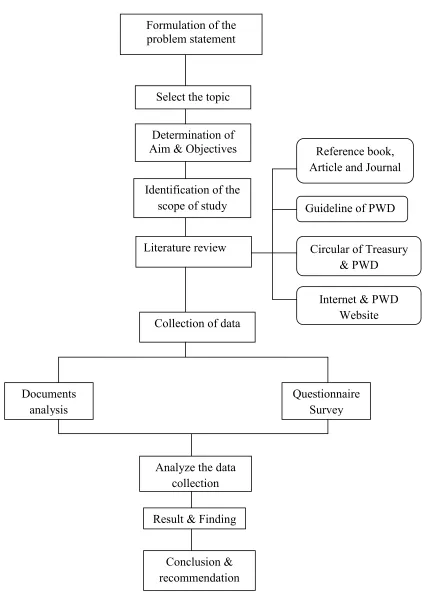
1.5 Research Methodology
Figure 1.1 : Research Methodology Flow chart Select the topic
Formulation of the problem statement
Determination of Aim & Objectives
Identification of the scope of study
Literature review
Reference book, Article and Journal
Guideline of PWD
Circular of Treasury & PWD Internet & PWD
Website Collection of data
Documents analysis
Questionnaire Survey
Analyze the data collection
Result & Finding
REFERENCES
Abd Shukor Ibrahim. Pendekatan Kaedah Statistik Di Dalam Penilaian Dan Perakuan Tender JKR. QS National Convention 2003. 18-19 August, 2003. JKR: Cawangan Kontrak & Ukur Bahan. 2003
Cawangan Kontrak & Ukur Bahan (2008). Penyediaan Anggaran Dan Pembangunan Sistem Maklumat Kos (PTK 2008). JKR: Cawangan Kontrak & Ukur Bahan
Cawangan Kontrak & Ukur Bahan (2008). Perolehan Kerajaan (PTK 2008). JKR: Cawangan Kontrak & Ukur Bahan
D.R. Ogunsemi and I.O.Aje. Journal of Financial Management of Property and Construction. A Model For Contractor’s Selection In Nigeria. 2006. 11 (1) : pp33-43 Department of Transportation. Ready-To-List and Construction Contract Award Guide
(RTL Guide). California, Section 7. 2010
Federal Highway of Administration. Guideline On Preparing Engineer’s Estimate, Bid Reviews And Evaluation. U.S Department Of Transportation, TA T 5080.4 and 5080.6. 2004
Ivor H. Seeley. (1996). Building Economics. (4th ed.). London: Palgrave Macmilan I.O.Aje, K.T. Odusami and D.R. Ogunsemi. Journal of Financial Management of
Property and Construction. The Impact of Contractors’ Management Capability On Cost and Time Performance of Construction Projects In Nigeria. 2009. 14 (2) : pp171-187
Jabatan Kerja Raya. Prosedur Perolehan Kerja. JKR Malaysia. JKR.PK(0).03. 2005 Jabatan Kerja Raya. Garis Panduan Penilaian Tender Semakan April 2010. Cawangan
Kontrak & Ukur Bahan, Surat Arahan Bil.2/2010. 2010
Kementerian Kewangan Malaysia. Penilaian Tender Menggunakan Kaedah Cut-Off Serta Kriteria Istimewa. Bahagian Perolehan Kerajaan, S/K.KEW/PK/PP/700 /00000023/21/A-5 Jld.13(17). 2009
Malaysia – German Chamber of Commerce. Market Watch Malaysia 2010 Construction Industry. Malaysia: Market Report. 2010
TABLE OF CONTENTS
CHAPTER TITLE PAGE
TITLE PAGE i
DECLARATION ii
ACKNOWLEDGEMENTS iii
ABSTRACT iv
ABSTRAK v
TABLE OF CONTENTS vi
LIST OF TABLES xi
LIST OF FIGURES xii
LIST OF ABBREVIATIONS xiv
LIST OF APPENDICES xv
1 INTRODUCTION
1.1 Introduction 1
1.2 Problem statement 3
1.3 Aim and Objective 5
1.4 Scope of study 6
2 TENDER EVALUATION
2.1 Introduction 9
2.2 Types of tender 9
2.2.1 Open tender/Bumiputera open tender 10
2.2.2 Selected tender 10
2.2.3 Direct negotiation tender 11
2.2.4 Pre-qualification 11
2.2.5 „Perbelanjaan Darurat tender‟ 12
2.3 Process of conventional acquisition in PWD 13 2.3.1 Process of acquisition of open tender 14
(conventional)
2.3.2 Process of acquisition of Selected Tender 17 (conventional)
2.4 The criteria of tender evaluation 19
2.5 Process and criteria of tender evaluation in PWD 20
2.5.1 First Level of Evaluation 20
2.5.2 Second level of evaluation 22
2.5.3 Third level of evaluation 27
2.6 Cut-off price 27
2.6.1 Freak 28
2.7 Summary 29
3 ESTIMATING
3.1 Introduction 30
3.2 Estimate and Purpose of Estimating 30
3.3 Types of Estimate 31
3.3.2 Detailed Estimate 33
3.4 Contractor‟s Estimate 33
3.4.1 Site visit 34
3.4.2 Construction method 34
3.4.3 Construction schedule 35
3.4.4 Quantity takes off 35
3.4.5 Calculation of cost 36
3.5 Preparation of estimate 36
3.5.1 Fluctuation of cost 37
3.5.2 Traffic condition 37
3.5.3 Restrictive work hours or method of work 37
3.5.4 Small quantity of works 38
3.5.5 Separated operation 38
3.5.6 Handwork and inefficient operations 39
3.5.7 Accessibility 39
3.5.8 Geographic location 39
3.5.9 Construction season 40
3.5.10 Material shortage 40
3.6 PWD Estimate 40
3.6.1 Department estimate 41
3.6.2 Preparation of department estimate 42
3.6.2.1Locality 43
3.6.2.2Urgency of the project 43
3.6.2.3Complexity of the project 43
3.6.2.4Site condition 44
3.6.2.5Material supply 44
3.6.2.6Increasing of commodity price 44
3.7 Summary 45
4 DATA COLLECTION
4.1 Introduction 46
4.2 Preparation of Questionnaire 47
4.3 Questionnaire survey 48
4.4 Document analysis 49
4.5 Content Analysis 50
4.6 Summary of Data 51
4.6.1 Frequency analysis 52
4.6.2 Average index 52
4.7 Summary 53
5 ANALYSIS AND RESULT
5.1 Introduction 54
5.2 Analysis 55
5.2.1 Questionnaire Analysis 55
5.2.2 Document analysis 91
5.3 Summary 98
6 CONCLUSION AND RECOMMENDATION
6.1 Introduction 99
6.2 Findings 99
6.2.2 Objective 2 - To review the process and 100 procedures in the preparation of department
estimate in Public Works Department (PWD).
6.2.3 Objective 3 - To assess the effectiveness 101 of department estimate in the tender evaluation.
6.3 Conclusion 102
6.4 Recommendation 103
REFERENCES 105
APPENDICES
LIST OF TABLES
TABLE NO. TITLE PAGE
4.1 Rating scale of Average Index 53
5.1 Time taken to prepare a department estimate 59 5.2 Factors of time required in preparing department estimate 62
5.3 Basis in preparing department estimate 64
5.4 Factors to be considered in the preparation of department 67
estimate
5.5 Factors of accuracy of the department estimate 73
5.6 Revision of department estimate 76
5.7 Basis of cut-off price 78
LIST OF FIGURES
FIGURE NO. TITLE PAGE
1.1 Research Methodology Flow chart 8
2.1 Process of conventional acquisition in PWD 14 2.2 Process of acquisition of open tender (conventional) 16 2.3 Process of acquisition of Selected Tender (conventional) 18 4.1 Five measures of scale based on Likert Scale 48
5.1 Working experience of respondent 55
5.2 Experience in preparing department estimate 56 5.3 Number of Department Estimate Prepared by Internal 57
Department
5.4 Number of Department Estimate Prepared by External 58 Consultant
5.5 Time taken to prepare a department estimate 59 5.6 Factors of time required in preparing department estimate 62
5.7 Basis in preparing department estimate 65
5.8 Factors to be considered in the preparation of department 68 estimate
5.9 Factors of accuracy of the department estimate 73 5.10 Number of Revision of department estimate 76
5.11 Basis of cut-off price 78
5.14 Cut-off Price and Department Estimate 93 5.15 The Percentage Difference Between Cut-off And Department 94
Estimate
LIST OF ABBREVIATIONS
ACDA - As Completed Detailed Abstract AKM - Anggaran Kakitangan Minimum ATDA - As Tendered Detail Abstract BPU - Bahagian Pembangunan Usahawan
BQ - Bill of Quantity
CV - Coefficient of Variation FRH - Faktor Rendahan Harga JKR - Jabatan Kerja Raya
KB - Keupayaan Biayawan
KK - Kemudahan Kredit
KWSP - Kumpulan Wang Simpanan Pekerja
MP - Modal Pusingan
NTBK - Nilai Tahunan Baki Kerja
NW - Nett Worth
PDA - Preliminary Detail Estimate PKK - Pusat Khidmat Kontraktor PWD - Public Works Department
QS - Quantity Surveyor
LIST OF APPENDICES
APPENDIX TITLE PAGE